"0148f1904a9b0d16"{"id":"1002591","slug":"pack-of-tree-ents","title":"Pack of tree ents","category":"Creatures \u0026 Monsters","engine":"5.0+","assetVersion":"","engineVersion":"Engine Version: 5.0+","tag":"Creatures","accent":"blue","visual":"character","summary":"Examine the Pack of tree ents featuring four distinct arboreal monster meshes, 47 animations per model, and Epic skeleton support in Unreal Engine 5.","platform":"Unreal Engine","indexPolicy":"index","publishedAt":"2026-11-14T05:35:27.957Z","updatedAt":"2026-11-14T05:35:27.957Z","sourceNotes":[],"fileContents":[],"compatibility":["Unreal Engine","Engine Version: 5.0+"],"featuredImage":{"alt":"Pack of tree ents","src":"/wp-content/uploads/published/2026/11/c5848e3311f0-4d204300-acf4-487c-a5b0-9085622338fb-d35a6a0c04.webp"},"hasDownloadLink":true,"downloads":0,"terms":[{"taxonomy":"category","slug":"creatures-and-monsters","name":"Creatures \u0026 Monsters"}],"galleryImages":[{"src":"/wp-content/uploads/published/2026/11/d9760ef4f9c8-2cf0a189-06f2-44b4-b3a6-45841a250282-3aadbacc01.webp","alt":"Pack of tree ents"},{"src":"/wp-content/uploads/published/2026/11/f256a78d2420-6f37f386-f2f5-4fdd-8ff7-5a2d9807f76b-a38cf7c510.webp","alt":"Pack of tree ents"},{"src":"/wp-content/uploads/published/2026/11/e99a33e45a5f-d11576f5-920f-4caf-aa2c-3066e9265262-fc32b0ec01.webp","alt":"Pack of tree ents"},{"src":"/wp-content/uploads/published/2026/11/d6ec74f1d1aa-f9c04202-7efc-497e-ae25-597b07944728-2944ee0a46.webp","alt":"Pack of tree ents"},{"src":"/wp-content/uploads/published/2026/11/9ff59ca36417-8a4a93a9-6d48-4c2d-9530-8585e813fe4b-4c51c7452b.webp","alt":"Pack of tree ents"},{"src":"/wp-content/uploads/published/2026/11/7c6d33fddfb8-4f4af6d6-8643-46da-894c-db3cf2f511f6-56a0649218.webp","alt":"Pack of tree ents"},{"src":"/wp-content/uploads/published/2026/11/79a91a30eec9-c9740507-38af-4ddd-80bc-8f5bb9c0ce8e-c79ae8ef52.webp","alt":"Pack of tree ents"},{"src":"/wp-content/uploads/published/2026/11/faed3a1bef92-61620e6f-497b-4127-9193-93ec242ab6fa-a0434c8d82.webp","alt":"Pack of tree ents"},{"src":"/wp-content/uploads/published/2026/11/9e3753109e61-51903118-c34b-4684-a098-f2f770026ba3-d8dfd1ddc4.webp","alt":"Pack of tree ents"},{"src":"/wp-content/uploads/published/2026/11/0d698493934e-1db8462a-26c2-4908-9385-c22a5c40cb86-ff26353fa7.webp","alt":"Pack of tree ents"}],"accessPanel":{"kind":"resource","title":"Get this resource","eyebrow":"Free resource","message":"Download this resource in your browser.","fileName":"Content.7z","safetyNote":"Resources are manually reviewed before listing to improve quality and reduce obvious risks.","actionLabel":"Get this resource","resourceType":"Resource archive","versions":[]},"contentHtml":"\u003cp\u003eFour distinct woodland guardians form the core of this asset collection: the oak ent, the ash ent, the birch ent, and the spruce ent. Each character represents a separate tree species translated into an ancient, mobile creature suited for fantasy worlds, role-playing encounters, and large-scale multiplayer environments. Built directly for modern engine workflows, the models supply complete character pipelines combining unique mesh silhouettes with dedicated motion sets and standardized skeletal structures.\u003c/p\u003e \u003ch2\u003eThe Four Tree Ent Species and Mesh Densities\u003c/h2\u003e\n\u003cp\u003eThe collection provides four standalone character meshes, each reflecting the botanical traits of its namesake species while maintaining the anatomy of a walking wooden monster. Bark structures, limbs, and canopy foliage are shaped specifically to differentiate a massive oak from a slender birch, an expansive ash, or a needle-covered spruce.\u003c/p\u003e \u003cp\u003eGeometric distribution varies substantially across the four models to balance the complexity of their unique foliage and branch canopies:\u003c/p\u003e\n\u003cul\u003e \u003cli\u003e\u003cstrong\u003eTree Ent Oak:\u003c/strong\u003e 24,299 vertices, utilizing a balanced geometric structure that captures thick, heavy limbs, rough bark creases, and classic broadleaf foliage clumps without unnecessary vertex bloat.\u003c/li\u003e \u003cli\u003e\u003cstrong\u003eTree Ent Birch:\u003c/strong\u003e 24,532 vertices, maintaining a similar density profile suited for a leaner profile, characteristic birch bark striping, and lighter canopy elements.\u003c/li\u003e \u003cli\u003e\u003cstrong\u003eTree Ent Spruce:\u003c/strong\u003e 55,191 vertices, stepping up polygon allocation to accommodate dense, layered conifer branches and needle clusters that define evergreen silhouettes.\u003c/li\u003e \u003cli\u003e\u003cstrong\u003eTree Ent Ash:\u003c/strong\u003e 78,580 vertices, providing the highest mesh density in the collection to support intricate branch layering, expansive limb systems, and multi-layered leaf cards.\u003c/li\u003e\n\u003c/ul\u003e \u003cp\u003eThese varying counts allow developers to select appropriate variants depending on the visual focus and performance budget of a scene. The oak and birch models operate cleanly in crowded battlefield scenarios where multiple creatures share the screen, whereas the ash and spruce variants provide the geometric depth required for high-fidelity hero encounters, cinematic cutscenes, or solo boss battles.\u003c/p\u003e \u003ch2\u003eAnimation Systems and Epic Skeleton Integration\u003c/h2\u003e\n\u003cp\u003eMobility is a central factor for arboreal creatures, which often require unique weight, momentum, and body language to appear convincing as animated plant life. Every creature in the set comes equipped with 47 individual animations, yielding a broad library of motion for immediate implementation. Because all four variants feature this identical 47-clip count, designers can construct shared gameplay logic, behavioral state trees, and combat reactions without dealing with missing states between the different species.\u003c/p\u003e \u003cp\u003eThe underlying framework is rigged directly to the Unreal Engine 5 Epic skeleton. Conforming to this industry-standard hierarchy removes the friction often associated with custom creature rigs. It enables easy retargeting to the standard UE5 mannequin and related skeletal systems, allowing creators to transfer existing player-character or monster animation libraries directly onto the tree ents, or retarget the ents' native 47 motions onto other compatible skeletal meshes.\u003c/p\u003e \u003cp\u003eBecause the bone hierarchy honors the Epic skeleton conventions, standard engine systems such as animation blueprints, blend spaces, control rigs, and motion matching function without requiring custom bone mapping workarounds. Retargeting profiles within Unreal Engine 5 can map the limbs, spine, and appendages cleanly to standard inputs.\u003c/p\u003e \u003ch2\u003ePBR Vegetation and Surface Textures in the Pack of Tree Ents\u003c/h2\u003e\n\u003cp\u003eThe visual execution pairs realistic proportions with physically based rendering (PBR) workflows. The surfaces emphasize tactile natural elements, depicting aged wood, weathered bark, root clusters, and live vegetation. The integration of leaf cards, hanging branches, and rough trunk geometry creates natural depth that reacts accurately to dynamic lighting conditions.\u003c/p\u003e \u003cp\u003eAll included preview captures were rendered inside Unreal Engine 5.0, showcasing how the PBR materials behave under the engine's lighting and shadow passes. Normal maps capture the jagged fissures of split bark, roughness maps define the difference between dry deadwood and fresh leafy growth, and ambient occlusion highlights the recesses where thick roots wrap around the torso and limbs.\u003c/p\u003e \u003cp\u003eThis attention to plant anatomy allows the creatures to blend naturally into forest biomes. An idle ent positioned among static landscape foliage can serve as an environmental ambush, springing to life when an adventurer approaches. The realistic aesthetic ensures the characters match contemporary vegetation libraries and photorealistic terrain scans.\u003c/p\u003e \u003ch2\u003eDeployment Across RPG and MMORPG Ecosystems\u003c/h2\u003e\n\u003cp\u003eThe specific mix of low-poly optimization principles and detailed surface geometry makes these models viable across multiple genres. In MMORPG and MMO production, memory budgets and draw calls are heavily constrained by player density and open-world scope. Having optimized options like the oak and birch models sitting under 25,000 vertices allows server-heavy titles to stage group raids and forest patrol events without exceeding client vertex limits.\u003c/p\u003e \u003cp\u003eSingle-player action RPGs can leverage the heavier spruce and ash meshes for close-quarters encounters where the player camera stays tight on the enemy. Boss encounters benefit from the 47 available animations, providing enough variety to establish distinct wind-up attacks, heavy ground stomps, flinch reactions, death collapses, and sweeping branch strikes.\u003c/p\u003e \u003cp\u003eBeyond traditional fantasy enemies, the models fit roles as ancient quest-givers, roaming druidic protectors, summonable nature allies, or passive wildlife within enchanted biomes. Their structural diversity across four botanical species offers instant visual hierarchy, making it simple to designate the birch as a swift scout, the oak as a frontline guardian, and the towering ash or spruce as high-tier wilderness lords.\u003c/p\u003e\n\n\u003ch2\u003eContinue Browsing Similar Packs\u003c/h2\u003e\n\u003cul\u003e\n\u003cli\u003e\u003ca href=\"https://3dcghub.com/werewolf-mythical-creature/\" rel=\"noopener noreferrer\"\u003e\u0026quot;Werewolf\u0026quot; - Mythical Creature\u003c/a\u003e\u003c/li\u003e\n\u003cli\u003e\u003ca href=\"https://3dcghub.com/dragon-2/\" rel=\"noopener noreferrer\"\u003eDragon\u003c/a\u003e\u003c/li\u003e\n\u003cli\u003e\u003ca href=\"https://3dcghub.com/ocean-monster-fish-pack-part-2-underwater-creatures-fish-low-poly-11/\" rel=\"noopener noreferrer\"\u003eOcean Monster Fish Pack - Part 2 - Underwater Creatures - Fish low poly - #11\u003c/a\u003e\u003c/li\u003e\n\u003cli\u003e\u003ca href=\"https://3dcghub.com/lizards/\" rel=\"noopener noreferrer\"\u003eLizards\u003c/a\u003e\u003c/li\u003e\n\u003cli\u003e\u003ca href=\"https://3dcghub.com/ghosts-in-the-dark/\" rel=\"noopener noreferrer\"\u003eGhosts in The Dark\u003c/a\u003e\u003c/li\u003e\n\u003c/ul\u003e","contentTextLength":6176,"navigation":{"current":58,"total":4543,"previous":{"id":"1002592","slug":"paladin-rpg-set","title":"Paladin RPG Set","category":"Humans","platform":"Unreal Engine","updatedAt":"2026-11-14T05:36:47.102Z"},"next":{"id":"1002590","slug":"modular-japanese-architecture-pack","title":"Modular Japanese Architecture Pack","category":"Buildings \u0026 Architecture","platform":"Unreal Engine","updatedAt":"2026-11-14T05:34:06.312Z"}},"relatedResources":[{"id":"1002603","slug":"stone-golem","title":"Stone Golem","category":"Creatures \u0026 Monsters","engine":"5.0+","assetVersion":"","engineVersion":"Engine Version: 5.0+","tag":"Creatures","accent":"blue","visual":"character","summary":"Examine the Stone Golem asset, featuring a 3.2m scale, Epic skeleton rigging, 4-finger hand setup, customizable colors, and stone, snow, and lava materials.","platform":"Unreal Engine","indexPolicy":"index","publishedAt":"2026-11-14T05:57:34.256Z","updatedAt":"2026-11-14T05:57:34.256Z","sourceNotes":[],"fileContents":[],"compatibility":["Unreal Engine","Engine Version: 5.0+"],"featuredImage":{"alt":"Stone Golem","src":"/wp-content/uploads/published/2026/11/84fc89e5354d-a051387d-fec3-468a-ae45-47fc5e3bdd65-a86c288e90.webp"},"hasDownloadLink":true,"downloads":0},{"id":"1002602","slug":"skeleton-guard-modular","title":"Skeleton Guard (Modular)","category":"Creatures \u0026 Monsters","engine":"5.0+","assetVersion":"","engineVersion":"Engine Version: 5.0+","tag":"Creatures","accent":"blue","visual":"character","summary":"Explore the modular Skeleton Guard asset, featuring detachable limbs, clothing physics, UE4 Epic Skeleton rigging, and UE5 retargeting.","platform":"Unreal Engine","indexPolicy":"index","publishedAt":"2026-11-14T05:52:53.030Z","updatedAt":"2026-11-14T05:52:53.030Z","sourceNotes":[],"fileContents":[],"compatibility":["Unreal Engine","Engine Version: 5.0+"],"featuredImage":{"alt":"Skeleton Guard (Modular)","src":"/wp-content/uploads/published/2026/11/d1906406dcca-14dc8fa0-5be7-47eb-91f6-a321181487e7-53266720b9.webp"},"hasDownloadLink":true,"downloads":0},{"id":"1002577","slug":"werewolf-mythical-creature","title":"\"Werewolf\" - Mythical Creature","category":"Creatures \u0026 Monsters","engine":"5.0+","assetVersion":"","engineVersion":"Engine Version: 5.0+","tag":"Creatures","accent":"blue","visual":"character","summary":"Explore the technical setup, mesh density, 4K skin variations, and Unreal Engine compatibility of the Werewolf mythical creature character model.","platform":"Unreal Engine","indexPolicy":"index","publishedAt":"2026-11-14T05:13:22.653Z","updatedAt":"2026-11-14T05:13:22.653Z","sourceNotes":[],"fileContents":[],"compatibility":["Unreal Engine","Engine Version: 5.0+"],"featuredImage":{"alt":"\"Werewolf\" - Mythical Creature","src":"/wp-content/uploads/published/2026/11/e28b011acd30-36331356-c989-46c0-a38b-e1c6bb832c7d-52ea206773.webp"},"hasDownloadLink":true,"downloads":0}]}
Creatures
Pack of tree ents
Examine the Pack of tree ents featuring four distinct arboreal monster meshes, 47 animations per model, and Epic skeleton support in Unreal Engine 5.
Four distinct woodland guardians form the core of this asset collection: the oak ent, the ash ent, the birch ent, and the spruce ent. Each character represents a separate tree species translated into an ancient, mobile creature suited for fantasy worlds, role-playing encounters, and large-scale multiplayer environments. Built directly for modern engine workflows, the models supply complete character pipelines combining unique mesh silhouettes with dedicated motion sets and standardized skeletal structures.
The Four Tree Ent Species and Mesh Densities
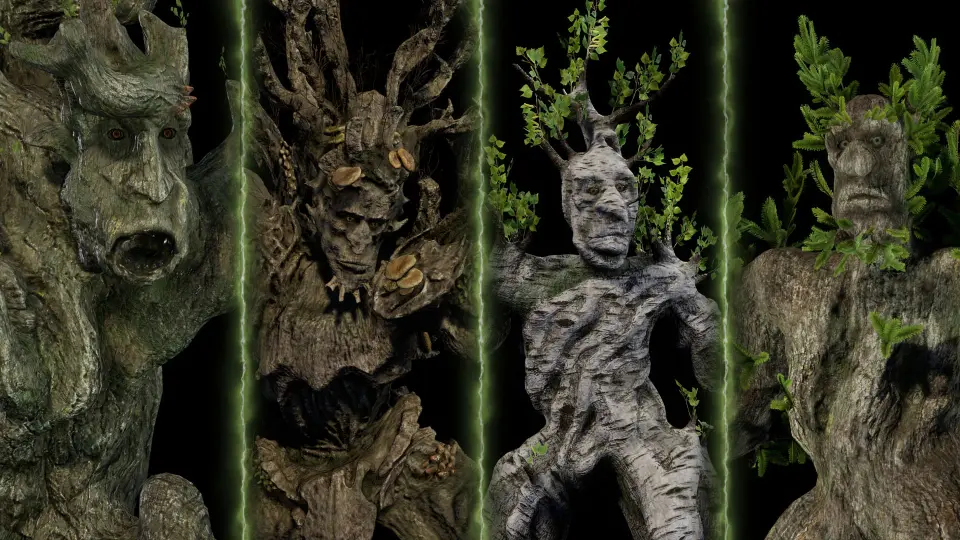
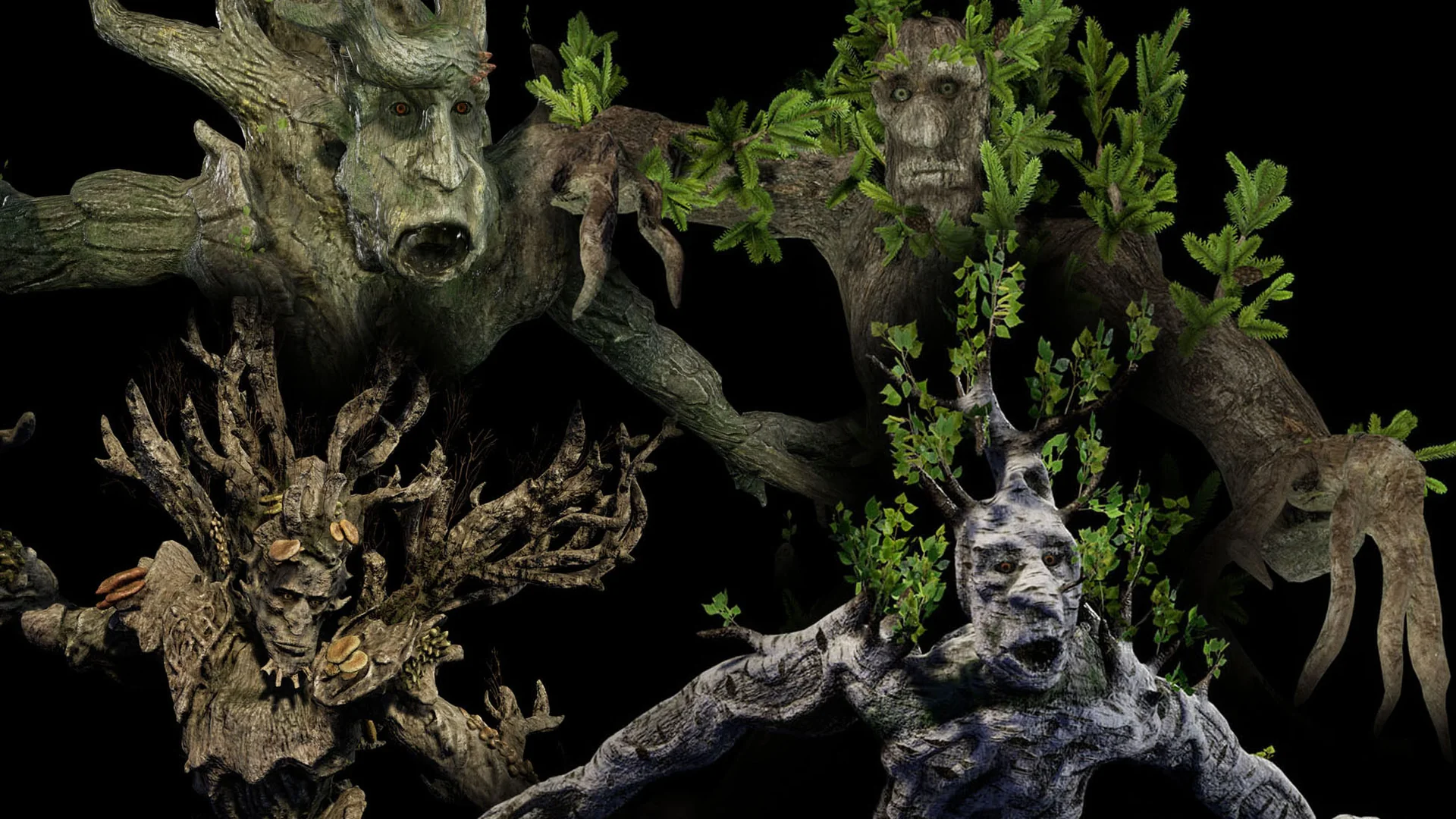
The collection provides four standalone character meshes, each reflecting the botanical traits of its namesake species while maintaining the anatomy of a walking wooden monster. Bark structures, limbs, and canopy foliage are shaped specifically to differentiate a massive oak from a slender birch, an expansive ash, or a needle-covered spruce.
Geometric distribution varies substantially across the four models to balance the complexity of their unique foliage and branch canopies:
Tree Ent Oak: 24,299 vertices, utilizing a balanced geometric structure that captures thick, heavy limbs, rough bark creases, and classic broadleaf foliage clumps without unnecessary vertex bloat.
Tree Ent Birch: 24,532 vertices, maintaining a similar density profile suited for a leaner profile, characteristic birch bark striping, and lighter canopy elements.
Tree Ent Spruce: 55,191 vertices, stepping up polygon allocation to accommodate dense, layered conifer branches and needle clusters that define evergreen silhouettes.
Tree Ent Ash: 78,580 vertices, providing the highest mesh density in the collection to support intricate branch layering, expansive limb systems, and multi-layered leaf cards.
These varying counts allow developers to select appropriate variants depending on the visual focus and performance budget of a scene. The oak and birch models operate cleanly in crowded battlefield scenarios where multiple creatures share the screen, whereas the ash and spruce variants provide the geometric depth required for high-fidelity hero encounters, cinematic cutscenes, or solo boss battles.
Animation Systems and Epic Skeleton Integration
Mobility is a central factor for arboreal creatures, which often require unique weight, momentum, and body language to appear convincing as animated plant life. Every creature in the set comes equipped with 47 individual animations, yielding a broad library of motion for immediate implementation. Because all four variants feature this identical 47-clip count, designers can construct shared gameplay logic, behavioral state trees, and combat reactions without dealing with missing states between the different species.
The underlying framework is rigged directly to the Unreal Engine 5 Epic skeleton. Conforming to this industry-standard hierarchy removes the friction often associated with custom creature rigs. It enables easy retargeting to the standard UE5 mannequin and related skeletal systems, allowing creators to transfer existing player-character or monster animation libraries directly onto the tree ents, or retarget the ents' native 47 motions onto other compatible skeletal meshes.
Because the bone hierarchy honors the Epic skeleton conventions, standard engine systems such as animation blueprints, blend spaces, control rigs, and motion matching function without requiring custom bone mapping workarounds. Retargeting profiles within Unreal Engine 5 can map the limbs, spine, and appendages cleanly to standard inputs.
PBR Vegetation and Surface Textures in the Pack of Tree Ents
The visual execution pairs realistic proportions with physically based rendering (PBR) workflows. The surfaces emphasize tactile natural elements, depicting aged wood, weathered bark, root clusters, and live vegetation. The integration of leaf cards, hanging branches, and rough trunk geometry creates natural depth that reacts accurately to dynamic lighting conditions.
All included preview captures were rendered inside Unreal Engine 5.0, showcasing how the PBR materials behave under the engine's lighting and shadow passes. Normal maps capture the jagged fissures of split bark, roughness maps define the difference between dry deadwood and fresh leafy growth, and ambient occlusion highlights the recesses where thick roots wrap around the torso and limbs.
This attention to plant anatomy allows the creatures to blend naturally into forest biomes. An idle ent positioned among static landscape foliage can serve as an environmental ambush, springing to life when an adventurer approaches. The realistic aesthetic ensures the characters match contemporary vegetation libraries and photorealistic terrain scans.
Deployment Across RPG and MMORPG Ecosystems
The specific mix of low-poly optimization principles and detailed surface geometry makes these models viable across multiple genres. In MMORPG and MMO production, memory budgets and draw calls are heavily constrained by player density and open-world scope. Having optimized options like the oak and birch models sitting under 25,000 vertices allows server-heavy titles to stage group raids and forest patrol events without exceeding client vertex limits.
Single-player action RPGs can leverage the heavier spruce and ash meshes for close-quarters encounters where the player camera stays tight on the enemy. Boss encounters benefit from the 47 available animations, providing enough variety to establish distinct wind-up attacks, heavy ground stomps, flinch reactions, death collapses, and sweeping branch strikes.
Beyond traditional fantasy enemies, the models fit roles as ancient quest-givers, roaming druidic protectors, summonable nature allies, or passive wildlife within enchanted biomes. Their structural diversity across four botanical species offers instant visual hierarchy, making it simple to designate the birch as a swift scout, the oak as a frontline guardian, and the towering ash or spruce as high-tier wilderness lords.
 Creatures
 Creatures
 Creatures
 Creatures