"0148f1904a9b0d16"{"id":"1002577","slug":"werewolf-mythical-creature","title":"\"Werewolf\" - Mythical Creature","category":"Creatures \u0026 Monsters","engine":"5.0+","assetVersion":"","engineVersion":"Engine Version: 5.0+","tag":"Creatures","accent":"blue","visual":"character","summary":"Explore the technical setup, mesh density, 4K skin variations, and Unreal Engine compatibility of the Werewolf mythical creature character model.","platform":"Unreal Engine","indexPolicy":"index","publishedAt":"2026-11-14T05:13:22.653Z","updatedAt":"2026-11-14T05:13:22.653Z","sourceNotes":[],"fileContents":[],"compatibility":["Unreal Engine","Engine Version: 5.0+"],"featuredImage":{"alt":"\"Werewolf\" - Mythical Creature","src":"/wp-content/uploads/published/2026/11/e28b011acd30-36331356-c989-46c0-a38b-e1c6bb832c7d-52ea206773.webp"},"hasDownloadLink":true,"downloads":0,"terms":[{"taxonomy":"category","slug":"creatures-and-monsters","name":"Creatures \u0026 Monsters"}],"galleryImages":[{"src":"/wp-content/uploads/published/2026/11/c8a2273e4d6c-1ca8155f-e8fa-4c30-b422-68ca2435478a-1d4349ed2c.webp","alt":"\"Werewolf\" - Mythical Creature"},{"src":"/wp-content/uploads/published/2026/11/5cc2fced586d-e6fef2a7-1136-415a-9b73-f4d2c5f2acb9-2ea0e611bc.webp","alt":"\"Werewolf\" - Mythical Creature"},{"src":"/wp-content/uploads/published/2026/11/176ad6236f4b-48242405-3690-4628-a41f-f504a3990ab0-e231a1f0bd.webp","alt":"\"Werewolf\" - Mythical Creature"},{"src":"/wp-content/uploads/published/2026/11/c272db93ea20-b4194095-8c72-417b-880f-3979dea8d12a-5a54dbab47.webp","alt":"\"Werewolf\" - Mythical Creature"},{"src":"/wp-content/uploads/published/2026/11/857a4cccd7a1-db8669e6-d730-4d2b-9bac-5bb3a11f3625-9b00b14114.webp","alt":"\"Werewolf\" - Mythical Creature"},{"src":"/wp-content/uploads/published/2026/11/398f33ac4c4e-265776ab-89c2-4aa4-96b6-fe6411c28a2e-6cfabc6846.webp","alt":"\"Werewolf\" - Mythical Creature"},{"src":"/wp-content/uploads/published/2026/11/d1e6acf2e23d-1dc015bb-fa70-46a9-9b92-44879c1bf078-f3caab624d.webp","alt":"\"Werewolf\" - Mythical Creature"},{"src":"/wp-content/uploads/published/2026/11/67d1bf4f5cdf-24242959-ef87-492f-bf59-da8e93610376-712f34307f.webp","alt":"\"Werewolf\" - Mythical Creature"},{"src":"/wp-content/uploads/published/2026/11/463c368b0565-52eb9975-98c0-4eb3-825a-6aa97c48c846-0a21857ac9.webp","alt":"\"Werewolf\" - Mythical Creature"},{"src":"/wp-content/uploads/published/2026/11/5f3076cf37c2-2ff46d7d-569f-4d92-9ba5-4e24f5dceee3-a3b1d0da87.webp","alt":"\"Werewolf\" - Mythical Creature"}],"accessPanel":{"kind":"resource","title":"Get this resource","eyebrow":"Free resource","message":"Download this resource in your browser.","fileName":"Content.7z","safetyNote":"Resources are manually reviewed before listing to improve quality and reduce obvious risks.","actionLabel":"Get this resource","resourceType":"Resource archive","versions":[]},"contentHtml":"\u003ch2\u003eVisual Articulation and Skeleton Foundation of the Werewolf\u003c/h2\u003e\n\u003cp\u003ePositioning a predatory entity within a game scene requires an underlying structure capable of handling natural movement and physical aggression. The werewolf is built to operate immediately within Unreal Engine 5 while anchoring its joint hierarchy to an Unreal Engine 4 skeleton. Utilizing the established UE4 bone layout provides direct continuity for setups relying on standard Epic skeleton conventions, enabling straightforward retargeting and access to expansive motion libraries without requiring customized bone remapping.\u003c/p\u003e\n\u003cp\u003eOperating inside modern real-time viewports demands both structural stability and visual menace. The character exhibits a dual identity across realistic, demonic, and folklore monster aesthetics, allowing it to fulfill roles ranging from solitary woodland beasts to stylized dark fantasy antagonists. Because the skeleton functions natively in Unreal Engine 5, developers can drop the mesh directly into active level sequences, test physical asset physics, and evaluate character blueprint behaviors without converting or patching bone nodes.\u003c/p\u003e \u003ch2\u003eGeometric Density Across Fur and Hairless Werewolf Meshes\u003c/h2\u003e\n\u003cp\u003eMesh complexity directly impacts rendering budgets, particularly when dealing with organic surfaces that require silhouette breakup such as claws, muscular frames, and pelt coats. The werewolf asset addresses runtime performance through two distinct polygonal configurations: a hairless minimum skin and a fully furred maximum skin.\u003c/p\u003e\n\u003cp\u003eThe minimum skin configuration presents an unadorned, sleek biological frame consisting of 5,903 vertices and 11,416 triangles. This base geometry is light enough for dense encounter scenarios where multiple monsters occupy the screen at once or where background processing constraints require tight polygon budgets. The topology preserves anatomical mass across the limbs, spine, and muzzle while stripping out auxiliary geometry, making it well-suited for low-overhead spawning passes or zombie-style horde distributions.\u003c/p\u003e\n\u003cp\u003eWhen environmental fidelity calls for dense surface detail, the maximum skin configuration introduces a complete fur layer. This expansion raises the geometry to 15,889 vertices and 16,456 triangles. The delta of roughly 5,000 triangles and nearly 10,000 vertices reflects the structural geometry dedicated to multi-layered fur strands and perimeter silhouette fringing. The increase provides realistic depth under dynamic lighting, capturing specular highlights across pelt layers while remaining within a manageable lowpoly envelope that runs smoothly on standard modern hardware.\u003c/p\u003e \u003ch2\u003eTexture Maps, Material Configurations, and Surface Variations\u003c/h2\u003e\n\u003cp\u003eSurface treatment across the model is handled by an extensive suite of 36 textures managed through 14 distinct materials. Every map is authored at a native resolution of 4096x4096 pixels, providing crisp visual definition across muscle fibers, claw surfaces, facial features, and fur strands when viewed from close camera angles.\u003c/p\u003e\n\u003cp\u003eFor projects targeting constrained platforms, competitive performance baselines, or distant level-of-detail tiers, these 4K texture maps can be downscaled within the engine texture editor without altering the core UV layout. Scaling the images down to 2048x2048 or lower preserves the underlying PBR shading while clearing memory bandwidth in crowded scenes.\u003c/p\u003e\n\u003cp\u003eCustomization across encounters relies on distinct skin variants tailored for both the underlying anatomy and the fur mesh:\u003c/p\u003e\n\u003cul\u003e \u003cli\u003e\u003cstrong\u003e6 Body Skins:\u003c/strong\u003e Provide distinct base epidermal looks, supporting variations that range from natural carnivore tones to demonic, neon-tinged, or corrupted undead motifs.\u003c/li\u003e \u003cli\u003e\u003cstrong\u003e4 Fur Skins:\u003c/strong\u003e Alter the coloration, tone, and visual texture of the external fur layer to match distinct environmental conditions such as deep woods, subterranean lairs, or nightmare realms.\u003c/li\u003e\n\u003c/ul\u003e\n\u003cp\u003ePairing these six body textures with the four fur options allows creators to diversify enemy rosters without altering the underlying character rig. Encounters can feature varying ranks of beasts, using specific palette pairings to visually separate alpha pack leaders from lesser pack members.\u003c/p\u003e \u003ch2\u003eMotion Sets for Real-Time Mythical Creature Encounters\u003c/h2\u003e\n\u003cp\u003eCombat pacing hinges on immediate readability during aggressive transitions. The asset ships with six core animations that address baseline combat and navigation states:\u003c/p\u003e\n\u003cul\u003e \u003cli\u003e\u003cstrong\u003eLocomotion:\u003c/strong\u003e A single walking animation handles persistent ground patrol, stalking maneuvers, and approach cycles.\u003c/li\u003e \u003cli\u003e\u003cstrong\u003eIdle Cycles:\u003c/strong\u003e Two distinct idle variations prevent the model from appearing frozen or repetitive during staging phases, giving ambient patrol routines subtle life.\u003c/li\u003e \u003cli\u003e\u003cstrong\u003eOffensive Action:\u003c/strong\u003e A dedicated attack animation provides an aggressive strike action for close-quarters engagements.\u003c/li\u003e \u003cli\u003e\u003cstrong\u003eDamage Reaction:\u003c/strong\u003e A get-hit clip yields responsive visual feedback when the creature sustains projectile or melee impacts, allowing players to register landed attacks.\u003c/li\u003e \u003cli\u003e\u003cstrong\u003eElimination:\u003c/strong\u003e A death sequence finishes the gameplay loop, transitioning the character smoothly into its terminal defeated state.\u003c/li\u003e\n\u003c/ul\u003e\n\u003cp\u003eThese clips form a self-contained action suite suitable for standard behavior tree implementations. Developers can blend the two idle cycles into the walking gait via blend spaces, route the attack into standard combat montages, and trigger the hit and death sequences directly via state machines.\u003c/p\u003e \u003ch2\u003ePipeline Compatibility and Practical Monster Deployment\u003c/h2\u003e\n\u003cp\u003eBeyond individual encounters, the model links conceptually to the Monster6 \"Nightmare\" game-ready character series, providing visual alignment when deployed alongside companion horror figures. The inclusion of modular styling, lowpoly construction principles, and adaptable texture sets means the creature can anchor dark folklore settings, populate stylized gothic dungeons, or serve as a hulking brawler in modern horror titles.\u003c/p\u003e\n\u003cp\u003eTeams building around Unreal Engine gain immediate utility from the combination of an Unreal Engine 4 skeleton foundation and native Unreal Engine 5 operational status. With full support for texture downscaling, modular fur toggling between 11.4k and 16.4k triangles, and essential combat motions ready to wire into animation blueprints, the asset acts as a dependable foundation for responsive, highly optimized creature encounters.\u003c/p\u003e\n\n\u003ch2\u003eMore From The Same Workflow\u003c/h2\u003e\n\u003cul\u003e\n\u003cli\u003e\u003ca href=\"https://3dcghub.com/animated-werewolf/\" rel=\"noopener noreferrer\"\u003eAnimated Werewolf\u003c/a\u003e\u003c/li\u003e\n\u003cli\u003e\u003ca href=\"https://3dcghub.com/ocean-monster-fish-pack-part-2-underwater-creatures-fish-low-poly-11/\" rel=\"noopener noreferrer\"\u003eOcean Monster Fish Pack - Part 2 - Underwater Creatures - Fish low poly - #11\u003c/a\u003e\u003c/li\u003e\n\u003cli\u003e\u003ca href=\"https://3dcghub.com/dragon-2/\" rel=\"noopener noreferrer\"\u003eDragon\u003c/a\u003e\u003c/li\u003e\n\u003cli\u003e\u003ca href=\"https://3dcghub.com/lizards/\" rel=\"noopener noreferrer\"\u003eLizards\u003c/a\u003e\u003c/li\u003e\n\u003cli\u003e\u003ca href=\"https://3dcghub.com/ghosts-in-the-dark/\" rel=\"noopener noreferrer\"\u003eGhosts in The Dark\u003c/a\u003e\u003c/li\u003e\n\u003c/ul\u003e","contentTextLength":6450,"navigation":{"current":72,"total":4543,"previous":{"id":"1002578","slug":"armored-stone-golem-dark-fantasy-boss","title":"Armored Stone Golem - Dark Fantasy Boss","category":"Characters \u0026 Creatures","platform":"Unreal Engine","updatedAt":"2026-11-14T05:14:45.881Z"},"next":{"id":"1002576","slug":"match-3-rpg-template","title":"Match 3 RPG Template","category":"RPG","platform":"Unreal Engine","updatedAt":"2026-11-13T20:14:38.214Z"}},"relatedResources":[{"id":"1002503","slug":"animated-werewolf","title":"Animated Werewolf","category":"Creatures \u0026 Monsters","engine":"4.15+,5.0+","assetVersion":"","engineVersion":"Engine Version: 4.15+,5.0+","tag":"Creatures","accent":"blue","visual":"character","summary":"Detailed breakdown of the Animated Werewolf model, featuring 73 animations, 69-bone rig, root motion sets, and modular fur geometry counts.","platform":"Unreal Engine","indexPolicy":"index","publishedAt":"2026-11-13T08:09:59.230Z","updatedAt":"2026-11-13T08:09:59.230Z","sourceNotes":[],"fileContents":[],"compatibility":["Unreal Engine","Engine Version: 4.15+,5.0+"],"featuredImage":{"alt":"Animated Werewolf","src":"/wp-content/uploads/published/2026/11/2bdc373908c4-1dfe5dcf-7418-415c-8199-72e9813dd799-ac1adfd838.webp"},"hasDownloadLink":true,"downloads":0},{"id":"1000084","slug":"ocean-monster-fish-pack-part-2-underwater-creatures-fish-low-poly-11","title":"Ocean Monster Fish Pack - Part 2 - Underwater Creatures - Fish low poly - #11","category":"Creatures \u0026 Monsters","engine":"5.5+","assetVersion":"","engineVersion":"Engine Version: 5.5+","tag":"Creatures","accent":"blue","visual":"character","summary":"Five low poly underwater predators with 4K PBR textures and creature-specific animation sets for Unreal Engine 4.18+ and Unity 2019+.","platform":"Unreal Engine","indexPolicy":"index","publishedAt":"2026-06-05T16:10:19.047Z","updatedAt":"2026-10-21T09:00:49.338Z","sourceNotes":[],"fileContents":[],"compatibility":["Unreal Engine","Engine Version: 5.5+"],"featuredImage":{"alt":"Ocean Monster Fish Pack - Part 2 - Underwater Creatures - Fish low poly - #11","src":"/wp-content/uploads/published/2026/06/b6571f02d880-f5259706-5176-48e5-9a7a-2b0dce6d60c0-f35957ada4.webp"},"hasDownloadLink":true,"downloads":1},{"id":"1002603","slug":"stone-golem","title":"Stone Golem","category":"Creatures \u0026 Monsters","engine":"5.0+","assetVersion":"","engineVersion":"Engine Version: 5.0+","tag":"Creatures","accent":"blue","visual":"character","summary":"Examine the Stone Golem asset, featuring a 3.2m scale, Epic skeleton rigging, 4-finger hand setup, customizable colors, and stone, snow, and lava materials.","platform":"Unreal Engine","indexPolicy":"index","publishedAt":"2026-11-14T05:57:34.256Z","updatedAt":"2026-11-14T05:57:34.256Z","sourceNotes":[],"fileContents":[],"compatibility":["Unreal Engine","Engine Version: 5.0+"],"featuredImage":{"alt":"Stone Golem","src":"/wp-content/uploads/published/2026/11/84fc89e5354d-a051387d-fec3-468a-ae45-47fc5e3bdd65-a86c288e90.webp"},"hasDownloadLink":true,"downloads":0}]}
Creatures
"Werewolf" - Mythical Creature
Explore the technical setup, mesh density, 4K skin variations, and Unreal Engine compatibility of the Werewolf mythical creature character model.
Visual Articulation and Skeleton Foundation of the Werewolf
Positioning a predatory entity within a game scene requires an underlying structure capable of handling natural movement and physical aggression. The werewolf is built to operate immediately within Unreal Engine 5 while anchoring its joint hierarchy to an Unreal Engine 4 skeleton. Utilizing the established UE4 bone layout provides direct continuity for setups relying on standard Epic skeleton conventions, enabling straightforward retargeting and access to expansive motion libraries without requiring customized bone remapping.
Operating inside modern real-time viewports demands both structural stability and visual menace. The character exhibits a dual identity across realistic, demonic, and folklore monster aesthetics, allowing it to fulfill roles ranging from solitary woodland beasts to stylized dark fantasy antagonists. Because the skeleton functions natively in Unreal Engine 5, developers can drop the mesh directly into active level sequences, test physical asset physics, and evaluate character blueprint behaviors without converting or patching bone nodes.
Geometric Density Across Fur and Hairless Werewolf Meshes
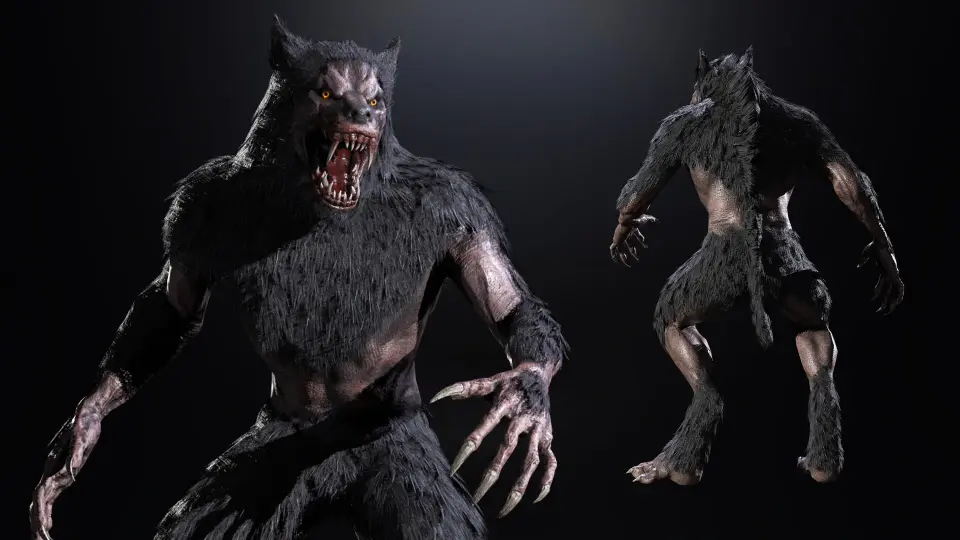
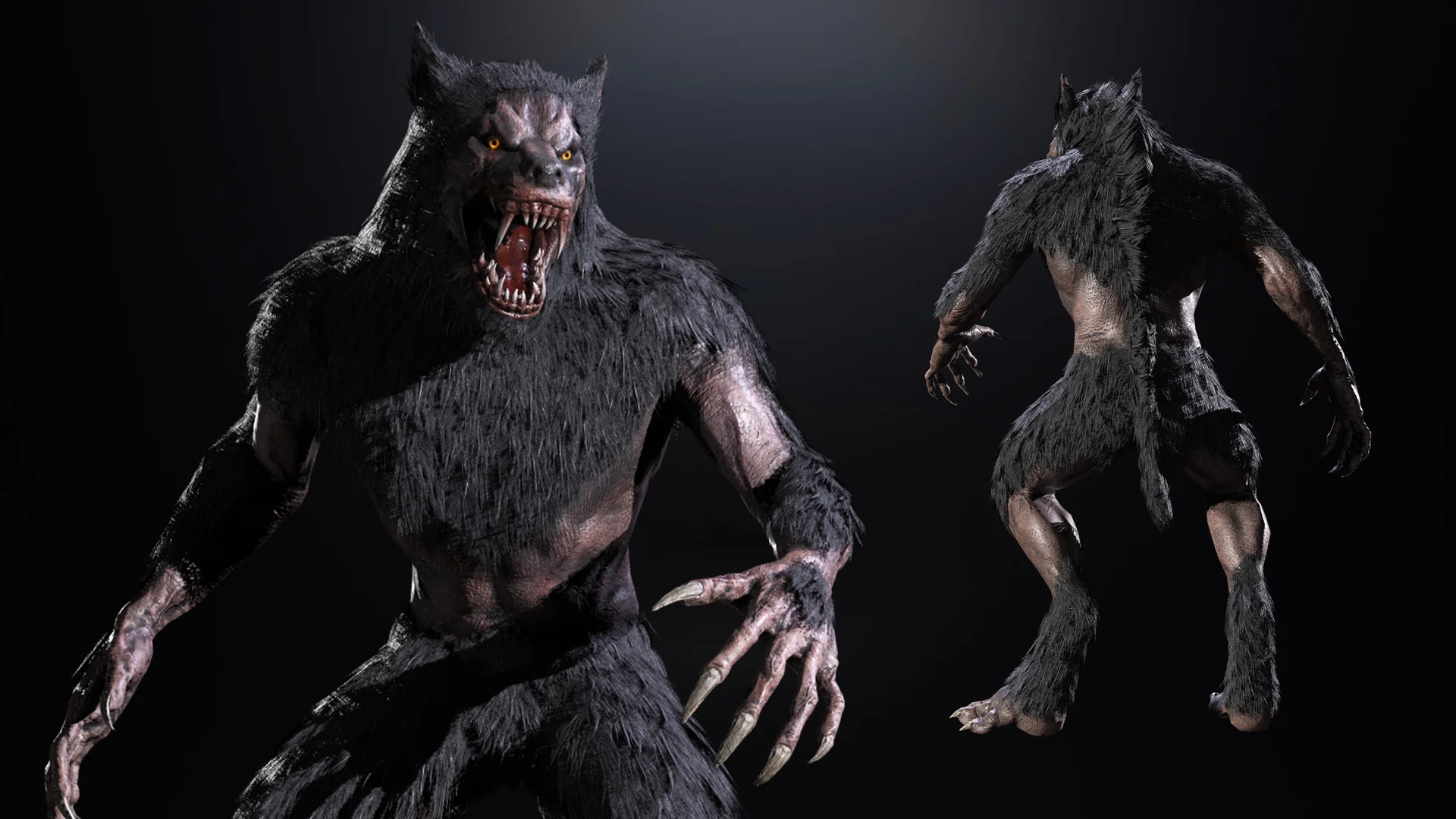
Mesh complexity directly impacts rendering budgets, particularly when dealing with organic surfaces that require silhouette breakup such as claws, muscular frames, and pelt coats. The werewolf asset addresses runtime performance through two distinct polygonal configurations: a hairless minimum skin and a fully furred maximum skin.
The minimum skin configuration presents an unadorned, sleek biological frame consisting of 5,903 vertices and 11,416 triangles. This base geometry is light enough for dense encounter scenarios where multiple monsters occupy the screen at once or where background processing constraints require tight polygon budgets. The topology preserves anatomical mass across the limbs, spine, and muzzle while stripping out auxiliary geometry, making it well-suited for low-overhead spawning passes or zombie-style horde distributions.
When environmental fidelity calls for dense surface detail, the maximum skin configuration introduces a complete fur layer. This expansion raises the geometry to 15,889 vertices and 16,456 triangles. The delta of roughly 5,000 triangles and nearly 10,000 vertices reflects the structural geometry dedicated to multi-layered fur strands and perimeter silhouette fringing. The increase provides realistic depth under dynamic lighting, capturing specular highlights across pelt layers while remaining within a manageable lowpoly envelope that runs smoothly on standard modern hardware.
Texture Maps, Material Configurations, and Surface Variations
Surface treatment across the model is handled by an extensive suite of 36 textures managed through 14 distinct materials. Every map is authored at a native resolution of 4096x4096 pixels, providing crisp visual definition across muscle fibers, claw surfaces, facial features, and fur strands when viewed from close camera angles.
For projects targeting constrained platforms, competitive performance baselines, or distant level-of-detail tiers, these 4K texture maps can be downscaled within the engine texture editor without altering the core UV layout. Scaling the images down to 2048x2048 or lower preserves the underlying PBR shading while clearing memory bandwidth in crowded scenes.
Customization across encounters relies on distinct skin variants tailored for both the underlying anatomy and the fur mesh:
6 Body Skins: Provide distinct base epidermal looks, supporting variations that range from natural carnivore tones to demonic, neon-tinged, or corrupted undead motifs.
4 Fur Skins: Alter the coloration, tone, and visual texture of the external fur layer to match distinct environmental conditions such as deep woods, subterranean lairs, or nightmare realms.
Pairing these six body textures with the four fur options allows creators to diversify enemy rosters without altering the underlying character rig. Encounters can feature varying ranks of beasts, using specific palette pairings to visually separate alpha pack leaders from lesser pack members.
Motion Sets for Real-Time Mythical Creature Encounters
Combat pacing hinges on immediate readability during aggressive transitions. The asset ships with six core animations that address baseline combat and navigation states:
Locomotion: A single walking animation handles persistent ground patrol, stalking maneuvers, and approach cycles.
Idle Cycles: Two distinct idle variations prevent the model from appearing frozen or repetitive during staging phases, giving ambient patrol routines subtle life.
Offensive Action: A dedicated attack animation provides an aggressive strike action for close-quarters engagements.
Damage Reaction: A get-hit clip yields responsive visual feedback when the creature sustains projectile or melee impacts, allowing players to register landed attacks.
Elimination: A death sequence finishes the gameplay loop, transitioning the character smoothly into its terminal defeated state.
These clips form a self-contained action suite suitable for standard behavior tree implementations. Developers can blend the two idle cycles into the walking gait via blend spaces, route the attack into standard combat montages, and trigger the hit and death sequences directly via state machines.
Pipeline Compatibility and Practical Monster Deployment
Beyond individual encounters, the model links conceptually to the Monster6 "Nightmare" game-ready character series, providing visual alignment when deployed alongside companion horror figures. The inclusion of modular styling, lowpoly construction principles, and adaptable texture sets means the creature can anchor dark folklore settings, populate stylized gothic dungeons, or serve as a hulking brawler in modern horror titles.
Teams building around Unreal Engine gain immediate utility from the combination of an Unreal Engine 4 skeleton foundation and native Unreal Engine 5 operational status. With full support for texture downscaling, modular fur toggling between 11.4k and 16.4k triangles, and essential combat motions ready to wire into animation blueprints, the asset acts as a dependable foundation for responsive, highly optimized creature encounters.
 Creatures
 Creatures
 Creatures
 Creatures