"0148f1904a9b0d16"{"id":"1002603","slug":"stone-golem","title":"Stone Golem","category":"Creatures \u0026 Monsters","engine":"5.0+","assetVersion":"","engineVersion":"Engine Version: 5.0+","tag":"Creatures","accent":"blue","visual":"character","summary":"Examine the Stone Golem asset, featuring a 3.2m scale, Epic skeleton rigging, 4-finger hand setup, customizable colors, and stone, snow, and lava materials.","platform":"Unreal Engine","indexPolicy":"index","publishedAt":"2026-11-14T05:57:34.256Z","updatedAt":"2026-11-14T05:57:34.256Z","sourceNotes":[],"fileContents":[],"compatibility":["Unreal Engine","Engine Version: 5.0+"],"featuredImage":{"alt":"Stone Golem","src":"/wp-content/uploads/published/2026/11/84fc89e5354d-a051387d-fec3-468a-ae45-47fc5e3bdd65-a86c288e90.webp"},"hasDownloadLink":true,"downloads":0,"terms":[{"taxonomy":"category","slug":"creatures-and-monsters","name":"Creatures \u0026 Monsters"}],"galleryImages":[{"src":"/wp-content/uploads/published/2026/11/c3677e1f4740-d913c83e-3491-447b-ae64-31891151f32e-5606db4070.webp","alt":"Stone Golem"},{"src":"/wp-content/uploads/published/2026/11/457be0faf8b7-036f2304-3194-45e4-8eef-3f3f68c48da7-a9a5fc4e40.webp","alt":"Stone Golem"},{"src":"/wp-content/uploads/published/2026/11/945efc7f8b85-75ec4f0d-146a-4f34-a549-1747915ae9b1-d3b68cf1cd.webp","alt":"Stone Golem"},{"src":"/wp-content/uploads/published/2026/11/60ea50c9a445-2272d7c5-4048-42b2-9187-bc0c013a5c75-909c25058d.webp","alt":"Stone Golem"},{"src":"/wp-content/uploads/published/2026/11/7fa81e94fa18-9d0a0fd6-cd43-4310-bd60-cacb8b0bd213-d470322e54.webp","alt":"Stone Golem"},{"src":"/wp-content/uploads/published/2026/11/2bd57378a1f9-b42489e4-c742-4c5a-bc62-45e73ff2d3df-0278ed981b.webp","alt":"Stone Golem"},{"src":"/wp-content/uploads/published/2026/11/7df74bdf31e2-ea03be5a-a362-41e6-ad54-0259a4f88e52-f326373b6d.webp","alt":"Stone Golem"},{"src":"/wp-content/uploads/published/2026/11/b09f9c188031-0e652157-ffd0-453c-a673-df651e78b541-0fa4131a9f.webp","alt":"Stone Golem"},{"src":"/wp-content/uploads/published/2026/11/fa9fa407aac3-71d9f080-a6e7-47a4-87f6-67cb12ff991d-a1348c1ca1.webp","alt":"Stone Golem"},{"src":"/wp-content/uploads/published/2026/11/1888483208de-e3e5eaa1-7987-4e50-8eba-6d58e3477c9e-0eb713ae38.webp","alt":"Stone Golem"}],"accessPanel":{"kind":"resource","title":"Get this resource","eyebrow":"Free resource","message":"Download this resource in your browser.","fileName":"Content.7z","safetyNote":"Resources are manually reviewed before listing to improve quality and reduce obvious risks.","actionLabel":"Get this resource","resourceType":"Resource archive","versions":[]},"contentHtml":"\u003cp\u003eConfigured as a massive elemental construct, the Stone Golem is based on a towering 3.2-meter stature, an Epic skeleton bone hierarchy, and adaptable material configurations spanning raw rock, snow, and molten rock. Handled as a fully rigged character mesh, the model translates heavy stone shapes into an articulate skeletal asset while incorporating distinct geometric and weighting characteristics that impact how animators apply motion to its limbs.\u003c/p\u003e \u003ch2\u003ePhysical Scale and the Stone Golem Skeletal Framework\u003c/h2\u003e\n\u003cp\u003eStanding at exactly 3.2 meters in height, the character represents a distinct scale tier well beyond human proportions. Standard character rigs built on the Epic skeleton framework generally hover near 1.8 meters, meaning this construct commands almost double that vertical clearance. In real-time environments, this scale immediately shifts gameplay interactions, camera framing, and collision boundary planning. Level spaces require generous overhead clearances, wider archways, and expanded combat arenas to comfortably stage an entity of this magnitude without clipping through architecture.\u003c/p\u003e \u003cp\u003eBecause the character uses the standard Epic skeleton, bone hierarchy names and joint orientations align directly with standard animation ecosystems. This skeletal convention provides a direct pathway for assigning motion libraries based on the same hierarchy, even though adjustments for limb length and massive physical mass are naturally required during configuration. Root motion setups, physics capsules, and inverse kinematics targets must account for the elevated center of mass that a 3.2-meter stone entity brings to a scene.\u003c/p\u003e \u003ch2\u003eHand Rigging and Finger Weighting on the Stone Golem\u003c/h2\u003e\n\u003cp\u003eThe mesh geometry diverges from standard human anatomy in its hands, adopting a stylized four-finger configuration per arm. This layout alters how the digits group and articulate compared to five-fingered human characters. More importantly, the skeletal binding features a specific technical detail: the little finger on the hand carries no skin weights. This unweighted fourth digit alters how animators must approach hand posing and grip motions.\u003c/p\u003e \u003cp\u003eWhen applying retargeted animations originating from a standard five-finger Epic skeleton, the absence of weighting on the little finger means that input transforms directed to that specific bone chain will not produce localized mesh deformation. Animators setting up weapon grips, boulder grabs, ground slams, or clenched fists need to map poses primarily across the weighted primary digits. Taking this weighting behavior into account early prevents unexpected rigid mesh issues or unnatural hand shapes when applying standard combat gestures.\u003c/p\u003e \u003ch2\u003eSurface Variations Across Stone, Snow, and Lava\u003c/h2\u003e\n\u003cp\u003eVisual presentation is divided across three clear environmental material treatments, giving the model flexibility across divergent visual themes:\u003c/p\u003e\n\u003cul\u003e \u003cli\u003e\u003cstrong\u003eRaw Stone:\u003c/strong\u003e A neutral, uncovered rock surface that serves as the baseline appearance for temperate ruins, ancient temples, or subterranean quarries.\u003c/li\u003e \u003cli\u003e\u003cstrong\u003eSnow Coverage:\u003c/strong\u003e An overlaid frozen treatment that deposits snow across the stone contours, situating the construct in sub-zero biomes, frozen mountain peaks, or glacial fortresses.\u003c/li\u003e \u003cli\u003e\u003cstrong\u003eLava Integration:\u003c/strong\u003e A volcanic configuration that introduces glowing lava running through the material channels, framing the character as an infernal or molten guardian suited for volcanic caverns and deep forges.\u003c/li\u003e\n\u003c/ul\u003e \u003cp\u003eComplementing these preset surface states is integrated color customization. Adjusting color values through the material parameters allows artists to alter the hue and tone of the rocky surfaces. Modifying these values makes it possible to match different rock types, such as limestone, granite, basalt, or oxidized desert sandstone, without altering the underlying mesh data.\u003c/p\u003e \u003ch2\u003eAnimation Pipeline Setup for the Golem Asset\u003c/h2\u003e\n\u003cp\u003ePromotional demonstration videos display dynamic motion sequences, but those specific animations are excluded from the asset package. The character is delivered strictly as a static rigged mesh bound to the Epic skeleton. Implementing the character into an interactive project requires sourcing, keyframing, or retargeting motions independently.\u003c/p\u003e \u003cp\u003eThe standard Epic skeleton framework simplifies this retargeting process substantially. Motion sets intended for humanoid and heavy biped archetypes can be retargeted directly onto the golem hierarchy. Animators must tune translation curves, step timings, and posture weight to ensure the 3.2-meter frame moves with appropriate inertia and ground-impact force. The physical mass implied by huge rock plates demands slower windups, extended recovery frames, and heavier footfall spacing than standard-sized humanoid fighters.\u003c/p\u003e \u003ch2\u003eEnvironmental Placement and Encounter Staging\u003c/h2\u003e\n\u003cp\u003eThe pairing of heavy scale with three distinct material variations gives the character immediate utility across various encounter roles. In its base stone state, the figure fits naturally into ancestral crypts, long-abandoned dwarven ruins, or standing circle monuments where it can serve as a static guardian that awakens when players approach. Its heavy geometry conveys high defense, resistance to standard attacks, and formidable physical power.\u003c/p\u003e \u003cp\u003eThe snow and lava treatments expand this role directly into specialized elemental zones. Placing the snow-clad variant along exposed mountain ridges, frozen lakes, or blizzards creates a thematic adversary suited for arctic survival environments. Conversely, routing the lava variant through magma chambers, smelting facilities, or cracked volcanic terrain turns the character into a heat-radiating boss encounter. Because color customization can be manipulated across these states, teams can establish distinct rank structures or elemental tiers purely through material adjustments across the exact same base model.\u003c/p\u003e \u003cp\u003eWith its verified 3.2-meter frame, four-finger hand geometry, Epic skeleton alignment, and versatile material paths, the construct functions as a flexible large-scale enemy or guardian ready to absorb custom animations and populate rugged project environments.\u003c/p\u003e\n\n\u003ch2\u003eContinue Browsing Similar Packs\u003c/h2\u003e\n\u003cul\u003e\n\u003cli\u003e\u003ca href=\"https://3dcghub.com/armored-stone-golem-dark-fantasy-boss/\" rel=\"noopener noreferrer\"\u003eArmored Stone Golem - Dark Fantasy Boss\u003c/a\u003e\u003c/li\u003e\n\u003cli\u003e\u003ca href=\"https://3dcghub.com/dragon-2/\" rel=\"noopener noreferrer\"\u003eDragon\u003c/a\u003e\u003c/li\u003e\n\u003cli\u003e\u003ca href=\"https://3dcghub.com/ocean-monster-fish-pack-part-2-underwater-creatures-fish-low-poly-11/\" rel=\"noopener noreferrer\"\u003eOcean Monster Fish Pack - Part 2 - Underwater Creatures - Fish low poly - #11\u003c/a\u003e\u003c/li\u003e\n\u003cli\u003e\u003ca href=\"https://3dcghub.com/lizards/\" rel=\"noopener noreferrer\"\u003eLizards\u003c/a\u003e\u003c/li\u003e\n\u003cli\u003e\u003ca href=\"https://3dcghub.com/dragon/\" rel=\"noopener noreferrer\"\u003eDragon\u003c/a\u003e\u003c/li\u003e\n\u003c/ul\u003e","contentTextLength":6259,"navigation":{"current":46,"total":4543,"previous":{"id":"1002604","slug":"stylized-characters-modular-stylized-character-creator-adventurer","title":"Stylized Characters - Modular Stylized Character Creator - Adventurer","category":"Characters \u0026 Creatures","platform":"Unreal Engine","updatedAt":"2026-11-14T05:58:43.213Z"},"next":{"id":"1002602","slug":"skeleton-guard-modular","title":"Skeleton Guard (Modular)","category":"Creatures \u0026 Monsters","platform":"Unreal Engine","updatedAt":"2026-11-14T05:52:53.030Z"}},"relatedResources":[{"id":"1002578","slug":"armored-stone-golem-dark-fantasy-boss","title":"Armored Stone Golem - Dark Fantasy Boss","category":"Characters \u0026 Creatures","engine":"5.1+","assetVersion":"","engineVersion":"Engine Version: 5.1+","tag":"Characters","accent":"blue","visual":"character","summary":"Examine the Armored Stone Golem for dark fantasy action RPGs, featuring UE5 Epic Skeleton rigging, 25 animations, 4K PBR textures, and 4 color variants.","platform":"Unreal Engine","indexPolicy":"index","publishedAt":"2026-11-14T05:14:45.881Z","updatedAt":"2026-11-14T05:14:45.881Z","sourceNotes":[],"fileContents":[],"compatibility":["Unreal Engine","Engine Version: 5.1+"],"featuredImage":{"alt":"Armored Stone Golem - Dark Fantasy Boss","src":"/wp-content/uploads/published/2026/11/a23701a7778c-967708b1-552f-4ec6-85a2-4940374834ec-1d4d4d5052.webp"},"hasDownloadLink":true,"downloads":0},{"id":"1002451","slug":"dragon-2","title":"Dragon","category":"Creatures \u0026 Monsters","engine":"5.5+","assetVersion":"","engineVersion":"Engine Version: 5.5+","tag":"Creatures","accent":"blue","visual":"character","summary":"Explore the implementation, mesh setups, 51 facial blendshapes, 8K single-UV textures, and animation systems for this 25-meter Unreal Engine dragon asset.","platform":"Unreal Engine","indexPolicy":"index","publishedAt":"2026-11-11T06:44:24.088Z","updatedAt":"2026-11-11T06:44:24.088Z","sourceNotes":[],"fileContents":[],"compatibility":["Unreal Engine","Engine Version: 5.5+"],"featuredImage":{"alt":"Dragon","src":"/wp-content/uploads/published/2026/11/6f7a5c60f7e5-5c01399b-b66b-4075-8a67-c1c0a4a7d513-21221a059f.webp"},"hasDownloadLink":true,"downloads":0},{"id":"1000084","slug":"ocean-monster-fish-pack-part-2-underwater-creatures-fish-low-poly-11","title":"Ocean Monster Fish Pack - Part 2 - Underwater Creatures - Fish low poly - #11","category":"Creatures \u0026 Monsters","engine":"5.5+","assetVersion":"","engineVersion":"Engine Version: 5.5+","tag":"Creatures","accent":"blue","visual":"character","summary":"Five low poly underwater predators with 4K PBR textures and creature-specific animation sets for Unreal Engine 4.18+ and Unity 2019+.","platform":"Unreal Engine","indexPolicy":"index","publishedAt":"2026-06-05T16:10:19.047Z","updatedAt":"2026-10-21T09:00:49.338Z","sourceNotes":[],"fileContents":[],"compatibility":["Unreal Engine","Engine Version: 5.5+"],"featuredImage":{"alt":"Ocean Monster Fish Pack - Part 2 - Underwater Creatures - Fish low poly - #11","src":"/wp-content/uploads/published/2026/06/b6571f02d880-f5259706-5176-48e5-9a7a-2b0dce6d60c0-f35957ada4.webp"},"hasDownloadLink":true,"downloads":1}]}
Creatures
Stone Golem
Examine the Stone Golem asset, featuring a 3.2m scale, Epic skeleton rigging, 4-finger hand setup, customizable colors, and stone, snow, and lava materials.
Configured as a massive elemental construct, the Stone Golem is based on a towering 3.2-meter stature, an Epic skeleton bone hierarchy, and adaptable material configurations spanning raw rock, snow, and molten rock. Handled as a fully rigged character mesh, the model translates heavy stone shapes into an articulate skeletal asset while incorporating distinct geometric and weighting characteristics that impact how animators apply motion to its limbs.
Physical Scale and the Stone Golem Skeletal Framework
Standing at exactly 3.2 meters in height, the character represents a distinct scale tier well beyond human proportions. Standard character rigs built on the Epic skeleton framework generally hover near 1.8 meters, meaning this construct commands almost double that vertical clearance. In real-time environments, this scale immediately shifts gameplay interactions, camera framing, and collision boundary planning. Level spaces require generous overhead clearances, wider archways, and expanded combat arenas to comfortably stage an entity of this magnitude without clipping through architecture.
Because the character uses the standard Epic skeleton, bone hierarchy names and joint orientations align directly with standard animation ecosystems. This skeletal convention provides a direct pathway for assigning motion libraries based on the same hierarchy, even though adjustments for limb length and massive physical mass are naturally required during configuration. Root motion setups, physics capsules, and inverse kinematics targets must account for the elevated center of mass that a 3.2-meter stone entity brings to a scene.
Hand Rigging and Finger Weighting on the Stone Golem
The mesh geometry diverges from standard human anatomy in its hands, adopting a stylized four-finger configuration per arm. This layout alters how the digits group and articulate compared to five-fingered human characters. More importantly, the skeletal binding features a specific technical detail: the little finger on the hand carries no skin weights. This unweighted fourth digit alters how animators must approach hand posing and grip motions.
When applying retargeted animations originating from a standard five-finger Epic skeleton, the absence of weighting on the little finger means that input transforms directed to that specific bone chain will not produce localized mesh deformation. Animators setting up weapon grips, boulder grabs, ground slams, or clenched fists need to map poses primarily across the weighted primary digits. Taking this weighting behavior into account early prevents unexpected rigid mesh issues or unnatural hand shapes when applying standard combat gestures.
Surface Variations Across Stone, Snow, and Lava
Visual presentation is divided across three clear environmental material treatments, giving the model flexibility across divergent visual themes:
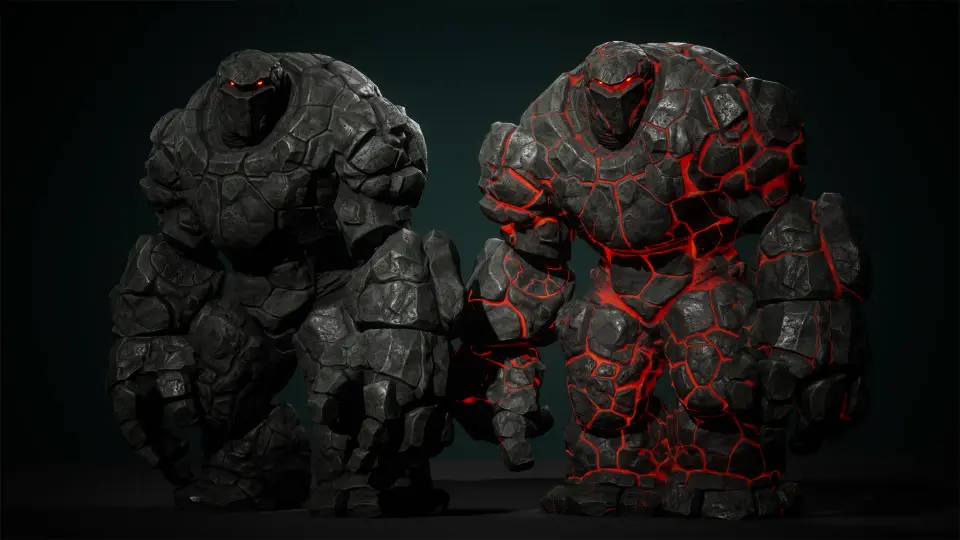
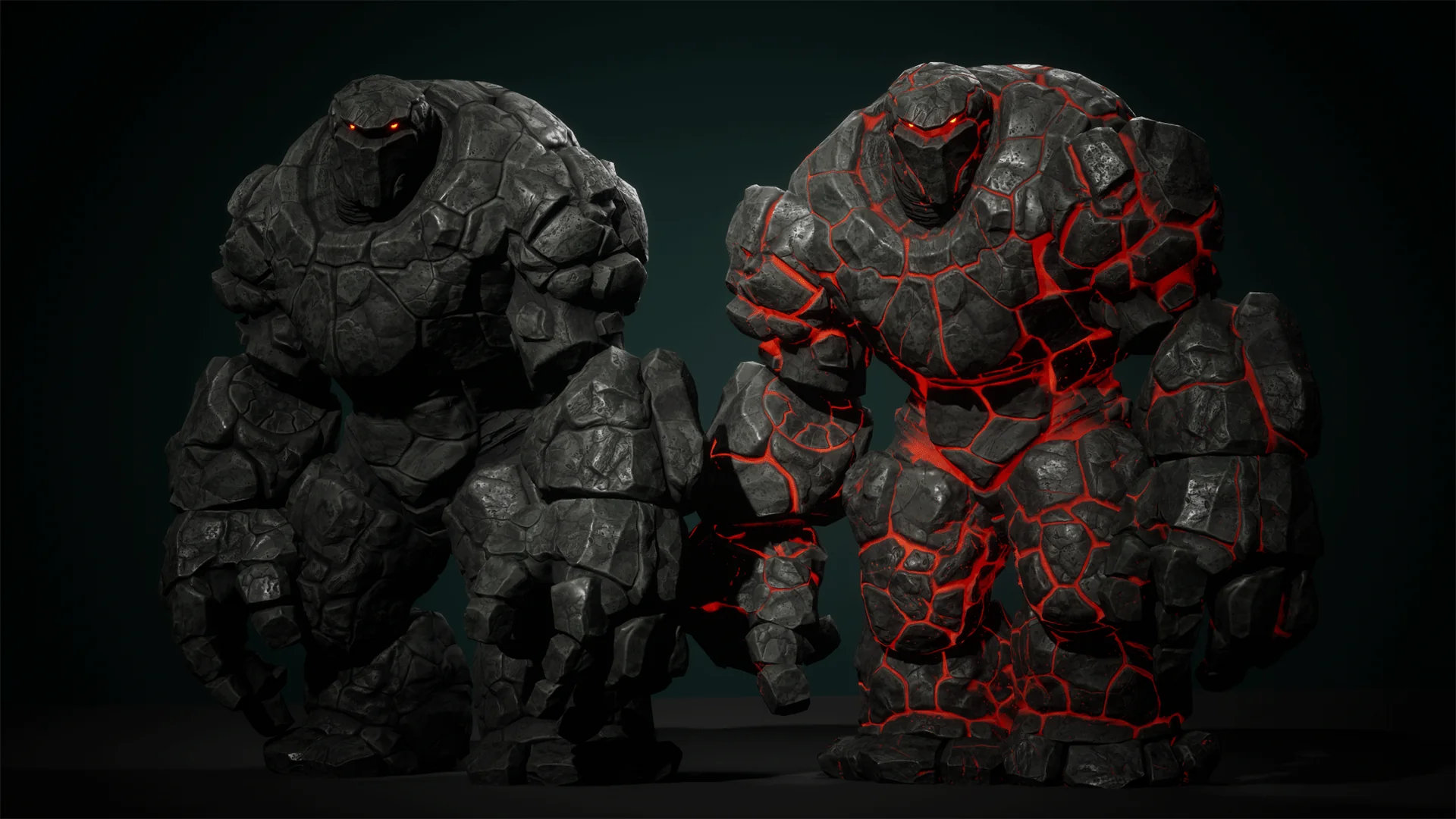
Raw Stone: A neutral, uncovered rock surface that serves as the baseline appearance for temperate ruins, ancient temples, or subterranean quarries.
Snow Coverage: An overlaid frozen treatment that deposits snow across the stone contours, situating the construct in sub-zero biomes, frozen mountain peaks, or glacial fortresses.
Lava Integration: A volcanic configuration that introduces glowing lava running through the material channels, framing the character as an infernal or molten guardian suited for volcanic caverns and deep forges.
Complementing these preset surface states is integrated color customization. Adjusting color values through the material parameters allows artists to alter the hue and tone of the rocky surfaces. Modifying these values makes it possible to match different rock types, such as limestone, granite, basalt, or oxidized desert sandstone, without altering the underlying mesh data.
Animation Pipeline Setup for the Golem Asset
Promotional demonstration videos display dynamic motion sequences, but those specific animations are excluded from the asset package. The character is delivered strictly as a static rigged mesh bound to the Epic skeleton. Implementing the character into an interactive project requires sourcing, keyframing, or retargeting motions independently.
The standard Epic skeleton framework simplifies this retargeting process substantially. Motion sets intended for humanoid and heavy biped archetypes can be retargeted directly onto the golem hierarchy. Animators must tune translation curves, step timings, and posture weight to ensure the 3.2-meter frame moves with appropriate inertia and ground-impact force. The physical mass implied by huge rock plates demands slower windups, extended recovery frames, and heavier footfall spacing than standard-sized humanoid fighters.
Environmental Placement and Encounter Staging
The pairing of heavy scale with three distinct material variations gives the character immediate utility across various encounter roles. In its base stone state, the figure fits naturally into ancestral crypts, long-abandoned dwarven ruins, or standing circle monuments where it can serve as a static guardian that awakens when players approach. Its heavy geometry conveys high defense, resistance to standard attacks, and formidable physical power.
The snow and lava treatments expand this role directly into specialized elemental zones. Placing the snow-clad variant along exposed mountain ridges, frozen lakes, or blizzards creates a thematic adversary suited for arctic survival environments. Conversely, routing the lava variant through magma chambers, smelting facilities, or cracked volcanic terrain turns the character into a heat-radiating boss encounter. Because color customization can be manipulated across these states, teams can establish distinct rank structures or elemental tiers purely through material adjustments across the exact same base model.
With its verified 3.2-meter frame, four-finger hand geometry, Epic skeleton alignment, and versatile material paths, the construct functions as a flexible large-scale enemy or guardian ready to absorb custom animations and populate rugged project environments.
 Creatures
 Characters
 Creatures
 Creatures