"0148f1904a9b0d16"{"id":"1002602","slug":"skeleton-guard-modular","title":"Skeleton Guard (Modular)","category":"Creatures \u0026 Monsters","engine":"5.0+","assetVersion":"","engineVersion":"Engine Version: 5.0+","tag":"Creatures","accent":"blue","visual":"character","summary":"Explore the modular Skeleton Guard asset, featuring detachable limbs, clothing physics, UE4 Epic Skeleton rigging, and UE5 retargeting.","platform":"Unreal Engine","indexPolicy":"index","publishedAt":"2026-11-14T05:52:53.030Z","updatedAt":"2026-11-14T05:52:53.030Z","sourceNotes":[],"fileContents":[],"compatibility":["Unreal Engine","Engine Version: 5.0+"],"featuredImage":{"alt":"Skeleton Guard (Modular)","src":"/wp-content/uploads/published/2026/11/d1906406dcca-14dc8fa0-5be7-47eb-91f6-a321181487e7-53266720b9.webp"},"hasDownloadLink":true,"downloads":0,"terms":[{"taxonomy":"category","slug":"creatures-and-monsters","name":"Creatures \u0026 Monsters"}],"galleryImages":[{"src":"/wp-content/uploads/published/2026/11/eda50079a463-ea473b64-f66f-4ee2-993e-2e79edfc51ca-3b1491d92d.webp","alt":"Skeleton Guard (Modular)"},{"src":"/wp-content/uploads/published/2026/11/76ecc264b0f0-60a2e05a-ae6d-40ef-a76c-bf766c05eae9-5bbd33f2cd.webp","alt":"Skeleton Guard (Modular)"},{"src":"/wp-content/uploads/published/2026/11/8489be1a21ab-fd5a7294-c449-4e37-a0d1-9d0a8e0acd81-020269e75d.webp","alt":"Skeleton Guard (Modular)"},{"src":"/wp-content/uploads/published/2026/11/93dbfd81c391-effd770a-3cf4-43b0-925a-a6b983f69b4c-9a4c54bf1d.webp","alt":"Skeleton Guard (Modular)"},{"src":"/wp-content/uploads/published/2026/11/4ae401def0be-2bd34e46-e55a-470c-ba85-cd8dec8e12bb-6842d4eb22.webp","alt":"Skeleton Guard (Modular)"},{"src":"/wp-content/uploads/published/2026/11/079cd344cc3d-403f3787-bf02-4b99-a4dd-bc6b3035da09-c533600f81.webp","alt":"Skeleton Guard (Modular)"},{"src":"/wp-content/uploads/published/2026/11/bc3499c4ca62-d4d05032-0fc6-461f-a777-b85cb8255363-f4093fd90b.webp","alt":"Skeleton Guard (Modular)"},{"src":"/wp-content/uploads/published/2026/11/16581bb7d39f-8829ed9f-252f-46ee-a7f0-4523b11a090e-606ed605f5.webp","alt":"Skeleton Guard (Modular)"},{"src":"/wp-content/uploads/published/2026/11/5ab1872bb24d-8e93c84f-b000-4783-8e70-8dfbee7b6c1d-3b0d5dff28.webp","alt":"Skeleton Guard (Modular)"},{"src":"/wp-content/uploads/published/2026/11/a9d6cc0f2903-d5c773ca-44c3-45cd-9a36-8bcc850eee1b-1578f66d51.webp","alt":"Skeleton Guard (Modular)"}],"accessPanel":{"kind":"resource","title":"Get this resource","eyebrow":"Free resource","message":"Download this resource in your browser.","fileName":"Content.7z","safetyNote":"Resources are manually reviewed before listing to improve quality and reduce obvious risks.","actionLabel":"Get this resource","resourceType":"Resource archive","versions":[]},"contentHtml":"\u003cp\u003eA hollow-eyed warrior patrolling damp flagstones carries an immediate sense of menace in medieval fantasy and survival horror titles. The Skeleton Guard (Modular) provides a versatile realization of this archetype, presenting an undead combatant that can shift from a standard dungeon patrol to a heavily armored boss or scattered battlefield remains. Rendered with realistic surface treatment showcased through Marmoset, the character pairs an anatomical bone structure with ragged medieval garments to fit multiple ranks of supernatural opposition.\u003c/p\u003e \u003ch2\u003eModular Skeleton Breakdown and Dismemberment\u003c/h2\u003e\n\u003cp\u003eCombat encounters involving skeletal enemies often require distinct visual variations and responsive destruction mechanics. The asset addresses this through two fundamental configurations: an assembled one-piece mesh for rapid deployment and an array of individual modular components. Having the model broken down into separate components allows creators to alter the character's silhouette by stripping away or interchanging pieces of armor and bone.\u003c/p\u003e \u003cp\u003eThis structural division directly supports full dismemberment systems. Because the limbs, torso, and skull are authored as distinct parts, developers can trigger dynamic mesh separation during intense combat sequences. A clean strike can shear off an arm, a heavy blunt impact can shatter a leg to force a crawling behavior, or a targeted blow can decapitate the figure entirely. Decoupling the head, arms, and legs from the main torso makes it simple to spawn detached anatomical props upon impact or drop severed bone elements into the environment as static level dressing.\u003c/p\u003e \u003cp\u003eModularity extends beyond bare bone structure into the warrior's garments. Both the skeletal anatomy and the accompanying clothing operate on an interchangeable logic. Game projects can mix bare ribs and leg bones with different fabric combinations, allowing a single asset foundation to populate an entire garrison of undead guards without repeating identical silhouettes. Stripping away garments yields a stark, weathered corpse, while layering torn garments establishes the appearance of an ancient feudal warrior still clinging to faded station.\u003c/p\u003e \u003ch2\u003eSkeleton Guard Rigging and Animation Pipelines\u003c/h2\u003e\n\u003cp\u003eTranslating an intricate undead model into an active combatant depends heavily on its underlying skeleton hierarchy. The asset is fully rigged to the UE4 Epic Skeleton standard, granting immediate access to extensive motion libraries and Animation Blueprint setups already established for standard humanoid characters. Locomotion loops, martial combat stances, death collapses, and flinch animations mapped to the default Epic hierarchy align naturally with the character's proportions.\u003c/p\u003e \u003cp\u003eProjects advancing their pipelines into Unreal Engine 5 can carry the character forward through standard retargeting workflows. Because the base bone assignments follow the UE4 convention, setting up retargeting chains within UE5 allows developers to adapt modern motion-capture libraries or IK-driven rigs without rebuilding bone weighting from scratch. This cross-engine flexibility ensures the character remains viable whether a production is operating within legacy pipelines or targeting newer engine capabilities.\u003c/p\u003e \u003cp\u003eBeyond the standard humanoid layout, the rig incorporates a dedicated jaw bone named joint_jaw. This mechanical addition gives animators direct programmatic control over the lower mandible. In action, the jaw bone can be articulated to deliver expressive combat screams, sinister conversational movements for dungeon bosses, or repetitive clattering chatter during idle patrol states. It also enables procedural opening behaviors when the skeleton sustains damage, eliminating the stiff, static expressions that often detract from low-poly undead character models.\u003c/p\u003e \u003ch2\u003eDynamic Cloth Physics and Eye Customization\u003c/h2\u003e\n\u003cp\u003eMovement on a skeletal figure can easily look overly rigid if fabric elements cling statically to bare bones. To counter this, the character features integrated physics of clothing. The tattered fabric panels, hanging wraps, and loose cloth sections react dynamically to root movement, combat velocity, and sudden turns. As the skeleton charges a player or recoils from a strike, the cloth flutters and drapes with realistic weight, creating visual contrast against the hard, unyielding surfaces of the skeleton's ribcage and limbs.\u003c/p\u003e \u003cp\u003eVisual readability also plays a major role in enemy design, particularly in dark environments where silhouette alone may not communicate threat level. The asset includes an easy color change system for the eyes. Developers can alter the ocular glow to reflect different combat states, magical allegiances, or rank tiers within a horde. A faint, smoldering amber can denote a dormant guard lying among dungeon remains, shifting to an incandescent crimson when the creature enters an alert combat loop. In fantasy settings involving elemental magic, switching the eye color to icy blue, toxic green, or void purple provides an instant narrative cue without needing new texture bakes.\u003c/p\u003e \u003ch2\u003eAdapting the Guard Across Dungeon and Survival Environments\u003c/h2\u003e\n\u003cp\u003eThe asset's technical specification balances realistic anatomical texturing with a low-poly budget, keeping runtime overhead low during multi-enemy battles. Survival horror games, dungeon crawlers, and dark fantasy role-playing games frequently deploy skeletons in groups, where draw calls and heavy vertex counts can otherwise limit scene complexity. Keeping the base geometry optimized allows technical artists to populate narrow catacombs or sprawling castle ruins with clusters of patrolling guards without causing performance bottlenecks.\u003c/p\u003e \u003cp\u003eBecause the character functions equally well as an intact warrior, an exoskeleton, or scattered anatomical remains, developers can script diverse encounters across a campaign. A player exploring a medieval crypt might encounter dormant bone piles that snap together into active monsters, or face an imposing undead lord commanding lesser armored minions built from the same swappable parts. The low-poly mesh footprint combined with Robot 3 compatibility creates a robust technical profile for fast-paced encounters where responsive physics, clean hit reactions, and modular destruction are essential.\u003c/p\u003e\n\n\u003ch2\u003eMore From The Same Workflow\u003c/h2\u003e\n\u003cul\u003e\n\u003cli\u003e\u003ca href=\"https://3dcghub.com/pack-of-tree-ents/\" rel=\"noopener noreferrer\"\u003ePack of tree ents\u003c/a\u003e\u003c/li\u003e\n\u003cli\u003e\u003ca href=\"https://3dcghub.com/monsters-skeleton/\" rel=\"noopener noreferrer\"\u003eMonsters - Skeleton\u003c/a\u003e\u003c/li\u003e\n\u003cli\u003e\u003ca href=\"https://3dcghub.com/skeleton-army/\" rel=\"noopener noreferrer\"\u003eSkeleton Army\u003c/a\u003e\u003c/li\u003e\n\u003cli\u003e\u003ca href=\"https://3dcghub.com/zombies-pack-01/\" rel=\"noopener noreferrer\"\u003eZombies Pack 01\u003c/a\u003e\u003c/li\u003e\n\u003cli\u003e\u003ca href=\"https://3dcghub.com/orc-collection/\" rel=\"noopener noreferrer\"\u003eOrc Collection\u003c/a\u003e\u003c/li\u003e\n\u003c/ul\u003e","contentTextLength":6368,"navigation":{"current":47,"total":4543,"previous":{"id":"1002603","slug":"stone-golem","title":"Stone Golem","category":"Creatures \u0026 Monsters","platform":"Unreal Engine","updatedAt":"2026-11-14T05:57:34.256Z"},"next":{"id":"1002601","slug":"scifi-beast06-bull","title":"SciFi Beast06 Bull","category":"Characters \u0026 Creatures","platform":"Unreal Engine","updatedAt":"2026-11-14T05:51:45.057Z"}},"relatedResources":[{"id":"1002603","slug":"stone-golem","title":"Stone Golem","category":"Creatures \u0026 Monsters","engine":"5.0+","assetVersion":"","engineVersion":"Engine Version: 5.0+","tag":"Creatures","accent":"blue","visual":"character","summary":"Examine the Stone Golem asset, featuring a 3.2m scale, Epic skeleton rigging, 4-finger hand setup, customizable colors, and stone, snow, and lava materials.","platform":"Unreal Engine","indexPolicy":"index","publishedAt":"2026-11-14T05:57:34.256Z","updatedAt":"2026-11-14T05:57:34.256Z","sourceNotes":[],"fileContents":[],"compatibility":["Unreal Engine","Engine Version: 5.0+"],"featuredImage":{"alt":"Stone Golem","src":"/wp-content/uploads/published/2026/11/84fc89e5354d-a051387d-fec3-468a-ae45-47fc5e3bdd65-a86c288e90.webp"},"hasDownloadLink":true,"downloads":0},{"id":"1002591","slug":"pack-of-tree-ents","title":"Pack of tree ents","category":"Creatures \u0026 Monsters","engine":"5.0+","assetVersion":"","engineVersion":"Engine Version: 5.0+","tag":"Creatures","accent":"blue","visual":"character","summary":"Examine the Pack of tree ents featuring four distinct arboreal monster meshes, 47 animations per model, and Epic skeleton support in Unreal Engine 5.","platform":"Unreal Engine","indexPolicy":"index","publishedAt":"2026-11-14T05:35:27.957Z","updatedAt":"2026-11-14T05:35:27.957Z","sourceNotes":[],"fileContents":[],"compatibility":["Unreal Engine","Engine Version: 5.0+"],"featuredImage":{"alt":"Pack of tree ents","src":"/wp-content/uploads/published/2026/11/c5848e3311f0-4d204300-acf4-487c-a5b0-9085622338fb-d35a6a0c04.webp"},"hasDownloadLink":true,"downloads":0},{"id":"2043","slug":"monsters-skeleton","title":"Monsters - Skeleton","category":"Creatures \u0026 Monsters","engine":"5.4+","assetVersion":"Engine version: 5.4+","engineVersion":"4.17","tag":"Creatures","accent":"blue","visual":"character","summary":"Enhance your game with this AAA-quality skeleton character. Optimized for VR, mobile, and PC, it features PBR textures and Epic Skeleton compatibility.","platform":"Unreal Engine","indexPolicy":"noindex","publishedAt":"2026-02-06T23:00:56.000Z","updatedAt":"2026-04-19T15:58:25.000Z","sourceNotes":[],"fileContents":[],"compatibility":["Unreal Engine","Engine version: 5.4+"],"featuredImage":{"alt":"Monsters - Skeleton","src":"https://3dcghub.com/wp-content/uploads/2026/02/e838c2c8-6e72-406b-b6c9-32c9be52581f.webp"},"hasDownloadLink":true,"downloads":0}]}
Creatures
Skeleton Guard (Modular)
Explore the modular Skeleton Guard asset, featuring detachable limbs, clothing physics, UE4 Epic Skeleton rigging, and UE5 retargeting.
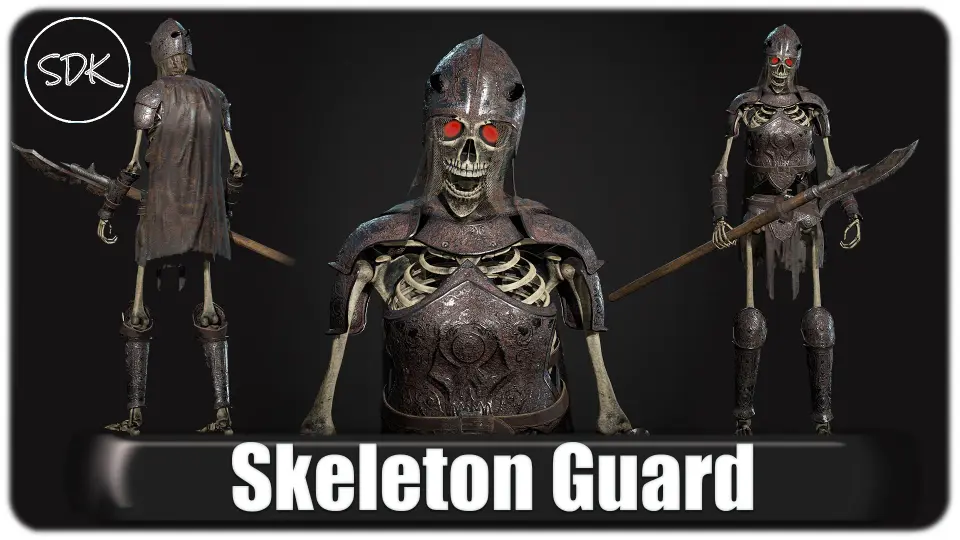
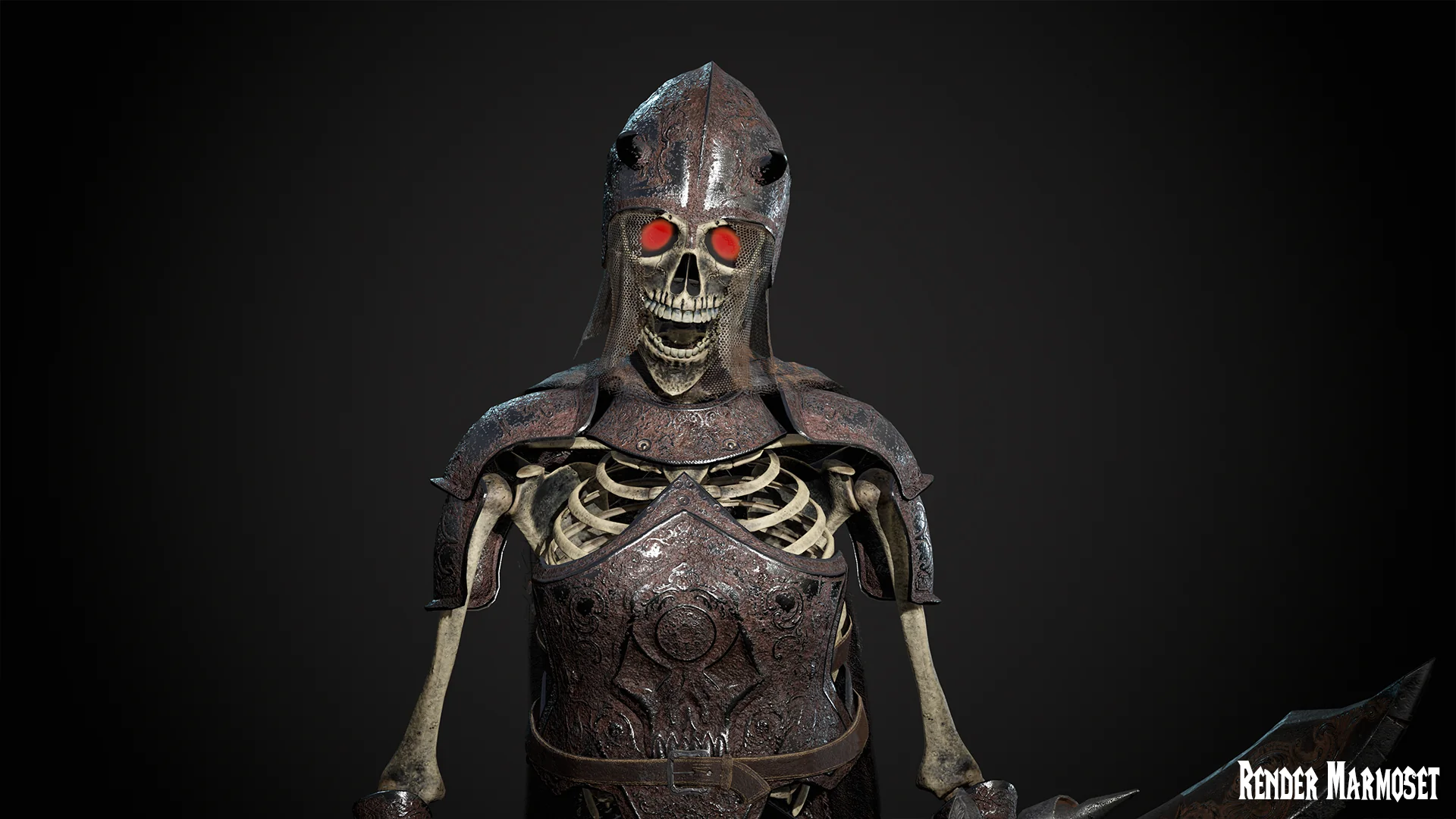
A hollow-eyed warrior patrolling damp flagstones carries an immediate sense of menace in medieval fantasy and survival horror titles. The Skeleton Guard (Modular) provides a versatile realization of this archetype, presenting an undead combatant that can shift from a standard dungeon patrol to a heavily armored boss or scattered battlefield remains. Rendered with realistic surface treatment showcased through Marmoset, the character pairs an anatomical bone structure with ragged medieval garments to fit multiple ranks of supernatural opposition.
Modular Skeleton Breakdown and Dismemberment
Combat encounters involving skeletal enemies often require distinct visual variations and responsive destruction mechanics. The asset addresses this through two fundamental configurations: an assembled one-piece mesh for rapid deployment and an array of individual modular components. Having the model broken down into separate components allows creators to alter the character's silhouette by stripping away or interchanging pieces of armor and bone.
This structural division directly supports full dismemberment systems. Because the limbs, torso, and skull are authored as distinct parts, developers can trigger dynamic mesh separation during intense combat sequences. A clean strike can shear off an arm, a heavy blunt impact can shatter a leg to force a crawling behavior, or a targeted blow can decapitate the figure entirely. Decoupling the head, arms, and legs from the main torso makes it simple to spawn detached anatomical props upon impact or drop severed bone elements into the environment as static level dressing.
Modularity extends beyond bare bone structure into the warrior's garments. Both the skeletal anatomy and the accompanying clothing operate on an interchangeable logic. Game projects can mix bare ribs and leg bones with different fabric combinations, allowing a single asset foundation to populate an entire garrison of undead guards without repeating identical silhouettes. Stripping away garments yields a stark, weathered corpse, while layering torn garments establishes the appearance of an ancient feudal warrior still clinging to faded station.
Skeleton Guard Rigging and Animation Pipelines
Translating an intricate undead model into an active combatant depends heavily on its underlying skeleton hierarchy. The asset is fully rigged to the UE4 Epic Skeleton standard, granting immediate access to extensive motion libraries and Animation Blueprint setups already established for standard humanoid characters. Locomotion loops, martial combat stances, death collapses, and flinch animations mapped to the default Epic hierarchy align naturally with the character's proportions.
Projects advancing their pipelines into Unreal Engine 5 can carry the character forward through standard retargeting workflows. Because the base bone assignments follow the UE4 convention, setting up retargeting chains within UE5 allows developers to adapt modern motion-capture libraries or IK-driven rigs without rebuilding bone weighting from scratch. This cross-engine flexibility ensures the character remains viable whether a production is operating within legacy pipelines or targeting newer engine capabilities.
Beyond the standard humanoid layout, the rig incorporates a dedicated jaw bone named joint_jaw. This mechanical addition gives animators direct programmatic control over the lower mandible. In action, the jaw bone can be articulated to deliver expressive combat screams, sinister conversational movements for dungeon bosses, or repetitive clattering chatter during idle patrol states. It also enables procedural opening behaviors when the skeleton sustains damage, eliminating the stiff, static expressions that often detract from low-poly undead character models.
Dynamic Cloth Physics and Eye Customization
Movement on a skeletal figure can easily look overly rigid if fabric elements cling statically to bare bones. To counter this, the character features integrated physics of clothing. The tattered fabric panels, hanging wraps, and loose cloth sections react dynamically to root movement, combat velocity, and sudden turns. As the skeleton charges a player or recoils from a strike, the cloth flutters and drapes with realistic weight, creating visual contrast against the hard, unyielding surfaces of the skeleton's ribcage and limbs.
Visual readability also plays a major role in enemy design, particularly in dark environments where silhouette alone may not communicate threat level. The asset includes an easy color change system for the eyes. Developers can alter the ocular glow to reflect different combat states, magical allegiances, or rank tiers within a horde. A faint, smoldering amber can denote a dormant guard lying among dungeon remains, shifting to an incandescent crimson when the creature enters an alert combat loop. In fantasy settings involving elemental magic, switching the eye color to icy blue, toxic green, or void purple provides an instant narrative cue without needing new texture bakes.
Adapting the Guard Across Dungeon and Survival Environments
The asset's technical specification balances realistic anatomical texturing with a low-poly budget, keeping runtime overhead low during multi-enemy battles. Survival horror games, dungeon crawlers, and dark fantasy role-playing games frequently deploy skeletons in groups, where draw calls and heavy vertex counts can otherwise limit scene complexity. Keeping the base geometry optimized allows technical artists to populate narrow catacombs or sprawling castle ruins with clusters of patrolling guards without causing performance bottlenecks.
Because the character functions equally well as an intact warrior, an exoskeleton, or scattered anatomical remains, developers can script diverse encounters across a campaign. A player exploring a medieval crypt might encounter dormant bone piles that snap together into active monsters, or face an imposing undead lord commanding lesser armored minions built from the same swappable parts. The low-poly mesh footprint combined with Robot 3 compatibility creates a robust technical profile for fast-paced encounters where responsive physics, clean hit reactions, and modular destruction are essential.
 Creatures
 Creatures
 Creatures
 Creatures