"0148f1904a9b0d16"{"id":"1002601","slug":"scifi-beast06-bull","title":"SciFi Beast06 Bull","category":"Characters \u0026 Creatures","engine":"5.0+","assetVersion":"","engineVersion":"Engine Version: 5.0+","tag":"Characters","accent":"blue","visual":"character","summary":"Explore the SciFi Beast06 Bull character asset, featuring 29 animations, an Epic UE4 skeleton with jaw and eye bones, 3 skins, and high-detail PBR geometry.","platform":"Unreal Engine","indexPolicy":"index","publishedAt":"2026-11-14T05:51:45.057Z","updatedAt":"2026-11-14T05:51:45.057Z","sourceNotes":[],"fileContents":[],"compatibility":["Unreal Engine","Engine Version: 5.0+"],"featuredImage":{"alt":"SciFi Beast06 Bull","src":"/wp-content/uploads/published/2026/11/75daddd8644b-2627b26b-19f4-4a9d-a329-7e7b205ab0ea-a531f10bfb.webp"},"hasDownloadLink":true,"downloads":0,"terms":[{"taxonomy":"category","slug":"characters-and-creatures","name":"Characters \u0026 Creatures"}],"galleryImages":[{"src":"/wp-content/uploads/published/2026/11/d930e14bf8ae-6f88501d-60a0-4a7f-b1e6-1fcfa39f6da0-d5a4abc3fa.webp","alt":"SciFi Beast06 Bull"},{"src":"/wp-content/uploads/published/2026/11/c2d1e5cdafaf-303a7172-98ad-4ee3-846f-455ab059af39-fc15bb80d2.webp","alt":"SciFi Beast06 Bull"},{"src":"/wp-content/uploads/published/2026/11/820dedb3bf32-79838f39-4fb8-434b-acfe-2693633f393d-3c1251ef73.webp","alt":"SciFi Beast06 Bull"},{"src":"/wp-content/uploads/published/2026/11/ec3dee540aea-2e38a84c-b9c9-4c57-ba51-904ab01f3220-bb9a72539d.webp","alt":"SciFi Beast06 Bull"},{"src":"/wp-content/uploads/published/2026/11/755aca886f4d-cdf9e996-a082-49b4-ad8d-5474b7aa903b-78d26dc933.webp","alt":"SciFi Beast06 Bull"},{"src":"/wp-content/uploads/published/2026/11/bdac331727fb-26a88db1-300a-4c21-8d86-fbed808f7f18-97c43864c4.webp","alt":"SciFi Beast06 Bull"},{"src":"/wp-content/uploads/published/2026/11/d00d25f20dd2-a7524ece-d049-4498-81d6-be6344aa996f-610495f0f9.webp","alt":"SciFi Beast06 Bull"},{"src":"/wp-content/uploads/published/2026/11/d7ee8e1fc44b-4daccad2-0e82-4bf2-91b0-682e8511ca0c-dde3d1cc89.webp","alt":"SciFi Beast06 Bull"},{"src":"/wp-content/uploads/published/2026/11/bec8a36de820-9d70fc69-caf1-46f9-b118-c501fc63a6f6-be9e11f38e.webp","alt":"SciFi Beast06 Bull"},{"src":"/wp-content/uploads/published/2026/11/0a530ab7f3e0-0eb74166-adb3-4375-80e5-91004d88b17d-f5b42c8bb0.webp","alt":"SciFi Beast06 Bull"}],"accessPanel":{"kind":"resource","title":"Get this resource","eyebrow":"Free resource","message":"Download this resource in your browser.","fileName":"Content.7z","safetyNote":"Resources are manually reviewed before listing to improve quality and reduce obvious risks.","actionLabel":"Get this resource","resourceType":"Resource archive","versions":[]},"contentHtml":"\u003ch2\u003eIntegrating the SciFi Beast06 Bull Skeleton\u003c/h2\u003e\u003cp\u003eBringing the SciFi Beast06 Bull into an active production begins with retargeting and skeletal assignment. Built on the Epic skeleton framework from Unreal Engine 4, the character slots directly into standard mannequin-compatible animation structures while including dedicated extension joints. The rig provides specialized extra bones for the eyes and the jaw, allowing technical animators to layer facial articulation, bite mechanics, and visual tracking directly over existing base passes.\u003c/p\u003e\u003cp\u003eBecause the character targets game-ready pipelines in first-person shooters, third-person action titles, and role-playing games, the bone hierarchy works cleanly with standard Animation Blueprint logic. The additional eye bones allow developers to drive look-at constraints toward players or dynamic world targets, while the jaw bone gives precise control for roaring sequences, snarling states, and bite impacts during close-range engagements. Setting up the asset involves pointing state machines toward its native clip library or blending its dedicated locomotion sequences with custom project-level procedural transforms.\u003c/p\u003e\u003ch2\u003eLocomotion and Combat Cycles of the Bull\u003c/h2\u003e\u003cp\u003eMovement responsiveness is anchored by a suite of 29 hand-crafted animations covering baseline traversal, sudden maneuvers, and layered combat interactions. The walking set features four directional variations covering forward, backward, left, and right movement, alongside an alternate forward cadence (F2) to introduce variation in enemy patrol routines. A dedicated run clip handles aggressive charges, while an explicit 180-degree turn animation handles sudden reorientation when a target evades the creature's forward line of sight.\u003c/p\u003e\u003cp\u003eAerial states and vertical transitions rely on a three-phase jump group, separating vertical transitions cleanly into distinct take-off, suspension, and landing steps. Idle behavior is supported by two distinct baseline resting animations, providing natural shifting motions for stationary guards, sentries, or patrolling heavy units.\u003c/p\u003e\u003cp\u003eCombat functionality offers substantial variety through six distinct attack animations. These separate offensive clips allow developers to construct multi-strike combo chains, alternate between sweeping horn attacks and stomping strikes, or gate heavy attacks behind specific gameplay conditions. When sustaining damage, the asset uses eight separate hit reaction animations (GetHit). This broad selection of impact reactions lets state machines translate directional bullet impacts, melee staggers, and explosive concussions into distinct visual recoil states without repetitive looping.\u003c/p\u003e\u003cp\u003eDefeat and transition mechanics are completed with two death variations and a dedicated rage animation. The rage cycle serves as an ideal phase-transition trigger for boss battles, allowing the creature to visually announce heightened aggression, defense buffs, or altered attack patterns. If the creature is routed or eliminated, the dual death clips allow developers to branch final ragdoll or kinematic defeat states based on the direction or intensity of the lethal blow.\u003c/p\u003e\u003ch2\u003eMesh Density and PBR Skin Variations\u003c/h2\u003e\u003cp\u003eFrom a rendering and geometric perspective, the creature is modeled with an explicit budget suited for modern real-time hardware. The character mesh consists of 87,597 triangles and 55,800 vertices. This density preserves intricate mechanical paneling, segmented armor plating, and underlying biological forms without pushing draw overhead beyond practical thresholds for standard enemy encounters or boss-tier staging.\u003c/p\u003e\u003cp\u003eSurface rendering is driven by physically based rendering (PBR) workflows, supporting high-fidelity light interaction across both metallic framework pieces and organic beast tissue. Each individual item on the character includes three distinct skin options. These material variants allow developers to populate different biomes, assign visual hierarchy to elite units, or convey distinct elemental, technological, or faction alignments without altering the underlying geometry.\u003c/p\u003e\u003cp\u003eVisual customization can be handled dynamically by swapping material instances across the three surface variants. Whether configuring a rusted, weathered look for abandoned industrial sectors or a high-tech metallic finish for advanced research facilities, the provided materials accommodate varying art directions across sci-fi, horror, and dark fantasy themes.\u003c/p\u003e\u003ch2\u003eSciFi Beast06 Bull in Boss Encounters and Combat Systems\u003c/h2\u003e\u003cp\u003eCombining the silhouettes of a mythic minotaur, a hulking animal, and a mechanized beast, the model readily fulfills roles ranging from heavy frontline infantry to a standalone stage boss. It is conceptually matched to the Sci-Fi Myth Boss pack, making it suitable for larger shared universes where cybernetic transformations of classic mythological monsters appear alongside one another.\u003c/p\u003e\u003cp\u003eBecause the asset focuses strictly on the character mesh, skeletal rig, and animation library, sound effects and visual particle systems are not included in the package. Production teams must layer audio cues—such as mechanical servo hums, hooved stomps, heavy breathing, and metallic strikes—directly into animation notifies. Similarly, weapon impacts, muzzle flashes, steam vents, or ground-pound particle bursts need to be linked through engine-level particle systems using the character's existing bone and socket locations.\u003c/p\u003e\u003cp\u003eThe mixture of mechanical plating, horror-styled anatomy, and animalistic posture makes the creature adaptable to both classic fantasy dungeons reworked with futuristic technology and gritty, close-quarters shooter corridors. Designers can script the creature as an unrelenting berserker that uses its run cycle to close distances rapidly, forcing players to manage space while reacting to its diverse six-attack repertoire.\u003c/p\u003e\u003ch2\u003eProduction Pipeline and Integration Notes\u003c/h2\u003e\u003cp\u003eWorking the model into an active build requires linking the 29 movement and combat sequences into an operational state tree. Utilizing the Epic skeleton base minimizes setup friction, enabling rapid mapping into Unreal Engine character blueprints. The extra eye and jaw joints can either be left under the control of baked animation clips or driven procedurally through skeletal control nodes in the anim graph for dynamic interactive feedback.\u003c/p\u003e\u003cp\u003eFor teams with specialized design requirements, the asset creator maintains ongoing support channels, welcoming developer inquiries regarding implementation challenges or requests for bespoke character animations. This active support avenue ensures that edge-case movement requirements, specific cinematic behaviors, or unique environmental interactions can be accommodated as a project progresses through its production milestones.\u003c/p\u003e\n\n\u003ch2\u003eRelated Resources Worth Checking\u003c/h2\u003e\n\u003cul\u003e\n\u003cli\u003e\u003ca href=\"https://3dcghub.com/scifi-beasts-pack/\" rel=\"noopener noreferrer\"\u003eSciFi Beasts Pack\u003c/a\u003e\u003c/li\u003e\n\u003cli\u003e\u003ca href=\"https://3dcghub.com/scifi-beast01-ghoul/\" rel=\"noopener noreferrer\"\u003eSciFi Beast01 Ghoul\u003c/a\u003e\u003c/li\u003e\n\u003cli\u003e\u003ca href=\"https://3dcghub.com/alien-fish-for-school-system-scifi-fantasy-creatures/\" rel=\"noopener noreferrer\"\u003eAlien Fish for School System - Scifi Fantasy Creatures\u003c/a\u003e\u003c/li\u003e\n\u003cli\u003e\u003ca href=\"https://3dcghub.com/bull-emperor/\" rel=\"noopener noreferrer\"\u003eBull Emperor\u003c/a\u003e\u003c/li\u003e\n\u003cli\u003e\u003ca href=\"https://3dcghub.com/scifi-alien-cyborg/\" rel=\"noopener noreferrer\"\u003eSCIFI Alien Cyborg\u003c/a\u003e\u003c/li\u003e\n\u003c/ul\u003e","contentTextLength":6917,"navigation":{"current":48,"total":4543,"previous":{"id":"1002602","slug":"skeleton-guard-modular","title":"Skeleton Guard (Modular)","category":"Creatures \u0026 Monsters","platform":"Unreal Engine","updatedAt":"2026-11-14T05:52:53.030Z"},"next":{"id":"1002600","slug":"sci-fi-troopers-collection","title":"Sci-FI Troopers Collection","category":"Characters \u0026 Creatures","platform":"Unreal Engine","updatedAt":"2026-11-14T05:50:39.758Z"}},"relatedResources":[{"id":"1001554","slug":"scifi-beasts-pack","title":"SciFi Beasts Pack","category":"Characters \u0026 Creatures","engine":"5.0+","assetVersion":"","engineVersion":"Engine Version: 5.0+","tag":"Characters","accent":"blue","visual":"character","summary":"Examine the technical layout, mesh specifications, and locomotion sets across the six characters and variants in the SciFi Beasts Pack.","platform":"Unreal Engine","indexPolicy":"index","publishedAt":"2026-10-10T03:41:56.863Z","updatedAt":"2026-10-10T03:41:56.863Z","sourceNotes":[],"fileContents":[],"compatibility":["Unreal Engine","Engine Version: 5.0+"],"featuredImage":{"alt":"SciFi Beasts Pack","src":"/wp-content/uploads/published/2026/10/e0956e8ba346-d65658bc-8d6e-461e-b2a2-84650a321346-9a948e76a3.webp"},"hasDownloadLink":true,"downloads":1},{"id":"1001758","slug":"scifi-beast01-ghoul","title":"SciFi Beast01 Ghoul","category":"Characters \u0026 Creatures","engine":"4.26+,5.0+","assetVersion":"","engineVersion":"Engine Version: 4.26+,5.0+","tag":"Characters","accent":"blue","visual":"character","summary":"Explore the SciFi Beast01 Ghoul character model, featuring modular mechanical attachments, 24 animations, three skin variants, and custom skeleton setup.","platform":"Unreal Engine","indexPolicy":"index","publishedAt":"2026-10-20T03:03:08.345Z","updatedAt":"2026-10-20T03:03:08.345Z","sourceNotes":[],"fileContents":[],"compatibility":["Unreal Engine","Engine Version: 4.26+,5.0+"],"featuredImage":{"alt":"SciFi Beast01 Ghoul","src":"/wp-content/uploads/published/2026/10/ade304976dc1-35c8dfc5-7372-49b5-99c4-be534060034a-32545bf056.webp"},"hasDownloadLink":true,"downloads":0},{"id":"1000270","slug":"alien-fish-for-school-system-scifi-fantasy-creatures","title":"Alien Fish for School System - Scifi Fantasy Creatures","category":"Characters \u0026 Creatures","engine":"4.26+,5.0+","assetVersion":"","engineVersion":"Engine Version: 4.26+,5.0+","tag":"Characters","accent":"blue","visual":"character","summary":"A detailed look at a collection of 11 alien fish models built for sci-fi and fantasy underwater scenes, featuring vertex animations and ragdoll physics.","platform":"Unreal Engine","indexPolicy":"index","publishedAt":"2026-07-02T16:20:03.507Z","updatedAt":"2026-07-02T16:20:03.507Z","sourceNotes":[],"fileContents":[],"compatibility":["Unreal Engine","Engine Version: 4.26+,5.0+"],"featuredImage":{"alt":"Alien Fish for School System - Scifi Fantasy Creatures","src":"/wp-content/uploads/published/2026/07/4a2deb272a93-72358cf9-0b31-4504-816a-4c9315511ad8-efad13f3d0.webp"},"hasDownloadLink":true,"downloads":0}]}
Characters
SciFi Beast06 Bull
Explore the SciFi Beast06 Bull character asset, featuring 29 animations, an Epic UE4 skeleton with jaw and eye bones, 3 skins, and high-detail PBR geometry.
Bringing the SciFi Beast06 Bull into an active production begins with retargeting and skeletal assignment. Built on the Epic skeleton framework from Unreal Engine 4, the character slots directly into standard mannequin-compatible animation structures while including dedicated extension joints. The rig provides specialized extra bones for the eyes and the jaw, allowing technical animators to layer facial articulation, bite mechanics, and visual tracking directly over existing base passes.
Because the character targets game-ready pipelines in first-person shooters, third-person action titles, and role-playing games, the bone hierarchy works cleanly with standard Animation Blueprint logic. The additional eye bones allow developers to drive look-at constraints toward players or dynamic world targets, while the jaw bone gives precise control for roaring sequences, snarling states, and bite impacts during close-range engagements. Setting up the asset involves pointing state machines toward its native clip library or blending its dedicated locomotion sequences with custom project-level procedural transforms.
Locomotion and Combat Cycles of the Bull
Movement responsiveness is anchored by a suite of 29 hand-crafted animations covering baseline traversal, sudden maneuvers, and layered combat interactions. The walking set features four directional variations covering forward, backward, left, and right movement, alongside an alternate forward cadence (F2) to introduce variation in enemy patrol routines. A dedicated run clip handles aggressive charges, while an explicit 180-degree turn animation handles sudden reorientation when a target evades the creature's forward line of sight.
Aerial states and vertical transitions rely on a three-phase jump group, separating vertical transitions cleanly into distinct take-off, suspension, and landing steps. Idle behavior is supported by two distinct baseline resting animations, providing natural shifting motions for stationary guards, sentries, or patrolling heavy units.
Combat functionality offers substantial variety through six distinct attack animations. These separate offensive clips allow developers to construct multi-strike combo chains, alternate between sweeping horn attacks and stomping strikes, or gate heavy attacks behind specific gameplay conditions. When sustaining damage, the asset uses eight separate hit reaction animations (GetHit). This broad selection of impact reactions lets state machines translate directional bullet impacts, melee staggers, and explosive concussions into distinct visual recoil states without repetitive looping.
Defeat and transition mechanics are completed with two death variations and a dedicated rage animation. The rage cycle serves as an ideal phase-transition trigger for boss battles, allowing the creature to visually announce heightened aggression, defense buffs, or altered attack patterns. If the creature is routed or eliminated, the dual death clips allow developers to branch final ragdoll or kinematic defeat states based on the direction or intensity of the lethal blow.
Mesh Density and PBR Skin Variations
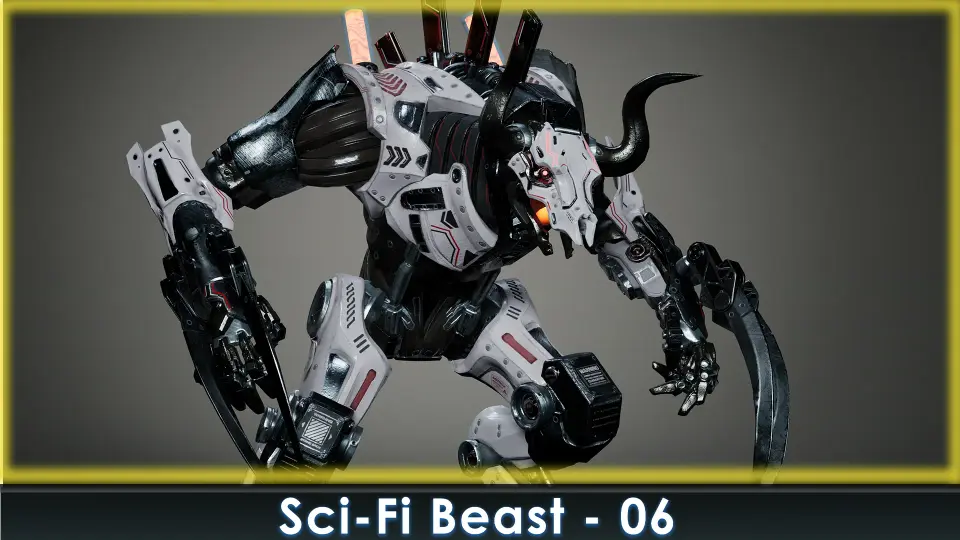
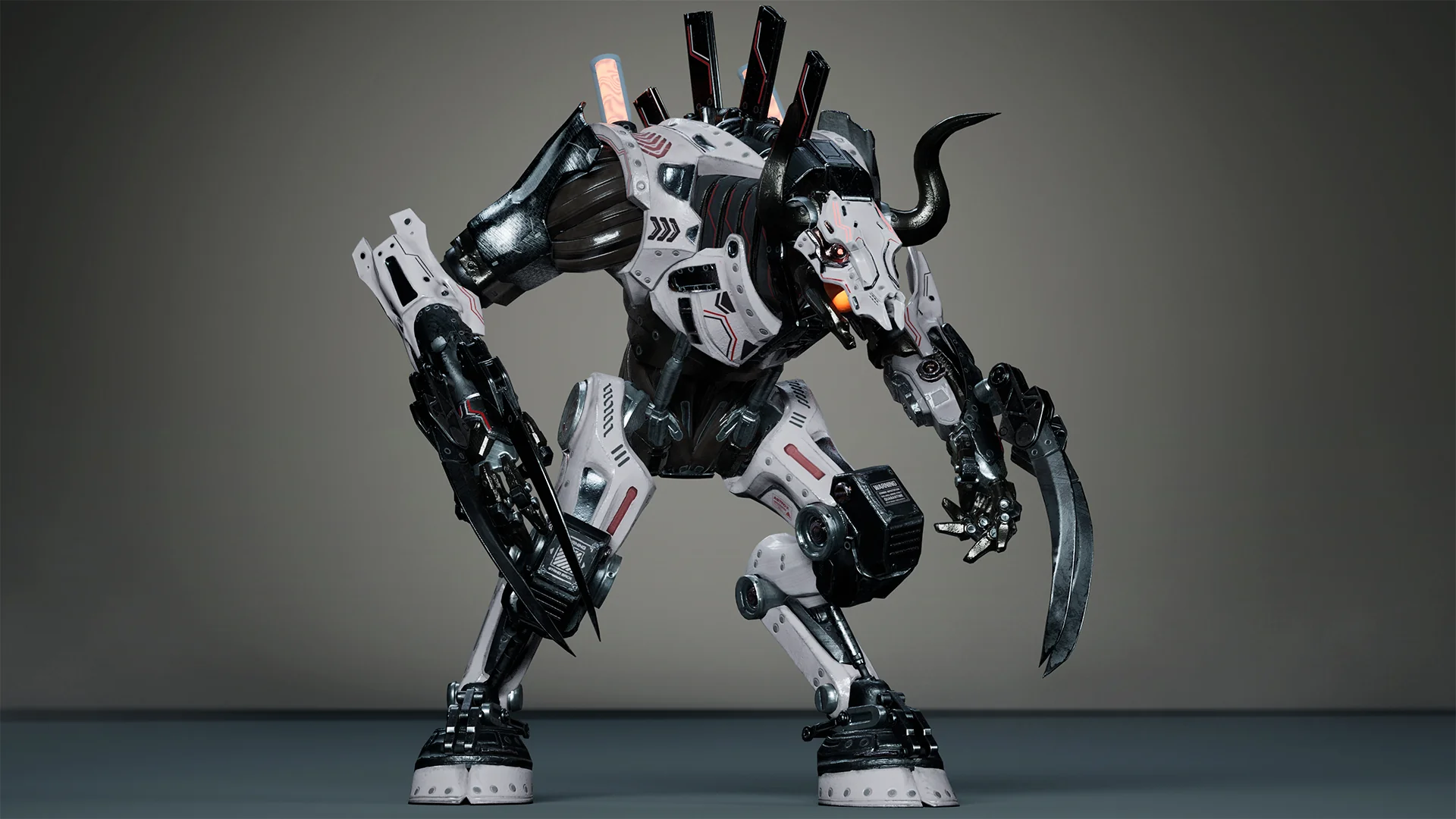
From a rendering and geometric perspective, the creature is modeled with an explicit budget suited for modern real-time hardware. The character mesh consists of 87,597 triangles and 55,800 vertices. This density preserves intricate mechanical paneling, segmented armor plating, and underlying biological forms without pushing draw overhead beyond practical thresholds for standard enemy encounters or boss-tier staging.
Surface rendering is driven by physically based rendering (PBR) workflows, supporting high-fidelity light interaction across both metallic framework pieces and organic beast tissue. Each individual item on the character includes three distinct skin options. These material variants allow developers to populate different biomes, assign visual hierarchy to elite units, or convey distinct elemental, technological, or faction alignments without altering the underlying geometry.
Visual customization can be handled dynamically by swapping material instances across the three surface variants. Whether configuring a rusted, weathered look for abandoned industrial sectors or a high-tech metallic finish for advanced research facilities, the provided materials accommodate varying art directions across sci-fi, horror, and dark fantasy themes.
SciFi Beast06 Bull in Boss Encounters and Combat Systems
Combining the silhouettes of a mythic minotaur, a hulking animal, and a mechanized beast, the model readily fulfills roles ranging from heavy frontline infantry to a standalone stage boss. It is conceptually matched to the Sci-Fi Myth Boss pack, making it suitable for larger shared universes where cybernetic transformations of classic mythological monsters appear alongside one another.
Because the asset focuses strictly on the character mesh, skeletal rig, and animation library, sound effects and visual particle systems are not included in the package. Production teams must layer audio cues—such as mechanical servo hums, hooved stomps, heavy breathing, and metallic strikes—directly into animation notifies. Similarly, weapon impacts, muzzle flashes, steam vents, or ground-pound particle bursts need to be linked through engine-level particle systems using the character's existing bone and socket locations.
The mixture of mechanical plating, horror-styled anatomy, and animalistic posture makes the creature adaptable to both classic fantasy dungeons reworked with futuristic technology and gritty, close-quarters shooter corridors. Designers can script the creature as an unrelenting berserker that uses its run cycle to close distances rapidly, forcing players to manage space while reacting to its diverse six-attack repertoire.
Production Pipeline and Integration Notes
Working the model into an active build requires linking the 29 movement and combat sequences into an operational state tree. Utilizing the Epic skeleton base minimizes setup friction, enabling rapid mapping into Unreal Engine character blueprints. The extra eye and jaw joints can either be left under the control of baked animation clips or driven procedurally through skeletal control nodes in the anim graph for dynamic interactive feedback.
For teams with specialized design requirements, the asset creator maintains ongoing support channels, welcoming developer inquiries regarding implementation challenges or requests for bespoke character animations. This active support avenue ensures that edge-case movement requirements, specific cinematic behaviors, or unique environmental interactions can be accommodated as a project progresses through its production milestones.
 Characters
 Characters
 Characters
 Characters