"7ad89cffa44984cf"{"id":"1002576","slug":"match-3-rpg-template","title":"Match 3 RPG Template","category":"RPG","engine":"5.0+","assetVersion":"","engineVersion":"Engine Version: 5.0+","tag":"RPG","accent":"blue","visual":"mech","summary":"A detailed look at the Match 3 RPG Template for Unreal Engine, featuring chain-link gem mechanics, character stats, wave combat, and mobile support.","platform":"Unreal Engine","indexPolicy":"index","publishedAt":"2026-11-13T20:14:38.214Z","updatedAt":"2026-11-13T20:14:38.214Z","sourceNotes":[],"fileContents":[],"compatibility":["Unreal Engine","Engine Version: 5.0+"],"featuredImage":{"alt":"Match 3 RPG Template","src":"/wp-content/uploads/published/2026/11/b1a96c43c745-1866d618-28e7-4a71-ab38-5175f0eaf08f-dc0ecf88c0.webp"},"hasDownloadLink":true,"downloads":0,"terms":[{"taxonomy":"category","slug":"rpg","name":"RPG"}],"galleryImages":[{"src":"/wp-content/uploads/published/2026/11/153e8820f209-50219856-4c16-4a6c-98e6-68618bcef9b7-8a82bc4154.webp","alt":"Match 3 RPG Template"},{"src":"/wp-content/uploads/published/2026/11/fe2c0e425ff2-be27e36c-93c7-4bee-a261-4c7616db52cd-179fb1f8a9.webp","alt":"Match 3 RPG Template"},{"src":"/wp-content/uploads/published/2026/11/32c98a3dd44a-e328d523-7dd6-4c87-8a97-305746b8563a-b5706e6b3c.webp","alt":"Match 3 RPG Template"},{"src":"/wp-content/uploads/published/2026/11/dcc662bfff72-07514a9c-c919-465b-be80-fdccd0d3c7c1-63b7ee1108.webp","alt":"Match 3 RPG Template"},{"src":"/wp-content/uploads/published/2026/11/6dfdbc00605c-ed235292-f9f1-486d-bee8-8d42d6a1ef62-9fb28b9e56.webp","alt":"Match 3 RPG Template"},{"src":"/wp-content/uploads/published/2026/11/48ccabcb0f9f-50b3bdc3-7fc3-455d-a475-bda905f60bdb-cf22b981b1.webp","alt":"Match 3 RPG Template"},{"src":"/wp-content/uploads/published/2026/11/6f400d8e2de2-872064e0-91ec-4f1d-b7c6-93564e2001d6-8ddb7b39e4.webp","alt":"Match 3 RPG Template"},{"src":"/wp-content/uploads/published/2026/11/b9dd2a21d52b-ece00a80-1fc8-44ef-a7c1-947bd5001166-2c5da35ca9.webp","alt":"Match 3 RPG Template"}],"accessPanel":{"kind":"resource","title":"Get this resource","eyebrow":"Free resource","message":"Download this resource in your browser.","fileName":"Content.7z","safetyNote":"Resources are manually reviewed before listing to improve quality and reduce obvious risks.","actionLabel":"Get this resource","resourceType":"Resource archive","versions":[]},"contentHtml":"\u003ch2\u003eTactical Puzzle Encounters in Fantasy Battle Scenarios\u003c/h2\u003e\u003cp\u003eHybrid role-playing games that rely on puzzle systems demand a tight relationship between grid actions and battlefield outcomes. Projects that aim to blend turn-based creature battles with tile matching often require extensive back-end coordination to ensure that player choices on the board accurately reflect character power, ability cooldowns, and damage calculations. The Match 3 RPG Template establishes this hybrid workflow directly within Unreal Engine, organizing interactive puzzle mechanics alongside turn-based combat encounters.\u003c/p\u003e\u003cp\u003eIn standard puzzle-combat designs, players alternate between surveying a gem layout and planning tactical moves against enemy formations. This template addresses setups where encounters progress through multi-stage battles, culminating in high-stakes dragon battles or formidable boss encounters. Because combat pacing relies on deliberate turn resolution rather than twitch reactions, the underlying logic must seamlessly translate connected tiles into immediate offensive strikes, tactical defensive buffs, or resource gathering for supportive skills.\u003c/p\u003e\u003ch2\u003eChain Link Mechanics on the Match Board\u003c/h2\u003e\u003cp\u003eThe core interactive system on the board departs from traditional swap-based matching by utilizing a chain-linking input model. Players select and trace continuous paths through matching adjacent gems directly on the grid. This chain-link mechanic shifts the gameplay focus toward path planning, spatial awareness, and combo length rather than simple three-in-a-row swaps.\u003c/p\u003e\u003cp\u003eConnecting gems across the grid drives the battle engine. Depending on how the grid is cleared, linked chains register input data that immediately feeds into character actions. The interactive grid logic is fully implemented without external code dependencies, allowing developers to adapt the board layout, match requirements, and chain behavior directly inside the engine editor. Because the gem board acts as the primary controller for combat execution, the chain-linking pipeline is built to handle quick sequential taps, path tracing, and immediate clear cycles without desynchronizing from active battle states.\u003c/p\u003e\u003ch2\u003eRPG Character Growth, Inventory, and Stat Scaling\u003c/h2\u003e\u003cp\u003eBehind the puzzle board operates a full role-playing backbone governed by attributes, gear, and combat mechanics. Characters possess distinct numerical stats that determine performance during battle. A dedicated damage system calculates outgoing offensive strikes and incoming enemy damage by reading these core character stats directly, ensuring that leveling up or altering loadouts produces tangible differences during a turn.\u003c/p\u003e\u003cp\u003eProgression is supported by an integrated inventory system that organizes equipment, combat consumables, and rewards gathered across encounters. Gear and items interact with the stat pipeline, letting creators configure character growth tracks that directly influence board efficiency and combat survival. Alongside base physical interactions, the character system supports both offensive and supportive skills:\u003c/p\u003e\u003cul\u003e\u003cli\u003eOffensive skills leverage player stats to execute focused strikes or amplified bursts against high-threat targets.\u003c/li\u003e\u003cli\u003eSupportive skills provide utility, enabling self-healing, status management, or survivability adjustments during demanding enemy turns.\u003c/li\u003e\u003cli\u003eInventory slots track collected equipment, weapons, and usable items to reinforce character power across consecutive encounters.\u003c/li\u003e\u003c/ul\u003e\u003cp\u003eBy routing the damage calculations through a structured stat model, player decisions on the board remain closely tied to long-term character progression rather than relying purely on puzzle RNG.\u003c/p\u003e\u003ch2\u003eCombat Encounters Across Enemy Waves and Boss Fights\u003c/h2\u003e\u003cp\u003eCombat progression in the template is structured around escalating wave mechanics. Rather than limiting encounters to single isolated skirmishes, players must clear sequential waves of enemies while managing character health, skill availability, and board states across each stage. This creates natural pacing challenges, requiring players to conserve resources during earlier enemy clusters to prepare for late-stage encounters.\u003c/p\u003e\u003cp\u003eWave structures naturally climax in dedicated boss fights, including large-scale combat encounters such as dragons or specialized fantasy adversaries. Boss encounters introduce higher health pools and persistent offensive pressure, forcing players to assemble longer chains and time both supportive and offensive skills precisely. Because the template is tailored for fantasy turn battles, the back-and-forth cadence gives equal weight to player chain planning and automated enemy retaliation cycles.\u003c/p\u003e\u003ch2\u003eTemplate Blueprint Architecture and Mobile Usability\u003c/h2\u003e\u003cp\u003eThe entire system is constructed with 100% Blueprints, making the template completely visual and modular without requiring native C++ programming. Node graphs handle gem generation, touch and drag input registration, wave transitions, stat formulas, and inventory operations. This structure makes the template highly customizable, allowing designers to alter chain length requirements, tune damage formulas, inject new skill archetypes, or rebalance enemy wave compositions directly within the graph view.\u003c/p\u003e\u003cp\u003eMobile compatibility is built into the interaction scheme from the ground up. Chain-linking gems via touch tracing maps naturally to mobile screens, ensuring responsive input across touch displays without requiring extensive input translation. Interface presentation is supported by clean fantasy visual elements, including integrated fantasy UI boxes, buttons, specialized weapon graphics, and icons for spells, skills, and inventory items sourced from classic fantasy game art libraries. Furthermore, the architecture maintains compatibility with the broader RPG Mega Bundle ecosystem, streamlining integration for creators assembling wider systems.\u003c/p\u003e\u003ch2\u003ePractical Suitability and Project Application\u003c/h2\u003e\u003cp\u003eThis package is particularly advantageous for solo developers, small teams, and technical designers prototyping turn-based puzzle combat games within Unreal Engine. Establishing a functional chain-linking puzzle grid alongside an interconnected stat, skill, and inventory system usually consumes weeks of engineering before gameplay balancing can even begin. By delivering a cohesive baseline where gem matches directly drive stat-based RPG damage, multi-wave encounters, and boss battles, the template eliminates the foundational hurdle of interconnecting grid logic with combat rules. It offers a solid, clean, and entirely visual launching pad for mobile-first fantasy puzzle adventures.\u003c/p\u003e\n\n\u003ch2\u003eContinue Browsing Similar Packs\u003c/h2\u003e\n\u003cul\u003e\n\u003cli\u003e\u003ca href=\"https://3dcghub.com/rpg-engine-v7/\" rel=\"noopener noreferrer\"\u003eRPG Engine V7\u003c/a\u003e\u003c/li\u003e\n\u003cli\u003e\u003ca href=\"https://3dcghub.com/moore-s-rpg-template/\" rel=\"noopener noreferrer\"\u003eMoore\u0026#039;s RPG Template\u003c/a\u003e\u003c/li\u003e\n\u003cli\u003e\u003ca href=\"https://3dcghub.com/survival-rpg-engine/\" rel=\"noopener noreferrer\"\u003eSurvival RPG Engine\u003c/a\u003e\u003c/li\u003e\n\u003cli\u003e\u003ca href=\"https://3dcghub.com/modern-rpg-bundle-v7-0-1/\" rel=\"noopener noreferrer\"\u003eModern RPG BUNDLE v7.0.1\u003c/a\u003e\u003c/li\u003e\n\u003cli\u003e\u003ca href=\"https://3dcghub.com/huge-arpg/\" rel=\"noopener noreferrer\"\u003eHuge ARPG\u003c/a\u003e\u003c/li\u003e\n\u003c/ul\u003e","contentTextLength":6706,"navigation":{"current":1,"total":4499,"next":{"id":"1002575","slug":"bodycam-backroom-vhs-effect","title":"Bodycam Backroom VHS Effect","category":"Action-Adventure","platform":"Unreal Engine","updatedAt":"2026-11-13T20:13:51.555Z"}},"relatedResources":[{"id":"1001702","slug":"rpg-engine-v7","title":"RPG Engine V7","category":"RPG","engine":"5.5+","assetVersion":"","engineVersion":"Engine Version: 5.5+","tag":"RPG","accent":"blue","visual":"mech","summary":"Explore RPG Engine V7, a multiplayer RPG framework for Unreal Engine 5 featuring replicated combat, MetaHuman integration, and DataAsset HUB configuration.","platform":"Unreal Engine","indexPolicy":"index","publishedAt":"2026-10-14T13:31:26.770Z","updatedAt":"2026-10-14T13:31:26.770Z","sourceNotes":[],"fileContents":[],"compatibility":["Unreal Engine","Engine Version: 5.5+"],"featuredImage":{"alt":"RPG Engine V7","src":"/wp-content/uploads/published/2026/10/b93a6c265b05-685c12d7-10e4-4c73-828e-25a26e074f1d-6592963c47.webp"},"hasDownloadLink":true,"downloads":2},{"id":"1001249","slug":"moore-s-rpg-template","title":"Moore's RPG Template","category":"RPG","engine":"5.4+","assetVersion":"","engineVersion":"Engine Version: 5.4+","tag":"RPG","accent":"blue","visual":"mech","summary":"Moore's RPG Template provides a single-player medieval high fantasy framework featuring MetaHuman integration, combat systems, and modular blueprint architectur","platform":"Unreal Engine","indexPolicy":"index","publishedAt":"2026-09-23T15:30:22.716Z","updatedAt":"2026-09-23T15:30:22.716Z","sourceNotes":[],"fileContents":[],"compatibility":["Unreal Engine","Engine Version: 5.4+"],"featuredImage":{"alt":"Moore's RPG Template","src":"/wp-content/uploads/published/2026/09/9a5d27a50db4-fa069f86-c509-4b85-b864-288f8a032627-2721a81ac6.webp"},"hasDownloadLink":true,"downloads":5},{"id":"1001584","slug":"survival-rpg-engine","title":"Survival RPG Engine","category":"RPG","engine":"5.5+","assetVersion":"","engineVersion":"Engine Version: 5.5+","tag":"RPG","accent":"blue","visual":"mech","summary":"Explore the mechanics of Survival RPG Engine, covering multiplayer networking, PCG world generation, building systems, and data-driven character progression.","platform":"Unreal Engine","indexPolicy":"index","publishedAt":"2026-10-10T09:08:31.079Z","updatedAt":"2026-10-10T09:08:31.079Z","sourceNotes":[],"fileContents":[],"compatibility":["Unreal Engine","Engine Version: 5.5+"],"featuredImage":{"alt":"Survival RPG Engine","src":"/wp-content/uploads/published/2026/10/5090c18eb0af-217516e7-a06d-4940-9399-2fc1ef6d175f-16d4eef1b1.webp"},"hasDownloadLink":true,"downloads":1}]}
RPG
Match 3 RPG Template
A detailed look at the Match 3 RPG Template for Unreal Engine, featuring chain-link gem mechanics, character stats, wave combat, and mobile support.
Category:Unreal Engine,RPGPlatform: Unreal EngineEngine Version: 5.0+Published: Nov 13, 2026
RPG
Resource overview
Tactical Puzzle Encounters in Fantasy Battle Scenarios
Hybrid role-playing games that rely on puzzle systems demand a tight relationship between grid actions and battlefield outcomes. Projects that aim to blend turn-based creature battles with tile matching often require extensive back-end coordination to ensure that player choices on the board accurately reflect character power, ability cooldowns, and damage calculations. The Match 3 RPG Template establishes this hybrid workflow directly within Unreal Engine, organizing interactive puzzle mechanics alongside turn-based combat encounters.
In standard puzzle-combat designs, players alternate between surveying a gem layout and planning tactical moves against enemy formations. This template addresses setups where encounters progress through multi-stage battles, culminating in high-stakes dragon battles or formidable boss encounters. Because combat pacing relies on deliberate turn resolution rather than twitch reactions, the underlying logic must seamlessly translate connected tiles into immediate offensive strikes, tactical defensive buffs, or resource gathering for supportive skills.
Chain Link Mechanics on the Match Board
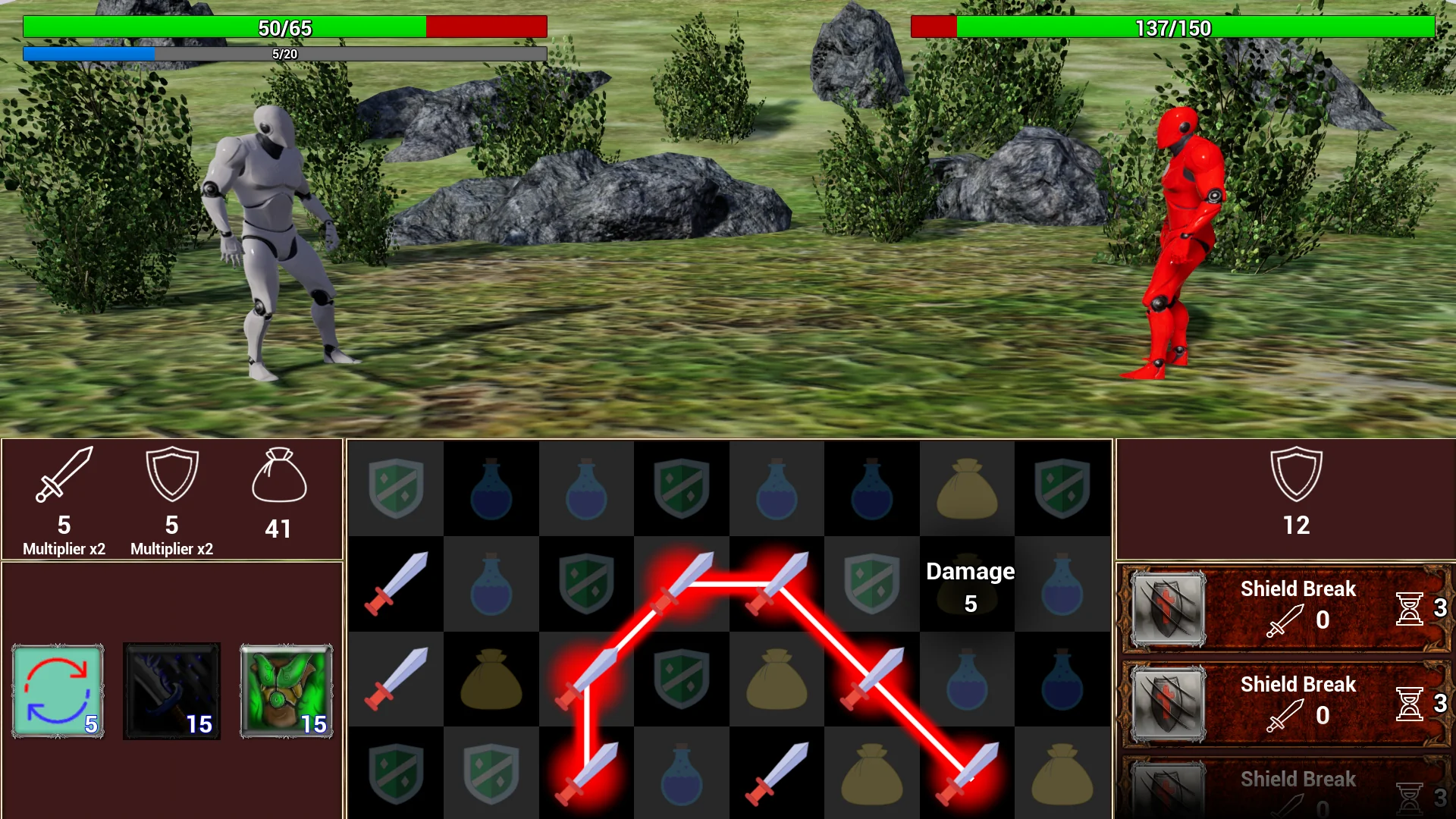
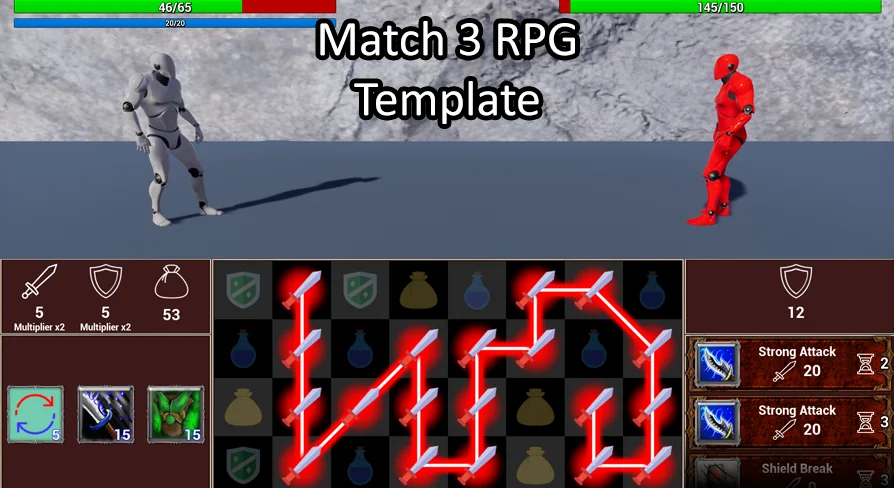
The core interactive system on the board departs from traditional swap-based matching by utilizing a chain-linking input model. Players select and trace continuous paths through matching adjacent gems directly on the grid. This chain-link mechanic shifts the gameplay focus toward path planning, spatial awareness, and combo length rather than simple three-in-a-row swaps.
Connecting gems across the grid drives the battle engine. Depending on how the grid is cleared, linked chains register input data that immediately feeds into character actions. The interactive grid logic is fully implemented without external code dependencies, allowing developers to adapt the board layout, match requirements, and chain behavior directly inside the engine editor. Because the gem board acts as the primary controller for combat execution, the chain-linking pipeline is built to handle quick sequential taps, path tracing, and immediate clear cycles without desynchronizing from active battle states.
RPG Character Growth, Inventory, and Stat Scaling
Behind the puzzle board operates a full role-playing backbone governed by attributes, gear, and combat mechanics. Characters possess distinct numerical stats that determine performance during battle. A dedicated damage system calculates outgoing offensive strikes and incoming enemy damage by reading these core character stats directly, ensuring that leveling up or altering loadouts produces tangible differences during a turn.
Progression is supported by an integrated inventory system that organizes equipment, combat consumables, and rewards gathered across encounters. Gear and items interact with the stat pipeline, letting creators configure character growth tracks that directly influence board efficiency and combat survival. Alongside base physical interactions, the character system supports both offensive and supportive skills:
Offensive skills leverage player stats to execute focused strikes or amplified bursts against high-threat targets.
Supportive skills provide utility, enabling self-healing, status management, or survivability adjustments during demanding enemy turns.
Inventory slots track collected equipment, weapons, and usable items to reinforce character power across consecutive encounters.
By routing the damage calculations through a structured stat model, player decisions on the board remain closely tied to long-term character progression rather than relying purely on puzzle RNG.
Combat Encounters Across Enemy Waves and Boss Fights
Combat progression in the template is structured around escalating wave mechanics. Rather than limiting encounters to single isolated skirmishes, players must clear sequential waves of enemies while managing character health, skill availability, and board states across each stage. This creates natural pacing challenges, requiring players to conserve resources during earlier enemy clusters to prepare for late-stage encounters.
Wave structures naturally climax in dedicated boss fights, including large-scale combat encounters such as dragons or specialized fantasy adversaries. Boss encounters introduce higher health pools and persistent offensive pressure, forcing players to assemble longer chains and time both supportive and offensive skills precisely. Because the template is tailored for fantasy turn battles, the back-and-forth cadence gives equal weight to player chain planning and automated enemy retaliation cycles.
Template Blueprint Architecture and Mobile Usability
The entire system is constructed with 100% Blueprints, making the template completely visual and modular without requiring native C++ programming. Node graphs handle gem generation, touch and drag input registration, wave transitions, stat formulas, and inventory operations. This structure makes the template highly customizable, allowing designers to alter chain length requirements, tune damage formulas, inject new skill archetypes, or rebalance enemy wave compositions directly within the graph view.
Mobile compatibility is built into the interaction scheme from the ground up. Chain-linking gems via touch tracing maps naturally to mobile screens, ensuring responsive input across touch displays without requiring extensive input translation. Interface presentation is supported by clean fantasy visual elements, including integrated fantasy UI boxes, buttons, specialized weapon graphics, and icons for spells, skills, and inventory items sourced from classic fantasy game art libraries. Furthermore, the architecture maintains compatibility with the broader RPG Mega Bundle ecosystem, streamlining integration for creators assembling wider systems.
Practical Suitability and Project Application
This package is particularly advantageous for solo developers, small teams, and technical designers prototyping turn-based puzzle combat games within Unreal Engine. Establishing a functional chain-linking puzzle grid alongside an interconnected stat, skill, and inventory system usually consumes weeks of engineering before gameplay balancing can even begin. By delivering a cohesive baseline where gem matches directly drive stat-based RPG damage, multi-wave encounters, and boss battles, the template eliminates the foundational hurdle of interconnecting grid logic with combat rules. It offers a solid, clean, and entirely visual launching pad for mobile-first fantasy puzzle adventures.
 RPG