"7ad89cffa44984cf"{"id":"1002503","slug":"animated-werewolf","title":"Animated Werewolf","category":"Creatures \u0026 Monsters","engine":"4.15+,5.0+","assetVersion":"","engineVersion":"Engine Version: 4.15+,5.0+","tag":"Creatures","accent":"blue","visual":"character","summary":"Detailed breakdown of the Animated Werewolf model, featuring 73 animations, 69-bone rig, root motion sets, and modular fur geometry counts.","platform":"Unreal Engine","indexPolicy":"index","publishedAt":"2026-11-13T08:09:59.230Z","updatedAt":"2026-11-13T08:09:59.230Z","sourceNotes":[],"fileContents":[],"compatibility":["Unreal Engine","Engine Version: 4.15+,5.0+"],"featuredImage":{"alt":"Animated Werewolf","src":"/wp-content/uploads/published/2026/11/2bdc373908c4-1dfe5dcf-7418-415c-8199-72e9813dd799-ac1adfd838.webp"},"hasDownloadLink":true,"downloads":0,"terms":[{"taxonomy":"category","slug":"creatures-and-monsters","name":"Creatures \u0026 Monsters"}],"galleryImages":[{"src":"/wp-content/uploads/published/2026/11/fa0b22d2d5b8-88c0efd8-472e-4e6f-9e88-2f2ba590cd85-4fb93b7d56.webp","alt":"Animated Werewolf"},{"src":"/wp-content/uploads/published/2026/11/d879fc32184a-92cf08e3-efbc-4149-8887-0eee12624604-00f46c9f1d.webp","alt":"Animated Werewolf"},{"src":"/wp-content/uploads/published/2026/11/6e0051b4c6cb-48523d0b-92de-4155-b7a5-9d0a3e064610-5770539063.webp","alt":"Animated Werewolf"},{"src":"/wp-content/uploads/published/2026/11/6bde3d9726e6-aa0f66a1-e6ae-473a-98cf-8b37498dae6e-5be88e5017.webp","alt":"Animated Werewolf"},{"src":"/wp-content/uploads/published/2026/11/436799150f32-555ab335-6b6b-48e3-8182-d7303c204bd2-4ac19973ab.webp","alt":"Animated Werewolf"}],"accessPanel":{"kind":"resource","title":"Get this resource","eyebrow":"Free resource","message":"Download this resource in your browser.","fileName":"Content.7z","safetyNote":"Resources are manually reviewed before listing to improve quality and reduce obvious risks.","actionLabel":"Get this resource","resourceType":"Resource archive","versions":[]},"contentHtml":"\u003cp\u003eA stalking creature lunges through shadows, its gait shifting between rapid dashes and heavy, grounded strikes. In real-time rendering and interactive development, achieving this level of creature weight requires an animation setup capable of handling dynamic trajectory changes alongside stable in-place maneuvering. The Animated Werewolf provides a structured character pipeline built to fill roles across horror, fantasy, and survival titles, whether acting as a primary antagonist, a towering demon, or a feral monster lurking within a broader horde.\u003c/p\u003e \u003ch2\u003eMotion Structure of the Animated Werewolf\u003c/h2\u003e \u003cp\u003eMotion fidelity defines how convincingly a quadruped or bipedal beast commands space in a scene. The asset supplies 73 distinct animations, providing coverage for standard locomotion, alert stances, aggressive encounters, and recovery phases. Rather than restricting projects to a single movement paradigm, this library divides motion into two specific technical categories: 50 classical on-place animations and 23 clips that incorporate root motion data.\u003c/p\u003e \u003cp\u003eClassical on-place animations isolate the character's movement cycles while keeping the root coordinate centered. This setup allows game systems to drive navigation, speed variables, and pathfinding via character capsules or external navigation agents. When a project relies on code-driven movement vectors, physics thrusters, or algorithmic steering behaviors, the 50 in-place clips allow blending across walks, runs, and turns without collision capsules detaching from the mesh origin.\u003c/p\u003e \u003ch2\u003eSeparating Standard and Root Motion Sets for the Werewolf\u003c/h2\u003e \u003cp\u003eWhen physical realism and exact positional displacement are paramount, root motion delivers grounded interaction. Within the package, the 23 root motion sequences carry the explicit \u0026quot;RM\u0026quot; prefix in their naming scheme. This deliberate labeling ensures rapid identification when setting up animation trees, separating asset files, or scripting complex behavioral transitions.\u003c/p\u003e \u003cp\u003eRoot motion animations transfer movement coordinates directly from the creature's root bone into the engine capsule. For lunges, vaulting attacks, pounces, and heavy recovery stumbles, using the RM-prefixed clips prevents the visual foot sliding that often occurs when manual capsule speed fails to match footfall keyframes. Developers working with state machines can branch between standard on-place movement for general navigation and switch to RM sequences during specific combat triggers, cinematic cutscenes, or lethal attack windups.\u003c/p\u003e \u003ch2\u003eSkeletal Hierarchy and 3ds Max Character Studio Origin\u003c/h2\u003e \u003cp\u003eUnderneath the mesh rests a skeleton composed of 69 bones. The animation set was authored directly using 3ds Max (3D MAX) Character Studio. Character Studio has long served as a staple for character animation, providing biped and procedural posing tools that translate into stable keyframe tracks across external engines.\u003c/p\u003e \u003cp\u003eA 69-bone configuration sits in a balanced technical envelope. It offers sufficient joint distribution to capture expressive spinal arches, broad chest expansion during roars, claw positioning, and jaw flexure without incurring the processing overhead of bloated cinema rigs. This makes the skeletal structure well-suited for multiple simultaneous instances in combat encounters, maintaining clear silhouettes and clean joint deformations while keeping computational load predictable across CPU evaluation cycles.\u003c/p\u003e \u003ch2\u003eFur Geometry Configurations and Triangle Budgets\u003c/h2\u003e \u003cp\u003eMesh complexity directly governs scene performance, particularly when managing multiple creature instances or adjusting visual scale across different rendering targets. The character addresses this by offering distinct geometry states based on whether fur cards and fur geometry elements are attached.\u003c/p\u003e \u003cp\u003eConfigured with all fur parts intact, the mesh reaches:\u003c/p\u003e\n\u003cul\u003e \u003cli\u003e16,844 polygons\u003c/li\u003e \u003cli\u003e33,612 triangles\u003c/li\u003e \u003cli\u003e22,482 vertices\u003c/li\u003e\n\u003c/ul\u003e \u003cp\u003eFor scenarios where visual density must be trimmed to save vertex shading power, or where the character is viewed from greater distances, stripping away the fur components substantially alters the footprint:\u003c/p\u003e\n\u003cul\u003e \u003cli\u003e11,564 polygons\u003c/li\u003e \u003cli\u003e23,052 triangles\u003c/li\u003e \u003cli\u003e11,733 vertices\u003c/li\u003e\n\u003c/ul\u003e \u003cp\u003eIsolating the fur parts accounts for an exact difference of 5,280 polygons, 10,560 triangles, and 10,749 vertices. This makes the fur layer a prime candidate for level-of-detail (LOD) swaps. Close-up encounters, hero showcase cutscenes, and boss fights can use the full 33,612-triangle configuration to preserve the wild, broken silhouette created by the fur. Mid-distance encounters, wave-based survival arenas, and dense forest engagements can drop down to the base 23,052-triangle mesh, preserving fundamental musculature and anatomy while eliminating nearly half of the total vertex count.\u003c/p\u003e \u003ch2\u003eAnimationblueprint Framework and Skeleton Army Pipeline\u003c/h2\u003e \u003cp\u003eConnecting skeletal data to interactive gameplay requires responsive logic frameworks. Tagged alongside Animationblueprint and script implementations, the asset is structured to integrate smoothly into controller networks that manage blend spaces, layered blend-per-bone profiles, and state machines. An Animationblueprint can evaluate runtime velocity, target range, and health thresholds to feed the appropriate clip from the 73-animation library into the final animation pose.\u003c/p\u003e \u003cp\u003eThe character is also noted for compatibility alongside Skeleton Army resources. This connection provides a natural route for projects developing undead factions, necromantic forces, or dark fantasy battlefields where monstrous werewolf forms fight in tandem with skeletal infantry. Because the rig is self-contained with 69 bones and clearly tagged root motion data, incorporating the creature into larger systemic creature packs or shared enemy AI directors can be accomplished without reworking the base animation assets.\u003c/p\u003e \u003cp\u003eWhether cast as an agile forest predator or a towering demonic monster, the Animated Werewolf pairs a distinct 73-clip animation library with flexible geometric profiles, offering a reliable, drop-in creature solution for real-time projects.\u003c/p\u003e\n\n\u003ch2\u003eContinue Browsing Similar Packs\u003c/h2\u003e\n\u003cul\u003e\n\u003cli\u003e\u003ca href=\"https://3dcghub.com/skeleton-army/\" rel=\"noopener noreferrer\"\u003eSkeleton Army\u003c/a\u003e\u003c/li\u003e\n\u003cli\u003e\u003ca href=\"https://3dcghub.com/ocean-monster-fish-pack-part-1-fish-low-poly-model-0/\" rel=\"noopener noreferrer\"\u003eOcean Monster Fish Pack - Part 1 - Fish low poly model - #0\u003c/a\u003e\u003c/li\u003e\n\u003cli\u003e\u003ca href=\"https://3dcghub.com/wyvern/\" rel=\"noopener noreferrer\"\u003eWyvern\u003c/a\u003e\u003c/li\u003e\n\u003cli\u003e\u003ca href=\"https://3dcghub.com/otherside-beast/\" rel=\"noopener noreferrer\"\u003eOtherside beast\u003c/a\u003e\u003c/li\u003e\n\u003cli\u003e\u003ca href=\"https://3dcghub.com/lizards/\" rel=\"noopener noreferrer\"\u003eLizards\u003c/a\u003e\u003c/li\u003e\n\u003c/ul\u003e","contentTextLength":6160,"navigation":{"current":74,"total":4499,"previous":{"id":"1002504","slug":"apocalypse-fatman","title":"Apocalypse Fatman","category":"Characters \u0026 Creatures","platform":"Unreal Engine","updatedAt":"2026-11-13T08:11:48.753Z"},"next":{"id":"1002502","slug":"alien-gray","title":"Alien Gray","category":"Characters \u0026 Creatures","platform":"Unreal Engine","updatedAt":"2026-11-13T08:08:56.784Z"}},"relatedResources":[{"id":"1002398","slug":"skeleton-army","title":"Skeleton Army","category":"Creatures \u0026 Monsters","engine":"4.12+,5.0+","assetVersion":"","engineVersion":"Engine Version: 4.12+,5.0+","tag":"Creatures","accent":"blue","visual":"character","summary":"A breakdown of the Skeleton Army package, detailing its four animated character classes, bone counts, mesh budgets, props, and siege weapon compatibility.","platform":"Unreal Engine","indexPolicy":"index","publishedAt":"2026-11-10T04:26:44.584Z","updatedAt":"2026-11-10T04:26:44.584Z","sourceNotes":[],"fileContents":[],"compatibility":["Unreal Engine","Engine Version: 4.12+,5.0+"],"featuredImage":{"alt":"Skeleton Army","src":"/wp-content/uploads/published/2026/11/cf397b5c8944-638f1475-c936-48d7-952d-8f3bde16101d-d9515b9625.webp"},"hasDownloadLink":true,"downloads":0},{"id":"1001825","slug":"ocean-monster-fish-pack-part-1-fish-low-poly-model-0","title":"Ocean Monster Fish Pack - Part 1 - Fish low poly model - #0","category":"Creatures \u0026 Monsters","engine":"4.18+,5.0+","assetVersion":"","engineVersion":"Engine Version: 4.18+,5.0+","tag":"Creatures","accent":"blue","visual":"character","summary":"Examine the low poly Ocean Monster Fish Pack featuring five animated, rigged marine creatures with 4K PBR textures across Unreal Engine and Unity.","platform":"Unreal Engine","indexPolicy":"index","publishedAt":"2026-10-21T08:18:12.289Z","updatedAt":"2026-10-21T08:18:12.289Z","sourceNotes":[],"fileContents":[],"compatibility":["Unreal Engine","Engine Version: 4.18+,5.0+"],"featuredImage":{"alt":"Ocean Monster Fish Pack - Part 1 - Fish low poly model - #0","src":"/wp-content/uploads/published/2026/10/307594b28609-aedf553b-e9ec-4960-a36d-06dec6ccf525-52826cf4ae.webp"},"hasDownloadLink":true,"downloads":0},{"id":"1000352","slug":"wyvern","title":"Wyvern","category":"Creatures \u0026 Monsters","engine":"4.26+,5.0+","assetVersion":"","engineVersion":"Engine Version: 4.26+,5.0+","tag":"Creatures","accent":"blue","visual":"character","summary":"A production-ready animated Wyvern optimized for Unreal Engine, featuring 25 animations, quad-based low-poly geometry, and 4K PBR texturing.","platform":"Unreal Engine","indexPolicy":"index","publishedAt":"2026-07-05T10:06:48.949Z","updatedAt":"2026-07-05T10:06:48.949Z","sourceNotes":[],"fileContents":[],"compatibility":["Unreal Engine","Engine Version: 4.26+,5.0+"],"featuredImage":{"alt":"Wyvern","src":"/wp-content/uploads/published/2026/07/c427cb373033-f988494e-d641-48f2-9b26-eb1aad7f5d8a-1a4d079702.webp"},"hasDownloadLink":true,"downloads":1}]}
Creatures
Animated Werewolf
Detailed breakdown of the Animated Werewolf model, featuring 73 animations, 69-bone rig, root motion sets, and modular fur geometry counts.
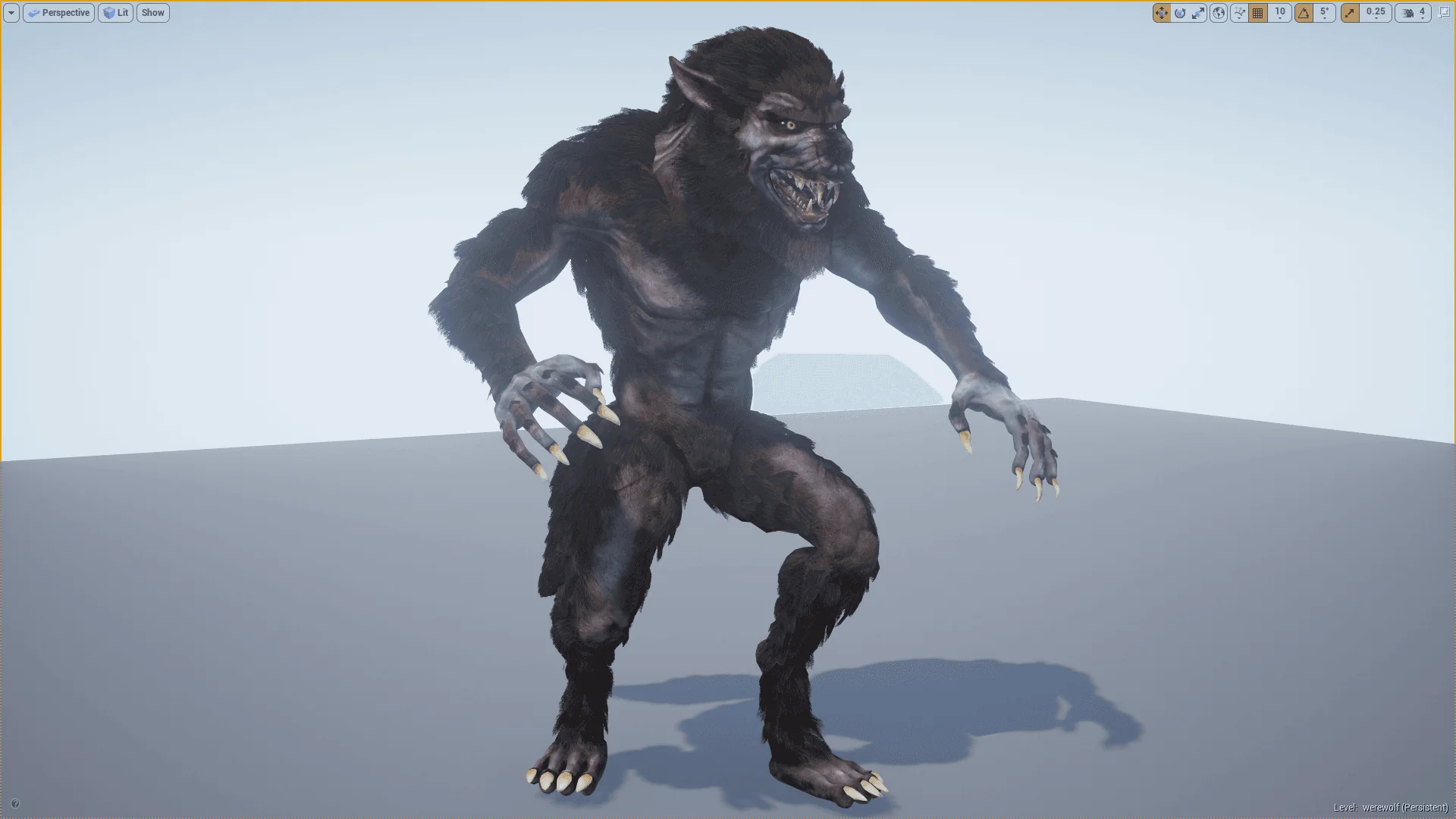
A stalking creature lunges through shadows, its gait shifting between rapid dashes and heavy, grounded strikes. In real-time rendering and interactive development, achieving this level of creature weight requires an animation setup capable of handling dynamic trajectory changes alongside stable in-place maneuvering. The Animated Werewolf provides a structured character pipeline built to fill roles across horror, fantasy, and survival titles, whether acting as a primary antagonist, a towering demon, or a feral monster lurking within a broader horde.
Motion Structure of the Animated Werewolf
Motion fidelity defines how convincingly a quadruped or bipedal beast commands space in a scene. The asset supplies 73 distinct animations, providing coverage for standard locomotion, alert stances, aggressive encounters, and recovery phases. Rather than restricting projects to a single movement paradigm, this library divides motion into two specific technical categories: 50 classical on-place animations and 23 clips that incorporate root motion data.
Classical on-place animations isolate the character's movement cycles while keeping the root coordinate centered. This setup allows game systems to drive navigation, speed variables, and pathfinding via character capsules or external navigation agents. When a project relies on code-driven movement vectors, physics thrusters, or algorithmic steering behaviors, the 50 in-place clips allow blending across walks, runs, and turns without collision capsules detaching from the mesh origin.
Separating Standard and Root Motion Sets for the Werewolf
When physical realism and exact positional displacement are paramount, root motion delivers grounded interaction. Within the package, the 23 root motion sequences carry the explicit "RM" prefix in their naming scheme. This deliberate labeling ensures rapid identification when setting up animation trees, separating asset files, or scripting complex behavioral transitions.
Root motion animations transfer movement coordinates directly from the creature's root bone into the engine capsule. For lunges, vaulting attacks, pounces, and heavy recovery stumbles, using the RM-prefixed clips prevents the visual foot sliding that often occurs when manual capsule speed fails to match footfall keyframes. Developers working with state machines can branch between standard on-place movement for general navigation and switch to RM sequences during specific combat triggers, cinematic cutscenes, or lethal attack windups.
Skeletal Hierarchy and 3ds Max Character Studio Origin
Underneath the mesh rests a skeleton composed of 69 bones. The animation set was authored directly using 3ds Max (3D MAX) Character Studio. Character Studio has long served as a staple for character animation, providing biped and procedural posing tools that translate into stable keyframe tracks across external engines.
A 69-bone configuration sits in a balanced technical envelope. It offers sufficient joint distribution to capture expressive spinal arches, broad chest expansion during roars, claw positioning, and jaw flexure without incurring the processing overhead of bloated cinema rigs. This makes the skeletal structure well-suited for multiple simultaneous instances in combat encounters, maintaining clear silhouettes and clean joint deformations while keeping computational load predictable across CPU evaluation cycles.
Fur Geometry Configurations and Triangle Budgets
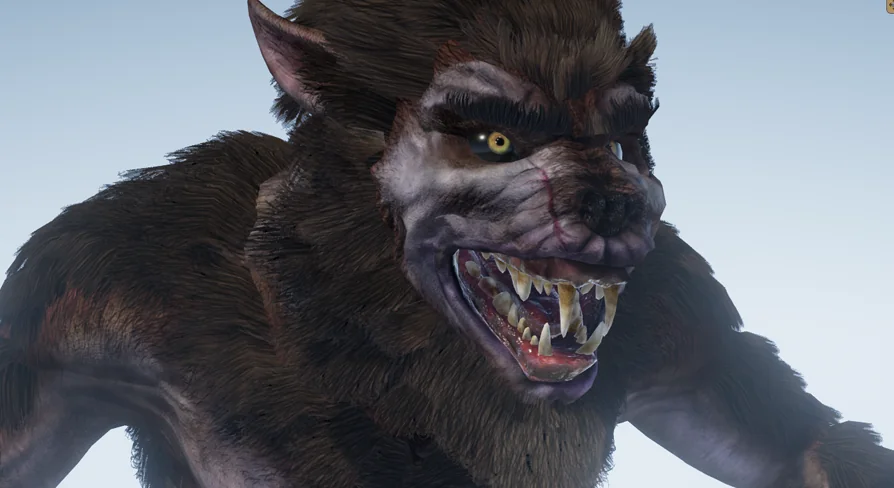
Mesh complexity directly governs scene performance, particularly when managing multiple creature instances or adjusting visual scale across different rendering targets. The character addresses this by offering distinct geometry states based on whether fur cards and fur geometry elements are attached.
Configured with all fur parts intact, the mesh reaches:
16,844 polygons
33,612 triangles
22,482 vertices
For scenarios where visual density must be trimmed to save vertex shading power, or where the character is viewed from greater distances, stripping away the fur components substantially alters the footprint:
11,564 polygons
23,052 triangles
11,733 vertices
Isolating the fur parts accounts for an exact difference of 5,280 polygons, 10,560 triangles, and 10,749 vertices. This makes the fur layer a prime candidate for level-of-detail (LOD) swaps. Close-up encounters, hero showcase cutscenes, and boss fights can use the full 33,612-triangle configuration to preserve the wild, broken silhouette created by the fur. Mid-distance encounters, wave-based survival arenas, and dense forest engagements can drop down to the base 23,052-triangle mesh, preserving fundamental musculature and anatomy while eliminating nearly half of the total vertex count.
Animationblueprint Framework and Skeleton Army Pipeline
Connecting skeletal data to interactive gameplay requires responsive logic frameworks. Tagged alongside Animationblueprint and script implementations, the asset is structured to integrate smoothly into controller networks that manage blend spaces, layered blend-per-bone profiles, and state machines. An Animationblueprint can evaluate runtime velocity, target range, and health thresholds to feed the appropriate clip from the 73-animation library into the final animation pose.
The character is also noted for compatibility alongside Skeleton Army resources. This connection provides a natural route for projects developing undead factions, necromantic forces, or dark fantasy battlefields where monstrous werewolf forms fight in tandem with skeletal infantry. Because the rig is self-contained with 69 bones and clearly tagged root motion data, incorporating the creature into larger systemic creature packs or shared enemy AI directors can be accomplished without reworking the base animation assets.
Whether cast as an agile forest predator or a towering demonic monster, the Animated Werewolf pairs a distinct 73-clip animation library with flexible geometric profiles, offering a reliable, drop-in creature solution for real-time projects.
 Creatures
 Creatures
 Creatures
 Creatures