"7ad89cffa44984cf"{"id":"1002504","slug":"apocalypse-fatman","title":"Apocalypse Fatman","category":"Characters \u0026 Creatures","engine":"4.18+,5.0+","assetVersion":"","engineVersion":"Engine Version: 4.18+,5.0+","tag":"Characters","accent":"blue","visual":"character","summary":"Explore the Apocalypse Fatman asset specifications, featuring 22 animations, 3 skin variations, modular hair geometry, and UE5 transformation compatibility.","platform":"Unreal Engine","indexPolicy":"index","publishedAt":"2026-11-13T08:11:48.753Z","updatedAt":"2026-11-13T08:11:48.753Z","sourceNotes":[],"fileContents":[],"compatibility":["Unreal Engine","Engine Version: 4.18+,5.0+"],"featuredImage":{"alt":"Apocalypse Fatman","src":"/wp-content/uploads/published/2026/11/61482a2e5529-aa538bab-54c8-4966-b42e-bb290ebed20f-4e479f56ba.webp"},"hasDownloadLink":true,"downloads":0,"terms":[{"taxonomy":"category","slug":"characters-and-creatures","name":"Characters \u0026 Creatures"}],"galleryImages":[{"src":"/wp-content/uploads/published/2026/11/68e147ded8f4-05516f53-31b7-4acc-906e-54d577bcef58-987ca49d6c.webp","alt":"Apocalypse Fatman"},{"src":"/wp-content/uploads/published/2026/11/426866920ad8-dba87fad-8b2b-4cfc-823a-32bdc86ff033-8932c430a3.webp","alt":"Apocalypse Fatman"},{"src":"/wp-content/uploads/published/2026/11/db92f0bfdc97-ce57bff6-dbfe-46ba-8fa6-423e75ccdd2f-5339b70143.webp","alt":"Apocalypse Fatman"},{"src":"/wp-content/uploads/published/2026/11/fd6e55d97926-13af9354-e7c2-4a07-8360-8249d423fa81-7d6ef80d0b.webp","alt":"Apocalypse Fatman"},{"src":"/wp-content/uploads/published/2026/11/cebbb0d1f886-730a6edf-caca-4c4a-b50f-5ae3e5143df5-a0a6f32a43.webp","alt":"Apocalypse Fatman"},{"src":"/wp-content/uploads/published/2026/11/a99e399e1e9b-cb6249b6-3017-459d-a142-e1a0c8c408f7-417b16a912.webp","alt":"Apocalypse Fatman"},{"src":"/wp-content/uploads/published/2026/11/e22bfde88ccb-718729a8-13ff-4b56-a3bd-16b25c350d31-bee3dc2160.webp","alt":"Apocalypse Fatman"},{"src":"/wp-content/uploads/published/2026/11/3c28333576fd-c18f2d4a-e399-4078-a079-42016b5cb72a-c987a47aff.webp","alt":"Apocalypse Fatman"},{"src":"/wp-content/uploads/published/2026/11/d941d800d66d-38a4f0f2-ac45-4afd-8aef-22bac97acd2e-403573afb6.webp","alt":"Apocalypse Fatman"},{"src":"/wp-content/uploads/published/2026/11/12af46995add-1d8fb7e7-95c8-43e8-bc84-729c7252b7da-b93572187f.webp","alt":"Apocalypse Fatman"}],"accessPanel":{"kind":"resource","title":"Get this resource","eyebrow":"Free resource","message":"Download this resource in your browser.","fileName":"Content.7z","safetyNote":"Resources are manually reviewed before listing to improve quality and reduce obvious risks.","actionLabel":"Get this resource","resourceType":"Resource archive","versions":[]},"contentHtml":"\u003ch2\u003eThe Apocalypse Fatman Mesh and Topology Breakdown\u003c/h2\u003e\n\u003cp\u003eThe Apocalypse Fatman character is structured around a low-poly geometric foundation tailored for real-time rendering pipelines. Rather than presenting a single collapsed mesh, the character is divided into distinct geometric groups: the main body mesh, dedicated head hair, and belly hair. This separation grants technical flexibility when configuring render passes, managing alpha sorting, or tweaking LOD stages across complex scene hierarchies.\u003c/p\u003e\n\u003cp\u003eIn terms of polygon density, the core body comprises 13,781 polygons, 16,641 vertices, and 26,938 triangles. This distribution concentrates geometric resolution around the heavy silhouette, facial mask, and foundational anatomy, ensuring stable skinning across deforming joints during intense physical action. The vertex count slightly exceeds the polygon count due to UV seams and normal splits necessary for crisp surface delineation across mechanical and organic surfaces.\u003c/p\u003e\n\u003cp\u003eSecondary hair elements are maintained as independent polygonal layers. The belly hair mesh contains 1,868 polygons, 5,644 vertices, and 3,736 triangles, reflecting a denser vertex-to-polygon ratio typical of layered card systems that simulate dense, coarse hair across the character's midsection. The head hair structure maintains a lighter footprint, built from 298 polygons, 894 vertices, and 596 triangles. Combined, the entire character assembly tallies exactly 31,270 triangles and 23,179 vertices. This budget sits comfortably within real-time constraints, giving developers sufficient overhead to populate multi-character combat scenarios or intense boss encounters without exceeding engine rasterization targets.\u003c/p\u003e \u003ch2\u003eSurface Variations and Thematic Equipment\u003c/h2\u003e\n\u003cp\u003eVisually and functionally, the character leans into a gritty, post-apocalyptic horror identity. Defined by a creepy, masked human form with heavy, corpulent proportions, the design incorporates aggressive thematic elements, including saw apparatus and flamethrower equipment. These implements establish the character as an intimidating, industrial scavenger or hazard-zone enforcer.\u003c/p\u003e\n\u003cp\u003eSurface treatments rely on physically based rendering (PBR) workflows, enabling precise light response across worn fabric, flesh, rusted metals, and protective gear. To support character differentiation without requiring geometry modifications, the skin setup provides three distinct color variations. These alternate skins allow level designers and gameplay programmers to deploy multiple instances of the character within an encounter—such as baseline shock troops, elite flamethrower units, or distinct wasteland factions—while preserving visual variety.\u003c/p\u003e\n\u003cp\u003eThe inclusion of the mask conceals facial features, allowing the character's physical presence to be communicated entirely through anatomical mass, equipped weapons, and motion profiles. Integrating specialized gear like saws and flamethrower parts directly alongside heavy human proportions establishes an imposing visual read from long camera distances, a vital consideration for fast-paced combat framing.\u003c/p\u003e \u003ch2\u003eDeconstructing the Apocalypse Fatman Animation Suite\u003c/h2\u003e\n\u003cp\u003eMovement and combat behaviors are driven by a library of 22 tailored animations. The model comes fully rigged, with skin weights carefully distributed to prevent volume collapse across the abdomen, limbs, and equipped gear during broad physical transitions. Rather than relying on simple cycle retargeting, the included motion clips reflect the momentum and weight shift intrinsic to a heavy, menacing human frame.\u003c/p\u003e\n\u003cp\u003eThe combat repertoire is especially broad, providing seven distinct attack animations. Having seven separate attack routines allows developers to program layered combat patterns, multi-stage melee combinations with the saw, or directed firing arcs using the flamethrower. Instead of repeating a single swing or shot, state machines can cycle through directional strikes, wind-ups, and recovery animations, maintaining unpredictable combat loops for AI opponents.\u003c/p\u003e\n\u003cp\u003eTo register the impact of player weaponry, the asset provides three hit reaction animations alongside three unique death sequences. Supplying multiple damage and death states is critical for avoiding visual monotony during high-density horde fights or repeated mini-boss confrontations. When a combat encounter reaches critical thresholds, a dedicated rage animation provides a clear visual telegraph, signaling state shifts such as increased aggression, altered movement speeds, or phase transitions.\u003c/p\u003e \u003ch2\u003eLocomotion and Combat State Machine Integration\u003c/h2\u003e\n\u003cp\u003eLocomotion covers the essential directional axes necessary for standard character controller architectures. The package provides an idle pool consisting of two separate idle states, allowing idle AI units to shift weight naturally without snapping back to an identical rest pose. Movement speeds and directions include:\u003c/p\u003e\n\u003cul\u003e\n\u003cli\u003eWalk (forward)\u003c/li\u003e\n\u003cli\u003eWalk back\u003c/li\u003e\n\u003cli\u003eWalk left\u003c/li\u003e\n\u003cli\u003eWalk right\u003c/li\u003e\n\u003cli\u003eRun (forward)\u003c/li\u003e\n\u003cli\u003eJump\u003c/li\u003e\n\u003c/ul\u003e\n\u003cp\u003eWith walk cycles configured for forward, backward, and lateral movement, the rig supports directional strafing state machines. This setup works cleanly when programming intelligent combat AI that keeps its weapon trained on a target while repositioning. The jump animation handles vertical traversal and gap clearing, matching the momentum established by the forward run cycle.\u003c/p\u003e\n\u003cp\u003eWhen chaining these 22 motions within an animation graph, the hit animations can be layered as upper-body blend poses or full-body interrupts depending on damage severity. The existence of multiple death clips also permits direction-aware knockdowns, ensuring that fatal damage triggers appropriate physical resolutions relative to incoming fire or melee blows.\u003c/p\u003e \u003ch2\u003ePerformance Budgets and Transformation Pipelines\u003c/h2\u003e\n\u003cp\u003eBeyond traditional standalone character setups, the asset notes compatibility with Unreal Engine 5 alongside systems configured for Werewolf and Real-Time Transformation workflows. In technical terms, transformation systems require meshes with clean deformation topology that can transition between baseline humanoid states and alternate morphological shapes without tearing UV boundaries or producing inverted normal artifacts.\u003c/p\u003e\n\u003cp\u003eThe relatively modest total of 31,270 triangles enables the mesh to transition smoothly through real-time morph targets or material-based vertex displacement systems common to UE5 transformation sequences. Because the head hair, belly hair, and main body exist as separate components, developers can orchestrate material dissolves, scale transformations, or mesh swaps independently across the different body zones. For instance, the hair meshes can scale down or blend out during a monstrous transition while the core body geometry deforms to match the target creature rig.\u003c/p\u003e\n\u003cp\u003eCombining low-poly optimization, PBR surface responses, three distinct skin palettes, and a comprehensive 22-animation combat library makes the Apocalypse Fatman asset an adaptable foundation for survival horror games, post-apocalyptic encounters, and complex shape-shifting character setups running in modern real-time engines.\u003c/p\u003e\n\n\u003ch2\u003eContinue Browsing Similar Packs\u003c/h2\u003e\n\u003cul\u003e\n\u003cli\u003e\u003ca href=\"https://3dcghub.com/post-apocalypse-girl/\" rel=\"noopener noreferrer\"\u003ePost Apocalypse Girl\u003c/a\u003e\u003c/li\u003e\n\u003cli\u003e\u003ca href=\"https://3dcghub.com/polygon-apocalypse-wasteland/\" rel=\"noopener noreferrer\"\u003ePOLYGON - Apocalypse Wasteland\u003c/a\u003e\u003c/li\u003e\n\u003cli\u003e\u003ca href=\"https://3dcghub.com/shieldmaiden/\" rel=\"noopener noreferrer\"\u003eShieldmaiden\u003c/a\u003e\u003c/li\u003e\n\u003cli\u003e\u003ca href=\"https://3dcghub.com/monster-beetle-pack/\" rel=\"noopener noreferrer\"\u003eMonster_Beetle_Pack\u003c/a\u003e\u003c/li\u003e\n\u003cli\u003e\u003ca href=\"https://3dcghub.com/mr-plague-doctor/\" rel=\"noopener noreferrer\"\u003emr. Plague Doctor\u003c/a\u003e\u003c/li\u003e\n\u003c/ul\u003e","contentTextLength":7211,"navigation":{"current":73,"total":4499,"previous":{"id":"1002505","slug":"arachnid","title":"Arachnid","category":"Characters \u0026 Creatures","platform":"Unreal Engine","updatedAt":"2026-11-13T08:13:22.983Z"},"next":{"id":"1002503","slug":"animated-werewolf","title":"Animated Werewolf","category":"Creatures \u0026 Monsters","platform":"Unreal Engine","updatedAt":"2026-11-13T08:09:59.230Z"}},"relatedResources":[{"id":"1002150","slug":"post-apocalypse-girl","title":"Post Apocalypse Girl","category":"Characters \u0026 Creatures","engine":"4.26+,5.0+","assetVersion":"","engineVersion":"Engine Version: 4.26+,5.0+","tag":"Characters","accent":"blue","visual":"character","summary":"Examine the Post Apocalypse Girl lowpoly character, featuring integrated weapon assets, animationblueprint support, and creature animation compatibility.","platform":"Unreal Engine","indexPolicy":"index","publishedAt":"2026-10-29T09:54:41.031Z","updatedAt":"2026-10-29T09:54:41.031Z","sourceNotes":[],"fileContents":[],"compatibility":["Unreal Engine","Engine Version: 4.26+,5.0+"],"featuredImage":{"alt":"Post Apocalypse Girl","src":"/wp-content/uploads/published/2026/10/0d49d2bdf78b-24d7fe34-d728-46d0-bb9e-ccca434fbc90-3e24b3ef16.webp"},"hasDownloadLink":true,"downloads":0},{"id":"6888","slug":"polygon-apocalypse-wasteland","title":"POLYGON - Apocalypse Wasteland","category":"Apocalyptic / Post-apocalyptic","engine":"4.26+,5.0+","assetVersion":"Engine version: 4.26+,5.0+","engineVersion":"4.26","tag":"Apocalyptic","accent":"blue","visual":"city","summary":"Build a massive, stylized dystopian world with the POLYGON - Apocalypse Wasteland asset pack. Featuring modular weapons, unique vehicles, and rigged characters, it is perfect for any survival or action game.","platform":"Unreal Engine","indexPolicy":"noindex","publishedAt":"2026-02-20T15:54:20.000Z","updatedAt":"2026-04-19T15:56:06.000Z","sourceNotes":[],"fileContents":[],"compatibility":["Unreal Engine","Engine version: 4.26+,5.0+"],"featuredImage":{"alt":"POLYGON - Apocalypse Wasteland","src":"https://3dcghub.com/wp-content/uploads/2026/02/dcf73dc6-d3a9-4bc4-bc6d-026b632a6155.webp"},"hasDownloadLink":true,"downloads":4},{"id":"1002501","slug":"shieldmaiden","title":"Shieldmaiden","category":"Characters \u0026 Creatures","engine":"4.18+,5.0+","assetVersion":"","engineVersion":"Engine Version: 4.18+,5.0+","tag":"Characters","accent":"blue","visual":"character","summary":"Explore the Shieldmaiden game-ready Viking character, featuring 4K PBR textures, Epic skin and hair shaders, immediate physics, and modular weapons.","platform":"Unreal Engine","indexPolicy":"index","publishedAt":"2026-11-12T18:26:55.975Z","updatedAt":"2026-11-12T18:26:55.975Z","sourceNotes":[],"fileContents":[],"compatibility":["Unreal Engine","Engine Version: 4.18+,5.0+"],"featuredImage":{"alt":"Shieldmaiden","src":"/wp-content/uploads/published/2026/11/b3bc0329ce00-fc4851d8-c863-4f4b-a80f-a9fb581ee787-1bbc99c564.webp"},"hasDownloadLink":true,"downloads":0}]}
Characters
Apocalypse Fatman
Explore the Apocalypse Fatman asset specifications, featuring 22 animations, 3 skin variations, modular hair geometry, and UE5 transformation compatibility.
The Apocalypse Fatman character is structured around a low-poly geometric foundation tailored for real-time rendering pipelines. Rather than presenting a single collapsed mesh, the character is divided into distinct geometric groups: the main body mesh, dedicated head hair, and belly hair. This separation grants technical flexibility when configuring render passes, managing alpha sorting, or tweaking LOD stages across complex scene hierarchies.
In terms of polygon density, the core body comprises 13,781 polygons, 16,641 vertices, and 26,938 triangles. This distribution concentrates geometric resolution around the heavy silhouette, facial mask, and foundational anatomy, ensuring stable skinning across deforming joints during intense physical action. The vertex count slightly exceeds the polygon count due to UV seams and normal splits necessary for crisp surface delineation across mechanical and organic surfaces.
Secondary hair elements are maintained as independent polygonal layers. The belly hair mesh contains 1,868 polygons, 5,644 vertices, and 3,736 triangles, reflecting a denser vertex-to-polygon ratio typical of layered card systems that simulate dense, coarse hair across the character's midsection. The head hair structure maintains a lighter footprint, built from 298 polygons, 894 vertices, and 596 triangles. Combined, the entire character assembly tallies exactly 31,270 triangles and 23,179 vertices. This budget sits comfortably within real-time constraints, giving developers sufficient overhead to populate multi-character combat scenarios or intense boss encounters without exceeding engine rasterization targets.
Surface Variations and Thematic Equipment
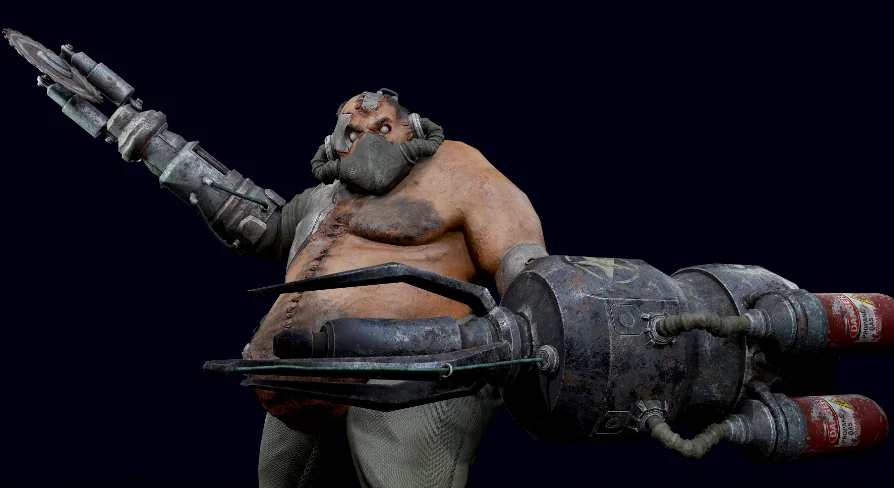
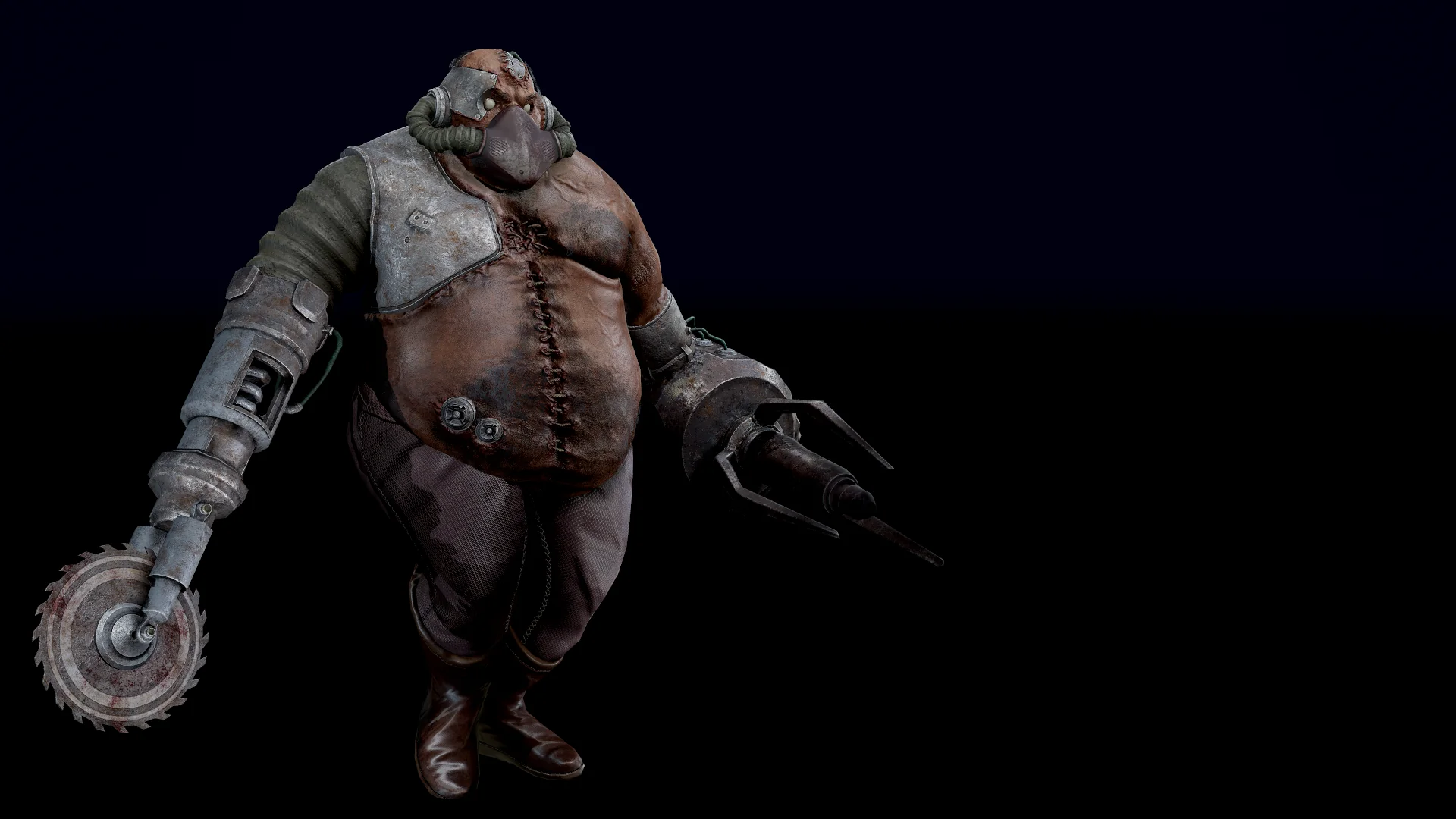
Visually and functionally, the character leans into a gritty, post-apocalyptic horror identity. Defined by a creepy, masked human form with heavy, corpulent proportions, the design incorporates aggressive thematic elements, including saw apparatus and flamethrower equipment. These implements establish the character as an intimidating, industrial scavenger or hazard-zone enforcer.
Surface treatments rely on physically based rendering (PBR) workflows, enabling precise light response across worn fabric, flesh, rusted metals, and protective gear. To support character differentiation without requiring geometry modifications, the skin setup provides three distinct color variations. These alternate skins allow level designers and gameplay programmers to deploy multiple instances of the character within an encounter—such as baseline shock troops, elite flamethrower units, or distinct wasteland factions—while preserving visual variety.
The inclusion of the mask conceals facial features, allowing the character's physical presence to be communicated entirely through anatomical mass, equipped weapons, and motion profiles. Integrating specialized gear like saws and flamethrower parts directly alongside heavy human proportions establishes an imposing visual read from long camera distances, a vital consideration for fast-paced combat framing.
Deconstructing the Apocalypse Fatman Animation Suite
Movement and combat behaviors are driven by a library of 22 tailored animations. The model comes fully rigged, with skin weights carefully distributed to prevent volume collapse across the abdomen, limbs, and equipped gear during broad physical transitions. Rather than relying on simple cycle retargeting, the included motion clips reflect the momentum and weight shift intrinsic to a heavy, menacing human frame.
The combat repertoire is especially broad, providing seven distinct attack animations. Having seven separate attack routines allows developers to program layered combat patterns, multi-stage melee combinations with the saw, or directed firing arcs using the flamethrower. Instead of repeating a single swing or shot, state machines can cycle through directional strikes, wind-ups, and recovery animations, maintaining unpredictable combat loops for AI opponents.
To register the impact of player weaponry, the asset provides three hit reaction animations alongside three unique death sequences. Supplying multiple damage and death states is critical for avoiding visual monotony during high-density horde fights or repeated mini-boss confrontations. When a combat encounter reaches critical thresholds, a dedicated rage animation provides a clear visual telegraph, signaling state shifts such as increased aggression, altered movement speeds, or phase transitions.
Locomotion and Combat State Machine Integration
Locomotion covers the essential directional axes necessary for standard character controller architectures. The package provides an idle pool consisting of two separate idle states, allowing idle AI units to shift weight naturally without snapping back to an identical rest pose. Movement speeds and directions include:
Walk (forward)
Walk back
Walk left
Walk right
Run (forward)
Jump
With walk cycles configured for forward, backward, and lateral movement, the rig supports directional strafing state machines. This setup works cleanly when programming intelligent combat AI that keeps its weapon trained on a target while repositioning. The jump animation handles vertical traversal and gap clearing, matching the momentum established by the forward run cycle.
When chaining these 22 motions within an animation graph, the hit animations can be layered as upper-body blend poses or full-body interrupts depending on damage severity. The existence of multiple death clips also permits direction-aware knockdowns, ensuring that fatal damage triggers appropriate physical resolutions relative to incoming fire or melee blows.
Performance Budgets and Transformation Pipelines
Beyond traditional standalone character setups, the asset notes compatibility with Unreal Engine 5 alongside systems configured for Werewolf and Real-Time Transformation workflows. In technical terms, transformation systems require meshes with clean deformation topology that can transition between baseline humanoid states and alternate morphological shapes without tearing UV boundaries or producing inverted normal artifacts.
The relatively modest total of 31,270 triangles enables the mesh to transition smoothly through real-time morph targets or material-based vertex displacement systems common to UE5 transformation sequences. Because the head hair, belly hair, and main body exist as separate components, developers can orchestrate material dissolves, scale transformations, or mesh swaps independently across the different body zones. For instance, the hair meshes can scale down or blend out during a monstrous transition while the core body geometry deforms to match the target creature rig.
Combining low-poly optimization, PBR surface responses, three distinct skin palettes, and a comprehensive 22-animation combat library makes the Apocalypse Fatman asset an adaptable foundation for survival horror games, post-apocalyptic encounters, and complex shape-shifting character setups running in modern real-time engines.
 Characters
 Characters
 Apocalyptic
 Characters