"a5cb8c597a561eb4"{"id":"1002150","slug":"post-apocalypse-girl","title":"Post Apocalypse Girl","category":"Characters \u0026 Creatures","engine":"4.26+,5.0+","assetVersion":"","engineVersion":"Engine Version: 4.26+,5.0+","tag":"Characters","accent":"blue","visual":"character","summary":"Examine the Post Apocalypse Girl lowpoly character, featuring integrated weapon assets, animationblueprint support, and creature animation compatibility.","platform":"Unreal Engine","publishedAt":"2026-10-29T09:54:41.031Z","updatedAt":"2026-10-29T09:54:41.031Z","sourceNotes":[],"fileContents":[],"compatibility":["Unreal Engine","Engine Version: 4.26+,5.0+"],"featuredImage":{"alt":"Post Apocalypse Girl","src":"/wp-content/uploads/published/2026/10/0d49d2bdf78b-24d7fe34-d728-46d0-bb9e-ccca434fbc90-3e24b3ef16.webp"},"hasDownloadLink":true,"downloads":0,"terms":[{"taxonomy":"category","slug":"characters-and-creatures","name":"Characters \u0026 Creatures"}],"galleryImages":[{"src":"/wp-content/uploads/published/2026/10/6c2076310632-06105fee-27ba-478f-b470-f28f643c0d20-c3c407e211.webp","alt":"Post Apocalypse Girl"},{"src":"/wp-content/uploads/published/2026/10/0582386c4ebb-5a6c6d86-8bea-4597-8d63-eb634504d06c-80a9f49176.webp","alt":"Post Apocalypse Girl"},{"src":"/wp-content/uploads/published/2026/10/2b145fb58450-2fb99984-2135-43a0-8487-a8f75bbe682c-b38e699fcf.webp","alt":"Post Apocalypse Girl"},{"src":"/wp-content/uploads/published/2026/10/d056e8ca5574-d6391e2c-d196-4951-8d37-5f2460fa7ae4-aaa8508db7.webp","alt":"Post Apocalypse Girl"},{"src":"/wp-content/uploads/published/2026/10/0d4f8362ec36-910aeb51-b712-417c-8b12-8fb9e8407240-2ed462eca9.webp","alt":"Post Apocalypse Girl"}],"accessPanel":{"kind":"resource","title":"Download this resource","eyebrow":"Free Download","message":"Log in or create a free account to start your download.","fileName":"Content.7z","safetyNote":"Resources are manually reviewed before listing to improve quality and reduce obvious risks.","actionLabel":"Download Free","resourceType":"Resource archive"},"contentHtml":"\u003cp\u003ePost Apocalypse Girl supplies a functional character package comprising a lowpoly model, an associated weapon, gameplay script components, and an animationblueprint. These integrated assets form a core framework intended to support characters in settings defined by scarcity, environmental collapse, and hostile encounters. By combining character geometry directly with dedicated control logic, the package bridges visual modeling and dynamic gameplay responsiveness.\u003c/p\u003e \u003cp\u003eDeveloping for survival and horror genres demands assets that remain visually distinct while fitting strictly within real-time rendering constraints. Having the character asset, weapon structure, and driving logic organized as a cohesive entity reduces the pipeline overhead of wiring independent assets together manually. The package then offers an accessible baseline for deploying responsive combatants, solitary wanderers, or defensive survivors directly into interactive test scenes.\u003c/p\u003e \u003ch2\u003eLowpoly Character Mesh and Weapon Elements\u003c/h2\u003e \u003cp\u003eThe visual foundation of Post Apocalypse Girl relies on a lowpoly character mesh paired with dedicated weapon equipment. Employing a lowpoly budget yields major technical advantages in scenes where performance headroom is tightly contested. In survival titles where visibility may be occluded by volumetric fog, darkness, or dense post-processing filters, efficient geometry prevents scene frame times from degrading during intense action.\u003c/p\u003e \u003cp\u003eThe accompanying weapon extends the narrative and mechanical scope of the model. Post-apocalyptic scenarios consistently rely on armed agency, requiring models that can switch between wandering, passive idling, and defensive stances. Because the weapon is treated as a core element alongside the character mesh, socketing and alignment workflows remain straightforward, allowing developers to establish weapon-handling archetypes quickly.\u003c/p\u003e \u003cp\u003eLowpoly geometry also proves practical when instancing multiple instances across a map. Whether the character is configured as a solitary protagonist, a roving scavenger, or part of a small enclave defending a compound, the polygon economy allows project teams to populate levels without forcing severe LOD compromises. This structural balance lets level designers emphasize environmental ruin and mood lighting while keeping character rendering lightweight.\u003c/p\u003e \u003ch2\u003eAnimationblueprint Systems and 56 Animations For Creatures Compatibility\u003c/h2\u003e \u003cp\u003eAt the center of the character's interactive capability is the animationblueprint, engineered to translate player input and state machines into physical movement. An animationblueprint coordinates transitions between locomotion, resting poses, aim offsets, and combat triggers. By housing the character's operational states within this system, the package ensures smooth state-blending during chaotic combat loops or slow-paced exploration phases.\u003c/p\u003e \u003cp\u003eA notable technical dimension of Post Apocalypse Girl is compatibility with the 56 Animations For Creatures set. While primarily functioning as a human survivor, this animation interoperability creates unique opportunities for non-standard character motion. In horror settings, exposing a humanoid mesh to creature-oriented animation data enables developers to produce uncanny, unnerving behaviors that defy conventional human movement.\u003c/p\u003e \u003cp\u003eApplying creature motion sets opens several direct design avenues:\u003c/p\u003e\n\u003cul\u003e \u003cli\u003eUnsettling infected behaviors featuring asymmetrical gaits, violent spasms, and erratic tracking routines.\u003c/li\u003e \u003cli\u003eFeral survivor archetypes that crawl, crouch low, or navigate ruins using predatory locomotion profiles.\u003c/li\u003e \u003cli\u003eDynamic hit reactions and flinches that convey severe bodily trauma appropriate for high-intensity survival horror encounters.\u003c/li\u003e \u003cli\u003eAggressive ambush sequences where an adversary leaps, lunges, or stalks through shadowed geometry.\u003c/li\u003e\n\u003c/ul\u003e \u003cp\u003eBlending standard survivor mechanics with the 56 Animations For Creatures library allows teams to diversify gameplay encounters without rigging entirely separate creature models from scratch. An animator or technical director can configure the animationblueprint to alternate between measured human combat stances and desperate, bestial maneuvers when stamina depletes or infection sets in.\u003c/p\u003e \u003ch2\u003eScript Behaviors in Survival and Horror Scenarios\u003c/h2\u003e \u003cp\u003eThe presence of dedicated script logic ensures that the visual mesh and animation state machines translate into practical gameplay events. In survival game development, characters do not simply navigate space; they interact with equipment, manage weapon readiness, and respond to hostile environmental pressures. Script integration serves as the connective tissue between user commands and state transitions.\u003c/p\u003e \u003cp\u003eWhen engineering horror interactions, pacing dictates everything. The underlying script handles the logic required to switch states—such as moving from exploratory stealth into high-stakes engagement. Because the character includes both weapon hooks and script logic, developers can bind combat inputs directly to animation events, synchronizing weapon strikes, reloads, or aiming mechanics with low latency.\u003c/p\u003e \u003cp\u003eThis technical foundation also streamlines integration into larger survival systems. Health depletion, inventory access, stamina management, and weapon degradation all rely on scripts that can communicate state changes back to the animationblueprint. Having a working script baseline allows teams to focus on game-specific balance rather than building foundational character controllers from zero.\u003c/p\u003e \u003ch2\u003eProject Staging Across Apocalypse and Survival Frameworks\u003c/h2\u003e \u003cp\u003eDeploying Post Apocalypse Girl into production environments centers on establishing mood and context. The post-apocalypse thematic umbrella spans everything from dry wasteland scavengers to bio-hazard quarantine refugees and supernatural horror survivors. The lightweight geometry and adaptable animation setup allow the character to sit comfortably within any of these stylistic directions.\u003c/p\u003e \u003cp\u003eIn a standard survival sandbox, the character operates cleanly as an everyday wanderer, scavenging abandoned infrastructure while relying on the lowpoly weapon for personal defense. The lean polygonal footprint makes the asset equally viable for mobile projects, stylized desktop releases, or top-down survival tactics games where large draw distances and top-heavy scene assets usually penalize performance.\u003c/p\u003e \u003cp\u003eWhen placed into explicit horror titles, the asset shifts roles effortlessly. Compatibility with creature animation data allows creators to present the character as a tragic victim of infection, a hostile mutant prowling decrepit corridors, or a player character whose stability visibly deteriorates over time. The dual capacity to handle both composed human survival actions and erratic creature movements makes the package a flexible asset across dark, tense, and survival-driven game spaces.\u003c/p\u003e\n\n\u003ch2\u003eExplore Similar Assets\u003c/h2\u003e\n\u003cul\u003e\n\u003cli\u003e\u003ca href=\"https://3dcghub.com/customizable-survival-girl/\" title=\"Customizable Survival Girl\"\u003eCustomizable Survival Girl\u003c/a\u003e\u003c/li\u003e\n\u003cli\u003e\u003ca href=\"https://3dcghub.com/cyberpunk-sniper-girl/\" title=\"Cyberpunk Sniper Girl\"\u003eCyberpunk Sniper Girl\u003c/a\u003e\u003c/li\u003e\n\u003cli\u003e\u003ca href=\"https://3dcghub.com/forest-druid-girl/\" title=\"Forest Druid Girl\"\u003eForest Druid Girl\u003c/a\u003e\u003c/li\u003e\n\u003cli\u003e\u003ca href=\"https://3dcghub.com/cyberpunk-girl-2/\" title=\"Cyberpunk Girl\"\u003eCyberpunk Girl\u003c/a\u003e\u003c/li\u003e\n\u003cli\u003e\u003ca href=\"https://3dcghub.com/ciber-girl/\" title=\"Ciber Girl\"\u003eCiber Girl\u003c/a\u003e\u003c/li\u003e\n\u003c/ul\u003e","contentTextLength":6927,"navigation":{"current":123,"total":4198,"previous":{"id":"1002151","slug":"post-process-toolkit","title":"Post Process Toolkit","category":"Art \u0026 Traditional","platform":"Unreal Engine","updatedAt":"2026-10-29T09:55:20.482Z"},"next":{"id":"1002149","slug":"portalify-advanced-level-streaming-supported-portal-system","title":"Portalify - Advanced Level Streaming Supported Portal System","category":"Procedural Systems","platform":"Unreal Engine","updatedAt":"2026-10-29T09:53:31.822Z"}},"relatedResources":[{"id":"2125","slug":"customizable-survival-girl","title":"Customizable Survival Girl","category":"Characters \u0026 Creatures","engine":"4.26+,5.0+","assetVersion":"Engine version: 4.26+,5.0+","engineVersion":"4.19","tag":"Characters","accent":"blue","visual":"character","summary":"Create unique characters with the Modular Survival Girl asset. Features 4K PBR textures, Epic Skeleton rigging, and customizable outfits for survival games.","platform":"Unreal Engine","publishedAt":"2026-02-07T07:28:22.000Z","updatedAt":"2026-04-19T15:58:06.000Z","sourceNotes":[],"fileContents":[],"compatibility":["Unreal Engine","Engine version: 4.26+,5.0+"],"featuredImage":{"alt":"Customizable Survival Girl","src":"https://3dcghub.com/wp-content/uploads/2026/02/00f6d419-2e01-4606-9200-648551ffb216.webp"},"hasDownloadLink":true,"downloads":1},{"id":"1001605","slug":"cyberpunk-sniper-girl","title":"Cyberpunk Sniper Girl","category":"Characters \u0026 Creatures","engine":"4.26+,5.0+","assetVersion":"","engineVersion":"Engine Version: 4.26+,5.0+","tag":"Characters","accent":"blue","visual":"character","summary":"Cyberpunk Sniper Girl character breakdown covering 4 body shapes, Epic Skeleton rigging, 10 4K PBR texture sets, and Apple ARKit facial blendshapes.","platform":"Unreal Engine","publishedAt":"2026-10-10T16:29:58.108Z","updatedAt":"2026-10-10T16:29:58.108Z","sourceNotes":[],"fileContents":[],"compatibility":["Unreal Engine","Engine Version: 4.26+,5.0+"],"featuredImage":{"alt":"Cyberpunk Sniper Girl","src":"/wp-content/uploads/published/2026/10/506286d4db2b-22acae93-9939-48b9-8849-2410b63ab75c-7980f17e44.webp"},"hasDownloadLink":true,"downloads":1},{"id":"1002185","slug":"samantha-cyberpunk-girl","title":"Samantha - Cyberpunk girl","category":"Characters \u0026 Creatures","engine":"4.22+,5.0+","assetVersion":"","engineVersion":"Engine Version: 4.22+,5.0+","tag":"Characters","accent":"blue","visual":"character","summary":"Integrate Samantha - Cyberpunk girl with single mesh geometry, 5 texture sets, socketed hair physics, and Undead Prisoners Pack compatibility.","platform":"Unreal Engine","publishedAt":"2026-10-29T14:26:36.100Z","updatedAt":"2026-10-29T14:26:36.100Z","sourceNotes":[],"fileContents":[],"compatibility":["Unreal Engine","Engine Version: 4.22+,5.0+"],"featuredImage":{"alt":"Samantha - Cyberpunk girl","src":"/wp-content/uploads/published/2026/10/81f7b6daaaa0-98828ec8-c6de-40c2-b9f1-8e79ad1227d0-7b6a58a401.webp"},"hasDownloadLink":true,"downloads":0}]}
Characters
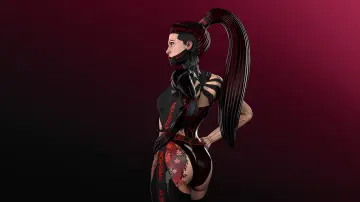
Post Apocalypse Girl
Examine the Post Apocalypse Girl lowpoly character, featuring integrated weapon assets, animationblueprint support, and creature animation compatibility.
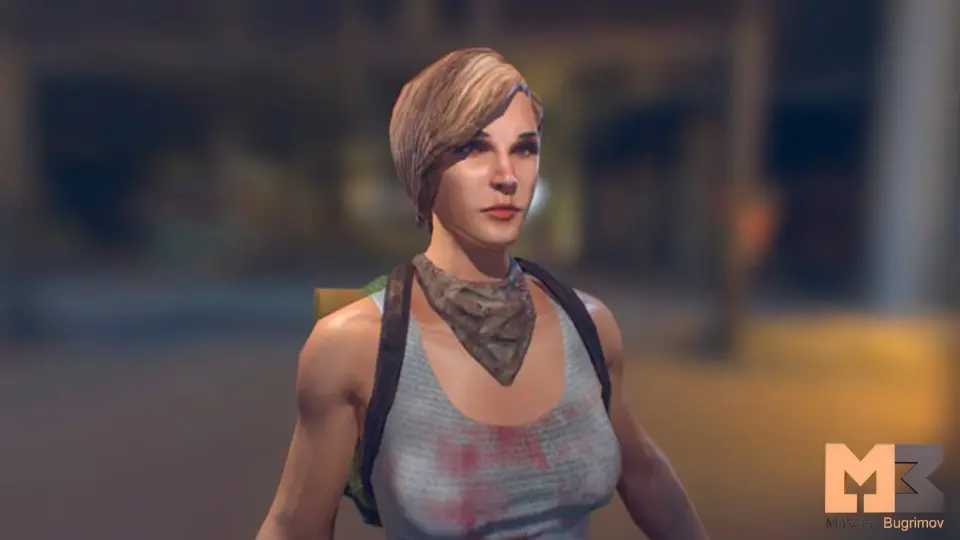
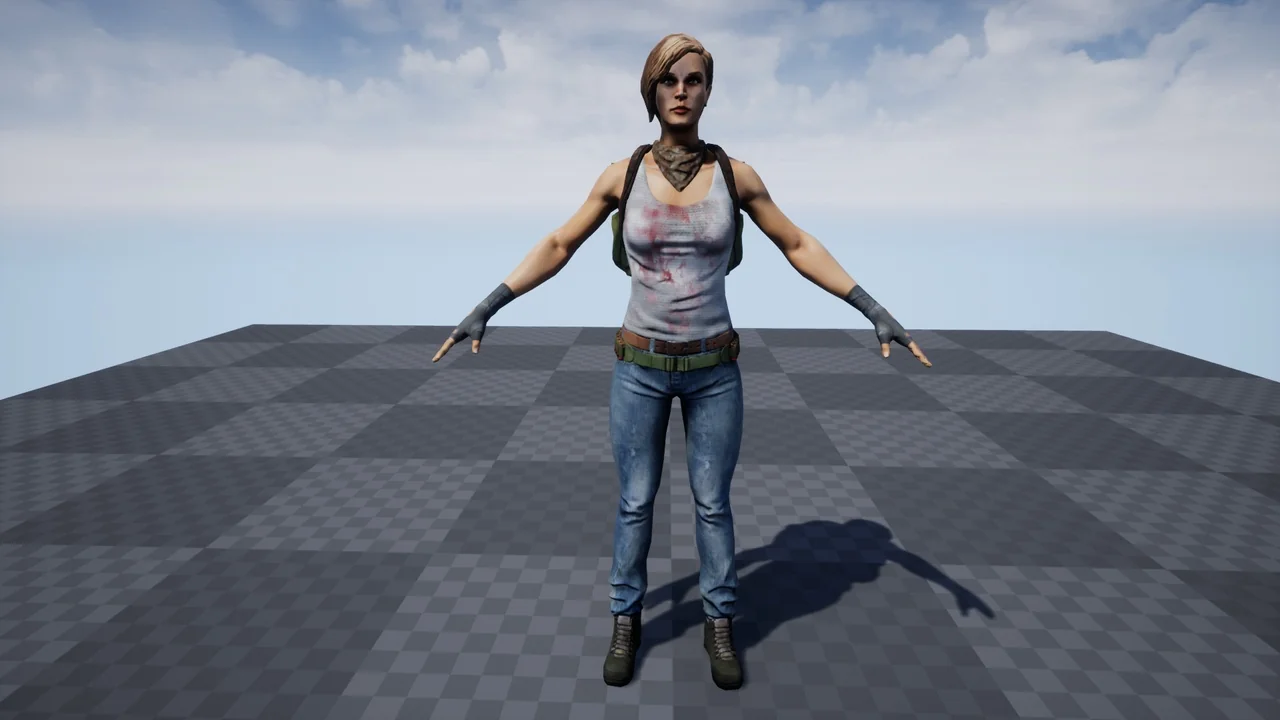
Post Apocalypse Girl supplies a functional character package comprising a lowpoly model, an associated weapon, gameplay script components, and an animationblueprint. These integrated assets form a core framework intended to support characters in settings defined by scarcity, environmental collapse, and hostile encounters. By combining character geometry directly with dedicated control logic, the package bridges visual modeling and dynamic gameplay responsiveness.
Developing for survival and horror genres demands assets that remain visually distinct while fitting strictly within real-time rendering constraints. Having the character asset, weapon structure, and driving logic organized as a cohesive entity reduces the pipeline overhead of wiring independent assets together manually. The package then offers an accessible baseline for deploying responsive combatants, solitary wanderers, or defensive survivors directly into interactive test scenes.
Lowpoly Character Mesh and Weapon Elements
The visual foundation of Post Apocalypse Girl relies on a lowpoly character mesh paired with dedicated weapon equipment. Employing a lowpoly budget yields major technical advantages in scenes where performance headroom is tightly contested. In survival titles where visibility may be occluded by volumetric fog, darkness, or dense post-processing filters, efficient geometry prevents scene frame times from degrading during intense action.
The accompanying weapon extends the narrative and mechanical scope of the model. Post-apocalyptic scenarios consistently rely on armed agency, requiring models that can switch between wandering, passive idling, and defensive stances. Because the weapon is treated as a core element alongside the character mesh, socketing and alignment workflows remain straightforward, allowing developers to establish weapon-handling archetypes quickly.
Lowpoly geometry also proves practical when instancing multiple instances across a map. Whether the character is configured as a solitary protagonist, a roving scavenger, or part of a small enclave defending a compound, the polygon economy allows project teams to populate levels without forcing severe LOD compromises. This structural balance lets level designers emphasize environmental ruin and mood lighting while keeping character rendering lightweight.
Animationblueprint Systems and 56 Animations For Creatures Compatibility
At the center of the character's interactive capability is the animationblueprint, engineered to translate player input and state machines into physical movement. An animationblueprint coordinates transitions between locomotion, resting poses, aim offsets, and combat triggers. By housing the character's operational states within this system, the package ensures smooth state-blending during chaotic combat loops or slow-paced exploration phases.
A notable technical dimension of Post Apocalypse Girl is compatibility with the 56 Animations For Creatures set. While primarily functioning as a human survivor, this animation interoperability creates unique opportunities for non-standard character motion. In horror settings, exposing a humanoid mesh to creature-oriented animation data enables developers to produce uncanny, unnerving behaviors that defy conventional human movement.
Applying creature motion sets opens several direct design avenues:
Feral survivor archetypes that crawl, crouch low, or navigate ruins using predatory locomotion profiles.
Dynamic hit reactions and flinches that convey severe bodily trauma appropriate for high-intensity survival horror encounters.
Aggressive ambush sequences where an adversary leaps, lunges, or stalks through shadowed geometry.
Blending standard survivor mechanics with the 56 Animations For Creatures library allows teams to diversify gameplay encounters without rigging entirely separate creature models from scratch. An animator or technical director can configure the animationblueprint to alternate between measured human combat stances and desperate, bestial maneuvers when stamina depletes or infection sets in.
Script Behaviors in Survival and Horror Scenarios
The presence of dedicated script logic ensures that the visual mesh and animation state machines translate into practical gameplay events. In survival game development, characters do not simply navigate space; they interact with equipment, manage weapon readiness, and respond to hostile environmental pressures. Script integration serves as the connective tissue between user commands and state transitions.
When engineering horror interactions, pacing dictates everything. The underlying script handles the logic required to switch states—such as moving from exploratory stealth into high-stakes engagement. Because the character includes both weapon hooks and script logic, developers can bind combat inputs directly to animation events, synchronizing weapon strikes, reloads, or aiming mechanics with low latency.
This technical foundation also streamlines integration into larger survival systems. Health depletion, inventory access, stamina management, and weapon degradation all rely on scripts that can communicate state changes back to the animationblueprint. Having a working script baseline allows teams to focus on game-specific balance rather than building foundational character controllers from zero.
Project Staging Across Apocalypse and Survival Frameworks
Deploying Post Apocalypse Girl into production environments centers on establishing mood and context. The post-apocalypse thematic umbrella spans everything from dry wasteland scavengers to bio-hazard quarantine refugees and supernatural horror survivors. The lightweight geometry and adaptable animation setup allow the character to sit comfortably within any of these stylistic directions.
In a standard survival sandbox, the character operates cleanly as an everyday wanderer, scavenging abandoned infrastructure while relying on the lowpoly weapon for personal defense. The lean polygonal footprint makes the asset equally viable for mobile projects, stylized desktop releases, or top-down survival tactics games where large draw distances and top-heavy scene assets usually penalize performance.
When placed into explicit horror titles, the asset shifts roles effortlessly. Compatibility with creature animation data allows creators to present the character as a tragic victim of infection, a hostile mutant prowling decrepit corridors, or a player character whose stability visibly deteriorates over time. The dual capacity to handle both composed human survival actions and erratic creature movements makes the package a flexible asset across dark, tense, and survival-driven game spaces.
 Characters
 Characters
 Characters
 Characters