"b00678cacce53329"{"id":"1002825","slug":"niagara-symbols","title":"Niagara Symbols","category":"Variety","engine":"4.26+,5.0+","assetVersion":"","engineVersion":"Engine Version: 4.26+,5.0+","tag":"Variety","accent":"blue","visual":"mech","summary":"Explore Niagara Symbols, an Unreal Engine particle pack featuring alphabet letters, numbers, currency signs, glyphs, and runes for game VFX.","platform":"Unreal Engine","indexPolicy":"index","publishedAt":"2026-11-20T08:13:18.772Z","updatedAt":"2026-11-20T08:13:18.772Z","sourceNotes":[],"fileContents":[],"compatibility":["Unreal Engine","Engine Version: 4.26+,5.0+"],"featuredImage":{"alt":"Niagara Symbols","src":"/wp-content/uploads/published/2026/11/a48ce7583c7f-1daffb7b-1d7d-457f-99a6-4fee023ec38e-55650372ab.webp"},"fileSizeBytes":34569066,"hasDownloadLink":true,"downloads":0,"terms":[{"taxonomy":"category","slug":"variety-vfx","name":"Variety"}],"galleryImages":[{"src":"/wp-content/uploads/published/2026/11/2af7e0cb91c7-8b0934f1-322d-4678-8d84-7306e819585b-da17000372.webp","alt":"Niagara Symbols"},{"src":"/wp-content/uploads/published/2026/11/a1ec2035c3ab-2a038079-ed9c-468a-a858-46e44b3c4061-36ce8f34c3.webp","alt":"Niagara Symbols"},{"src":"/wp-content/uploads/published/2026/11/fe38a5aed343-8b51a47f-c8c5-4a12-b412-c7f695933e2a-ebc1c545c4.webp","alt":"Niagara Symbols"},{"src":"/wp-content/uploads/published/2026/11/6c084560b8d1-c5a59bc4-c61b-4ab7-b04e-a2b6652f24c0-62823f3b84.webp","alt":"Niagara Symbols"},{"src":"/wp-content/uploads/published/2026/11/cde541bbf67c-d3bea2cc-4908-423a-941d-8faea71e7d2e-ebb868a48d.webp","alt":"Niagara Symbols"},{"src":"/wp-content/uploads/published/2026/11/9aed84d6f6d8-c4bf0b72-bee6-42d0-b6a9-39baac596486-6a634aeb98.webp","alt":"Niagara Symbols"},{"src":"/wp-content/uploads/published/2026/11/ba9b8f85304f-8af011d5-b2de-4cbf-847e-676bc715c989-e231aafb45.webp","alt":"Niagara Symbols"},{"src":"/wp-content/uploads/published/2026/11/daf0ccaf2bf5-9ef5072b-3b8c-4692-8edf-eabea63e2122-cc13f0bb8c.webp","alt":"Niagara Symbols"},{"src":"/wp-content/uploads/published/2026/11/d67ecc39cd02-bd0a0108-1c04-46dd-8e13-c318c18b4381-67d94223ff.webp","alt":"Niagara Symbols"},{"src":"/wp-content/uploads/published/2026/11/705387cff8ad-bbd27d9b-b246-4fc2-a6e7-310de307eeb9-8e6bd0ccdf.webp","alt":"Niagara Symbols"}],"accessPanel":{"kind":"resource","title":"Get this resource","safetyNote":"Resources are manually reviewed before listing to improve quality and reduce obvious risks.","fileName":"Content.7z","resourceType":"Resource archive","versions":[]},"contentHtml":"\u003cp\u003eVisual effects in modern games frequently bridge the gap between abstract energy simulations and readable graphic communication. In complex titles, a particle burst is rarely just an explosion of light; it regularly needs to communicate specific data, arcane lore, or systemic feedback to the player. Whether establishing a glowing puzzle lock inside an ancient tomb, displaying a digital cascade of terminal data across a cyberpunk computer terminal, or showing floating rewards, typography rendered through particle systems serves an essential role in visual direction. Niagara Symbols answers this specific operational requirement by providing standalone visual effects shaped directly as alphanumeric characters, standard graphic notations, and ancient runic glyphs.\u003c/p\u003e \u003ch2\u003eVisual Typographies Inside Niagara Symbols\u003c/h2\u003e \u003cp\u003eThe core structure of Niagara Symbols centers on turning identifiable typography into functional visual systems. While standard interface elements rely on flat two-dimensional widgets rendered on the viewport screen, particle-driven symbols exist natively within the three-dimensional game world. They inherit the lighting, volumetric space, and temporal behavior of the surrounding game environment.\u003c/p\u003e \u003cp\u003eThe package contains the full English alphabet, providing letterforms that emit, float, drift, or dissipate according to the parameters of their particle emitters. Having individual letters accessible as native visual effects enables level designers and technical artists to place typographic cues directly on surfaces, project ethereal messages mid-air, or trigger dynamic letter bursts during character interactions. Because these are built as Niagara systems, they behave like any other physics-aware visual effect, carrying velocity, scale transformations, and particle death cycles that feel coherent alongside standard environmental VFX.\u003c/p\u003e \u003ch2\u003eAlphanumeric Glyphs, Numbers, and Punctuation Effects\u003c/h2\u003e \u003cp\u003eBeyond the standard letters of the alphabet, the package includes complete numeric characters and selected visual symbols. Numerical effects range from single digits to sequences that can be deployed to represent mechanical or computational logic in a scene. Numbers are universal visual components in interactive projects, applied everywhere from countdown timers and numeric locks to in-world telemetry displays and floating damage notifications.\u003c/p\u003e \u003cp\u003eAccompanying the numbers are distinct punctuation and operational marks, specifically including the hash (#), the dollar sign ($), and the ampersand (\u0026amp;), alongside related symbols. These particular glyphs carry immediate contextual weight:\u003c/p\u003e \u003cul\u003e \u003cli\u003e\u003cstrong\u003eThe Dollar Sign ($):\u003c/strong\u003e Functions naturally in economy-driven events, loot drops, trading terminals, and arcade-style reward feedback where physicalized wealth indicators reinforce player actions.\u003c/li\u003e \u003cli\u003e\u003cstrong\u003eThe Hash Sign (#):\u003c/strong\u003e Fits cleanly into technical readouts, coding sequences, server rack visualizations, digital glitch sequences, and channel-indexing interfaces.\u003c/li\u003e \u003cli\u003e\u003cstrong\u003eThe Ampersand (\u0026amp;):\u003c/strong\u003e Serves as a connective punctuation mark in environmental typography, title sequencing, and stylized interface notifications within the world space.\u003c/li\u003e\n\u003c/ul\u003e \u003cp\u003eDeploying these characters as dedicated visual effects avoids the flat look of screen-space text. Instead of anchoring an interface layer over the camera, a designer can spawn a dollar sign particle directly at the coordinates of a collected container, or burst a series of numbers and hashes from a hacked console, maintaining spatial consistency.\u003c/p\u003e \u003ch2\u003eArcane Rune Symbols for Fantasy Setups\u003c/h2\u003e \u003cp\u003eMoving outside modern typography and computational notation, Niagara Symbols also incorporates a set of runes. Runic effects shift the aesthetic focus entirely toward fantasy, mysticism, and historical world-building. Where Latin letters and punctuation convey technical or literal information, runes represent abstract power, dormant spells, and ancient languages.\u003c/p\u003e \u003cp\u003eThese runic effects can be positioned to populate magical summoning circles on dungeon floors, glow along the edges of enchanted weapon blades, or float upward from ritual altars during scripted sequences. In fantasy level design, runes provide an immediate visual language for danger or interactive mystery. A sealed chamber door etched with glowing particle runes informs players of a puzzle requirement without relying on explicit text dialog. Because the runes share the underlying Niagara architecture of the rest of the pack, they integrate cleanly into broader magical spell assemblies, allowing creators to blend runic sigils into larger casts alongside elemental flares or smoke bursts.\u003c/p\u003e \u003ch2\u003ePlacement in the Big Niagara Bundle Architecture\u003c/h2\u003e \u003cp\u003eNiagara Symbols is also included as part of the Big Niagara Bundle Blueprint Bundle 2, highlighting its intent to operate within broader modular development frameworks. In projects utilizing extensive visual effect libraries, maintaining uniformity across particle systems is critical for performance profiling and visual coherence. Having symbolic effects packaged in this bundle format ensures that they can be referenced cleanly alongside complementary systems, blueprints, and gameplay triggers.\u003c/p\u003e \u003cp\u003eBy categorizing letters, numbers, functional symbols, and runes within a single system-focused delivery, the collection provides a consistent asset vocabulary. Technical artists can swap a numeric emitter for a runic one without rewriting base spawn behaviors, standardizing the implementation of floating glyphs across an entire production.\u003c/p\u003e \u003ch2\u003eTarget Scenarios for System-Driven Particle Displays\u003c/h2\u003e \u003cp\u003eThe primary utility of this asset collection appears in environments where diegetic visual feedback is preferred over static two-dimensional user interface canvas elements. Technical artists building virtual reality experiences, arcade combat titles, sci-fi environments, and dungeon crawlers all share a need for readable shapes that react to scene lighting and world physics.\u003c/p\u003e \u003cp\u003eInstead of generating custom texture atlases, setting up bespoke sub-UV particle alignments, and writing custom emitter behaviors from scratch for basic letters or glyphs, teams can utilize these pre-assembled Niagara systems. The package serves developers seeking a direct, dependable library of communicative visual elements, delivering clear alphanumeric characters and mystical runes ready for deployment in active game worlds.\u003c/p\u003e\n\n\u003ch2\u003eMore From The Same Workflow\u003c/h2\u003e\n\u003cul\u003e\n\u003cli\u003e\u003ca href=\"https://3dcghub.com/matrix-rain-of-symbols-vfx/\" rel=\"noopener noreferrer\"\u003eMatrix / Rain of Symbols - VFX\u003c/a\u003e\u003c/li\u003e\n\u003cli\u003e\u003ca href=\"https://3dcghub.com/niagara-realistic-starter-vfx-pack/\" rel=\"noopener noreferrer\"\u003eNiagara Realistic Starter VFX Pack\u003c/a\u003e\u003c/li\u003e\n\u003cli\u003e\u003ca href=\"https://3dcghub.com/niagara-sci-fi-starter-vfx-pack/\" rel=\"noopener noreferrer\"\u003eNiagara Sci-Fi Starter VFX Pack\u003c/a\u003e\u003c/li\u003e\n\u003cli\u003e\u003ca href=\"https://3dcghub.com/niagara-hologram-aura/\" rel=\"noopener noreferrer\"\u003eNiagara Hologram Aura\u003c/a\u003e\u003c/li\u003e\n\u003cli\u003e\u003ca href=\"https://3dcghub.com/niagara-effects05/\" rel=\"noopener noreferrer\"\u003eNiagara Effects05\u003c/a\u003e\u003c/li\u003e\n\u003c/ul\u003e","contentTextLength":6502,"navigation":{"current":55,"total":4797,"previous":{"id":"1002826","slug":"ninja-player","title":"Ninja Player","category":"Variety","platform":"Unreal Engine","updatedAt":"2026-11-20T08:14:46.570Z"},"next":{"id":"1002824","slug":"niagara-sci-fi-starter-vfx-pack","title":"Niagara Sci-Fi Starter VFX Pack","category":"Variety","platform":"Unreal Engine","updatedAt":"2026-11-20T08:01:46.751Z"}},"relatedResources":[{"id":"1002101","slug":"matrix-rain-of-symbols-vfx","title":"Matrix / Rain of Symbols - VFX","category":"Variety","engine":"5.0+","assetVersion":"","engineVersion":"Engine Version: 5.0+","tag":"Variety","accent":"blue","visual":"mech","summary":"Create cascading code simulations and digital illusions in Unreal Engine 5 with Matrix / Rain of Symbols - VFX, featuring customizable Niagara systems.","platform":"Unreal Engine","indexPolicy":"index","publishedAt":"2026-10-29T08:46:24.158Z","updatedAt":"2026-10-29T08:46:24.158Z","sourceNotes":[],"fileContents":[],"compatibility":["Unreal Engine","Engine Version: 5.0+"],"featuredImage":{"alt":"Matrix / Rain of Symbols - VFX","src":"/wp-content/uploads/published/2026/10/9a74edcfdc30-e714abdf-6bee-4c74-b512-4ec089db75d9-0bcf9a6e1b.webp"},"fileSizeBytes":5700102,"hasDownloadLink":true,"downloads":0},{"id":"1002278","slug":"niagara-realistic-starter-vfx-pack","title":"Niagara Realistic Starter VFX Pack","category":"Variety","engine":"4.25+,5.0+","assetVersion":"","engineVersion":"Engine Version: 4.25+,5.0+","tag":"Variety","accent":"blue","visual":"mech","summary":"Examine the Niagara Realistic Starter VFX Pack, featuring 148 particle systems, transform-based scaling, and comprehensive environmental and combat effects.","platform":"Unreal Engine","indexPolicy":"index","publishedAt":"2026-10-29T16:36:27.991Z","updatedAt":"2026-10-29T16:36:27.991Z","sourceNotes":[],"fileContents":[],"compatibility":["Unreal Engine","Engine Version: 4.25+,5.0+"],"featuredImage":{"alt":"Niagara Realistic Starter VFX Pack","src":"/wp-content/uploads/published/2026/10/926adaa76d87-2c37688c-2dc0-4683-8cf4-d600fcea15d4-f5feac6fed.webp"},"fileSizeBytes":960341083,"hasDownloadLink":true,"downloads":2},{"id":"1002871","slug":"niagara-dissolution-examples","title":"Niagara Dissolution Examples","category":"Variety","engine":"4.26+,5.0+","assetVersion":"","engineVersion":"Engine Version: 4.26+,5.0+","tag":"Variety","accent":"blue","visual":"luts","summary":"Explore practical methods for static and skeletal mesh dissolution in Unreal Engine using Niagara particle systems, Blueprints, and Scene Capture 2D.","platform":"Unreal Engine","indexPolicy":"index","publishedAt":"2026-11-20T16:36:06.698Z","updatedAt":"2026-11-20T16:36:06.698Z","sourceNotes":[],"fileContents":[],"compatibility":["Unreal Engine","Engine Version: 4.26+,5.0+"],"featuredImage":{"alt":"Niagara Dissolution Examples","src":"/wp-content/uploads/published/2026/11/64b1ca88f365-f5399d97-8536-41d5-b3ea-1db17fa2985e-5d821fcbd2.webp"},"fileSizeBytes":239817559,"hasDownloadLink":true,"downloads":0}]}
Resource screenshots
1 / 10
Join our channel
Follow 3DCGHUB on Telegram for new resource drops, migration updates, and community notices.
Visual effects in modern games frequently bridge the gap between abstract energy simulations and readable graphic communication. In complex titles, a particle burst is rarely just an explosion of light; it regularly needs to communicate specific data, arcane lore, or systemic feedback to the player. Whether establishing a glowing puzzle lock inside an ancient tomb, displaying a digital cascade of terminal data across a cyberpunk computer terminal, or showing floating rewards, typography rendered through particle systems serves an essential role in visual direction. Niagara Symbols answers this specific operational requirement by providing standalone visual effects shaped directly as alphanumeric characters, standard graphic notations, and ancient runic glyphs.
Visual Typographies Inside Niagara Symbols
The core structure of Niagara Symbols centers on turning identifiable typography into functional visual systems. While standard interface elements rely on flat two-dimensional widgets rendered on the viewport screen, particle-driven symbols exist natively within the three-dimensional game world. They inherit the lighting, volumetric space, and temporal behavior of the surrounding game environment.
The package contains the full English alphabet, providing letterforms that emit, float, drift, or dissipate according to the parameters of their particle emitters. Having individual letters accessible as native visual effects enables level designers and technical artists to place typographic cues directly on surfaces, project ethereal messages mid-air, or trigger dynamic letter bursts during character interactions. Because these are built as Niagara systems, they behave like any other physics-aware visual effect, carrying velocity, scale transformations, and particle death cycles that feel coherent alongside standard environmental VFX.
Alphanumeric Glyphs, Numbers, and Punctuation Effects
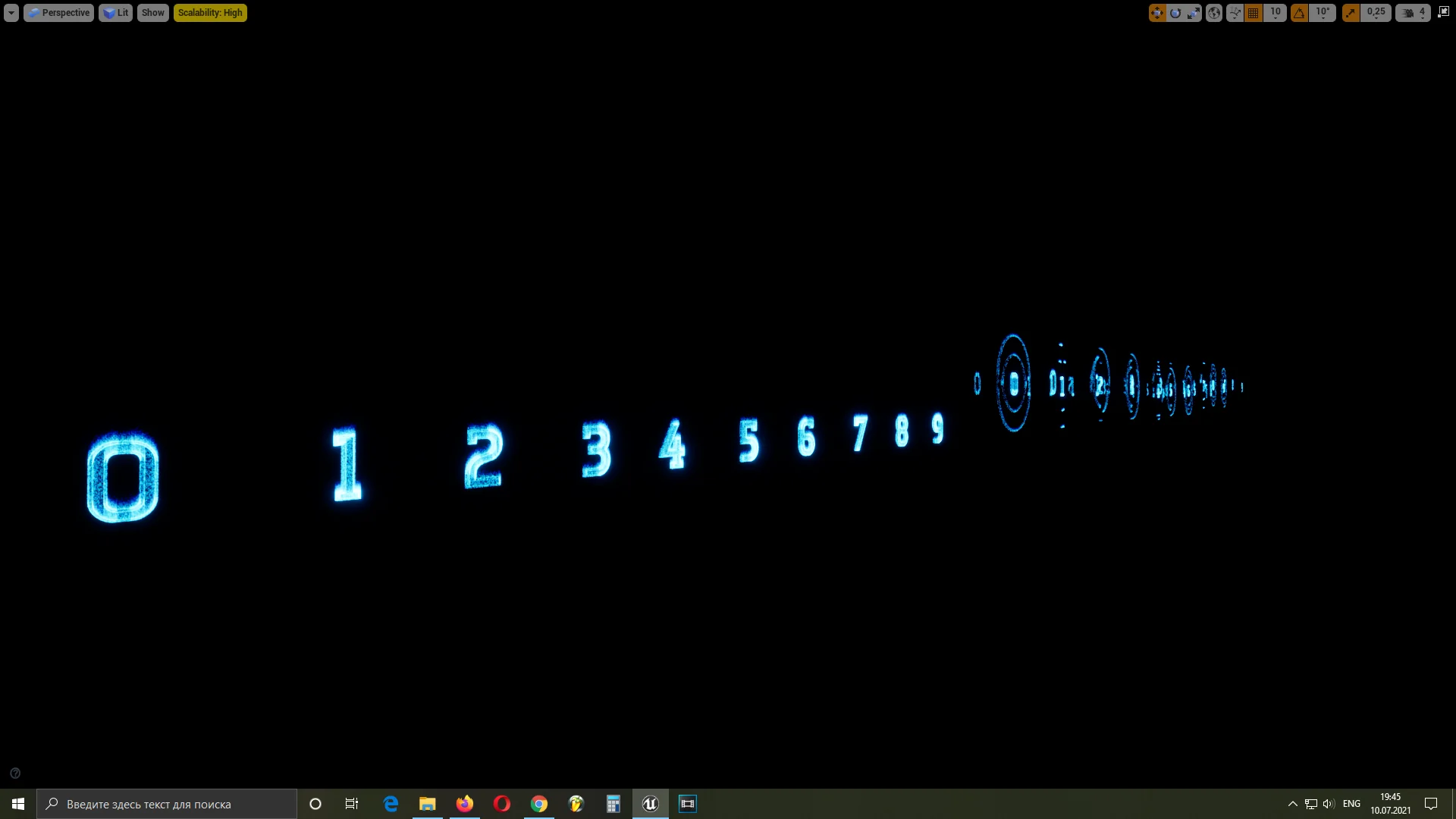
Beyond the standard letters of the alphabet, the package includes complete numeric characters and selected visual symbols. Numerical effects range from single digits to sequences that can be deployed to represent mechanical or computational logic in a scene. Numbers are universal visual components in interactive projects, applied everywhere from countdown timers and numeric locks to in-world telemetry displays and floating damage notifications.
Accompanying the numbers are distinct punctuation and operational marks, specifically including the hash (#), the dollar sign ($), and the ampersand (&), alongside related symbols. These particular glyphs carry immediate contextual weight:
The Dollar Sign ($): Functions naturally in economy-driven events, loot drops, trading terminals, and arcade-style reward feedback where physicalized wealth indicators reinforce player actions.
The Hash Sign (#): Fits cleanly into technical readouts, coding sequences, server rack visualizations, digital glitch sequences, and channel-indexing interfaces.
The Ampersand (&): Serves as a connective punctuation mark in environmental typography, title sequencing, and stylized interface notifications within the world space.
Deploying these characters as dedicated visual effects avoids the flat look of screen-space text. Instead of anchoring an interface layer over the camera, a designer can spawn a dollar sign particle directly at the coordinates of a collected container, or burst a series of numbers and hashes from a hacked console, maintaining spatial consistency.
Arcane Rune Symbols for Fantasy Setups
Moving outside modern typography and computational notation, Niagara Symbols also incorporates a set of runes. Runic effects shift the aesthetic focus entirely toward fantasy, mysticism, and historical world-building. Where Latin letters and punctuation convey technical or literal information, runes represent abstract power, dormant spells, and ancient languages.
These runic effects can be positioned to populate magical summoning circles on dungeon floors, glow along the edges of enchanted weapon blades, or float upward from ritual altars during scripted sequences. In fantasy level design, runes provide an immediate visual language for danger or interactive mystery. A sealed chamber door etched with glowing particle runes informs players of a puzzle requirement without relying on explicit text dialog. Because the runes share the underlying Niagara architecture of the rest of the pack, they integrate cleanly into broader magical spell assemblies, allowing creators to blend runic sigils into larger casts alongside elemental flares or smoke bursts.
Placement in the Big Niagara Bundle Architecture
Niagara Symbols is also included as part of the Big Niagara Bundle Blueprint Bundle 2, highlighting its intent to operate within broader modular development frameworks. In projects utilizing extensive visual effect libraries, maintaining uniformity across particle systems is critical for performance profiling and visual coherence. Having symbolic effects packaged in this bundle format ensures that they can be referenced cleanly alongside complementary systems, blueprints, and gameplay triggers.
By categorizing letters, numbers, functional symbols, and runes within a single system-focused delivery, the collection provides a consistent asset vocabulary. Technical artists can swap a numeric emitter for a runic one without rewriting base spawn behaviors, standardizing the implementation of floating glyphs across an entire production.
Target Scenarios for System-Driven Particle Displays
The primary utility of this asset collection appears in environments where diegetic visual feedback is preferred over static two-dimensional user interface canvas elements. Technical artists building virtual reality experiences, arcade combat titles, sci-fi environments, and dungeon crawlers all share a need for readable shapes that react to scene lighting and world physics.
Instead of generating custom texture atlases, setting up bespoke sub-UV particle alignments, and writing custom emitter behaviors from scratch for basic letters or glyphs, teams can utilize these pre-assembled Niagara systems. The package serves developers seeking a direct, dependable library of communicative visual elements, delivering clear alphanumeric characters and mystical runes ready for deployment in active game worlds.
 Variety
 Variety
 Variety