"b00678cacce53329"{"id":"1002820","slug":"niagara-hologram-aura","title":"Niagara Hologram Aura","category":"Variety","engine":"4.27+,5.0+","assetVersion":"","engineVersion":"Engine Version: 4.27+,5.0+","tag":"Variety","accent":"blue","visual":"mech","summary":"Explore Niagara Hologram Aura, featuring mesh reconstruction experiments using Scene Capture, Mesh Distance Fields, Niagara FX, and Blueprints.","platform":"Unreal Engine","indexPolicy":"index","publishedAt":"2026-11-20T07:55:15.549Z","updatedAt":"2026-11-20T07:55:15.549Z","sourceNotes":[],"fileContents":[],"compatibility":["Unreal Engine","Engine Version: 4.27+,5.0+"],"featuredImage":{"alt":"Niagara Hologram Aura","src":"/wp-content/uploads/published/2026/11/5fa85276a05e-799fca1c-36aa-4ab9-987f-0e3a7d395a2e-fc7451a0c3.webp"},"fileSizeBytes":72151251,"hasDownloadLink":true,"downloads":0,"terms":[{"taxonomy":"category","slug":"variety-vfx","name":"Variety"}],"galleryImages":[{"src":"/wp-content/uploads/published/2026/11/e2ad050b4448-887cb142-bddd-4f58-992f-edb00fe6da9d-364af3fc86.webp","alt":"Niagara Hologram Aura"},{"src":"/wp-content/uploads/published/2026/11/2a2c1670d3a2-a67d13f6-1afe-4ab6-8504-64e25695baae-42af73c01d.webp","alt":"Niagara Hologram Aura"},{"src":"/wp-content/uploads/published/2026/11/c9c02970a1c0-5fc1973a-6671-4161-8629-6fe2cddc33c4-cfab035926.webp","alt":"Niagara Hologram Aura"},{"src":"/wp-content/uploads/published/2026/11/c02196c2d621-a7a762aa-951c-4dc7-9320-e53a3913e8ac-bc20d07721.webp","alt":"Niagara Hologram Aura"},{"src":"/wp-content/uploads/published/2026/11/4f0c1db84464-e402a5c1-b5e1-46ed-be7a-e1ed6be41210-b2807adde5.webp","alt":"Niagara Hologram Aura"},{"src":"/wp-content/uploads/published/2026/11/3736d0db04cf-20972465-d51a-409e-a96e-60611d001d7e-6e02f4b8d9.webp","alt":"Niagara Hologram Aura"},{"src":"/wp-content/uploads/published/2026/11/bc8e3aa92893-b0e9485b-53ca-418b-84f5-f2c38b7a77cc-48c004971e.webp","alt":"Niagara Hologram Aura"},{"src":"/wp-content/uploads/published/2026/11/2d033a091a20-04c67418-6303-4140-97df-6ed17556b031-715d525370.webp","alt":"Niagara Hologram Aura"},{"src":"/wp-content/uploads/published/2026/11/e1b0b04f1d80-5b7863ab-d211-4bb5-bea8-4d835d7a34b3-f046d1ab3d.webp","alt":"Niagara Hologram Aura"},{"src":"/wp-content/uploads/published/2026/11/487e564f97a9-0d3525da-5a2b-4555-8c4b-1f710bcd71ad-01302fb17a.webp","alt":"Niagara Hologram Aura"}],"accessPanel":{"kind":"resource","title":"Get this resource","safetyNote":"Resources are manually reviewed before listing to improve quality and reduce obvious risks.","fileName":"Niagara Hologram Aura.7z","resourceType":"Resource archive","versions":[]},"contentHtml":"\u003cp\u003eScene Capture components, Mesh Distance Field data, Blueprint logic, and Niagara particle emitters constitute the foundation of Niagara Hologram Aura. The project centers on experimental methods for capturing real-time geometry and reconstructing it as a holographic visual phenomenon. Rather than relying solely on static mesh emission or conventional translucent materials, the implementation investigates dynamic surface awareness to build visual aura layers and holographic replicas in real-time environments.\u003c/p\u003e \u003cp\u003eBy bringing together Niagara visual effects and underlying scene analysis tools, the workflow demonstrates how complex geometry can be translated into luminous, disembodied representations. The interaction between spatial queries and particle simulation enables distinct silhouettes, perimeter glimmers, and digital projection artifacts that conform directly to target objects.\u003c/p\u003e \u003ch2\u003eMesh Sampling and Hologram Reconstruction Techniques\u003c/h2\u003e \u003cp\u003eReconstructing a mesh as a hologram requires accurate spatial data regarding where a surface exists in 3D space. Niagara Hologram Aura approaches this through experiments combining Mesh Distance Fields with Scene Capture utilities. A Mesh Distance Field stores signed distance data representing the proximity to the nearest surface point across an asset. When harnessed within particle simulations, this volumetric spatial representation allows individual Niagara particles to detect surfaces, conform to specific contours, and calculate distance offsets from solid geometry.\u003c/p\u003e \u003cp\u003eScene Capture functionality complements this spatial awareness by sampling the visual state of objects within the viewport. Depending on how the capture component is structured, it captures spatial, depth, or silhouette information directly from scene actors. Feeding this captured visual information back into particle calculations allows the holographic effect to match the profile of arbitrary meshes, adapting to structural shifts and complex geometric profiles without requiring manual UV unwrapping or dedicated particle skeletal meshes.\u003c/p\u003e \u003cp\u003eThese dual sampling methods unlock experimental avenues for digital reconstruction. A static or animated mesh can be sampled dynamically, allowing the holographic effect to float adjacent to the original object or replace it entirely with a digitized, point-cloud or scanline aesthetic. The aura effect emerges naturally where distance values transition away from the physical boundary, producing an ethereal field around the mesh exterior.\u003c/p\u003e \u003ch2\u003eScene Capture Integration in the Niagara System\u003c/h2\u003e \u003cp\u003eThe translation from raw scene data into particle motion relies on Niagara's flexible data interface pipeline. When Scene Capture units record the target environment, the resulting texture buffers or depth values become readable within particle stages. Niagara modules read the spatial coordinates and visual attributes generated by the capture pass, translating two-dimensional or depth-based information into three-dimensional particle vectors.\u003c/p\u003e \u003cp\u003eParticles within the system evaluate these inputs on a per-frame basis. If an emitter needs to simulate holographic jitter, scanning bands, or signal disruption, it samples the captured data alongside mathematical noise algorithms. This setup produces a layered effect where the structural integrity of the mesh remains recognizable even while individual particles disperse, shimmer, or drift along surface normals.\u003c/p\u003e \u003cp\u003eBecause the setup utilizes real-time distance field data, particles do not simply sit flat against polygonal faces. Instead, they operate inside a continuous field of influence. Emitters can push particles inward toward the original volume or cast them outward along distance field gradients, forming glowing perimeter fringes and atmospheric energy fields that preserve the silhouette of complex assets.\u003c/p\u003e \u003ch2\u003eBlueprint Architecture for Aura Generation\u003c/h2\u003e \u003cp\u003eBlueprint integration acts as the central coordinator between visual components, rendering passes, and particle systems. Within this setup, Blueprints manage the lifecycle of Scene Capture components, target mesh references, and the execution of the Niagara simulation. Because dynamic effects depend on accurate positioning and parameter passing, Blueprint scripts handle the mathematical alignment between captured projections and active particle volumes.\u003c/p\u003e \u003cp\u003eBlueprint graphs also provide control surfaces for adjusting visual behavior. By exposing variables such as capture resolution, distance thresholds, projection scales, and particle response parameters, the setup allows users to tune the visual personality of the hologram without rebuilding the underlying emitters. This architecture supports rapid prototyping across various mesh shapes, enabling creators to swap target objects and immediately evaluate the fidelity of the reconstructed aura.\u003c/p\u003e \u003cp\u003eDynamic event handling within Blueprints facilitates timing controls for the effect. Emitters can be triggered to build a mesh reconstruction sequentially, flicker during simulated power fluctuations, or dissipate into ambient particle drift. The Blueprint structure binds the capture pass to these lifecycle events, ensuring that the projection updates reliably as target conditions evolve in the scene.\u003c/p\u003e \u003ch2\u003eVisual Execution of Niagara Hologram Effects\u003c/h2\u003e \u003cp\u003eThe visual signature of Niagara Hologram Aura balances translucent energy projection with structural legibility. Standard mesh rendering often conceals internal structures through solid shading, but holographic reconstruction visualizes objects as semi-transparent, point-based, or wire-like volumes. Distance field calculations enable bright highlight lines where surfaces meet or overlap, naturally accentuating geometric features like edges, folds, and crevasses.\u003c/p\u003e \u003cp\u003eParticle color gradients, emissive brightness controls, and size scales govern how the aura reads from varying camera distances. Close up, the hologram reveals individual particle matrices or localized energy currents traveling across the mesh surface. From a distance, these individual elements resolve into a cohesive, glowing silhouette that communicates the identity of the target object through light alone.\u003c/p\u003e \u003cp\u003eBecause the reconstruction draws on spatial coordinates rather than pre-baked flipbooks or static textures, it adapts effortlessly to varied geometric complexities. Curving biological shapes, sharp mechanical surfaces, and asymmetrical props each generate distinct distance field signatures, resulting in bespoke visual auras tailored to the contours of each individual asset.\u003c/p\u003e \u003ch2\u003eApplication in Real-Time Visual Environments\u003c/h2\u003e \u003cp\u003eProjects involving science fiction environments, tactical interface visualization, cybernetic augmentation, or ethereal manifestations can utilize these reconstruction workflows to achieve non-standard visual feedback. Tactical holographic displays, digital scan visualizations, defensive forcefields, and supernatural auras all benefit from the spatial conformity provided by distance field and scene capture techniques.\u003c/p\u003e \u003cp\u003eTechnical artists looking to understand particle-level spatial sampling can examine how the Blueprint logic handles scene capture data and passes it into Niagara parameters. The resource serves as a concrete study in moving beyond traditional particle emission points, providing an experimental framework for projecting, conforming, and animating particle volumes directly over dynamic geometric surfaces.\u003c/p\u003e\n\n\u003ch2\u003eRelated Resources Worth Checking\u003c/h2\u003e\n\u003cul\u003e\n\u003cli\u003e\u003ca href=\"https://3dcghub.com/sci-fi-hud-effects/\" rel=\"noopener noreferrer\"\u003eSci-fi HUD Effects\u003c/a\u003e\u003c/li\u003e\n\u003cli\u003e\u003ca href=\"https://3dcghub.com/big-niagara-bundle/\" rel=\"noopener noreferrer\"\u003eBig Niagara Bundle\u003c/a\u003e\u003c/li\u003e\n\u003cli\u003e\u003ca href=\"https://3dcghub.com/ring-aura-vfx/\" rel=\"noopener noreferrer\"\u003eRing Aura VFX\u003c/a\u003e\u003c/li\u003e\n\u003cli\u003e\u003ca href=\"https://3dcghub.com/niagara-hologram-pack/\" rel=\"noopener noreferrer\"\u003eNiagara Hologram Pack\u003c/a\u003e\u003c/li\u003e\n\u003cli\u003e\u003ca href=\"https://3dcghub.com/niagara-realistic-starter-vfx-pack/\" rel=\"noopener noreferrer\"\u003eNiagara Realistic Starter VFX Pack\u003c/a\u003e\u003c/li\u003e\n\u003c/ul\u003e","contentTextLength":7539,"navigation":{"current":60,"total":4797,"previous":{"id":"1002821","slug":"niagara-ice-skill-vfx-set-vol-2","title":"Niagara Ice Skill Vfx Set Vol. 2","category":"Spells \u0026 Combat","platform":"Unreal Engine","updatedAt":"2026-11-20T07:56:18.610Z"},"next":{"id":"1002819","slug":"niagara-effects05","title":"Niagara Effects05","category":"Variety","platform":"Unreal Engine","updatedAt":"2026-11-20T07:54:19.847Z"}},"relatedResources":[{"id":"1000480","slug":"sci-fi-hud-effects","title":"Sci-fi HUD Effects","category":"Variety","engine":"4.26+,5.0+","assetVersion":"","engineVersion":"Engine Version: 4.26+,5.0+","tag":"Variety","accent":"blue","visual":"mech","summary":"Unreal Engine package of animated HUD effects built from blueprints, skeletal meshes, 2K sprite textures, and Niagara systems for device screens and holograms.","platform":"Unreal Engine","indexPolicy":"index","publishedAt":"2026-07-12T06:01:25.891Z","updatedAt":"2026-07-12T06:01:25.891Z","sourceNotes":[],"fileContents":[],"compatibility":["Unreal Engine","Engine Version: 4.26+,5.0+"],"featuredImage":{"alt":"Sci-fi HUD Effects","src":"/wp-content/uploads/published/2026/07/b83b3e2c775d-4026d93b-0655-4e84-91a7-0c636ea5f2d2-5621ce40c7.webp"},"fileSizeBytes":134276365,"hasDownloadLink":true,"downloads":1},{"id":"1001192","slug":"big-niagara-bundle","title":"Big Niagara Bundle","category":"Variety","engine":"5.0+","assetVersion":"","engineVersion":"Engine Version: 5.0+","tag":"Variety","accent":"blue","visual":"mech","summary":"A collection of 453 Niagara effects across 13 packs, featuring weather, holograms, abstract space visual systems, blueprints, and meshes.","platform":"Unreal Engine","indexPolicy":"index","publishedAt":"2026-09-17T07:36:32.355Z","updatedAt":"2026-09-17T07:36:32.355Z","sourceNotes":[],"fileContents":[],"compatibility":["Unreal Engine","Engine Version: 5.0+"],"featuredImage":{"alt":"Big Niagara Bundle","src":"/wp-content/uploads/published/2026/09/6fe3d65ea8f9-aae557ef-41e9-40c5-bffc-ac14b60707ec-02490edbb6.webp"},"fileSizeBytes":230410995,"hasDownloadLink":true,"downloads":0},{"id":"17417","slug":"ring-aura-vfx","title":"Ring Aura VFX","category":"Variety","engine":"5.0+","assetVersion":"Engine version: 5.0+","engineVersion":"5.0","tag":"Variety","accent":"blue","visual":"animation","summary":"Enhance your project with Ring Aura VFX, a collection of 20 unique and high-quality visual effects. These assets are optimized for efficiency and offer easy customization without requiring deep knowledge of the Niagara System.","platform":"Unreal Engine","indexPolicy":"noindex","publishedAt":"2026-03-13T14:31:52.000Z","updatedAt":"2026-04-19T15:43:32.000Z","sourceNotes":[],"fileContents":[],"compatibility":["Unreal Engine","Engine version: 5.0+"],"featuredImage":{"alt":"Ring Aura VFX","src":"https://3dcghub.com/wp-content/uploads/2026/03/21a4270e-5f24-45c0-bfd5-eabf331aad3f.webp"},"fileSizeBytes":33608783,"hasDownloadLink":true,"downloads":2}]}
Resource screenshots
1 / 10
Join our channel
Follow 3DCGHUB on Telegram for new resource drops, migration updates, and community notices.
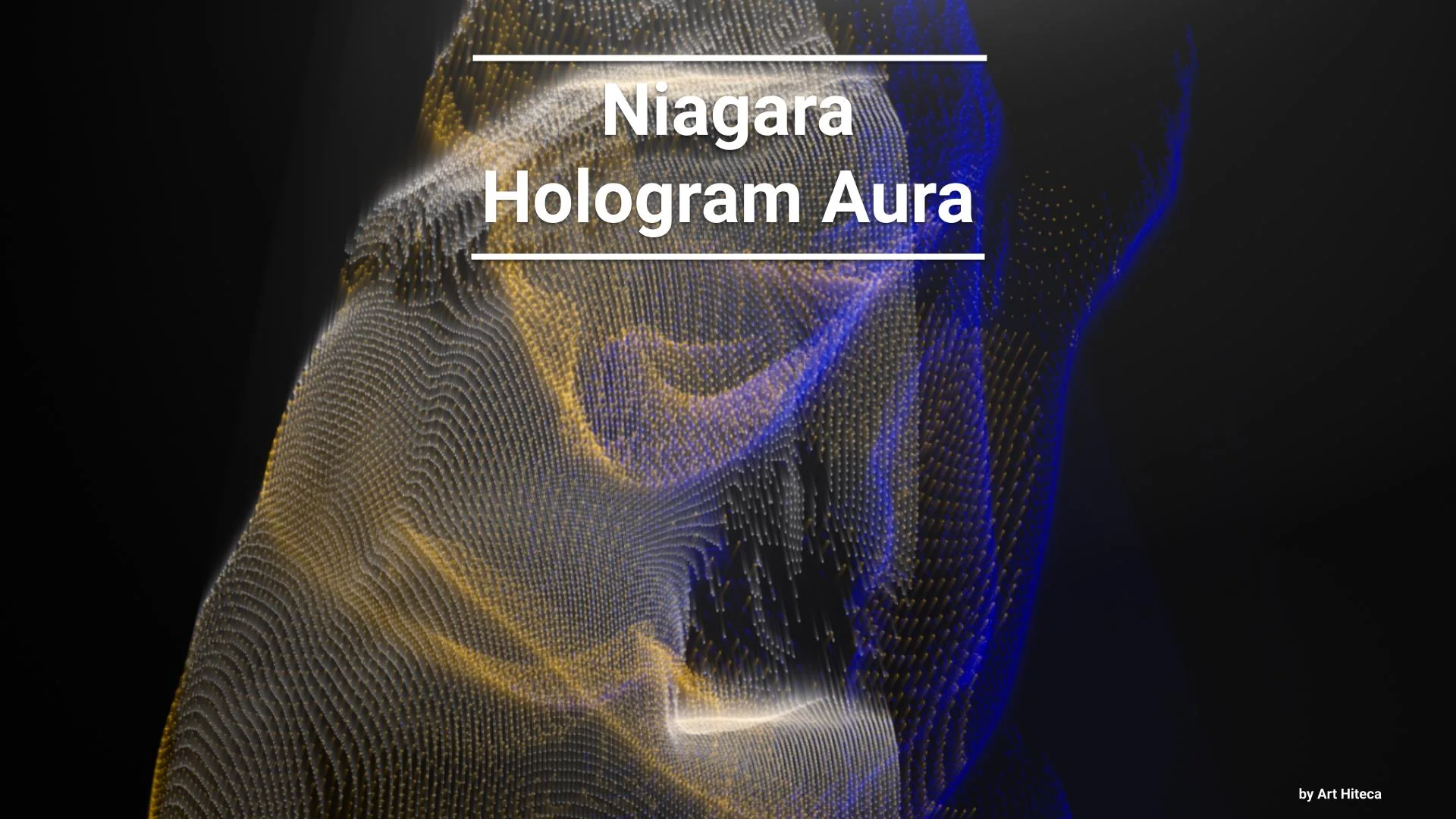
Scene Capture components, Mesh Distance Field data, Blueprint logic, and Niagara particle emitters constitute the foundation of Niagara Hologram Aura. The project centers on experimental methods for capturing real-time geometry and reconstructing it as a holographic visual phenomenon. Rather than relying solely on static mesh emission or conventional translucent materials, the implementation investigates dynamic surface awareness to build visual aura layers and holographic replicas in real-time environments.
By bringing together Niagara visual effects and underlying scene analysis tools, the workflow demonstrates how complex geometry can be translated into luminous, disembodied representations. The interaction between spatial queries and particle simulation enables distinct silhouettes, perimeter glimmers, and digital projection artifacts that conform directly to target objects.
Mesh Sampling and Hologram Reconstruction Techniques
Reconstructing a mesh as a hologram requires accurate spatial data regarding where a surface exists in 3D space. Niagara Hologram Aura approaches this through experiments combining Mesh Distance Fields with Scene Capture utilities. A Mesh Distance Field stores signed distance data representing the proximity to the nearest surface point across an asset. When harnessed within particle simulations, this volumetric spatial representation allows individual Niagara particles to detect surfaces, conform to specific contours, and calculate distance offsets from solid geometry.
Scene Capture functionality complements this spatial awareness by sampling the visual state of objects within the viewport. Depending on how the capture component is structured, it captures spatial, depth, or silhouette information directly from scene actors. Feeding this captured visual information back into particle calculations allows the holographic effect to match the profile of arbitrary meshes, adapting to structural shifts and complex geometric profiles without requiring manual UV unwrapping or dedicated particle skeletal meshes.
These dual sampling methods unlock experimental avenues for digital reconstruction. A static or animated mesh can be sampled dynamically, allowing the holographic effect to float adjacent to the original object or replace it entirely with a digitized, point-cloud or scanline aesthetic. The aura effect emerges naturally where distance values transition away from the physical boundary, producing an ethereal field around the mesh exterior.
Scene Capture Integration in the Niagara System
The translation from raw scene data into particle motion relies on Niagara's flexible data interface pipeline. When Scene Capture units record the target environment, the resulting texture buffers or depth values become readable within particle stages. Niagara modules read the spatial coordinates and visual attributes generated by the capture pass, translating two-dimensional or depth-based information into three-dimensional particle vectors.
Particles within the system evaluate these inputs on a per-frame basis. If an emitter needs to simulate holographic jitter, scanning bands, or signal disruption, it samples the captured data alongside mathematical noise algorithms. This setup produces a layered effect where the structural integrity of the mesh remains recognizable even while individual particles disperse, shimmer, or drift along surface normals.
Because the setup utilizes real-time distance field data, particles do not simply sit flat against polygonal faces. Instead, they operate inside a continuous field of influence. Emitters can push particles inward toward the original volume or cast them outward along distance field gradients, forming glowing perimeter fringes and atmospheric energy fields that preserve the silhouette of complex assets.
Blueprint Architecture for Aura Generation
Blueprint integration acts as the central coordinator between visual components, rendering passes, and particle systems. Within this setup, Blueprints manage the lifecycle of Scene Capture components, target mesh references, and the execution of the Niagara simulation. Because dynamic effects depend on accurate positioning and parameter passing, Blueprint scripts handle the mathematical alignment between captured projections and active particle volumes.
Blueprint graphs also provide control surfaces for adjusting visual behavior. By exposing variables such as capture resolution, distance thresholds, projection scales, and particle response parameters, the setup allows users to tune the visual personality of the hologram without rebuilding the underlying emitters. This architecture supports rapid prototyping across various mesh shapes, enabling creators to swap target objects and immediately evaluate the fidelity of the reconstructed aura.
Dynamic event handling within Blueprints facilitates timing controls for the effect. Emitters can be triggered to build a mesh reconstruction sequentially, flicker during simulated power fluctuations, or dissipate into ambient particle drift. The Blueprint structure binds the capture pass to these lifecycle events, ensuring that the projection updates reliably as target conditions evolve in the scene.
Visual Execution of Niagara Hologram Effects
The visual signature of Niagara Hologram Aura balances translucent energy projection with structural legibility. Standard mesh rendering often conceals internal structures through solid shading, but holographic reconstruction visualizes objects as semi-transparent, point-based, or wire-like volumes. Distance field calculations enable bright highlight lines where surfaces meet or overlap, naturally accentuating geometric features like edges, folds, and crevasses.
Particle color gradients, emissive brightness controls, and size scales govern how the aura reads from varying camera distances. Close up, the hologram reveals individual particle matrices or localized energy currents traveling across the mesh surface. From a distance, these individual elements resolve into a cohesive, glowing silhouette that communicates the identity of the target object through light alone.
Because the reconstruction draws on spatial coordinates rather than pre-baked flipbooks or static textures, it adapts effortlessly to varied geometric complexities. Curving biological shapes, sharp mechanical surfaces, and asymmetrical props each generate distinct distance field signatures, resulting in bespoke visual auras tailored to the contours of each individual asset.
Application in Real-Time Visual Environments
Projects involving science fiction environments, tactical interface visualization, cybernetic augmentation, or ethereal manifestations can utilize these reconstruction workflows to achieve non-standard visual feedback. Tactical holographic displays, digital scan visualizations, defensive forcefields, and supernatural auras all benefit from the spatial conformity provided by distance field and scene capture techniques.
Technical artists looking to understand particle-level spatial sampling can examine how the Blueprint logic handles scene capture data and passes it into Niagara parameters. The resource serves as a concrete study in moving beyond traditional particle emission points, providing an experimental framework for projecting, conforming, and animating particle volumes directly over dynamic geometric surfaces.
 Variety
 Variety
 Variety