"b00678cacce53329"{"id":"1002824","slug":"niagara-sci-fi-starter-vfx-pack","title":"Niagara Sci-Fi Starter VFX Pack","category":"Variety","engine":"4.25+,5.0+","assetVersion":"","engineVersion":"Engine Version: 4.25+,5.0+","tag":"Variety","accent":"blue","visual":"mech","summary":"A technical breakdown of the Niagara Sci-Fi Starter VFX Pack, covering 80 particle systems, scale handling, materials, meshes, and prototyping workflows.","platform":"Unreal Engine","indexPolicy":"index","publishedAt":"2026-11-20T08:01:46.751Z","updatedAt":"2026-11-20T08:01:46.751Z","sourceNotes":[],"fileContents":[],"compatibility":["Unreal Engine","Engine Version: 4.25+,5.0+"],"featuredImage":{"alt":"Niagara Sci-Fi Starter VFX Pack","src":"/wp-content/uploads/published/2026/11/04195f3fcc68-a0d8c532-4fe0-4b42-bc6c-9ce9f9c7cc25-68e9114bd6.webp"},"fileSizeBytes":230322289,"hasDownloadLink":true,"downloads":0,"terms":[{"taxonomy":"category","slug":"variety-vfx","name":"Variety"}],"galleryImages":[{"src":"/wp-content/uploads/published/2026/11/aad4f99247f8-4a545dfb-3eae-42d9-ab1d-59d15c61a1a8-540eef992c.webp","alt":"Niagara Sci-Fi Starter VFX Pack"},{"src":"/wp-content/uploads/published/2026/11/200fd63957eb-6bad1ba3-f4f2-4783-9fba-0b828762832e-29ec63f819.webp","alt":"Niagara Sci-Fi Starter VFX Pack"},{"src":"/wp-content/uploads/published/2026/11/1d4362cd963a-2cd13a20-afc9-4222-a325-b452a47b2c7a-a492f84075.webp","alt":"Niagara Sci-Fi Starter VFX Pack"},{"src":"/wp-content/uploads/published/2026/11/2764ac68b8eb-388f6d4b-02bb-4411-baf5-781bf383f312-598d5205f5.webp","alt":"Niagara Sci-Fi Starter VFX Pack"},{"src":"/wp-content/uploads/published/2026/11/450ffc2b25cf-c0af0380-3115-4dd7-b66f-fa26961e7916-67ca9ad73f.webp","alt":"Niagara Sci-Fi Starter VFX Pack"},{"src":"/wp-content/uploads/published/2026/11/7498638d68c9-bdf68fe3-7fd9-4e20-84a4-a99794ff4e7a-b00eeb2c1a.webp","alt":"Niagara Sci-Fi Starter VFX Pack"},{"src":"/wp-content/uploads/published/2026/11/9e872bc9eee6-7d2623d3-40c2-4afe-8e4e-4b0ea5e21c57-ccc030574e.webp","alt":"Niagara Sci-Fi Starter VFX Pack"},{"src":"/wp-content/uploads/published/2026/11/6328b88f3540-9493def3-dafd-4952-adf6-9d07e4cd38f2-54baed5720.webp","alt":"Niagara Sci-Fi Starter VFX Pack"},{"src":"/wp-content/uploads/published/2026/11/cb96beb58541-7e7ab593-5e12-48a2-b1bf-d5a57c8db4d3-b8f4187569.webp","alt":"Niagara Sci-Fi Starter VFX Pack"},{"src":"/wp-content/uploads/published/2026/11/287d4e0307c9-407bdb63-97a7-465c-a719-9c4f01c7c70f-3075d4449d.webp","alt":"Niagara Sci-Fi Starter VFX Pack"}],"accessPanel":{"kind":"resource","title":"Get this resource","safetyNote":"Resources are manually reviewed before listing to improve quality and reduce obvious risks.","fileName":"Content.7z","resourceType":"Resource archive","versions":[]},"contentHtml":"\u003cp\u003eFuturistic gameplay spaces require clear, readable visual feedback the moment weapons fire, spatial rifts activate, or protective barriers absorb damage. Building real-time simulations for speculative technology from scratch often consumes significant setup time during greyboxing and mechanic verification. The Niagara Sci-Fi Starter VFX Pack supplies ready-to-deploy visual components intended to assist developers during the initial stages of world-building, mechanics testing, and rapid prototyping.\u003c/p\u003e \u003ch2\u003eSci-Fi Combat Dynamics and Weapon Visuals\u003c/h2\u003e\n\u003cp\u003eCombat sequences in speculative fiction depend heavily on high-energy visual responses. When a projectile leaves a barrel or an energy beam cuts across a corridor, the visual effects must establish both direction and force. Within this collection, direct weapon behaviors are represented through designated shoot sequences, muzzle flash bursts, and concentrated laser emissions. These projectile and emission styles allow developers to assemble firearm mechanics, mounted energy cannons, or handheld futuristic weapons without building base emitters first.\u003c/p\u003e \u003cp\u003eSurface collisions and damage feedback are covered through impact effects, scatterings of sparks, and secondary explosions. Rather than relying solely on metallic or synthetic debris, the set includes blood particle assets to handle biological targets, enabling weapon interactions to register against both synthetic platforms and living combatants. Electromagnetic pulse effects, electric discharges, and defensive shield assets provide visual layers for non-lethal disruptions, technology overrides, and energy absorption fields.\u003c/p\u003e \u003ch2\u003eAtmospheric and Spatial Niagara Phenomena\u003c/h2\u003e\n\u003cp\u003eBeyond weapon fire, futuristic environments rely on spatial distortions and atmospheric details to establish an alien or high-tech setting. Portals and gates serve as transport hubs, jump points, or teleportation stations. These assets supply visible boundaries and energy barriers to delineate access points or level transitions across industrial facilities and starships. For more extreme physical scenarios, deep space anomalies such as black holes create gravitational focal points within a scene, drawing the viewer's eye toward intense cosmic disruptions.\u003c/p\u003e \u003cp\u003eInformation delivery in science-fiction environments frequently shifts away from physical monitors toward projection systems. Integrated hologram effects support interactive interfaces, tactical readouts, and holographic projection props. Environmental continuity is reinforced through atmospheric particle components, including drifts of smoke, escaping steam jets, dynamic dust clouds, lightning strikes, and twisting tornadoes. These elements allow artists to populate derelict industrial bays, terraformed planetary surfaces, or damaged spaceship corridors with coherent ambient activity.\u003c/p\u003e \u003ch2\u003eTransform Adjustments in the Starter VFX Architecture\u003c/h2\u003e\n\u003cp\u003eAdapting particle systems across different map scales and prop sizes often presents technical hurdles in modern engines. To prevent manual emitter-by-emitter resizing, this collection incorporates an Easy Scale System. Artists can adjust the overall footprint of an effect directly from the standard Transform menu inside the editor viewport. Resizing the root transform dynamically alters the visual volume of the particle simulation without demanding deep edits inside the emitter stack.\u003c/p\u003e \u003cp\u003eCertain dynamic behaviors—such as directional velocities, turbulence fields, and gravity acceleration—can interact unpredictably when parent hierarchies are scaled uniformly. Under specific setup conditions, users need to activate the Local Emitter toggle on the affected systems. Turning on this setting forces internal particle calculations to evaluate within local coordinate space rather than world space, ensuring that forces, drags, and acceleration paths scale reliably alongside the primary mesh or blueprint transform.\u003c/p\u003e \u003ch2\u003eResource Inventory and Structural Composition\u003c/h2\u003e\n\u003cp\u003eUnderpinning the visual effects is a modular set of engine assets balanced to minimize setup overhead while maintaining visual diversity across levels:\u003c/p\u003e\n\u003cul\u003e \u003cli\u003e\u003cstrong\u003e80 Unique Effects:\u003c/strong\u003e Covering offensive lasers, weapon discharges, impacts, defensive shields, spatial rifts, environmental steam, smoke, weather anomalies, and interface holograms.\u003c/li\u003e \u003cli\u003e\u003cstrong\u003e97 Materials:\u003c/strong\u003e Providing specialized surface shaders, energy fresnels, additive glows, distortion masks, and impact decals.\u003c/li\u003e \u003cli\u003e\u003cstrong\u003e81 Textures:\u003c/strong\u003e Supplying sprite sheets, noise patterns, mask channels, and particulate lookups required across the Niagara simulations.\u003c/li\u003e \u003cli\u003e\u003cstrong\u003e14 Unique Meshes:\u003c/strong\u003e Delivering tailored geometric shapes used to emit particles, define shockwave rings, form shield hulls, and focus energy beams.\u003c/li\u003e \u003cli\u003e\u003cstrong\u003e1 Blueprint:\u003c/strong\u003e Providing core functional logic to preview, coordinate, or trigger specific effect behaviors during project setup.\u003c/li\u003e\n\u003c/ul\u003e \u003ch2\u003ePrototyping Context and Development Ecosystem\u003c/h2\u003e\n\u003cp\u003eEarly-stage production requires systems that establish functional gameplay loops before final art passes take place. By supplying complete event feedback—ranging from initial muzzle flash and traveling laser to the final impact explosion, electric arc, or blood splatter—teams can balance gameplay timing, test encounter clarity, and evaluate combat readability without waiting for dedicated technical art passes. The included gates, tornadoes, and black holes similarly clarify level objectives and environmental hazards from the earliest prototype stages.\u003c/p\u003e \u003cp\u003eThis collection also shares functional parallels with other specialized libraries created by the same developer. Creators who work across various rendering setups or visual styles can integrate this pack alongside the Niagara Realistic Starter VFX Pack, Water Starter VFX Pack, or earlier Cascade-based releases such as the Realistic Starter VFX Pack and Destructible Props. For character-focused pipelines, the developer has also provided targeted character setups such as the LizardMan Pack and Lizardman Shaman.\u003c/p\u003e \u003cp\u003eFor independent developers, technical artists, and level designers blocking out sci-fi environments, the package establishes an immediate functional baseline. Its combination of accessible transform scaling, comprehensive combat types, and deep atmospheric coverage eliminates the need to author foundational effects from scratch, accelerating the path from an empty test level to a fully readable prototype.\u003c/p\u003e\n\n\u003ch2\u003eRelated Resources Worth Checking\u003c/h2\u003e\n\u003cul\u003e\n\u003cli\u003e\u003ca href=\"https://3dcghub.com/niagara-realistic-starter-vfx-pack/\" rel=\"noopener noreferrer\"\u003eNiagara Realistic Starter VFX Pack\u003c/a\u003e\u003c/li\u003e\n\u003cli\u003e\u003ca href=\"https://3dcghub.com/vfx-attack-trails/\" rel=\"noopener noreferrer\"\u003eVFX Attack Trails\u003c/a\u003e\u003c/li\u003e\n\u003cli\u003e\u003ca href=\"https://3dcghub.com/niagara-hologram-aura/\" rel=\"noopener noreferrer\"\u003eNiagara Hologram Aura\u003c/a\u003e\u003c/li\u003e\n\u003cli\u003e\u003ca href=\"https://3dcghub.com/niagara-effects05/\" rel=\"noopener noreferrer\"\u003eNiagara Effects05\u003c/a\u003e\u003c/li\u003e\n\u003cli\u003e\u003ca href=\"https://3dcghub.com/niagara-effects04/\" rel=\"noopener noreferrer\"\u003eNiagara Effects04\u003c/a\u003e\u003c/li\u003e\n\u003c/ul\u003e","contentTextLength":6484,"navigation":{"current":56,"total":4797,"previous":{"id":"1002825","slug":"niagara-symbols","title":"Niagara Symbols","category":"Variety","platform":"Unreal Engine","updatedAt":"2026-11-20T08:13:18.772Z"},"next":{"id":"1002823","slug":"niagara-ribbon-examples","title":"Niagara Ribbon examples","category":"Weather","platform":"Unreal Engine","updatedAt":"2026-11-20T07:58:36.251Z"}},"relatedResources":[{"id":"1002278","slug":"niagara-realistic-starter-vfx-pack","title":"Niagara Realistic Starter VFX Pack","category":"Variety","engine":"4.25+,5.0+","assetVersion":"","engineVersion":"Engine Version: 4.25+,5.0+","tag":"Variety","accent":"blue","visual":"mech","summary":"Examine the Niagara Realistic Starter VFX Pack, featuring 148 particle systems, transform-based scaling, and comprehensive environmental and combat effects.","platform":"Unreal Engine","indexPolicy":"index","publishedAt":"2026-10-29T16:36:27.991Z","updatedAt":"2026-10-29T16:36:27.991Z","sourceNotes":[],"fileContents":[],"compatibility":["Unreal Engine","Engine Version: 4.25+,5.0+"],"featuredImage":{"alt":"Niagara Realistic Starter VFX Pack","src":"/wp-content/uploads/published/2026/10/926adaa76d87-2c37688c-2dc0-4683-8cf4-d600fcea15d4-f5feac6fed.webp"},"fileSizeBytes":960341083,"hasDownloadLink":true,"downloads":2},{"id":"1001915","slug":"vfx-attack-trails","title":"VFX Attack Trails","category":"Variety","engine":"4.26+,5.0+","assetVersion":"","engineVersion":"Engine Version: 4.26+,5.0+","tag":"Variety","accent":"blue","visual":"mech","summary":"Equip combat systems with VFX Attack Trails, featuring 13 Cascade and 13 Niagara trails, alongside hit and cast effects compatible with Modular Fantasy Knights.","platform":"Unreal Engine","indexPolicy":"index","publishedAt":"2026-10-22T11:52:25.654Z","updatedAt":"2026-10-22T11:52:25.654Z","sourceNotes":[],"fileContents":[],"compatibility":["Unreal Engine","Engine Version: 4.26+,5.0+"],"featuredImage":{"alt":"VFX Attack Trails","src":"/wp-content/uploads/published/2026/10/8eabaef1e52f-2148a916-d817-4ae5-aae6-5fac0b6a729c-214779413d.webp"},"fileSizeBytes":706228212,"hasDownloadLink":true,"downloads":2},{"id":"1002871","slug":"niagara-dissolution-examples","title":"Niagara Dissolution Examples","category":"Variety","engine":"4.26+,5.0+","assetVersion":"","engineVersion":"Engine Version: 4.26+,5.0+","tag":"Variety","accent":"blue","visual":"luts","summary":"Explore practical methods for static and skeletal mesh dissolution in Unreal Engine using Niagara particle systems, Blueprints, and Scene Capture 2D.","platform":"Unreal Engine","indexPolicy":"index","publishedAt":"2026-11-20T16:36:06.698Z","updatedAt":"2026-11-20T16:36:06.698Z","sourceNotes":[],"fileContents":[],"compatibility":["Unreal Engine","Engine Version: 4.26+,5.0+"],"featuredImage":{"alt":"Niagara Dissolution Examples","src":"/wp-content/uploads/published/2026/11/64b1ca88f365-f5399d97-8536-41d5-b3ea-1db17fa2985e-5d821fcbd2.webp"},"fileSizeBytes":239817559,"hasDownloadLink":true,"downloads":0}]}
Resource screenshots
1 / 10
Join our channel
Follow 3DCGHUB on Telegram for new resource drops, migration updates, and community notices.
Futuristic gameplay spaces require clear, readable visual feedback the moment weapons fire, spatial rifts activate, or protective barriers absorb damage. Building real-time simulations for speculative technology from scratch often consumes significant setup time during greyboxing and mechanic verification. The Niagara Sci-Fi Starter VFX Pack supplies ready-to-deploy visual components intended to assist developers during the initial stages of world-building, mechanics testing, and rapid prototyping.
Sci-Fi Combat Dynamics and Weapon Visuals
Combat sequences in speculative fiction depend heavily on high-energy visual responses. When a projectile leaves a barrel or an energy beam cuts across a corridor, the visual effects must establish both direction and force. Within this collection, direct weapon behaviors are represented through designated shoot sequences, muzzle flash bursts, and concentrated laser emissions. These projectile and emission styles allow developers to assemble firearm mechanics, mounted energy cannons, or handheld futuristic weapons without building base emitters first.
Surface collisions and damage feedback are covered through impact effects, scatterings of sparks, and secondary explosions. Rather than relying solely on metallic or synthetic debris, the set includes blood particle assets to handle biological targets, enabling weapon interactions to register against both synthetic platforms and living combatants. Electromagnetic pulse effects, electric discharges, and defensive shield assets provide visual layers for non-lethal disruptions, technology overrides, and energy absorption fields.
Atmospheric and Spatial Niagara Phenomena
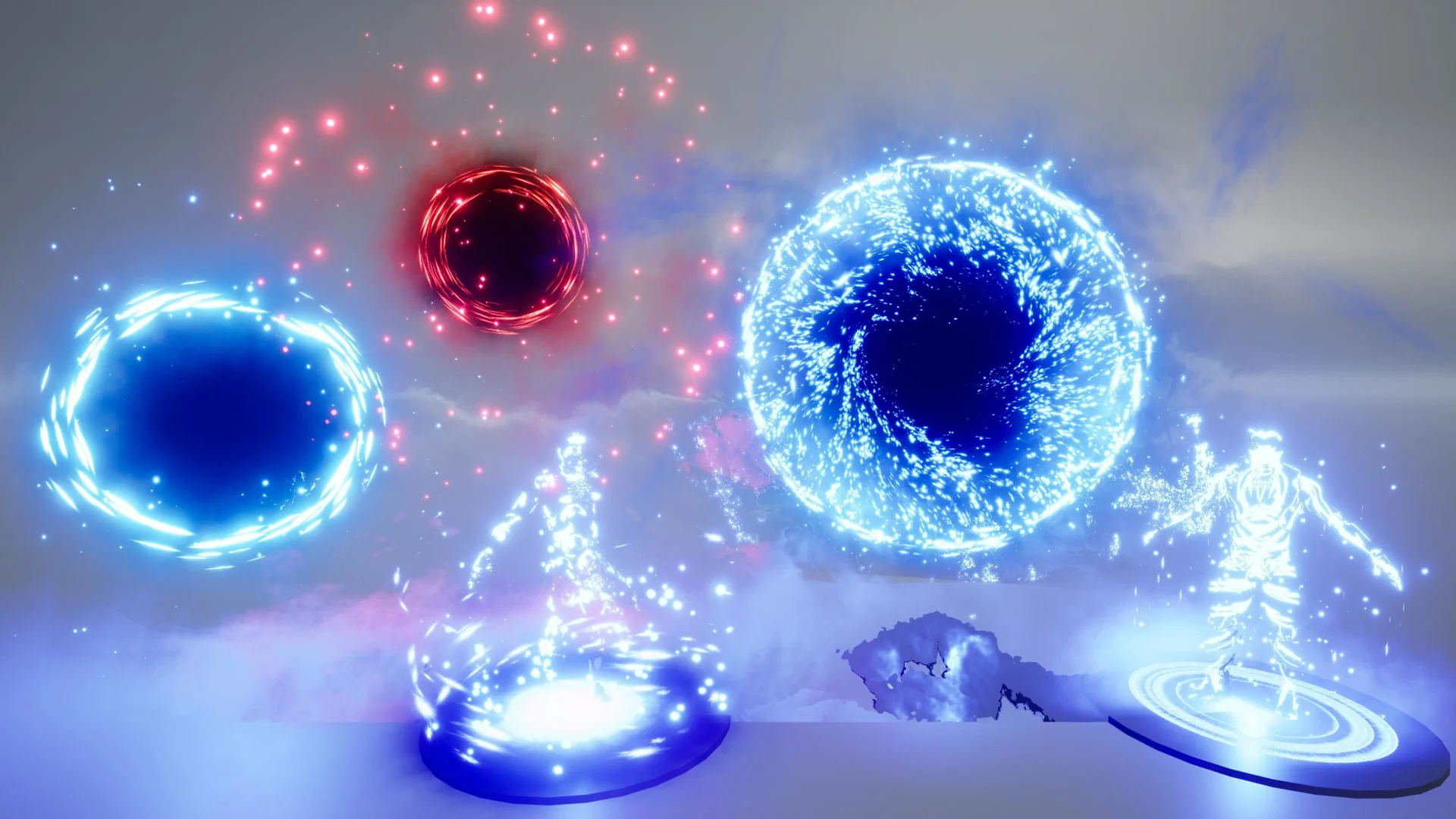
Beyond weapon fire, futuristic environments rely on spatial distortions and atmospheric details to establish an alien or high-tech setting. Portals and gates serve as transport hubs, jump points, or teleportation stations. These assets supply visible boundaries and energy barriers to delineate access points or level transitions across industrial facilities and starships. For more extreme physical scenarios, deep space anomalies such as black holes create gravitational focal points within a scene, drawing the viewer's eye toward intense cosmic disruptions.
Information delivery in science-fiction environments frequently shifts away from physical monitors toward projection systems. Integrated hologram effects support interactive interfaces, tactical readouts, and holographic projection props. Environmental continuity is reinforced through atmospheric particle components, including drifts of smoke, escaping steam jets, dynamic dust clouds, lightning strikes, and twisting tornadoes. These elements allow artists to populate derelict industrial bays, terraformed planetary surfaces, or damaged spaceship corridors with coherent ambient activity.
Transform Adjustments in the Starter VFX Architecture
Adapting particle systems across different map scales and prop sizes often presents technical hurdles in modern engines. To prevent manual emitter-by-emitter resizing, this collection incorporates an Easy Scale System. Artists can adjust the overall footprint of an effect directly from the standard Transform menu inside the editor viewport. Resizing the root transform dynamically alters the visual volume of the particle simulation without demanding deep edits inside the emitter stack.
Certain dynamic behaviors—such as directional velocities, turbulence fields, and gravity acceleration—can interact unpredictably when parent hierarchies are scaled uniformly. Under specific setup conditions, users need to activate the Local Emitter toggle on the affected systems. Turning on this setting forces internal particle calculations to evaluate within local coordinate space rather than world space, ensuring that forces, drags, and acceleration paths scale reliably alongside the primary mesh or blueprint transform.
Resource Inventory and Structural Composition
Underpinning the visual effects is a modular set of engine assets balanced to minimize setup overhead while maintaining visual diversity across levels:
97 Materials: Providing specialized surface shaders, energy fresnels, additive glows, distortion masks, and impact decals.
81 Textures: Supplying sprite sheets, noise patterns, mask channels, and particulate lookups required across the Niagara simulations.
14 Unique Meshes: Delivering tailored geometric shapes used to emit particles, define shockwave rings, form shield hulls, and focus energy beams.
1 Blueprint: Providing core functional logic to preview, coordinate, or trigger specific effect behaviors during project setup.
Prototyping Context and Development Ecosystem
Early-stage production requires systems that establish functional gameplay loops before final art passes take place. By supplying complete event feedback—ranging from initial muzzle flash and traveling laser to the final impact explosion, electric arc, or blood splatter—teams can balance gameplay timing, test encounter clarity, and evaluate combat readability without waiting for dedicated technical art passes. The included gates, tornadoes, and black holes similarly clarify level objectives and environmental hazards from the earliest prototype stages.
This collection also shares functional parallels with other specialized libraries created by the same developer. Creators who work across various rendering setups or visual styles can integrate this pack alongside the Niagara Realistic Starter VFX Pack, Water Starter VFX Pack, or earlier Cascade-based releases such as the Realistic Starter VFX Pack and Destructible Props. For character-focused pipelines, the developer has also provided targeted character setups such as the LizardMan Pack and Lizardman Shaman.
For independent developers, technical artists, and level designers blocking out sci-fi environments, the package establishes an immediate functional baseline. Its combination of accessible transform scaling, comprehensive combat types, and deep atmospheric coverage eliminates the need to author foundational effects from scratch, accelerating the path from an empty test level to a fully readable prototype.
 Variety
 Variety
 Variety