"b00678cacce53329"{"id":"1002823","slug":"niagara-ribbon-examples","title":"Niagara Ribbon examples","category":"Weather","engine":"4.26+,5.0+","assetVersion":"","engineVersion":"Engine Version: 4.26+,5.0+","tag":"Weather","accent":"blue","visual":"mech","summary":"Explore Niagara Ribbon examples featuring lightning, procedural tree structures, and conceptual systems for real-time visual effects.","platform":"Unreal Engine","indexPolicy":"index","publishedAt":"2026-11-20T07:58:36.251Z","updatedAt":"2026-11-20T07:58:36.251Z","sourceNotes":[],"fileContents":[],"compatibility":["Unreal Engine","Engine Version: 4.26+,5.0+"],"featuredImage":{"alt":"Niagara Ribbon examples","src":"/wp-content/uploads/published/2026/11/2d56e9a2782a-7cb66038-81bf-4e32-af4a-5aaf65747410-f9a90f0f60.webp"},"fileSizeBytes":440933117,"hasDownloadLink":true,"downloads":0,"terms":[{"taxonomy":"category","slug":"weather-vfx","name":"Weather"}],"galleryImages":[{"src":"/wp-content/uploads/published/2026/11/38bd78d7bb4d-0cf573f3-3716-42a2-8037-349a20fd4669-11593f4521.webp","alt":"Niagara Ribbon examples"},{"src":"/wp-content/uploads/published/2026/11/f9b23df07795-df20e346-7f54-40e8-8d03-1d9cae71871f-5c68320a88.webp","alt":"Niagara Ribbon examples"},{"src":"/wp-content/uploads/published/2026/11/2151070852ff-46570dd2-5470-4f4a-a837-c2aa06e4ee6e-e27f0fed8a.webp","alt":"Niagara Ribbon examples"},{"src":"/wp-content/uploads/published/2026/11/f7c1d0fc42ff-e5dd679c-341d-4b1e-a6c9-3f7947b45103-ed6534f730.webp","alt":"Niagara Ribbon examples"},{"src":"/wp-content/uploads/published/2026/11/5c001b3be2b5-90abbc4b-b707-4b01-bcc0-b4e2caa10432-72b9755bee.webp","alt":"Niagara Ribbon examples"},{"src":"/wp-content/uploads/published/2026/11/e31bc6c814ae-b7d6347d-5d3a-45dc-b454-3cc8b175782c-03da48ba5d.webp","alt":"Niagara Ribbon examples"},{"src":"/wp-content/uploads/published/2026/11/77eff24106cd-4140a6d9-5a21-4c81-93f3-e358b7b77ca7-c03b07a469.webp","alt":"Niagara Ribbon examples"},{"src":"/wp-content/uploads/published/2026/11/215911b9409b-151553f9-df7a-44b8-ae4c-ebd5ddbd7f8a-85a4a7b2ab.webp","alt":"Niagara Ribbon examples"},{"src":"/wp-content/uploads/published/2026/11/00fd2d0d31c1-6a2338d4-c75c-48b9-b3e8-b8b0a97aec79-e086ba6c38.webp","alt":"Niagara Ribbon examples"},{"src":"/wp-content/uploads/published/2026/11/9675d92e1bda-1ceff624-d269-4b91-8569-78a7bee0f1e7-aeaa0b2dc7.webp","alt":"Niagara Ribbon examples"}],"accessPanel":{"kind":"resource","title":"Get this resource","safetyNote":"Resources are manually reviewed before listing to improve quality and reduce obvious risks.","fileName":"Niagara Ribbon examples.7z","resourceType":"Resource archive","versions":[]},"contentHtml":"\u003ch2\u003eProcedural Arcs in Niagara Ribbon Lightning\u003c/h2\u003e\n\u003cp\u003eConnecting discrete particles into continuous, unbroken geometry is the defining strength of ribbon renderers within the Niagara framework. In standard particle setups, high-velocity electrical bursts often separate into disjointed sprites unless spawn rates are pushed to extreme densities. The lightning systems within Niagara Ribbon examples take the opposite approach by using ribbons to generate continuous paths that hold their form across sudden direction changes and jagged offsets.\u003c/p\u003e\n\u003cp\u003eRibbons calculate continuity by evaluating particles along an ordered sequence. When constructing lightning, individual particles act as control vertices along an electrical arc. As an emitter seeds positions between start and end vectors, ribbon renderers interpolate geometry between those points instantaneously. Jitter, displacement, and branching behavior can be applied to the underlying particle coordinates without ripping the visual mesh apart. The package then offers a unified bolt that maintains consistent surface thickness, sharp angle pivots, and clean texture coordinate distribution from the discharge origin down to the strike target.\u003c/p\u003e\n\u003cp\u003eBecause lightning requires high visual impact within extremely short lifespans, ribbon-based arcs offer distinct performance advantages. Rather than relying on heavy geometric meshes or overdrawn billboard clusters, a ribbon emitter generates lightweight polygonal strips on the fly. The continuous strip allows electric glow, noise textures, and energy gradients to travel seamlessly along the path of the bolt, capturing the erratic nature of high-voltage discharges while keeping particle counts tightly managed.\u003c/p\u003e \u003ch2\u003eOrganic Structures Formed with Ribbon Trees\u003c/h2\u003e\n\u003cp\u003eWhile ribbon renderers are frequently reserved for ephemeral energy bursts, projectile trails, or weapon swings, their procedural properties also translate directly into structural modeling. The tree examples in the collection demonstrate how connected particle ribbons can construct branching, organic silhouettes that resemble trunks, limbs, and natural canopies.\u003c/p\u003e\n\u003cp\u003eGenerating tree forms with ribbons relies on sustained particle paths where particles persist over time or spawn in cascading parent-child relationships. An initial emitter drives the core trunk upward, laying down ribbon geometry that defines primary girth and upward taper. Secondary emitters can sample coordinates along the primary ribbon, spawning child ribbons that diverge at outward angles to establish major boughs and secondary twigs. Controlling particle scale over life directly dictates ribbon width, allowing stems to narrow naturally toward their tips.\u003c/p\u003e\n\u003cp\u003eThis organic application showcases how continuous geometry can bridge the gap between static environmental modeling and dynamic VFX. When ribbon-based trees are integrated into a scene, their geometry remains fundamentally procedural. Wind forces, directional turbulence, and growth animations can be introduced directly at the emitter stage, producing vegetation that reacts, sways, or materializes through particle simulation rather than traditional skeletal rigs or vertex animation textures.\u003c/p\u003e \u003ch2\u003eAbstract Geometry in Conceptual Systems\u003c/h2\u003e\n\u003cp\u003eBeyond recognizable physical phenomena like lightning and vegetation, Niagara Ribbon examples provides a series of conceptual systems designed to test ribbon behavior under non-standard mathematical rules. These setups step away from literal environmental elements to showcase how continuous strips behave when driven by abstract mathematical functions, algorithmic pathing, and complex velocity fields.\u003c/p\u003e\n\u003cp\u003eIn conceptual ribbon setups, particle motion is frequently dictated by vector math such as curl noise, spiral vortexes, harmonic oscillations, and custom coordinate transforms. As particles navigate these mathematical fields, the ribbon trails leave behind geometric traces of the simulation. A system driven by tight rotational forces creates complex woven tubes and helices, while broad, chaotic noise fields produce oscillating planar ribbons that flutter and fold across three-dimensional space.\u003c/p\u003e\n\u003cp\u003eThese conceptual demonstrations serve as a sandbox for exploring how ribbons handle severe geometric deformation. When particle velocities cross paths or fold back on themselves, ribbons must manage twisting, edge alignment, and UV stretching. Observing these conceptual systems in motion reveals how tangent calculation and normal generation operate across ribbon vertices, providing practical insights for artists looking to design sci-fi anomalies, magical glyphs, dimensional rifts, or procedural motion graphics.\u003c/p\u003e \u003ch2\u003eDeconstructing Niagara Ribbon Workflows\u003c/h2\u003e\n\u003cp\u003eWorking effectively with ribbons requires an understanding of specific Niagara module stacks that do not apply to conventional sprite or mesh emitters. Ribbon emitters require strict particle indexing to determine which particle connects to which, preventing ribbon segments from erroneously linking across separate visual clusters.\u003c/p\u003e\n\u003cp\u003eA primary mechanic illustrated throughout these examples is the assignment of Ribbon IDs. When a single emitter generates multiple lightning branches or several independent tree limbs, each distinct strand must carry a unique Ribbon ID attribute. The ribbon renderer groups particles sharing the same ID and sorts them according to their age or an explicit normalized ribbon link parameter. Without proper Ribbon ID management, an emitter spawning multiple bolts or branches simultaneously would create unwanted webbing geometry stretching between completely unrelated particles.\u003c/p\u003e\n\u003cp\u003eTexture coordinate generation represents another core component of these ribbon workflows. Unlike static models with pre-unwrapped UV layouts, ribbons generate their texture mapping dynamically along their length and across their width. In the lightning and conceptual examples, the U-coordinate typically tracks the distance from the particle of origin to the newest particle, allowing directional energy pulses or jagged mask textures to tile fluidly along the beam. The V-coordinate spans across the width of the ribbon, facilitating soft falloff edges, core luminance gradients, and double-sided material behaviors.\u003c/p\u003e\n\u003cp\u003eTo assist with dissecting these modular setups, the creator provides dedicated video tutorials exploring the underlying architecture of the project. These walkthroughs unpack module ordering, parameter linking, and emitter settings, helping users translate the project's foundational logic into their own custom Niagara systems.\u003c/p\u003e \u003ch2\u003eImplementing Ribbon Demonstrations in Real-Time Production\u003c/h2\u003e\n\u003cp\u003eThe specialized setups within this package provide practical foundations across several game and cinematic production scenarios. Visual effects artists building stormy environments, high-fantasy spellcraft, or electrified weaponry can adapt the lightning ribbon emitter modules to generate immediate, high-fidelity strikes without starting from an empty emitter stack.\u003c/p\u003e\n\u003cp\u003eFor environment and world-building teams, the procedural tree setups demonstrate alternative methods for populating surreal biomes, alien worlds, or dynamic background landscapes. Because the branches are formed from live particle ribbons, they can be configured to sprout dynamically during gameplay events, regenerate following destruction, or dissolve into ambient embers.\u003c/p\u003e\n\u003cp\u003eThe conceptual systems serve as valuable reference points for technical artists focused on advanced procedural motion. By reviewing how ribbon renderers react to multi-axis acceleration, particle ordering, and varying width curves, developers gain clear models for building custom UI elements, motion-tracked holographic effects, and intricate spell arrays. The included demonstrations confirm that Niagara ribbons remain among the most flexible geometry-generation tools available for real-time visual development.\u003c/p\u003e\n\n\u003ch2\u003eExplore Similar Assets\u003c/h2\u003e\n\u003cul\u003e\n\u003cli\u003e\u003ca href=\"https://3dcghub.com/lazy-godray/\" rel=\"noopener noreferrer\"\u003eLazy Godray\u003c/a\u003e\u003c/li\u003e\n\u003cli\u003e\u003ca href=\"https://3dcghub.com/good-fx-rain/\" rel=\"noopener noreferrer\"\u003eGood FX : Rain\u003c/a\u003e\u003c/li\u003e\n\u003cli\u003e\u003ca href=\"https://3dcghub.com/niagara-weather/\" rel=\"noopener noreferrer\"\u003eNiagara Weather\u003c/a\u003e\u003c/li\u003e\n\u003cli\u003e\u003ca href=\"https://3dcghub.com/natural-and-insects-p1/\" rel=\"noopener noreferrer\"\u003eNatural And Insects P1\u003c/a\u003e\u003c/li\u003e\n\u003cli\u003e\u003ca href=\"https://3dcghub.com/ja-silent-hill-2-fog-vfx/\" rel=\"noopener noreferrer\"\u003eJA - Silent Hill 2 Fog VFX\u003c/a\u003e\u003c/li\u003e\n\u003c/ul\u003e","contentTextLength":7977,"navigation":{"current":57,"total":4797,"previous":{"id":"1002824","slug":"niagara-sci-fi-starter-vfx-pack","title":"Niagara Sci-Fi Starter VFX Pack","category":"Variety","platform":"Unreal Engine","updatedAt":"2026-11-20T08:01:46.751Z"},"next":{"id":"1002822","slug":"niagara-ray-vfx-pack-energy-ray-hit-effects","title":"Niagara Ray VFX Pack (Energy, Ray, Hit Effects)","category":"Spells \u0026 Combat","platform":"Unreal Engine","updatedAt":"2026-11-20T07:57:41.195Z"}},"relatedResources":[{"id":"1002798","slug":"lazy-godray","title":"Lazy Godray","category":"Weather","engine":"4.24+,5.0+","assetVersion":"","engineVersion":"Engine Version: 4.24+,5.0+","tag":"Weather","accent":"blue","visual":"mech","summary":"Build isolated, geometry-driven atmospheric light shafts in Unreal Engine using Lazy Godray's unlit VFX Blueprint, Niagara dust, and overdraw-friendly setups.","platform":"Unreal Engine","indexPolicy":"index","publishedAt":"2026-11-20T07:22:44.806Z","updatedAt":"2026-11-20T07:22:44.806Z","sourceNotes":[],"fileContents":[],"compatibility":["Unreal Engine","Engine Version: 4.24+,5.0+"],"featuredImage":{"alt":"Lazy Godray","src":"/wp-content/uploads/published/2026/11/b18aed2fadeb-fa8f6687-466f-4236-95f1-769b3e9241c4-2664a28dc5.webp"},"fileSizeBytes":62915299,"hasDownloadLink":true,"downloads":0},{"id":"1001731","slug":"good-fx-rain","title":"Good FX : Rain","category":"Weather","engine":"4.25+,5.0+","assetVersion":"","engineVersion":"Engine Version: 4.25+,5.0+","tag":"Weather","accent":"blue","visual":"mech","summary":"Good FX: Rain delivers a drag-and-drop Niagara rain and splash simulation with Blueprint controls for spawn rate, scale, color, and range.","platform":"Unreal Engine","indexPolicy":"index","publishedAt":"2026-10-20T02:37:07.841Z","updatedAt":"2026-10-20T02:37:07.841Z","sourceNotes":[],"fileContents":[],"compatibility":["Unreal Engine","Engine Version: 4.25+,5.0+"],"featuredImage":{"alt":"Good FX : Rain","src":"/wp-content/uploads/published/2026/10/8582e50667f8-77fae63e-f4e9-45c9-8e22-f2cb6c8749f0-441821f992.webp"},"fileSizeBytes":20099958,"hasDownloadLink":true,"downloads":1},{"id":"1002132","slug":"niagara-weather","title":"Niagara Weather","category":"Weather","engine":"4.27+,5.0+","assetVersion":"","engineVersion":"Engine Version: 4.27+,5.0+","tag":"Weather","accent":"blue","visual":"mech","summary":"Niagara Weather supplies 20 Niagara systems for Unreal Engine, featuring rain, snow, blizzard, wind, and falling leaves for environment design.","platform":"Unreal Engine","indexPolicy":"index","publishedAt":"2026-10-29T09:13:04.872Z","updatedAt":"2026-10-29T09:13:04.872Z","sourceNotes":[],"fileContents":[],"compatibility":["Unreal Engine","Engine Version: 4.27+,5.0+"],"featuredImage":{"alt":"Niagara Weather","src":"/wp-content/uploads/published/2026/10/131d02cfc31a-58cf1805-d8b9-4879-be71-3617e3c4d33a-f934227ba1.webp"},"fileSizeBytes":28604211,"hasDownloadLink":true,"downloads":0}]}
Resource screenshots
1 / 10
Join our channel
Follow 3DCGHUB on Telegram for new resource drops, migration updates, and community notices.
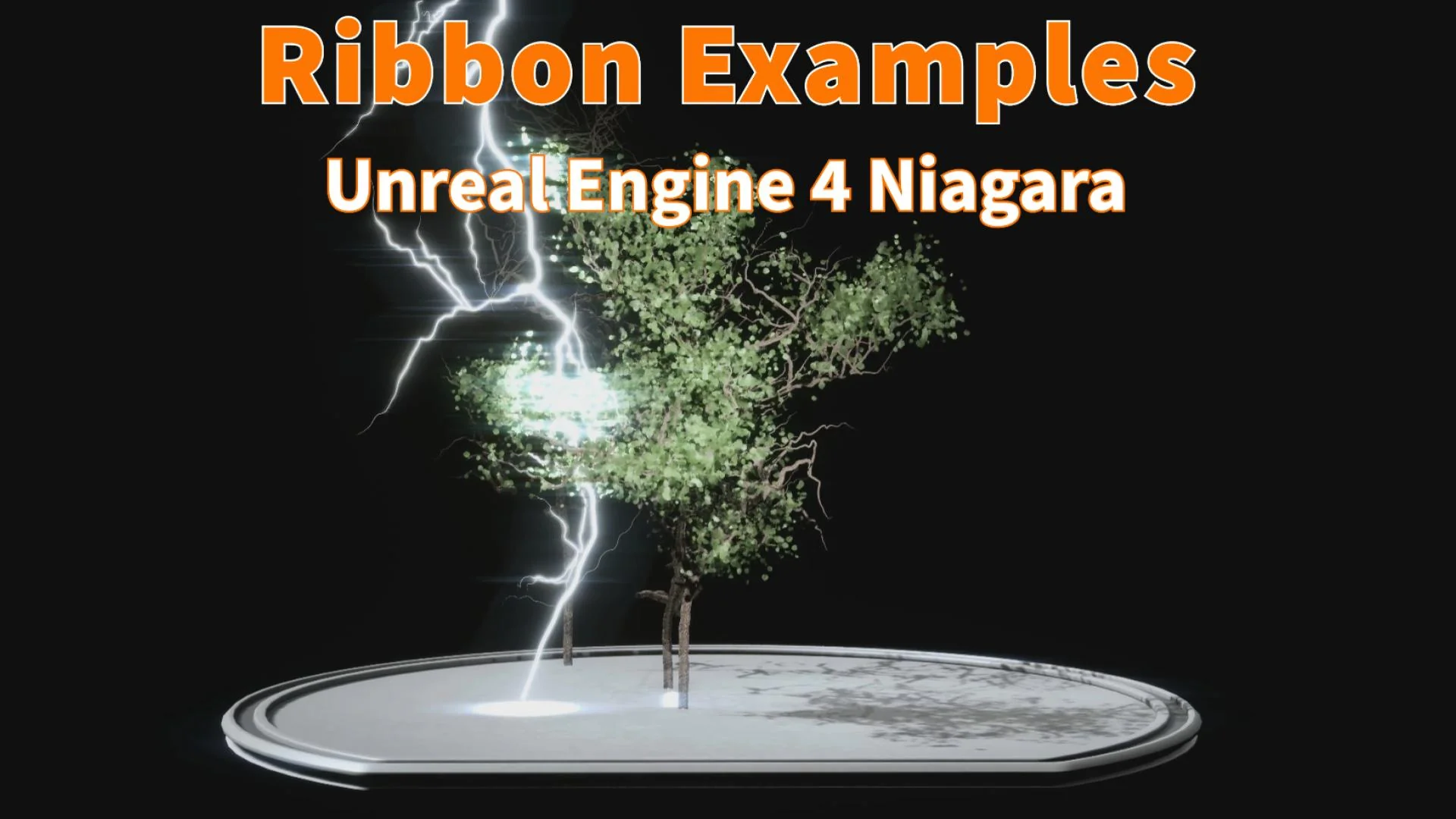
Connecting discrete particles into continuous, unbroken geometry is the defining strength of ribbon renderers within the Niagara framework. In standard particle setups, high-velocity electrical bursts often separate into disjointed sprites unless spawn rates are pushed to extreme densities. The lightning systems within Niagara Ribbon examples take the opposite approach by using ribbons to generate continuous paths that hold their form across sudden direction changes and jagged offsets.
Ribbons calculate continuity by evaluating particles along an ordered sequence. When constructing lightning, individual particles act as control vertices along an electrical arc. As an emitter seeds positions between start and end vectors, ribbon renderers interpolate geometry between those points instantaneously. Jitter, displacement, and branching behavior can be applied to the underlying particle coordinates without ripping the visual mesh apart. The package then offers a unified bolt that maintains consistent surface thickness, sharp angle pivots, and clean texture coordinate distribution from the discharge origin down to the strike target.
Because lightning requires high visual impact within extremely short lifespans, ribbon-based arcs offer distinct performance advantages. Rather than relying on heavy geometric meshes or overdrawn billboard clusters, a ribbon emitter generates lightweight polygonal strips on the fly. The continuous strip allows electric glow, noise textures, and energy gradients to travel seamlessly along the path of the bolt, capturing the erratic nature of high-voltage discharges while keeping particle counts tightly managed.
Organic Structures Formed with Ribbon Trees
While ribbon renderers are frequently reserved for ephemeral energy bursts, projectile trails, or weapon swings, their procedural properties also translate directly into structural modeling. The tree examples in the collection demonstrate how connected particle ribbons can construct branching, organic silhouettes that resemble trunks, limbs, and natural canopies.
Generating tree forms with ribbons relies on sustained particle paths where particles persist over time or spawn in cascading parent-child relationships. An initial emitter drives the core trunk upward, laying down ribbon geometry that defines primary girth and upward taper. Secondary emitters can sample coordinates along the primary ribbon, spawning child ribbons that diverge at outward angles to establish major boughs and secondary twigs. Controlling particle scale over life directly dictates ribbon width, allowing stems to narrow naturally toward their tips.
This organic application showcases how continuous geometry can bridge the gap between static environmental modeling and dynamic VFX. When ribbon-based trees are integrated into a scene, their geometry remains fundamentally procedural. Wind forces, directional turbulence, and growth animations can be introduced directly at the emitter stage, producing vegetation that reacts, sways, or materializes through particle simulation rather than traditional skeletal rigs or vertex animation textures.
Abstract Geometry in Conceptual Systems
Beyond recognizable physical phenomena like lightning and vegetation, Niagara Ribbon examples provides a series of conceptual systems designed to test ribbon behavior under non-standard mathematical rules. These setups step away from literal environmental elements to showcase how continuous strips behave when driven by abstract mathematical functions, algorithmic pathing, and complex velocity fields.
In conceptual ribbon setups, particle motion is frequently dictated by vector math such as curl noise, spiral vortexes, harmonic oscillations, and custom coordinate transforms. As particles navigate these mathematical fields, the ribbon trails leave behind geometric traces of the simulation. A system driven by tight rotational forces creates complex woven tubes and helices, while broad, chaotic noise fields produce oscillating planar ribbons that flutter and fold across three-dimensional space.
These conceptual demonstrations serve as a sandbox for exploring how ribbons handle severe geometric deformation. When particle velocities cross paths or fold back on themselves, ribbons must manage twisting, edge alignment, and UV stretching. Observing these conceptual systems in motion reveals how tangent calculation and normal generation operate across ribbon vertices, providing practical insights for artists looking to design sci-fi anomalies, magical glyphs, dimensional rifts, or procedural motion graphics.
Deconstructing Niagara Ribbon Workflows
Working effectively with ribbons requires an understanding of specific Niagara module stacks that do not apply to conventional sprite or mesh emitters. Ribbon emitters require strict particle indexing to determine which particle connects to which, preventing ribbon segments from erroneously linking across separate visual clusters.
A primary mechanic illustrated throughout these examples is the assignment of Ribbon IDs. When a single emitter generates multiple lightning branches or several independent tree limbs, each distinct strand must carry a unique Ribbon ID attribute. The ribbon renderer groups particles sharing the same ID and sorts them according to their age or an explicit normalized ribbon link parameter. Without proper Ribbon ID management, an emitter spawning multiple bolts or branches simultaneously would create unwanted webbing geometry stretching between completely unrelated particles.
Texture coordinate generation represents another core component of these ribbon workflows. Unlike static models with pre-unwrapped UV layouts, ribbons generate their texture mapping dynamically along their length and across their width. In the lightning and conceptual examples, the U-coordinate typically tracks the distance from the particle of origin to the newest particle, allowing directional energy pulses or jagged mask textures to tile fluidly along the beam. The V-coordinate spans across the width of the ribbon, facilitating soft falloff edges, core luminance gradients, and double-sided material behaviors.
To assist with dissecting these modular setups, the creator provides dedicated video tutorials exploring the underlying architecture of the project. These walkthroughs unpack module ordering, parameter linking, and emitter settings, helping users translate the project's foundational logic into their own custom Niagara systems.
Implementing Ribbon Demonstrations in Real-Time Production
The specialized setups within this package provide practical foundations across several game and cinematic production scenarios. Visual effects artists building stormy environments, high-fantasy spellcraft, or electrified weaponry can adapt the lightning ribbon emitter modules to generate immediate, high-fidelity strikes without starting from an empty emitter stack.
For environment and world-building teams, the procedural tree setups demonstrate alternative methods for populating surreal biomes, alien worlds, or dynamic background landscapes. Because the branches are formed from live particle ribbons, they can be configured to sprout dynamically during gameplay events, regenerate following destruction, or dissolve into ambient embers.
The conceptual systems serve as valuable reference points for technical artists focused on advanced procedural motion. By reviewing how ribbon renderers react to multi-axis acceleration, particle ordering, and varying width curves, developers gain clear models for building custom UI elements, motion-tracked holographic effects, and intricate spell arrays. The included demonstrations confirm that Niagara ribbons remain among the most flexible geometry-generation tools available for real-time visual development.
 Weather
 Weather
 Weather