"148d1066ed74e216"{"id":"1002924","slug":"miss-no-hit","title":"Miss No Hit","category":"Engine Tools","engine":"5.3","assetVersion":"Asset Version: 1.32","engineVersion":"Engine Version: 5.3","tag":"Engine Tools","accent":"blue","visual":"mech","summary":"Miss No Hit is a multithreaded hit detection system performing volume-wide traces across hitboxes, solving fast-movement gaps in melee and combat gameplay.","platform":"Unreal Engine","indexPolicy":"index","publishedAt":"2026-11-21T22:49:53.601Z","updatedAt":"2026-11-21T22:49:53.601Z","sourceNotes":[],"fileContents":[],"compatibility":["Unreal Engine","Asset Version: 1.32","Engine Version: 5.3"],"featuredImage":{"alt":"Miss No Hit","src":"/wp-content/uploads/published/2026/11/cc128179b5e2-7212844a-9f07-44f3-ae6f-65cfe82f44e3-c49d6e0212.webp"},"fileSizeBytes":314904,"hasDownloadLink":true,"downloads":0,"terms":[{"taxonomy":"category","slug":"engine-tools-tools-and-plugins","name":"Engine Tools"}],"galleryImages":[{"src":"/wp-content/uploads/published/2026/11/0266fe84b55d-604e5553-4655-4de3-b135-f37467a31ee1-b537d8a4c7.webp","alt":"Miss No Hit"},{"src":"/wp-content/uploads/published/2026/11/0d4238f02b06-7478ba70-e9db-43cd-8bd2-76850f951ea0-52348cc98c.webp","alt":"Miss No Hit"},{"src":"/wp-content/uploads/published/2026/11/398017bcc666-6c1a4448-78db-46c7-beb8-0652ed4c5759-ef05fdda6c.webp","alt":"Miss No Hit"},{"src":"/wp-content/uploads/published/2026/11/3da92636aa98-9427e50a-03bd-49b0-9b11-aa8331c50b15-22d63ab971.webp","alt":"Miss No Hit"},{"src":"/wp-content/uploads/published/2026/11/1b0cc66a0dd0-0625e8cb-5ace-415e-bd40-bed6b457e9a0-ad2ffe3650.webp","alt":"Miss No Hit"},{"src":"/wp-content/uploads/published/2026/11/802b6c6f45a6-ced009a8-dfd1-4dcc-b6db-b79b25eea89a-01714fb9d7.webp","alt":"Miss No Hit"},{"src":"/wp-content/uploads/published/2026/11/bb6937b74d77-84ce769a-985f-4042-a412-7d76214485e2-d266491a75.webp","alt":"Miss No Hit"},{"src":"/wp-content/uploads/published/2026/11/79b35201999f-512fde81-927a-419b-a1e6-b3c451868e24-a9eb488b8c.webp","alt":"Miss No Hit"}],"accessPanel":{"kind":"resource","title":"Get this resource","safetyNote":"Resources are manually reviewed before listing to improve quality and reduce obvious risks.","fileName":"Miss No Hit.7z","resourceType":"Resource archive","versions":[]},"contentHtml":"\u003ch2\u003eHigh-Speed Combat and the Challenge of Detection Gaps\u003c/h2\u003e\u003cp\u003eFast-paced melee combat, rapid projectile sweeps, and erratic character movements frequently expose the weaknesses of conventional collision systems. In dynamic gameplay, swinging a greatsword, executing a swift martial arts combo, or triggering high-velocity sweeping strikes requires instantaneous collision feedback. When actions move too quickly across frames, basic collision systems fail to register impacts, breaking player immersion and introducing gameplay inconsistencies.\u003c/p\u003e\u003cp\u003eStandard collision checks relying strictly on primitive overlap events often struggle during intense gameplay. When a character weapon or damaging volume travels across a wide arc between two successive frames, the physical volume teleports from one transformation to the next rather than sweeping smoothly through the intervening air. If an enemy stands between those two sampled positions, an overlap check might never detect the interaction. Fluctuating frame rates compound this issue, stretching the distance covered per frame and widening the window where strikes pass straight through targets without triggering contact.\u003c/p\u003e\u003cp\u003eA common workaround involves casting line traces between an object's current and previous locations. While this provides a rudimentary bridge across temporal gaps, line traces bring substantial processing burdens when scaled across multiple combatants or complex weapon geometries. More importantly, isolated line traces trace only narrow strands of space, leaving massive spatial gaps between the lines where targets can slip through undetected. Miss No Hit counters these systemic pitfalls by executing traces against the entire volume of the hitbox, ensuring no empty pockets remain for strikes to miss.\u003c/p\u003e\u003ch2\u003eMiss No Hit Architectural Foundations and Performance Engineering\u003c/h2\u003e\u003cp\u003eProcessing hit checks across entire hitbox volumes demands careful computational architecture, especially when multiple actors, weapons, and environmental sweeps occur at the same instant. Miss No Hit tackles this through multithreaded core logic written in C++ that is intentionally cache-friendly and shaped by modern hardware constraints. Rather than bogging down the main game thread with sequential trace evaluations, the underlying code distributes calculations efficiently across available cores.\u003c/p\u003e\u003cp\u003eMemory management plays a central role in sustaining high trace volumes without causing micro-stutters or frame drops. Miss No Hit utilizes memory pooling to handle tracer allocations. Repeatedly creating and destroying collision query data structures during rapid swings causes heap fragmentation and spikes garbage collection overhead. By reusing allocated memory pools, the system keeps execution paths lean and predictable under sustained combat conditions.\u003c/p\u003e\u003cp\u003eComplementing memory pooling is tick aggregation. Rather than allowing hundreds of independent components to tick unpredictably across the frame, the system groups trace updates together to reduce component update overhead. Through the combined application of multithreading, memory pooling, and tick aggregation, Miss No Hit can process thousands of tracers simultaneously with minimal impact on overall game performance. This capacity allows developers to deploy detailed, volumetric trace fields across chaotic battlefield scenarios, large skirmishes, or multi-weapon combinations without sacrificing framerate stability.\u003c/p\u003e\u003ch2\u003eCustomizing Trace Behaviors Within Miss No Hit\u003c/h2\u003e\u003cp\u003eDifferent combat scenarios require distinct approaches to temporal sampling. A slow, heavy hammer swing demands different update cadence than a rapid-fire flurry of daggers or an area-of-effect sweep. Miss No Hit provides customizable tick behavior to adapt trace execution directly to the gameplay context. Creators can configure the system to operate under three distinct timing modes: tick-by-distance, fixed rate tick, and match game tick.\u003c/p\u003e\u003cp\u003eTick-by-distance mode triggers collision evaluations based on spatial displacement rather than time. If a weapon moves only a fraction of an inch during an idle breath, the system conserves computational resources by withholding traces. As soon as a rapid swing commences, the tracer samples points proportionally to the physical distance covered through the air. This ensures dense coverage during high-speed arcs while preventing unnecessary checks when moving slowly.\u003c/p\u003e\u003cp\u003eFixed rate tick establishes an independent temporal cadence for hit evaluations. This mode decouples trace frequency from dynamic framerate swings, ensuring that hit detection fidelity remains completely consistent whether the game runs at thirty, sixty, or one hundred twenty frames per second. For projects that prefer absolute synchronization with native rendering and simulation cycles, the match game tick mode aligns trace updates directly with the engine's primary game tick, integrating hit checks seamlessly into the standard per-frame update loop.\u003c/p\u003e\u003ch2\u003eHit Filtering and Exposed Trace Controls\u003c/h2\u003e\u003cp\u003eRegistering a hit is not merely about finding geometric intersection; it requires granular control over what gets struck and how that event is processed. Miss No Hit exposes deep trace settings that give developers precise authority over collision parameters. Designers can tune exactly how the hitbox checks geometry, sweeping custom volumes through the game world to match the physical forms of swords, claws, shields, or spell effects.\u003c/p\u003e\u003cp\u003eHit filtering options expand this precision further by determining how hit registration operates once contact occurs. In complex combat scenes, sweeps might intersect friendly allies, corpses, destructible props, or overlapping enemy hitboxes. Filtering controls allow designers to isolate valid combat targets, manage single-target versus multi-target penetration, ignore specific collision layers, and prevent duplicate hit registrations from a single continuous swing. This gives combat designers the exact levers required to build tight, reliable gameplay feels, from heavy cleaving blows that pass through multiple foes to razor-sharp parrying zones that demand surgical precision.\u003c/p\u003e\u003ch2\u003eWorkflow Integration Across Blueprints, C++, and Anim Notifies\u003c/h2\u003e\u003cp\u003eA hit detection framework must integrate smoothly into production pipelines across multiple disciplines, from technical animators timing swings to programmers structuring combat mechanics. Miss No Hit meets developers across their preferred toolsets, offering complete control through C++, Blueprints, and Anim Notifies.\u003c/p\u003e\u003cp\u003eFor Blueprint users, the system features an intuitive and clutter-free interface. The details panel automatically reveals relevant parameters based on current configuration choices while hiding irrelevant options. This contextual filtering keeps the workspace clean, preventing designers from having to navigate sprawling lists of unused settings when configuring a simple weapon trace. Technical animators can embed Anim Notifies directly within attack animations, activating and deactivating volume traces exactly at the start and end of combat swing arcs. Gameplay programmers seeking low-level access can interface directly with the C++ architecture to construct custom combat logic, link traces into specialized damage pipelines, or coordinate complex sweep behaviors.\u003c/p\u003e\u003cp\u003eDevelopers building melee action titles, dynamic action RPGs, or high-speed fighting systems will benefit most from this framework. By replacing porous overlap tests and incomplete line arrays with multithreaded volume tracing, Miss No Hit delivers reliable impact registration for high-velocity combat scenes.\u003c/p\u003e\n\n\u003ch2\u003eExplore Similar Assets\u003c/h2\u003e\n\u003cul\u003e\n\u003cli\u003e\u003ca href=\"https://3dcghub.com/did-it-hit-trace-detection-plugin/\" rel=\"noopener noreferrer\"\u003eDid it hit - Trace Detection Plugin\u003c/a\u003e\u003c/li\u003e\n\u003cli\u003e\u003ca href=\"https://3dcghub.com/asian-music-pack-ghost-of-asia-no-ai-just-talent/\" rel=\"noopener noreferrer\"\u003eAsian Music Pack - Ghost of Asia - No AI, Just Talent\u003c/a\u003e\u003c/li\u003e\n\u003cli\u003e\u003ca href=\"https://3dcghub.com/ultimate-hit-reaction-system/\" rel=\"noopener noreferrer\"\u003eUltimate Hit Reaction System\u003c/a\u003e\u003c/li\u003e\n\u003cli\u003e\u003ca href=\"https://3dcghub.com/slash-and-hit-vfx-with-sfx/\" rel=\"noopener noreferrer\"\u003eSlash and Hit VFX (with SFX)\u003c/a\u003e\u003c/li\u003e\n\u003cli\u003e\u003ca href=\"https://3dcghub.com/insta-deform-component/\" rel=\"noopener noreferrer\"\u003eInsta Deform Component\u003c/a\u003e\u003c/li\u003e\n\u003c/ul\u003e","contentTextLength":7778,"navigation":{"current":48,"total":4890,"previous":{"id":"1002925","slug":"multi-objects-renaming-tool-rename-assets-and-actors","title":"Multi Objects Renaming Tool (Rename Assets \u0026 Actors)","category":"Engine Tools","platform":"Unreal Engine","updatedAt":"2026-11-21T22:53:51.900Z"},"next":{"id":"1002923","slug":"interactive-objects-system","title":"Interactive Objects System","category":"Action-Adventure","platform":"Unreal Engine","updatedAt":"2026-11-21T22:49:10.238Z"}},"relatedResources":[{"id":"13853","slug":"did-it-hit-trace-detection-plugin","title":"Did it hit - Trace Detection Plugin","category":"Engine Tools","engine":"4.25 - 5.8","assetVersion":"Asset Version:1.1.0 - 1.5","engineVersion":"Engine version: 4.25 - 5.8","tag":"Engine Tools","accent":"blue","visual":"luts","summary":"Solve the issue of skipped collisions in fast-paced games. This plugin provides a high-performance tracing system for bullets and weapon swings that standard colliders might miss.","platform":"Unreal Engine","indexPolicy":"noindex","publishedAt":"2026-03-11T10:23:29.000Z","updatedAt":"2026-09-29T08:41:33.282Z","sourceNotes":[],"fileContents":[],"compatibility":["Unreal Engine","Asset Version:1.1.0 - 1.5","Engine version: 4.25 - 5.8"],"featuredImage":{"alt":"Did it hit - Trace Detection Plugin","src":"https://3dcghub.com/wp-content/uploads/2026/03/bd3e4c0f-52b7-4c26-a033-df949ae21c94.webp"},"fileSizeBytes":135486939,"hasDownloadLink":true,"downloads":0},{"id":"1001953","slug":"asian-music-pack-ghost-of-asia-no-ai-just-talent","title":"Asian Music Pack - Ghost of Asia - No AI, Just Talent","category":"Music","engine":"5.0+","assetVersion":"","engineVersion":"Engine Version: 5.0+","tag":"Music","accent":"blue","visual":"audio","summary":"Handcrafted orchestral music featuring traditional Asian flutes, strings, and vocals for RPGs, MMOs, quiet towns, exploration, and stealth.","platform":"Unreal Engine","indexPolicy":"index","publishedAt":"2026-10-24T11:31:57.915Z","updatedAt":"2026-10-24T11:31:57.915Z","sourceNotes":[],"fileContents":[],"compatibility":["Unreal Engine","Engine Version: 5.0+"],"featuredImage":{"alt":"Asian Music Pack - Ghost of Asia - No AI, Just Talent","src":"/wp-content/uploads/published/2026/10/687c95442102-9761f1dd-7c47-440a-ae95-ddbb2cefd578-c9a71ba18e.webp"},"fileSizeBytes":337306595,"hasDownloadLink":true,"downloads":0},{"id":"1001475","slug":"ultimate-hit-reaction-system","title":"Ultimate Hit Reaction System","category":"Gameplay Features","engine":"5.6+","assetVersion":"","engineVersion":"Engine Version: 5.6+","tag":"Gameplay Features","accent":"blue","visual":"mech","summary":"A deep dive into the Ultimate Hit Reaction System for Unreal Engine, covering its 168 mocap animations, Chooser Tables, Motion Warping, and IK integration.","platform":"Unreal Engine","indexPolicy":"index","publishedAt":"2026-10-08T08:28:50.048Z","updatedAt":"2026-10-08T08:28:50.048Z","sourceNotes":[],"fileContents":[],"compatibility":["Unreal Engine","Engine Version: 5.6+"],"featuredImage":{"alt":"Ultimate Hit Reaction System","src":"/wp-content/uploads/published/2026/10/8833d5e34c3d-c4d6cc46-3a57-4651-a1d2-e8585976b5ea-a14898b9cd.webp"},"fileSizeBytes":208071510,"hasDownloadLink":true,"downloads":3}]}[{"id":4225,"sourceId":4225,"taxonomyId":4225,"taxonomy":"category","slug":"asset-library","name":"Asset Library","parentId":null,"count":4744,"hasChildren":true,"href":"/","seoTitle":"Free Game Assets Library | 3DCGHUB","seoDescription":"Browse free Unreal Engine, Unity, Blender assets and game development tutorials on 3DCGHUB with previews, compatibility notes, and secure downloads.","sitemapEnabled":true,"children":[{"id":4227,"sourceId":4227,"taxonomyId":4227,"taxonomy":"category","slug":"blender-add-ons-plugins","name":"Blender Add-ons \u0026 Plugins","parentId":4225,"count":10,"hasChildren":false,"href":"/category/blender-add-ons-plugins/","seoTitle":"Free Blender Add-ons \u0026 Plugins | 3DCGHUB","seoDescription":"Browse free Blender Add-ons \u0026 Plugins tools for Blender on 3DCGHUB: curated downloads with preview images, compatibility notes and secure download access.","sitemapEnabled":true},{"id":514,"sourceId":514,"taxonomyId":514,"taxonomy":"category","slug":"unity-2","name":"Unity","parentId":4225,"count":453,"hasChildren":true,"href":"/category/unity-2/","seoTitle":"Free Unity Assets | 3DCGHUB","seoDescription":"Browse free Unity resources on 3DCGHUB: curated downloads with preview images, compatibility notes and secure download access.","sitemapEnabled":true,"children":[{"id":523,"sourceId":523,"taxonomyId":523,"taxonomy":"category","slug":"2d","name":"2D","parentId":514,"count":1,"hasChildren":true,"href":"/category/2d/","seoTitle":"Free Unity 2D | 3DCGHUB","seoDescription":"Browse free 2D assets for Unity on 3DCGHUB: curated downloads with preview images, compatibility notes and secure download access.","sitemapEnabled":true},{"id":515,"sourceId":515,"taxonomyId":515,"taxonomy":"category","slug":"3d-unity-2","name":"3D","parentId":514,"count":162,"hasChildren":true,"href":"/category/3d-unity-2/","seoTitle":"Free Unity 3D Assets | 3DCGHUB","seoDescription":"Browse free 3D assets for Unity on 3DCGHUB: curated downloads with preview images, compatibility notes and secure download access.","sitemapEnabled":true},{"id":565,"sourceId":565,"taxonomyId":565,"taxonomy":"category","slug":"add-ons","name":"Add-Ons","parentId":514,"count":2,"hasChildren":false,"href":"/category/add-ons/","seoTitle":"Free Unity Add-Ons | 3DCGHUB","seoDescription":"Browse free Add-Ons assets for Unity on 3DCGHUB: curated downloads with preview images, compatibility notes and secure download access.","sitemapEnabled":true},{"id":529,"sourceId":529,"taxonomyId":529,"taxonomy":"category","slug":"audio-unity-2","name":"Audio","parentId":514,"count":1,"hasChildren":true,"href":"/category/audio-unity-2/","seoTitle":"Free Unity Audio | 3DCGHUB","seoDescription":"Browse free Audio for Unity on 3DCGHUB: curated downloads with preview images, compatibility notes and secure download access.","sitemapEnabled":true},{"id":557,"sourceId":557,"taxonomyId":557,"taxonomy":"category","slug":"templates","name":"Templates","parentId":514,"count":36,"hasChildren":true,"href":"/category/templates/","seoTitle":"Free Unity Templates | 3DCGHUB","seoDescription":"Browse free Unity project templates on 3DCGHUB. Starter kits with previews, compatibility notes, and secure download access.","sitemapEnabled":true},{"id":533,"sourceId":533,"taxonomyId":533,"taxonomy":"category","slug":"tools-unity-2","name":"Tools","parentId":514,"count":0,"hasChildren":true,"href":"/category/tools-unity-2/","sitemapEnabled":true},{"id":554,"sourceId":554,"taxonomyId":554,"taxonomy":"category","slug":"vfx-unity-2","name":"VFX","parentId":514,"count":4,"hasChildren":true,"href":"/category/vfx-unity-2/","seoTitle":"Free Unity VFX | 3DCGHUB","seoDescription":"Browse free VFX for Unity on 3DCGHUB: curated downloads with preview images, compatibility notes and secure download access.","sitemapEnabled":true}]},{"id":511,"sourceId":511,"taxonomyId":511,"taxonomy":"category","slug":"unreal-engine-2","name":"Unreal Engine","parentId":4225,"count":4282,"hasChildren":true,"href":"/category/unreal-engine-2/","seoTitle":"Free Unreal Engine Assets | 3DCGHUB","seoDescription":"Browse free Unreal Engine resources on 3DCGHUB: curated downloads with preview images, compatibility notes and secure download access.","sitemapEnabled":true,"children":[{"id":54,"sourceId":54,"taxonomyId":54,"taxonomy":"category","slug":"3d","name":"3D","parentId":511,"count":2428,"hasChildren":true,"href":"/category/3d/","seoTitle":"Free Unreal Engine 3D | 3DCGHUB","seoDescription":"Browse free 3D assets for Unreal Engine on 3DCGHUB: curated downloads with preview images, compatibility notes and secure download access.","sitemapEnabled":true},{"id":441,"sourceId":441,"taxonomyId":441,"taxonomy":"category","slug":"animations","name":"Animations","parentId":511,"count":245,"hasChildren":true,"href":"/category/animations/","seoTitle":"Free Unreal Engine Animations | 3DCGHUB","seoDescription":"Browse free Animations for Unreal Engine on 3DCGHUB: curated downloads with preview images, compatibility notes and secure download access.","sitemapEnabled":true},{"id":446,"sourceId":446,"taxonomyId":446,"taxonomy":"category","slug":"audio","name":"Audio","parentId":511,"count":63,"hasChildren":true,"href":"/category/audio/","seoTitle":"Free Unreal Engine Audio Resources | 3DCGHUB","seoDescription":"Browse free Unreal Engine audio resources including sound effects, voices, dialogue, and ambient sounds. Curated free downloads on 3DCGHUB.","sitemapEnabled":true},{"id":466,"sourceId":466,"taxonomyId":466,"taxonomy":"category","slug":"game-systems","name":"Game Systems","parentId":511,"count":356,"hasChildren":true,"href":"/category/game-systems/","seoTitle":"Free Unreal Engine Game Systems | 3DCGHUB","seoDescription":"Browse free Game Systems tools for Unreal Engine on 3DCGHUB: curated downloads with preview images, compatibility notes and secure download access.","sitemapEnabled":true},{"id":478,"sourceId":478,"taxonomyId":478,"taxonomy":"category","slug":"game-templates","name":"Game Templates","parentId":511,"count":150,"hasChildren":true,"href":"/category/game-templates/","seoTitle":"Free Unreal Engine Game Templates | 3DCGHUB","seoDescription":"Browse free Game Templates for Unreal Engine on 3DCGHUB: curated downloads with preview images, compatibility notes and secure download access.","sitemapEnabled":true},{"id":432,"sourceId":432,"taxonomyId":432,"taxonomy":"category","slug":"hdri","name":"HDRI","parentId":511,"count":6,"hasChildren":true,"href":"/category/hdri/","seoTitle":"Free Unreal Engine HDRI | 3DCGHUB","seoDescription":"Browse free Unreal Engine HDRI skies and lighting maps on 3DCGHUB. Environment lighting with previews and secure downloads.","sitemapEnabled":true},{"id":228,"sourceId":228,"taxonomyId":228,"taxonomy":"category","slug":"material-and-textures","name":"Material \u0026 Textures","parentId":511,"count":172,"hasChildren":true,"href":"/category/material-and-textures/","seoTitle":"Free Unreal Engine Material \u0026 Textures | 3DCGHUB","seoDescription":"Browse free Material \u0026 Textures for Unreal Engine on 3DCGHUB: curated downloads with preview images, compatibility notes and secure download access.","sitemapEnabled":true},{"id":298,"sourceId":298,"taxonomyId":298,"taxonomy":"category","slug":"sprites-and-flipbooks","name":"Sprites \u0026 Flipbooks","parentId":511,"count":17,"hasChildren":true,"href":"/category/sprites-and-flipbooks/","seoTitle":"Free Unreal Engine Sprites \u0026 Flipbooks | 3DCGHUB","seoDescription":"Browse free Sprites \u0026 Flipbooks assets for Unreal Engine on 3DCGHUB: curated downloads with preview images, compatibility notes and secure download access.","sitemapEnabled":true},{"id":489,"sourceId":489,"taxonomyId":489,"taxonomy":"category","slug":"tools-and-plugins","name":"Tools \u0026 Plugins","parentId":511,"count":390,"hasChildren":true,"href":"/category/tools-and-plugins/","seoTitle":"Free Unreal Engine Tools \u0026 Plugins | 3DCGHUB","seoDescription":"Browse free Tools \u0026 Plugins for Unreal Engine on 3DCGHUB: curated downloads with preview images, compatibility notes and secure download access.","sitemapEnabled":true},{"id":459,"sourceId":459,"taxonomyId":459,"taxonomy":"category","slug":"ui","name":"UI","parentId":511,"count":43,"hasChildren":true,"href":"/category/ui/","seoTitle":"Free Unreal Engine UI | 3DCGHUB","seoDescription":"Browse free UI for Unreal Engine on 3DCGHUB: curated downloads with preview images, compatibility notes and secure download access.","sitemapEnabled":true},{"id":450,"sourceId":450,"taxonomyId":450,"taxonomy":"category","slug":"vfx","name":"VFX","parentId":511,"count":412,"hasChildren":true,"href":"/category/vfx/","seoTitle":"Free Unreal Engine VFX | 3DCGHUB","seoDescription":"Browse free VFX for Unreal Engine on 3DCGHUB: curated downloads with preview images, compatibility notes and secure download access.","sitemapEnabled":true}]}]},{"id":4222,"sourceId":4222,"taxonomyId":4222,"taxonomy":"category","slug":"tutorial-library","name":"Tutorial Library","parentId":null,"count":117,"hasChildren":false,"href":"/tutorials/","seoTitle":"Free Game Development Tutorial Library | 3DCGHUB","seoDescription":"Browse free game development tutorials for Unreal Engine, Unity, Blender, and more on 3DCGHUB with practical workflows and secure downloads.","sitemapEnabled":true}]
Resource screenshots
1 / 8
Join our channel
Follow 3DCGHUB on Telegram for new resource drops, migration updates, and community notices.
Resources are manually reviewed before listing to improve quality and reduce obvious risks.
No account required
Engine Tools
Miss No Hit
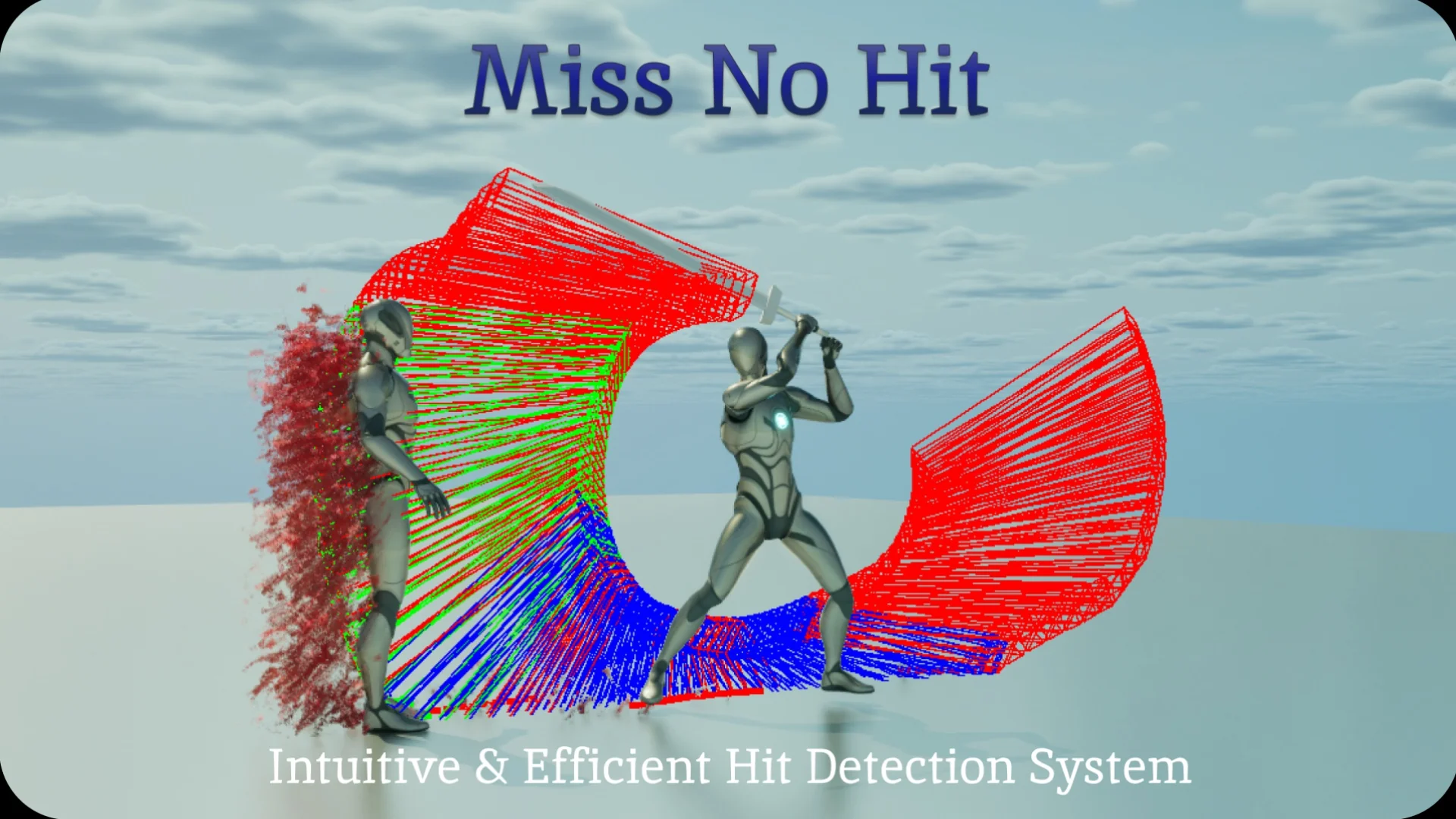
Miss No Hit is a multithreaded hit detection system performing volume-wide traces across hitboxes, solving fast-movement gaps in melee and combat gameplay.
High-Speed Combat and the Challenge of Detection Gaps
Fast-paced melee combat, rapid projectile sweeps, and erratic character movements frequently expose the weaknesses of conventional collision systems. In dynamic gameplay, swinging a greatsword, executing a swift martial arts combo, or triggering high-velocity sweeping strikes requires instantaneous collision feedback. When actions move too quickly across frames, basic collision systems fail to register impacts, breaking player immersion and introducing gameplay inconsistencies.
Standard collision checks relying strictly on primitive overlap events often struggle during intense gameplay. When a character weapon or damaging volume travels across a wide arc between two successive frames, the physical volume teleports from one transformation to the next rather than sweeping smoothly through the intervening air. If an enemy stands between those two sampled positions, an overlap check might never detect the interaction. Fluctuating frame rates compound this issue, stretching the distance covered per frame and widening the window where strikes pass straight through targets without triggering contact.
A common workaround involves casting line traces between an object's current and previous locations. While this provides a rudimentary bridge across temporal gaps, line traces bring substantial processing burdens when scaled across multiple combatants or complex weapon geometries. More importantly, isolated line traces trace only narrow strands of space, leaving massive spatial gaps between the lines where targets can slip through undetected. Miss No Hit counters these systemic pitfalls by executing traces against the entire volume of the hitbox, ensuring no empty pockets remain for strikes to miss.
Miss No Hit Architectural Foundations and Performance Engineering
Processing hit checks across entire hitbox volumes demands careful computational architecture, especially when multiple actors, weapons, and environmental sweeps occur at the same instant. Miss No Hit tackles this through multithreaded core logic written in C++ that is intentionally cache-friendly and shaped by modern hardware constraints. Rather than bogging down the main game thread with sequential trace evaluations, the underlying code distributes calculations efficiently across available cores.
Memory management plays a central role in sustaining high trace volumes without causing micro-stutters or frame drops. Miss No Hit utilizes memory pooling to handle tracer allocations. Repeatedly creating and destroying collision query data structures during rapid swings causes heap fragmentation and spikes garbage collection overhead. By reusing allocated memory pools, the system keeps execution paths lean and predictable under sustained combat conditions.
Complementing memory pooling is tick aggregation. Rather than allowing hundreds of independent components to tick unpredictably across the frame, the system groups trace updates together to reduce component update overhead. Through the combined application of multithreading, memory pooling, and tick aggregation, Miss No Hit can process thousands of tracers simultaneously with minimal impact on overall game performance. This capacity allows developers to deploy detailed, volumetric trace fields across chaotic battlefield scenarios, large skirmishes, or multi-weapon combinations without sacrificing framerate stability.
Customizing Trace Behaviors Within Miss No Hit
Different combat scenarios require distinct approaches to temporal sampling. A slow, heavy hammer swing demands different update cadence than a rapid-fire flurry of daggers or an area-of-effect sweep. Miss No Hit provides customizable tick behavior to adapt trace execution directly to the gameplay context. Creators can configure the system to operate under three distinct timing modes: tick-by-distance, fixed rate tick, and match game tick.
Tick-by-distance mode triggers collision evaluations based on spatial displacement rather than time. If a weapon moves only a fraction of an inch during an idle breath, the system conserves computational resources by withholding traces. As soon as a rapid swing commences, the tracer samples points proportionally to the physical distance covered through the air. This ensures dense coverage during high-speed arcs while preventing unnecessary checks when moving slowly.
Fixed rate tick establishes an independent temporal cadence for hit evaluations. This mode decouples trace frequency from dynamic framerate swings, ensuring that hit detection fidelity remains completely consistent whether the game runs at thirty, sixty, or one hundred twenty frames per second. For projects that prefer absolute synchronization with native rendering and simulation cycles, the match game tick mode aligns trace updates directly with the engine's primary game tick, integrating hit checks seamlessly into the standard per-frame update loop.
Hit Filtering and Exposed Trace Controls
Registering a hit is not merely about finding geometric intersection; it requires granular control over what gets struck and how that event is processed. Miss No Hit exposes deep trace settings that give developers precise authority over collision parameters. Designers can tune exactly how the hitbox checks geometry, sweeping custom volumes through the game world to match the physical forms of swords, claws, shields, or spell effects.
Hit filtering options expand this precision further by determining how hit registration operates once contact occurs. In complex combat scenes, sweeps might intersect friendly allies, corpses, destructible props, or overlapping enemy hitboxes. Filtering controls allow designers to isolate valid combat targets, manage single-target versus multi-target penetration, ignore specific collision layers, and prevent duplicate hit registrations from a single continuous swing. This gives combat designers the exact levers required to build tight, reliable gameplay feels, from heavy cleaving blows that pass through multiple foes to razor-sharp parrying zones that demand surgical precision.
Workflow Integration Across Blueprints, C++, and Anim Notifies
A hit detection framework must integrate smoothly into production pipelines across multiple disciplines, from technical animators timing swings to programmers structuring combat mechanics. Miss No Hit meets developers across their preferred toolsets, offering complete control through C++, Blueprints, and Anim Notifies.
For Blueprint users, the system features an intuitive and clutter-free interface. The details panel automatically reveals relevant parameters based on current configuration choices while hiding irrelevant options. This contextual filtering keeps the workspace clean, preventing designers from having to navigate sprawling lists of unused settings when configuring a simple weapon trace. Technical animators can embed Anim Notifies directly within attack animations, activating and deactivating volume traces exactly at the start and end of combat swing arcs. Gameplay programmers seeking low-level access can interface directly with the C++ architecture to construct custom combat logic, link traces into specialized damage pipelines, or coordinate complex sweep behaviors.
Developers building melee action titles, dynamic action RPGs, or high-speed fighting systems will benefit most from this framework. By replacing porous overlap tests and incomplete line arrays with multithreaded volume tracing, Miss No Hit delivers reliable impact registration for high-velocity combat scenes.
 Engine Tools
 Music
 Gameplay Features