"d037b61901c110d2"{"id":"1002679","slug":"mesic-flatwoods-habitat-brush","title":"Mesic Flatwoods Habitat Brush","category":"Forest \u0026 Jungle","engine":"5.0+","assetVersion":"","engineVersion":"Engine Version: 5.0+","tag":"Forest \u0026 Jungle","accent":"blue","visual":"mech","summary":"Create authentic Central Florida environments with Mesic Flatwoods Habitat Brush, featuring 134 meshes, GIS-based ecosystems, and foliage painting presets.","platform":"Unreal Engine","indexPolicy":"index","publishedAt":"2026-11-16T22:29:57.567Z","updatedAt":"2026-11-16T22:29:57.567Z","sourceNotes":[],"fileContents":[],"compatibility":["Unreal Engine","Engine Version: 5.0+"],"featuredImage":{"alt":"Mesic Flatwoods Habitat Brush","src":"/wp-content/uploads/published/2026/11/03fc5d7d5f3d-3e037f39-c3ce-41f3-940e-e68fe5760859-23ef5ead28.webp"},"fileSizeBytes":248979374,"hasDownloadLink":true,"downloads":0,"terms":[{"taxonomy":"category","slug":"forest-and-jungle","name":"Forest \u0026 Jungle"}],"galleryImages":[{"src":"/wp-content/uploads/published/2026/11/0d625a352e44-0269755d-4671-4718-814e-c2d18690c10d-c8375cef87.webp","alt":"Mesic Flatwoods Habitat Brush"},{"src":"/wp-content/uploads/published/2026/11/9af3ff0d6123-5b504126-decb-4c82-9ac9-ad06c9c89fc1-c42ef9177a.webp","alt":"Mesic Flatwoods Habitat Brush"},{"src":"/wp-content/uploads/published/2026/11/3439e69d9f94-971ff165-d7c2-40a8-9255-95e02e50ef23-8b2bfd42b7.webp","alt":"Mesic Flatwoods Habitat Brush"}],"accessPanel":{"kind":"resource","title":"Get this resource","eyebrow":"Free resource","message":"Download this resource in your browser.","fileName":"Content.7z","safetyNote":"Resources are manually reviewed before listing to improve quality and reduce obvious risks.","actionLabel":"Get this resource","resourceType":"Resource archive","versions":[]},"contentHtml":"\u003ch2\u003eAssembling Southeastern Ecosystems with Mesic Flatwoods Botany\u003c/h2\u003e\n\u003cp\u003eRecreating wild regional ecology requires assets that reflect actual plant associations rather than generic green cover. Mesic Flatwoods Habitat Brush centers on the biological makeup of Central Florida flatwoods, providing 134 unique meshes mapped directly from 33 distinct plant species. Each plant model is constructed using photographs taken in the wild, translating native botanical textures directly into real-time environments without relying on stylized approximations.\u003c/p\u003e\n\u003cp\u003eThe botanical catalog spans all vertical tiers of a Southeastern pine flatwood ecosystem:\u003c/p\u003e\n\u003cul\u003e\n\u003cli\u003e\u003cstrong\u003eOverstory and Canopy Trees:\u003c/strong\u003e Longleaf Pine, Pond Cypress, Sand Live Oak, Dahoon Holly, and Sabal Palm.\u003c/li\u003e\n\u003cli\u003e\u003cstrong\u003eMidstory Shrubs and Palms:\u003c/strong\u003e Saw Palmetto, Wax Myrtle, Fetterbush, American Beautyberry, Scrub Rosemary, and Coontie.\u003c/li\u003e\n\u003cli\u003e\u003cstrong\u003eHerbaceous Wildflowers:\u003c/strong\u003e Blazing Star, Coastalplain Honeycomb, Feay's Palafox, Flattop Goldenrod, Florida Paintbrush, Florida Tickseed, Forked Bluecurl, Goldenrod, Hooded Pitcher Plant, Rayless Sunflower, Scarlet Calamint, Shortleaf Rosegentian, St. John's Wort, Tall Jointweed, and Titusville Balm.\u003c/li\u003e\n\u003cli\u003e\u003cstrong\u003eUnderstory Grasses and Ground Plants:\u003c/strong\u003e Wiregrass, Chalky Bluestem, Lopsided Indiangrass, Bracken Fern, Prickly Pear, Reindeer Moss, and the epiphytic Spanish Moss.\u003c/li\u003e\n\u003c/ul\u003e\n\u003cp\u003eDistributing 134 unique meshes across these 33 plant species ensures natural visual variance across an entire terrain. Multiple geometry variations per species prevent obvious repetitive tiling patterns, allowing scenes to maintain believable structural irregularities across low-shrub expanses, grassy ground planes, and high tree canopies.\u003c/p\u003e \u003ch2\u003eLarge-Scale Brush Work and Density Presets\u003c/h2\u003e\n\u003cp\u003ePopulating vast geographic tracts with individual foliage instances can quickly stall development workflows. The package resolves this by supplying a dedicated landscape specifically configured for broad-scale foliage painting, paired with preset foliage densities made for covering expansive terrains. A brush size of 4000 is recommended when working with the landscape asset, enabling artists to deposit large swaths of natural community layers in broad, continuous passes.\u003c/p\u003e\n\u003cp\u003ePreset foliage densities govern how the various species interlock during the painting process. Rather than forcing manual adjustments for individual stems, the presets balance cluster spacing, distribution weight, and edge blending across open forest floors. Ground-tier species such as Wiregrass and Bracken Fern can be distributed evenly across broad areas, while taller structural elements like Longleaf Pine and Sabal Palm can be balanced through controlled scatter frequencies.\u003c/p\u003e\n\u003cp\u003eBecause the models are built as low-polygon geometry with dedicated levels of detail (LODs), wide brush painting remains viable across extensive viewing distances. Meshes transition through their respective LOD stages smoothly, limiting geometry overhead during real-time navigation across sprawling environments.\u003c/p\u003e \u003ch2\u003eMaterial Shading, Leaf Rustle, and Subsurface Light\u003c/h2\u003e\n\u003cp\u003eVegetation lighting requires specialized material handling to avoid the stiff, artificial look of opaque polygonal planes. The included plant shaders integrate subsurface scattering (SSS) maps that control light transparency and reflection on leaf surfaces. Sunlight passing through thin foliage, such as the fronds of Saw Palmetto or the delicate petals of Florida Tickseed, scatters realistically through the reverse side of the mesh, mirroring true leaf translucency.\u003c/p\u003e\n\u003cp\u003eDynamic movement is handled by an editable wind material featuring leaf rustle effects. Instead of applying uniform sway across an entire plant actor, the shader system introduces micro-motion to foliage boundaries. This allows fine grasses, slender stems like Chalky Bluestem, and suspended Spanish Moss to flutter in response to environmental drafts while rigid tree trunks remain stable. The wind parameters can be adjusted directly within the material setup to match calm forest mornings or turbulent storm conditions.\u003c/p\u003e\n\u003cp\u003eLow-polygon optimization ensures that these shader effects function efficiently within AR and VR runtimes. The combination of photographic base textures, subsurface translucency maps, and optimized polycounts keeps render calls constrained without sacrificing botanical surface fidelity up close.\u003c/p\u003e \u003ch2\u003eGround Surface Noise and Terrain Texturing\u003c/h2\u003e\n\u003cp\u003eA believable habitat floor requires continuity between underlying terrain materials and overlapping foliage bases. The asset library includes six dedicated ground materials intended for landscape painting. These materials supply foundational forest-floor textures, representing typical Florida flatwood soils, organic debris, and damp ground substrates.\u003c/p\u003e\n\u003cp\u003eTo eliminate harsh transitions where plant geometry intersects painted terrain, specialized weed meshes are supplied to introduce ground surface noise. Scattering these fine weeds across painted paths breaks up texture seams, disguises edge clipping, and adds micro-topography to flat polygons. Interweaving ground materials with low-lying Reindeer Moss, Bracken Fern patches, and weed noise produces a dense, organic matting typical of undisturbed wild flatwoods.\u003c/p\u003e \u003ch2\u003eScientific Distribution and GIS-Informed Habitat Design\u003c/h2\u003e\n\u003cp\u003eBeyond asset libraries, building ecologically valid natural scenes requires an understanding of how native species gather in real life. The package includes an example natural community and ecosystem built directly from Central Florida plant inventory records and plant distribution GIS data. This sample level serves as a spatial reference for where individual species naturally cluster, how wet-soil plants like Hooded Pitcher Plant and Pond Cypress position relative to upland pine species, and how scrub understory arranges itself beneath open pine canopies.\u003c/p\u003e\n\u003cp\u003eThis GIS-informed structure makes the asset especially valuable for educational simulation software, museum installations, environmental visualization, and research projects requiring strict ecological reality. Virtual field trips, historical landscape reconstructions, and nature walk simulations can rely on pre-mapped community logic rather than speculative plant placement.\u003c/p\u003e\n\u003cp\u003eTechnical artists, environmental level designers, and serious simulation developers gain a complete toolkit for building authentic Southeastern landscapes. With wild-photographed sources, low-poly AR/VR performance baselines, procedural wind materials, and biologically accurate density data, the collection handles both the micro-scale nuances of individual wildflowers and the macro-scale demands of expansive wilderness brush painting.\u003c/p\u003e\n\n\u003ch2\u003eMore From The Same Workflow\u003c/h2\u003e\n\u003cul\u003e\n\u003cli\u003e\u003ca href=\"https://3dcghub.com/basin-swamp-habitat-brush/\" rel=\"noopener noreferrer\"\u003eBasin Swamp Habitat Brush\u003c/a\u003e\u003c/li\u003e\n\u003cli\u003e\u003ca href=\"https://3dcghub.com/mediterranean-coast/\" rel=\"noopener noreferrer\"\u003eMediterranean Coast\u003c/a\u003e\u003c/li\u003e\n\u003cli\u003e\u003ca href=\"https://3dcghub.com/mae-oak-forest/\" rel=\"noopener noreferrer\"\u003eMAE Oak Forest\u003c/a\u003e\u003c/li\u003e\n\u003cli\u003e\u003ca href=\"https://3dcghub.com/lush-stylized-environment-set/\" rel=\"noopener noreferrer\"\u003eLUSH: Stylized Environment Set\u003c/a\u003e\u003c/li\u003e\n\u003cli\u003e\u003ca href=\"https://3dcghub.com/low-poly-nature/\" rel=\"noopener noreferrer\"\u003eLow Poly Nature\u003c/a\u003e\u003c/li\u003e\n\u003c/ul\u003e","contentTextLength":6745,"navigation":{"current":10,"total":4611,"previous":{"id":"1002680","slug":"modular-asian-medieval-city","title":"Modular Asian Medieval City","category":"Cities","platform":"Unreal Engine","updatedAt":"2026-11-16T22:31:22.898Z"},"next":{"id":"1002678","slug":"mediterranean-coast","title":"Mediterranean Coast","category":"Forest \u0026 Jungle","platform":"Unreal Engine","updatedAt":"2026-11-16T22:29:16.177Z"}},"relatedResources":[{"id":"1002688","slug":"scrubby-flatwoods-habitat-brush","title":"Scrubby Flatwoods Habitat Brush","category":"Forest \u0026 Jungle","engine":"5.0+","assetVersion":"","engineVersion":"Engine Version: 5.0+","tag":"Forest \u0026 Jungle","accent":"blue","visual":"mech","summary":"Examine the Scrubby Flatwoods Habitat Brush, featuring Central Florida plant species like Longleaf Pine, Saw Palmetto, and Wiregrass for virtual environments.","platform":"Unreal Engine","indexPolicy":"index","publishedAt":"2026-11-16T22:45:18.155Z","updatedAt":"2026-11-16T22:45:18.155Z","sourceNotes":[],"fileContents":[],"compatibility":["Unreal Engine","Engine Version: 5.0+"],"featuredImage":{"alt":"Scrubby Flatwoods Habitat Brush","src":"/wp-content/uploads/published/2026/11/685ed7892533-26771ffd-4d04-4070-ba79-cea84eac19f3-2307013c68.webp"},"fileSizeBytes":214594549,"hasDownloadLink":true,"downloads":0},{"id":"1002652","slug":"basin-swamp-habitat-brush","title":"Basin Swamp Habitat Brush","category":"Forest \u0026 Jungle","engine":"5.0+","assetVersion":"","engineVersion":"Engine Version: 5.0+","tag":"Forest \u0026 Jungle","accent":"blue","visual":"mech","summary":"Explore the Basin Swamp Habitat Brush, featuring 17 photorealistic low-poly plant species, 73 unique meshes, GIS-based ecosystems, and terrain painting tools.","platform":"Unreal Engine","indexPolicy":"index","publishedAt":"2026-11-16T21:51:27.105Z","updatedAt":"2026-11-16T21:51:27.105Z","sourceNotes":[],"fileContents":[],"compatibility":["Unreal Engine","Engine Version: 5.0+"],"featuredImage":{"alt":"Basin Swamp Habitat Brush","src":"/wp-content/uploads/published/2026/11/9654da7ee0c1-3a2a75b8-9cbc-41fe-9dbe-399c0dbbb761-9f225abda9.webp"},"fileSizeBytes":204506307,"hasDownloadLink":true,"downloads":0},{"id":"1002678","slug":"mediterranean-coast","title":"Mediterranean Coast","category":"Forest \u0026 Jungle","engine":"5.0+","assetVersion":"","engineVersion":"Engine Version: 5.0+","tag":"Forest \u0026 Jungle","accent":"blue","visual":"mech","summary":"Explore the Mediterranean Coast environment map, featuring Nanite-enabled foliage in 5.1, landscape paint tools, background mountains, and wind systems.","platform":"Unreal Engine","indexPolicy":"index","publishedAt":"2026-11-16T22:29:16.177Z","updatedAt":"2026-11-16T22:29:16.177Z","sourceNotes":[],"fileContents":[],"compatibility":["Unreal Engine","Engine Version: 5.0+"],"featuredImage":{"alt":"Mediterranean Coast","src":"/wp-content/uploads/published/2026/11/7041f9ea0799-84990bdf-13d6-4a55-88be-17e2c46330b3-2a4df54cf2.webp"},"fileSizeBytes":4510029460,"hasDownloadLink":true,"downloads":0}]}
Resource screenshots
1 / 3
Forest & Jungle
Mesic Flatwoods Habitat Brush
Create authentic Central Florida environments with Mesic Flatwoods Habitat Brush, featuring 134 meshes, GIS-based ecosystems, and foliage painting presets.
Assembling Southeastern Ecosystems with Mesic Flatwoods Botany
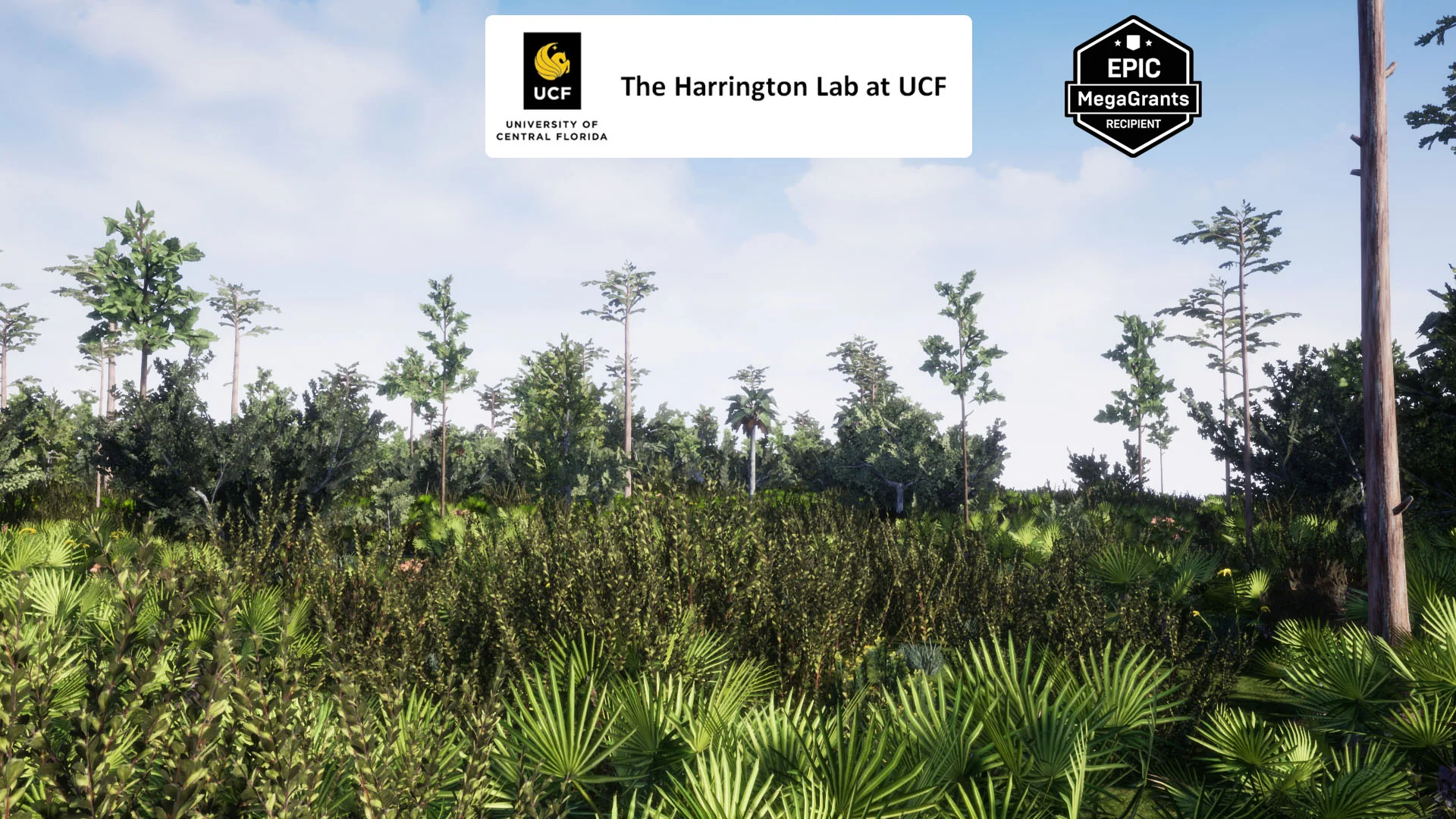
Recreating wild regional ecology requires assets that reflect actual plant associations rather than generic green cover. Mesic Flatwoods Habitat Brush centers on the biological makeup of Central Florida flatwoods, providing 134 unique meshes mapped directly from 33 distinct plant species. Each plant model is constructed using photographs taken in the wild, translating native botanical textures directly into real-time environments without relying on stylized approximations.
The botanical catalog spans all vertical tiers of a Southeastern pine flatwood ecosystem:
Overstory and Canopy Trees: Longleaf Pine, Pond Cypress, Sand Live Oak, Dahoon Holly, and Sabal Palm.
Midstory Shrubs and Palms: Saw Palmetto, Wax Myrtle, Fetterbush, American Beautyberry, Scrub Rosemary, and Coontie.
Understory Grasses and Ground Plants: Wiregrass, Chalky Bluestem, Lopsided Indiangrass, Bracken Fern, Prickly Pear, Reindeer Moss, and the epiphytic Spanish Moss.
Distributing 134 unique meshes across these 33 plant species ensures natural visual variance across an entire terrain. Multiple geometry variations per species prevent obvious repetitive tiling patterns, allowing scenes to maintain believable structural irregularities across low-shrub expanses, grassy ground planes, and high tree canopies.
Large-Scale Brush Work and Density Presets
Populating vast geographic tracts with individual foliage instances can quickly stall development workflows. The package resolves this by supplying a dedicated landscape specifically configured for broad-scale foliage painting, paired with preset foliage densities made for covering expansive terrains. A brush size of 4000 is recommended when working with the landscape asset, enabling artists to deposit large swaths of natural community layers in broad, continuous passes.
Preset foliage densities govern how the various species interlock during the painting process. Rather than forcing manual adjustments for individual stems, the presets balance cluster spacing, distribution weight, and edge blending across open forest floors. Ground-tier species such as Wiregrass and Bracken Fern can be distributed evenly across broad areas, while taller structural elements like Longleaf Pine and Sabal Palm can be balanced through controlled scatter frequencies.
Because the models are built as low-polygon geometry with dedicated levels of detail (LODs), wide brush painting remains viable across extensive viewing distances. Meshes transition through their respective LOD stages smoothly, limiting geometry overhead during real-time navigation across sprawling environments.
Material Shading, Leaf Rustle, and Subsurface Light
Vegetation lighting requires specialized material handling to avoid the stiff, artificial look of opaque polygonal planes. The included plant shaders integrate subsurface scattering (SSS) maps that control light transparency and reflection on leaf surfaces. Sunlight passing through thin foliage, such as the fronds of Saw Palmetto or the delicate petals of Florida Tickseed, scatters realistically through the reverse side of the mesh, mirroring true leaf translucency.
Dynamic movement is handled by an editable wind material featuring leaf rustle effects. Instead of applying uniform sway across an entire plant actor, the shader system introduces micro-motion to foliage boundaries. This allows fine grasses, slender stems like Chalky Bluestem, and suspended Spanish Moss to flutter in response to environmental drafts while rigid tree trunks remain stable. The wind parameters can be adjusted directly within the material setup to match calm forest mornings or turbulent storm conditions.
Low-polygon optimization ensures that these shader effects function efficiently within AR and VR runtimes. The combination of photographic base textures, subsurface translucency maps, and optimized polycounts keeps render calls constrained without sacrificing botanical surface fidelity up close.
Ground Surface Noise and Terrain Texturing
A believable habitat floor requires continuity between underlying terrain materials and overlapping foliage bases. The asset library includes six dedicated ground materials intended for landscape painting. These materials supply foundational forest-floor textures, representing typical Florida flatwood soils, organic debris, and damp ground substrates.
To eliminate harsh transitions where plant geometry intersects painted terrain, specialized weed meshes are supplied to introduce ground surface noise. Scattering these fine weeds across painted paths breaks up texture seams, disguises edge clipping, and adds micro-topography to flat polygons. Interweaving ground materials with low-lying Reindeer Moss, Bracken Fern patches, and weed noise produces a dense, organic matting typical of undisturbed wild flatwoods.
Scientific Distribution and GIS-Informed Habitat Design
Beyond asset libraries, building ecologically valid natural scenes requires an understanding of how native species gather in real life. The package includes an example natural community and ecosystem built directly from Central Florida plant inventory records and plant distribution GIS data. This sample level serves as a spatial reference for where individual species naturally cluster, how wet-soil plants like Hooded Pitcher Plant and Pond Cypress position relative to upland pine species, and how scrub understory arranges itself beneath open pine canopies.
This GIS-informed structure makes the asset especially valuable for educational simulation software, museum installations, environmental visualization, and research projects requiring strict ecological reality. Virtual field trips, historical landscape reconstructions, and nature walk simulations can rely on pre-mapped community logic rather than speculative plant placement.
Technical artists, environmental level designers, and serious simulation developers gain a complete toolkit for building authentic Southeastern landscapes. With wild-photographed sources, low-poly AR/VR performance baselines, procedural wind materials, and biologically accurate density data, the collection handles both the micro-scale nuances of individual wildflowers and the macro-scale demands of expansive wilderness brush painting.
 Forest & Jungle
 Forest & Jungle
 Forest & Jungle