"d037b61901c110d2"{"id":"1002674","slug":"low-poly-nature","title":"Low Poly Nature","category":"Forest \u0026 Jungle","engine":"5.0+","assetVersion":"","engineVersion":"Engine Version: 5.0+","tag":"Forest \u0026 Jungle","accent":"blue","visual":"mech","summary":"Explore the Low Poly Nature asset pack, featuring over 800 game-ready models, botanical flora, terrain, modular props, and Nanite and Lumen support.","platform":"Unreal Engine","indexPolicy":"index","publishedAt":"2026-11-16T22:24:45.110Z","updatedAt":"2026-11-16T22:24:45.110Z","sourceNotes":[],"fileContents":[],"compatibility":["Unreal Engine","Engine Version: 5.0+"],"featuredImage":{"alt":"Low Poly Nature","src":"/wp-content/uploads/published/2026/11/02d40754b7fb-2bf5d15c-d60b-4c05-9761-c6388af8d6b5-5cfbb89cae.webp"},"fileSizeBytes":123287532,"hasDownloadLink":true,"downloads":0,"terms":[{"taxonomy":"category","slug":"forest-and-jungle","name":"Forest \u0026 Jungle"}],"galleryImages":[{"src":"/wp-content/uploads/published/2026/11/e4787cde2909-b3f63daf-285d-404a-8380-57e41507b7a8-d8e37fcb27.webp","alt":"Low Poly Nature"},{"src":"/wp-content/uploads/published/2026/11/69829ff6b602-0005ae4d-c975-40c1-84f3-529a5956f77d-ad4b7908ce.webp","alt":"Low Poly Nature"},{"src":"/wp-content/uploads/published/2026/11/755542defe0f-7df3ee80-b458-4dbd-aa3c-addf79ba4dec-5c783dc2bb.webp","alt":"Low Poly Nature"},{"src":"/wp-content/uploads/published/2026/11/40faef26cbe5-e4fd2290-7fc4-41a3-8a85-9f7855b9b602-40e8c19095.webp","alt":"Low Poly Nature"},{"src":"/wp-content/uploads/published/2026/11/9585d821c30a-b84fbad0-a064-4e7f-ba9d-c7cfa0c5c822-1fb4179ba2.webp","alt":"Low Poly Nature"},{"src":"/wp-content/uploads/published/2026/11/1b66d5a84ca7-b599e83d-bf89-4523-865c-5413ab4a81ee-92f5967037.webp","alt":"Low Poly Nature"},{"src":"/wp-content/uploads/published/2026/11/73ebf0abe9db-07accf3b-01d3-4e61-8f31-10beb8d6dcc4-2971ac5b91.webp","alt":"Low Poly Nature"},{"src":"/wp-content/uploads/published/2026/11/31dcbbf0fd27-938d9f38-9e8e-440f-8157-360b005ebbf8-8bef9e7665.webp","alt":"Low Poly Nature"},{"src":"/wp-content/uploads/published/2026/11/3fca197d0ac4-b71ee92a-5e81-467e-8375-bcb6346273d5-49e139dc79.webp","alt":"Low Poly Nature"},{"src":"/wp-content/uploads/published/2026/11/5a85f2010677-21482e75-ab3d-4ca5-9f31-069866e80a9b-9ce89293cf.webp","alt":"Low Poly Nature"}],"accessPanel":{"kind":"resource","title":"Get this resource","eyebrow":"Free resource","message":"Download this resource in your browser.","fileName":"Content.7z","safetyNote":"Resources are manually reviewed before listing to improve quality and reduce obvious risks.","actionLabel":"Get this resource","resourceType":"Resource archive","versions":[]},"contentHtml":"\u003cp\u003eLow Poly Nature brings together over 800 game-ready 3D assets targeted at building stylized exterior environments. Rather than relying on simple abstract stand-ins, the kit balances geometric minimalism with botanical realism across various temperate, woodland, and wetland ecosystems. The collection spans structural ground meshes, full-sized forest canopies, ground-level brush, flowering field plants, weathered organic debris, and handcrafted human-made outposts, offering an expansive foundation for open-world zones, modular levels, and mobile stages.\u003c/p\u003e\u003ch2\u003eLow Poly Nature Architecture and Arboreal Variety\u003c/h2\u003e\u003cp\u003eTrees establish the primary silhouette and vertical profile of any wilderness layout. The library provides 110 primary tree meshes that cover diverse biological families and canopy silhouettes. Coniferous woodland setups rely heavily on 51 distinct pine tree meshes, which allow level designers to populate dense mountain slopes and highland forests without immediate repetition. Deciduous regions use 18 white-barked birches and 17 broad-crowned oaks to produce mixed forests, seasonal parks, or sunlit groves. For riparian zones, marshlands, and lake edges, 14 weeping willow models introduce sprawling branches and hanging foliage masses, supported by 10 additional generic trees for filling background gaps.\u003c/p\u003e\u003cp\u003eForest floors require decay and transition assets to feel cohesive. The arboreal collection accounts for ecological lifecycles by including 15 withered trees alongside detailed logging and timber debris. Designers can position 42 individual tree logs—including 12 pre-assembled log piles—as well as 19 tree trunks and stumps to indicate previous clearance or forest turnover. Surface transitions are smoothed out through 6 modular tree roots that emerge from soil geometry, alongside 13 fallen tree branches that can be scattered beneath the canopy to break up flat surfaces.\u003c/p\u003e\u003ch2\u003eUndergrowth Density: Low Poly Plants, Grasses, and Fungi\u003c/h2\u003e\u003cp\u003eMid-ground and ground-cover flora make up the largest numerical component of the collection, led by 196 flowering and leafy plant meshes. Ground coverage ranges from common underbrush to identifiable woodland wildflowers. The botanical lineup includes 36 nettles, 13 ferns, 12 wild garlic clusters, 9 shoreline reeds, and 6 young saplings. Flowering specimens add distinct color accents to green meadows, featuring 15 daisies, 13 dandelions, 9 bluebells, and 9 tall foxgloves. Aquatic environments are supported by 22 water lily meshes built to float across calm surfaces.\u003c/p\u003e\u003cp\u003eVertical surfaces such as cliffs, structural walls, and tree trunks are handled through an ivy system comprising 52 dedicated assets. This ivy set includes 20 complex climbing structures for dense coverage, 20 simplified variants for lighter surface distribution, 10 pre-grouped ivy clusters, and 2 standalone leaf models for fine manual placement. Low Poly Nature rounds out its undergrowth with 40 bush meshes, 15 of which are classified as compact shrubs, giving designers control over foliage density across fields and pathways.\u003c/p\u003e\u003cp\u003eFungi provide both realism and stylized fantasy detailing through 83 mushroom models. Several notable real-world species are represented across varying growth stages: 22 red-capped fly agarics, 15 shaggy ink caps, 13 parasol mushrooms, 12 porcini, 10 toxic death caps, 9 golden girolles, and 2 generic mushrooms. Grass coverage is equally broad, providing 80 separate grass models divided between high-detail hero clusters and simplified variants. These grass meshes are supplied in lush, dried, and mixed ecological variations, enabling visual storytelling across arid plains, wet meadows, or sun-baked roadsides.\u003c/p\u003e\u003ch2\u003eTerrain Topography, Geological Assets, and Waterplanes\u003c/h2\u003e\u003cp\u003eWorld composition begins with ground topography, which is addressed through 69 modular terrain meshes. For structural land formation, the pack includes 20 flat four-meter tiles suitable for grid-aligned bases, paths, and platforming sections. Undulating surfaces can be sculpted using 6 low hills, 16 landscape mounds, and 16 small ground piles that integrate seamlessly with the smaller vegetation. For broad world outlines and skyline silhouettes, 5 distant background mountain meshes establish high-elevation horizons, while 6 floating islands cater to non-traditional, fantasy-driven level layouts.\u003c/p\u003e\u003cp\u003eSurface transitions, transitions of elevation, and water edges leverage 35 rock models and 5 cliff assets. The stone library includes 9 ready-made rock piles to speed up prop placement in ravines, riverbeds, or scree fields. Water bodies integrate with the land geometry through 15 simple tileable water plane meshes, giving developers an efficient base for ponds, rivers, swamps, and shorelines without requiring complex dynamic simulation rigs.\u003c/p\u003e\u003ch2\u003eMan-Made Structures, Campsites, and Ruined Stonework\u003c/h2\u003e\u003cp\u003eTo support settlement boundaries, outposts, and explorer sites, the package includes modular structural pieces and camp props. Boundary delineation relies on a 50-piece modular fence set, which can be configured to enclose pastures, line dirt trails, or establish farm limits. Decaying architecture is represented by 13 ruined wall pieces, made up of 6 damaged standing wall sections, 2 rubble piles, and 5 cut stone slabs, supplemented by 7 individual wooden planks.\u003c/p\u003e\u003cp\u003eCampsites and staging areas utilize 10 campfire models. These feature two distinct campfire types, each modeled across three developmental stages to represent starting, active, and dying embers, accompanied by dedicated firewood and perimeter stone pieces. The asset pack is visually and stylistically matched to integrate directly alongside the Ultimate Low Poly Graveyards asset pack, making it possible to connect abandoned settlements, ruined shrines, and wilderness burial grounds within a single visual ecosystem.\u003c/p\u003e\u003ch2\u003ePalette Shifting and Modern Engine Integration\u003c/h2\u003e\u003cp\u003eColor grading and texture management rely on a unified texture atlas system. Models map directly to a shared palette texture, which minimizes draw calls and simplifies project-wide art direction changes. Customization requires swapping or editing only the single atlas texture, assisted by an included annotated variant that clearly maps the coordinate regions for every asset family. The collection ships with four distinct palette texture variants out of the box:\u003c/p\u003e\u003cul\u003e\u003cli\u003eBaseline, offering balanced saturation for standard stylized daylight.\u003c/li\u003e\u003cli\u003eVibrant, emphasizing heightened chroma for fantasy landscapes.\u003c/li\u003e\u003cli\u003eToned down, providing muted values for overcast, grounded scenes.\u003c/li\u003e\u003cli\u003eFlat, delivering clean, unshaded color zones for minimalist rendering.\u003c/li\u003e\u003c/ul\u003e\u003cp\u003eOn modern rendering pipelines, the static meshes within the Unreal Engine 5.x version of the pack have Nanite enabled directly, while the overall construction remains compatible with Lumen dynamic illumination. Whether targeted at mobile performance constraints or high-density modern desktop scenes, the modular assets scale effectively across diverse production workflows.\u003c/p\u003e\n\n\u003ch2\u003eRelated Resources Worth Checking\u003c/h2\u003e\n\u003cul\u003e\n\u003cli\u003e\u003ca href=\"https://3dcghub.com/basin-swamp-habitat-brush/\" rel=\"noopener noreferrer\"\u003eBasin Swamp Habitat Brush\u003c/a\u003e\u003c/li\u003e\n\u003cli\u003e\u003ca href=\"https://3dcghub.com/stylized-landscape-5-biomes-stylized-low-poly-forest-orasot-bundle/\" rel=\"noopener noreferrer\"\u003eStylized Landscape 5 Biomes + Stylized + Low poly forest : Orasot Bundle\u003c/a\u003e\u003c/li\u003e\n\u003cli\u003e\u003ca href=\"https://3dcghub.com/35-ar-vr-northeastern-us-plants-and-ecosystems/\" rel=\"noopener noreferrer\"\u003e35 AR VR Northeastern US Plants and Ecosystems\u003c/a\u003e\u003c/li\u003e\n\u003cli\u003e\u003ca href=\"https://3dcghub.com/low-poly-snow-forest/\" rel=\"noopener noreferrer\"\u003eLow Poly Snow Forest\u003c/a\u003e\u003c/li\u003e\n\u003cli\u003e\u003ca href=\"https://3dcghub.com/low-poly-rainforest-pack/\" rel=\"noopener noreferrer\"\u003eLow Poly Rainforest Pack\u003c/a\u003e\u003c/li\u003e\n\u003c/ul\u003e","contentTextLength":7203,"navigation":{"current":15,"total":4611,"previous":{"id":"1002675","slug":"low-poly-town","title":"Low Poly Town","category":"Cities","platform":"Unreal Engine","updatedAt":"2026-11-16T22:25:52.897Z"},"next":{"id":"1002673","slug":"lookout-tower","title":"Lookout Tower","category":"Forest \u0026 Jungle","platform":"Unreal Engine","updatedAt":"2026-11-16T22:23:53.864Z"}},"relatedResources":[{"id":"1002652","slug":"basin-swamp-habitat-brush","title":"Basin Swamp Habitat Brush","category":"Forest \u0026 Jungle","engine":"5.0+","assetVersion":"","engineVersion":"Engine Version: 5.0+","tag":"Forest \u0026 Jungle","accent":"blue","visual":"mech","summary":"Explore the Basin Swamp Habitat Brush, featuring 17 photorealistic low-poly plant species, 73 unique meshes, GIS-based ecosystems, and terrain painting tools.","platform":"Unreal Engine","indexPolicy":"index","publishedAt":"2026-11-16T21:51:27.105Z","updatedAt":"2026-11-16T21:51:27.105Z","sourceNotes":[],"fileContents":[],"compatibility":["Unreal Engine","Engine Version: 5.0+"],"featuredImage":{"alt":"Basin Swamp Habitat Brush","src":"/wp-content/uploads/published/2026/11/9654da7ee0c1-3a2a75b8-9cbc-41fe-9dbe-399c0dbbb761-9f225abda9.webp"},"fileSizeBytes":204506307,"hasDownloadLink":true,"downloads":0},{"id":"1000892","slug":"stylized-landscape-5-biomes-stylized-low-poly-forest-orasot-bundle","title":"Stylized Landscape 5 Biomes + Stylized + Low poly forest : Orasot Bundle","category":"Forest \u0026 Jungle","engine":"5.2+","assetVersion":"","engineVersion":"Engine Version: 5.2+","tag":"Forest \u0026 Jungle","accent":"blue","visual":"city","summary":"This bundle merges stylized forest, five-biome landscape, and low-poly forest assets with a practical exposure fix for DefaultEngine.ini and virtual texture set","platform":"Unreal Engine","indexPolicy":"index","publishedAt":"2026-08-06T04:37:15.039Z","updatedAt":"2026-08-06T04:37:15.039Z","sourceNotes":[],"fileContents":[],"compatibility":["Unreal Engine","Engine Version: 5.2+"],"featuredImage":{"alt":"Stylized Landscape 5 Biomes + Stylized + Low poly forest : Orasot Bundle","src":"/wp-content/uploads/published/2026/08/d7e4432aba24-96cbb20e-4693-449f-94da-c2b94b1eecfe-b7d03925eb.webp"},"fileSizeBytes":922868643,"hasDownloadLink":true,"downloads":3},{"id":"1001036","slug":"35-ar-vr-northeastern-us-plants-and-ecosystems","title":"35 AR VR Northeastern US Plants and Ecosystems","category":"Forest \u0026 Jungle","engine":"4.26+,5.0+","assetVersion":"","engineVersion":"Engine Version: 4.26+,5.0+","tag":"Forest \u0026 Jungle","accent":"blue","visual":"mech","summary":"A 35-plant AR/VR pack built from wild photographs, with 102 low-poly meshes, LODs, wind material, and subsurface scattering for Appalachian landscapes.","platform":"Unreal Engine","indexPolicy":"index","publishedAt":"2026-08-27T09:14:52.711Z","updatedAt":"2026-08-27T09:14:52.711Z","sourceNotes":[],"fileContents":[],"compatibility":["Unreal Engine","Engine Version: 4.26+,5.0+"],"featuredImage":{"alt":"35 AR VR Northeastern US Plants and Ecosystems","src":"/wp-content/uploads/published/2026/08/6ed0e278dc08-4e00e931-9fb3-4774-aee7-4e9de627ad0f-91681ca39c.webp"},"fileSizeBytes":526750784,"hasDownloadLink":true,"downloads":0}]}
Resource screenshots
1 / 10
Forest & Jungle
Low Poly Nature
Explore the Low Poly Nature asset pack, featuring over 800 game-ready models, botanical flora, terrain, modular props, and Nanite and Lumen support.
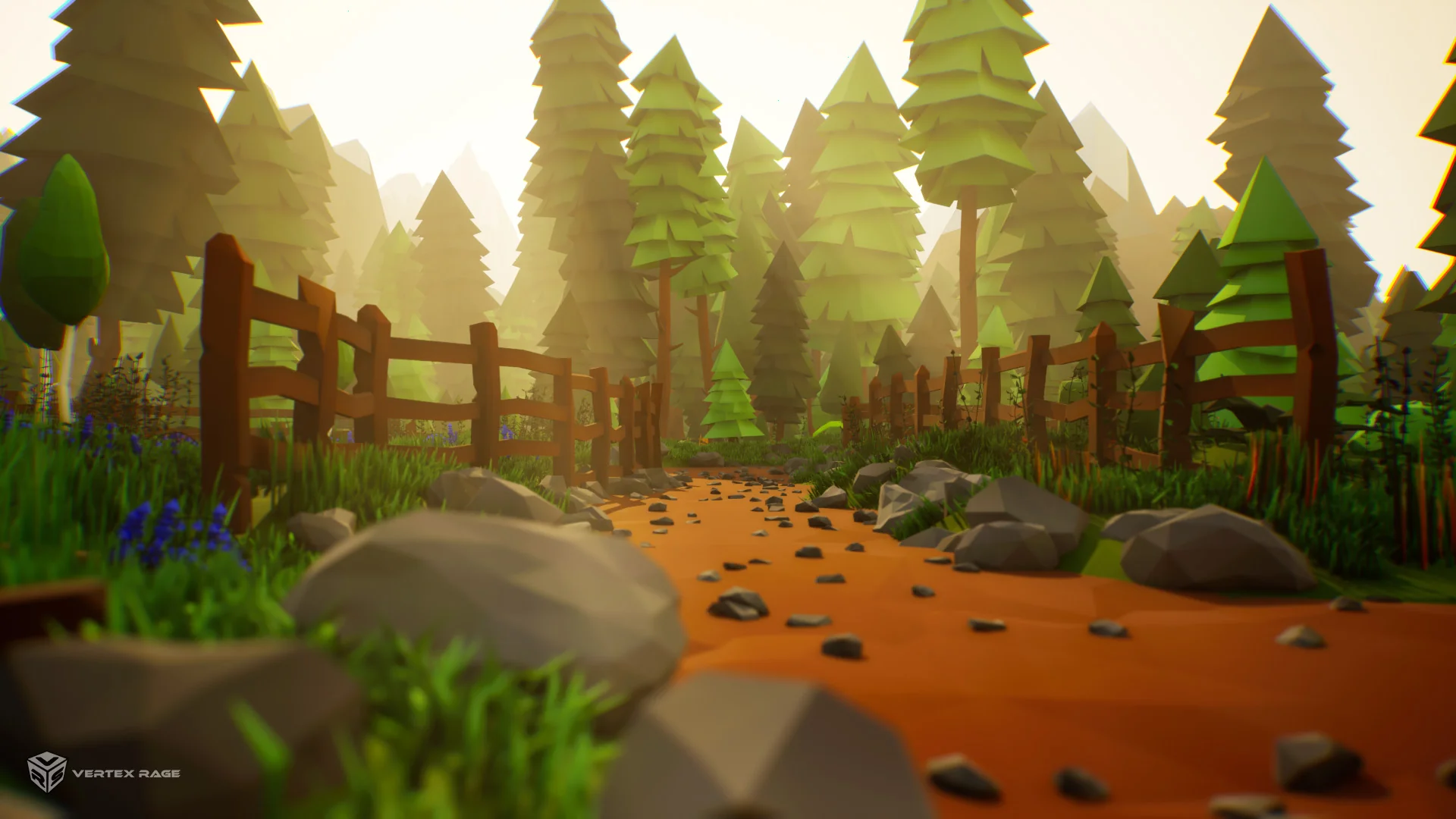
Low Poly Nature brings together over 800 game-ready 3D assets targeted at building stylized exterior environments. Rather than relying on simple abstract stand-ins, the kit balances geometric minimalism with botanical realism across various temperate, woodland, and wetland ecosystems. The collection spans structural ground meshes, full-sized forest canopies, ground-level brush, flowering field plants, weathered organic debris, and handcrafted human-made outposts, offering an expansive foundation for open-world zones, modular levels, and mobile stages.
Low Poly Nature Architecture and Arboreal Variety
Trees establish the primary silhouette and vertical profile of any wilderness layout. The library provides 110 primary tree meshes that cover diverse biological families and canopy silhouettes. Coniferous woodland setups rely heavily on 51 distinct pine tree meshes, which allow level designers to populate dense mountain slopes and highland forests without immediate repetition. Deciduous regions use 18 white-barked birches and 17 broad-crowned oaks to produce mixed forests, seasonal parks, or sunlit groves. For riparian zones, marshlands, and lake edges, 14 weeping willow models introduce sprawling branches and hanging foliage masses, supported by 10 additional generic trees for filling background gaps.
Forest floors require decay and transition assets to feel cohesive. The arboreal collection accounts for ecological lifecycles by including 15 withered trees alongside detailed logging and timber debris. Designers can position 42 individual tree logs—including 12 pre-assembled log piles—as well as 19 tree trunks and stumps to indicate previous clearance or forest turnover. Surface transitions are smoothed out through 6 modular tree roots that emerge from soil geometry, alongside 13 fallen tree branches that can be scattered beneath the canopy to break up flat surfaces.
Undergrowth Density: Low Poly Plants, Grasses, and Fungi
Mid-ground and ground-cover flora make up the largest numerical component of the collection, led by 196 flowering and leafy plant meshes. Ground coverage ranges from common underbrush to identifiable woodland wildflowers. The botanical lineup includes 36 nettles, 13 ferns, 12 wild garlic clusters, 9 shoreline reeds, and 6 young saplings. Flowering specimens add distinct color accents to green meadows, featuring 15 daisies, 13 dandelions, 9 bluebells, and 9 tall foxgloves. Aquatic environments are supported by 22 water lily meshes built to float across calm surfaces.
Vertical surfaces such as cliffs, structural walls, and tree trunks are handled through an ivy system comprising 52 dedicated assets. This ivy set includes 20 complex climbing structures for dense coverage, 20 simplified variants for lighter surface distribution, 10 pre-grouped ivy clusters, and 2 standalone leaf models for fine manual placement. Low Poly Nature rounds out its undergrowth with 40 bush meshes, 15 of which are classified as compact shrubs, giving designers control over foliage density across fields and pathways.
Fungi provide both realism and stylized fantasy detailing through 83 mushroom models. Several notable real-world species are represented across varying growth stages: 22 red-capped fly agarics, 15 shaggy ink caps, 13 parasol mushrooms, 12 porcini, 10 toxic death caps, 9 golden girolles, and 2 generic mushrooms. Grass coverage is equally broad, providing 80 separate grass models divided between high-detail hero clusters and simplified variants. These grass meshes are supplied in lush, dried, and mixed ecological variations, enabling visual storytelling across arid plains, wet meadows, or sun-baked roadsides.
Terrain Topography, Geological Assets, and Waterplanes
World composition begins with ground topography, which is addressed through 69 modular terrain meshes. For structural land formation, the pack includes 20 flat four-meter tiles suitable for grid-aligned bases, paths, and platforming sections. Undulating surfaces can be sculpted using 6 low hills, 16 landscape mounds, and 16 small ground piles that integrate seamlessly with the smaller vegetation. For broad world outlines and skyline silhouettes, 5 distant background mountain meshes establish high-elevation horizons, while 6 floating islands cater to non-traditional, fantasy-driven level layouts.
Surface transitions, transitions of elevation, and water edges leverage 35 rock models and 5 cliff assets. The stone library includes 9 ready-made rock piles to speed up prop placement in ravines, riverbeds, or scree fields. Water bodies integrate with the land geometry through 15 simple tileable water plane meshes, giving developers an efficient base for ponds, rivers, swamps, and shorelines without requiring complex dynamic simulation rigs.
Man-Made Structures, Campsites, and Ruined Stonework
To support settlement boundaries, outposts, and explorer sites, the package includes modular structural pieces and camp props. Boundary delineation relies on a 50-piece modular fence set, which can be configured to enclose pastures, line dirt trails, or establish farm limits. Decaying architecture is represented by 13 ruined wall pieces, made up of 6 damaged standing wall sections, 2 rubble piles, and 5 cut stone slabs, supplemented by 7 individual wooden planks.
Campsites and staging areas utilize 10 campfire models. These feature two distinct campfire types, each modeled across three developmental stages to represent starting, active, and dying embers, accompanied by dedicated firewood and perimeter stone pieces. The asset pack is visually and stylistically matched to integrate directly alongside the Ultimate Low Poly Graveyards asset pack, making it possible to connect abandoned settlements, ruined shrines, and wilderness burial grounds within a single visual ecosystem.
Palette Shifting and Modern Engine Integration
Color grading and texture management rely on a unified texture atlas system. Models map directly to a shared palette texture, which minimizes draw calls and simplifies project-wide art direction changes. Customization requires swapping or editing only the single atlas texture, assisted by an included annotated variant that clearly maps the coordinate regions for every asset family. The collection ships with four distinct palette texture variants out of the box:
Baseline, offering balanced saturation for standard stylized daylight.
Vibrant, emphasizing heightened chroma for fantasy landscapes.
Toned down, providing muted values for overcast, grounded scenes.
Flat, delivering clean, unshaded color zones for minimalist rendering.
On modern rendering pipelines, the static meshes within the Unreal Engine 5.x version of the pack have Nanite enabled directly, while the overall construction remains compatible with Lumen dynamic illumination. Whether targeted at mobile performance constraints or high-density modern desktop scenes, the modular assets scale effectively across diverse production workflows.
 Forest & Jungle
 Forest & Jungle
 Forest & Jungle