"d037b61901c110d2"{"id":"1002675","slug":"low-poly-town","title":"Low Poly Town","category":"Cities","engine":"5.0+","assetVersion":"","engineVersion":"Engine Version: 5.0+","tag":"Cities","accent":"blue","visual":"mech","summary":"Build stylized urban and rural scenes with the Low Poly Town asset pack, featuring over 150 models, modular roads, cars, nature props, and demo maps.","platform":"Unreal Engine","indexPolicy":"index","publishedAt":"2026-11-16T22:25:52.897Z","updatedAt":"2026-11-16T22:25:52.897Z","sourceNotes":[],"fileContents":[],"compatibility":["Unreal Engine","Engine Version: 5.0+"],"featuredImage":{"alt":"Low Poly Town","src":"/wp-content/uploads/published/2026/11/7c12cb261e29-dca73494-2ad5-49cd-a399-b5848b7245ca-1afc616abc.webp"},"fileSizeBytes":1009067543,"hasDownloadLink":true,"downloads":0,"terms":[{"taxonomy":"category","slug":"cities","name":"Cities"}],"galleryImages":[{"src":"/wp-content/uploads/published/2026/11/fab7a801a3b1-775de2b1-e8fe-42e7-9c95-b35b531a83a2-ded091bde5.webp","alt":"Low Poly Town"},{"src":"/wp-content/uploads/published/2026/11/6d20a0ebb024-552067fa-ab53-452e-955d-27412b63894a-a029c39d18.webp","alt":"Low Poly Town"},{"src":"/wp-content/uploads/published/2026/11/df6b1124c40a-40f6db83-fc69-4b6e-be1b-2e308404ad9e-6fc674658e.webp","alt":"Low Poly Town"},{"src":"/wp-content/uploads/published/2026/11/bd0f193e3162-571402ac-9a11-430d-99b7-2975cbc029a6-8d9242eaaf.webp","alt":"Low Poly Town"},{"src":"/wp-content/uploads/published/2026/11/1c7eaf0cbf2a-30235125-31d0-4fc9-82fa-2e18f8f33b07-d33f74eb0c.webp","alt":"Low Poly Town"},{"src":"/wp-content/uploads/published/2026/11/eccc4cddab78-5cc0788e-b29d-48f7-9895-1e14a7167b2f-517fa3870a.webp","alt":"Low Poly Town"},{"src":"/wp-content/uploads/published/2026/11/46f1de2cb73a-53cfecd8-b854-4b8c-8b25-a1f7fc08e8f3-2a8e5f3306.webp","alt":"Low Poly Town"},{"src":"/wp-content/uploads/published/2026/11/9d54ff1f3c55-0b4e6bdf-b88f-43ad-97fe-b47d4a8cc594-7365786ec0.webp","alt":"Low Poly Town"},{"src":"/wp-content/uploads/published/2026/11/a12e85b3132e-55a77cac-f20f-4891-acf6-cc39b9d5be54-78d5fa8090.webp","alt":"Low Poly Town"},{"src":"/wp-content/uploads/published/2026/11/b2f70aef1a53-d988b346-8acb-4a85-baf6-498006ad3b9b-3adec8faca.webp","alt":"Low Poly Town"}],"accessPanel":{"kind":"resource","title":"Get this resource","eyebrow":"Free resource","message":"Download this resource in your browser.","fileName":"Content.7z","safetyNote":"Resources are manually reviewed before listing to improve quality and reduce obvious risks.","actionLabel":"Get this resource","resourceType":"Resource archive","versions":[]},"contentHtml":"\u003cp\u003eStylized environments rely heavily on cohesive silhouettes, clean geometric definition, and harmonized visual proportions to convey atmosphere without leaning on dense photorealistic texture sets. The Low Poly Town collection brings together a complete construction toolkit engineered for assembling urban city centers, countryside settlements, fantasy villages, and suburban neighborhoods. Constructed with a clear polyart aesthetic, the asset library provides all the fundamental architectural footprints, roadside infrastructure pieces, natural foliage, and animated accents needed to assemble comprehensive, interactive game levels from the ground up.\u003c/p\u003e \u003ch2\u003eConstructing Districts with Low Poly Town Modular Architecture\u003c/h2\u003e\n\u003cp\u003eAt the center of the Low Poly Town asset kit is a catalog of more than 150 distinct models intended for direct modular layout. Architectural construction forms the foundation of any municipal level, and this collection provides diverse building elements to accommodate varied building heights, neighborhood styles, and settlement densities. Game creators can assemble standalone residential houses, dense townhouse clusters, and wide suburban arrangements using the provided structural pieces.\u003c/p\u003e\n\u003cp\u003eBecause the architectural silhouettes draw inspiration from both contemporary downtown centers and pastoral countryhouse settings, the models can be combined to map out distinct municipal zones. A level designer can construct a tightly organized commercial core or downtown avenue featuring adjacent townhouses, then transition outward toward low-density rural perimeters defined by detached village houses and open yards. Wall sections included across the pack offer clean physical barriers to segment properties, partition alleys, form defensive compound borders, or separate high-traffic thoroughfares from quiet domestic courtyards.\u003c/p\u003e\n\u003cp\u003eThe structural assets also include perimeter fences that assist in dividing land parcels without generating heavy visual obstruction. By pairing fences with standalone house models and structural boundary walls, developers can establish distinct player pathways, delineate playable boundaries, and structure maze-like residential side streets that guide movement intuitively through village or town layouts.\u003c/p\u003e \u003ch2\u003eRoadway Networks, Cars, and Poly Infrastructure\u003c/h2\u003e\n\u003cp\u003eA functioning town environment requires organized transport corridors, and this pack supplies modular roads configured for flexible grid creation. The modular road pieces allow level builders to snap together custom road systems, whether laying down extensive multi-lane city streets, compact village lanes, four-way intersections, or gentle branching pathways. These road networks serve as the primary navigational spine for player navigation, establishing clear visual routes that direct traffic through commercial districts and outward toward open rural landscapes.\u003c/p\u003e\n\u003cp\u003eTo populate these roadways with municipal activity, the asset pack includes car models styled in the same low poly aesthetic. Positioning cars along the modular road sections immediately introduces a sense of urban traffic and active transport. Level designers can align vehicles in orderly street-side parking formations, park them within residential driveways, or stage them in dense traffic patterns along major intersections. This vehicle presence transforms static road geometry into believable streets capable of supporting driving mechanics, urban exploration, or dynamic player traversal.\u003c/p\u003e\n\u003cp\u003eAccompanying the roadway system are street lights and exterior lamps that punctuate sidewalks, curbs, and alleyways. These fixtures serve dual functional and visual purposes: they ground the road network within realistic municipal planning conventions while providing natural placement markers for scene illumination. Arranging street lights along regular curb intervals establishes rhythmic sightlines for the player, clarifying path progression during low-visibility or nighttime game sequences.\u003c/p\u003e \u003ch2\u003eStreetscape Props, Lighting, and Town Dressing\u003c/h2\u003e\n\u003cp\u003ePopulating the micro-spaces of a settlement prevents cityscapes from feeling vacant or sterile. Beyond primary buildings and transport networks, the Low Poly Town kit supplies a wide variety of props that give each district a lived-in character. Street corners, alleys, market squares, and loading areas can be dressed using barrels, lamps, and assorted outdoor utility objects that signal active municipal usage.\u003c/p\u003e\n\u003cp\u003eBarrels can be clustered against building foundations, stacked behind commercial townhouses, or positioned near village storehouses to establish environmental storytelling cues, supply points, or interactive cover geometry. Because the collection includes both tall street lights and smaller standalone lamps, lighting options can be varied based on environmental context. Taller street lights naturally suit wide avenues and open intersections, while smaller lamps are well suited for front porches, narrow residential passages, tavern entrances, or garden walkways.\u003c/p\u003e\n\u003cp\u003eThe combination of small boundary fences, barrels, and lampposts enables designers to create micro-points of interest throughout the game world. An empty corner between two townhouses can be quickly transformed into a fenced storage alcove, a municipal service yard, or a resting point simply by grouping a few barrels, an overhead lamp, and connecting fence segments.\u003c/p\u003e \u003ch2\u003eLandscape Textures and Nature in Low Poly Environments\u003c/h2\u003e\n\u003cp\u003eNatural surface materials and organic vegetation are essential to balance geometric structures and paved street networks. The package incorporates landscape ground textures alongside dedicated grass textures to provide an organic base layer across the terrain. These ground materials can be painted across underlying terrain meshes, softening the transition between modular roadway edges, building foundations, and surrounding countryside terrain.\u003c/p\u003e\n\u003cp\u003eTrees included in the collection supply vertical contrast against the straight edges of modular houses and perimeter walls. By placing trees along street boulevards, level designers can create shaded sidewalks and green residential buffers. In larger quantities, these trees can be grouped into public town parks, roadside tree lines, or dense surrounding forests that naturally enclose the perimeter of the playable town map.\u003c/p\u003e\n\u003cp\u003eThe interplay between natural elements and constructed buildings allows developers to support varied thematic settings. By prioritizing the grass textures, dirt ground materials, and tree models around standalone houses, the pack creates relaxed rural villages and countryhouse estates. Conversely, reducing vegetation and emphasizing modular roads, townhouses, cars, and street lights yields a bustling downtown cityscape.\u003c/p\u003e \u003ch2\u003eBirds Flying Animation, Scene Setup, and Demonstration Maps\u003c/h2\u003e\n\u003cp\u003eA frequent challenge when building low poly environments is avoiding visual stillness. To counter static scene presentation, the Low Poly Town pack includes a birds flying animation that brings motion to the airspace above the town. Placing animated flying birds overhead introduces natural ambient motion across rooftops, street avenues, and open parkland, making the entire settlement feel active and populated even from high vantage points.\u003c/p\u003e\n\u003cp\u003eTo assist developers in evaluating and integrating the collection, the package provides two dedicated map configurations:\u003c/p\u003e\n\u003cul\u003e \u003cli\u003e\u003cstrong\u003eOverview Map:\u003c/strong\u003e Lays out every one of the 150+ different models in an organized, gallery-style catalog. This setup enables developers to rapidly inspect individual houses, walls, fences, street lights, lamps, cars, trees, modular roads, and small props in clean isolation, simplifying asset discovery and staging.\u003c/li\u003e \u003cli\u003e\u003cstrong\u003eDemo Map:\u003c/strong\u003e Features a fully assembled town environment showing how the architectural assets, modular roads, cars, props, landscape ground and grass textures, and flying birds animation interact in a cohesive scene. This practical example serves as an active template for spatial layout, prop density, and natural integration.\u003c/li\u003e\n\u003c/ul\u003e \u003ch2\u003eMobile and Top-Down Workflow Optimization for Town Environments\u003c/h2\u003e\n\u003cp\u003eConstructed with mobile-friendly asset standards, the geometry and texturing throughout the collection are tailored for high runtime efficiency. The low polygon counts and clean polyart styling limit the computational load placed on rendering hardware, making the pack well suited for mobile game projects where battery life, thermal throttling, and hardware memory budgets require disciplined optimization.\u003c/p\u003e\n\u003cp\u003eThese lightweight technical characteristics also make the assets effective for top-down, isometric, and isometric-tactical camera perspectives. When viewed from elevated viewing angles, the bold geometric outlines of the houses, roads, and cars maintain high visual readability. Players can quickly differentiate road networks, building boundaries, and interactive props without visual clutter, which is critical for city builders, traffic simulations, village management games, and real-time tactical titles.\u003c/p\u003e\n\n\u003ch2\u003eExplore Similar Assets\u003c/h2\u003e\n\u003cul\u003e\n\u003cli\u003e\u003ca href=\"https://3dcghub.com/street-creator-set/\" rel=\"noopener noreferrer\"\u003eStreet Creator Set\u003c/a\u003e\u003c/li\u003e\n\u003cli\u003e\u003ca href=\"https://3dcghub.com/poly-town-city-modular/\" rel=\"noopener noreferrer\"\u003ePOLY - Town City Modular\u003c/a\u003e\u003c/li\u003e\n\u003cli\u003e\u003ca href=\"https://3dcghub.com/assetsville-town-2-modular-county/\" rel=\"noopener noreferrer\"\u003eAssetsville Town 2 - Modular County\u003c/a\u003e\u003c/li\u003e\n\u003cli\u003e\u003ca href=\"https://3dcghub.com/lisbon-streets/\" rel=\"noopener noreferrer\"\u003eLisbon Streets\u003c/a\u003e\u003c/li\u003e\n\u003cli\u003e\u003ca href=\"https://3dcghub.com/suburbs-vol-13-roof-antennas-nanite-and-low-poly/\" rel=\"noopener noreferrer\"\u003eSuburbs VOL.13 - Roof Antennas (Nanite and Low Poly)\u003c/a\u003e\u003c/li\u003e\n\u003c/ul\u003e","contentTextLength":9137,"navigation":{"current":14,"total":4611,"previous":{"id":"1002676","slug":"lush-stylized-environment-set","title":"LUSH: Stylized Environment Set","category":"Forest \u0026 Jungle","platform":"Unreal Engine","updatedAt":"2026-11-16T22:26:42.482Z"},"next":{"id":"1002674","slug":"low-poly-nature","title":"Low Poly Nature","category":"Forest \u0026 Jungle","platform":"Unreal Engine","updatedAt":"2026-11-16T22:24:45.110Z"}},"relatedResources":[{"id":"4375","slug":"street-creator-set","title":"Street Creator Set","category":"Cities","engine":"4.26+,5.0+","assetVersion":"Engine version: 4.26+,5.0+","engineVersion":"4.10","tag":"Cities","accent":"blue","visual":"audio","summary":"Create realistic low-poly urban environments with the Modular Street Creator Set. Features tileable roads, sidewalks, and various color options for 3D projects.","platform":"Unreal Engine","indexPolicy":"noindex","publishedAt":"2026-02-13T07:37:58.000Z","updatedAt":"2026-04-19T15:57:09.000Z","sourceNotes":[],"fileContents":[],"compatibility":["Unreal Engine","Engine version: 4.26+,5.0+"],"featuredImage":{"alt":"Street Creator Set","src":"https://3dcghub.com/wp-content/uploads/2026/02/1f09545f-41a9-4178-9b54-ca0c52c9871b.webp"},"fileSizeBytes":2144892042,"hasDownloadLink":true,"downloads":1},{"id":"7299","slug":"poly-town-city-modular","title":"POLY - Town City Modular","category":"Cities","engine":"4.26+,5.0+","assetVersion":"Engine version: 4.26+,5.0+","engineVersion":"4.24","tag":"Cities","accent":"blue","visual":"city","summary":"Build expansive and visually striking urban environments with the POLY - Town City Modular asset pack. This collection offers nearly 600 modular pieces, ranging from buildings to vehicles, perfect for stylized game projects.","platform":"Unreal Engine","indexPolicy":"noindex","publishedAt":"2026-02-21T12:24:18.000Z","updatedAt":"2026-04-19T15:56:01.000Z","sourceNotes":[],"fileContents":[],"compatibility":["Unreal Engine","Engine version: 4.26+,5.0+"],"featuredImage":{"alt":"POLY - Town City Modular","src":"https://3dcghub.com/wp-content/uploads/2026/02/36816de8-f25b-4ab2-b475-4aafa559f5d0.webp"},"fileSizeBytes":99881857,"hasDownloadLink":true,"downloads":1},{"id":"7018","slug":"assetsville-town-2-modular-county","title":"Assetsville Town 2 - Modular County","category":"Cities","engine":"4.26+,5.0+","assetVersion":"Engine version: 4.26+,5.0+","engineVersion":"4.26","tag":"Cities","accent":"blue","visual":"city","summary":"Create expansive and detailed urban environments with ease using this modular county pack. It features advanced blueprints for roads, parcels, and vehicles to speed up your workflow.","platform":"Unreal Engine","indexPolicy":"noindex","publishedAt":"2026-02-20T16:51:03.000Z","updatedAt":"2026-04-19T15:56:04.000Z","sourceNotes":[],"fileContents":[],"compatibility":["Unreal Engine","Engine version: 4.26+,5.0+"],"featuredImage":{"alt":"Assetsville Town 2 - Modular County","src":"https://3dcghub.com/wp-content/uploads/2026/02/998c76a0-64c0-4175-a23c-9aeb7cec59f3.webp"},"fileSizeBytes":179290779,"hasDownloadLink":true,"downloads":0}]}
Resource screenshots
1 / 10
Cities
Low Poly Town
Build stylized urban and rural scenes with the Low Poly Town asset pack, featuring over 150 models, modular roads, cars, nature props, and demo maps.
Stylized environments rely heavily on cohesive silhouettes, clean geometric definition, and harmonized visual proportions to convey atmosphere without leaning on dense photorealistic texture sets. The Low Poly Town collection brings together a complete construction toolkit engineered for assembling urban city centers, countryside settlements, fantasy villages, and suburban neighborhoods. Constructed with a clear polyart aesthetic, the asset library provides all the fundamental architectural footprints, roadside infrastructure pieces, natural foliage, and animated accents needed to assemble comprehensive, interactive game levels from the ground up.
Constructing Districts with Low Poly Town Modular Architecture
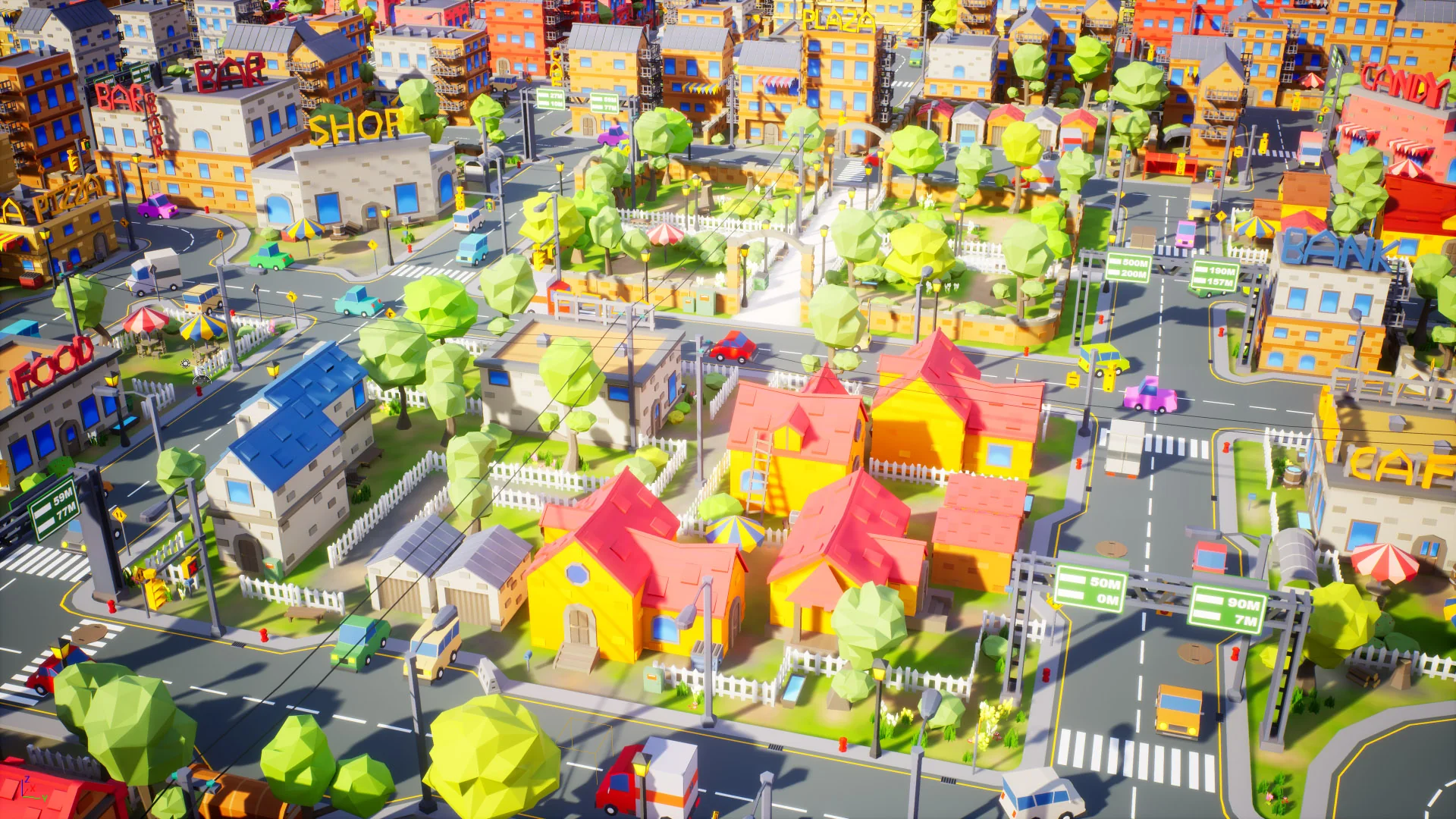
At the center of the Low Poly Town asset kit is a catalog of more than 150 distinct models intended for direct modular layout. Architectural construction forms the foundation of any municipal level, and this collection provides diverse building elements to accommodate varied building heights, neighborhood styles, and settlement densities. Game creators can assemble standalone residential houses, dense townhouse clusters, and wide suburban arrangements using the provided structural pieces.
Because the architectural silhouettes draw inspiration from both contemporary downtown centers and pastoral countryhouse settings, the models can be combined to map out distinct municipal zones. A level designer can construct a tightly organized commercial core or downtown avenue featuring adjacent townhouses, then transition outward toward low-density rural perimeters defined by detached village houses and open yards. Wall sections included across the pack offer clean physical barriers to segment properties, partition alleys, form defensive compound borders, or separate high-traffic thoroughfares from quiet domestic courtyards.
The structural assets also include perimeter fences that assist in dividing land parcels without generating heavy visual obstruction. By pairing fences with standalone house models and structural boundary walls, developers can establish distinct player pathways, delineate playable boundaries, and structure maze-like residential side streets that guide movement intuitively through village or town layouts.
Roadway Networks, Cars, and Poly Infrastructure
A functioning town environment requires organized transport corridors, and this pack supplies modular roads configured for flexible grid creation. The modular road pieces allow level builders to snap together custom road systems, whether laying down extensive multi-lane city streets, compact village lanes, four-way intersections, or gentle branching pathways. These road networks serve as the primary navigational spine for player navigation, establishing clear visual routes that direct traffic through commercial districts and outward toward open rural landscapes.
To populate these roadways with municipal activity, the asset pack includes car models styled in the same low poly aesthetic. Positioning cars along the modular road sections immediately introduces a sense of urban traffic and active transport. Level designers can align vehicles in orderly street-side parking formations, park them within residential driveways, or stage them in dense traffic patterns along major intersections. This vehicle presence transforms static road geometry into believable streets capable of supporting driving mechanics, urban exploration, or dynamic player traversal.
Accompanying the roadway system are street lights and exterior lamps that punctuate sidewalks, curbs, and alleyways. These fixtures serve dual functional and visual purposes: they ground the road network within realistic municipal planning conventions while providing natural placement markers for scene illumination. Arranging street lights along regular curb intervals establishes rhythmic sightlines for the player, clarifying path progression during low-visibility or nighttime game sequences.
Streetscape Props, Lighting, and Town Dressing
Populating the micro-spaces of a settlement prevents cityscapes from feeling vacant or sterile. Beyond primary buildings and transport networks, the Low Poly Town kit supplies a wide variety of props that give each district a lived-in character. Street corners, alleys, market squares, and loading areas can be dressed using barrels, lamps, and assorted outdoor utility objects that signal active municipal usage.
Barrels can be clustered against building foundations, stacked behind commercial townhouses, or positioned near village storehouses to establish environmental storytelling cues, supply points, or interactive cover geometry. Because the collection includes both tall street lights and smaller standalone lamps, lighting options can be varied based on environmental context. Taller street lights naturally suit wide avenues and open intersections, while smaller lamps are well suited for front porches, narrow residential passages, tavern entrances, or garden walkways.
The combination of small boundary fences, barrels, and lampposts enables designers to create micro-points of interest throughout the game world. An empty corner between two townhouses can be quickly transformed into a fenced storage alcove, a municipal service yard, or a resting point simply by grouping a few barrels, an overhead lamp, and connecting fence segments.
Landscape Textures and Nature in Low Poly Environments
Natural surface materials and organic vegetation are essential to balance geometric structures and paved street networks. The package incorporates landscape ground textures alongside dedicated grass textures to provide an organic base layer across the terrain. These ground materials can be painted across underlying terrain meshes, softening the transition between modular roadway edges, building foundations, and surrounding countryside terrain.
Trees included in the collection supply vertical contrast against the straight edges of modular houses and perimeter walls. By placing trees along street boulevards, level designers can create shaded sidewalks and green residential buffers. In larger quantities, these trees can be grouped into public town parks, roadside tree lines, or dense surrounding forests that naturally enclose the perimeter of the playable town map.
The interplay between natural elements and constructed buildings allows developers to support varied thematic settings. By prioritizing the grass textures, dirt ground materials, and tree models around standalone houses, the pack creates relaxed rural villages and countryhouse estates. Conversely, reducing vegetation and emphasizing modular roads, townhouses, cars, and street lights yields a bustling downtown cityscape.
Birds Flying Animation, Scene Setup, and Demonstration Maps
A frequent challenge when building low poly environments is avoiding visual stillness. To counter static scene presentation, the Low Poly Town pack includes a birds flying animation that brings motion to the airspace above the town. Placing animated flying birds overhead introduces natural ambient motion across rooftops, street avenues, and open parkland, making the entire settlement feel active and populated even from high vantage points.
To assist developers in evaluating and integrating the collection, the package provides two dedicated map configurations:
Overview Map: Lays out every one of the 150+ different models in an organized, gallery-style catalog. This setup enables developers to rapidly inspect individual houses, walls, fences, street lights, lamps, cars, trees, modular roads, and small props in clean isolation, simplifying asset discovery and staging.
Demo Map: Features a fully assembled town environment showing how the architectural assets, modular roads, cars, props, landscape ground and grass textures, and flying birds animation interact in a cohesive scene. This practical example serves as an active template for spatial layout, prop density, and natural integration.
Mobile and Top-Down Workflow Optimization for Town Environments
Constructed with mobile-friendly asset standards, the geometry and texturing throughout the collection are tailored for high runtime efficiency. The low polygon counts and clean polyart styling limit the computational load placed on rendering hardware, making the pack well suited for mobile game projects where battery life, thermal throttling, and hardware memory budgets require disciplined optimization.
These lightweight technical characteristics also make the assets effective for top-down, isometric, and isometric-tactical camera perspectives. When viewed from elevated viewing angles, the bold geometric outlines of the houses, roads, and cars maintain high visual readability. Players can quickly differentiate road networks, building boundaries, and interactive props without visual clutter, which is critical for city builders, traffic simulations, village management games, and real-time tactical titles.
 Cities
 Cities
 Cities