"d037b61901c110d2"{"id":"1002676","slug":"lush-stylized-environment-set","title":"LUSH: Stylized Environment Set","category":"Forest \u0026 Jungle","engine":"5.0+","assetVersion":"","engineVersion":"Engine Version: 5.0+","tag":"Forest \u0026 Jungle","accent":"blue","visual":"city","summary":"Examine the technical layout, terrain systems, foliage assets, and water tools inside LUSH: Stylized Environment Set for stylized natural environments.","platform":"Unreal Engine","indexPolicy":"index","publishedAt":"2026-11-16T22:26:42.482Z","updatedAt":"2026-11-16T22:26:42.482Z","sourceNotes":[],"fileContents":[],"compatibility":["Unreal Engine","Engine Version: 5.0+"],"featuredImage":{"alt":"LUSH: Stylized Environment Set","src":"/wp-content/uploads/published/2026/11/5372490bf58d-693b3d8c-df53-4b0a-89b9-80662f79decb-1a873cafdc.webp"},"fileSizeBytes":470520656,"hasDownloadLink":true,"downloads":0,"terms":[{"taxonomy":"category","slug":"forest-and-jungle","name":"Forest \u0026 Jungle"}],"galleryImages":[{"src":"/wp-content/uploads/published/2026/11/ab3d5a57d677-c9ae8bb1-9e83-44af-86f4-9573bc3ee9e1-7f97f31539.webp","alt":"LUSH: Stylized Environment Set"},{"src":"/wp-content/uploads/published/2026/11/126153080a7f-cc1b6769-95fd-4770-b36b-0a7df631c13a-a2c50880c1.webp","alt":"LUSH: Stylized Environment Set"},{"src":"/wp-content/uploads/published/2026/11/dd184921873e-18811a0e-b61e-4770-b7a0-9eb71083e180-fb85f544cc.webp","alt":"LUSH: Stylized Environment Set"},{"src":"/wp-content/uploads/published/2026/11/5834e6748a66-bb076e69-1458-4eab-b22c-00122d03ccbf-5c12d41023.webp","alt":"LUSH: Stylized Environment Set"},{"src":"/wp-content/uploads/published/2026/11/77e135ee0867-0a88056c-72d0-4bae-b444-7f1888803f42-347aa35211.webp","alt":"LUSH: Stylized Environment Set"},{"src":"/wp-content/uploads/published/2026/11/d8787f08d25f-4b06e868-c648-48c1-88b6-fd0be2310f97-33f4ac9858.webp","alt":"LUSH: Stylized Environment Set"},{"src":"/wp-content/uploads/published/2026/11/82edc5fd4372-9468ea3a-9ffe-422a-877f-0ee61c2489da-78563aaf8c.webp","alt":"LUSH: Stylized Environment Set"},{"src":"/wp-content/uploads/published/2026/11/c0d3f5d24b57-b9301b70-63c9-4b15-9d28-842c84f7b074-c6aeb9cfbf.webp","alt":"LUSH: Stylized Environment Set"},{"src":"/wp-content/uploads/published/2026/11/faf697f15232-11e3da82-7ffd-4517-a584-376d43d678fc-873e09b3c8.webp","alt":"LUSH: Stylized Environment Set"},{"src":"/wp-content/uploads/published/2026/11/c5891702e2b2-696e421a-3734-4591-a825-ceb961d25841-7c1bf702c0.webp","alt":"LUSH: Stylized Environment Set"}],"accessPanel":{"kind":"resource","title":"Get this resource","eyebrow":"Free resource","message":"Download this resource in your browser.","fileName":"Content.7z","safetyNote":"Resources are manually reviewed before listing to improve quality and reduce obvious risks.","actionLabel":"Get this resource","resourceType":"Resource archive","versions":[]},"contentHtml":"\u003cp\u003eCreating cohesive natural environments in a stylized art style requires balancing mesh optimization, clean silhouettes, and responsive terrain materials. Projects exploring tropical islands, dense jungles, or inland wetlands often face visual fragmentation when combining assets from disparate sources. LUSH: Stylized Environment Set addresses this challenge by providing a unified library of 50 stylized and optimized meshes alongside dedicated terrain and water systems designed to interact directly with Unreal Engine’s rendering features.\u003c/p\u003e \u003ch2\u003eBuilding Tropical and Swamp Biomes with LUSH Assets\u003c/h2\u003e\n\u003cp\u003eThe mesh library inside the package is tailored toward warm, lush biomes that require distinct vertical layers of vegetation. At the canopy level, developers have access to multiple arboreal types designed with distinct trunk profiles and stylized foliage clumps. The package includes one large tree, two medium trees, two swamp trees with exposed root structures, four Type A palm trees, four Type B palm trees, and four banana trees. This spread of palm and banana variations allows level designers to populate shorelines, jungle clearings, and cliff edges without repeating identical geometric silhouettes.\u003c/p\u003e\n\u003cp\u003eUnderneath the tree canopy, mid-tier and ground-level coverage is handled by specialized shrubs, ground covers, and decor. The set supplies one large bush and four medium bushes, complemented by two broad-leaf taro plants and eight flower clumps drawn from four distinct flower types. For horizontal coverage across exposed terrain or rock faces, four ground ivy meshes can be layered against cliff walls or tree trunks. Ground detailing is reinforced by two distinct grass types—generic and tiny—which work alongside four individual ground stones, two pre-arranged stone sets, three standard rocks, and a long rock formation to break up flat expanses of earth.\u003c/p\u003e \u003ch2\u003eConfiguring the Stylized Auto-Landscape and Terrain Layers\u003c/h2\u003e\n\u003cp\u003eGround composition relies on an integrated seven-layer auto-landscape material engineered to adapt to geometric slopes and hand-painted weight maps. Incorporating modern engine workflows, the landscape requires both Runtime Virtual Textures (RVT) and Generate Mesh Distance Fields to be enabled within the Project Settings. These settings ensure that landscape data, material blending, and distance-field interactions between foliage, rocks, and the ground plane compute properly.\u003c/p\u003e\n\u003cp\u003eThe terrain system features dedicated material passes to support diverse surface types across a single map. Following updates to the system, the landscape includes a dedicated Gravel layer to help transition between raw soil, shorelines, and rocky paths. Material logic updates to \u003ccode\u003eM_LND_Base\u003c/code\u003e Also resolve packaging artifacts, eliminating the black striping issues that previously affected landscapes in packaged game builds. The included demo level demonstrates the seven-layer auto-setup in practice, showing how the new gravel layer integrates with grass, soil, and rock faces on contoured terrain.\u003c/p\u003e \u003ch2\u003eStylized Water Component and Submerged Rendering\u003c/h2\u003e\n\u003cp\u003eAquatic environments are anchored by \u003ccode\u003eBP_StylizedWaterComponent\u003c/code\u003e, a blueprint-driven system paired with two specialized water component meshes. This component handles both open-water surfaces and contained pools, supporting circular water mesh layouts alongside conventional rectangular bodies of water. For surface interest in wetland configurations, the kit includes a stylized lily pad mesh that integrates naturally with the specialized swamp tree models.\u003c/p\u003e\n\u003cp\u003eThe component extends beneath the surface through the \u003ccode\u003eM_PP_Underwater\u003c/code\u003e Post-process material. When the player camera enters the water volume, the post-process material applies specialized submerged visuals, featuring customizable controls for fake atmospheric blur and chromatic aberration. Surface and underwater illumination can be customized using an included caustics texture, allowing developers to tune light refraction patterns across sunken rocks and bed textures to match the art style of their project.\u003c/p\u003e \u003ch2\u003eCustomization Textures and Post-Processing Controls\u003c/h2\u003e\n\u003cp\u003eTo prevent uniform surface repetition across large maps, the package provides additional modular textures for key environment surfaces. Bark materials can be alternated using two extra bark texture sets, comprising six maps across Basecolor, Normal, and combined RAOH (Roughness, Ambient Occlusion, Height) channels. Sandy stretches receive similar modular support through an extra sand texture set, complete with its own Basecolor, Normal, and RAOH textures.\u003c/p\u003e\n\u003cp\u003eFoliage variety is supported by three extra leaf mask textures, which allow developers to alter the opacity, distribution, and silhouette properties of tree cards and shrub materials. Scene grading is tied together by an included post-processing Look-Up Table (LUT), standardizing color balance and contrast across the demo scene. For technical testing and spatial validation, the playable demo setup incorporates an adjustable camera distance feature, letting artists inspect asset fidelity, LOD behavior, and material transitions from both tight third-person distances and broader isometric views.\u003c/p\u003e \u003ch2\u003eTarget Workflows and Practical Production Scenarios\u003c/h2\u003e\n\u003cp\u003eSolo developers and stylized environment teams benefit most from this setup when constructing colorful natural landscapes that need quick turnaround times. Because the terrain material, water blueprint, and foliage library are tuned to the same stylized baseline, artists avoid the tedious task of balancing specular responses, wind shaders, or color palettes across unrelated marketplace packs. Projects building island survival adventures, stylized action RPGs, coastal levels, or platformer wetlands can deploy the included demo level layout directly or use its components as a pre-calibrated framework for custom open worlds.\u003c/p\u003e\n\n\u003ch2\u003eMore From The Same Workflow\u003c/h2\u003e\n\u003cul\u003e\n\u003cli\u003e\u003ca href=\"https://3dcghub.com/stylized-landscape-5-biomes-stylized-low-poly-forest-orasot-bundle/\" rel=\"noopener noreferrer\"\u003eStylized Landscape 5 Biomes + Stylized + Low poly forest : Orasot Bundle\u003c/a\u003e\u003c/li\u003e\n\u003cli\u003e\u003ca href=\"https://3dcghub.com/stylized-summer-forest/\" rel=\"noopener noreferrer\"\u003eStylized Summer Forest\u003c/a\u003e\u003c/li\u003e\n\u003cli\u003e\u003ca href=\"https://3dcghub.com/stylescape-stylized-environment-kit/\" rel=\"noopener noreferrer\"\u003eStylescape: Stylized Environment Kit\u003c/a\u003e\u003c/li\u003e\n\u003cli\u003e\u003ca href=\"https://3dcghub.com/wildlands-stylized-nature-pine-forest-trees-foliage-nature-forest-biome/\" rel=\"noopener noreferrer\"\u003eWildlands: Stylized Nature (Pine Forest, Trees, Foliage, Nature, Forest, Biome)\u003c/a\u003e\u003c/li\u003e\n\u003cli\u003e\u003ca href=\"https://3dcghub.com/stylized-mountain-environment-open-world-stylized-environment/\" rel=\"noopener noreferrer\"\u003eStylized Mountain Environment - Open World Stylized Environment\u003c/a\u003e\u003c/li\u003e\n\u003c/ul\u003e","contentTextLength":6126,"navigation":{"current":13,"total":4611,"previous":{"id":"1002677","slug":"mae-oak-forest","title":"MAE Oak Forest","category":"Forest \u0026 Jungle","platform":"Unreal Engine","updatedAt":"2026-11-16T22:28:18.437Z"},"next":{"id":"1002675","slug":"low-poly-town","title":"Low Poly Town","category":"Cities","platform":"Unreal Engine","updatedAt":"2026-11-16T22:25:52.897Z"}},"relatedResources":[{"id":"1000892","slug":"stylized-landscape-5-biomes-stylized-low-poly-forest-orasot-bundle","title":"Stylized Landscape 5 Biomes + Stylized + Low poly forest : Orasot Bundle","category":"Forest \u0026 Jungle","engine":"5.2+","assetVersion":"","engineVersion":"Engine Version: 5.2+","tag":"Forest \u0026 Jungle","accent":"blue","visual":"city","summary":"This bundle merges stylized forest, five-biome landscape, and low-poly forest assets with a practical exposure fix for DefaultEngine.ini and virtual texture set","platform":"Unreal Engine","indexPolicy":"index","publishedAt":"2026-08-06T04:37:15.039Z","updatedAt":"2026-08-06T04:37:15.039Z","sourceNotes":[],"fileContents":[],"compatibility":["Unreal Engine","Engine Version: 5.2+"],"featuredImage":{"alt":"Stylized Landscape 5 Biomes + Stylized + Low poly forest : Orasot Bundle","src":"/wp-content/uploads/published/2026/08/d7e4432aba24-96cbb20e-4693-449f-94da-c2b94b1eecfe-b7d03925eb.webp"},"fileSizeBytes":922868643,"hasDownloadLink":true,"downloads":3},{"id":"8299","slug":"stylized-summer-forest","title":"Stylized Summer Forest","category":"Forest \u0026 Jungle","engine":"5.2+","assetVersion":"Engine version: 5.2+","engineVersion":"5.2","tag":"Forest \u0026 Jungle","accent":"blue","visual":"city","summary":"Build a lush, artistic woodland with the Stylized Summer Forest asset pack. This comprehensive collection for Unreal Engine 5 includes over 60 unique meshes and optimized PBR materials.","platform":"Unreal Engine","indexPolicy":"index","publishedAt":"2026-02-23T16:43:33.000Z","updatedAt":"2026-05-31T12:48:26.238Z","sourceNotes":[],"fileContents":[],"compatibility":["Unreal Engine","Engine version: 5.2+"],"featuredImage":{"alt":"Stylized Summer Forest","src":"https://3dcghub.com/wp-content/uploads/2026/02/dcc18fe1-4b99-4e39-aa8b-71fbab817f3f.webp"},"fileSizeBytes":434243073,"hasDownloadLink":true,"downloads":2},{"id":"27966","slug":"stylescape-stylized-environment-kit","title":"Stylescape: Stylized Environment Kit","category":"Forest \u0026 Jungle","engine":"5.0+","assetVersion":"Engine version: 5.0+","engineVersion":"","tag":"Forest \u0026 Jungle","accent":"blue","visual":"city","summary":"Stylescape starts with a practical setup path: landscape tools, foliage systems, and a demo level that shows how the pieces come together. Its feature set focuses on stylized outdoor scene building with layered terrain, animated vegetation, RVT blending, an...","platform":"Unreal Engine","indexPolicy":"index","publishedAt":"2026-04-30T07:46:23.000Z","updatedAt":"2026-04-30T07:46:24.000Z","sourceNotes":[],"fileContents":[],"compatibility":["Unreal Engine","Engine version: 5.0+"],"featuredImage":{"alt":"Stylescape: Stylized Environment Kit","src":"https://3dcghub.com/wp-content/uploads/2026/04/919df961bd95_fa7d20f4-93b7-4cca-baea-d2f63da591a6.webp"},"fileSizeBytes":956611762,"hasDownloadLink":true,"downloads":0}]}
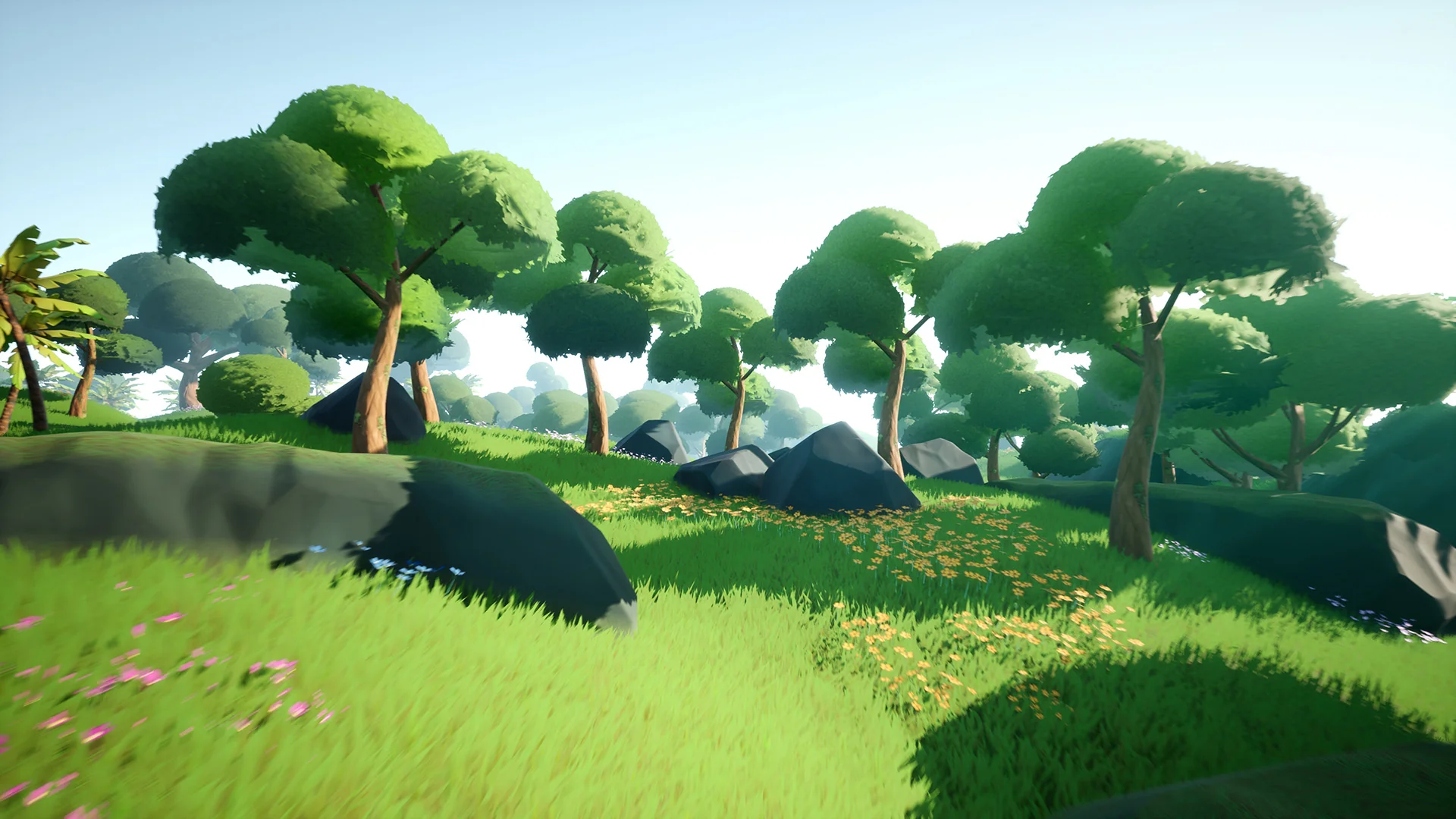
Resource screenshots
1 / 10
Forest & Jungle
LUSH: Stylized Environment Set
Examine the technical layout, terrain systems, foliage assets, and water tools inside LUSH: Stylized Environment Set for stylized natural environments.
Creating cohesive natural environments in a stylized art style requires balancing mesh optimization, clean silhouettes, and responsive terrain materials. Projects exploring tropical islands, dense jungles, or inland wetlands often face visual fragmentation when combining assets from disparate sources. LUSH: Stylized Environment Set addresses this challenge by providing a unified library of 50 stylized and optimized meshes alongside dedicated terrain and water systems designed to interact directly with Unreal Engine’s rendering features.
Building Tropical and Swamp Biomes with LUSH Assets
The mesh library inside the package is tailored toward warm, lush biomes that require distinct vertical layers of vegetation. At the canopy level, developers have access to multiple arboreal types designed with distinct trunk profiles and stylized foliage clumps. The package includes one large tree, two medium trees, two swamp trees with exposed root structures, four Type A palm trees, four Type B palm trees, and four banana trees. This spread of palm and banana variations allows level designers to populate shorelines, jungle clearings, and cliff edges without repeating identical geometric silhouettes.
Underneath the tree canopy, mid-tier and ground-level coverage is handled by specialized shrubs, ground covers, and decor. The set supplies one large bush and four medium bushes, complemented by two broad-leaf taro plants and eight flower clumps drawn from four distinct flower types. For horizontal coverage across exposed terrain or rock faces, four ground ivy meshes can be layered against cliff walls or tree trunks. Ground detailing is reinforced by two distinct grass types—generic and tiny—which work alongside four individual ground stones, two pre-arranged stone sets, three standard rocks, and a long rock formation to break up flat expanses of earth.
Configuring the Stylized Auto-Landscape and Terrain Layers
Ground composition relies on an integrated seven-layer auto-landscape material engineered to adapt to geometric slopes and hand-painted weight maps. Incorporating modern engine workflows, the landscape requires both Runtime Virtual Textures (RVT) and Generate Mesh Distance Fields to be enabled within the Project Settings. These settings ensure that landscape data, material blending, and distance-field interactions between foliage, rocks, and the ground plane compute properly.
The terrain system features dedicated material passes to support diverse surface types across a single map. Following updates to the system, the landscape includes a dedicated Gravel layer to help transition between raw soil, shorelines, and rocky paths. Material logic updates to M_LND_Base Also resolve packaging artifacts, eliminating the black striping issues that previously affected landscapes in packaged game builds. The included demo level demonstrates the seven-layer auto-setup in practice, showing how the new gravel layer integrates with grass, soil, and rock faces on contoured terrain.
Stylized Water Component and Submerged Rendering
Aquatic environments are anchored by BP_StylizedWaterComponent, a blueprint-driven system paired with two specialized water component meshes. This component handles both open-water surfaces and contained pools, supporting circular water mesh layouts alongside conventional rectangular bodies of water. For surface interest in wetland configurations, the kit includes a stylized lily pad mesh that integrates naturally with the specialized swamp tree models.
The component extends beneath the surface through the M_PP_Underwater Post-process material. When the player camera enters the water volume, the post-process material applies specialized submerged visuals, featuring customizable controls for fake atmospheric blur and chromatic aberration. Surface and underwater illumination can be customized using an included caustics texture, allowing developers to tune light refraction patterns across sunken rocks and bed textures to match the art style of their project.
Customization Textures and Post-Processing Controls
To prevent uniform surface repetition across large maps, the package provides additional modular textures for key environment surfaces. Bark materials can be alternated using two extra bark texture sets, comprising six maps across Basecolor, Normal, and combined RAOH (Roughness, Ambient Occlusion, Height) channels. Sandy stretches receive similar modular support through an extra sand texture set, complete with its own Basecolor, Normal, and RAOH textures.
Foliage variety is supported by three extra leaf mask textures, which allow developers to alter the opacity, distribution, and silhouette properties of tree cards and shrub materials. Scene grading is tied together by an included post-processing Look-Up Table (LUT), standardizing color balance and contrast across the demo scene. For technical testing and spatial validation, the playable demo setup incorporates an adjustable camera distance feature, letting artists inspect asset fidelity, LOD behavior, and material transitions from both tight third-person distances and broader isometric views.
Target Workflows and Practical Production Scenarios
Solo developers and stylized environment teams benefit most from this setup when constructing colorful natural landscapes that need quick turnaround times. Because the terrain material, water blueprint, and foliage library are tuned to the same stylized baseline, artists avoid the tedious task of balancing specular responses, wind shaders, or color palettes across unrelated marketplace packs. Projects building island survival adventures, stylized action RPGs, coastal levels, or platformer wetlands can deploy the included demo level layout directly or use its components as a pre-calibrated framework for custom open worlds.
 Forest & Jungle
 Forest & Jungle
 Forest & Jungle