"d037b61901c110d2"{"id":"1002678","slug":"mediterranean-coast","title":"Mediterranean Coast","category":"Forest \u0026 Jungle","engine":"5.0+","assetVersion":"","engineVersion":"Engine Version: 5.0+","tag":"Forest \u0026 Jungle","accent":"blue","visual":"mech","summary":"Explore the Mediterranean Coast environment map, featuring Nanite-enabled foliage in 5.1, landscape paint tools, background mountains, and wind systems.","platform":"Unreal Engine","indexPolicy":"index","publishedAt":"2026-11-16T22:29:16.177Z","updatedAt":"2026-11-16T22:29:16.177Z","sourceNotes":[],"fileContents":[],"compatibility":["Unreal Engine","Engine Version: 5.0+"],"featuredImage":{"alt":"Mediterranean Coast","src":"/wp-content/uploads/published/2026/11/7041f9ea0799-84990bdf-13d6-4a55-88be-17e2c46330b3-2a4df54cf2.webp"},"fileSizeBytes":4510029460,"hasDownloadLink":true,"downloads":0,"terms":[{"taxonomy":"category","slug":"forest-and-jungle","name":"Forest \u0026 Jungle"}],"galleryImages":[{"src":"/wp-content/uploads/published/2026/11/33a6d11abde3-83ffc5ac-83c1-4fe1-8448-ff39d351672c-4e2c69f8f6.webp","alt":"Mediterranean Coast"},{"src":"/wp-content/uploads/published/2026/11/9aa8be3509a2-5ebc98ee-0607-4654-a89b-6ccad76e6303-f422ed2878.webp","alt":"Mediterranean Coast"},{"src":"/wp-content/uploads/published/2026/11/e0bd912297eb-3f38acaa-15ca-43b7-a144-f5c7f2383bbe-b460b151e7.webp","alt":"Mediterranean Coast"},{"src":"/wp-content/uploads/published/2026/11/a9560b636f3d-5077ebc1-0960-4149-ab07-d74f134fe784-62735c6c37.webp","alt":"Mediterranean Coast"},{"src":"/wp-content/uploads/published/2026/11/9873468f6a0e-5a79ad88-f986-4f8e-b0c2-8182750fd05e-b54646528d.webp","alt":"Mediterranean Coast"},{"src":"/wp-content/uploads/published/2026/11/79c3b00dfdd4-8e18718a-2dd2-43fa-aa69-9be9606c195f-4b3b329577.webp","alt":"Mediterranean Coast"},{"src":"/wp-content/uploads/published/2026/11/d1a6342c188d-06aa75a1-2ece-4fe0-b512-0b81528e2cc4-02fe015f93.webp","alt":"Mediterranean Coast"},{"src":"/wp-content/uploads/published/2026/11/3ac694625d33-cb81ab74-a1f6-4204-b493-7205211d20f7-109e55dd50.webp","alt":"Mediterranean Coast"},{"src":"/wp-content/uploads/published/2026/11/37a6de094e60-fe2bfb49-ba48-4054-bb81-50205fd5a69f-47f8bfffba.webp","alt":"Mediterranean Coast"}],"accessPanel":{"kind":"resource","title":"Get this resource","eyebrow":"Free resource","message":"Download this resource in your browser.","fileName":"Content.7z","safetyNote":"Resources are manually reviewed before listing to improve quality and reduce obvious risks.","actionLabel":"Get this resource","resourceType":"Resource archive","versions":[]},"contentHtml":"\u003ch2\u003eEstablishing Realistic Coastal and River Environments\u003c/h2\u003e\n\u003cp\u003eOpen-world exterior environments set along temperate coastlines present distinct spatial challenges. Establishing convincing transitions from sea level up through river corridors and onto rocky bluffs requires an integrated balance of geology, foliage distribution, and expansive horizon framing. Projects exploring maritime shores, rugged natural inlets, or Mediterranean terrain types often face early roadblocks when assembling discrete landforms into a cohesive level layout.\u003c/p\u003e\n\u003cp\u003eMediterranean Coast functions as a complete, fully level designed environment map that unites these disparate natural elements immediately. Rather than serving as an isolated kit of scattered props, the map lays out a fully realized exterior space where rocky topography, running rivers, and coastal borders connect in continuous natural gradients. This pre-assembled map configuration allows teams to drop directly into an established natural layout for exterior exploration, cinematic sequences, or large-scale navigational testing.\u003c/p\u003e\n\u003cp\u003eThe layout is geared specifically toward realistic landscape representation. Sharp geological contrasts—where coastal rock banks meet shoreline vegetation and interior rivers—give the scene clear regional identity. For games and virtual productions requiring believable European coastal or maritime geography, the environment map supplies a grounded foundation that resolves initial terrain blockouts from day one.\u003c/p\u003e \u003ch2\u003eMediterranean Landscape Composition and Horizon Depth\u003c/h2\u003e\n\u003cp\u003eCreating believable scale in wide-open coastal settings depends heavily on backdrop management. Without carefully placed distant landmarks, open shorelines can feel flat, artificial, or abruptly bounded by map boundaries. The composition of this package resolves distant sightlines by integrating dedicated background mountain meshes designed specifically to provide depth in the surrounding scenery.\u003c/p\u003e\n\u003cp\u003eThese background mountain meshes wrap around the playable territory, ensuring that sightlines across water, open fields, and along riverbanks terminate against natural geological silhouettes rather than empty horizon lines. This vertical framing enhances the sense of scale across the entire map, allowing cameras and players at shoreline levels to look inland or across river mouths and perceive distant mountain ranges looming behind the immediate terrain.\u003c/p\u003e\n\u003cp\u003eAt ground level, the terrain balances rugged rock masses with realistic waterways. Rivers wind naturally across the scene, intersecting the broader coastal layout and introducing variable ground forms. The presence of both riverbanks and sea-facing cliffs allows for varied elevation changes, vantage points, and realistic pathways where flowing fresh water converges with marine coastal views.\u003c/p\u003e \u003ch2\u003eCoast Foliage Distribution with Landscape Paint Tools\u003c/h2\u003e\n\u003cp\u003ePopulating large-scale outdoor maps manually with flora can consume significant production hours. Mediterranean Coast addresses this workflow bottleneck by pairing its natural assets with specialized landscape paint tools suited to easy forest population. These painting utilities allow environment artists and level designers to scatter dense foliage groupings across targeted zones of the terrain without placing individual stems by hand.\u003c/p\u003e\n\u003cp\u003eThe vegetation kit itself centers on regional greenery, featuring coastal grass types and trees characteristic of the biome. Through the landscape painting setup, creators can blend grass cover across open riverbanks and rapidly apply dense tree canopies across rolling hillsides. The tools streamline the distribution process, ensuring that natural plant density matches the underlying ground textures and rock outcroppings.\u003c/p\u003e\n\u003cp\u003eIn engine version 5.1, the package implements Nanite support across the project, with trees specifically gaining Nanite enablement in version 5.1.0. This Nanite foliage architecture radically alters how dense forests operate inside the scene. By allowing high-poly tree models to stream geometry adaptively through Nanite, the environment maintains visual fidelity on dense tree trunks and canopy structures without relying on conventional, aggressive level-of-detail pop-in. This enables thick woodlands along the coast to remain crisp and stable across long rendering distances.\u003c/p\u003e \u003ch2\u003eWind Dynamics and In-Level Player Interaction\u003c/h2\u003e\n\u003cp\u003eA static natural environment quickly loses its sense of realism if the landscape remains completely motionless during active gameplay. To preserve environmental believability, Mediterranean Coast incorporates a global wind system that influences the surrounding foliage. Trees and grass respond to this broad atmospheric simulation, creating unified natural motion across the entire visual field.\u003c/p\u003e\n\u003cp\u003eA single global wind setup ensures that environmental movement remains synchronized. When gusts sweep across the terrain, distant canopy motion reflects the same dynamic energy as shoreline grass blades near the camera. This coordinated movement links the foreground, rivers, and hillside forests into a unified ecological space, which is particularly beneficial for projects utilizing dynamic weather transitions or wide cinematic pans.\u003c/p\u003e\n\u003cp\u003eIn tandem with atmospheric motion, the map includes integrated player interaction. The environment is calibrated to accommodate active player traversal out of the box. Characters can navigate the shoreline paths, cross river features, climb rocky inclines, and interact with the natural terrain contours smoothly. This turns the package from a simple visual backdrop into a functional, playable staging ground suitable for immediate gameplay mechanics or third-person walkthroughs.\u003c/p\u003e \u003ch2\u003eIntegration Practicalities and Target Production Workflows\u003c/h2\u003e\n\u003cp\u003eBecause Mediterranean Coast incorporates modern geometric pipelines and integrated systems, proper setup procedures are critical. Specifically, the project has Nanite enabled for 5.1, making it essential to consult the provided documentation before adding the pack to an existing project. Reviewing these setup guidelines guarantees that project rendering parameters, Nanite configurations, and interaction frameworks align properly with your project settings before asset migration begins.\u003c/p\u003e\n\u003cp\u003eThe pack is particularly useful for small- to mid-sized production teams, architectural visualizers, and solo technical artists who need a fully functional, photorealistic coastal biome without spending months sculpting landscapes and tuning scatter tools. Game developers prototyping third-person adventure titles, historical dramas, or realistic survival mechanics can leverage the map as an immediate setting, benefiting from the pre-balanced riverways, background mountains, and wind-reactive vegetation.\u003c/p\u003e\n\u003cp\u003eBy bringing together Nanite-enabled trees, dedicated background scale assets, customizable landscape painting workflows, and reactive environmental movement, the map provides a comprehensive framework for realistic coastal world building that balances immediate visual fidelity with practical game-level utility.\u003c/p\u003e\n\n\u003ch2\u003eContinue Browsing Similar Packs\u003c/h2\u003e\n\u003cul\u003e\n\u003cli\u003e\u003ca href=\"https://3dcghub.com/red-pine-biome/\" rel=\"noopener noreferrer\"\u003eRed Pine Biome\u003c/a\u003e\u003c/li\u003e\n\u003cli\u003e\u003ca href=\"https://3dcghub.com/mae-oak-forest/\" rel=\"noopener noreferrer\"\u003eMAE Oak Forest\u003c/a\u003e\u003c/li\u003e\n\u003cli\u003e\u003ca href=\"https://3dcghub.com/lush-stylized-environment-set/\" rel=\"noopener noreferrer\"\u003eLUSH: Stylized Environment Set\u003c/a\u003e\u003c/li\u003e\n\u003cli\u003e\u003ca href=\"https://3dcghub.com/low-poly-nature/\" rel=\"noopener noreferrer\"\u003eLow Poly Nature\u003c/a\u003e\u003c/li\u003e\n\u003cli\u003e\u003ca href=\"https://3dcghub.com/lookout-tower/\" rel=\"noopener noreferrer\"\u003eLookout Tower\u003c/a\u003e\u003c/li\u003e\n\u003c/ul\u003e","contentTextLength":7152,"navigation":{"current":11,"total":4611,"previous":{"id":"1002679","slug":"mesic-flatwoods-habitat-brush","title":"Mesic Flatwoods Habitat Brush","category":"Forest \u0026 Jungle","platform":"Unreal Engine","updatedAt":"2026-11-16T22:29:57.567Z"},"next":{"id":"1002677","slug":"mae-oak-forest","title":"MAE Oak Forest","category":"Forest \u0026 Jungle","platform":"Unreal Engine","updatedAt":"2026-11-16T22:28:18.437Z"}},"relatedResources":[{"id":"1000663","slug":"red-pine-biome","title":"Red Pine Biome","category":"Forest \u0026 Jungle","engine":"5.4+","assetVersion":"","engineVersion":"Engine Version: 5.4+","tag":"Forest \u0026 Jungle","accent":"blue","visual":"mech","summary":"Red Pine Biome delivers Mediterranean red pine trees, endemic vegetation, cliffs, and scatter with landscape material, procedural foliage, and wind interaction.","platform":"Unreal Engine","indexPolicy":"index","publishedAt":"2026-07-22T06:41:11.442Z","updatedAt":"2026-07-22T06:41:11.442Z","sourceNotes":[],"fileContents":[],"compatibility":["Unreal Engine","Engine Version: 5.4+"],"featuredImage":{"alt":"Red Pine Biome","src":"/wp-content/uploads/published/2026/07/b774421f9718-c6d49ccf-c1a0-425a-bc09-3d64bdd79653-d7a4531c7f.webp"},"fileSizeBytes":1903831292,"hasDownloadLink":true,"downloads":1},{"id":"1002688","slug":"scrubby-flatwoods-habitat-brush","title":"Scrubby Flatwoods Habitat Brush","category":"Forest \u0026 Jungle","engine":"5.0+","assetVersion":"","engineVersion":"Engine Version: 5.0+","tag":"Forest \u0026 Jungle","accent":"blue","visual":"mech","summary":"Examine the Scrubby Flatwoods Habitat Brush, featuring Central Florida plant species like Longleaf Pine, Saw Palmetto, and Wiregrass for virtual environments.","platform":"Unreal Engine","indexPolicy":"index","publishedAt":"2026-11-16T22:45:18.155Z","updatedAt":"2026-11-16T22:45:18.155Z","sourceNotes":[],"fileContents":[],"compatibility":["Unreal Engine","Engine Version: 5.0+"],"featuredImage":{"alt":"Scrubby Flatwoods Habitat Brush","src":"/wp-content/uploads/published/2026/11/685ed7892533-26771ffd-4d04-4070-ba79-cea84eac19f3-2307013c68.webp"},"fileSizeBytes":214594549,"hasDownloadLink":true,"downloads":0},{"id":"1002679","slug":"mesic-flatwoods-habitat-brush","title":"Mesic Flatwoods Habitat Brush","category":"Forest \u0026 Jungle","engine":"5.0+","assetVersion":"","engineVersion":"Engine Version: 5.0+","tag":"Forest \u0026 Jungle","accent":"blue","visual":"mech","summary":"Create authentic Central Florida environments with Mesic Flatwoods Habitat Brush, featuring 134 meshes, GIS-based ecosystems, and foliage painting presets.","platform":"Unreal Engine","indexPolicy":"index","publishedAt":"2026-11-16T22:29:57.567Z","updatedAt":"2026-11-16T22:29:57.567Z","sourceNotes":[],"fileContents":[],"compatibility":["Unreal Engine","Engine Version: 5.0+"],"featuredImage":{"alt":"Mesic Flatwoods Habitat Brush","src":"/wp-content/uploads/published/2026/11/03fc5d7d5f3d-3e037f39-c3ce-41f3-940e-e68fe5760859-23ef5ead28.webp"},"fileSizeBytes":248979374,"hasDownloadLink":true,"downloads":0}]}
Resource screenshots
1 / 9
Forest & Jungle
Mediterranean Coast
Explore the Mediterranean Coast environment map, featuring Nanite-enabled foliage in 5.1, landscape paint tools, background mountains, and wind systems.
Establishing Realistic Coastal and River Environments
Open-world exterior environments set along temperate coastlines present distinct spatial challenges. Establishing convincing transitions from sea level up through river corridors and onto rocky bluffs requires an integrated balance of geology, foliage distribution, and expansive horizon framing. Projects exploring maritime shores, rugged natural inlets, or Mediterranean terrain types often face early roadblocks when assembling discrete landforms into a cohesive level layout.
Mediterranean Coast functions as a complete, fully level designed environment map that unites these disparate natural elements immediately. Rather than serving as an isolated kit of scattered props, the map lays out a fully realized exterior space where rocky topography, running rivers, and coastal borders connect in continuous natural gradients. This pre-assembled map configuration allows teams to drop directly into an established natural layout for exterior exploration, cinematic sequences, or large-scale navigational testing.
The layout is geared specifically toward realistic landscape representation. Sharp geological contrasts—where coastal rock banks meet shoreline vegetation and interior rivers—give the scene clear regional identity. For games and virtual productions requiring believable European coastal or maritime geography, the environment map supplies a grounded foundation that resolves initial terrain blockouts from day one.
Mediterranean Landscape Composition and Horizon Depth
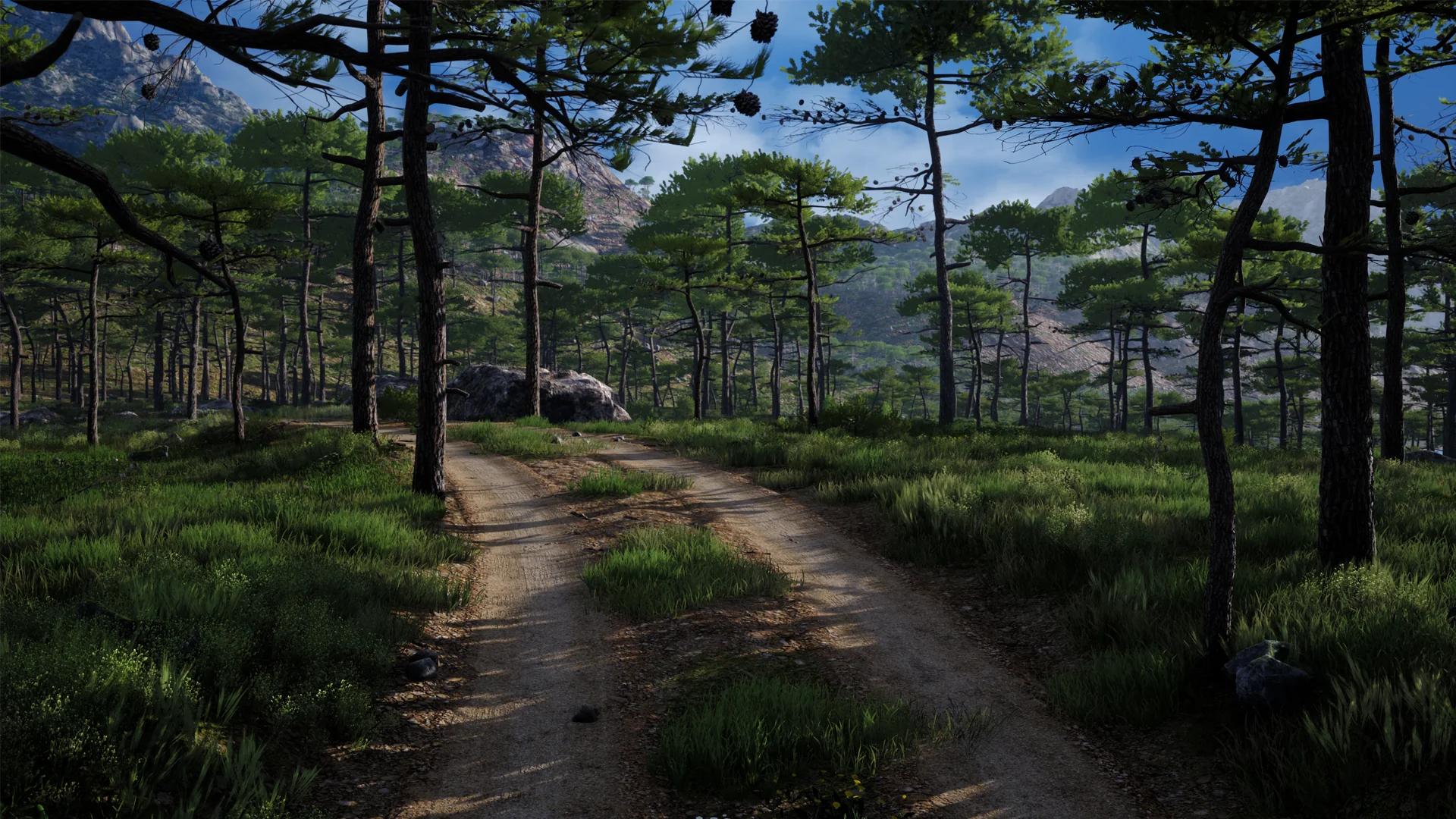
Creating believable scale in wide-open coastal settings depends heavily on backdrop management. Without carefully placed distant landmarks, open shorelines can feel flat, artificial, or abruptly bounded by map boundaries. The composition of this package resolves distant sightlines by integrating dedicated background mountain meshes designed specifically to provide depth in the surrounding scenery.
These background mountain meshes wrap around the playable territory, ensuring that sightlines across water, open fields, and along riverbanks terminate against natural geological silhouettes rather than empty horizon lines. This vertical framing enhances the sense of scale across the entire map, allowing cameras and players at shoreline levels to look inland or across river mouths and perceive distant mountain ranges looming behind the immediate terrain.
At ground level, the terrain balances rugged rock masses with realistic waterways. Rivers wind naturally across the scene, intersecting the broader coastal layout and introducing variable ground forms. The presence of both riverbanks and sea-facing cliffs allows for varied elevation changes, vantage points, and realistic pathways where flowing fresh water converges with marine coastal views.
Coast Foliage Distribution with Landscape Paint Tools
Populating large-scale outdoor maps manually with flora can consume significant production hours. Mediterranean Coast addresses this workflow bottleneck by pairing its natural assets with specialized landscape paint tools suited to easy forest population. These painting utilities allow environment artists and level designers to scatter dense foliage groupings across targeted zones of the terrain without placing individual stems by hand.
The vegetation kit itself centers on regional greenery, featuring coastal grass types and trees characteristic of the biome. Through the landscape painting setup, creators can blend grass cover across open riverbanks and rapidly apply dense tree canopies across rolling hillsides. The tools streamline the distribution process, ensuring that natural plant density matches the underlying ground textures and rock outcroppings.
In engine version 5.1, the package implements Nanite support across the project, with trees specifically gaining Nanite enablement in version 5.1.0. This Nanite foliage architecture radically alters how dense forests operate inside the scene. By allowing high-poly tree models to stream geometry adaptively through Nanite, the environment maintains visual fidelity on dense tree trunks and canopy structures without relying on conventional, aggressive level-of-detail pop-in. This enables thick woodlands along the coast to remain crisp and stable across long rendering distances.
Wind Dynamics and In-Level Player Interaction
A static natural environment quickly loses its sense of realism if the landscape remains completely motionless during active gameplay. To preserve environmental believability, Mediterranean Coast incorporates a global wind system that influences the surrounding foliage. Trees and grass respond to this broad atmospheric simulation, creating unified natural motion across the entire visual field.
A single global wind setup ensures that environmental movement remains synchronized. When gusts sweep across the terrain, distant canopy motion reflects the same dynamic energy as shoreline grass blades near the camera. This coordinated movement links the foreground, rivers, and hillside forests into a unified ecological space, which is particularly beneficial for projects utilizing dynamic weather transitions or wide cinematic pans.
In tandem with atmospheric motion, the map includes integrated player interaction. The environment is calibrated to accommodate active player traversal out of the box. Characters can navigate the shoreline paths, cross river features, climb rocky inclines, and interact with the natural terrain contours smoothly. This turns the package from a simple visual backdrop into a functional, playable staging ground suitable for immediate gameplay mechanics or third-person walkthroughs.
Integration Practicalities and Target Production Workflows
Because Mediterranean Coast incorporates modern geometric pipelines and integrated systems, proper setup procedures are critical. Specifically, the project has Nanite enabled for 5.1, making it essential to consult the provided documentation before adding the pack to an existing project. Reviewing these setup guidelines guarantees that project rendering parameters, Nanite configurations, and interaction frameworks align properly with your project settings before asset migration begins.
The pack is particularly useful for small- to mid-sized production teams, architectural visualizers, and solo technical artists who need a fully functional, photorealistic coastal biome without spending months sculpting landscapes and tuning scatter tools. Game developers prototyping third-person adventure titles, historical dramas, or realistic survival mechanics can leverage the map as an immediate setting, benefiting from the pre-balanced riverways, background mountains, and wind-reactive vegetation.
By bringing together Nanite-enabled trees, dedicated background scale assets, customizable landscape painting workflows, and reactive environmental movement, the map provides a comprehensive framework for realistic coastal world building that balances immediate visual fidelity with practical game-level utility.
 Forest & Jungle
 Forest & Jungle
 Forest & Jungle