"d037b61901c110d2"{"id":"1002680","slug":"modular-asian-medieval-city","title":"Modular Asian Medieval City","category":"Cities","engine":"5.0+","assetVersion":"","engineVersion":"Engine Version: 5.0+","tag":"Cities","accent":"blue","visual":"city","summary":"Explore the technical setup, Lumen lighting, Epic Skeleton scaling, and modular layout workflow of the Modular Asian Medieval City environment.","platform":"Unreal Engine","indexPolicy":"index","publishedAt":"2026-11-16T22:31:22.898Z","updatedAt":"2026-11-16T22:31:22.898Z","sourceNotes":[],"fileContents":[],"compatibility":["Unreal Engine","Engine Version: 5.0+"],"featuredImage":{"alt":"Modular Asian Medieval City","src":"/wp-content/uploads/published/2026/11/2de1c05196e5-642d4ddb-6912-484d-8263-7fe939a00f8b-19dadc7e35.webp"},"fileSizeBytes":995250163,"hasDownloadLink":true,"downloads":0,"terms":[{"taxonomy":"category","slug":"cities","name":"Cities"}],"galleryImages":[{"src":"/wp-content/uploads/published/2026/11/5873b3a26900-3661fd02-ff18-41e9-a954-9dd318225433-478453c9b8.webp","alt":"Modular Asian Medieval City"},{"src":"/wp-content/uploads/published/2026/11/b1dfc2525f72-1f61bd25-5712-43cd-aafb-bec0734dca45-e834f5922b.webp","alt":"Modular Asian Medieval City"},{"src":"/wp-content/uploads/published/2026/11/f1d1b4f2ea1d-55aed166-88bd-4703-98f7-9e15f2315888-9507eaecaf.webp","alt":"Modular Asian Medieval City"},{"src":"/wp-content/uploads/published/2026/11/c34eba97bd0a-4466a316-7e31-4d2e-a645-ac5fa7141228-f10eae264d.webp","alt":"Modular Asian Medieval City"},{"src":"/wp-content/uploads/published/2026/11/3537c0ccd114-160b0416-b821-4e34-b29b-a4f8b64a9346-564dabdb72.webp","alt":"Modular Asian Medieval City"},{"src":"/wp-content/uploads/published/2026/11/0e279f893d11-89017f08-19c8-4e33-86c0-e491ea01b046-83faa3d77a.webp","alt":"Modular Asian Medieval City"},{"src":"/wp-content/uploads/published/2026/11/72f4150745ff-ccd79e81-8ff9-44e1-b420-a84de1636db6-0ab0275c19.webp","alt":"Modular Asian Medieval City"},{"src":"/wp-content/uploads/published/2026/11/cfd392c65251-06450029-a558-4fa1-bbc1-4bbd47b75449-c877cdf5d8.webp","alt":"Modular Asian Medieval City"},{"src":"/wp-content/uploads/published/2026/11/c6041b2cae4a-603a02a5-193c-422f-a658-71377e137a11-4e7d76ea86.webp","alt":"Modular Asian Medieval City"},{"src":"/wp-content/uploads/published/2026/11/4510efc41667-ed1302c7-eae8-4bed-9409-d1d5760965bb-63d417aaf0.webp","alt":"Modular Asian Medieval City"}],"accessPanel":{"kind":"resource","title":"Get this resource","eyebrow":"Free resource","message":"Download this resource in your browser.","fileName":"Content.7z","safetyNote":"Resources are manually reviewed before listing to improve quality and reduce obvious risks.","actionLabel":"Get this resource","resourceType":"Resource archive","versions":[]},"contentHtml":"\u003ch2\u003eAssembling Medieval Asian City Architecture and Waterfronts\u003c/h2\u003e\u003cp\u003eConstructing sprawling historical settlements requires structural assets that align precisely along shared geometric boundaries while maintaining authentic regional character. Modular Asian Medieval City provides the structural foundation needed to assemble historical Chinese and Japanese urban environments. The collection covers complete town districts, spanning waterfront ports, dense street sectors, and sacred temple courtyards. Because the pieces rely on modular logic, individual wall sections, entry gates, dock pilings, and tiled roofs can be snapped together to form distinct architectural profiles without forcing repetitive district patterns across an open level.\u003c/p\u003e\u003cp\u003ePort areas bridge the gap between dry ground and waterways, utilizing specialized components to construct piers, loading docks, and riverbank embankments. Moving inward from the shoreline, structural components transition into high-density commercial and residential streets. Timber framing, interlocking brackets, stone foundations, and distinct clay roof tiling allow level designers to replicate the density seen in ancient East Asian trade hubs. Temple compounds introduce grander, sweeping rooflines and elevated platforms, creating natural focal points for skyline navigation across wide game environments.\u003c/p\u003e\u003cp\u003eLow-poly construction techniques keep base mesh footprints manageable across vast scenes. Rather than relying on singular, heavy hero models that consume disproportionate render budgets, the system distributes architectural weight across clean, reusable modular pieces. This structure supports broad historical vistas where multiple tiers of elevation—from low-lying water canals to elevated temple sanctuaries—must remain visible simultaneously.\u003c/p\u003e\u003ch2\u003eInterior Volumes, Street Dressing, and Weapon Props\u003c/h2\u003e\u003cp\u003eMany environment packages focus solely on building facades, leaving structural shells hollow and inaccessible to gameplay. Modular Asian Medieval City avoids this boundary by including interior structural pieces, permitting seamless progression from exterior thoroughfares into functional indoor spaces. Doorways, internal partitions, floorboards, and ceiling framework enable traversable houses, guard stations, and temple interiors that hold up under close player scrutiny.\u003c/p\u003e\u003cp\u003eTo transition empty rooms and barren thoroughfares into believable lived-in spaces, the kit supplies an assortment of props and period-accurate weapons. Street spaces can be dressed with utilitarian objects that reinforce trade and municipal activity, breaking up flat ground surfaces and providing natural cover points for combat encounters. Weapons included in the collection furnish armories, guard barracks, and individual character loadouts, keeping the historical motif consistent between static level architecture and interactive gear.\u003c/p\u003e\u003cp\u003eEvery prop and weapon asset is authored using physically based rendering workflows. PBR material definitions ensure wood grain, polished lacquer, weathered stone, and forged metals react convincingly under varying lighting angles. Surface roughness, metallic values, and specular responses are balanced to preserve realism, preventing the stylized gloss or flat diffuse shading that often breaks immersion in period-specific titles.\u003c/p\u003e\u003ch2\u003eLumen Support and Project Settings in Unreal Engine 5.0+\u003c/h2\u003e\u003cp\u003eLighting ancient architecture demands accurate representation of deep eaves, narrow alleyways, and shadowed interior sanctuaries. Modular Asian Medieval City is built to leverage Lumen dynamic global illumination inside Unreal Engine 5.0 and newer versions. When fully configured, indirect light naturally bounces off paving stones into covered verandas, catching the undersides of complex bracket systems and illuminating shaded rooms without manual light placement.\u003c/p\u003e\u003cp\u003eTo achieve intended visual results, specific engine configurations must be verified within the target project. Global illumination must be set to Lumen in the project settings, and software ray tracing features must be properly engaged. The environment package includes explicit instructions to guide developers through enabling these lighting systems, ensuring that bounced light, sky occlusion, and dark interior chambers render reliably from the moment a level is loaded.\u003c/p\u003e\u003cp\u003eDynamic lighting eliminates the friction of baking static lightmaps during rapid level iteration, though traditional lightmap coordinates remain available across the asset pool for productions utilizing baked workflows. When running under dynamic time-of-day cycles or shifting weather, Lumen calculates diffuse interreflection across the modular wood and plaster surfaces, preserving high contrast in shaded alleys while preventing indoor areas from washing out.\u003c/p\u003e\u003ch2\u003eMesh Distance Fields and Modular Water Interactions\u003c/h2\u003e\u003cp\u003eWater elements are central to port cities, river districts, and temple reflection ponds. In Modular Asian Medieval City, the visual fidelity of water surfaces is directly tied to mesh distance fields. Project settings must have generate mesh distance fields turned on to unlock the intended water effects. Without distance fields active, water planes cannot accurately detect nearby meshes, leading to unnatural shorelines and broken surface interactions around dock pilings, stone retaining walls, and partially submerged debris.\u003c/p\u003e\u003cp\u003eEnabling mesh distance fields supplies the engine with signed distance field representations of every static mesh in the scene. The water materials query this spatial data to generate shoreline foam, edge blending, and depth-based translucency where river water meets stone embankments or timber docks. Distance fields also feed Lumen software ray tracing, reinforcing indirect shadowing under piers, inside drainage channels, and along low-clearance bridges.\u003c/p\u003e\u003cp\u003eBecause distance field generation incurs memory overhead, meshes across the pack are optimized with clean collision hulls and streamlined base forms. The balance between low-poly vertex distribution and accurate distance field volume generation keeps memory consumption stable, allowing broad water bodies and complex waterfront settlements to run side by side without triggering distance field cache bottlenecks.\u003c/p\u003e\u003ch2\u003eEpic Skeleton Scaling and Runtime Optimization Systems\u003c/h2\u003e\u003cp\u003eScale discrepancies can disrupt third-person camera framing, weapon grip alignment, and first-person doorway clearance. All structural components, props, and weapons in Modular Asian Medieval City are scaled precisely to match the standard Epic Skeleton. Door heights clear standard character capsules cleanly, stair risers accommodate default step heights without clipping or awkward foot placement, and weapon handles align naturally with standard skeletal hand sockets. This standard scaling removes the need for uniform or non-uniform transform tweaks when importing meshes into existing game frameworks.\u003c/p\u003e\u003cp\u003eRuntime performance is maintained through a complete optimization stack deployed across the asset catalog:\u003c/p\u003e\u003cul\u003e\u003cli\u003e\u003cstrong\u003eLevels of Detail (LODs):\u003c/strong\u003e Every modular building section, prop, and weapon incorporates pre-configured LOD stages that aggressively reduce polycounts as objects recede from the camera viewpoint.\u003c/li\u003e\u003cli\u003e\u003cstrong\u003eCustom Collision:\u003c/strong\u003e Accurate, low-overhead collision primitives ensure player pawns and physical projectiles collide predictably with walls, stairs, and props without relying on costly complex-per-poly collision checks.\u003c/li\u003e\u003cli\u003e\u003cstrong\u003ePre-Computed Lightmaps:\u003c/strong\u003e Dedicated lightmap UV channels are included, giving teams the flexibility to bake static lighting if target hardware limits dynamic global illumination.\u003c/li\u003e\u003cli\u003e\u003cstrong\u003eMesh Distance Fields:\u003c/strong\u003e Clean geometric forms ensure accurate distance field representation for ambient occlusion, water blending, and global lighting calculations.\u003c/li\u003e\u003c/ul\u003e\u003cp\u003eBy pairing strict modular snapping with Epic Skeleton alignment and comprehensive runtime optimizations, the environment functions as a dependable production kit for historical Chinese and Japanese settings in modern game engines.\u003c/p\u003e\n\n\u003ch2\u003eMore From The Same Workflow\u003c/h2\u003e\n\u003cul\u003e\n\u003cli\u003e\u003ca href=\"https://3dcghub.com/stylized-town-assets-pack/\" rel=\"noopener noreferrer\"\u003eStylized Town Assets Pack\u003c/a\u003e\u003c/li\u003e\n\u003cli\u003e\u003ca href=\"https://3dcghub.com/city-environment-megapack-vol-02/\" rel=\"noopener noreferrer\"\u003eCity Environment Megapack vol 02\u003c/a\u003e\u003c/li\u003e\n\u003cli\u003e\u003ca href=\"https://3dcghub.com/modular-amsterdam-city-street-with-canal/\" rel=\"noopener noreferrer\"\u003eModular Amsterdam City Street with Canal\u003c/a\u003e\u003c/li\u003e\n\u003cli\u003e\u003ca href=\"https://3dcghub.com/visus-city-vol-2/\" rel=\"noopener noreferrer\"\u003eVisus City Vol 2\u003c/a\u003e\u003c/li\u003e\n\u003cli\u003e\u003ca href=\"https://3dcghub.com/miami-vice-city/\" rel=\"noopener noreferrer\"\u003eMiami Vice City\u003c/a\u003e\u003c/li\u003e\n\u003c/ul\u003e","contentTextLength":8137,"navigation":{"current":9,"total":4611,"previous":{"id":"1002681","slug":"modular-dungeon-collection","title":"Modular Dungeon Collection","category":"Fantasy","platform":"Unreal Engine","updatedAt":"2026-11-16T22:32:18.014Z"},"next":{"id":"1002679","slug":"mesic-flatwoods-habitat-brush","title":"Mesic Flatwoods Habitat Brush","category":"Forest \u0026 Jungle","platform":"Unreal Engine","updatedAt":"2026-11-16T22:29:57.567Z"}},"relatedResources":[{"id":"1001681","slug":"stylized-town-assets-pack","title":"Stylized Town Assets Pack","category":"Cities","engine":"4.26+,5.0+","assetVersion":"","engineVersion":"Engine Version: 4.26+,5.0+","tag":"Cities","accent":"blue","visual":"mech","summary":"Explore the Stylized Town Assets Pack for Unreal Engine, featuring 84 low poly modular medieval props, an exposure map, and multi-camera support.","platform":"Unreal Engine","indexPolicy":"index","publishedAt":"2026-10-13T15:32:30.683Z","updatedAt":"2026-10-13T15:32:30.683Z","sourceNotes":[],"fileContents":[],"compatibility":["Unreal Engine","Engine Version: 4.26+,5.0+"],"featuredImage":{"alt":"Stylized Town Assets Pack","src":"/wp-content/uploads/published/2026/10/4dbf5c4afa3c-abf4dfc1-393d-44c4-8b8e-ece50059906e-eb383c98e7.webp"},"fileSizeBytes":638578371,"hasDownloadLink":true,"downloads":0},{"id":"1002654","slug":"city-environment-megapack-vol-02","title":"City Environment Megapack vol 02","category":"Cities","engine":"5.0+","assetVersion":"","engineVersion":"Engine Version: 5.0+","tag":"Cities","accent":"blue","visual":"city","summary":"Explore modular urban worldbuilding across Japanese streetscapes, Brazilian favelas, and Middle Eastern architecture in City Environment Megapack vol 02.","platform":"Unreal Engine","indexPolicy":"index","publishedAt":"2026-11-16T21:53:15.433Z","updatedAt":"2026-11-16T21:53:15.433Z","sourceNotes":[],"fileContents":[],"compatibility":["Unreal Engine","Engine Version: 5.0+"],"featuredImage":{"alt":"City Environment Megapack vol 02","src":"/wp-content/uploads/published/2026/11/89cfd7016d43-e4118286-0e73-4492-befe-29951273ddfb-bc91e43046.webp"},"fileSizeBytes":18231753417,"hasDownloadLink":true,"downloads":0},{"id":"1001701","slug":"modular-amsterdam-city-street-with-canal","title":"Modular Amsterdam City Street with Canal","category":"Cities","engine":"5.4+","assetVersion":"","engineVersion":"Engine Version: 5.4+","tag":"Cities","accent":"blue","visual":"city","summary":"Build authentic Dutch urban scenes with modular canal-side architecture, street props, Nanite-ready meshes, and 4K PBR textures in Unreal Engine.","platform":"Unreal Engine","indexPolicy":"index","publishedAt":"2026-10-14T13:30:10.202Z","updatedAt":"2026-10-14T13:30:10.202Z","sourceNotes":[],"fileContents":[],"compatibility":["Unreal Engine","Engine Version: 5.4+"],"featuredImage":{"alt":"Modular Amsterdam City Street with Canal","src":"/wp-content/uploads/published/2026/10/23e966ee0759-1a53411b-9b5a-4e48-86dc-fc10e925d417-6eb4ff8a13.webp"},"fileSizeBytes":3274918872,"hasDownloadLink":true,"downloads":2}]}
Resource screenshots
1 / 10
Cities
Modular Asian Medieval City
Explore the technical setup, Lumen lighting, Epic Skeleton scaling, and modular layout workflow of the Modular Asian Medieval City environment.
Assembling Medieval Asian City Architecture and Waterfronts
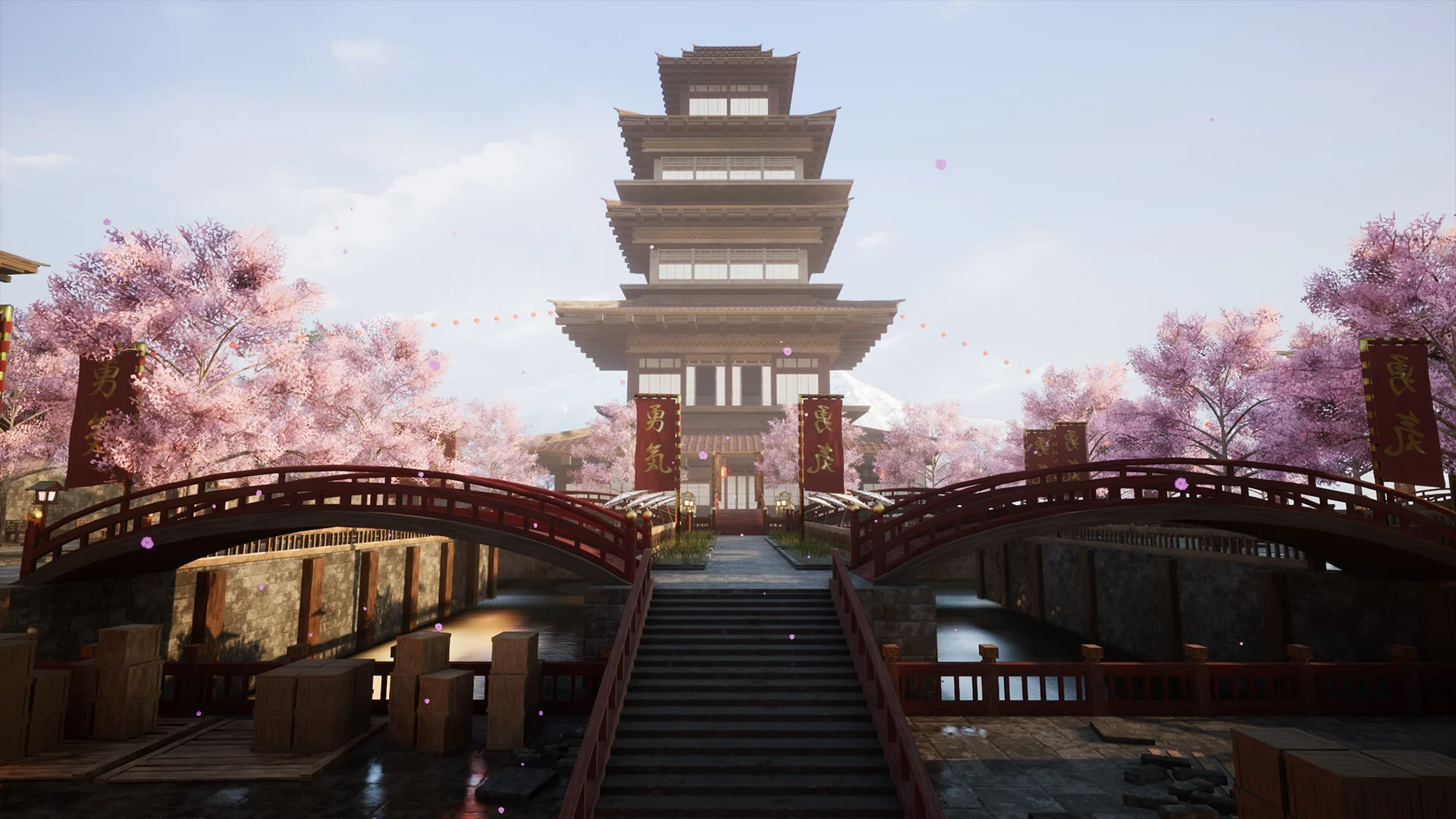
Constructing sprawling historical settlements requires structural assets that align precisely along shared geometric boundaries while maintaining authentic regional character. Modular Asian Medieval City provides the structural foundation needed to assemble historical Chinese and Japanese urban environments. The collection covers complete town districts, spanning waterfront ports, dense street sectors, and sacred temple courtyards. Because the pieces rely on modular logic, individual wall sections, entry gates, dock pilings, and tiled roofs can be snapped together to form distinct architectural profiles without forcing repetitive district patterns across an open level.
Port areas bridge the gap between dry ground and waterways, utilizing specialized components to construct piers, loading docks, and riverbank embankments. Moving inward from the shoreline, structural components transition into high-density commercial and residential streets. Timber framing, interlocking brackets, stone foundations, and distinct clay roof tiling allow level designers to replicate the density seen in ancient East Asian trade hubs. Temple compounds introduce grander, sweeping rooflines and elevated platforms, creating natural focal points for skyline navigation across wide game environments.
Low-poly construction techniques keep base mesh footprints manageable across vast scenes. Rather than relying on singular, heavy hero models that consume disproportionate render budgets, the system distributes architectural weight across clean, reusable modular pieces. This structure supports broad historical vistas where multiple tiers of elevation—from low-lying water canals to elevated temple sanctuaries—must remain visible simultaneously.
Interior Volumes, Street Dressing, and Weapon Props
Many environment packages focus solely on building facades, leaving structural shells hollow and inaccessible to gameplay. Modular Asian Medieval City avoids this boundary by including interior structural pieces, permitting seamless progression from exterior thoroughfares into functional indoor spaces. Doorways, internal partitions, floorboards, and ceiling framework enable traversable houses, guard stations, and temple interiors that hold up under close player scrutiny.
To transition empty rooms and barren thoroughfares into believable lived-in spaces, the kit supplies an assortment of props and period-accurate weapons. Street spaces can be dressed with utilitarian objects that reinforce trade and municipal activity, breaking up flat ground surfaces and providing natural cover points for combat encounters. Weapons included in the collection furnish armories, guard barracks, and individual character loadouts, keeping the historical motif consistent between static level architecture and interactive gear.
Every prop and weapon asset is authored using physically based rendering workflows. PBR material definitions ensure wood grain, polished lacquer, weathered stone, and forged metals react convincingly under varying lighting angles. Surface roughness, metallic values, and specular responses are balanced to preserve realism, preventing the stylized gloss or flat diffuse shading that often breaks immersion in period-specific titles.
Lumen Support and Project Settings in Unreal Engine 5.0+
Lighting ancient architecture demands accurate representation of deep eaves, narrow alleyways, and shadowed interior sanctuaries. Modular Asian Medieval City is built to leverage Lumen dynamic global illumination inside Unreal Engine 5.0 and newer versions. When fully configured, indirect light naturally bounces off paving stones into covered verandas, catching the undersides of complex bracket systems and illuminating shaded rooms without manual light placement.
To achieve intended visual results, specific engine configurations must be verified within the target project. Global illumination must be set to Lumen in the project settings, and software ray tracing features must be properly engaged. The environment package includes explicit instructions to guide developers through enabling these lighting systems, ensuring that bounced light, sky occlusion, and dark interior chambers render reliably from the moment a level is loaded.
Dynamic lighting eliminates the friction of baking static lightmaps during rapid level iteration, though traditional lightmap coordinates remain available across the asset pool for productions utilizing baked workflows. When running under dynamic time-of-day cycles or shifting weather, Lumen calculates diffuse interreflection across the modular wood and plaster surfaces, preserving high contrast in shaded alleys while preventing indoor areas from washing out.
Mesh Distance Fields and Modular Water Interactions
Water elements are central to port cities, river districts, and temple reflection ponds. In Modular Asian Medieval City, the visual fidelity of water surfaces is directly tied to mesh distance fields. Project settings must have generate mesh distance fields turned on to unlock the intended water effects. Without distance fields active, water planes cannot accurately detect nearby meshes, leading to unnatural shorelines and broken surface interactions around dock pilings, stone retaining walls, and partially submerged debris.
Enabling mesh distance fields supplies the engine with signed distance field representations of every static mesh in the scene. The water materials query this spatial data to generate shoreline foam, edge blending, and depth-based translucency where river water meets stone embankments or timber docks. Distance fields also feed Lumen software ray tracing, reinforcing indirect shadowing under piers, inside drainage channels, and along low-clearance bridges.
Because distance field generation incurs memory overhead, meshes across the pack are optimized with clean collision hulls and streamlined base forms. The balance between low-poly vertex distribution and accurate distance field volume generation keeps memory consumption stable, allowing broad water bodies and complex waterfront settlements to run side by side without triggering distance field cache bottlenecks.
Epic Skeleton Scaling and Runtime Optimization Systems
Scale discrepancies can disrupt third-person camera framing, weapon grip alignment, and first-person doorway clearance. All structural components, props, and weapons in Modular Asian Medieval City are scaled precisely to match the standard Epic Skeleton. Door heights clear standard character capsules cleanly, stair risers accommodate default step heights without clipping or awkward foot placement, and weapon handles align naturally with standard skeletal hand sockets. This standard scaling removes the need for uniform or non-uniform transform tweaks when importing meshes into existing game frameworks.
Runtime performance is maintained through a complete optimization stack deployed across the asset catalog:
Levels of Detail (LODs): Every modular building section, prop, and weapon incorporates pre-configured LOD stages that aggressively reduce polycounts as objects recede from the camera viewpoint.
Custom Collision: Accurate, low-overhead collision primitives ensure player pawns and physical projectiles collide predictably with walls, stairs, and props without relying on costly complex-per-poly collision checks.
Pre-Computed Lightmaps: Dedicated lightmap UV channels are included, giving teams the flexibility to bake static lighting if target hardware limits dynamic global illumination.
Mesh Distance Fields: Clean geometric forms ensure accurate distance field representation for ambient occlusion, water blending, and global lighting calculations.
By pairing strict modular snapping with Epic Skeleton alignment and comprehensive runtime optimizations, the environment functions as a dependable production kit for historical Chinese and Japanese settings in modern game engines.
 Cities
 Cities
 Cities