"d037b61901c110d2"{"id":"1002681","slug":"modular-dungeon-collection","title":"Modular Dungeon Collection","category":"Fantasy","engine":"5.0+","assetVersion":"","engineVersion":"Engine Version: 5.0+","tag":"Fantasy","accent":"blue","visual":"mech","summary":"Examine the Modular Dungeon Collection, featuring 67 modular pieces, 50 props, tileable wall materials, and an included sample dungeon scene.","platform":"Unreal Engine","indexPolicy":"index","publishedAt":"2026-11-16T22:32:18.014Z","updatedAt":"2026-11-16T22:32:18.014Z","sourceNotes":[],"fileContents":[],"compatibility":["Unreal Engine","Engine Version: 5.0+"],"featuredImage":{"alt":"Modular Dungeon Collection","src":"/wp-content/uploads/published/2026/11/87b648d8b0ad-58a605aa-4795-41b6-9a44-2aa0b292179a-4463c4b223.webp"},"fileSizeBytes":3437938730,"hasDownloadLink":true,"downloads":0,"terms":[{"taxonomy":"category","slug":"fantasy","name":"Fantasy"}],"galleryImages":[{"src":"/wp-content/uploads/published/2026/11/f636d2c32f7e-0100e9f9-b69f-4303-9d4f-afc62a87eec6-37d1ade7a2.webp","alt":"Modular Dungeon Collection"},{"src":"/wp-content/uploads/published/2026/11/1da34f5d9666-c19f18a2-a896-49d5-b83f-e9780b940af9-6e79c534b1.webp","alt":"Modular Dungeon Collection"},{"src":"/wp-content/uploads/published/2026/11/2354873f3a22-11ba70bb-c61e-4291-8aa6-cbaa293339bf-e16abb6f9d.webp","alt":"Modular Dungeon Collection"},{"src":"/wp-content/uploads/published/2026/11/9d8715eaf7bd-8f682bc0-3a1f-4e38-99ba-e48309ff4394-457630c205.webp","alt":"Modular Dungeon Collection"},{"src":"/wp-content/uploads/published/2026/11/8fa24e12e54e-a4774721-519f-4c2e-a15a-2f8f18a569ef-41ad2fcf13.webp","alt":"Modular Dungeon Collection"},{"src":"/wp-content/uploads/published/2026/11/74f3ae287929-56a61e57-959b-4080-83fc-319fd6870f8f-394fe1b434.webp","alt":"Modular Dungeon Collection"},{"src":"/wp-content/uploads/published/2026/11/f36577c31526-b7274be9-6495-4fa4-bfbe-9e3e22877eda-1183b195db.webp","alt":"Modular Dungeon Collection"},{"src":"/wp-content/uploads/published/2026/11/d2716774ba81-b0f91dab-e5b9-4a92-98fd-ff04bdddb7da-382658f15c.webp","alt":"Modular Dungeon Collection"},{"src":"/wp-content/uploads/published/2026/11/6126b7222b87-a5bfd13b-8c48-45db-a14b-0c228c1d4651-81f6bab018.webp","alt":"Modular Dungeon Collection"},{"src":"/wp-content/uploads/published/2026/11/404dbe8157cc-9dd942bf-d1eb-4c33-8572-d5e77cf896cb-1618b8c1c6.webp","alt":"Modular Dungeon Collection"}],"accessPanel":{"kind":"resource","title":"Get this resource","eyebrow":"Free resource","message":"Download this resource in your browser.","fileName":"Content.7z","safetyNote":"Resources are manually reviewed before listing to improve quality and reduce obvious risks.","actionLabel":"Get this resource","resourceType":"Resource archive","versions":[]},"contentHtml":"\u003cp\u003eConstructing subterranean environments requires a dependable spatial logic where stone corridors, vaulted chambers, and fortified doorways align without manual geometric correction. The Modular Dungeon Collection addresses this requirement by delivering an environment construction kit geared toward realistic medieval, gothic, and ancient fantasy architecture. Designed to build everything from tight underground crypts to sprawling catacomb networks, the kit combines structural components with interior dressings to support flexible level construction from the ground up.\u003c/p\u003e \u003ch2\u003eAssembling Layouts with Modular Dungeon Structural Assets\u003c/h2\u003e\n\u003cp\u003eAt the center of the package is a library of 67 modular pieces developed to snap together across varied floor plans and elevations. These structural meshes form the architectural backbone of a level, providing the necessary boundaries, passages, and structural transitions needed to outline tombs, prison blocks, or ancient stone halls. Because the geometric footprints are modular, level designers can iterate on corridor length, room depth, and vertical transitions without remodeling base elements or introducing irregular seam lines.\u003c/p\u003e\n\u003cp\u003eThe collection balances straightforward hallway segments with specialized structural junctures. Builders can orchestrate multi-room dungeon crawls by linking wide central chambers to narrow access tunnels or burial vaults. Having 67 discrete architectural parts ensures that repetitive silhouettes can be broken up across extended interior runs. Designers can alter room perimeters, introduce recessed wall niches, or build multi-tiered stone chambers while preserving consistent grid alignment across the entire scene.\u003c/p\u003e \u003ch2\u003eSurface Uniformity and Tileable Wall Materials\u003c/h2\u003e\n\u003cp\u003eA primary technical consideration in modular environment design is texture continuity. When distinct mesh segments meet, mismatched UV seams or clashing surface values can break the illusion of continuous stone masonry. The Modular Dungeon Collection resolves this by assigning a single, tileable PBR material across all wall pieces. Every wall asset in the kit references this shared material setup, establishing uniform roughness, normal details, and stone coloration throughout the environment.\u003c/p\u003e\n\u003cp\u003eThis single-material structure introduces significant flexibility into the environment workflow:\u003c/p\u003e\n\u003cul\u003e \u003cli\u003e\u003cstrong\u003eGlobal Material Swaps:\u003c/strong\u003e Replacing the default stone material with an alternate tileable texture instantly updates every wall piece across the entire level layout.\u003c/li\u003e \u003cli\u003e\u003cstrong\u003eScale Adjustments:\u003c/strong\u003e Designers can tweak texture coordinate tiling directly within the material properties to adapt the surface scale for larger cathedral-scale crypts or tighter catacomb corridors.\u003c/li\u003e \u003cli\u003e\u003cstrong\u003eStylistic Customization:\u003c/strong\u003e Custom brick, carved masonry, or weathered rock textures can be dropped into the master material slot without requiring remapping or mesh-level texture rebaking.\u003c/li\u003e\n\u003c/ul\u003e\n\u003cp\u003eBy relying on a unified tileable setup rather than locked, unique texture bakes on every structural face, the package ensures visual harmony while minimizing the memory footprint associated with multiple redundant wall texture sets.\u003c/p\u003e \u003ch2\u003eDungeon Collection Props and Skeletal Rigging\u003c/h2\u003e\n\u003cp\u003eEmpty stone halls require dressings to convey function, age, and decay. To support this narrative detailing, the collection includes 50 individual props designed to populate subterranean chambers, catacombs, and ancient burial sites. These objects provide the necessary visual interruptions to convert sterile geometric blocks into occupied or abandoned medieval interiors.\u003c/p\u003e\n\u003cp\u003eAmong the prop selection is a physics-rigged skeleton asset, providing realistic skeletal remains that react to physical forces within the scene. Rather than relying solely on static bone meshes that require manual placement, the physics setup allows for dynamic ragdoll interactions or realistic natural resting positions against dungeon walls, inside iron cages, or strewn across stone floors. Later iterations of the package expand on this asset by including dedicated static poses for skeletons, giving designers ready-to-use arrangements for quick environmental storytelling without requiring physics simulation passes during level layout.\u003c/p\u003e\n\u003cp\u003eThe remaining props are optimized for scene performance, ensuring that detailed clutter passes across large underground facilities do not disproportionately degrade framerates. Scatter elements, storage items, and thematic dungeon dressings can be distributed liberally through corridors and vaulted rooms to reinforce the feeling of a fortified medieval stronghold or a long-sealed ancient crypt.\u003c/p\u003e \u003ch2\u003eMesh Revisions and Demo Scene Optimisation\u003c/h2\u003e\n\u003cp\u003eReliable collision and clearance tolerances are critical when assembling interactive interior spaces. In earlier versions of modular kits, swinging or sliding door assets can encounter alignment issues. Development updates to the collection directly targeted these functional constraints. Door geometries underwent explicit clearance adjustments to eliminate clipping through doorway surrounds, preventing visual artifacts when doors swing open or closed. Specific scale corrections were also applied to assets designated as Door 01 and Door 02, ensuring that their bounding dimensions align precisely with their matching doorframe thresholds.\u003c/p\u003e\n\u003cp\u003eThe kit expanded over time through the addition of five new meshes, widening the architectural combinations available for custom floor plans. In addition to structural revisions, the package includes a fully realized sample dungeon level. This demonstration scene acts as a functional benchmark, exhibiting how the 67 modular pieces, 50 props, and seamless wall materials fit together into a cohesive game-ready environment.\u003c/p\u003e\n\u003cp\u003eSubsequent updates brought specific performance optimizations to this demo scene, refining mesh culling and spatial efficiency. The demo lighting was also reworked to better showcase the depth and shadow response of the stone surfaces, demonstrating effective methods for illuminating dark catacombs, recessed crypts, and grand dungeon chambers. A dedicated video demonstration accompanies these scene revisions, offering an immediate breakdown of spatial scale, asset layout, and overall visual balance.\u003c/p\u003e \u003ch2\u003ePractical Integration in Subterranean Level Design\u003c/h2\u003e\n\u003cp\u003eWhen implementing the Modular Dungeon Collection within a production pipeline, its greatest utility lies in rapid prototyping coupled with clean material management. Because the wall components share a unified tileable material, art teams are not locked into a single aesthetic. A scene can begin as a grim medieval torture chamber, transition into a sacred gothic crypt, or become an ancient forgotten tomb simply by swapping the tileable base textures while keeping the underlying 67-piece structural skeleton intact.\u003c/p\u003e\n\u003cp\u003eThe combination of structural snap pieces, scalable materials, optimized props, and an interactive physics-rigged skeleton delivers a self-contained toolkit for realistic interior level creation. For developers seeking an organized, performance-conscious foundation for subterranean spaces, the collection offers both the individual building blocks and the tested layout framework necessary to begin immediate production.\u003c/p\u003e\n\n\u003ch2\u003eRelated Resources Worth Checking\u003c/h2\u003e\n\u003cul\u003e\n\u003cli\u003e\u003ca href=\"https://3dcghub.com/dungeon-lamps/\" rel=\"noopener noreferrer\"\u003eDungeon Lamps\u003c/a\u003e\u003c/li\u003e\n\u003cli\u003e\u003ca href=\"https://3dcghub.com/the-caves/\" rel=\"noopener noreferrer\"\u003eThe Caves\u003c/a\u003e\u003c/li\u003e\n\u003cli\u003e\u003ca href=\"https://3dcghub.com/deep-elder-caves/\" rel=\"noopener noreferrer\"\u003eDeep Elder Caves\u003c/a\u003e\u003c/li\u003e\n\u003cli\u003e\u003ca href=\"https://3dcghub.com/stylized-dungeon-castle/\" rel=\"noopener noreferrer\"\u003eStylized Dungeon Castle\u003c/a\u003e\u003c/li\u003e\n\u003cli\u003e\u003ca href=\"https://3dcghub.com/fantasy-mining-dungeon/\" rel=\"noopener noreferrer\"\u003eFantasy Mining Dungeon\u003c/a\u003e\u003c/li\u003e\n\u003c/ul\u003e","contentTextLength":7305,"navigation":{"current":8,"total":4611,"previous":{"id":"1002682","slug":"modular-gothic-temple-medieval-winter-snow","title":"Modular Gothic Temple (medieval/winter/snow)","category":"Fantasy","platform":"Unreal Engine","updatedAt":"2026-11-16T22:33:11.443Z"},"next":{"id":"1002680","slug":"modular-asian-medieval-city","title":"Modular Asian Medieval City","category":"Cities","platform":"Unreal Engine","updatedAt":"2026-11-16T22:31:22.898Z"}},"relatedResources":[{"id":"1002660","slug":"dungeon-lamps","title":"Dungeon Lamps","category":"Fantasy","engine":"5.0+","assetVersion":"","engineVersion":"Engine Version: 5.0+","tag":"Fantasy","accent":"blue","visual":"mech","summary":"Explore the Dungeon Lamps pack featuring 195 modular assets, 4 PBR sets on a single atlas, 8K textures, fire particles, and interactive Blueprints.","platform":"Unreal Engine","indexPolicy":"index","publishedAt":"2026-11-16T22:05:08.760Z","updatedAt":"2026-11-16T22:05:08.760Z","sourceNotes":[],"fileContents":[],"compatibility":["Unreal Engine","Engine Version: 5.0+"],"featuredImage":{"alt":"Dungeon Lamps","src":"/wp-content/uploads/published/2026/11/3b2da474095d-2304246c-1291-4ce2-b4ec-8c1207472ce2-94403d55f2.webp"},"fileSizeBytes":1526164930,"hasDownloadLink":true,"downloads":0},{"id":"8036","slug":"the-caves","title":"The Caves","category":"Fantasy","engine":"4.26+,5.0+","assetVersion":"Engine version: 4.26+,5.0+","engineVersion":"4.17","tag":"Fantasy","accent":"blue","visual":"city","summary":"Transform your game environments with a comprehensive collection of underground assets. This modular pack offers over 150 models and ready-to-use blueprints for creating deep, atmospheric dungeons.","platform":"Unreal Engine","indexPolicy":"noindex","publishedAt":"2026-02-22T16:33:47.000Z","updatedAt":"2026-04-19T15:55:37.000Z","sourceNotes":[],"fileContents":[],"compatibility":["Unreal Engine","Engine version: 4.26+,5.0+"],"featuredImage":{"alt":"The Caves","src":"https://3dcghub.com/wp-content/uploads/2026/02/c0537004-5ad5-4b86-8120-fdee962ce754.webp"},"fileSizeBytes":810219104,"hasDownloadLink":true,"downloads":0},{"id":"1002656","slug":"deep-elder-caves","title":"Deep Elder Caves","category":"Dungeon","engine":"5.0+","assetVersion":"","engineVersion":"Engine Version: 5.0+","tag":"Dungeon","accent":"blue","visual":"mech","summary":"Explore the technical modularity, texel-density scaling, ORM materials, and prop workflows available in the Deep Elder Caves environment asset collection.","platform":"Unreal Engine","indexPolicy":"index","publishedAt":"2026-11-16T21:55:21.915Z","updatedAt":"2026-11-16T21:55:21.915Z","sourceNotes":[],"fileContents":[],"compatibility":["Unreal Engine","Engine Version: 5.0+"],"featuredImage":{"alt":"Deep Elder Caves","src":"/wp-content/uploads/published/2026/11/254b9c6a3886-282528f5-3a0a-43a2-8892-22e14b36b8b9-04bf3e14ae.webp"},"fileSizeBytes":3054684836,"hasDownloadLink":true,"downloads":0}]}
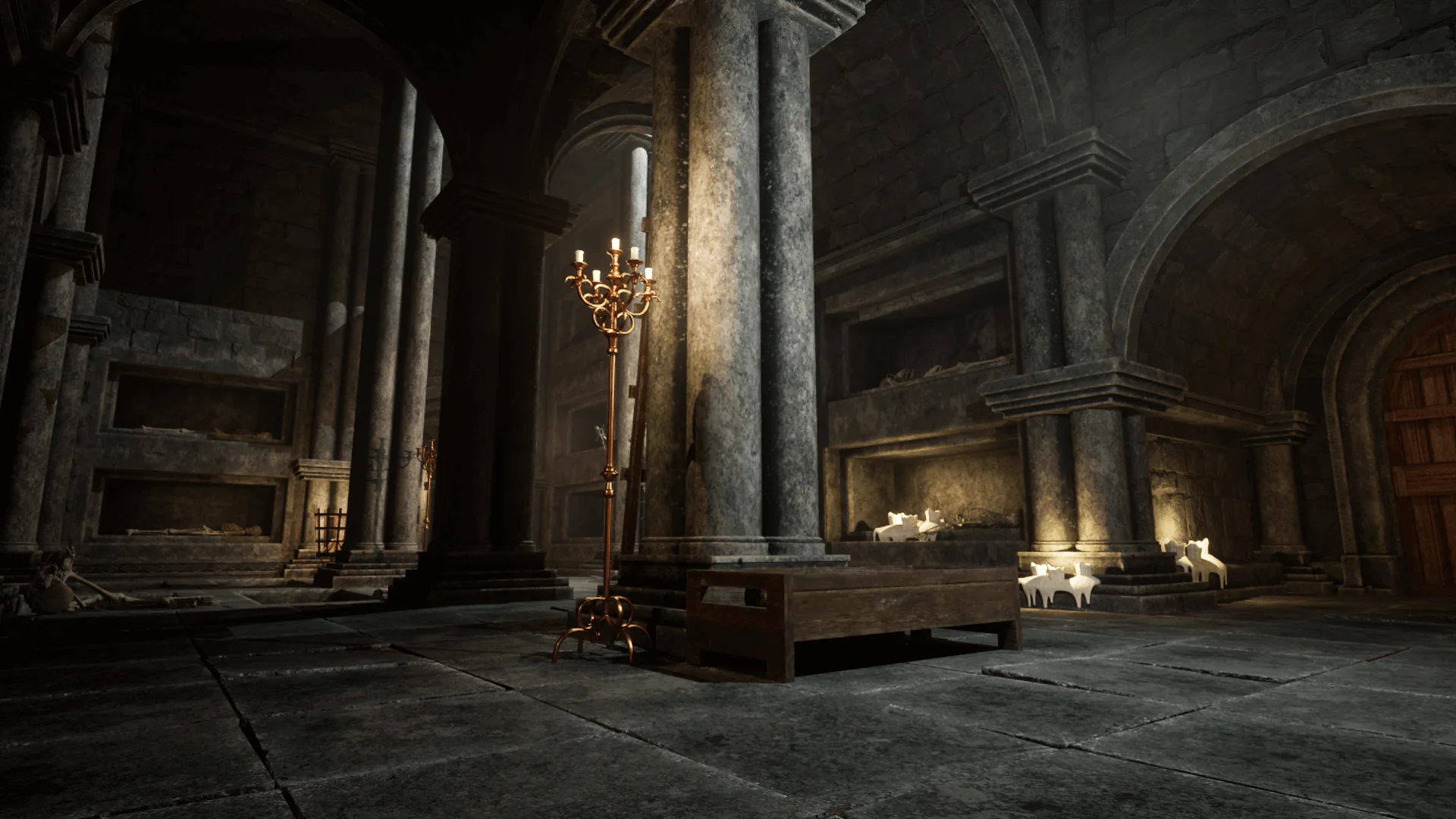
Resource screenshots
1 / 10
Fantasy
Modular Dungeon Collection
Examine the Modular Dungeon Collection, featuring 67 modular pieces, 50 props, tileable wall materials, and an included sample dungeon scene.
Constructing subterranean environments requires a dependable spatial logic where stone corridors, vaulted chambers, and fortified doorways align without manual geometric correction. The Modular Dungeon Collection addresses this requirement by delivering an environment construction kit geared toward realistic medieval, gothic, and ancient fantasy architecture. Designed to build everything from tight underground crypts to sprawling catacomb networks, the kit combines structural components with interior dressings to support flexible level construction from the ground up.
Assembling Layouts with Modular Dungeon Structural Assets
At the center of the package is a library of 67 modular pieces developed to snap together across varied floor plans and elevations. These structural meshes form the architectural backbone of a level, providing the necessary boundaries, passages, and structural transitions needed to outline tombs, prison blocks, or ancient stone halls. Because the geometric footprints are modular, level designers can iterate on corridor length, room depth, and vertical transitions without remodeling base elements or introducing irregular seam lines.
The collection balances straightforward hallway segments with specialized structural junctures. Builders can orchestrate multi-room dungeon crawls by linking wide central chambers to narrow access tunnels or burial vaults. Having 67 discrete architectural parts ensures that repetitive silhouettes can be broken up across extended interior runs. Designers can alter room perimeters, introduce recessed wall niches, or build multi-tiered stone chambers while preserving consistent grid alignment across the entire scene.
Surface Uniformity and Tileable Wall Materials
A primary technical consideration in modular environment design is texture continuity. When distinct mesh segments meet, mismatched UV seams or clashing surface values can break the illusion of continuous stone masonry. The Modular Dungeon Collection resolves this by assigning a single, tileable PBR material across all wall pieces. Every wall asset in the kit references this shared material setup, establishing uniform roughness, normal details, and stone coloration throughout the environment.
This single-material structure introduces significant flexibility into the environment workflow:
Global Material Swaps: Replacing the default stone material with an alternate tileable texture instantly updates every wall piece across the entire level layout.
Scale Adjustments: Designers can tweak texture coordinate tiling directly within the material properties to adapt the surface scale for larger cathedral-scale crypts or tighter catacomb corridors.
Stylistic Customization: Custom brick, carved masonry, or weathered rock textures can be dropped into the master material slot without requiring remapping or mesh-level texture rebaking.
By relying on a unified tileable setup rather than locked, unique texture bakes on every structural face, the package ensures visual harmony while minimizing the memory footprint associated with multiple redundant wall texture sets.
Dungeon Collection Props and Skeletal Rigging
Empty stone halls require dressings to convey function, age, and decay. To support this narrative detailing, the collection includes 50 individual props designed to populate subterranean chambers, catacombs, and ancient burial sites. These objects provide the necessary visual interruptions to convert sterile geometric blocks into occupied or abandoned medieval interiors.
Among the prop selection is a physics-rigged skeleton asset, providing realistic skeletal remains that react to physical forces within the scene. Rather than relying solely on static bone meshes that require manual placement, the physics setup allows for dynamic ragdoll interactions or realistic natural resting positions against dungeon walls, inside iron cages, or strewn across stone floors. Later iterations of the package expand on this asset by including dedicated static poses for skeletons, giving designers ready-to-use arrangements for quick environmental storytelling without requiring physics simulation passes during level layout.
The remaining props are optimized for scene performance, ensuring that detailed clutter passes across large underground facilities do not disproportionately degrade framerates. Scatter elements, storage items, and thematic dungeon dressings can be distributed liberally through corridors and vaulted rooms to reinforce the feeling of a fortified medieval stronghold or a long-sealed ancient crypt.
Mesh Revisions and Demo Scene Optimisation
Reliable collision and clearance tolerances are critical when assembling interactive interior spaces. In earlier versions of modular kits, swinging or sliding door assets can encounter alignment issues. Development updates to the collection directly targeted these functional constraints. Door geometries underwent explicit clearance adjustments to eliminate clipping through doorway surrounds, preventing visual artifacts when doors swing open or closed. Specific scale corrections were also applied to assets designated as Door 01 and Door 02, ensuring that their bounding dimensions align precisely with their matching doorframe thresholds.
The kit expanded over time through the addition of five new meshes, widening the architectural combinations available for custom floor plans. In addition to structural revisions, the package includes a fully realized sample dungeon level. This demonstration scene acts as a functional benchmark, exhibiting how the 67 modular pieces, 50 props, and seamless wall materials fit together into a cohesive game-ready environment.
Subsequent updates brought specific performance optimizations to this demo scene, refining mesh culling and spatial efficiency. The demo lighting was also reworked to better showcase the depth and shadow response of the stone surfaces, demonstrating effective methods for illuminating dark catacombs, recessed crypts, and grand dungeon chambers. A dedicated video demonstration accompanies these scene revisions, offering an immediate breakdown of spatial scale, asset layout, and overall visual balance.
Practical Integration in Subterranean Level Design
When implementing the Modular Dungeon Collection within a production pipeline, its greatest utility lies in rapid prototyping coupled with clean material management. Because the wall components share a unified tileable material, art teams are not locked into a single aesthetic. A scene can begin as a grim medieval torture chamber, transition into a sacred gothic crypt, or become an ancient forgotten tomb simply by swapping the tileable base textures while keeping the underlying 67-piece structural skeleton intact.
The combination of structural snap pieces, scalable materials, optimized props, and an interactive physics-rigged skeleton delivers a self-contained toolkit for realistic interior level creation. For developers seeking an organized, performance-conscious foundation for subterranean spaces, the collection offers both the individual building blocks and the tested layout framework necessary to begin immediate production.
 Fantasy
 Fantasy
 Dungeon