"d037b61901c110d2"{"id":"1002656","slug":"deep-elder-caves","title":"Deep Elder Caves","category":"Dungeon","engine":"5.0+","assetVersion":"","engineVersion":"Engine Version: 5.0+","tag":"Dungeon","accent":"blue","visual":"mech","summary":"Explore the technical modularity, texel-density scaling, ORM materials, and prop workflows available in the Deep Elder Caves environment asset collection.","platform":"Unreal Engine","indexPolicy":"index","publishedAt":"2026-11-16T21:55:21.915Z","updatedAt":"2026-11-16T21:55:21.915Z","sourceNotes":[],"fileContents":[],"compatibility":["Unreal Engine","Engine Version: 5.0+"],"featuredImage":{"alt":"Deep Elder Caves","src":"/wp-content/uploads/published/2026/11/254b9c6a3886-282528f5-3a0a-43a2-8892-22e14b36b8b9-04bf3e14ae.webp"},"fileSizeBytes":3054684836,"hasDownloadLink":true,"downloads":0,"terms":[{"taxonomy":"category","slug":"dungeon","name":"Dungeon"}],"galleryImages":[{"src":"/wp-content/uploads/published/2026/11/e63fcc5bcee9-cf6d28cc-153a-4d24-8ef0-6c716d6ff29b-49d4c65e3d.webp","alt":"Deep Elder Caves"},{"src":"/wp-content/uploads/published/2026/11/c0b8b6bd5ae0-919d0b8e-5da7-4d78-b526-4e7c325c8d5c-c2242f977c.webp","alt":"Deep Elder Caves"},{"src":"/wp-content/uploads/published/2026/11/54d94f9d3346-7be50f68-aab4-4d4e-b5c1-3884c30c31f4-77d7da3c91.webp","alt":"Deep Elder Caves"},{"src":"/wp-content/uploads/published/2026/11/2f7793ca9497-a58a52cd-4cfc-4ccf-aecd-3484b4a0061d-406efd5fd3.webp","alt":"Deep Elder Caves"},{"src":"/wp-content/uploads/published/2026/11/5b352b49371c-55e07b1a-5be5-49c5-a063-26937e05e07c-c6ea83db01.webp","alt":"Deep Elder Caves"},{"src":"/wp-content/uploads/published/2026/11/7b5ca69dea2a-3d027064-375d-4d00-a5c2-6f7590b9b8e3-83f7ed37ed.webp","alt":"Deep Elder Caves"},{"src":"/wp-content/uploads/published/2026/11/765f8694263e-4dde9540-eb90-4274-a83e-d2e53729a822-83469dfbef.webp","alt":"Deep Elder Caves"},{"src":"/wp-content/uploads/published/2026/11/c1e5ea5698b2-dbbfa493-f8b9-4644-b862-c25060bd4fec-27a894c660.webp","alt":"Deep Elder Caves"},{"src":"/wp-content/uploads/published/2026/11/fdb2264a75b1-a0948c06-aa82-44d0-95fb-8fe86bbfabf0-0767c797ab.webp","alt":"Deep Elder Caves"},{"src":"/wp-content/uploads/published/2026/11/c32aeb59c4bc-3907c3e8-c55f-4201-93cc-e04d6a409065-25e269c237.webp","alt":"Deep Elder Caves"}],"accessPanel":{"kind":"resource","title":"Get this resource","eyebrow":"Free resource","message":"Download this resource in your browser.","fileName":"Content.7z","safetyNote":"Resources are manually reviewed before listing to improve quality and reduce obvious risks.","actionLabel":"Get this resource","resourceType":"Resource archive","versions":[]},"contentHtml":"\u003ch2\u003eConstructing Layouts with Deep Elder Caves Modular Meshes\u003c/h2\u003e\u003cp\u003eBuilding subterranean environments often forces a compromise between organic rock shapes and reusable grid-aligned geometry. Deep Elder Caves addresses this balance by supplying 29 architectural modular structural meshes made for cave interiors. The structural foundation includes walls, structural pillars, expansive arches, and floor segments that interlock to define caverns, tunnels, and deep dungeon pathways. Because underground structures rarely conform to uniform room sizes, these architectural parts support direct scaling adjustments without penalizing the visual fidelity of the rock surfaces.\u003c/p\u003e\u003cp\u003eA critical technical capability built into these modular cave pieces is the preservation of uniform texel density during scale operations. When stretching or shrinking standard static meshes, UV coordinates typically distort, leading to blurred or stretched texture details that break visual consistency. With this asset set, scaling up a cave wall to form a towering cavern or reducing a pillar to create a narrow chokepoint maintains consistent UV mapping. Level designers can freely manipulate proportions in the viewport to match combat geometry or traversal requirements, eliminating the need to model bespoke connector meshes for irregular cavern spaces.\u003c/p\u003e\u003ch2\u003eMaterial Setup, ORM Packing, and Vertex Blending\u003c/h2\u003e\u003cp\u003eSurfacing subterranean chambers requires both memory efficiency and localized surface variation. The package implements master materials driven by packed ORM texture maps. By consolidating Ambient Occlusion, Roughness, and Metallic channels into individual RGB texture samplers, the environment reduces texture fetch operations and conserves GPU memory across large scenes. These master materials are built for straightforward customization, allowing developers to adjust global roughness responses, tint rock strata, or tweak reflectivity to accommodate subterranean moisture.\u003c/p\u003e\u003cp\u003eTo avoid visible tiling seams across expansive rock faces and cavern floors, the tileable materials leverage vertex color painting. Artists can paint directly on mesh vertices within the viewport to blend different material layers across surfaces. This technique enables smooth transitions from dry stone to damp subterranean soil, or from rough cavern bedrock to mineral-dusted surfaces, breaking repetitive patterns without requiring unique baked textures for every modular segment. Visual enrichment decals supplement this workflow, layering additional localized imperfections, surface cracks, and weathering over the base geometry.\u003c/p\u003e\u003ch2\u003eDressing Caves with Organic and Relic Props\u003c/h2\u003e\u003cp\u003eBeyond structural framework pieces, the collection contains 178 distinct prop assets that furnish narrative and spatial context. Subterranean set dressing is divided across geological debris, organic vegetation, skeletal remains, and dungeon treasure. The geological component features rocks of various sizes, enabling level artists to scatter jagged boulders around the base of modular walls or create irregular stepping stones across deep chambers.\u003c/p\u003e\u003cp\u003eOrganic dressing focuses heavily on cave flora and subterranean growth. Designers can populate caverns with huge and small fantasy mushrooms, creating distinct focal points or biological clusters. Foliage layers are further enriched by shrubs and hanging or creeping roots. The root assets combine 3D polygonal geometry with alpha cutouts, balancing silhouette depth against performance overhead. These natural components enable scenes to shift instantly from barren rock tombs to bioluminescent underground ecosystems.\u003c/p\u003e\u003cp\u003eDungeon narrative storytelling is reinforced through specific thematic props: \u003c/p\u003e\u003cul\u003e\u003cli\u003eSolid skeleton meshes arranged in multiple distinct poses for environmental storytelling\u003c/li\u003e\u003cli\u003eLoose bone piles and individual skulls for scattering across encounter areas\u003c/li\u003e\u003cli\u003eTreasure chests configured in three distinct color variations alongside loose coins\u003c/li\u003e\u003cli\u003eAncient fallen head statues that hint at ruined civilizations embedded in the rock\u003c/li\u003e\u003cli\u003eTiny habitat statues that bring small-scale focal detail to cavern alcoves and shrines\u003c/li\u003e\u003c/ul\u003e\u003ch2\u003eVisual Articulation in the Demonstration Level\u003c/h2\u003e\u003cp\u003eThe included completed cave environment demonstrates two primary atmospheric treatments using the same core asset library. One section showcases a classic cold, dark subterranean cave. This treatment leans on stark stony materials, subdued lighting, skeletal debris, and dry rock formations, fitting traditional dungeon crawls and bleak fantasy scenarios where navigation hazards and isolation define the experience.\u003c/p\u003e\u003cp\u003eA secondary area of the demonstration map illustrates a warmer fantasy cave biome. By introducing vibrant mushroom clusters, softer ambient illumination, and dense patches of roots and shrubs, the environment transforms into an overgrown biological cavern. Because the customizable master materials permit rapid adjustments to surface properties and the vertex color system accommodates localized material changes, transitioning an entire scene between these two stylistic extremes requires no modification to the underlying mesh topologies.\u003c/p\u003e\u003ch2\u003eProduction Integration and Optimization\u003c/h2\u003e\u003cp\u003eThe full 250-piece library is tuned for performance across action games and fantasy role-playing titles. Every mesh in the package features optimized levels of detail (LODs), allowing high-density rock silhouettes to transition smoothly to simplified forms across camera distances. This optimization protects frame rates in vast underground spaces where draw calls and polygon counts can rapidly escalate.\u003c/p\u003e\u003cp\u003eThe combination of low-poly optimization principles, packed ORM texture workflows, and scalable modular architecture positions the package as a robust starting foundation for fantasy dungeon systems. Whether assembling tight corridor networks, expansive boss arenas, or multi-tiered cavern shafts, developers can deploy the modular structural objects, blend surfaces with vertex color painting, and populate the resulting layouts using the extensive prop catalog.\u003c/p\u003e\n\n\u003ch2\u003eRelated Resources Worth Checking\u003c/h2\u003e\n\u003cul\u003e\n\u003cli\u003e\u003ca href=\"https://3dcghub.com/dragon-s-lair-dragon-cave-dragon-dragon-cave-stylized-cave-dragons/\" rel=\"noopener noreferrer\"\u003eDragon\u0026#039;s Lair - Dragon Cave (Dragon, Dragon Cave, Stylized Cave, Dragons)\u003c/a\u003e\u003c/li\u003e\n\u003cli\u003e\u003ca href=\"https://3dcghub.com/whimsical-caves-kit/\" rel=\"noopener noreferrer\"\u003eWhimsical Caves Kit\u003c/a\u003e\u003c/li\u003e\n\u003cli\u003e\u003ca href=\"https://3dcghub.com/merlins-cave-environment-fantasy-dungeon-cave-fantasy-dungeon-cave-cave-cave/\" rel=\"noopener noreferrer\"\u003eMerlins Cave Environment ( Fantasy Dungeon Cave Fantasy Dungeon Cave Cave Cave )\u003c/a\u003e\u003c/li\u003e\n\u003cli\u003e\u003ca href=\"https://3dcghub.com/underground-ossuary/\" rel=\"noopener noreferrer\"\u003eUnderground Ossuary\u003c/a\u003e\u003c/li\u003e\n\u003cli\u003e\u003ca href=\"https://3dcghub.com/ancient-cave-ruins-ancient-temple-ruins-ancient-valley/\" rel=\"noopener noreferrer\"\u003eAncient Cave Ruins (Ancient Temple Ruins, Ancient Valley )\u003c/a\u003e\u003c/li\u003e\n\u003c/ul\u003e","contentTextLength":6308,"navigation":{"current":33,"total":4611,"previous":{"id":"1002657","slug":"deep-water-station","title":"Deep Water Station","category":"Aquatic","platform":"Unreal Engine","updatedAt":"2026-11-16T21:58:39.666Z"},"next":{"id":"1002655","slug":"construction-props","title":"Construction PROPS","category":"Industrial","platform":"Unreal Engine","updatedAt":"2026-11-16T21:54:09.323Z"}},"relatedResources":[{"id":"1002087","slug":"dragon-s-lair-dragon-cave-dragon-dragon-cave-stylized-cave-dragons","title":"Dragon's Lair - Dragon Cave (Dragon, Dragon Cave, Stylized Cave, Dragons)","category":"Dungeon","engine":"5.0+","assetVersion":"","engineVersion":"Engine Version: 5.0+","tag":"Dungeon","accent":"blue","visual":"mech","summary":"Build stylized subterranean chambers with modular boulders, chain splines, infinite dragon tail mechanics, 4 atmospheric VFX systems, and cinematic sequences.","platform":"Unreal Engine","indexPolicy":"index","publishedAt":"2026-10-26T15:56:42.683Z","updatedAt":"2026-10-26T15:56:42.683Z","sourceNotes":[],"fileContents":[],"compatibility":["Unreal Engine","Engine Version: 5.0+"],"featuredImage":{"alt":"Dragon's Lair - Dragon Cave (Dragon, Dragon Cave, Stylized Cave, Dragons)","src":"/wp-content/uploads/published/2026/10/3f8308cb89a8-6b795529-ccd0-4ef9-a0b8-116c5943a2fa-9e76d5a6e2.webp"},"fileSizeBytes":280575161,"hasDownloadLink":true,"downloads":2},{"id":"1001772","slug":"whimsical-caves-kit","title":"Whimsical Caves Kit","category":"Dungeon","engine":"5.0+","assetVersion":"","engineVersion":"Engine Version: 5.0+","tag":"Dungeon","accent":"blue","visual":"mech","summary":"Explore the Whimsical Caves Kit, featuring handcrafted cave meshes, scale-adapting tiling materials, ORM maps, automatic LODs, and modular rock piles.","platform":"Unreal Engine","indexPolicy":"index","publishedAt":"2026-10-20T03:21:43.242Z","updatedAt":"2026-10-20T03:21:43.242Z","sourceNotes":[],"fileContents":[],"compatibility":["Unreal Engine","Engine Version: 5.0+"],"featuredImage":{"alt":"Whimsical Caves Kit","src":"/wp-content/uploads/published/2026/10/56116c5b0ee5-9ec9fdc1-dd03-45f2-bb70-090dd63476ef-a37fd78290.webp"},"fileSizeBytes":2753222620,"hasDownloadLink":true,"downloads":0},{"id":"1000378","slug":"merlins-cave-environment-fantasy-dungeon-cave-fantasy-dungeon-cave-cave-cave","title":"Merlins Cave Environment ( Fantasy Dungeon Cave Fantasy Dungeon Cave Cave Cave )","category":"Dungeon","engine":"4.26+,5.0+","assetVersion":"","engineVersion":"Engine Version: 4.26+,5.0+","tag":"Dungeon","accent":"blue","visual":"city","summary":"A detailed breakdown of the Merlins Cave Environment, featuring 135 unique meshes, world-aligned materials, and the Ultimate Level Art Tool for modular level de","platform":"Unreal Engine","indexPolicy":"index","publishedAt":"2026-07-06T18:41:47.502Z","updatedAt":"2026-07-06T18:41:47.502Z","sourceNotes":[],"fileContents":[],"compatibility":["Unreal Engine","Engine Version: 4.26+,5.0+"],"featuredImage":{"alt":"Merlins Cave Environment ( Fantasy Dungeon Cave Fantasy Dungeon Cave Cave Cave )","src":"/wp-content/uploads/published/2026/07/87649763adde-a91ad985-ca50-4949-a2bd-274c7f9ed342-b848070cb4.webp"},"fileSizeBytes":2086819593,"hasDownloadLink":true,"downloads":1}]}
Resource screenshots
1 / 10
Dungeon
Deep Elder Caves
Explore the technical modularity, texel-density scaling, ORM materials, and prop workflows available in the Deep Elder Caves environment asset collection.
Constructing Layouts with Deep Elder Caves Modular Meshes
Building subterranean environments often forces a compromise between organic rock shapes and reusable grid-aligned geometry. Deep Elder Caves addresses this balance by supplying 29 architectural modular structural meshes made for cave interiors. The structural foundation includes walls, structural pillars, expansive arches, and floor segments that interlock to define caverns, tunnels, and deep dungeon pathways. Because underground structures rarely conform to uniform room sizes, these architectural parts support direct scaling adjustments without penalizing the visual fidelity of the rock surfaces.
A critical technical capability built into these modular cave pieces is the preservation of uniform texel density during scale operations. When stretching or shrinking standard static meshes, UV coordinates typically distort, leading to blurred or stretched texture details that break visual consistency. With this asset set, scaling up a cave wall to form a towering cavern or reducing a pillar to create a narrow chokepoint maintains consistent UV mapping. Level designers can freely manipulate proportions in the viewport to match combat geometry or traversal requirements, eliminating the need to model bespoke connector meshes for irregular cavern spaces.
Material Setup, ORM Packing, and Vertex Blending
Surfacing subterranean chambers requires both memory efficiency and localized surface variation. The package implements master materials driven by packed ORM texture maps. By consolidating Ambient Occlusion, Roughness, and Metallic channels into individual RGB texture samplers, the environment reduces texture fetch operations and conserves GPU memory across large scenes. These master materials are built for straightforward customization, allowing developers to adjust global roughness responses, tint rock strata, or tweak reflectivity to accommodate subterranean moisture.
To avoid visible tiling seams across expansive rock faces and cavern floors, the tileable materials leverage vertex color painting. Artists can paint directly on mesh vertices within the viewport to blend different material layers across surfaces. This technique enables smooth transitions from dry stone to damp subterranean soil, or from rough cavern bedrock to mineral-dusted surfaces, breaking repetitive patterns without requiring unique baked textures for every modular segment. Visual enrichment decals supplement this workflow, layering additional localized imperfections, surface cracks, and weathering over the base geometry.
Dressing Caves with Organic and Relic Props
Beyond structural framework pieces, the collection contains 178 distinct prop assets that furnish narrative and spatial context. Subterranean set dressing is divided across geological debris, organic vegetation, skeletal remains, and dungeon treasure. The geological component features rocks of various sizes, enabling level artists to scatter jagged boulders around the base of modular walls or create irregular stepping stones across deep chambers.
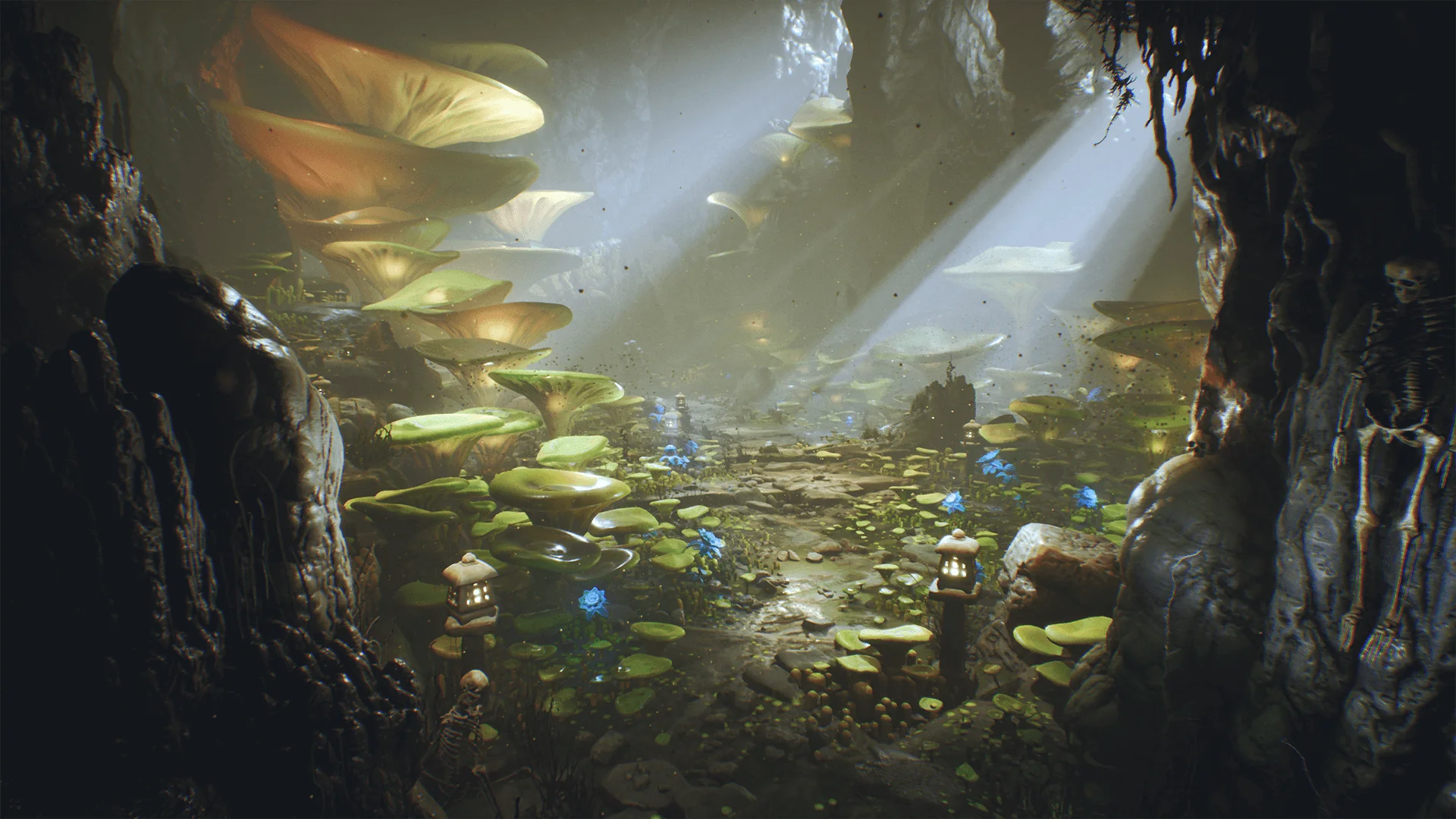
Organic dressing focuses heavily on cave flora and subterranean growth. Designers can populate caverns with huge and small fantasy mushrooms, creating distinct focal points or biological clusters. Foliage layers are further enriched by shrubs and hanging or creeping roots. The root assets combine 3D polygonal geometry with alpha cutouts, balancing silhouette depth against performance overhead. These natural components enable scenes to shift instantly from barren rock tombs to bioluminescent underground ecosystems.
Dungeon narrative storytelling is reinforced through specific thematic props:
Solid skeleton meshes arranged in multiple distinct poses for environmental storytelling
Loose bone piles and individual skulls for scattering across encounter areas
Treasure chests configured in three distinct color variations alongside loose coins
Ancient fallen head statues that hint at ruined civilizations embedded in the rock
Tiny habitat statues that bring small-scale focal detail to cavern alcoves and shrines
Visual Articulation in the Demonstration Level
The included completed cave environment demonstrates two primary atmospheric treatments using the same core asset library. One section showcases a classic cold, dark subterranean cave. This treatment leans on stark stony materials, subdued lighting, skeletal debris, and dry rock formations, fitting traditional dungeon crawls and bleak fantasy scenarios where navigation hazards and isolation define the experience.
A secondary area of the demonstration map illustrates a warmer fantasy cave biome. By introducing vibrant mushroom clusters, softer ambient illumination, and dense patches of roots and shrubs, the environment transforms into an overgrown biological cavern. Because the customizable master materials permit rapid adjustments to surface properties and the vertex color system accommodates localized material changes, transitioning an entire scene between these two stylistic extremes requires no modification to the underlying mesh topologies.
Production Integration and Optimization
The full 250-piece library is tuned for performance across action games and fantasy role-playing titles. Every mesh in the package features optimized levels of detail (LODs), allowing high-density rock silhouettes to transition smoothly to simplified forms across camera distances. This optimization protects frame rates in vast underground spaces where draw calls and polygon counts can rapidly escalate.
The combination of low-poly optimization principles, packed ORM texture workflows, and scalable modular architecture positions the package as a robust starting foundation for fantasy dungeon systems. Whether assembling tight corridor networks, expansive boss arenas, or multi-tiered cavern shafts, developers can deploy the modular structural objects, blend surfaces with vertex color painting, and populate the resulting layouts using the extensive prop catalog.
 Dungeon
 Dungeon
 Dungeon