"7ad89cffa44984cf"{"id":"1002544","slug":"little-dragons-tiger","title":"Little Dragons Tiger","category":"Characters \u0026 Creatures","engine":"4.26+,5.0+","assetVersion":"","engineVersion":"Engine Version: 4.26+,5.0+","tag":"Characters","accent":"blue","visual":"character","summary":"Technical breakdown of Little Dragons Tiger, detailing animation setups, styles, egg hatching sequences, and Horse Animset compatibility.","platform":"Unreal Engine","indexPolicy":"index","publishedAt":"2026-11-13T09:52:17.153Z","updatedAt":"2026-11-13T09:52:17.153Z","sourceNotes":[],"fileContents":[],"compatibility":["Unreal Engine","Engine Version: 4.26+,5.0+"],"featuredImage":{"alt":"Little Dragons Tiger","src":"/wp-content/uploads/published/2026/11/92b1590b536d-dec9fe4d-1906-45b3-8031-4abd1d56097a-9913410b38.webp"},"hasDownloadLink":true,"downloads":0,"terms":[{"taxonomy":"category","slug":"characters-and-creatures","name":"Characters \u0026 Creatures"}],"galleryImages":[{"src":"/wp-content/uploads/published/2026/11/30b715c6d834-0028a16b-e1d8-42f4-9bd4-ae9862ba39fa-c6ef099c5d.webp","alt":"Little Dragons Tiger"},{"src":"/wp-content/uploads/published/2026/11/7ab29b62c958-86acc41a-2fc4-428e-a824-67511511c759-f5030fa058.webp","alt":"Little Dragons Tiger"},{"src":"/wp-content/uploads/published/2026/11/94cc20eb7181-f61d2edd-ebe1-49db-9a13-6d31987b496a-ebb5c37e6c.webp","alt":"Little Dragons Tiger"},{"src":"/wp-content/uploads/published/2026/11/34783b72c49a-0ae119bf-ac42-45d8-be21-505d81c727c1-c9bba91ef1.webp","alt":"Little Dragons Tiger"},{"src":"/wp-content/uploads/published/2026/11/58c80e4dfde1-dce7ba24-7f69-4d84-a762-6f66d009bdb6-a62b682ceb.webp","alt":"Little Dragons Tiger"},{"src":"/wp-content/uploads/published/2026/11/bf03960b4970-2c339d69-539c-446d-bc0b-9cf80f7ce59f-8a27e1e1f0.webp","alt":"Little Dragons Tiger"},{"src":"/wp-content/uploads/published/2026/11/d7305c212648-faf9b117-4c25-4d15-bfe7-47d7872c21f7-cdd8f37405.webp","alt":"Little Dragons Tiger"},{"src":"/wp-content/uploads/published/2026/11/5f27b88050bb-c23ec42d-646a-47ff-88ca-86ff251baa09-f8dcc841a1.webp","alt":"Little Dragons Tiger"},{"src":"/wp-content/uploads/published/2026/11/70457b46020f-c9ad1c64-d13a-4fc0-9b62-5cee7b155712-c7f587cd8a.webp","alt":"Little Dragons Tiger"},{"src":"/wp-content/uploads/published/2026/11/71ceb192a00b-72a3bfcc-92ad-4b1a-8622-edfa5b5a97d5-863a249531.webp","alt":"Little Dragons Tiger"}],"accessPanel":{"kind":"resource","title":"Get this resource","eyebrow":"Free resource","message":"Download this resource in your browser.","fileName":"Content.7z","safetyNote":"Resources are manually reviewed before listing to improve quality and reduce obvious risks.","actionLabel":"Get this resource","resourceType":"Resource archive","versions":[]},"contentHtml":"\u003ch2\u003eIntegrating the Little Dragons Tiger Animationblueprint\u003c/h2\u003e\u003cp\u003eDeploying the Little Dragons Tiger begins in the animation pipeline, where the character operates through a dedicated Animationblueprint and underlying script components. The core asset provides two distinct motion philosophies: standard in-place cycles and root-motion animations. Deciding between these two setups defines how movement data interacts with the character controller or navigation component. In-place animations allow the game engine's character movement script to dictate ground velocity, friction, and acceleration curves directly, making it suitable for responsive player-controlled movement or network-replicated entity positions. Root-motion files extract translation and rotation directly from the bone transforms, preventing foot sliding during complex changes of pace or irregular directional shifts.\u003c/p\u003e\u003cp\u003eThe package organizes more than 150 high-quality animations to supply every locomotion state and reactive transition needed for dynamic creatures. Integrating these clips into a state machine requires segmenting ground travel, aerial states, aquatic behavior, and resting cycles into modular sub-graphs. Because the asset is tagged for use as a pet, monster, or companion character, setting up transitions between autonomous companion logic and direct movement commands involves linking script variables directly into the animation blueprint parameters.\u003c/p\u003e\u003ch2\u003eLocomotion States for Little Dragons Across Land, Air, and Water\u003c/h2\u003e\u003cp\u003eGround traversal within the asset is structured across multiple distinct velocity bands rather than a basic run-walk blend. The animation library includes dedicated clips for walks, trots, and full runs, providing the necessary mechanical progression for quadrupeds of this build. Blend spaces can transition cleanly from slow investigative walking cycles into brisk trotting before opening into high-speed sprints. Directional control is supported by discrete turning animations, allowing the creature to pivot naturally when tracking targets or navigating tight level geometry without pivoting purely on the capsule axis.\u003c/p\u003e\u003cp\u003eMobility extends into vertical and evasion mechanics through dedicated jumps and dodges. Dodging animations supply directional burst movements useful for combat maneuvers or evasion scripts, while jumping sequences handle ground launch, mid-air anticipation, and landing impacts. Beyond terrestrial locomotion, the asset supports multi-environment behavior with complete swim and underwater animation sets. The distinction between surface swimming and true underwater movement permits smooth depth shifts, allowing designers to trigger surface-level breaststroke movements or three-axis submerged swimming depending on the character’s vertical position within a water volume.\u003c/p\u003e\u003cp\u003eFlight capabilities complete the movement framework. The flying animation suite supplies the continuous flapping and gliding postures required when transitioning from elevated cliffs or launching from the ground. Blending seamlessly between falling states, gliding physics, and forward propulsion ensures the wyvern-like creature moves plausibly between terrain exploration and mid-air tracking.\u003c/p\u003e\u003ch2\u003eAction Sequences and Life-Cycle Integration for the Tiger Model\u003c/h2\u003e\u003cp\u003eCombat and social presence rely on an extensive assortment of specialized action clips, hit reactions, and emotional states. Offensive scripting makes use of distinct attack types, including physical melee strikes and ranged fire-breathing cycles. Melee strikes can be linked to physical bone colliders to trigger trace checks during claw and tail swings, while fire attacks present sustained breath poses suitable for coupling with socketed particle systems. Damage handling is mapped through get-hit animations that interrupt current state routines, routing into multiple death sequences depending on whether mortality occurs on land, during flight, or in water.\u003c/p\u003e\u003cp\u003eNon-combat behaviors provide significant depth for passive wildlife or pet systems:\u003c/p\u003e\u003cul\u003e\u003cli\u003eIdle loops that vary between neutral awareness and relaxed poses\u003c/li\u003e\u003cli\u003eSleep animations that permit environmental day-and-night cycles or resting spots\u003c/li\u003e\u003cli\u003eEmotions and specialized actions to convey personality, alert states, or pet interactions\u003c/li\u003e\u003c/ul\u003e\u003cp\u003eA notable feature is the inclusion of physical egg models accompanied by dedicated hatching animations. This allows projects incorporating companion breeding, monster farming, or wildlife nesting to stage complete life-cycle transitions. The hatching clip serves as an interactive bridge, letting the designer trigger shell-fracture sequences before substituting the static egg mesh with the active dragon character in an emerging state.\u003c/p\u003e\u003ch2\u003eDeploying Tiger Dragon Mesh Styles and Color Palettes\u003c/h2\u003e\u003cp\u003eVisual versatility is achieved through four distinct structural mesh styles, making the asset adaptable across wildly different rendering targets and art directions. The collection includes Realistic, Toon, Simple Box, and Poly Art representations. The Realistic style captures fine anatomical definition, skin folds, and nuanced muscle structure suitable for modern rendering environments. The Toon presentation leverages handpainted art aesthetics, prioritizing expressive silhouettes and clean surface treatments that align with stylized adventures.\u003c/p\u003e\u003cp\u003eFor projects requiring abstract, geometric, or low-overhead aesthetic treatments, the Simple Box and Poly Art variants offer unique low-complexity solutions. Simple Box provides a blocky, voxel-adjacent construction, while Poly Art relies on faceted planar topology to create modern geometric creatures. Each of the four individual styles comes equipped with five distinct color variants, yielding twenty visual permutations. These variations allow developers to differentiate creature ranks, elements, nesting regions, or rarity tiers without creating supplementary texture maps or editing base materials manually.\u003c/p\u003e\u003ch2\u003eMotion Adaptation and Horse Animset Alignment\u003c/h2\u003e\u003cp\u003eThe skeletal mechanics of the asset demonstrate practical cross-compatibility with the Horse Animset, giving animators an established foundation when retargeting or sharing motion trees. Because quadrupedal bone hierarchies often introduce rigging mismatches across varied asset lines, alignment with established quadruped conventions streamlines the creation of supplementary motions. Projects already leveraging horse locomotion or similar four-legged state machines can map bone axes with minimal retargeting offsets.\u003c/p\u003e\u003cp\u003eThis shared anatomical logic simplifies integration for studios managing extensive rosters of mountable entities or pack beasts. Designers can plug the Little Dragons Tiger directly into existing mounting rigs, wagon harnesses, or cavalry behaviors that already depend on standard quadruped bone mapping. Combined with its standalone locomotion, aerial mechanics, multi-style rendering options, and life-cycle hatching assets, the package operates as a self-contained creature solution ready for deployment across diverse interactive scenarios.\u003c/p\u003e\n\n\u003ch2\u003eRelated Resources Worth Checking\u003c/h2\u003e\n\u003cul\u003e\n\u003cli\u003e\u003ca href=\"https://3dcghub.com/little-dragons-mouse/\" rel=\"noopener noreferrer\"\u003eLittle Dragons Mouse\u003c/a\u003e\u003c/li\u003e\n\u003cli\u003e\u003ca href=\"https://3dcghub.com/little-dragon-sea/\" rel=\"noopener noreferrer\"\u003eLittle Dragon Sea\u003c/a\u003e\u003c/li\u003e\n\u003cli\u003e\u003ca href=\"https://3dcghub.com/elemental-dragon/\" rel=\"noopener noreferrer\"\u003eElemental Dragon\u003c/a\u003e\u003c/li\u003e\n\u003cli\u003e\u003ca href=\"https://3dcghub.com/black-dragon/\" rel=\"noopener noreferrer\"\u003eBlack Dragon\u003c/a\u003e\u003c/li\u003e\n\u003cli\u003e\u003ca href=\"https://3dcghub.com/poly-art-tiger/\" rel=\"noopener noreferrer\"\u003ePoly Art Tiger\u003c/a\u003e\u003c/li\u003e\n\u003c/ul\u003e","contentTextLength":7133,"navigation":{"current":33,"total":4499,"previous":{"id":"1002545","slug":"lizardman-shaman","title":"Lizardman (Shaman)","category":"Characters \u0026 Creatures","platform":"Unreal Engine","updatedAt":"2026-11-13T09:54:05.454Z"},"next":{"id":"1002543","slug":"little-dragons-mouse","title":"Little Dragons Mouse","category":"Characters \u0026 Creatures","platform":"Unreal Engine","updatedAt":"2026-11-13T09:49:01.516Z"}},"relatedResources":[{"id":"1002543","slug":"little-dragons-mouse","title":"Little Dragons Mouse","category":"Characters \u0026 Creatures","engine":"4.26+,5.0+","assetVersion":"","engineVersion":"Engine Version: 4.26+,5.0+","tag":"Characters","accent":"blue","visual":"character","summary":"Examine the models, 150+ animations, hatching cycles, and visual styles included in Little Dragons Mouse for fantasy pet and creature systems.","platform":"Unreal Engine","indexPolicy":"index","publishedAt":"2026-11-13T09:49:01.516Z","updatedAt":"2026-11-13T09:49:01.516Z","sourceNotes":[],"fileContents":[],"compatibility":["Unreal Engine","Engine Version: 4.26+,5.0+"],"featuredImage":{"alt":"Little Dragons Mouse","src":"/wp-content/uploads/published/2026/11/3ba1393b2b8f-f2f154f8-e422-4ce0-9f6f-a7a26c38a5d6-5255acfe07.webp"},"hasDownloadLink":true,"downloads":0},{"id":"1002542","slug":"little-dragon-sea","title":"Little Dragon Sea","category":"Characters \u0026 Creatures","engine":"4.15+,5.0+","assetVersion":"","engineVersion":"Engine Version: 4.15+,5.0+","tag":"Characters","accent":"blue","visual":"character","summary":"Examine the technical integration, visual styles, and 120 locomotion and action animations provided in the Little Dragon Sea asset collection.","platform":"Unreal Engine","indexPolicy":"index","publishedAt":"2026-11-13T09:47:38.951Z","updatedAt":"2026-11-13T09:47:38.951Z","sourceNotes":[],"fileContents":[],"compatibility":["Unreal Engine","Engine Version: 4.15+,5.0+"],"featuredImage":{"alt":"Little Dragon Sea","src":"/wp-content/uploads/published/2026/11/bd1ea715e089-02c595b9-11ae-4d26-a487-a85db35fc074-61935685dc.webp"},"hasDownloadLink":true,"downloads":0},{"id":"1002553","slug":"dragons-pack-pbr","title":"Dragons Pack PBR","category":"Characters \u0026 Creatures","engine":"4.26+,5.0+","assetVersion":"","engineVersion":"Engine Version: 4.26+,5.0+","tag":"Characters","accent":"blue","visual":"character","summary":"A modular dragon character with three heads, four backs, two tails, morphable meshes, land and air animations, riding gear, and texture customization.","platform":"Unreal Engine","indexPolicy":"index","publishedAt":"2026-11-13T10:44:04.939Z","updatedAt":"2026-11-13T10:44:04.939Z","sourceNotes":[],"fileContents":[],"compatibility":["Unreal Engine","Engine Version: 4.26+,5.0+"],"featuredImage":{"alt":"Dragons Pack PBR","src":"/wp-content/uploads/published/2026/11/3da1c57f3803-c7f49a80-8d53-4c2e-a37d-b60a8158091b-4055ba50f8.webp"},"hasDownloadLink":true,"downloads":0}]}
Characters
Little Dragons Tiger
Technical breakdown of Little Dragons Tiger, detailing animation setups, styles, egg hatching sequences, and Horse Animset compatibility.
Integrating the Little Dragons Tiger Animationblueprint
Deploying the Little Dragons Tiger begins in the animation pipeline, where the character operates through a dedicated Animationblueprint and underlying script components. The core asset provides two distinct motion philosophies: standard in-place cycles and root-motion animations. Deciding between these two setups defines how movement data interacts with the character controller or navigation component. In-place animations allow the game engine's character movement script to dictate ground velocity, friction, and acceleration curves directly, making it suitable for responsive player-controlled movement or network-replicated entity positions. Root-motion files extract translation and rotation directly from the bone transforms, preventing foot sliding during complex changes of pace or irregular directional shifts.
The package organizes more than 150 high-quality animations to supply every locomotion state and reactive transition needed for dynamic creatures. Integrating these clips into a state machine requires segmenting ground travel, aerial states, aquatic behavior, and resting cycles into modular sub-graphs. Because the asset is tagged for use as a pet, monster, or companion character, setting up transitions between autonomous companion logic and direct movement commands involves linking script variables directly into the animation blueprint parameters.
Locomotion States for Little Dragons Across Land, Air, and Water
Ground traversal within the asset is structured across multiple distinct velocity bands rather than a basic run-walk blend. The animation library includes dedicated clips for walks, trots, and full runs, providing the necessary mechanical progression for quadrupeds of this build. Blend spaces can transition cleanly from slow investigative walking cycles into brisk trotting before opening into high-speed sprints. Directional control is supported by discrete turning animations, allowing the creature to pivot naturally when tracking targets or navigating tight level geometry without pivoting purely on the capsule axis.
Mobility extends into vertical and evasion mechanics through dedicated jumps and dodges. Dodging animations supply directional burst movements useful for combat maneuvers or evasion scripts, while jumping sequences handle ground launch, mid-air anticipation, and landing impacts. Beyond terrestrial locomotion, the asset supports multi-environment behavior with complete swim and underwater animation sets. The distinction between surface swimming and true underwater movement permits smooth depth shifts, allowing designers to trigger surface-level breaststroke movements or three-axis submerged swimming depending on the character’s vertical position within a water volume.
Flight capabilities complete the movement framework. The flying animation suite supplies the continuous flapping and gliding postures required when transitioning from elevated cliffs or launching from the ground. Blending seamlessly between falling states, gliding physics, and forward propulsion ensures the wyvern-like creature moves plausibly between terrain exploration and mid-air tracking.
Action Sequences and Life-Cycle Integration for the Tiger Model
Combat and social presence rely on an extensive assortment of specialized action clips, hit reactions, and emotional states. Offensive scripting makes use of distinct attack types, including physical melee strikes and ranged fire-breathing cycles. Melee strikes can be linked to physical bone colliders to trigger trace checks during claw and tail swings, while fire attacks present sustained breath poses suitable for coupling with socketed particle systems. Damage handling is mapped through get-hit animations that interrupt current state routines, routing into multiple death sequences depending on whether mortality occurs on land, during flight, or in water.
Non-combat behaviors provide significant depth for passive wildlife or pet systems:
Idle loops that vary between neutral awareness and relaxed poses
Sleep animations that permit environmental day-and-night cycles or resting spots
Emotions and specialized actions to convey personality, alert states, or pet interactions
A notable feature is the inclusion of physical egg models accompanied by dedicated hatching animations. This allows projects incorporating companion breeding, monster farming, or wildlife nesting to stage complete life-cycle transitions. The hatching clip serves as an interactive bridge, letting the designer trigger shell-fracture sequences before substituting the static egg mesh with the active dragon character in an emerging state.
Deploying Tiger Dragon Mesh Styles and Color Palettes
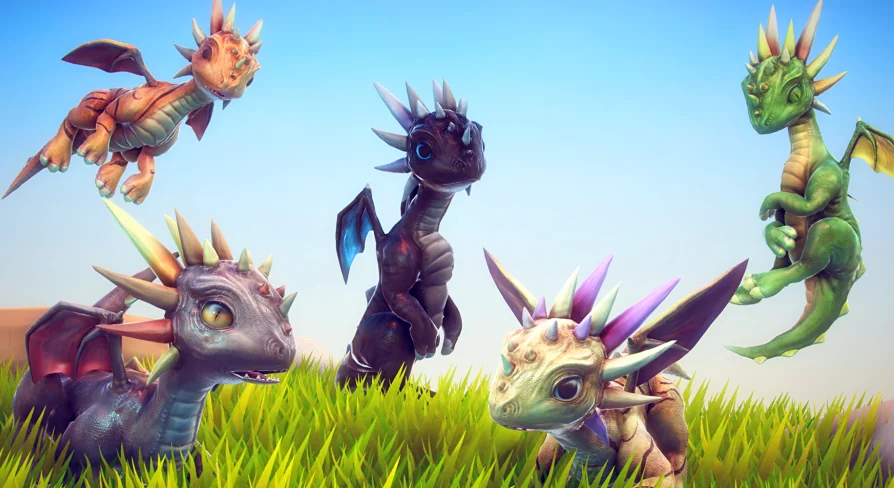
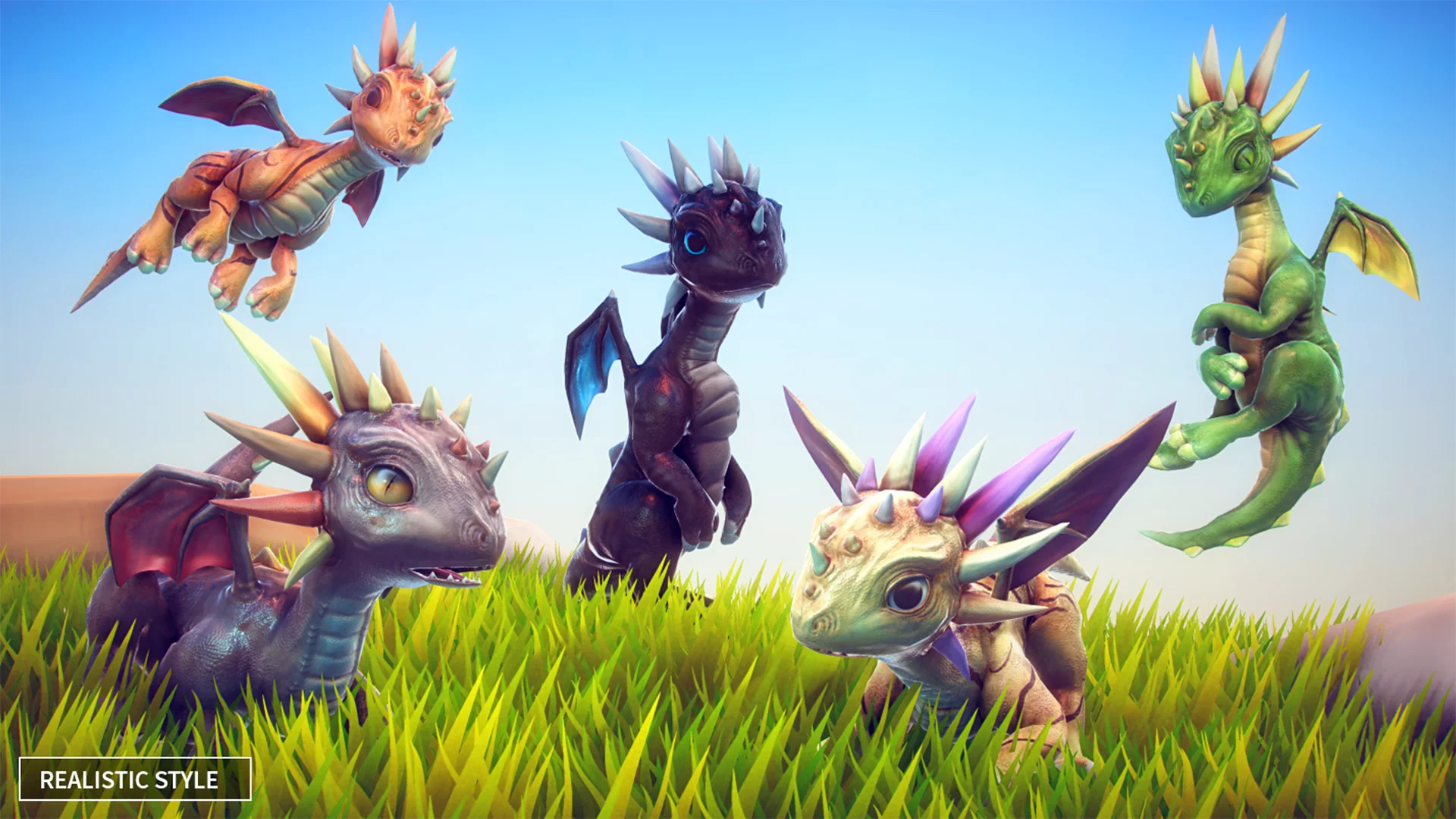
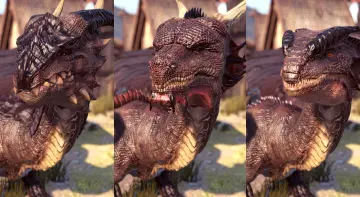
Visual versatility is achieved through four distinct structural mesh styles, making the asset adaptable across wildly different rendering targets and art directions. The collection includes Realistic, Toon, Simple Box, and Poly Art representations. The Realistic style captures fine anatomical definition, skin folds, and nuanced muscle structure suitable for modern rendering environments. The Toon presentation leverages handpainted art aesthetics, prioritizing expressive silhouettes and clean surface treatments that align with stylized adventures.
For projects requiring abstract, geometric, or low-overhead aesthetic treatments, the Simple Box and Poly Art variants offer unique low-complexity solutions. Simple Box provides a blocky, voxel-adjacent construction, while Poly Art relies on faceted planar topology to create modern geometric creatures. Each of the four individual styles comes equipped with five distinct color variants, yielding twenty visual permutations. These variations allow developers to differentiate creature ranks, elements, nesting regions, or rarity tiers without creating supplementary texture maps or editing base materials manually.
Motion Adaptation and Horse Animset Alignment
The skeletal mechanics of the asset demonstrate practical cross-compatibility with the Horse Animset, giving animators an established foundation when retargeting or sharing motion trees. Because quadrupedal bone hierarchies often introduce rigging mismatches across varied asset lines, alignment with established quadruped conventions streamlines the creation of supplementary motions. Projects already leveraging horse locomotion or similar four-legged state machines can map bone axes with minimal retargeting offsets.
This shared anatomical logic simplifies integration for studios managing extensive rosters of mountable entities or pack beasts. Designers can plug the Little Dragons Tiger directly into existing mounting rigs, wagon harnesses, or cavalry behaviors that already depend on standard quadruped bone mapping. Combined with its standalone locomotion, aerial mechanics, multi-style rendering options, and life-cycle hatching assets, the package operates as a self-contained creature solution ready for deployment across diverse interactive scenarios.
 Characters
 Characters
 Characters
 Characters