"7ad89cffa44984cf"{"id":"1002542","slug":"little-dragon-sea","title":"Little Dragon Sea","category":"Characters \u0026 Creatures","engine":"4.15+,5.0+","assetVersion":"","engineVersion":"Engine Version: 4.15+,5.0+","tag":"Characters","accent":"blue","visual":"character","summary":"Examine the technical integration, visual styles, and 120 locomotion and action animations provided in the Little Dragon Sea asset collection.","platform":"Unreal Engine","indexPolicy":"index","publishedAt":"2026-11-13T09:47:38.951Z","updatedAt":"2026-11-13T09:47:38.951Z","sourceNotes":[],"fileContents":[],"compatibility":["Unreal Engine","Engine Version: 4.15+,5.0+"],"featuredImage":{"alt":"Little Dragon Sea","src":"/wp-content/uploads/published/2026/11/bd1ea715e089-02c595b9-11ae-4d26-a487-a85db35fc074-61935685dc.webp"},"hasDownloadLink":true,"downloads":0,"terms":[{"taxonomy":"category","slug":"characters-and-creatures","name":"Characters \u0026 Creatures"}],"galleryImages":[{"src":"/wp-content/uploads/published/2026/11/31ca1ea8deca-6045dc85-3214-430b-a3a7-96245070d029-b2a7576570.webp","alt":"Little Dragon Sea"},{"src":"/wp-content/uploads/published/2026/11/fd3b8ad94802-750bebc1-5abc-4a16-8029-5ed5ec17888d-89a461fc0f.webp","alt":"Little Dragon Sea"},{"src":"/wp-content/uploads/published/2026/11/6b146cfd887a-3c6d219b-6172-490b-a413-1fba3a596621-63a60614d2.webp","alt":"Little Dragon Sea"},{"src":"/wp-content/uploads/published/2026/11/b7da5eb67ff0-03753c63-38ab-48a5-9320-c37cdd015865-fe75f324d8.webp","alt":"Little Dragon Sea"},{"src":"/wp-content/uploads/published/2026/11/fa06f412e2d7-d43ed7c8-a46a-4e57-8ab4-26c048903861-6bb28e0bd7.webp","alt":"Little Dragon Sea"},{"src":"/wp-content/uploads/published/2026/11/ec5d461cb6b4-66740663-dfe9-4e58-a317-bd85786fcb4a-5f79632004.webp","alt":"Little Dragon Sea"},{"src":"/wp-content/uploads/published/2026/11/3a0abc9240ac-3a8ab67c-0de6-4f6f-bb3e-95e684ef6ac4-87a932dbf4.webp","alt":"Little Dragon Sea"},{"src":"/wp-content/uploads/published/2026/11/996f0c453ea9-c3acad8d-a331-438c-9d74-df6af3c86620-7ae483d719.webp","alt":"Little Dragon Sea"},{"src":"/wp-content/uploads/published/2026/11/aa0caf727e78-018d1aa6-582d-4136-94a6-a4d1c9971fc1-b3b09f0c13.webp","alt":"Little Dragon Sea"},{"src":"/wp-content/uploads/published/2026/11/faa56e8765c4-32537042-9110-4a43-874e-e4bcadec9ff5-df16a10025.webp","alt":"Little Dragon Sea"}],"accessPanel":{"kind":"resource","title":"Get this resource","eyebrow":"Free resource","message":"Download this resource in your browser.","fileName":"Content.7z","safetyNote":"Resources are manually reviewed before listing to improve quality and reduce obvious risks.","actionLabel":"Get this resource","resourceType":"Resource archive","versions":[]},"contentHtml":"\u003ch2\u003eIntegrating the Little Dragon Sea Rig into a Custom Controller\u003c/h2\u003e\u003cp\u003eDeploying Little Dragon Sea into an interactive project requires setting up a dedicated pawn or character framework from scratch. The package contains raw asset data: 3D models, texture maps, and animation sequences. It does not supply pre-built character controller Blueprints, player movement code, or environmental set pieces. Bringing the creature to life in an engine demands creating an Animation Blueprint, defining state machines, and wiring input mappings to drive the provided movement sets.\u003c/p\u003e\u003cp\u003eBecause the creature is styled as a baby fantasy wyvern or pet companion, games often handle its navigation through either artificial intelligence navigation meshes or direct player control. The asset structure leaves that decision open. Without bundled controller Blueprints, technical artists and gameplay programmers are free to map movement components directly to existing project architectures without having to unpick unwanted script dependencies. The core delivery focuses on the skeletal structure, skinning, and motion data needed to populate an active scene.\u003c/p\u003e\u003ch2\u003eMotion Profiles: In-Place and Root Motion Locomotion\u003c/h2\u003e\u003cp\u003eLocomotion forms the largest segment of the animation library, which features 120 animations in total, exceeding the base tier of 115 high-quality motion clips. These animations are split across in-place and root motion variants, accommodating distinct game system architectures. Physics-driven controllers that calculate linear velocity via character movement components utilize in-place sequences, keeping the root bone stationary at the origin. Projects relying on precise root motion drive the capsule or collider directly from the root bone translation and rotation, preventing foot-sliding across ground surfaces and irregular turns.\u003c/p\u003e\u003cp\u003eThe ground travel moves smoothly between distinct gaits:\u003c/p\u003e\u003cul\u003e\u003cli\u003eWalking cycles for idle pacing, following players as a pet, or passive creature wandering\u003c/li\u003e\u003cli\u003eTrotting clips for intermediate navigation speeds\u003c/li\u003e\u003cli\u003eFull running cycles for rapid pursuit, flight takeoffs, or evasion\u003c/li\u003e\u003cli\u003eJump phases, including liftoffs, mid-air apex holds, and landing impacts\u003c/li\u003e\u003cli\u003eDodge actions designed to break incoming targeting during combat or defensive reactions\u003c/li\u003e\u003c/ul\u003e\u003cp\u003eBecause Little Dragon Sea incorporates aquatic mechanics alongside standard terrestrial travel, movement extends beyond dry land. Dedicated swimming animations cover horizontal water navigation, while diving animations handle transitions into deeper volumes and downward vertical motion. When transitioning to open air, the flight animations take over, giving the wyvern creature the necessary flapping and gliding sequences to transition from ground runs or jump apexes straight into aerial movement.\u003c/p\u003e\u003ch2\u003eFour Visual Styles and Palette Variations for the Dragon Mesh\u003c/h2\u003e\u003cp\u003eVisual cohesion depends heavily on asset rendering modes. Little Dragon Sea addresses diverse artistic pipelines by providing four separate aesthetic styles for the creature model:\u003c/p\u003e\u003cul\u003e\u003cli\u003e\u003cstrong\u003eRealistic:\u003c/strong\u003e Features detailed texturing and biological modeling suited for visually dense, high-fidelity fantasy scenes.\u003c/li\u003e\u003cli\u003e\u003cstrong\u003eToon:\u003c/strong\u003e Uses clean edge definition, bold handpainted styling, and vivid accents suited for whimsical or stylized projects.\u003c/li\u003e\u003cli\u003e\u003cstrong\u003eSimple Box:\u003c/strong\u003e Employs blocky geometry with cubic forms, matching voxel or retro-inspired titles.\u003c/li\u003e\u003cli\u003e\u003cstrong\u003ePoly Art:\u003c/strong\u003e Utilizes faceted, low-polygon geometry with flat shading surfaces, ideal for modern geometric indie art directions.\u003c/li\u003e\u003c/ul\u003e\u003cp\u003eEach of the four styles comes equipped with five distinct color schemes. This structure provides twenty possible appearance combinations without requiring manual texture painting. In a production pipeline, this variety allows developers to use the same underlying skeleton and motion library to represent different elemental affinities, hostile creature variations, or selectable pet skins while maintaining structural consistency across game levels.\u003c/p\u003e\u003ch2\u003eEgg Stages and Hatching Sequences in the Little Dragon Sea Set\u003c/h2\u003e\u003cp\u003eIn addition to active character models, the package includes dedicated egg meshes accompanied by hatching animation sequences. This additions enables lifecycle mechanics, nesting systems, or pet-taming sequences without sourcing mismatched secondary props.\u003c/p\u003e\u003cp\u003eSetting up the hatching sequence in an animation state machine generally involves two phases. First, an egg actor rests in the world as a static or looping interactive object. When game logic triggers an incubation event, the hatching animation plays, fracturing or opening the shell to reveal the newborn dragon creature. From there, gameplay logic swaps the egg entity for the rigged baby wyvern mesh, initializing its default state machine. The inclusion of matching egg assets ensures the visual transition from nest object to living creature retains identical aesthetic styles, whether using the Toon, Realistic, Simple Box, or Poly Art variants.\u003c/p\u003e\u003ch2\u003eState Machine Behavior, Animation Sets, and Horse Animset Compatibility\u003c/h2\u003e\u003cp\u003eBeyond standard locomotion, the 120 animation clips cover a broad range of interactive behaviors essential for combat encounters and companion pet logic. Attack sequences provide strike frames for close-range engagements, while get-hit responses give impact feedback when taking damage. Death sequences resolve defeats cleanly on ground or water surfaces. For idle downtime, specialized animations cover sleeping postures as well as expressive emotional actions, allowing technical designers to set up secondary state machines that fire contextual reactions when the creature is idle, interacting with the player, or resting in camp zones.\u003c/p\u003e\u003cp\u003eOn the animation pipeline side, the asset features compatibility with the Horse Animset framework. This shared motion compatibility simplifies the workflow for animators wishing to retarget, blend, or share quadruped skeletal data across diverse creature archetypes within an existing production pipeline. When building out the animation graph, blend spaces can readily interpolate between the walk, trot, and run states, while layered nodes isolate the emotion and attack sequences to the upper body when the creature needs to strike or emote while maintaining continuous locomotion.\u003c/p\u003e\u003ch2\u003eProduction Integration Summary\u003c/h2\u003e\u003cp\u003eLittle Dragon Sea provides an animation-dense, multi-style creature set designed to integrate straight into custom engine systems. By supplying complete in-place and root motion animations alongside egg hatching cycles, four aesthetic styles, and twenty color palettes, the package supplies the core art assets needed for fantasy pets, enemies, and companions while allowing developers total architectural freedom over their own character controllers and interactive scripts.\u003c/p\u003e\n\n\u003ch2\u003eExplore Similar Assets\u003c/h2\u003e\n\u003cul\u003e\n\u003cli\u003e\u003ca href=\"https://3dcghub.com/elemental-dragon/\" rel=\"noopener noreferrer\"\u003eElemental Dragon\u003c/a\u003e\u003c/li\u003e\n\u003cli\u003e\u003ca href=\"https://3dcghub.com/black-dragon/\" rel=\"noopener noreferrer\"\u003eBlack Dragon\u003c/a\u003e\u003c/li\u003e\n\u003cli\u003e\u003ca href=\"https://3dcghub.com/dinosaur-megalodon-sea-monster-series-5/\" rel=\"noopener noreferrer\"\u003eDinosaur MEGALODON - Sea Monster Series 5\u003c/a\u003e\u003c/li\u003e\n\u003cli\u003e\u003ca href=\"https://3dcghub.com/winter-dragon-wyvern/\" rel=\"noopener noreferrer\"\u003eWinter Dragon (Wyvern)\u003c/a\u003e\u003c/li\u003e\n\u003cli\u003e\u003ca href=\"https://3dcghub.com/desert-dragon/\" rel=\"noopener noreferrer\"\u003eDESERT DRAGON\u003c/a\u003e\u003c/li\u003e\n\u003c/ul\u003e","contentTextLength":6817,"navigation":{"current":35,"total":4499,"previous":{"id":"1002543","slug":"little-dragons-mouse","title":"Little Dragons Mouse","category":"Characters \u0026 Creatures","platform":"Unreal Engine","updatedAt":"2026-11-13T09:49:01.516Z"},"next":{"id":"1002541","slug":"light-lamellar-armour-pack","title":"Light Lamellar Armour Pack","category":"Characters \u0026 Creatures","platform":"Unreal Engine","updatedAt":"2026-11-13T09:45:33.266Z"}},"relatedResources":[{"id":"1002544","slug":"little-dragons-tiger","title":"Little Dragons Tiger","category":"Characters \u0026 Creatures","engine":"4.26+,5.0+","assetVersion":"","engineVersion":"Engine Version: 4.26+,5.0+","tag":"Characters","accent":"blue","visual":"character","summary":"Technical breakdown of Little Dragons Tiger, detailing animation setups, styles, egg hatching sequences, and Horse Animset compatibility.","platform":"Unreal Engine","indexPolicy":"index","publishedAt":"2026-11-13T09:52:17.153Z","updatedAt":"2026-11-13T09:52:17.153Z","sourceNotes":[],"fileContents":[],"compatibility":["Unreal Engine","Engine Version: 4.26+,5.0+"],"featuredImage":{"alt":"Little Dragons Tiger","src":"/wp-content/uploads/published/2026/11/92b1590b536d-dec9fe4d-1906-45b3-8031-4abd1d56097a-9913410b38.webp"},"hasDownloadLink":true,"downloads":0},{"id":"1002543","slug":"little-dragons-mouse","title":"Little Dragons Mouse","category":"Characters \u0026 Creatures","engine":"4.26+,5.0+","assetVersion":"","engineVersion":"Engine Version: 4.26+,5.0+","tag":"Characters","accent":"blue","visual":"character","summary":"Examine the models, 150+ animations, hatching cycles, and visual styles included in Little Dragons Mouse for fantasy pet and creature systems.","platform":"Unreal Engine","indexPolicy":"index","publishedAt":"2026-11-13T09:49:01.516Z","updatedAt":"2026-11-13T09:49:01.516Z","sourceNotes":[],"fileContents":[],"compatibility":["Unreal Engine","Engine Version: 4.26+,5.0+"],"featuredImage":{"alt":"Little Dragons Mouse","src":"/wp-content/uploads/published/2026/11/3ba1393b2b8f-f2f154f8-e422-4ce0-9f6f-a7a26c38a5d6-5255acfe07.webp"},"hasDownloadLink":true,"downloads":0},{"id":"1002553","slug":"dragons-pack-pbr","title":"Dragons Pack PBR","category":"Characters \u0026 Creatures","engine":"4.26+,5.0+","assetVersion":"","engineVersion":"Engine Version: 4.26+,5.0+","tag":"Characters","accent":"blue","visual":"character","summary":"A modular dragon character with three heads, four backs, two tails, morphable meshes, land and air animations, riding gear, and texture customization.","platform":"Unreal Engine","indexPolicy":"index","publishedAt":"2026-11-13T10:44:04.939Z","updatedAt":"2026-11-13T10:44:04.939Z","sourceNotes":[],"fileContents":[],"compatibility":["Unreal Engine","Engine Version: 4.26+,5.0+"],"featuredImage":{"alt":"Dragons Pack PBR","src":"/wp-content/uploads/published/2026/11/3da1c57f3803-c7f49a80-8d53-4c2e-a37d-b60a8158091b-4055ba50f8.webp"},"hasDownloadLink":true,"downloads":0}]}
Characters
Little Dragon Sea
Examine the technical integration, visual styles, and 120 locomotion and action animations provided in the Little Dragon Sea asset collection.
Integrating the Little Dragon Sea Rig into a Custom Controller
Deploying Little Dragon Sea into an interactive project requires setting up a dedicated pawn or character framework from scratch. The package contains raw asset data: 3D models, texture maps, and animation sequences. It does not supply pre-built character controller Blueprints, player movement code, or environmental set pieces. Bringing the creature to life in an engine demands creating an Animation Blueprint, defining state machines, and wiring input mappings to drive the provided movement sets.
Because the creature is styled as a baby fantasy wyvern or pet companion, games often handle its navigation through either artificial intelligence navigation meshes or direct player control. The asset structure leaves that decision open. Without bundled controller Blueprints, technical artists and gameplay programmers are free to map movement components directly to existing project architectures without having to unpick unwanted script dependencies. The core delivery focuses on the skeletal structure, skinning, and motion data needed to populate an active scene.
Motion Profiles: In-Place and Root Motion Locomotion
Locomotion forms the largest segment of the animation library, which features 120 animations in total, exceeding the base tier of 115 high-quality motion clips. These animations are split across in-place and root motion variants, accommodating distinct game system architectures. Physics-driven controllers that calculate linear velocity via character movement components utilize in-place sequences, keeping the root bone stationary at the origin. Projects relying on precise root motion drive the capsule or collider directly from the root bone translation and rotation, preventing foot-sliding across ground surfaces and irregular turns.
The ground travel moves smoothly between distinct gaits:
Walking cycles for idle pacing, following players as a pet, or passive creature wandering
Trotting clips for intermediate navigation speeds
Full running cycles for rapid pursuit, flight takeoffs, or evasion
Jump phases, including liftoffs, mid-air apex holds, and landing impacts
Dodge actions designed to break incoming targeting during combat or defensive reactions
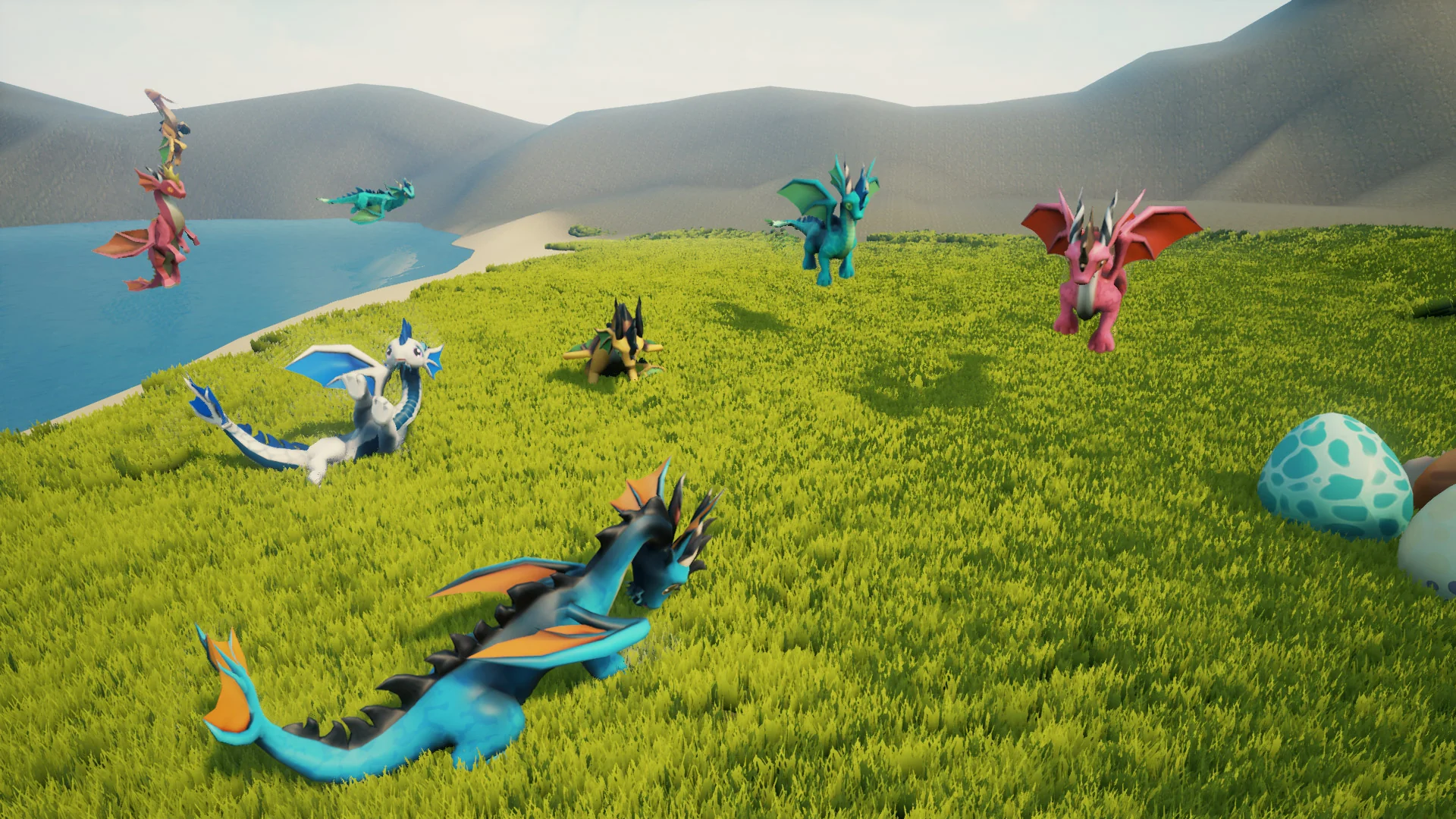
Because Little Dragon Sea incorporates aquatic mechanics alongside standard terrestrial travel, movement extends beyond dry land. Dedicated swimming animations cover horizontal water navigation, while diving animations handle transitions into deeper volumes and downward vertical motion. When transitioning to open air, the flight animations take over, giving the wyvern creature the necessary flapping and gliding sequences to transition from ground runs or jump apexes straight into aerial movement.
Four Visual Styles and Palette Variations for the Dragon Mesh
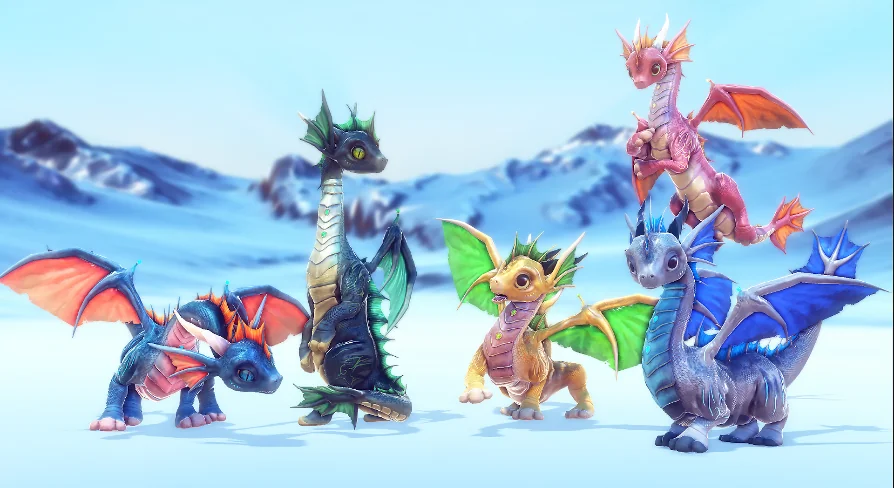
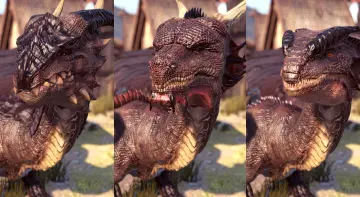
Visual cohesion depends heavily on asset rendering modes. Little Dragon Sea addresses diverse artistic pipelines by providing four separate aesthetic styles for the creature model:
Realistic: Features detailed texturing and biological modeling suited for visually dense, high-fidelity fantasy scenes.
Toon: Uses clean edge definition, bold handpainted styling, and vivid accents suited for whimsical or stylized projects.
Simple Box: Employs blocky geometry with cubic forms, matching voxel or retro-inspired titles.
Poly Art: Utilizes faceted, low-polygon geometry with flat shading surfaces, ideal for modern geometric indie art directions.
Each of the four styles comes equipped with five distinct color schemes. This structure provides twenty possible appearance combinations without requiring manual texture painting. In a production pipeline, this variety allows developers to use the same underlying skeleton and motion library to represent different elemental affinities, hostile creature variations, or selectable pet skins while maintaining structural consistency across game levels.
Egg Stages and Hatching Sequences in the Little Dragon Sea Set
In addition to active character models, the package includes dedicated egg meshes accompanied by hatching animation sequences. This additions enables lifecycle mechanics, nesting systems, or pet-taming sequences without sourcing mismatched secondary props.
Setting up the hatching sequence in an animation state machine generally involves two phases. First, an egg actor rests in the world as a static or looping interactive object. When game logic triggers an incubation event, the hatching animation plays, fracturing or opening the shell to reveal the newborn dragon creature. From there, gameplay logic swaps the egg entity for the rigged baby wyvern mesh, initializing its default state machine. The inclusion of matching egg assets ensures the visual transition from nest object to living creature retains identical aesthetic styles, whether using the Toon, Realistic, Simple Box, or Poly Art variants.
State Machine Behavior, Animation Sets, and Horse Animset Compatibility
Beyond standard locomotion, the 120 animation clips cover a broad range of interactive behaviors essential for combat encounters and companion pet logic. Attack sequences provide strike frames for close-range engagements, while get-hit responses give impact feedback when taking damage. Death sequences resolve defeats cleanly on ground or water surfaces. For idle downtime, specialized animations cover sleeping postures as well as expressive emotional actions, allowing technical designers to set up secondary state machines that fire contextual reactions when the creature is idle, interacting with the player, or resting in camp zones.
On the animation pipeline side, the asset features compatibility with the Horse Animset framework. This shared motion compatibility simplifies the workflow for animators wishing to retarget, blend, or share quadruped skeletal data across diverse creature archetypes within an existing production pipeline. When building out the animation graph, blend spaces can readily interpolate between the walk, trot, and run states, while layered nodes isolate the emotion and attack sequences to the upper body when the creature needs to strike or emote while maintaining continuous locomotion.
Production Integration Summary
Little Dragon Sea provides an animation-dense, multi-style creature set designed to integrate straight into custom engine systems. By supplying complete in-place and root motion animations alongside egg hatching cycles, four aesthetic styles, and twenty color palettes, the package supplies the core art assets needed for fantasy pets, enemies, and companions while allowing developers total architectural freedom over their own character controllers and interactive scripts.
 Characters
 Characters
 Characters
 Characters