"7ad89cffa44984cf"{"id":"1002523","slug":"elemental-dragon","title":"Elemental Dragon","category":"Characters \u0026 Creatures","engine":"4.26+,5.0+","assetVersion":"","engineVersion":"Engine Version: 4.26+,5.0+","tag":"Characters","accent":"blue","visual":"character","summary":"A detailed look at the Elemental Dragon package, featuring realistic, low-poly, and toon variants, motion data, and Horse Animset compatibility.","platform":"Unreal Engine","indexPolicy":"index","publishedAt":"2026-11-13T09:09:14.448Z","updatedAt":"2026-11-13T09:09:14.448Z","sourceNotes":[],"fileContents":[],"compatibility":["Unreal Engine","Engine Version: 4.26+,5.0+"],"featuredImage":{"alt":"Elemental Dragon","src":"/wp-content/uploads/published/2026/11/4687e05793dd-570ccd2c-2f63-4844-8c1a-bddd0a66a592-a75bd8228b.webp"},"hasDownloadLink":true,"downloads":0,"terms":[{"taxonomy":"category","slug":"characters-and-creatures","name":"Characters \u0026 Creatures"}],"galleryImages":[{"src":"/wp-content/uploads/published/2026/11/1a7491492da1-b4fa6517-f28f-4b1b-876a-44a388afc643-e7f6d5f05a.webp","alt":"Elemental Dragon"},{"src":"/wp-content/uploads/published/2026/11/4562e6ce020f-8affdf37-6076-4073-bb6f-2279a5609517-ed297b5eae.webp","alt":"Elemental Dragon"},{"src":"/wp-content/uploads/published/2026/11/3962f5dd61d7-7672a2d0-688b-4fd5-bbc8-594d5b9d5e1b-9e5eaf47fe.webp","alt":"Elemental Dragon"},{"src":"/wp-content/uploads/published/2026/11/7a021f5683bd-fd74d213-edaa-49fd-8058-57f677421f2d-91d77381ff.webp","alt":"Elemental Dragon"},{"src":"/wp-content/uploads/published/2026/11/c74684b82c6f-e8a11d0c-050b-4e59-8076-470a5067d272-f1c5b73d20.webp","alt":"Elemental Dragon"},{"src":"/wp-content/uploads/published/2026/11/e0cd5608b2bf-416bbf9d-772b-42a5-9d88-0d539d204597-f4f8f07b98.webp","alt":"Elemental Dragon"},{"src":"/wp-content/uploads/published/2026/11/b08bf06bd895-7586faec-ded8-4ab3-b4dc-86689269a634-7adf19f787.webp","alt":"Elemental Dragon"},{"src":"/wp-content/uploads/published/2026/11/9318146f1c48-d6c0fdda-6530-4f35-923a-d18da30a9bf1-34aedd542c.webp","alt":"Elemental Dragon"},{"src":"/wp-content/uploads/published/2026/11/e17f7260bf7f-92911a0b-35b7-43f6-9d73-737a43815d12-88b7f58c04.webp","alt":"Elemental Dragon"},{"src":"/wp-content/uploads/published/2026/11/becfc01cd440-96e0ce03-27d6-40ba-a1b1-a08868556890-8e2cba542f.webp","alt":"Elemental Dragon"}],"accessPanel":{"kind":"resource","title":"Get this resource","eyebrow":"Free resource","message":"Download this resource in your browser.","fileName":"Content.7z","safetyNote":"Resources are manually reviewed before listing to improve quality and reduce obvious risks.","actionLabel":"Get this resource","resourceType":"Resource archive","versions":[]},"contentHtml":"\u003cp\u003eFantasy productions frequently require iconic creature archetypes that can shift between grim, high-fidelity encounters and lighthearted, stylized adventures. A winged reptile serves equally well as an airborne roaming apex predator, a dungeon guardian guarding an underground hoard, or a mount patrolling a broad overland map. Fitting such a creature into distinct project aesthetics usually requires tracking down separate assets that share little in common regarding proportions or animation structure. The Elemental Dragon directly addresses this dilemma by presenting a core creature asset engineered to function across three starkly varied aesthetic pipelines: a detailed realistic treatment, an angular poly-art low-poly configuration, and an unlit or simplified toon setup driven strictly through diffuse texturing.\u003c/p\u003e \u003ch2\u003eStyling the Elemental Dragon for Different Visual Directions\u003c/h2\u003e\n\u003cp\u003eProject art directions diverge significantly depending on platform constraints, target demographics, and rendering budgets. Rather than forcing a single art style onto a production, the Elemental Dragon package supplies distinct artistic renditions within a unified creature theme. The realistic version addresses projects running modern physical-based shading models where surface depth, micro-details, scale definition, and light interaction must match real-world material responses. In high-density forests, mountain peaks, or cavernous stone arenas, this realistic presentation integrates alongside detailed foliage and stone surfaces without looking out of place.\u003c/p\u003e \u003cp\u003eFor indie titles, mobile platforms, or retro-leaning projects, the poly-art low-poly option provides an immediate alternative. This rendition emphasizes faceted surfaces, crisp silhouette edges, and clean geometric planar shifts. Low-poly art styles rely heavily on strong structural readability from a distance, making the low-poly dragon an exceptional candidate for top-down strategy games, stylized isometric role-playing games, or minimalist survival titles where high frame rates and lightweight geometry take precedence.\u003c/p\u003e \u003cp\u003eThe toon variant relies on a diffuse-only texturing pipeline. By dropping complex multi-map texture calculations such as specular highlights, normal displacements, and roughness values, the toon version works seamlessly in flat-shaded, cel-shaded, or hand-painted aesthetic frameworks. Projects that employ custom post-process line detection, unlit mobile shaders, or bright, anime-inspired fantasy palettes can deploy this version directly. Because the visual information is concentrated entirely into the diffuse channel, rendering overhead remains minimal, providing consistent visual clarity in games with fast-paced combat or screen-filling visual effects.\u003c/p\u003e \u003ch2\u003eIntegrating the Dragon into Existing Movement and Animset Pipelines\u003c/h2\u003e\n\u003cp\u003eSkeletal motion and mechanical structure define how convincingly a large fantasy reptile moves through a virtual world. Grounded travel, wing beats, transitions from resting stances to attack postures, and directional pivots require structured animation data. The package provides the core animation assets necessary to express the dragon's weight, balance, and physical presence without locking the creator into a rigid, closed implementation.\u003c/p\u003e \u003cp\u003eA notable technical aspect of this setup is compatibility aligned with Horse Animset standards. Quadrupedal animation hierarchies often face translation hurdles when moving between different creature rigs, but compatibility with established horse animset conventions provides a familiar structural baseline. This allows developers accustomed to four-legged locomotion systems to adapt ground movement patterns, gait cycles, trotting transitions, turning blends, and stops onto the dragon's four-legged foundation. While aerial mechanics introduce wings and vertical flight patterns, maintaining quadrupedal motion consistency on the ground ensures that terrestrial navigation does not look awkward or floaty.\u003c/p\u003e \u003cp\u003eBecause the package references animation blueprints and scripting touchpoints, developers have the freedom to construct their own state machines, blend spaces, and procedural aiming layers. Whether building an airborne strafing run, an evasive backward hop, or a grounded tail whip, the supplied animations serve as the foundational building blocks for responsive state-driven character logic.\u003c/p\u003e \u003ch2\u003eCore Deliverables: Meshes, Textures, and Motion Data\u003c/h2\u003e\n\u003cp\u003eProduction efficiency often hinges on knowing precisely what an asset contains and where boundary lines are drawn. The package strictly provides the central artistic assets: the dragon models, their accompanying texture maps, and the animation sets. There are no pre-built Blueprints or ready-made character controllers bundled into the download. This deliberate omission keeps the project files clean, lightweight, and free from unwanted dependencies, input mappings, or conflicting gameplay logic.\u003c/p\u003e \u003cp\u003eIn studios with established movement engines, dropping in pre-wired character blueprints often creates friction. Developers usually have to spend development time stripping out unwanted camera setups, placeholder health systems, custom movement components, or hardcoded control schemes before the creature can interface with existing player or enemy AI frameworks. By delivering unencumbered models, textures, and animations, the package fits straight into custom animation trees and proprietary enemy management systems without requiring clean-up or refactoring.\u003c/p\u003e \u003cp\u003eThe absence of pre-baked character controllers means the implementation team holds complete control over how the dragon behaves in play. A programmer can hook the motion assets into a complex behavior tree for a flying boss, assign it to a simple path-following script for an ambient background threat, or wire the inputs into a player-controlled mount system without overriding existing game-mode logic.\u003c/p\u003e \u003ch2\u003eEnvironment Independence and World Staging\u003c/h2\u003e\n\u003cp\u003eMany asset collections combine characters with modular environmental props, rock formations, nest set pieces, or specific biome scatter to create a complete scene. The Elemental Dragon pack does not include any environment assets, keeping its entire focus locked on the creature itself. The lack of bundled terrain, flora, or structural clutter ensures that the file footprint remains dedicated strictly to the creature's mesh variants, surface textures, and animation files.\u003c/p\u003e \u003cp\u003eThis isolation leaves world-building entirely open to level designers. The dragon can be staged within scorched volcanic calderas, frozen mountain ridges, overgrown ancient ruins, or minimalist abstract arenas without dragging along unused foliage or terrain materials that clutter the project directory. The versatility of having realistic, low-poly, and diffuse-only toon variations ensures that whatever biome is built, the dragon can match the specific rendering standards of that chosen world.\u003c/p\u003e \u003ch2\u003eTarget Workflows and Production Suitability\u003c/h2\u003e\n\u003cp\u003eTechnical artists, indie developers, and gameplay engineers building fantasy action titles, arena battlers, or exploration games stand to benefit most from this package. Because it omits gameplay controllers, it is tailored specifically for creators who already possess an underlying gameplay framework, an enemy AI architecture, or a player-mount movement system, and simply require a high-quality, fully animated dragon mesh to populate that system.\u003c/p\u003e \u003cp\u003eTeams building across divergent aesthetic styles or prototyping mechanics in low-poly before scaling up to realistic visuals will find particular utility in the multiple art configurations. A project can begin its greybox or stylized prototyping phase using the poly-art low-poly or toon mesh, dial in flight physics, hitboxes, and attack timings, and later swap in the realistic model without re-engineering the underlying animation states. For studios seeking a flexible fantasy creature asset that delivers core models and motion while staying out of the way of custom game code, the package offers a clean, production-ready foundation.\u003c/p\u003e\n\n\u003ch2\u003eMore From The Same Workflow\u003c/h2\u003e\n\u003cul\u003e\n\u003cli\u003e\u003ca href=\"https://3dcghub.com/black-dragon/\" rel=\"noopener noreferrer\"\u003eBlack Dragon\u003c/a\u003e\u003c/li\u003e\n\u003cli\u003e\u003ca href=\"https://3dcghub.com/winter-dragon-wyvern/\" rel=\"noopener noreferrer\"\u003eWinter Dragon (Wyvern)\u003c/a\u003e\u003c/li\u003e\n\u003cli\u003e\u003ca href=\"https://3dcghub.com/desert-dragon/\" rel=\"noopener noreferrer\"\u003eDESERT DRAGON\u003c/a\u003e\u003c/li\u003e\n\u003cli\u003e\u003ca href=\"https://3dcghub.com/forest-golems/\" rel=\"noopener noreferrer\"\u003eForest Golems\u003c/a\u003e\u003c/li\u003e\n\u003cli\u003e\u003ca href=\"https://3dcghub.com/wyvern-rex-lite-version/\" rel=\"noopener noreferrer\"\u003eWyvern Rex Lite Version\u003c/a\u003e\u003c/li\u003e\n\u003c/ul\u003e","contentTextLength":8151,"navigation":{"current":54,"total":4499,"previous":{"id":"1002524","slug":"esm-haunt-army","title":"ESM Haunt Army","category":"Characters \u0026 Creatures","platform":"Unreal Engine","updatedAt":"2026-11-13T09:14:33.428Z"},"next":{"id":"1002522","slug":"dragon-for-boss-monster-pbr","title":"Dragon for Boss Monster : PBR","category":"Creatures \u0026 Monsters","platform":"Unreal Engine","updatedAt":"2026-11-13T09:07:10.432Z"}},"relatedResources":[{"id":"1002553","slug":"dragons-pack-pbr","title":"Dragons Pack PBR","category":"Characters \u0026 Creatures","engine":"4.26+,5.0+","assetVersion":"","engineVersion":"Engine Version: 4.26+,5.0+","tag":"Characters","accent":"blue","visual":"character","summary":"A modular dragon character with three heads, four backs, two tails, morphable meshes, land and air animations, riding gear, and texture customization.","platform":"Unreal Engine","indexPolicy":"index","publishedAt":"2026-11-13T10:44:04.939Z","updatedAt":"2026-11-13T10:44:04.939Z","sourceNotes":[],"fileContents":[],"compatibility":["Unreal Engine","Engine Version: 4.26+,5.0+"],"featuredImage":{"alt":"Dragons Pack PBR","src":"/wp-content/uploads/published/2026/11/3da1c57f3803-c7f49a80-8d53-4c2e-a37d-b60a8158091b-4055ba50f8.webp"},"hasDownloadLink":true,"downloads":0},{"id":"1002544","slug":"little-dragons-tiger","title":"Little Dragons Tiger","category":"Characters \u0026 Creatures","engine":"4.26+,5.0+","assetVersion":"","engineVersion":"Engine Version: 4.26+,5.0+","tag":"Characters","accent":"blue","visual":"character","summary":"Technical breakdown of Little Dragons Tiger, detailing animation setups, styles, egg hatching sequences, and Horse Animset compatibility.","platform":"Unreal Engine","indexPolicy":"index","publishedAt":"2026-11-13T09:52:17.153Z","updatedAt":"2026-11-13T09:52:17.153Z","sourceNotes":[],"fileContents":[],"compatibility":["Unreal Engine","Engine Version: 4.26+,5.0+"],"featuredImage":{"alt":"Little Dragons Tiger","src":"/wp-content/uploads/published/2026/11/92b1590b536d-dec9fe4d-1906-45b3-8031-4abd1d56097a-9913410b38.webp"},"hasDownloadLink":true,"downloads":0},{"id":"1002543","slug":"little-dragons-mouse","title":"Little Dragons Mouse","category":"Characters \u0026 Creatures","engine":"4.26+,5.0+","assetVersion":"","engineVersion":"Engine Version: 4.26+,5.0+","tag":"Characters","accent":"blue","visual":"character","summary":"Examine the models, 150+ animations, hatching cycles, and visual styles included in Little Dragons Mouse for fantasy pet and creature systems.","platform":"Unreal Engine","indexPolicy":"index","publishedAt":"2026-11-13T09:49:01.516Z","updatedAt":"2026-11-13T09:49:01.516Z","sourceNotes":[],"fileContents":[],"compatibility":["Unreal Engine","Engine Version: 4.26+,5.0+"],"featuredImage":{"alt":"Little Dragons Mouse","src":"/wp-content/uploads/published/2026/11/3ba1393b2b8f-f2f154f8-e422-4ce0-9f6f-a7a26c38a5d6-5255acfe07.webp"},"hasDownloadLink":true,"downloads":0}]}
Characters
Elemental Dragon
A detailed look at the Elemental Dragon package, featuring realistic, low-poly, and toon variants, motion data, and Horse Animset compatibility.
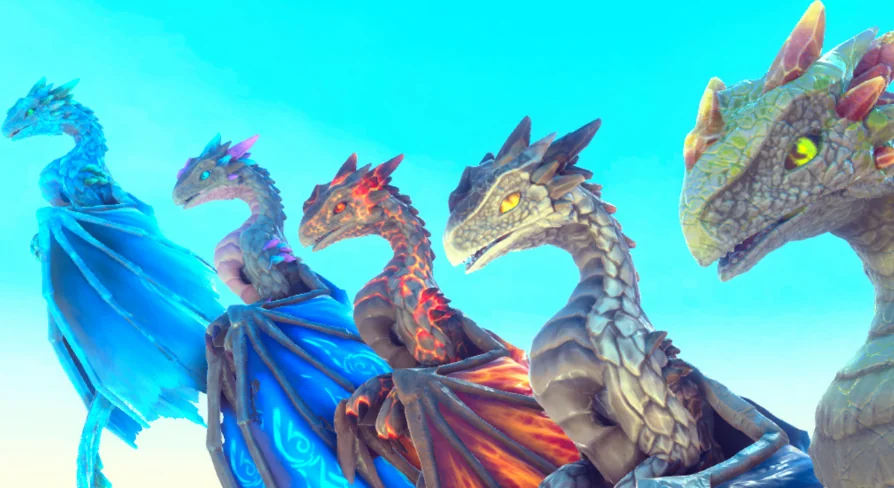
Fantasy productions frequently require iconic creature archetypes that can shift between grim, high-fidelity encounters and lighthearted, stylized adventures. A winged reptile serves equally well as an airborne roaming apex predator, a dungeon guardian guarding an underground hoard, or a mount patrolling a broad overland map. Fitting such a creature into distinct project aesthetics usually requires tracking down separate assets that share little in common regarding proportions or animation structure. The Elemental Dragon directly addresses this dilemma by presenting a core creature asset engineered to function across three starkly varied aesthetic pipelines: a detailed realistic treatment, an angular poly-art low-poly configuration, and an unlit or simplified toon setup driven strictly through diffuse texturing.
Styling the Elemental Dragon for Different Visual Directions
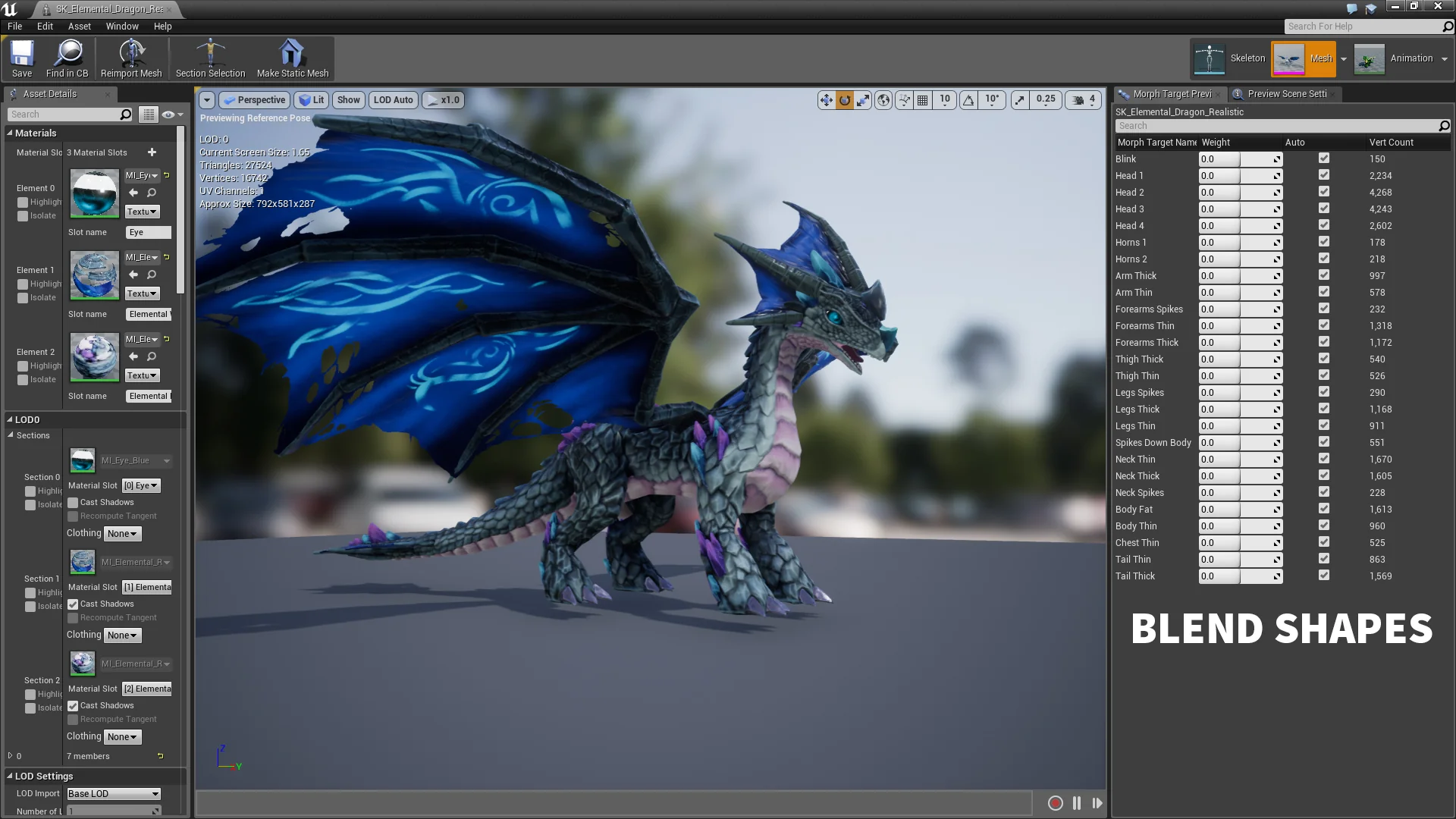
Project art directions diverge significantly depending on platform constraints, target demographics, and rendering budgets. Rather than forcing a single art style onto a production, the Elemental Dragon package supplies distinct artistic renditions within a unified creature theme. The realistic version addresses projects running modern physical-based shading models where surface depth, micro-details, scale definition, and light interaction must match real-world material responses. In high-density forests, mountain peaks, or cavernous stone arenas, this realistic presentation integrates alongside detailed foliage and stone surfaces without looking out of place.
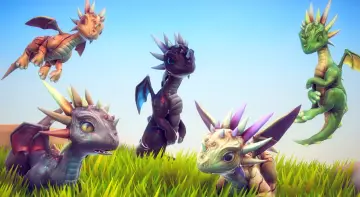
For indie titles, mobile platforms, or retro-leaning projects, the poly-art low-poly option provides an immediate alternative. This rendition emphasizes faceted surfaces, crisp silhouette edges, and clean geometric planar shifts. Low-poly art styles rely heavily on strong structural readability from a distance, making the low-poly dragon an exceptional candidate for top-down strategy games, stylized isometric role-playing games, or minimalist survival titles where high frame rates and lightweight geometry take precedence.
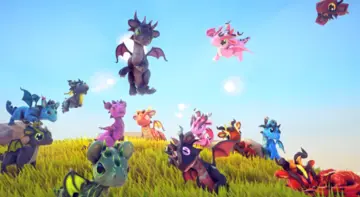
The toon variant relies on a diffuse-only texturing pipeline. By dropping complex multi-map texture calculations such as specular highlights, normal displacements, and roughness values, the toon version works seamlessly in flat-shaded, cel-shaded, or hand-painted aesthetic frameworks. Projects that employ custom post-process line detection, unlit mobile shaders, or bright, anime-inspired fantasy palettes can deploy this version directly. Because the visual information is concentrated entirely into the diffuse channel, rendering overhead remains minimal, providing consistent visual clarity in games with fast-paced combat or screen-filling visual effects.
Integrating the Dragon into Existing Movement and Animset Pipelines
Skeletal motion and mechanical structure define how convincingly a large fantasy reptile moves through a virtual world. Grounded travel, wing beats, transitions from resting stances to attack postures, and directional pivots require structured animation data. The package provides the core animation assets necessary to express the dragon's weight, balance, and physical presence without locking the creator into a rigid, closed implementation.
A notable technical aspect of this setup is compatibility aligned with Horse Animset standards. Quadrupedal animation hierarchies often face translation hurdles when moving between different creature rigs, but compatibility with established horse animset conventions provides a familiar structural baseline. This allows developers accustomed to four-legged locomotion systems to adapt ground movement patterns, gait cycles, trotting transitions, turning blends, and stops onto the dragon's four-legged foundation. While aerial mechanics introduce wings and vertical flight patterns, maintaining quadrupedal motion consistency on the ground ensures that terrestrial navigation does not look awkward or floaty.
Because the package references animation blueprints and scripting touchpoints, developers have the freedom to construct their own state machines, blend spaces, and procedural aiming layers. Whether building an airborne strafing run, an evasive backward hop, or a grounded tail whip, the supplied animations serve as the foundational building blocks for responsive state-driven character logic.
Core Deliverables: Meshes, Textures, and Motion Data
Production efficiency often hinges on knowing precisely what an asset contains and where boundary lines are drawn. The package strictly provides the central artistic assets: the dragon models, their accompanying texture maps, and the animation sets. There are no pre-built Blueprints or ready-made character controllers bundled into the download. This deliberate omission keeps the project files clean, lightweight, and free from unwanted dependencies, input mappings, or conflicting gameplay logic.
In studios with established movement engines, dropping in pre-wired character blueprints often creates friction. Developers usually have to spend development time stripping out unwanted camera setups, placeholder health systems, custom movement components, or hardcoded control schemes before the creature can interface with existing player or enemy AI frameworks. By delivering unencumbered models, textures, and animations, the package fits straight into custom animation trees and proprietary enemy management systems without requiring clean-up or refactoring.
The absence of pre-baked character controllers means the implementation team holds complete control over how the dragon behaves in play. A programmer can hook the motion assets into a complex behavior tree for a flying boss, assign it to a simple path-following script for an ambient background threat, or wire the inputs into a player-controlled mount system without overriding existing game-mode logic.
Environment Independence and World Staging
Many asset collections combine characters with modular environmental props, rock formations, nest set pieces, or specific biome scatter to create a complete scene. The Elemental Dragon pack does not include any environment assets, keeping its entire focus locked on the creature itself. The lack of bundled terrain, flora, or structural clutter ensures that the file footprint remains dedicated strictly to the creature's mesh variants, surface textures, and animation files.
This isolation leaves world-building entirely open to level designers. The dragon can be staged within scorched volcanic calderas, frozen mountain ridges, overgrown ancient ruins, or minimalist abstract arenas without dragging along unused foliage or terrain materials that clutter the project directory. The versatility of having realistic, low-poly, and diffuse-only toon variations ensures that whatever biome is built, the dragon can match the specific rendering standards of that chosen world.
Target Workflows and Production Suitability
Technical artists, indie developers, and gameplay engineers building fantasy action titles, arena battlers, or exploration games stand to benefit most from this package. Because it omits gameplay controllers, it is tailored specifically for creators who already possess an underlying gameplay framework, an enemy AI architecture, or a player-mount movement system, and simply require a high-quality, fully animated dragon mesh to populate that system.
Teams building across divergent aesthetic styles or prototyping mechanics in low-poly before scaling up to realistic visuals will find particular utility in the multiple art configurations. A project can begin its greybox or stylized prototyping phase using the poly-art low-poly or toon mesh, dial in flight physics, hitboxes, and attack timings, and later swap in the realistic model without re-engineering the underlying animation states. For studios seeking a flexible fantasy creature asset that delivers core models and motion while staying out of the way of custom game code, the package offers a clean, production-ready foundation.
 Characters
 Characters
 Characters
 Characters