"7b46a695175d8694"{"id":"1001521","slug":"interactive-foliage-and-vegetation-system","title":"Interactive Foliage and Vegetation System","category":"Game Mechanics","engine":"5.4","assetVersion":"Asset Version: 1.0.0","engineVersion":"Engine Version: 5.4","tag":"Game Mechanics","accent":"blue","visual":"mech","summary":"Examine the Interactive Foliage and Vegetation System, exploring its C++ architecture, skeletal mesh physics, shader displacement, and PCG limits.","platform":"Unreal Engine","publishedAt":"2026-10-09T13:33:45.442Z","updatedAt":"2026-10-09T13:33:45.442Z","sourceNotes":[],"fileContents":[],"compatibility":["Unreal Engine","Asset Version: 1.0.0","Engine Version: 5.4"],"featuredImage":{"alt":"Interactive Foliage and Vegetation System","src":"/wp-content/uploads/published/2026/10/bb775a3c739a-57db783a-4718-4b1b-9c19-526bd2dd4808-38a2876edf.webp"},"hasDownloadLink":true,"downloads":0,"terms":[{"taxonomy":"category","slug":"game-mechanics-tools-and-plugins","name":"Game Mechanics"}],"galleryImages":[{"src":"/wp-content/uploads/published/2026/10/ff9983d7c134-4f520cdf-b505-4572-815a-c31036e5ecca-d97b270846.webp","alt":"Interactive Foliage and Vegetation System"},{"src":"/wp-content/uploads/published/2026/10/076c7c458d76-f1163da1-77a4-4797-bd55-443f9ca3af85-a4fe7ebb7e.webp","alt":"Interactive Foliage and Vegetation System"},{"src":"/wp-content/uploads/published/2026/10/ce45b93a9911-dce3f71d-02a6-445b-9aea-f48f2fb28e1a-1ba4a9386b.webp","alt":"Interactive Foliage and Vegetation System"},{"src":"/wp-content/uploads/published/2026/10/a6e6a59c541c-f0455bd2-b2a0-4f45-a90f-98756af61bcf-42cdf1188e.webp","alt":"Interactive Foliage and Vegetation System"},{"src":"/wp-content/uploads/published/2026/10/73904c4dd175-d5b8bcb2-df47-47fc-8fb6-4d2f5a303e53-9981e82f64.webp","alt":"Interactive Foliage and Vegetation System"},{"src":"/wp-content/uploads/published/2026/10/9d83c6f90d14-b249c659-907a-44d5-9585-cb8ef29d1642-3b26d833d8.webp","alt":"Interactive Foliage and Vegetation System"}],"accessPanel":{"kind":"resource","title":"Download this resource","eyebrow":"Free Download","message":"Log in or create a free account to start your download.","fileName":"Interactive Foliage and Vegetation System.7z","safetyNote":"Resources are manually reviewed before listing to improve quality and reduce obvious risks.","actionLabel":"Download Free","resourceType":"Resource archive"},"contentHtml":"\u003cp\u003eWhen a character pushes through dense ground cover, foliage should yield, bend under weight, and spring back without stalling scene performance. The Interactive Foliage and Vegetation System approaches this dynamic through an underlying C++ architecture designed to deliver AAA-level efficiency. By separating the computational workload into dedicated code classes and configurable Blueprints, the framework balances visual fidelity against runtime execution across modern desktop and console environments.\u003c/p\u003e \u003ch2\u003eSkeletal Mesh and Shader Based Foliage Interaction\u003c/h2\u003e\n\u003cp\u003eInteraction in vegetation environments generally falls between two distinct technical pathways: structural deformation through skeletal hierarchies or mathematical displacement through material shaders. This system incorporates both options, allowing artists to select the interaction pipeline best suited to specific plant structures.\u003c/p\u003e\n\u003cp\u003eSkeletal mesh interaction is configured for complex vegetation models that require physical joint transformations when colliding with characters or moving actors. In contrast, static foliage uses shader-based interaction to deform surface vertices dynamically. This shader workflow allows large quantities of ground clutter, small plants, and undergrowth to react visually without the heavy CPU overhead associated with individual skeletal simulations. Both static and skeletal meshes maintain compatibility with ambient wind systems, ensuring that reactive bends and directional impulses seamlessly blend into ongoing ambient breeze cycles.\u003c/p\u003e\n\u003cp\u003eMulti-object interaction is supported out of the box. Rather than restricting physical displacement to a single player character, the system evaluates overlapping colliders from multiple scene actors simultaneously. Moving vehicles, enemies, and companions can push through the same cluster of plants, with the underlying mathematics calculating compound directional forces rather than overriding prior interaction data.\u003c/p\u003e \u003ch2\u003eConfiguring Foliage Mass, Stiffness, and Push Force\u003c/h2\u003e\n\u003cp\u003eNo two plant varieties behave the exact same way during collision. A heavy woody bush resists movement differently than dry reeds or thin blades of grass. To accommodate these differences, the system allows distinct interaction settings per foliage type, giving developers granular control over the physical parameters of each species.\u003c/p\u003e\n\u003cp\u003eKey properties govern how plants bend, resist, and return to an initial position:\u003c/p\u003e\n\u003cul\u003e \u003cli\u003e\u003cstrong\u003eFoliage Stiffness:\u003c/strong\u003e Determines structural rigidity, controlling how hard a plant resists deflection when a force is applied.\u003c/li\u003e \u003cli\u003e\u003cstrong\u003eFoliage Damping Factor:\u003c/strong\u003e Governs how quickly secondary oscillation settles down after an interacting object leaves the plant volume.\u003c/li\u003e \u003cli\u003e\u003cstrong\u003eFoliage Mass:\u003c/strong\u003e Influences physical inertia, dictating the visual weight of thick branches or light stems.\u003c/li\u003e \u003cli\u003e\u003cstrong\u003ePush Force:\u003c/strong\u003e Defines the direct energy transmitted from an interacting actor into the foliage structure.\u003c/li\u003e \u003cli\u003e\u003cstrong\u003eRange of Interaction:\u003c/strong\u003e Dictates the spatial distance at which actors begin influencing foliage vertices or joints.\u003c/li\u003e\n\u003c/ul\u003e\n\u003cp\u003eFor ground cover such as tall grass, lawn patches, or broad-leaf ground vegetation, the package includes a dedicated flattening feature. Rather than simply deflecting laterally, low-height foliage can be pushed down toward the terrain surface underfoot. This replicates footsteps and dragging bodies across dense ground mats. Accompanying physical movement is an audio triggers feature: collision events can automatically play sound effects selected randomly from an array, ensuring footsteps through brush produce diverse rustling and snapping sounds without repetitive audio patterns.\u003c/p\u003e \u003ch2\u003ePCG Support and Vegetation Generation Boundaries\u003c/h2\u003e\n\u003cp\u003eIntegrating reactive vegetation into procedural pipelines introduces distinct technical constraints. The Interactive Foliage and Vegetation System supports Procedural Content Generation (PCG) frameworks when working with skeletal mesh foliage. This allows large-scale worlds populated by procedural rules to retain skeletal deformation properties when actors intersect the generated instances.\u003c/p\u003e\n\u003cp\u003eImportant limitations exist within procedural workflows, however. The system does not support PCG integration for shader-based interaction foliage because interaction data cannot be processed through to the procedural pipeline. Teams deploying large biomes must structure their procedural distribution rules carefully: procedural generation graphs can deploy skeletal mesh assets that require reactive physical displacement, while shader-driven interactive foliage must be populated using non-PCG placement techniques to preserve material-driven deformation.\u003c/p\u003e\n\u003cp\u003eAsset flexibility extends beyond custom authored geometry. The system functions with both custom foliage meshes and existing Quixel foliage assets. This allows teams relying on Megascans libraries to apply interactive displacement profiles directly onto scanned natural assets without re-authoring base geometry.\u003c/p\u003e \u003ch2\u003eArchitecture, Debugging Tools, and Platform Targets\u003c/h2\u003e\n\u003cp\u003eThe system is contained within four core C++ classes and four Blueprints. Consolidating the core mathematical displacement inside compiled C++ provides high runtime efficiency, while the Blueprints expose essential gameplay bindings and parameter tuning. Built-in debugging tools give developers visual feedback inside the viewport, simplifying the process of checking interaction radiuses, actor influence boundaries, and force directionals during playtests.\u003c/p\u003e\n\u003cp\u003eMultiplayer network replication is highlighted within the feature design, enabling consistent foliage movement across connected clients, though project developers should note technical spec sheets denote network replication as unflagged at the root level, requiring teams to verify their project-specific replication setup. In production scenes involving aquatic environments, the package maintains compatibility with Interactive Water, Ocean and Swim Systems, enabling seamless transitions when characters emerge from dynamic water bodies into reactive shorelines.\u003c/p\u003e\n\u003cp\u003eDeployment targets include Windows, Mac, and Linux, alongside console support on PlayStation 4 and Xbox platforms. Mobile platforms are explicitly not supported, reflecting the computational demands of multi-actor push forces, skeletal calculations, and active shader manipulations.\u003c/p\u003e \u003ch2\u003eProduction Takeaway for Environmental Teams\u003c/h2\u003e\n\u003cp\u003eThe system bridges the gap between static environmental dressings and responsive game worlds by providing distinct physical profiles for disparate plant species. Because PCG workflows are strictly limited to skeletal meshes while shader-based deformation handles static foliage independently, technical artists should map out their vegetation hierarchy early. By balancing low-overhead shader grass against structurally responsive skeletal shrubs and trees, teams can establish dense, reactive ecosystems that perform consistently across desktop and console targets.\u003c/p\u003e\n\n\u003ch2\u003eExplore Similar Assets\u003c/h2\u003e\n\u003cul\u003e\n\u003cli\u003e\u003ca href=\"https://3dcghub.com/landscaping-aquatic-plants/\" title=\"Landscaping Aquatic Plants\"\u003eLandscaping Aquatic Plants\u003c/a\u003e\u003c/li\u003e\n\u003cli\u003e\u003ca href=\"https://3dcghub.com/uipf-unified-interactive-physical-foliage/\" title=\"UIPF - Unified Interactive Physical Foliage\"\u003eUIPF - Unified Interactive Physical Foliage\u003c/a\u003e\u003c/li\u003e\n\u003cli\u003e\u003ca href=\"https://3dcghub.com/foliage-vol-13-southern-oak-trees-nanite-and-low-poly/\" title=\"Foliage VOL.13 - Southern Oak Trees (Nanite and Low Poly)\"\u003eFoliage VOL.13 - Southern Oak Trees (Nanite and Low Poly)\u003c/a\u003e\u003c/li\u003e\n\u003cli\u003e\u003ca href=\"https://3dcghub.com/foliage-vol-6-broom-bushes-nanite-and-low-poly/\" title=\"Foliage VOL.6 - Broom Bushes (Nanite and Low Poly)\"\u003eFoliage VOL.6 - Broom Bushes (Nanite and Low Poly)\u003c/a\u003e\u003c/li\u003e\n\u003cli\u003e\u003ca href=\"https://3dcghub.com/fantasy-plants-4/\" title=\"Fantasy plants 4\"\u003eFantasy plants 4\u003c/a\u003e\u003c/li\u003e\n\u003c/ul\u003e","contentTextLength":7099,"navigation":{"current":24,"total":3481,"previous":{"id":"1001522","slug":"interactive-procedural-city-generator","title":"Interactive Procedural City Generator","category":"Procedural Systems","platform":"Unreal Engine","updatedAt":"2026-10-09T13:34:43.038Z"},"next":{"id":"1001520","slug":"house-along-the-river-house-river-village-stylized-stylised-environment-3d","title":"House Along the River ( House River Village Stylized Stylised Environment 3d )","category":"Fantasy","platform":"Unreal Engine","updatedAt":"2026-10-09T13:20:19.696Z"}},"relatedResources":[{"id":"1280","slug":"landscaping-aquatic-plants","title":"Landscaping Aquatic Plants","category":"Buildings \u0026 Architecture","engine":"5.1+","assetVersion":"Engine version: 5.1+","engineVersion":"5.1","tag":"Buildings","accent":"blue","visual":"audio","summary":"Enhance your digital environments with realistic aquatic plants. Features Nanite support, Pivot Painter 2.0 for fluid movement, and Lumen-ready PBR materials.","platform":"Unreal Engine","publishedAt":"2026-02-06T17:33:13.000Z","updatedAt":"2026-04-19T15:58:12.000Z","sourceNotes":[],"fileContents":[],"compatibility":["Unreal Engine","Engine version: 5.1+"],"featuredImage":{"alt":"Landscaping Aquatic Plants","src":"https://3dcghub.com/wp-content/uploads/2026/02/2902db8c-8257-4918-8d2a-d17da271bfa3.png"},"hasDownloadLink":true,"downloads":3},{"id":"14707","slug":"uipf-unified-interactive-physical-foliage","title":"UIPF - Unified Interactive Physical Foliage","category":"Engine Tools","engine":"5.3","assetVersion":"Engine version: 5.3","engineVersion":"4.20","tag":"Engine Tools","accent":"blue","visual":"audio","summary":"UIPF - Unified Interactive Physical Foliage provides a high-performance solution for adding realistic interaction to game environments, from swaying grass to bendy plants.","platform":"Unreal Engine","publishedAt":"2026-03-11T19:07:09.000Z","updatedAt":"2026-04-19T15:45:41.000Z","sourceNotes":[],"fileContents":[],"compatibility":["Unreal Engine","Engine version: 5.3"],"featuredImage":{"alt":"UIPF - Unified Interactive Physical Foliage","src":"https://3dcghub.com/wp-content/uploads/2026/03/416e817c-b004-49bf-9a26-9c0ef3ecf7f6.webp"},"hasDownloadLink":true,"downloads":2},{"id":"4220","slug":"foliage-vol-13-southern-oak-trees-nanite-and-low-poly","title":"Foliage VOL.13 - Southern Oak Trees (Nanite and Low Poly)","category":"Trees","engine":"5.1+","assetVersion":"Engine version: 5.1+","engineVersion":"5.1","tag":"Trees","accent":"blue","visual":"luts","summary":"Enhance your Unreal Engine projects with realistic Southern Oak trees. Featuring Nanite support, 4K textures, and Spanish Moss options for AAA game environments","platform":"Unreal Engine","publishedAt":"2026-02-10T11:39:48.000Z","updatedAt":"2026-04-19T15:57:11.000Z","sourceNotes":[],"fileContents":[],"compatibility":["Unreal Engine","Engine version: 5.1+"],"featuredImage":{"alt":"Foliage VOL.13 - Southern Oak Trees (Nanite and Low Poly)","src":"https://3dcghub.com/wp-content/uploads/2026/02/0d934ec2-fe6c-4920-b954-59d91143a3fb.webp"},"hasDownloadLink":true,"downloads":0}]}
Game Mechanics
Interactive Foliage and Vegetation System
Examine the Interactive Foliage and Vegetation System, exploring its C++ architecture, skeletal mesh physics, shader displacement, and PCG limits.
When a character pushes through dense ground cover, foliage should yield, bend under weight, and spring back without stalling scene performance. The Interactive Foliage and Vegetation System approaches this dynamic through an underlying C++ architecture designed to deliver AAA-level efficiency. By separating the computational workload into dedicated code classes and configurable Blueprints, the framework balances visual fidelity against runtime execution across modern desktop and console environments.
Skeletal Mesh and Shader Based Foliage Interaction
Interaction in vegetation environments generally falls between two distinct technical pathways: structural deformation through skeletal hierarchies or mathematical displacement through material shaders. This system incorporates both options, allowing artists to select the interaction pipeline best suited to specific plant structures.
Skeletal mesh interaction is configured for complex vegetation models that require physical joint transformations when colliding with characters or moving actors. In contrast, static foliage uses shader-based interaction to deform surface vertices dynamically. This shader workflow allows large quantities of ground clutter, small plants, and undergrowth to react visually without the heavy CPU overhead associated with individual skeletal simulations. Both static and skeletal meshes maintain compatibility with ambient wind systems, ensuring that reactive bends and directional impulses seamlessly blend into ongoing ambient breeze cycles.
Multi-object interaction is supported out of the box. Rather than restricting physical displacement to a single player character, the system evaluates overlapping colliders from multiple scene actors simultaneously. Moving vehicles, enemies, and companions can push through the same cluster of plants, with the underlying mathematics calculating compound directional forces rather than overriding prior interaction data.
Configuring Foliage Mass, Stiffness, and Push Force
No two plant varieties behave the exact same way during collision. A heavy woody bush resists movement differently than dry reeds or thin blades of grass. To accommodate these differences, the system allows distinct interaction settings per foliage type, giving developers granular control over the physical parameters of each species.
Key properties govern how plants bend, resist, and return to an initial position:
Foliage Stiffness: Determines structural rigidity, controlling how hard a plant resists deflection when a force is applied.
Foliage Damping Factor: Governs how quickly secondary oscillation settles down after an interacting object leaves the plant volume.
Foliage Mass: Influences physical inertia, dictating the visual weight of thick branches or light stems.
Push Force: Defines the direct energy transmitted from an interacting actor into the foliage structure.
Range of Interaction: Dictates the spatial distance at which actors begin influencing foliage vertices or joints.
For ground cover such as tall grass, lawn patches, or broad-leaf ground vegetation, the package includes a dedicated flattening feature. Rather than simply deflecting laterally, low-height foliage can be pushed down toward the terrain surface underfoot. This replicates footsteps and dragging bodies across dense ground mats. Accompanying physical movement is an audio triggers feature: collision events can automatically play sound effects selected randomly from an array, ensuring footsteps through brush produce diverse rustling and snapping sounds without repetitive audio patterns.
PCG Support and Vegetation Generation Boundaries
Integrating reactive vegetation into procedural pipelines introduces distinct technical constraints. The Interactive Foliage and Vegetation System supports Procedural Content Generation (PCG) frameworks when working with skeletal mesh foliage. This allows large-scale worlds populated by procedural rules to retain skeletal deformation properties when actors intersect the generated instances.
Important limitations exist within procedural workflows, however. The system does not support PCG integration for shader-based interaction foliage because interaction data cannot be processed through to the procedural pipeline. Teams deploying large biomes must structure their procedural distribution rules carefully: procedural generation graphs can deploy skeletal mesh assets that require reactive physical displacement, while shader-driven interactive foliage must be populated using non-PCG placement techniques to preserve material-driven deformation.
Asset flexibility extends beyond custom authored geometry. The system functions with both custom foliage meshes and existing Quixel foliage assets. This allows teams relying on Megascans libraries to apply interactive displacement profiles directly onto scanned natural assets without re-authoring base geometry.
Architecture, Debugging Tools, and Platform Targets
The system is contained within four core C++ classes and four Blueprints. Consolidating the core mathematical displacement inside compiled C++ provides high runtime efficiency, while the Blueprints expose essential gameplay bindings and parameter tuning. Built-in debugging tools give developers visual feedback inside the viewport, simplifying the process of checking interaction radiuses, actor influence boundaries, and force directionals during playtests.
Multiplayer network replication is highlighted within the feature design, enabling consistent foliage movement across connected clients, though project developers should note technical spec sheets denote network replication as unflagged at the root level, requiring teams to verify their project-specific replication setup. In production scenes involving aquatic environments, the package maintains compatibility with Interactive Water, Ocean and Swim Systems, enabling seamless transitions when characters emerge from dynamic water bodies into reactive shorelines.
Deployment targets include Windows, Mac, and Linux, alongside console support on PlayStation 4 and Xbox platforms. Mobile platforms are explicitly not supported, reflecting the computational demands of multi-actor push forces, skeletal calculations, and active shader manipulations.
Production Takeaway for Environmental Teams
The system bridges the gap between static environmental dressings and responsive game worlds by providing distinct physical profiles for disparate plant species. Because PCG workflows are strictly limited to skeletal meshes while shader-based deformation handles static foliage independently, technical artists should map out their vegetation hierarchy early. By balancing low-overhead shader grass against structurally responsive skeletal shrubs and trees, teams can establish dense, reactive ecosystems that perform consistently across desktop and console targets.
 Game Mechanics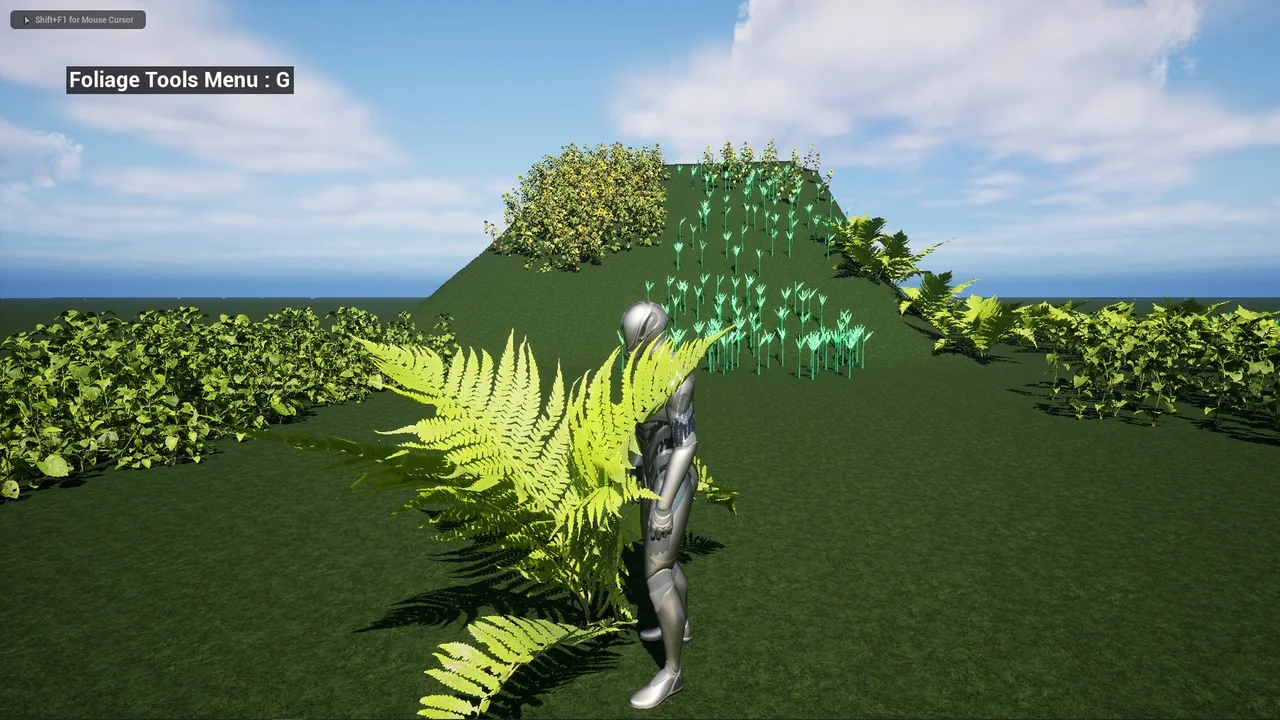
 Buildings
 Engine Tools
 Trees
Trees