"6b09b40477bc408d"{"id":"1002741","slug":"vegetation-vol-1-forest-automaterial","title":"Vegetation Vol 1 - Forest Automaterial","category":"Apocalyptic / Post-apocalyptic","engine":"5.0+","assetVersion":"","engineVersion":"Engine Version: 5.0+","tag":"Apocalyptic","accent":"blue","visual":"luts","summary":"Examine Vegetation Vol 1 - Forest Automaterial by Six Sides Studios, featuring a 6-layer landscape setup, procedural foliage spawner, RVT, and water shaders.","platform":"Unreal Engine","indexPolicy":"index","publishedAt":"2026-11-19T02:46:41.356Z","updatedAt":"2026-11-19T02:46:41.356Z","sourceNotes":[],"fileContents":[],"compatibility":["Unreal Engine","Engine Version: 5.0+"],"featuredImage":{"alt":"Vegetation Vol 1 - Forest Automaterial","src":"/wp-content/uploads/published/2026/11/183e4edb02a7-586aa044-565a-488f-85a7-13d7e098da1c-9256d16111.webp"},"hasDownloadLink":true,"downloads":0,"terms":[{"taxonomy":"category","slug":"apocalyptic-post-apocalyptic","name":"Apocalyptic / Post-apocalyptic"}],"galleryImages":[{"src":"/wp-content/uploads/published/2026/11/30a2c910045a-6add63db-9e8a-4901-afb6-ec3c6f408a1b-5c35ed9baa.webp","alt":"Vegetation Vol 1 - Forest Automaterial"},{"src":"/wp-content/uploads/published/2026/11/c97668739c98-7322c88b-8f01-4b82-803f-df33ab817b33-0e451f4d5a.webp","alt":"Vegetation Vol 1 - Forest Automaterial"},{"src":"/wp-content/uploads/published/2026/11/909e7f034590-6c35c3f8-fe46-4dc0-8d51-ac550d146966-9fb004034f.webp","alt":"Vegetation Vol 1 - Forest Automaterial"},{"src":"/wp-content/uploads/published/2026/11/035d30005980-513726cc-71ab-4c11-802f-8abedbb71c54-78d2d8ad65.webp","alt":"Vegetation Vol 1 - Forest Automaterial"},{"src":"/wp-content/uploads/published/2026/11/c76cd7035127-443718a0-d77d-4a27-88a0-5bf95bb6db3e-d332b72ffb.webp","alt":"Vegetation Vol 1 - Forest Automaterial"},{"src":"/wp-content/uploads/published/2026/11/81bf1fc9db10-e4b048e1-3539-44a5-9997-75ae7b2c8586-419ce481fb.webp","alt":"Vegetation Vol 1 - Forest Automaterial"},{"src":"/wp-content/uploads/published/2026/11/16afe727e813-9b52eec4-a14a-4abb-b3dd-90675a01f295-17ee45b032.webp","alt":"Vegetation Vol 1 - Forest Automaterial"},{"src":"/wp-content/uploads/published/2026/11/beec43a4b87b-19bcc8ad-0fde-4467-b03e-89554d73c999-4bbf421b4f.webp","alt":"Vegetation Vol 1 - Forest Automaterial"},{"src":"/wp-content/uploads/published/2026/11/03dcb1739f75-9c9069c3-142e-461c-b7e4-cf3813ac6c87-758531a715.webp","alt":"Vegetation Vol 1 - Forest Automaterial"},{"src":"/wp-content/uploads/published/2026/11/c775d06bb1f6-822be4c6-9fa2-4f56-a75e-f0d2b9ad2446-2fe0dfd394.webp","alt":"Vegetation Vol 1 - Forest Automaterial"}],"accessPanel":{"kind":"resource","title":"Get this resource","safetyNote":"Resources are manually reviewed before listing to improve quality and reduce obvious risks.","fileName":"Content.7z","resourceType":"Resource archive","versions":[]},"contentHtml":"\u003cp\u003eConstructing expansive outdoor levels often introduces a severe bottleneck during world assembly. Hand-painting square kilometers of terrain, manually scattering distinct flora types, and repeatedly cleaning up clipping foliage across trails, rivers, and clearings drains critical production time. When visual consistency across stylized terrain and foliage is required, coordinating landscape shaders with organic vegetation models becomes even more demanding.\u003c/p\u003e \u003cp\u003eVegetation Vol 1 - Forest Automaterial addresses this structural pipeline challenge by coupling an automated terrain system with procedural distribution tools. Developed by Six Sides Studios, the package unites stylized nature assets, multi-layered ground materials, water surface shaders, and modern rendering optimizations into a cohesive framework. Its structure allows level designers to transition from an untextured heightmap to a fully dressed forest environment in minutes, rather than spending days on manual placement.\u003c/p\u003e \u003ch2\u003eStreamlining Terrain Shading with the Forest Automaterial\u003c/h2\u003e \u003cp\u003eTerrain painting typically requires balancing slope calculations, texture transitions, and height offsets. The central component of this package is an automaterial that handles the heavy lifting of surface texturing automatically based on the geometry of the landscape mesh.\u003c/p\u003e \u003cp\u003eThe system adapts surface textures across changes in elevation and angle, applying appropriate ground coverings to sheer cliffs, gentle slopes, and flat valleys without requiring hours of manual layer painting. By maintaining seamless transitions between rock textures and soft ground covers, the shader ensures that stylized terrain retains its readability from both close-up player perspectives and wide overhead angles. This automatic distribution serves as an ideal base for expansive nature environments in survival, RPG, and fantasy titles where massive terrain expanses must look visually unified without repetitive manual intervention.\u003c/p\u003e \u003ch2\u003eSix Distinct Surface Layers and Foliage Removal Logic\u003c/h2\u003e \u003cp\u003eWhile automation handles the broader terrain contours, artistic control remains necessary for specialized level design needs. The terrain material provides six distinct layers to give creators hands-on influence over specific zones of the landscape.\u003c/p\u003e \u003cp\u003eAmong these layers, the dedicated Removal Foliage layer plays a functional role in gameplay grayboxing and world cleanup. In procedural workflows, automated plant scattering frequently invades areas intended for dirt paths, campsites, clearings, or water edges. By painting with the Removal Foliage layer, designers can selectively suppress foliage instances in targeted spots across the terrain while updating the ground surface underneath. This mechanism eliminates the tedious task of manually selecting and deleting individual vegetation instances, ensuring that roads, building footprints, and structural areas remain clear of stray pine trees or bushes.\u003c/p\u003e \u003ch2\u003eProcedural Forest Spawning in a Single Click\u003c/h2\u003e \u003cp\u003ePopulating a sprawling landscape by hand often leads to unnatural patterns or immense time sink. To bypass this friction, the package incorporates a configured Procedural Foliage Spawner that populates an entire forest ecosystem with a single click.\u003c/p\u003e \u003cp\u003eThe spawner is preconfigured with the package's foliage assets, coordinating the placement of pine trees, dense bushes, and ground-level grass according to natural distribution rules. Trees naturally group together, while undergrowth fills intermediate spaces without creating chaotic density spikes. For developers working on medieval, fantasy, or wilderness survival environments, this procedural approach creates believable woodland density instantly. Designers can generate an ambient forest across square miles of rolling hills, evaluate sightlines and navigation immediately, and regenerate variations whenever the underlying terrain heightmap undergoes revisions.\u003c/p\u003e \u003ch2\u003eStylized Vegetation Assets and Environmental Water Systems\u003c/h2\u003e \u003cp\u003eVisual cohesion is a hallmark of stylized environments, where mismatched asset packs often disrupt player immersion. This package features the unique stylized visual signature exclusive to the team at Six Sides Studios, maintaining a clear artistic direction across all included assets.\u003c/p\u003e \u003cp\u003eThe flora selection includes stylized pine trees, lowpoly foliage variants, sturdy bushes, and field grass, all modeled to maintain crisp silhouettes and clear color separation. The aesthetic carries an ambient, lowpoly appeal tailored for stylized adventure worlds and action role-playing games. Complementing the plant life and rock components, the package also supplies dedicated materials for rivers and lakes. Water bodies are fundamental to forest composition, and having purpose-built river and lake shaders directly aligned with the terrain palette allows creators to fashion mountain streams, placid pools, and expansive waterways that harmonize directly with the surrounding ground and tree canopies.\u003c/p\u003e \u003ch2\u003eRuntime Virtual Texturing for Stylized Open-World Pipelines\u003c/h2\u003e \u003cp\u003eDense foliage and multi-layered landscape materials can quickly overburden the graphics pipeline if left unmanaged. To safeguard performance across large open-world maps, the vegetation and landscape systems are optimized with Runtime Virtual Texturing (RVT).\u003c/p\u003e \u003cp\u003eRVT reduces runtime rendering costs by caching landscape and material data into virtual textures, significantly cutting the draw-call and shader complexity overhead typically caused by complex automaterial evaluations. This setup also facilitates seamless blending between the ground material and the bases of intersecting assets, such as rocks and tree trunks, preventing harsh intersection lines and grounding the lowpoly elements naturally into the dirt. Comprehensive documentation is included to help developers navigate the RVT configuration, procedural spawner settings, and layer controls smoothly.\u003c/p\u003e \u003cp\u003eOriginally selected as part of the Epic Games Free Asset Program in December 2024, the collection stands as a thoroughly organized production toolkit. It suits indie teams and solo developers aiming to build stylized medieval realms, survival wildernesses, or fantasy RPG worlds where fast iteration, optimized performance, and aesthetic unity are essential from the very first level blockout.\u003c/p\u003e\n\n\u003ch2\u003eMore From The Same Workflow\u003c/h2\u003e\n\u003cul\u003e\n\u003cli\u003e\u003ca href=\"https://3dcghub.com/forest-landscape-materials-vol-ii/\" rel=\"noopener noreferrer\"\u003eForest Landscape Materials Vol. II\u003c/a\u003e\u003c/li\u003e\n\u003cli\u003e\u003ca href=\"https://3dcghub.com/stylized-nature-vol-1-stylized-environment-bundle/\" rel=\"noopener noreferrer\"\u003eStylized Nature Vol. 1 | Stylized Environment Bundle\u003c/a\u003e\u003c/li\u003e\n\u003cli\u003e\u003ca href=\"https://3dcghub.com/forest-landscape-materials-vol-i/\" rel=\"noopener noreferrer\"\u003eForest Landscape Materials Vol.I\u003c/a\u003e\u003c/li\u003e\n\u003cli\u003e\u003ca href=\"https://3dcghub.com/foliage-vol-32-dead-forest-nanite/\" rel=\"noopener noreferrer\"\u003eFoliage VOL.32 - Dead Forest (Nanite)\u003c/a\u003e\u003c/li\u003e\n\u003cli\u003e\u003ca href=\"https://3dcghub.com/landscape-vol-02/\" rel=\"noopener noreferrer\"\u003eLandscape VOL 02\u003c/a\u003e\u003c/li\u003e\n\u003c/ul\u003e","contentTextLength":6479,"navigation":{"current":1,"total":4663,"next":{"id":"1002740","slug":"underwater-world-70-assets","title":"Underwater World / 70 Assets","category":"Aquatic","platform":"Unreal Engine","updatedAt":"2026-11-19T02:45:41.177Z"}},"relatedResources":[{"id":"1001209","slug":"forest-landscape-materials-vol-ii","title":"Forest Landscape Materials Vol. II","category":"Nature \u0026 Terrain","engine":"5.0+","assetVersion":"","engineVersion":"Engine Version: 5.0+","tag":"Nature \u0026 Terrain","accent":"blue","visual":"luts","summary":"A detailed look at Forest Landscape Materials Vol. II, featuring 3mx3m photoscanned deciduous forest textures and multiple displacement methods.","platform":"Unreal Engine","indexPolicy":"index","publishedAt":"2026-09-19T08:41:22.784Z","updatedAt":"2026-09-19T08:41:22.784Z","sourceNotes":[],"fileContents":[],"compatibility":["Unreal Engine","Engine Version: 5.0+"],"featuredImage":{"alt":"Forest Landscape Materials Vol. II","src":"/wp-content/uploads/published/2026/09/87bf5469786d-c8f44977-9c23-4412-9186-783fc612d0d0-bae97017a8.webp"},"fileSizeBytes":918602994,"hasDownloadLink":true,"downloads":0},{"id":"1000481","slug":"stylized-nature-vol-1-stylized-environment-bundle","title":"Stylized Nature Vol. 1 | Stylized Environment Bundle","category":"Forest \u0026 Jungle","engine":"5.2+","assetVersion":"","engineVersion":"Engine Version: 5.2+","tag":"Forest \u0026 Jungle","accent":"blue","visual":"city","summary":"A stylized environment bundle for Unreal Engine featuring landscape tools for cliffs, grass distribution, runtime virtual textures, interactive foliage, and dyn","platform":"Unreal Engine","indexPolicy":"index","publishedAt":"2026-07-12T06:08:17.870Z","updatedAt":"2026-07-12T06:08:17.870Z","sourceNotes":[],"fileContents":[],"compatibility":["Unreal Engine","Engine Version: 5.2+"],"featuredImage":{"alt":"Stylized Nature Vol. 1 | Stylized Environment Bundle","src":"/wp-content/uploads/published/2026/07/26ef167c9a89-bc3026b6-a0c9-4dcc-82d5-8ee5de21e891-9887ed431f.webp"},"fileSizeBytes":341399543,"hasDownloadLink":true,"downloads":3},{"id":"1001210","slug":"forest-landscape-materials-vol-i","title":"Forest Landscape Materials Vol.I","category":"Nature \u0026 Terrain","engine":"5.0+","assetVersion":"","engineVersion":"Engine Version: 5.0+","tag":"Nature \u0026 Terrain","accent":"blue","visual":"luts","summary":"Examine Forest Landscape Materials Vol.I, featuring 3mx3m photo-scanned coniferous forest surfaces with multiple displacement methods.","platform":"Unreal Engine","indexPolicy":"index","publishedAt":"2026-09-19T08:43:08.399Z","updatedAt":"2026-09-19T08:43:08.399Z","sourceNotes":[],"fileContents":[],"compatibility":["Unreal Engine","Engine Version: 5.0+"],"featuredImage":{"alt":"Forest Landscape Materials Vol.I","src":"/wp-content/uploads/published/2026/09/b61bfba68fd5-e493231b-b7cb-4dda-a978-64109746a3b0-09225789f5.webp"},"fileSizeBytes":744944505,"hasDownloadLink":true,"downloads":0}]}
Resource screenshots
1 / 10
Join our channel
Follow 3DCGHUB on Telegram for new resource drops, migration updates, and community notices.
Resources are manually reviewed before listing to improve quality and reduce obvious risks.
No account required
Apocalyptic
Vegetation Vol 1 - Forest Automaterial
Examine Vegetation Vol 1 - Forest Automaterial by Six Sides Studios, featuring a 6-layer landscape setup, procedural foliage spawner, RVT, and water shaders.
Constructing expansive outdoor levels often introduces a severe bottleneck during world assembly. Hand-painting square kilometers of terrain, manually scattering distinct flora types, and repeatedly cleaning up clipping foliage across trails, rivers, and clearings drains critical production time. When visual consistency across stylized terrain and foliage is required, coordinating landscape shaders with organic vegetation models becomes even more demanding.
Vegetation Vol 1 - Forest Automaterial addresses this structural pipeline challenge by coupling an automated terrain system with procedural distribution tools. Developed by Six Sides Studios, the package unites stylized nature assets, multi-layered ground materials, water surface shaders, and modern rendering optimizations into a cohesive framework. Its structure allows level designers to transition from an untextured heightmap to a fully dressed forest environment in minutes, rather than spending days on manual placement.
Streamlining Terrain Shading with the Forest Automaterial
Terrain painting typically requires balancing slope calculations, texture transitions, and height offsets. The central component of this package is an automaterial that handles the heavy lifting of surface texturing automatically based on the geometry of the landscape mesh.
The system adapts surface textures across changes in elevation and angle, applying appropriate ground coverings to sheer cliffs, gentle slopes, and flat valleys without requiring hours of manual layer painting. By maintaining seamless transitions between rock textures and soft ground covers, the shader ensures that stylized terrain retains its readability from both close-up player perspectives and wide overhead angles. This automatic distribution serves as an ideal base for expansive nature environments in survival, RPG, and fantasy titles where massive terrain expanses must look visually unified without repetitive manual intervention.
Six Distinct Surface Layers and Foliage Removal Logic
While automation handles the broader terrain contours, artistic control remains necessary for specialized level design needs. The terrain material provides six distinct layers to give creators hands-on influence over specific zones of the landscape.
Among these layers, the dedicated Removal Foliage layer plays a functional role in gameplay grayboxing and world cleanup. In procedural workflows, automated plant scattering frequently invades areas intended for dirt paths, campsites, clearings, or water edges. By painting with the Removal Foliage layer, designers can selectively suppress foliage instances in targeted spots across the terrain while updating the ground surface underneath. This mechanism eliminates the tedious task of manually selecting and deleting individual vegetation instances, ensuring that roads, building footprints, and structural areas remain clear of stray pine trees or bushes.
Procedural Forest Spawning in a Single Click
Populating a sprawling landscape by hand often leads to unnatural patterns or immense time sink. To bypass this friction, the package incorporates a configured Procedural Foliage Spawner that populates an entire forest ecosystem with a single click.
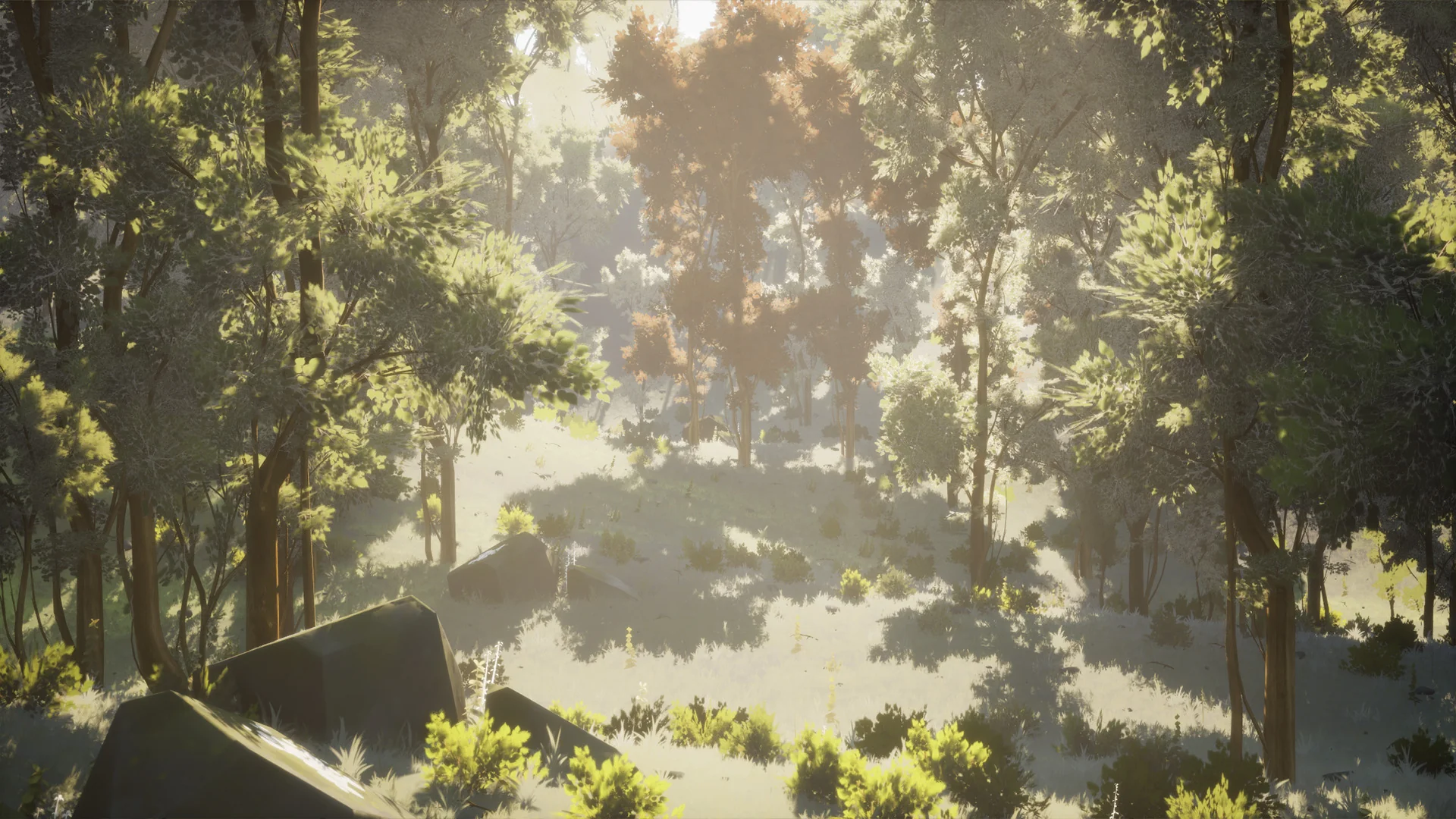
The spawner is preconfigured with the package's foliage assets, coordinating the placement of pine trees, dense bushes, and ground-level grass according to natural distribution rules. Trees naturally group together, while undergrowth fills intermediate spaces without creating chaotic density spikes. For developers working on medieval, fantasy, or wilderness survival environments, this procedural approach creates believable woodland density instantly. Designers can generate an ambient forest across square miles of rolling hills, evaluate sightlines and navigation immediately, and regenerate variations whenever the underlying terrain heightmap undergoes revisions.
Stylized Vegetation Assets and Environmental Water Systems
Visual cohesion is a hallmark of stylized environments, where mismatched asset packs often disrupt player immersion. This package features the unique stylized visual signature exclusive to the team at Six Sides Studios, maintaining a clear artistic direction across all included assets.
The flora selection includes stylized pine trees, lowpoly foliage variants, sturdy bushes, and field grass, all modeled to maintain crisp silhouettes and clear color separation. The aesthetic carries an ambient, lowpoly appeal tailored for stylized adventure worlds and action role-playing games. Complementing the plant life and rock components, the package also supplies dedicated materials for rivers and lakes. Water bodies are fundamental to forest composition, and having purpose-built river and lake shaders directly aligned with the terrain palette allows creators to fashion mountain streams, placid pools, and expansive waterways that harmonize directly with the surrounding ground and tree canopies.
Runtime Virtual Texturing for Stylized Open-World Pipelines
Dense foliage and multi-layered landscape materials can quickly overburden the graphics pipeline if left unmanaged. To safeguard performance across large open-world maps, the vegetation and landscape systems are optimized with Runtime Virtual Texturing (RVT).
RVT reduces runtime rendering costs by caching landscape and material data into virtual textures, significantly cutting the draw-call and shader complexity overhead typically caused by complex automaterial evaluations. This setup also facilitates seamless blending between the ground material and the bases of intersecting assets, such as rocks and tree trunks, preventing harsh intersection lines and grounding the lowpoly elements naturally into the dirt. Comprehensive documentation is included to help developers navigate the RVT configuration, procedural spawner settings, and layer controls smoothly.
Originally selected as part of the Epic Games Free Asset Program in December 2024, the collection stands as a thoroughly organized production toolkit. It suits indie teams and solo developers aiming to build stylized medieval realms, survival wildernesses, or fantasy RPG worlds where fast iteration, optimized performance, and aesthetic unity are essential from the very first level blockout.
 Nature & Terrain
 Forest & Jungle
 Nature & Terrain