"2596237520a17fbf"{"id":"1002908","slug":"custom-shape-volumes","title":"Custom Shape Volumes","category":"Gameplay Features","engine":"5.1+","assetVersion":"","engineVersion":"Engine Version: 5.1+","tag":"Gameplay Features","accent":"blue","visual":"mech","summary":"A deep dive into Custom Shape Volumes, a spline-based Unreal Engine Blueprint system for matching trigger volumes to roads, coastlines, and complex 3D rooms.","platform":"Unreal Engine","indexPolicy":"index","publishedAt":"2026-11-21T15:37:48.565Z","updatedAt":"2026-11-21T15:37:48.565Z","sourceNotes":[],"fileContents":[],"compatibility":["Unreal Engine","Engine Version: 5.1+"],"featuredImage":{"alt":"Custom Shape Volumes","src":"/wp-content/uploads/published/2026/11/5c75710af976-c99bdacb-cdf9-4900-971b-1c6cdaaad5ab-bc2f07acac.webp"},"fileSizeBytes":163168580,"hasDownloadLink":true,"downloads":0,"terms":[{"taxonomy":"category","slug":"gameplay-features","name":"Gameplay Features"}],"galleryImages":[{"src":"/wp-content/uploads/published/2026/11/c5150f8960f8-ae3a4758-18c3-4739-adb2-b0eee2ff434e-aeb04db34c.webp","alt":"Custom Shape Volumes"},{"src":"/wp-content/uploads/published/2026/11/a69aa6d37bff-40541879-f344-4c07-8020-199b13cc34da-7bc0e01635.webp","alt":"Custom Shape Volumes"},{"src":"/wp-content/uploads/published/2026/11/4962b6c7e3ef-e368b1f8-2a93-4f09-bec4-6832b01cad9d-4e863508bd.webp","alt":"Custom Shape Volumes"},{"src":"/wp-content/uploads/published/2026/11/6f975cf0fdd2-327174de-de04-4ab6-ac0f-ef0da21364cb-fa100fc542.webp","alt":"Custom Shape Volumes"},{"src":"/wp-content/uploads/published/2026/11/9b77102f3682-936d101b-20b1-4ee7-8335-b8e56dd1af55-341c34a2f1.webp","alt":"Custom Shape Volumes"}],"contentHtml":"\u003ch2\u003eFitting Irregular Environments with Custom Shape Volumes\u003c/h2\u003e\u003cp\u003eWinding postapocalyptic highways, irregular cave systems, jagged coastlines, and angled interior chambers rarely conform to the rigid boundaries of primitive box colliders. Level designers building realistic open worlds, third-person adventure layouts, or zombie-infested ruins often face the friction of stacking dozens of overlapping box triggers just to approximate a single curved corridor or winding shoreline. Custom Shape Volumes addresses this structural mismatch directly by replacing rigid box triggers with spline-based boundaries that trace the precise topography and architecture of an environment.\u003c/p\u003e\u003cp\u003eInstead of forcing level geometry to compromise with box colliders, the system allows creators to draw customized spline paths directly within the editor viewport. These paths generate responsive volumes that match the real contours of roads, terrain, and architectural partitions. When a player character wanders down an arched alleyway or steps across an uneven shoreline, the game logic detects the boundary cleanly, eliminating the dead zones, false triggers, and awkward gaps that inevitably occur when assembling curved areas from arrays of square triggers.\u003c/p\u003e\u003ch2\u003eExtruding Height and Blending Spatial Boundaries\u003c/h2\u003e\u003cp\u003ePlanar shapes only solve part of the spatial challenge in level construction. Realistic game spaces feature multi-story buildings, vertical drops, bridge underpasses, and tiered landscape elevations where a flat trigger footprint would bleed into unintended vertical layers. Custom Shape Volumes includes an optional height setting to generate true 3D volumes. By toggling and adjusting height properties, a volume can encompass an entire subterranean cellar or stop short before affecting an upper floor, maintaining clean containment within complex vertical architecture.\u003c/p\u003e\u003cp\u003eBeyond binary enter-and-exit conditions, the toolset introduces a configurable fade range designed to manage gradual transitions. Rather than snapping gameplay effects on and off the moment an actor crosses an edge, the system monitors when a player approaches an area. As the character moves through the configurable fade margin toward the core shape, values interpolate progressively. This gradual blending allows environmental changes to shift naturally as the player draws closer, softening the boundary between distinct zones.\u003c/p\u003e\u003ch2\u003eArchitecture of the Volumes Framework and Included Blueprints\u003c/h2\u003e\u003cp\u003eUnder the hood, the system is organized as a modular framework consisting of 21 Blueprints. At the core of the hierarchy sits a reusable parent Blueprint that encapsulates the underlying spline math, spatial containment checks, and boundary behaviors. Rather than building custom trigger logic from scratch for every unique scene requirement, developers can derive new volume classes directly from this parent actor.\u003c/p\u003e\u003cp\u003eThe package ships with three practical child implementations demonstrating how to build upon the parent framework:\u003c/p\u003e\u003cul\u003e\u003cli\u003e\u003cstrong\u003eExample Post-Process Volume:\u003c/strong\u003e Applies visual grading and rendering effects that follow organic landscape contours, eliminating hard rectangular cutoffs when transitioning between lighting conditions or atmospheric states.\u003c/li\u003e\u003cli\u003e\u003cstrong\u003eExample Area-Audio Volume:\u003c/strong\u003e Handles localized soundscapes, ambiances, and musical cues that dynamically conform to meandering rivers, irregularly shaped rooms, or outdoor clearings.\u003c/li\u003e\u003cli\u003e\u003cstrong\u003eExample Named-Location Volume:\u003c/strong\u003e Demonstrates attaching named location data to a volume, so entering an area can report or trigger location-specific logic.\u003c/li\u003e\u003c/ul\u003e\u003cp\u003eBecause the core detection and shape-drawing features reside in the parent Blueprint, authoring specialized gameplay triggers—such as hazardous environmental zones, localized weather volumes, or territory capture areas—requires only extending the parent logic and overriding entry, exit, or approach behaviors.\u003c/p\u003e\u003ch2\u003eOptimization Variables and Layered Triggers\u003c/h2\u003e\u003cp\u003eTracking custom geometric boundaries and distance-based approach thresholds can become demanding if applied carelessly across dense scenes. Custom Shape Volumes provides dedicated optimization variables alongside a layering system to regulate computational cost per area. Level designers can adjust the exposed optimization settings and organize volumes into discrete functional layers based on their immediate gameplay importance.\u003c/p\u003e\u003cp\u003eBy structuring volumes into layers, the system avoids running heavy checks on secondary triggers when they are not relevant to the player's immediate context. A broad location volume can sit in one layer while local audio or post-process volumes sit in another, so a scene does not have to evaluate every volume in the same way. This tiered setup prevents performance degradation in large maps that contain high volumes of modular spline triggers, keeping boundary queries scalable throughout expansive world partitions.\u003c/p\u003e\u003ch2\u003eMultiplayer Behavior and Workflow Integration\u003c/h2\u003e\u003cp\u003eIn networked environments, player movement and character states require clear ownership boundaries. Within the project setup, both the player character and artificial intelligence agents are fully replicated across the network, while the volume logic itself runs locally on client machines by default. This local execution model prevents unnecessary server-side network traffic from being consumed by client-specific tasks like visual post-process blending, local UI region name displays, and personal ambient audio playback.\u003c/p\u003e\u003cp\u003eRecognized as Unreal Engine Sponsored Content in July 2021, the pack includes a comprehensive ecosystem of learning and testing materials. Developers can inspect a preconfigured demo map, test gameplay mechanics within a playable demo, and reference a full tutorial playlist alongside an overview video and trailer. For active troubleshooting, community discussions and technical support are handled via Discord, with historical inquiries and review feedback documented on Orbital Market. The combination of modular parent architecture, local client optimization, and spline flexibility makes the pack a practical tool for any production seeking to free its level logic from the constraints of primitive box collision.\u003c/p\u003e\n\n\u003ch2\u003eRelated Resources Worth Checking\u003c/h2\u003e\n\u003cul\u003e\n\u003cli\u003e\u003ca href=\"https://3dcghub.com/custom-movement/\" rel=\"noopener noreferrer\"\u003eCustom Movement\u003c/a\u003e\u003c/li\u003e\n\u003cli\u003e\u003ca href=\"https://3dcghub.com/ultimate-horse-system-horse-horse-riding-horse-system-mount-rideable-horse/\" rel=\"noopener noreferrer\"\u003eUltimate Horse System (Horse, Horse Riding, Horse System, Mount, Rideable Horse)\u003c/a\u003e\u003c/li\u003e\n\u003cli\u003e\u003ca href=\"https://3dcghub.com/orbit-camera/\" rel=\"noopener noreferrer\"\u003eOrbit Camera\u003c/a\u003e\u003c/li\u003e\n\u003cli\u003e\u003ca href=\"https://3dcghub.com/3d-tilemap-simple-helper/\" rel=\"noopener noreferrer\"\u003e3D Tilemap - Simple Helper\u003c/a\u003e\u003c/li\u003e\n\u003cli\u003e\u003ca href=\"https://3dcghub.com/advanced-photo-mode/\" rel=\"noopener noreferrer\"\u003eAdvanced Photo Mode\u003c/a\u003e\u003c/li\u003e\n\u003c/ul\u003e","contentTextLength":6326,"navigation":{"current":11,"total":4839,"previous":{"id":"1002909","slug":"drivable-cars-4x4-off-road-four-wheel-drive-car","title":"Drivable Cars: 4x4 Off Road Four Wheel Drive Car","category":"Cars \u0026 Trucks","platform":"Unreal Engine","updatedAt":"2026-11-21T15:38:42.598Z"},"next":{"id":"1002907","slug":"combat-components","title":"Combat Components","category":"Engine Tools","platform":"Unreal Engine","updatedAt":"2026-11-21T15:37:23.981Z"}},"relatedResources":[{"id":"1002902","slug":"custom-movement","title":"Custom Movement","category":"Gameplay Features","engine":"5.4+","assetVersion":"","engineVersion":"Engine Version: 5.4+","tag":"Gameplay Features","accent":"blue","visual":"mech","summary":"A Blueprint-driven system implementing networked ladder and climbing mechanics using a dedicated CharacterMovement component in Unreal Engine.","platform":"Unreal Engine","indexPolicy":"index","publishedAt":"2026-11-21T04:49:36.981Z","updatedAt":"2026-11-21T04:49:36.981Z","sourceNotes":[],"fileContents":[],"compatibility":["Unreal Engine","Engine Version: 5.4+"],"featuredImage":{"alt":"Custom Movement","src":"/wp-content/uploads/published/2026/11/d0cea167d052-bf6a0dcb-01f5-47af-8051-6f93fc19057b-b1c7914eca.webp"},"fileSizeBytes":278954228,"hasDownloadLink":true,"downloads":0},{"id":"1001711","slug":"ultimate-horse-system-horse-horse-riding-horse-system-mount-rideable-horse","title":"Ultimate Horse System (Horse, Horse Riding, Horse System, Mount, Rideable Horse)","category":"Gameplay Features","engine":"5.1+","assetVersion":"","engineVersion":"Engine Version: 5.1+","tag":"Gameplay Features","accent":"blue","visual":"mech","summary":"Explore the Ultimate Horse System for Unreal Engine, featuring full network replication, modular saddles, Foot IK, water interaction, and custom rider support.","platform":"Unreal Engine","indexPolicy":"index","publishedAt":"2026-10-14T17:15:39.983Z","updatedAt":"2026-10-14T17:15:39.983Z","sourceNotes":[],"fileContents":[],"compatibility":["Unreal Engine","Engine Version: 5.1+"],"featuredImage":{"alt":"Ultimate Horse System (Horse, Horse Riding, Horse System, Mount, Rideable Horse)","src":"/wp-content/uploads/published/2026/10/6dc76c7660f2-d252bb16-9c4e-4df7-8a68-0bb86ab4c882-eca349b4ab.webp"},"fileSizeBytes":3102861934,"hasDownloadLink":true,"downloads":2},{"id":"1002135","slug":"orbit-camera","title":"Orbit Camera","category":"Gameplay Features","engine":"5.1+","assetVersion":"","engineVersion":"Engine Version: 5.1+","tag":"Gameplay Features","accent":"blue","visual":"mech","summary":"Explore the Orbit Camera pawn blueprint, featuring custom pivot targeting, dolly zooms, camera switching transitions, and a clean screenshot album.","platform":"Unreal Engine","indexPolicy":"index","publishedAt":"2026-10-29T09:23:20.322Z","updatedAt":"2026-10-29T09:23:20.322Z","sourceNotes":[],"fileContents":[],"compatibility":["Unreal Engine","Engine Version: 5.1+"],"featuredImage":{"alt":"Orbit Camera","src":"/wp-content/uploads/published/2026/10/e324a714a1c3-3b75bef2-164f-4162-916b-96dc9e94da5f-912c0b74b8.webp"},"fileSizeBytes":10222386,"hasDownloadLink":true,"downloads":0}]}
Resource screenshots
1 / 5
Join our channel
Follow 3DCGHUB on Telegram for new resource drops, migration updates, and community notices.
A deep dive into Custom Shape Volumes, a spline-based Unreal Engine Blueprint system for matching trigger volumes to roads, coastlines, and complex 3D rooms.
Fitting Irregular Environments with Custom Shape Volumes
Winding postapocalyptic highways, irregular cave systems, jagged coastlines, and angled interior chambers rarely conform to the rigid boundaries of primitive box colliders. Level designers building realistic open worlds, third-person adventure layouts, or zombie-infested ruins often face the friction of stacking dozens of overlapping box triggers just to approximate a single curved corridor or winding shoreline. Custom Shape Volumes addresses this structural mismatch directly by replacing rigid box triggers with spline-based boundaries that trace the precise topography and architecture of an environment.
Instead of forcing level geometry to compromise with box colliders, the system allows creators to draw customized spline paths directly within the editor viewport. These paths generate responsive volumes that match the real contours of roads, terrain, and architectural partitions. When a player character wanders down an arched alleyway or steps across an uneven shoreline, the game logic detects the boundary cleanly, eliminating the dead zones, false triggers, and awkward gaps that inevitably occur when assembling curved areas from arrays of square triggers.
Extruding Height and Blending Spatial Boundaries
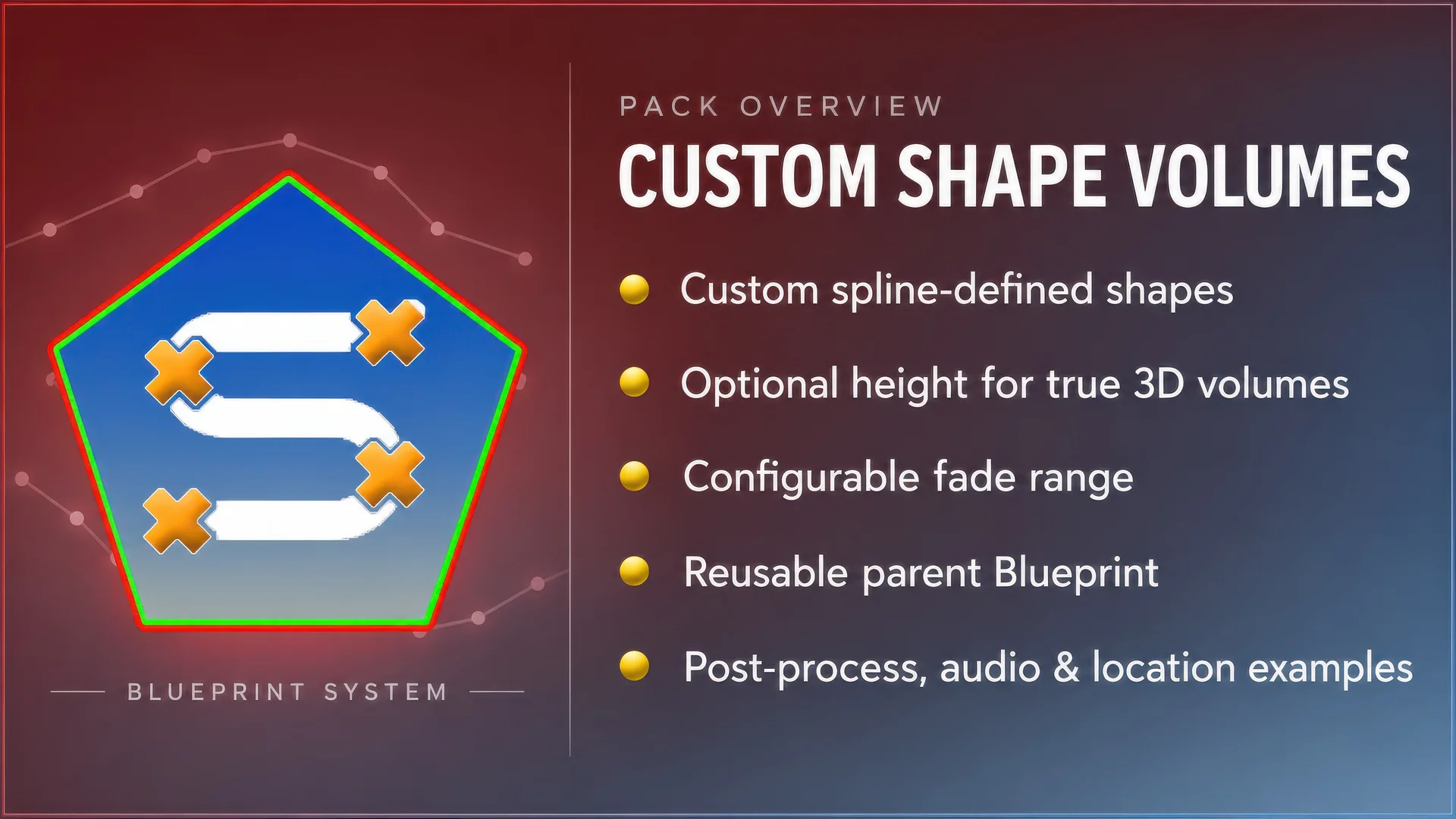
Planar shapes only solve part of the spatial challenge in level construction. Realistic game spaces feature multi-story buildings, vertical drops, bridge underpasses, and tiered landscape elevations where a flat trigger footprint would bleed into unintended vertical layers. Custom Shape Volumes includes an optional height setting to generate true 3D volumes. By toggling and adjusting height properties, a volume can encompass an entire subterranean cellar or stop short before affecting an upper floor, maintaining clean containment within complex vertical architecture.
Beyond binary enter-and-exit conditions, the toolset introduces a configurable fade range designed to manage gradual transitions. Rather than snapping gameplay effects on and off the moment an actor crosses an edge, the system monitors when a player approaches an area. As the character moves through the configurable fade margin toward the core shape, values interpolate progressively. This gradual blending allows environmental changes to shift naturally as the player draws closer, softening the boundary between distinct zones.
Architecture of the Volumes Framework and Included Blueprints
Under the hood, the system is organized as a modular framework consisting of 21 Blueprints. At the core of the hierarchy sits a reusable parent Blueprint that encapsulates the underlying spline math, spatial containment checks, and boundary behaviors. Rather than building custom trigger logic from scratch for every unique scene requirement, developers can derive new volume classes directly from this parent actor.
The package ships with three practical child implementations demonstrating how to build upon the parent framework:
Example Post-Process Volume: Applies visual grading and rendering effects that follow organic landscape contours, eliminating hard rectangular cutoffs when transitioning between lighting conditions or atmospheric states.
Example Area-Audio Volume: Handles localized soundscapes, ambiances, and musical cues that dynamically conform to meandering rivers, irregularly shaped rooms, or outdoor clearings.
Example Named-Location Volume: Demonstrates attaching named location data to a volume, so entering an area can report or trigger location-specific logic.
Because the core detection and shape-drawing features reside in the parent Blueprint, authoring specialized gameplay triggers—such as hazardous environmental zones, localized weather volumes, or territory capture areas—requires only extending the parent logic and overriding entry, exit, or approach behaviors.
Optimization Variables and Layered Triggers
Tracking custom geometric boundaries and distance-based approach thresholds can become demanding if applied carelessly across dense scenes. Custom Shape Volumes provides dedicated optimization variables alongside a layering system to regulate computational cost per area. Level designers can adjust the exposed optimization settings and organize volumes into discrete functional layers based on their immediate gameplay importance.
By structuring volumes into layers, the system avoids running heavy checks on secondary triggers when they are not relevant to the player's immediate context. A broad location volume can sit in one layer while local audio or post-process volumes sit in another, so a scene does not have to evaluate every volume in the same way. This tiered setup prevents performance degradation in large maps that contain high volumes of modular spline triggers, keeping boundary queries scalable throughout expansive world partitions.
Multiplayer Behavior and Workflow Integration
In networked environments, player movement and character states require clear ownership boundaries. Within the project setup, both the player character and artificial intelligence agents are fully replicated across the network, while the volume logic itself runs locally on client machines by default. This local execution model prevents unnecessary server-side network traffic from being consumed by client-specific tasks like visual post-process blending, local UI region name displays, and personal ambient audio playback.
Recognized as Unreal Engine Sponsored Content in July 2021, the pack includes a comprehensive ecosystem of learning and testing materials. Developers can inspect a preconfigured demo map, test gameplay mechanics within a playable demo, and reference a full tutorial playlist alongside an overview video and trailer. For active troubleshooting, community discussions and technical support are handled via Discord, with historical inquiries and review feedback documented on Orbital Market. The combination of modular parent architecture, local client optimization, and spline flexibility makes the pack a practical tool for any production seeking to free its level logic from the constraints of primitive box collision.
 Gameplay Features
 Gameplay Features
 Gameplay Features