"2596237520a17fbf"{"id":"1002909","slug":"drivable-cars-4x4-off-road-four-wheel-drive-car","title":"Drivable Cars: 4x4 Off Road Four Wheel Drive Car","category":"Cars \u0026 Trucks","engine":"5.1+","assetVersion":"","engineVersion":"Engine Version: 5.1+","tag":"Cars \u0026 Trucks","accent":"blue","visual":"mech","summary":"Explore the mechanics, Blueprint architecture, LOD structure, and camera systems of the 4x4 off-road vehicle setup for Unreal Engine 4 and 5.","platform":"Unreal Engine","indexPolicy":"index","publishedAt":"2026-11-21T15:38:42.598Z","updatedAt":"2026-11-21T15:38:42.598Z","sourceNotes":[],"fileContents":[],"compatibility":["Unreal Engine","Engine Version: 5.1+"],"featuredImage":{"alt":"Drivable Cars: 4x4 Off Road Four Wheel Drive Car","src":"/wp-content/uploads/published/2026/11/e7a675630518-63f2983f-139e-4b60-83e6-4690615af486-3cf9bec88c.webp"},"fileSizeBytes":1098032757,"hasDownloadLink":true,"downloads":0,"terms":[{"taxonomy":"category","slug":"cars-and-trucks","name":"Cars \u0026 Trucks"}],"galleryImages":[{"src":"/wp-content/uploads/published/2026/11/66c0aaf9d891-9da42ec9-54e3-4e7d-aa69-2f57f7ae720f-85f9b8a550.webp","alt":"Drivable Cars: 4x4 Off Road Four Wheel Drive Car"},{"src":"/wp-content/uploads/published/2026/11/43a02df9cb82-ec848f1b-f6f3-47ae-860e-10ed646abb86-0e25add3cc.webp","alt":"Drivable Cars: 4x4 Off Road Four Wheel Drive Car"},{"src":"/wp-content/uploads/published/2026/11/3740b06bc845-290829d2-31b9-48b0-8c02-75893281c816-b2fe276330.webp","alt":"Drivable Cars: 4x4 Off Road Four Wheel Drive Car"},{"src":"/wp-content/uploads/published/2026/11/58a7672908b3-ff93fde1-5fe8-4bb1-b147-96dc7df6f9cf-e8f584cd34.webp","alt":"Drivable Cars: 4x4 Off Road Four Wheel Drive Car"},{"src":"/wp-content/uploads/published/2026/11/797504a798e8-3117a925-553b-4d07-b016-207ea9119acd-0e5411e713.webp","alt":"Drivable Cars: 4x4 Off Road Four Wheel Drive Car"},{"src":"/wp-content/uploads/published/2026/11/8bc4356c4602-45c0c432-1092-4f13-bacd-6b6f40b7b5b4-0d17a154a5.webp","alt":"Drivable Cars: 4x4 Off Road Four Wheel Drive Car"},{"src":"/wp-content/uploads/published/2026/11/a7892cec9514-0536d7b2-ca54-4b24-8ad1-3ccc13ce909d-06da0f6dfe.webp","alt":"Drivable Cars: 4x4 Off Road Four Wheel Drive Car"},{"src":"/wp-content/uploads/published/2026/11/e88039dd0478-3b8aa971-8f7e-4827-b528-6a13fe465f3a-870f99b302.webp","alt":"Drivable Cars: 4x4 Off Road Four Wheel Drive Car"},{"src":"/wp-content/uploads/published/2026/11/d534ae704900-8203f164-cc5d-4ec6-b2dc-6c43d55efd64-0c7a6a0a8c.webp","alt":"Drivable Cars: 4x4 Off Road Four Wheel Drive Car"},{"src":"/wp-content/uploads/published/2026/11/4eb799b9ff4c-dd1ad121-8f45-45b2-9625-b6ec6f8a6846-9bd0b3dbb2.webp","alt":"Drivable Cars: 4x4 Off Road Four Wheel Drive Car"}],"contentHtml":"\u003cp\u003eA character approaches an unbranded off-road vehicle, the door opens smoothly along a scripted timeline, and the third-person mannequin transitions straight into the cab. With hands snapping directly to the turning steering wheel via inverse kinematics, the vehicle shifts from an idle prop into an active player pawn. Drivable Cars: 4x4 Off Road Four Wheel Drive Car delivers this exact operational flow in Unreal Engine 4 and Unreal Engine 5, combining vehicle-template driving functions, driver IK animations, and interactive cockpit mechanics without depending on real-world manufacturer licensing.\u003c/p\u003e \u003ch2\u003eBehind the Wheel of the 4x4 Off Road Rig\u003c/h2\u003e\n\u003cp\u003eInteraction starts at the boundary between pedestrian locomotion and vehicular control. The asset integrates cleanly with standard Unreal Engine third-person template movement functions, allowing developers to maintain existing character controllers without discarding their default animation sets. When initiating the entry sequence, the system relies on timeline-driven door animations to open and shut the cab realistically rather than popping the character instantaneously into the driver seat.\u003c/p\u003e \u003cp\u003eInside the cabin, the third-person mannequin switches into a dedicated driving pose. This state uses an IK solution for the arms, locking the character's hands precisely to the steering wheel mesh as it turns in response to player steering inputs. Because the steering wheel is isolated as its own mesh asset, its rotation matches directional vehicle commands directly, selling the physical connection between the driver model and the steering column during sharp turns and rugged maneuvers.\u003c/p\u003e \u003cp\u003eExiting the vehicle mirrors this functional transition. Triggering the exit action plays the timeline door opening once again, unbinds the driver pawn, and reinstates standard template movement, leaving the vehicle idle until another entry event occurs.\u003c/p\u003e \u003ch2\u003eDrivable Cars Handling, Cockpit Instruments, and Cameras\u003c/h2\u003e\n\u003cp\u003eDriving mechanics stem directly from Unreal Engine vehicle template conventions. Control inputs handle throttle application, directional turning, active braking, and rear-gear reversing with support for keyboard, mouse, and gamepad hardware. This standardization ensures developers can map custom input actions or adjust dead zones across multiple input devices without rewriting the core vehicle handler.\u003c/p\u003e \u003cp\u003eVisual feedback inside and outside the cab relies on an adaptable camera and gauge layout:\u003c/p\u003e\n\u003cul\u003e\n\u003cli\u003e\u003cstrong\u003eDual Viewpoints:\u003c/strong\u003e Players can toggle between a first-person interior view and a third-person chase camera positioned outside the vehicle chassis.\u003c/li\u003e\n\u003cli\u003e\u003cstrong\u003eExterior Camera Manipulation:\u003c/strong\u003e The outside camera mode includes orbit and zoom controls, allowing players to survey steep terrain or examine clearance during off-road driving.\u003c/li\u003e\n\u003cli\u003e\u003cstrong\u003eInteractive Dashboard:\u003c/strong\u003e The interior cockpit features working instrumentation that tracks real-time engine revs and forward velocity, driving functional RPM and speed needles across the dash cluster.\u003c/li\u003e\n\u003cli\u003e\u003cstrong\u003eToggleable Lighting:\u003c/strong\u003e Vehicle lights can be switched on or off dynamically during traversal, lighting the path ahead in low-visibility environments.\u003c/li\u003e\n\u003c/ul\u003e \u003ch2\u003eAcoustic Design, Smoke FX, and Collision Response\u003c/h2\u003e\n\u003cp\u003eMechanical movement is paired with reactive sound and visual fx cues that respond to engine load and ground interaction. Engine audio covers the initial starter ignition, an RPM-dependent engine layer that responds to acceleration, and a decay effect tied to gear changes. These continuous cues are supplemented by dedicated event sounds for door opening and closing and for impacts against terrain or obstacles.\u003c/p\u003e \u003cp\u003eVisual effects support the vehicle's off-road theme through integrated smoke particle systems. The included emitters add visible smoke effects around the vehicle during driving, reinforcing the off-road presentation. Combined with the underlying impact audio cues, these effects provide immediate sensory feedback whenever the chassis interacts aggressively with steep declines or physical barricades.\u003c/p\u003e \u003ch2\u003eFour Wheel Drive Car Meshes, LODs, and Environment Props\u003c/h2\u003e\n\u003cp\u003eVisual performance hinges on structured level-of-detail optimization. The main four-wheel-drive vehicle body is a single rigged mesh equipped with four distinct LOD levels. This reduction cascade allows complex exterior paneling and suspension assemblies to step down in geometry at longer view distances, preserving frame rates in open-world layouts or scenes populated by multiple vehicles.\u003c/p\u003e \u003cp\u003eComponent breakdown includes dedicated sub-assets crafted for mechanical precision:\u003c/p\u003e\n\u003cul\u003e\n\u003cli\u003e\u003cstrong\u003eRigged Chassis:\u003c/strong\u003e A custom-designed 4x4 body featuring four LOD stages, modeled with an original, brand-agnostic design to avoid trademark conflicts.\u003c/li\u003e\n\u003cli\u003e\u003cstrong\u003eSteering Wheel:\u003c/strong\u003e Built as an independent component with two dedicated LOD levels to maintain silhouette fidelity during close-up cockpit views while reducing polygon overhead from exterior chase distances.\u003c/li\u003e\n\u003cli\u003e\u003cstrong\u003eBrake Calipers:\u003c/strong\u003e Modeled as discrete mesh parts positioned over the wheel assemblies to provide mechanical depth through open-spoke rims.\u003c/li\u003e\n\u003cli\u003e\u003cstrong\u003eMannequin Integration:\u003c/strong\u003e Uses the standard UE third-person character mannequin, complete with the full default animation set alongside the dedicated arm IK driving pose.\u003c/li\u003e\n\u003cli\u003e\u003cstrong\u003eTest Environment Props:\u003c/strong\u003e Includes supplemental static meshes consisting of a traffic cone, an incline ramp, and a designated driving path for immediate suspension and clearance testing.\u003c/li\u003e\n\u003c/ul\u003e \u003ch2\u003eBlueprint Architecture and Pipeline Compatibility\u003c/h2\u003e\n\u003cp\u003eThe system is organized across 18 distinct Blueprints, keeping interaction hooks, camera states, instrumentation logic, and vehicle movement compartmentalized. This modular Blueprint setup prevents feature bloat inside the primary vehicle pawn, making it straightforward to inspect specific subroutines like camera zooming or light toggling without untangling unrelated audio triggers.\u003c/p\u003e \u003cp\u003ePlatform deployment is configured natively for Windows-based development environments, with explicit support excluding Mac. While the base 4x4 configuration runs without built-in network replication out of the box, its framework maintains full structural compatibility with the Driveable Cars: Multiplayer Pack for projects targeting networked multiplayer sessions. It also interfaces directly with existing setups structured through the Driveable Cars: Basic Pack and Drivable Cars: Advanced Pack, enabling teams to slot this off-road variant into broader multi-vehicle rosters without re-engineering character interaction logic, control bindings, or camera managers.\u003c/p\u003e\n\n\u003ch2\u003eRelated Resources Worth Checking\u003c/h2\u003e\n\u003cul\u003e\n\u003cli\u003e\u003ca href=\"https://3dcghub.com/vehicles-vol-9-future-cars-low-poly/\" rel=\"noopener noreferrer\"\u003eVehicles VOL.9- Future Cars (Low Poly)\u003c/a\u003e\u003c/li\u003e\n\u003cli\u003e\u003ca href=\"https://3dcghub.com/hatchback-car-driveable-animated-realistic-hatchback-car-driveable-vehicle/\" rel=\"noopener noreferrer\"\u003eHatchBack Car Driveable / Animated / Realistic (HatchBack Car Driveable Vehicle)\u003c/a\u003e\u003c/li\u003e\n\u003cli\u003e\u003ca href=\"https://3dcghub.com/classic-limousine-driveable-functional-classic-limousine-car-drivable/\" rel=\"noopener noreferrer\"\u003eClassic Limousine / Driveable / Functional ( Classic Limousine Car Drivable )\u003c/a\u003e\u003c/li\u003e\n\u003cli\u003e\u003ca href=\"https://3dcghub.com/drift-car-mamba-drivable-and-customizable/\" rel=\"noopener noreferrer\"\u003eDrift Car Mamba - Drivable and customizable\u003c/a\u003e\u003c/li\u003e\n\u003cli\u003e\u003ca href=\"https://3dcghub.com/classic-sport-car-01-classic-sport-car-cars-vintage-vehicle-vehicles/\" rel=\"noopener noreferrer\"\u003eClassic Sport Car 01 ( Classic Sport Car Cars Vintage Vehicle Vehicles )\u003c/a\u003e\u003c/li\u003e\n\u003c/ul\u003e","contentTextLength":6804,"navigation":{"current":10,"total":4839,"previous":{"id":"1002910","slug":"ezprojectiles-realistic-bullet-simulation","title":"EZProjectiles - Realistic Bullet Simulation","category":"Procedural Systems","platform":"Unreal Engine","updatedAt":"2026-11-21T15:39:35.038Z"},"next":{"id":"1002908","slug":"custom-shape-volumes","title":"Custom Shape Volumes","category":"Gameplay Features","platform":"Unreal Engine","updatedAt":"2026-11-21T15:37:48.565Z"}},"relatedResources":[{"id":"1000709","slug":"vehicles-vol-9-future-cars-low-poly","title":"Vehicles VOL.9- Future Cars (Low Poly)","category":"Cars \u0026 Trucks","engine":"5.3+","assetVersion":"","engineVersion":"Engine Version: 5.3+","tag":"Cars \u0026 Trucks","accent":"blue","visual":"mech","summary":"Seven futuristic low-poly car props with 4K textures, channel-packed maps, tintable paint, and Lumen support for Unreal Engine 5.0+.","platform":"Unreal Engine","indexPolicy":"index","publishedAt":"2026-07-24T02:11:02.648Z","updatedAt":"2026-10-21T04:23:37.954Z","sourceNotes":[],"fileContents":[],"compatibility":["Unreal Engine","Engine Version: 5.3+"],"featuredImage":{"alt":"Vehicles VOL.9- Future Cars (Low Poly)","src":"/wp-content/uploads/published/2026/07/1299c7959656-ce73ca95-e379-4b7d-9098-f38abd0ef20e-72885a4f92.webp"},"fileSizeBytes":2688893609,"hasDownloadLink":true,"downloads":3},{"id":"1002048","slug":"hatchback-car-driveable-animated-realistic-hatchback-car-driveable-vehicle","title":"HatchBack Car Driveable / Animated / Realistic (HatchBack Car Driveable Vehicle)","category":"Cars \u0026 Trucks","engine":"5.0+","assetVersion":"","engineVersion":"Engine Version: 5.0+","tag":"Cars \u0026 Trucks","accent":"blue","visual":"mech","summary":"Driveable and customizable hatchback vehicle package featuring separated meshes, interactive door controls, customizable material parameters, and ULAT support.","platform":"Unreal Engine","indexPolicy":"index","publishedAt":"2026-10-26T15:04:27.811Z","updatedAt":"2026-10-26T15:04:27.811Z","sourceNotes":[],"fileContents":[],"compatibility":["Unreal Engine","Engine Version: 5.0+"],"featuredImage":{"alt":"HatchBack Car Driveable / Animated / Realistic (HatchBack Car Driveable Vehicle)","src":"/wp-content/uploads/published/2026/10/03471613c350-d50f04e7-569f-4720-8475-e7eee2d8e2e6-a82e58e275.webp"},"fileSizeBytes":240536183,"hasDownloadLink":true,"downloads":1},{"id":"4970","slug":"classic-limousine-driveable-functional-classic-limousine-car-drivable","title":"Classic Limousine / Driveable / Functional ( Classic Limousine Car Drivable )","category":"Cars \u0026 Trucks","engine":"5.0+","assetVersion":"Engine version: 5.0+","engineVersion":"4.22","tag":"Cars \u0026 Trucks","accent":"blue","visual":"character","summary":"Enhance your project with a realistic, driveable classic limousine. Features interactive doors, a radio system, and fully customizable materials for Unreal Engi","platform":"Unreal Engine","indexPolicy":"noindex","publishedAt":"2026-02-14T17:13:04.000Z","updatedAt":"2026-04-19T15:57:02.000Z","sourceNotes":[],"fileContents":[],"compatibility":["Unreal Engine","Engine version: 5.0+"],"featuredImage":{"alt":"Classic Limousine / Driveable / Functional ( Classic Limousine Car Drivable )","src":"https://3dcghub.com/wp-content/uploads/2026/02/8ea3ba45-7619-4fc2-878e-c971c5834b84.webp"},"fileSizeBytes":618897687,"hasDownloadLink":true,"downloads":1}]}
Resource screenshots
1 / 10
Join our channel
Follow 3DCGHUB on Telegram for new resource drops, migration updates, and community notices.
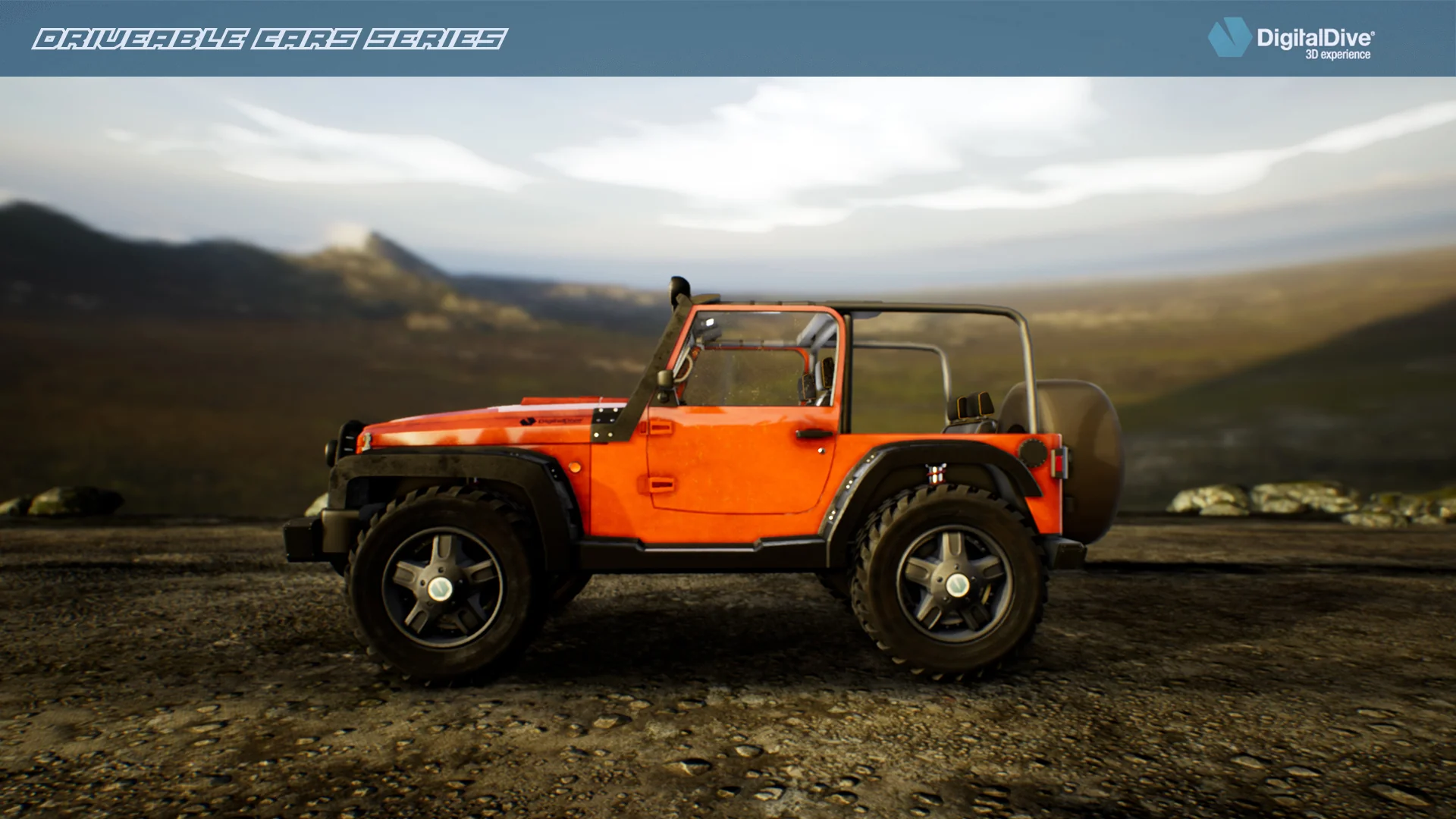
A character approaches an unbranded off-road vehicle, the door opens smoothly along a scripted timeline, and the third-person mannequin transitions straight into the cab. With hands snapping directly to the turning steering wheel via inverse kinematics, the vehicle shifts from an idle prop into an active player pawn. Drivable Cars: 4x4 Off Road Four Wheel Drive Car delivers this exact operational flow in Unreal Engine 4 and Unreal Engine 5, combining vehicle-template driving functions, driver IK animations, and interactive cockpit mechanics without depending on real-world manufacturer licensing.
Behind the Wheel of the 4x4 Off Road Rig
Interaction starts at the boundary between pedestrian locomotion and vehicular control. The asset integrates cleanly with standard Unreal Engine third-person template movement functions, allowing developers to maintain existing character controllers without discarding their default animation sets. When initiating the entry sequence, the system relies on timeline-driven door animations to open and shut the cab realistically rather than popping the character instantaneously into the driver seat.
Inside the cabin, the third-person mannequin switches into a dedicated driving pose. This state uses an IK solution for the arms, locking the character's hands precisely to the steering wheel mesh as it turns in response to player steering inputs. Because the steering wheel is isolated as its own mesh asset, its rotation matches directional vehicle commands directly, selling the physical connection between the driver model and the steering column during sharp turns and rugged maneuvers.
Exiting the vehicle mirrors this functional transition. Triggering the exit action plays the timeline door opening once again, unbinds the driver pawn, and reinstates standard template movement, leaving the vehicle idle until another entry event occurs.
Drivable Cars Handling, Cockpit Instruments, and Cameras
Driving mechanics stem directly from Unreal Engine vehicle template conventions. Control inputs handle throttle application, directional turning, active braking, and rear-gear reversing with support for keyboard, mouse, and gamepad hardware. This standardization ensures developers can map custom input actions or adjust dead zones across multiple input devices without rewriting the core vehicle handler.
Visual feedback inside and outside the cab relies on an adaptable camera and gauge layout:
Dual Viewpoints: Players can toggle between a first-person interior view and a third-person chase camera positioned outside the vehicle chassis.
Exterior Camera Manipulation: The outside camera mode includes orbit and zoom controls, allowing players to survey steep terrain or examine clearance during off-road driving.
Interactive Dashboard: The interior cockpit features working instrumentation that tracks real-time engine revs and forward velocity, driving functional RPM and speed needles across the dash cluster.
Toggleable Lighting: Vehicle lights can be switched on or off dynamically during traversal, lighting the path ahead in low-visibility environments.
Acoustic Design, Smoke FX, and Collision Response
Mechanical movement is paired with reactive sound and visual fx cues that respond to engine load and ground interaction. Engine audio covers the initial starter ignition, an RPM-dependent engine layer that responds to acceleration, and a decay effect tied to gear changes. These continuous cues are supplemented by dedicated event sounds for door opening and closing and for impacts against terrain or obstacles.
Visual effects support the vehicle's off-road theme through integrated smoke particle systems. The included emitters add visible smoke effects around the vehicle during driving, reinforcing the off-road presentation. Combined with the underlying impact audio cues, these effects provide immediate sensory feedback whenever the chassis interacts aggressively with steep declines or physical barricades.
Four Wheel Drive Car Meshes, LODs, and Environment Props
Visual performance hinges on structured level-of-detail optimization. The main four-wheel-drive vehicle body is a single rigged mesh equipped with four distinct LOD levels. This reduction cascade allows complex exterior paneling and suspension assemblies to step down in geometry at longer view distances, preserving frame rates in open-world layouts or scenes populated by multiple vehicles.
Component breakdown includes dedicated sub-assets crafted for mechanical precision:
Rigged Chassis: A custom-designed 4x4 body featuring four LOD stages, modeled with an original, brand-agnostic design to avoid trademark conflicts.
Steering Wheel: Built as an independent component with two dedicated LOD levels to maintain silhouette fidelity during close-up cockpit views while reducing polygon overhead from exterior chase distances.
Brake Calipers: Modeled as discrete mesh parts positioned over the wheel assemblies to provide mechanical depth through open-spoke rims.
Mannequin Integration: Uses the standard UE third-person character mannequin, complete with the full default animation set alongside the dedicated arm IK driving pose.
Test Environment Props: Includes supplemental static meshes consisting of a traffic cone, an incline ramp, and a designated driving path for immediate suspension and clearance testing.
Blueprint Architecture and Pipeline Compatibility
The system is organized across 18 distinct Blueprints, keeping interaction hooks, camera states, instrumentation logic, and vehicle movement compartmentalized. This modular Blueprint setup prevents feature bloat inside the primary vehicle pawn, making it straightforward to inspect specific subroutines like camera zooming or light toggling without untangling unrelated audio triggers.
Platform deployment is configured natively for Windows-based development environments, with explicit support excluding Mac. While the base 4x4 configuration runs without built-in network replication out of the box, its framework maintains full structural compatibility with the Driveable Cars: Multiplayer Pack for projects targeting networked multiplayer sessions. It also interfaces directly with existing setups structured through the Driveable Cars: Basic Pack and Drivable Cars: Advanced Pack, enabling teams to slot this off-road variant into broader multi-vehicle rosters without re-engineering character interaction logic, control bindings, or camera managers.
 Cars & Trucks
 Cars & Trucks
 Cars & Trucks