"2596237520a17fbf"{"id":"1002902","slug":"custom-movement","title":"Custom Movement","category":"Gameplay Features","engine":"5.4+","assetVersion":"","engineVersion":"Engine Version: 5.4+","tag":"Gameplay Features","accent":"blue","visual":"mech","summary":"A Blueprint-driven system implementing networked ladder and climbing mechanics using a dedicated CharacterMovement component in Unreal Engine.","platform":"Unreal Engine","indexPolicy":"index","publishedAt":"2026-11-21T04:49:36.981Z","updatedAt":"2026-11-21T04:49:36.981Z","sourceNotes":[],"fileContents":[],"compatibility":["Unreal Engine","Engine Version: 5.4+"],"featuredImage":{"alt":"Custom Movement","src":"/wp-content/uploads/published/2026/11/d0cea167d052-bf6a0dcb-01f5-47af-8051-6f93fc19057b-b1c7914eca.webp"},"fileSizeBytes":278954228,"hasDownloadLink":true,"downloads":0,"terms":[{"taxonomy":"category","slug":"gameplay-features","name":"Gameplay Features"}],"galleryImages":[{"src":"/wp-content/uploads/published/2026/11/9debff463839-d0492288-822a-42b6-b49f-e1daadb75fa1-9cf7d8d509.webp","alt":"Custom Movement"},{"src":"/wp-content/uploads/published/2026/11/de23e17b601f-056ae861-564f-4d18-9267-572a91f4d17b-82f80b3da5.webp","alt":"Custom Movement"},{"src":"/wp-content/uploads/published/2026/11/066898c4303c-6ca7d6f3-4fbf-42fb-8e51-c7b7881e4de5-b483443447.webp","alt":"Custom Movement"},{"src":"/wp-content/uploads/published/2026/11/5e234ac8a585-ec5e4a25-9fad-4abc-a0f1-9fc646d8eff4-8607bd2358.webp","alt":"Custom Movement"},{"src":"/wp-content/uploads/published/2026/11/7d4b09c659ae-dfdd89b4-0f23-4b33-9e75-f8c3eb10e53d-1eb224af69.webp","alt":"Custom Movement"},{"src":"/wp-content/uploads/published/2026/11/840b81fef59e-3fe6bd46-964f-4384-b611-883ac66f51ad-d4da977890.webp","alt":"Custom Movement"},{"src":"/wp-content/uploads/published/2026/11/21802c0b3da2-fd814d9e-6a24-4238-962d-fb0301c5c440-a946521e87.webp","alt":"Custom Movement"},{"src":"/wp-content/uploads/published/2026/11/ae0e1e2fa705-bc671b54-a1cc-4ecd-9100-6cdefcaee416-76628c63af.webp","alt":"Custom Movement"},{"src":"/wp-content/uploads/published/2026/11/a98e9cdca65b-741e77a9-f19e-4f8f-965d-715006be34df-6278138f30.webp","alt":"Custom Movement"},{"src":"/wp-content/uploads/published/2026/11/95d5ef5bbd95-e3eb17b5-e221-4288-88b4-8b2d9bf6b358-d3ff067402.webp","alt":"Custom Movement"}],"contentHtml":"\u003cp\u003eVertical level geometry presents unique design opportunities, whether navigating scaffolding on an industrial site, ascending deep maintenance shafts, or scaling sheer walls across an obstacle course. Standard walking and falling physics quickly fall short when a character needs to interact directly with vertical props. Rather than relying on rigid, scripted trigger sequences or basic teleportation volumes, implementing a dedicated locomotion mode allows characters to physically traverse structures like ladders and vertical walls while maintaining player control.\u003c/p\u003e \u003ch2\u003eVertical Traversal with Custom Movement Logic\u003c/h2\u003e \u003cp\u003eAdding climbing mechanics to a character requires a distinct set of physical rules that differ fundamentally from running or falling. The system is engineered to handle both ladder navigation and surface climbing within the same cohesive architecture. By engaging specific movement routines for vertical surfaces, the player character can smoothly latch onto rungs or wall faces, transition their stance, and travel along vertical axes without falling into standard gravity-driven physics states.\u003c/p\u003e \u003cp\u003eBecause these actions are built directly into the character's core movement handling, climbing does not behave as an isolated mini-game or disconnected cutscene. It operates as an extension of the player's standard movement toolkit. Level designers can place climbable structures throughout environments to bridge high and low elevations, construct vertical puzzles, or build multi-tier routes through game spaces, knowing that the character transitions reliably between standard footing and vertical grip.\u003c/p\u003e \u003ch2\u003eDecoupled Architecture Through BP_CustomMovementComponent\u003c/h2\u003e \u003cp\u003eComplex movement systems often clutter primary character blueprints, turning core game logic into an unmanageable web of nodes. This setup avoids that pitfall by isolating all movement calculations inside a standalone component named BP_CustomMovementComponent. By packaging the specialized math, surface checks, and execution nodes inside this component, the player character itself remains uncluttered.\u003c/p\u003e \u003cp\u003eIntegrating the mechanic into an existing character requires minimal node placement. Instead of rebuilding or manually copying hundreds of lines of logic into the main character graph, developers place only the necessary interface nodes in their character blueprint to communicate with the component. The underlying system is constructed entirely using Blueprints. Working 100% in visual scripting ensures that every sub-graph, state check, and variable remains fully accessible for visual inspection, modification, and debugging without needing C++ compilation pipelines.\u003c/p\u003e \u003ch2\u003eExtending Custom Movement Modes for Networked Climbing\u003c/h2\u003e \u003cp\u003eUnreal Engine provides native movement modes such as Walking, Falling, Swimming, and Flying, along with a specialized Custom Mode inside the standard CharacterMovement system. This project implements its ladder and climbing operations directly within that Custom Mode. Utilizing this native hook allows the mechanics to tap straight into the engine's built-in prediction and state validation pipelines.\u003c/p\u003e \u003cp\u003eReplicating specialized movement over a network is notoriously difficult, as desynchronizations between clients and servers often lead to harsh snapping, rubber-banding, or dropped inputs. Because this mechanic operates within the engine's movement framework, it includes native support for multiplayer network play. The server retains authority over the character's spatial position on ladders and walls, while client instances receive synchronized updates to ensure that climbing animations, velocity changes, and detachments mirror accurately across all connected players.\u003c/p\u003e \u003ch2\u003eMultiplayer Testing Workflows in Dedicated and Listen Environments\u003c/h2\u003e \u003cp\u003eValidating networked locomotion requires reliable and repeatable testing procedures. Developers can evaluate the multiplayer behavior of the climbing and ladder systems directly through console-driven connection tests inside executable builds.\u003c/p\u003e \u003cp\u003eTo establish a host environment, the session begins by executing a console command on the hosting machine:\u003c/p\u003e \u003cpre\u003e\u003ccode\u003eOpen DemoMap?Listen\u003c/code\u003e\u003c/pre\u003e \u003cp\u003eThis command launches the demonstration map while designating that specific instance as a listen server capable of receiving external player connections. Client instances can subsequently join the active server instance by opening the in-game console and directing the client to the host's network address:\u003c/p\u003e \u003cpre\u003e\u003ccode\u003eOpen ServerIP\u003c/code\u003e\u003c/pre\u003e \u003cp\u003eWhen testing across multiple windows on the same local development workstation, entering a local loopback address such as \u003ccode\u003eOpen 127.0.0.1\u003c/code\u003e Allows rapid verification of client-server synchronization. Testers can observe both screens simultaneously to monitor whether the client mounts ladders smoothly, whether surface transitions misalign on the server, and how cleanly the character dismounts onto solid ground across varying network conditions.\u003c/p\u003e \u003ch2\u003eUnreal Engine 5.4 Foundation and Template Alignment\u003c/h2\u003e \u003cp\u003eLocomotion standards evolve alongside the engine's animation and skeleton systems. Initially recognized as a Monthly Unreal Engine Sponsored Content release for July 2019, the system has seen continuous evolution to match modern engine baselines. Updated releases target Unreal Engine 5.4 and higher versions, ensuring direct compatibility with modern editor toolsets and performance pipelines.\u003c/p\u003e \u003cp\u003eThe updated project is structured around the modern Unreal Engine third-person template base. Rather than relying on legacy mannequin setups, the animation pipeline features dedicated animations retargeted and configured for Manny, the standardized Unreal Engine 5 character model. This gives developers working on modern projects an immediate, working reference for how climbing poses, ladder grips, and transitional blend spaces should hook into the newer skeletal hierarchy. The clean division between visual assets, template configurations, and the modular movement component provides a practical baseline for projects requiring vertical exploration in both single-player and networked multiplayer environments.\u003c/p\u003e\n\n\u003ch2\u003eContinue Browsing Similar Packs\u003c/h2\u003e\n\u003cul\u003e\n\u003cli\u003e\u003ca href=\"https://3dcghub.com/ultimate-horse-system-horse-horse-riding-horse-system-mount-rideable-horse/\" rel=\"noopener noreferrer\"\u003eUltimate Horse System (Horse, Horse Riding, Horse System, Mount, Rideable Horse)\u003c/a\u003e\u003c/li\u003e\n\u003cli\u003e\u003ca href=\"https://3dcghub.com/action-adventure-movement-system/\" rel=\"noopener noreferrer\"\u003eAction-Adventure Movement System\u003c/a\u003e\u003c/li\u003e\n\u003cli\u003e\u003ca href=\"https://3dcghub.com/orbit-camera/\" rel=\"noopener noreferrer\"\u003eOrbit Camera\u003c/a\u003e\u003c/li\u003e\n\u003cli\u003e\u003ca href=\"https://3dcghub.com/advanced-photo-mode/\" rel=\"noopener noreferrer\"\u003eAdvanced Photo Mode\u003c/a\u003e\u003c/li\u003e\n\u003cli\u003e\u003ca href=\"https://3dcghub.com/custom-loot-box/\" rel=\"noopener noreferrer\"\u003eCustom Loot Box\u003c/a\u003e\u003c/li\u003e\n\u003c/ul\u003e","contentTextLength":6251,"navigation":{"current":22,"total":4839,"previous":{"id":"1002903","slug":"file-helper-plugin","title":"File Helper Plugin","category":"Engine Tools","platform":"Unreal Engine","updatedAt":"2026-11-21T04:50:02.963Z"},"next":{"id":"1002900","slug":"auto-material-setup","title":"Auto Material Setup","category":"Automations","platform":"Unreal Engine","updatedAt":"2026-11-21T04:47:53.189Z"}},"relatedResources":[{"id":"1002908","slug":"custom-shape-volumes","title":"Custom Shape Volumes","category":"Gameplay Features","engine":"5.1+","assetVersion":"","engineVersion":"Engine Version: 5.1+","tag":"Gameplay Features","accent":"blue","visual":"mech","summary":"A deep dive into Custom Shape Volumes, a spline-based Unreal Engine Blueprint system for matching trigger volumes to roads, coastlines, and complex 3D rooms.","platform":"Unreal Engine","indexPolicy":"index","publishedAt":"2026-11-21T15:37:48.565Z","updatedAt":"2026-11-21T15:37:48.565Z","sourceNotes":[],"fileContents":[],"compatibility":["Unreal Engine","Engine Version: 5.1+"],"featuredImage":{"alt":"Custom Shape Volumes","src":"/wp-content/uploads/published/2026/11/5c75710af976-c99bdacb-cdf9-4900-971b-1c6cdaaad5ab-bc2f07acac.webp"},"fileSizeBytes":163168580,"hasDownloadLink":true,"downloads":0},{"id":"1001711","slug":"ultimate-horse-system-horse-horse-riding-horse-system-mount-rideable-horse","title":"Ultimate Horse System (Horse, Horse Riding, Horse System, Mount, Rideable Horse)","category":"Gameplay Features","engine":"5.1+","assetVersion":"","engineVersion":"Engine Version: 5.1+","tag":"Gameplay Features","accent":"blue","visual":"mech","summary":"Explore the Ultimate Horse System for Unreal Engine, featuring full network replication, modular saddles, Foot IK, water interaction, and custom rider support.","platform":"Unreal Engine","indexPolicy":"index","publishedAt":"2026-10-14T17:15:39.983Z","updatedAt":"2026-10-14T17:15:39.983Z","sourceNotes":[],"fileContents":[],"compatibility":["Unreal Engine","Engine Version: 5.1+"],"featuredImage":{"alt":"Ultimate Horse System (Horse, Horse Riding, Horse System, Mount, Rideable Horse)","src":"/wp-content/uploads/published/2026/10/6dc76c7660f2-d252bb16-9c4e-4df7-8a68-0bb86ab4c882-eca349b4ab.webp"},"fileSizeBytes":3102861934,"hasDownloadLink":true,"downloads":2},{"id":"1001032","slug":"action-adventure-movement-system","title":"Action-Adventure Movement System","category":"Gameplay Features","engine":"5.3+","assetVersion":"Asset Version: 1.3.3","engineVersion":"Engine Version: 5.3+","tag":"Gameplay Features","accent":"blue","visual":"mech","summary":"A 100% Blueprint Unreal Engine framework with 475+ animations covering parkour, climbing, swimming, grappling, ropes, rail grinding, interactions, and multiplay","platform":"Unreal Engine","indexPolicy":"index","publishedAt":"2026-08-23T13:56:31.671Z","updatedAt":"2026-08-23T13:56:31.671Z","sourceNotes":[],"fileContents":[],"compatibility":["Unreal Engine","Asset Version: 1.3.3","Engine Version: 5.3+"],"featuredImage":{"alt":"Action-Adventure Movement System","src":"/wp-content/uploads/published/2026/08/f6ca4747d539-f55a9c3a-5939-4fc7-b9c9-20258a3197bf-86a0ba7a37.webp"},"fileSizeBytes":906702553,"hasDownloadLink":true,"downloads":15}]}
Resource screenshots
1 / 10
Join our channel
Follow 3DCGHUB on Telegram for new resource drops, migration updates, and community notices.
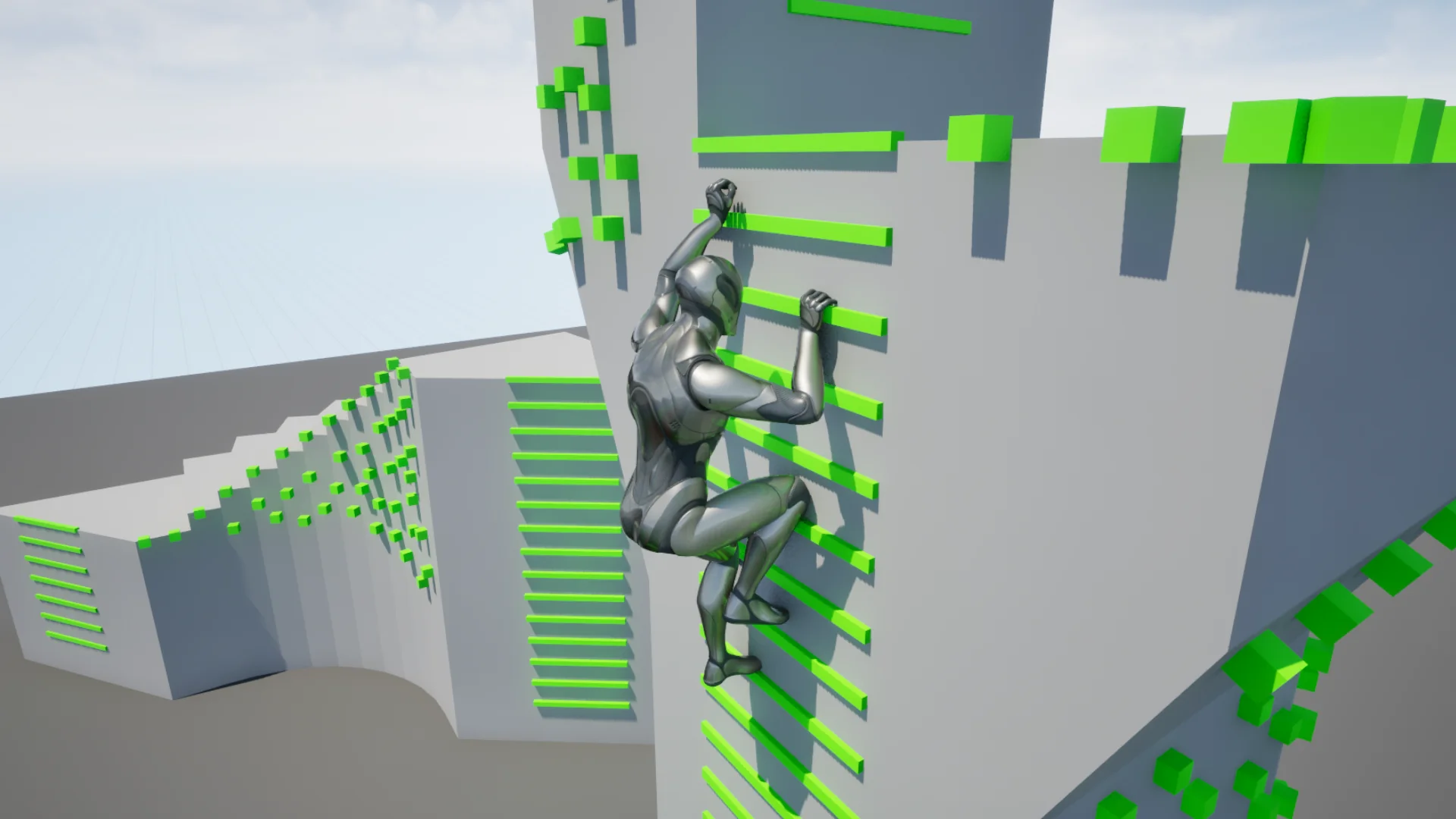
Vertical level geometry presents unique design opportunities, whether navigating scaffolding on an industrial site, ascending deep maintenance shafts, or scaling sheer walls across an obstacle course. Standard walking and falling physics quickly fall short when a character needs to interact directly with vertical props. Rather than relying on rigid, scripted trigger sequences or basic teleportation volumes, implementing a dedicated locomotion mode allows characters to physically traverse structures like ladders and vertical walls while maintaining player control.
Vertical Traversal with Custom Movement Logic
Adding climbing mechanics to a character requires a distinct set of physical rules that differ fundamentally from running or falling. The system is engineered to handle both ladder navigation and surface climbing within the same cohesive architecture. By engaging specific movement routines for vertical surfaces, the player character can smoothly latch onto rungs or wall faces, transition their stance, and travel along vertical axes without falling into standard gravity-driven physics states.
Because these actions are built directly into the character's core movement handling, climbing does not behave as an isolated mini-game or disconnected cutscene. It operates as an extension of the player's standard movement toolkit. Level designers can place climbable structures throughout environments to bridge high and low elevations, construct vertical puzzles, or build multi-tier routes through game spaces, knowing that the character transitions reliably between standard footing and vertical grip.
Decoupled Architecture Through BP_CustomMovementComponent
Complex movement systems often clutter primary character blueprints, turning core game logic into an unmanageable web of nodes. This setup avoids that pitfall by isolating all movement calculations inside a standalone component named BP_CustomMovementComponent. By packaging the specialized math, surface checks, and execution nodes inside this component, the player character itself remains uncluttered.
Integrating the mechanic into an existing character requires minimal node placement. Instead of rebuilding or manually copying hundreds of lines of logic into the main character graph, developers place only the necessary interface nodes in their character blueprint to communicate with the component. The underlying system is constructed entirely using Blueprints. Working 100% in visual scripting ensures that every sub-graph, state check, and variable remains fully accessible for visual inspection, modification, and debugging without needing C++ compilation pipelines.
Extending Custom Movement Modes for Networked Climbing
Unreal Engine provides native movement modes such as Walking, Falling, Swimming, and Flying, along with a specialized Custom Mode inside the standard CharacterMovement system. This project implements its ladder and climbing operations directly within that Custom Mode. Utilizing this native hook allows the mechanics to tap straight into the engine's built-in prediction and state validation pipelines.
Replicating specialized movement over a network is notoriously difficult, as desynchronizations between clients and servers often lead to harsh snapping, rubber-banding, or dropped inputs. Because this mechanic operates within the engine's movement framework, it includes native support for multiplayer network play. The server retains authority over the character's spatial position on ladders and walls, while client instances receive synchronized updates to ensure that climbing animations, velocity changes, and detachments mirror accurately across all connected players.
Multiplayer Testing Workflows in Dedicated and Listen Environments
Validating networked locomotion requires reliable and repeatable testing procedures. Developers can evaluate the multiplayer behavior of the climbing and ladder systems directly through console-driven connection tests inside executable builds.
To establish a host environment, the session begins by executing a console command on the hosting machine:
Open DemoMap?Listen
This command launches the demonstration map while designating that specific instance as a listen server capable of receiving external player connections. Client instances can subsequently join the active server instance by opening the in-game console and directing the client to the host's network address:
Open ServerIP
When testing across multiple windows on the same local development workstation, entering a local loopback address such as Open 127.0.0.1 Allows rapid verification of client-server synchronization. Testers can observe both screens simultaneously to monitor whether the client mounts ladders smoothly, whether surface transitions misalign on the server, and how cleanly the character dismounts onto solid ground across varying network conditions.
Unreal Engine 5.4 Foundation and Template Alignment
Locomotion standards evolve alongside the engine's animation and skeleton systems. Initially recognized as a Monthly Unreal Engine Sponsored Content release for July 2019, the system has seen continuous evolution to match modern engine baselines. Updated releases target Unreal Engine 5.4 and higher versions, ensuring direct compatibility with modern editor toolsets and performance pipelines.
The updated project is structured around the modern Unreal Engine third-person template base. Rather than relying on legacy mannequin setups, the animation pipeline features dedicated animations retargeted and configured for Manny, the standardized Unreal Engine 5 character model. This gives developers working on modern projects an immediate, working reference for how climbing poses, ladder grips, and transitional blend spaces should hook into the newer skeletal hierarchy. The clean division between visual assets, template configurations, and the modular movement component provides a practical baseline for projects requiring vertical exploration in both single-player and networked multiplayer environments.
 Gameplay Features
 Gameplay Features
 Gameplay Features