"7ad89cffa44984cf"{"id":"1002517","slug":"creepy-girl","title":"Creepy Girl","category":"Characters \u0026 Creatures","engine":"4.18+,5.0+","assetVersion":"","engineVersion":"Engine Version: 4.18+,5.0+","tag":"Characters","accent":"blue","visual":"character","summary":"Explore implementation details, Epic skeleton compatibility, and visual horror design for the realistic Creepy Girl character asset.","platform":"Unreal Engine","indexPolicy":"index","publishedAt":"2026-11-13T08:58:56.485Z","updatedAt":"2026-11-13T08:58:56.485Z","sourceNotes":[],"fileContents":[],"compatibility":["Unreal Engine","Engine Version: 4.18+,5.0+"],"featuredImage":{"alt":"Creepy Girl","src":"/wp-content/uploads/published/2026/11/7cc88696a884-47def1bb-b60f-4bbd-8f15-ba9cb5b13205-8766ec52e0.webp"},"hasDownloadLink":true,"downloads":0,"terms":[{"taxonomy":"category","slug":"characters-and-creatures","name":"Characters \u0026 Creatures"}],"galleryImages":[{"src":"/wp-content/uploads/published/2026/11/994f858c669c-c7fc7c0a-9f98-4117-a3d2-6710b489d1e4-d1b63c3a0b.webp","alt":"Creepy Girl"},{"src":"/wp-content/uploads/published/2026/11/f10f0b83e3a5-c411c30c-4e80-40c1-847c-90f1211c6532-449a9ab2b6.webp","alt":"Creepy Girl"},{"src":"/wp-content/uploads/published/2026/11/4933a4232d3d-cbf5797e-65c8-478d-818e-b3ad4c85b946-823305bcad.webp","alt":"Creepy Girl"},{"src":"/wp-content/uploads/published/2026/11/3298537a1cfa-9c474cc3-56fd-418f-8c3b-428c90cf8623-2cb20a5d4d.webp","alt":"Creepy Girl"},{"src":"/wp-content/uploads/published/2026/11/144bf85f3f73-a9843dff-1cba-403d-88bf-346f938cb89c-a770657bdf.webp","alt":"Creepy Girl"},{"src":"/wp-content/uploads/published/2026/11/26a3794005cd-beff944a-3141-4f9f-966d-57cf850d38a6-fc1d745f1d.webp","alt":"Creepy Girl"},{"src":"/wp-content/uploads/published/2026/11/4484251e4b84-6426e729-aca0-4e73-88e8-01f55b19b7d5-adf09b9188.webp","alt":"Creepy Girl"},{"src":"/wp-content/uploads/published/2026/11/e057317c6d34-8dd2f78b-c5d3-4fd6-b493-166d09f60809-62c51b2d8f.webp","alt":"Creepy Girl"},{"src":"/wp-content/uploads/published/2026/11/25bb2c2bf92d-f744ffcf-a8a8-4050-ad60-43a5f80c0abf-49f930df6d.webp","alt":"Creepy Girl"}],"accessPanel":{"kind":"resource","title":"Get this resource","eyebrow":"Free resource","message":"Download this resource in your browser.","fileName":"Content.7z","safetyNote":"Resources are manually reviewed before listing to improve quality and reduce obvious risks.","actionLabel":"Get this resource","resourceType":"Resource archive","versions":[]},"contentHtml":"\u003ch2\u003eStaging the Creepy Girl in Realistic Horror Environments\u003c/h2\u003e\u003cp\u003eHorror game design depends heavily on the believable disruption of ordinary forms. In tension-heavy spaces such as decayed asylum corridors, derelict homes, or subterranean quarantine zones, character models must convey danger immediately upon visual contact. Creepy Girl functions within these exact scenarios, offering a realistic female character specifically styled around scary, horror, and zombie themes. Because the visual execution prioritizes realistic detailing rather than stylized distortion, the unsettling elements carry an immediate punch when placed beneath dynamic lighting.\u003c/p\u003e\u003cp\u003ePresenting a realistic human figure in a state of horrific transformation creates instant psychological unease. Rather than relying solely on creature-like monsters or abstract silhouettes, introducing a recognizable female figure transformed by violent physical trauma anchors the player's fear in something tangible. The model operates naturally as a relentless pursuer, a sudden jump-scare encounter in tight corridors, or a stationary set-piece figure staged to raise dread as the player approaches.\u003c/p\u003e\u003ch2\u003eFacial Details and the Visual Anatomy of Creepy Girl\u003c/h2\u003e\u003cp\u003eThe defining visual traits of Creepy Girl center on severe, explicit facial alterations. Embedded directly into her face are pronounced stitches and protruding nails, delivering an immediate impression of surgical violation or reanimated torment. These tactile elements elevate the model beyond a basic undead archetype into a bespoke entity with an implied backstory of violence or experimental trauma.\u003c/p\u003e\u003cp\u003eThe presence of stitches across the skin surface introduces distinct texturing opportunities for horror creators. Under flashlight beams or low ambient occlusion, stitched lacerations create deep, irregular grooves that break up the specular highlights of realistic skin. The seams draw the player's eye directly to the center of the face, reinforcing the disturbing asymmetry of the character.\u003c/p\u003e\u003cp\u003eComplementing the thread work, the nails driven into her face serve as stark metallic interruptions against the flesh. Hard surface elements embedded in organic skin create strong visual contrast. When illuminated by point lights, swinging lanterns, or muzzle flashes, the nails catch sharp highlights and cast miniature shadows across the surrounding facial contours. This distinct combination of metal and thread gives the character an immediate sense of tactile brutality, signaling to players that the entity has undergone extreme physical alteration.\u003c/p\u003e\u003ch2\u003eEpic Skeleton Implementation and Animation Pipelines\u003c/h2\u003e\u003cp\u003eUnderneath the surface detailing, the character is structured to integrate smoothly into modern technical workflows through full compatibility with the Epic skeleton. For developers building interactive horror experiences or real-time cinematic sequences, structural skeletal alignment is one of the most critical aspects of asset adoption. Conforming to the Epic skeleton standard bypasses the tedious process of custom bone mapping, weight rebuilding, or skeleton restructuring.\u003c/p\u003e\u003cp\u003eBecause the hierarchy matches the established standard, an extensive range of animation data can be targeted to Creepy Girl immediately. Standard locomotion blendspaces, crouching walks, frantic sprints, erratic stalking cycles, and violent strike animations can be retargeted or directly applied without deformation issues around critical joints. Developers can immediately deploy existing motion libraries to test how the character navigates a level, tests navmesh bounds, or transitions between wandering and aggressive states.\u003c/p\u003e\u003cp\u003eThe skeletal setup also supports secondary physical behaviors and engine-level character mechanics. Physics asset setups, ragdoll transitions upon defeat, and directional hit-reaction blends depend directly on clean, standardized joint orientations. Whether the character needs to stagger backward after a firearm impact or crumple down a flight of stairs via physics simulation, the Epic skeleton alignment ensures that collision capsules and rigid bodies behave predictably within the engine's physics subsystem.\u003c/p\u003e\u003ch2\u003eWorking Alongside the Cute Little Girl Compatibility Setup\u003c/h2\u003e\u003cp\u003eBeyond standard skeletal integration, Creepy Girl features direct compatibility with Cute Little Girl. This structural relationship opens up powerful creative avenues for horror developers seeking to execute narrative duality, psychological hallucinations, or visual transformations between innocence and decay.\u003c/p\u003e\u003cp\u003eIn psychological horror games, environmental and character shifts frequently reflect the protagonist's unraveling mental state. Because Creepy Girl shares technical compatibility with Cute Little Girl, developers can implement seamless mesh swapping or transition sequences without rebuilding underlying animation state machines. A character can appear as Cute Little Girl during peaceful narrative sequences, flashbacks, or distant visions, only to instantly swap to the stitched, nail-pierced Creepy Girl model when lighting changes, proximity triggers trip, or madness mechanics take effect.\u003c/p\u003e\u003cp\u003eThis compatibility also facilitates efficient memory and data handling across complex projects. Shared proportions or unified skeletal conventions mean that both forms can reference the same core controller logic, motion sets, and cinematic staging tracks. Directors can choreograph a single cutscene or gameplay sequence and alternate between the innocent and monstrous presentations by toggling visibility or triggering dynamic material dissolves, saving substantial production time while maintaining rigorous thematic coherence.\u003c/p\u003e\u003ch2\u003eEvaluating Motion and Presentation via Video Demonstration\u003c/h2\u003e\u003cp\u003eA video demonstration accompanies the character asset, offering a direct reference for evaluating real-time motion and material fidelity before technical implementation. Reviewing the model through video allows animators and technical artists to inspect critical visual factors that static screenshots cannot convey.\u003c/p\u003e\u003cp\u003eMotion previews are particularly important for a character featuring embedded foreign objects. Developers can observe how the facial skin behaves around the nails and stitches during skeletal articulation, checking that the metallic elements stay rigid while the surrounding flesh deforms naturally during neck rotations, torso twists, and jaw articulations. The video also highlights how the realistic skin shading interacts with changing light angles, demonstrating how the metallic sheen of the nails and the matte texture of the stitches perform together under active lighting conditions.\u003c/p\u003e\u003ch2\u003eTarget Production Roles and Project Deployment\u003c/h2\u003e\u003cp\u003eCreepy Girl is tailored for indie developers, technical animators, and cinematic artists constructing grim, story-driven horror titles. Teams building survival horror games benefit from the instant availability of an Epic skeleton zombie asset that requires zero rig adjustments before entering testing loops. Cinematic creators focusing on short-form horror vignettes gain a distinct, narratively charged character whose stitched and nailed features immediately communicate a dark, visceral premise.\u003c/p\u003e\u003cp\u003eBy unifying standard Epic skeleton rigging with the visceral shock of detailed facial trauma and cross-asset compatibility with Cute Little Girl, this asset provides an efficient, ready-to-animate antagonist capable of elevating the tension in any realistic horror setting.\u003c/p\u003e\n\n\u003ch2\u003eContinue Browsing Similar Packs\u003c/h2\u003e\n\u003cul\u003e\n\u003cli\u003e\u003ca href=\"https://3dcghub.com/subculture-girl/\" rel=\"noopener noreferrer\"\u003eSubculture Girl\u003c/a\u003e\u003c/li\u003e\n\u003cli\u003e\u003ca href=\"https://3dcghub.com/girl-anastasia/\" rel=\"noopener noreferrer\"\u003eGirl Anastasia\u003c/a\u003e\u003c/li\u003e\n\u003cli\u003e\u003ca href=\"https://3dcghub.com/defender-girl/\" rel=\"noopener noreferrer\"\u003eDefender Girl\u003c/a\u003e\u003c/li\u003e\n\u003cli\u003e\u003ca href=\"https://3dcghub.com/vampire-girl-remaster/\" rel=\"noopener noreferrer\"\u003eVampire Girl Remaster\u003c/a\u003e\u003c/li\u003e\n\u003cli\u003e\u003ca href=\"https://3dcghub.com/novice-girl/\" rel=\"noopener noreferrer\"\u003eNovice Girl\u003c/a\u003e\u003c/li\u003e\n\u003c/ul\u003e","contentTextLength":7540,"navigation":{"current":60,"total":4499,"previous":{"id":"1002518","slug":"customized-alien-soldier","title":"Customized Alien Soldier","category":"Characters \u0026 Creatures","platform":"Unreal Engine","updatedAt":"2026-11-13T09:01:27.266Z"},"next":{"id":"1002516","slug":"creeping-creatures-pack","title":"Creeping Creatures Pack","category":"Characters \u0026 Creatures","platform":"Unreal Engine","updatedAt":"2026-11-13T08:57:45.236Z"}},"relatedResources":[{"id":"1002496","slug":"subculture-girl","title":"Subculture Girl","category":"Characters \u0026 Creatures","engine":"4.21+,5.0+","assetVersion":"","engineVersion":"Engine Version: 4.21+,5.0+","tag":"Characters","accent":"blue","visual":"character","summary":"Explore Subculture Girl for Unreal Engine, featuring modular clothing, 40 Blueprint combinations, NvCloth skirt physics, and deep material masking.","platform":"Unreal Engine","indexPolicy":"index","publishedAt":"2026-11-12T04:04:56.009Z","updatedAt":"2026-11-12T04:04:56.009Z","sourceNotes":[],"fileContents":[],"compatibility":["Unreal Engine","Engine Version: 4.21+,5.0+"],"featuredImage":{"alt":"Subculture Girl","src":"/wp-content/uploads/published/2026/11/68cbf763cdde-b8b88f11-ae6e-4044-828a-d9ec94b9c819-9cdc7bfc70.webp"},"hasDownloadLink":true,"downloads":0},{"id":"1002479","slug":"girl-anastasia","title":"Girl Anastasia","category":"Characters \u0026 Creatures","engine":"4.21+,5.0+","assetVersion":"","engineVersion":"Engine Version: 4.21+,5.0+","tag":"Characters","accent":"blue","visual":"character","summary":"Explore the low-poly, realistic PBR female character Girl Anastasia, built with Animation Blueprint support for RPG, strategy, and shooter projects.","platform":"Unreal Engine","indexPolicy":"index","publishedAt":"2026-11-12T03:34:23.461Z","updatedAt":"2026-11-12T03:34:23.461Z","sourceNotes":[],"fileContents":[],"compatibility":["Unreal Engine","Engine Version: 4.21+,5.0+"],"featuredImage":{"alt":"Girl Anastasia","src":"/wp-content/uploads/published/2026/11/6846003e441c-1926a9e7-cc79-4ab1-9481-3828a6331ff3-5c0dbe4328.webp"},"hasDownloadLink":true,"downloads":0},{"id":"1002473","slug":"defender-girl","title":"Defender Girl","category":"Characters \u0026 Creatures","engine":"4.18+,5.0+","assetVersion":"","engineVersion":"Engine Version: 4.18+,5.0+","tag":"Characters","accent":"blue","visual":"character","summary":"Technical breakdown of the Defender Girl low-poly character model, covering its UE4 skeleton in UE5, PBR textures, tissue physics, and mesh metrics.","platform":"Unreal Engine","indexPolicy":"index","publishedAt":"2026-11-12T03:21:41.247Z","updatedAt":"2026-11-12T03:21:41.247Z","sourceNotes":[],"fileContents":[],"compatibility":["Unreal Engine","Engine Version: 4.18+,5.0+"],"featuredImage":{"alt":"Defender Girl","src":"/wp-content/uploads/published/2026/11/34ebf783c1cb-7e1bc220-ffb4-405c-a452-f998b5628309-21cc64a9cc.webp"},"hasDownloadLink":true,"downloads":0}]}
Characters
Creepy Girl
Explore implementation details, Epic skeleton compatibility, and visual horror design for the realistic Creepy Girl character asset.
Staging the Creepy Girl in Realistic Horror Environments
Horror game design depends heavily on the believable disruption of ordinary forms. In tension-heavy spaces such as decayed asylum corridors, derelict homes, or subterranean quarantine zones, character models must convey danger immediately upon visual contact. Creepy Girl functions within these exact scenarios, offering a realistic female character specifically styled around scary, horror, and zombie themes. Because the visual execution prioritizes realistic detailing rather than stylized distortion, the unsettling elements carry an immediate punch when placed beneath dynamic lighting.
Presenting a realistic human figure in a state of horrific transformation creates instant psychological unease. Rather than relying solely on creature-like monsters or abstract silhouettes, introducing a recognizable female figure transformed by violent physical trauma anchors the player's fear in something tangible. The model operates naturally as a relentless pursuer, a sudden jump-scare encounter in tight corridors, or a stationary set-piece figure staged to raise dread as the player approaches.
Facial Details and the Visual Anatomy of Creepy Girl
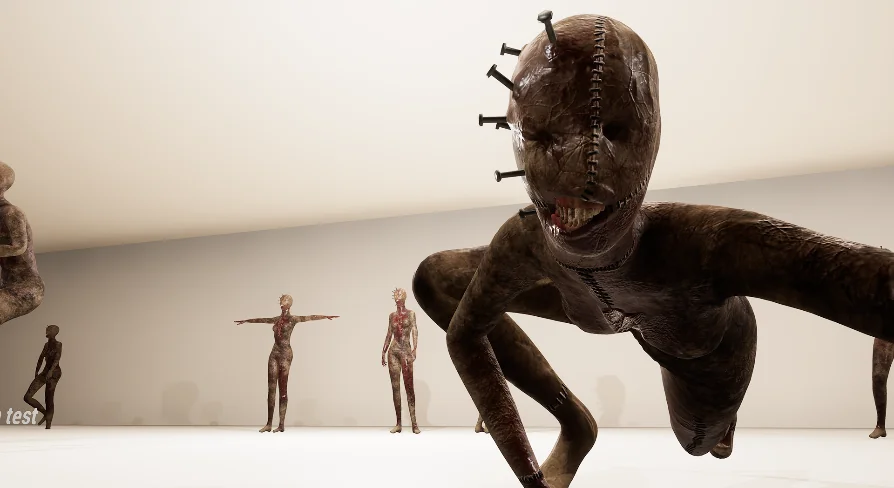
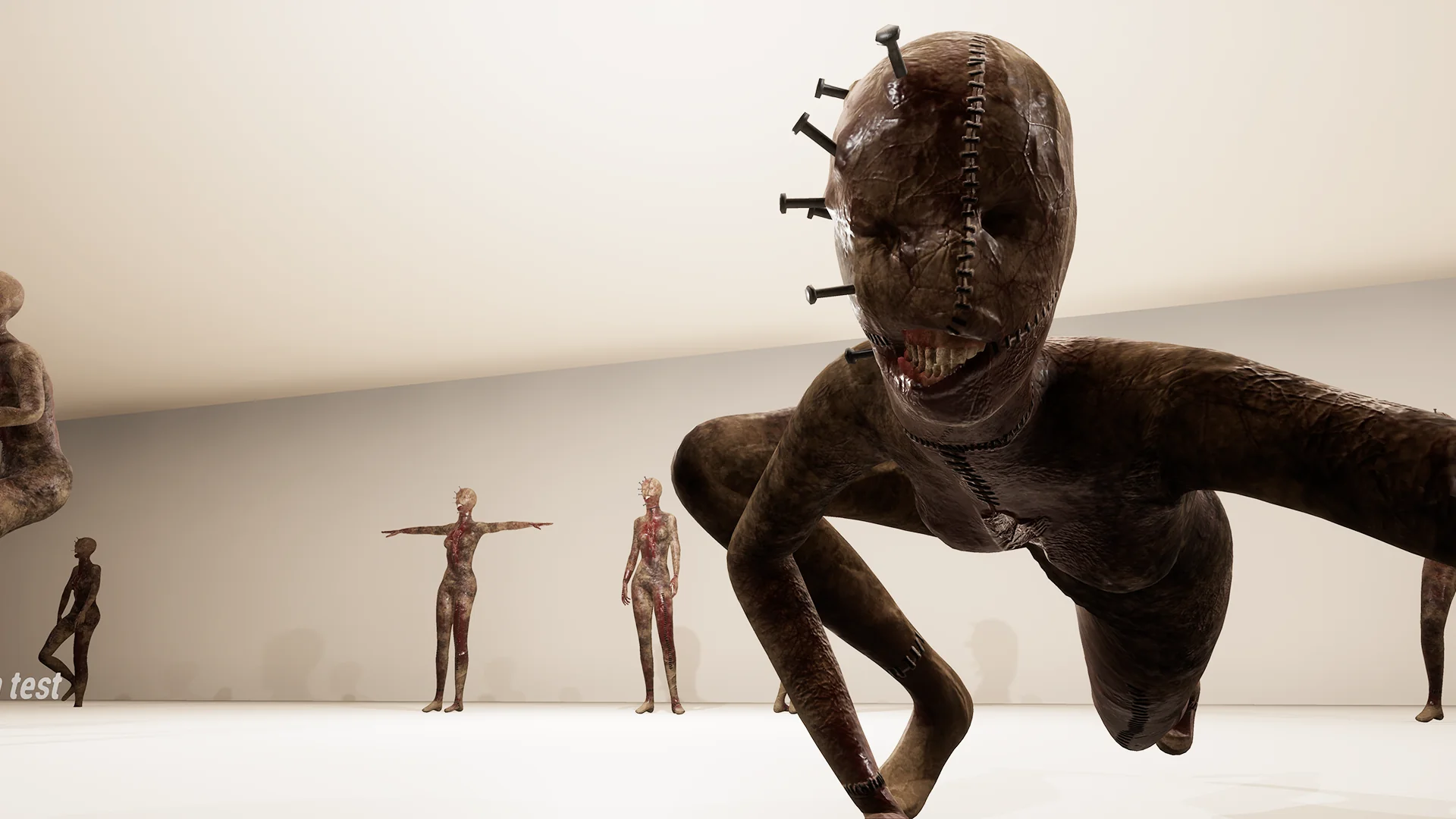
The defining visual traits of Creepy Girl center on severe, explicit facial alterations. Embedded directly into her face are pronounced stitches and protruding nails, delivering an immediate impression of surgical violation or reanimated torment. These tactile elements elevate the model beyond a basic undead archetype into a bespoke entity with an implied backstory of violence or experimental trauma.
The presence of stitches across the skin surface introduces distinct texturing opportunities for horror creators. Under flashlight beams or low ambient occlusion, stitched lacerations create deep, irregular grooves that break up the specular highlights of realistic skin. The seams draw the player's eye directly to the center of the face, reinforcing the disturbing asymmetry of the character.
Complementing the thread work, the nails driven into her face serve as stark metallic interruptions against the flesh. Hard surface elements embedded in organic skin create strong visual contrast. When illuminated by point lights, swinging lanterns, or muzzle flashes, the nails catch sharp highlights and cast miniature shadows across the surrounding facial contours. This distinct combination of metal and thread gives the character an immediate sense of tactile brutality, signaling to players that the entity has undergone extreme physical alteration.
Epic Skeleton Implementation and Animation Pipelines
Underneath the surface detailing, the character is structured to integrate smoothly into modern technical workflows through full compatibility with the Epic skeleton. For developers building interactive horror experiences or real-time cinematic sequences, structural skeletal alignment is one of the most critical aspects of asset adoption. Conforming to the Epic skeleton standard bypasses the tedious process of custom bone mapping, weight rebuilding, or skeleton restructuring.
Because the hierarchy matches the established standard, an extensive range of animation data can be targeted to Creepy Girl immediately. Standard locomotion blendspaces, crouching walks, frantic sprints, erratic stalking cycles, and violent strike animations can be retargeted or directly applied without deformation issues around critical joints. Developers can immediately deploy existing motion libraries to test how the character navigates a level, tests navmesh bounds, or transitions between wandering and aggressive states.
The skeletal setup also supports secondary physical behaviors and engine-level character mechanics. Physics asset setups, ragdoll transitions upon defeat, and directional hit-reaction blends depend directly on clean, standardized joint orientations. Whether the character needs to stagger backward after a firearm impact or crumple down a flight of stairs via physics simulation, the Epic skeleton alignment ensures that collision capsules and rigid bodies behave predictably within the engine's physics subsystem.
Working Alongside the Cute Little Girl Compatibility Setup
Beyond standard skeletal integration, Creepy Girl features direct compatibility with Cute Little Girl. This structural relationship opens up powerful creative avenues for horror developers seeking to execute narrative duality, psychological hallucinations, or visual transformations between innocence and decay.
In psychological horror games, environmental and character shifts frequently reflect the protagonist's unraveling mental state. Because Creepy Girl shares technical compatibility with Cute Little Girl, developers can implement seamless mesh swapping or transition sequences without rebuilding underlying animation state machines. A character can appear as Cute Little Girl during peaceful narrative sequences, flashbacks, or distant visions, only to instantly swap to the stitched, nail-pierced Creepy Girl model when lighting changes, proximity triggers trip, or madness mechanics take effect.
This compatibility also facilitates efficient memory and data handling across complex projects. Shared proportions or unified skeletal conventions mean that both forms can reference the same core controller logic, motion sets, and cinematic staging tracks. Directors can choreograph a single cutscene or gameplay sequence and alternate between the innocent and monstrous presentations by toggling visibility or triggering dynamic material dissolves, saving substantial production time while maintaining rigorous thematic coherence.
Evaluating Motion and Presentation via Video Demonstration
A video demonstration accompanies the character asset, offering a direct reference for evaluating real-time motion and material fidelity before technical implementation. Reviewing the model through video allows animators and technical artists to inspect critical visual factors that static screenshots cannot convey.
Motion previews are particularly important for a character featuring embedded foreign objects. Developers can observe how the facial skin behaves around the nails and stitches during skeletal articulation, checking that the metallic elements stay rigid while the surrounding flesh deforms naturally during neck rotations, torso twists, and jaw articulations. The video also highlights how the realistic skin shading interacts with changing light angles, demonstrating how the metallic sheen of the nails and the matte texture of the stitches perform together under active lighting conditions.
Target Production Roles and Project Deployment
Creepy Girl is tailored for indie developers, technical animators, and cinematic artists constructing grim, story-driven horror titles. Teams building survival horror games benefit from the instant availability of an Epic skeleton zombie asset that requires zero rig adjustments before entering testing loops. Cinematic creators focusing on short-form horror vignettes gain a distinct, narratively charged character whose stitched and nailed features immediately communicate a dark, visceral premise.
By unifying standard Epic skeleton rigging with the visceral shock of detailed facial trauma and cross-asset compatibility with Cute Little Girl, this asset provides an efficient, ready-to-animate antagonist capable of elevating the tension in any realistic horror setting.
 Characters
 Characters
 Characters
 Characters