"7ad89cffa44984cf"{"id":"1002518","slug":"customized-alien-soldier","title":"Customized Alien Soldier","category":"Characters \u0026 Creatures","engine":"4.26+,5.0+","assetVersion":"","engineVersion":"Engine Version: 4.26+,5.0+","tag":"Characters","accent":"blue","visual":"character","summary":"Explore practical deployment of the Customized Alien Soldier, covering head customization, clothing textures, Epic Skeleton rigging, and TPS inventory setups.","platform":"Unreal Engine","indexPolicy":"index","publishedAt":"2026-11-13T09:01:27.266Z","updatedAt":"2026-11-13T09:01:27.266Z","sourceNotes":[],"fileContents":[],"compatibility":["Unreal Engine","Engine Version: 4.26+,5.0+"],"featuredImage":{"alt":"Customized Alien Soldier","src":"/wp-content/uploads/published/2026/11/a41d3ed9784d-75a52f70-3a85-4bbd-a7d9-7e6daa6e1586-be52a9786d.webp"},"hasDownloadLink":true,"downloads":0,"terms":[{"taxonomy":"category","slug":"characters-and-creatures","name":"Characters \u0026 Creatures"}],"galleryImages":[{"src":"/wp-content/uploads/published/2026/11/d53babef4381-e596b83f-2513-493c-a9fd-64fc72a56d7c-aedfe7af13.webp","alt":"Customized Alien Soldier"},{"src":"/wp-content/uploads/published/2026/11/8e2e3a90840d-0f4acafe-7dc9-4b39-a981-9ffd7a31b387-3c88f0048e.webp","alt":"Customized Alien Soldier"},{"src":"/wp-content/uploads/published/2026/11/8c290e8ba941-f758c75e-99f1-4e91-a508-8e75e90d95e6-ef8494b37c.webp","alt":"Customized Alien Soldier"},{"src":"/wp-content/uploads/published/2026/11/04364c2964df-262865a5-aa15-4e99-891e-2ee25de4244f-1d1ce27aa9.webp","alt":"Customized Alien Soldier"},{"src":"/wp-content/uploads/published/2026/11/7fc951a97510-8cf26ab6-7ad3-4232-8f1f-4d4b998e1eb4-141296b535.webp","alt":"Customized Alien Soldier"},{"src":"/wp-content/uploads/published/2026/11/6a1044038356-d91375c5-66cd-45c9-bfd8-48c68eb0cff6-e6347c5c3f.webp","alt":"Customized Alien Soldier"},{"src":"/wp-content/uploads/published/2026/11/6b60b3746df7-23c2928c-989f-40cb-8561-365e9d37cf66-e2790adcc9.webp","alt":"Customized Alien Soldier"},{"src":"/wp-content/uploads/published/2026/11/e55c3a32d224-159b4db4-adea-43ff-8f5f-6c5cea98f6f2-a6a86dfd77.webp","alt":"Customized Alien Soldier"},{"src":"/wp-content/uploads/published/2026/11/2cb638edf4de-56aae227-8471-4d7f-ae37-b2b2508645af-10c30ed9bf.webp","alt":"Customized Alien Soldier"},{"src":"/wp-content/uploads/published/2026/11/c309072b81e3-ba241f13-1685-48cc-868e-58b6b3d049e4-3ea93f324d.webp","alt":"Customized Alien Soldier"}],"accessPanel":{"kind":"resource","title":"Get this resource","eyebrow":"Free resource","message":"Download this resource in your browser.","fileName":"Content.7z","safetyNote":"Resources are manually reviewed before listing to improve quality and reduce obvious risks.","actionLabel":"Get this resource","resourceType":"Resource archive","versions":[]},"contentHtml":"\u003cp\u003eSci-fi battlefields, remote planetary outposts, and subterranean fantasy combat zones demand humanoid infantry models capable of adapting to distinct combat situations. In lowpoly shooter environments, visual readability and clear mechanical behavior take precedence over excessive surface micro-detail. A combatant operating across the stylistic frontier of science fiction and tactical fantasy needs to function reliably both as an individual threat and as a member of an organized squad. Deploying an extraterrestrial foot soldier into stylized combat encounters gives developers immediate access to familiar tactical behaviors while retaining a distinct non-human identity on the battlefield.\u003c/p\u003e\u003ch2\u003eStaging Alien Combat Encounters in Stylized Environments\u003c/h2\u003e\u003cp\u003eIndustrial corridors, planetary defense bases, and fortified extraterrestrial strongholds require hostile units that move with military order. When constructing tactical combat encounters, enemy silhouettes must communicate their intended behavior to players in fractions of a second. Combining non-human anatomical features with structured soldier uniforms allows the model to convey both biological hostility and military discipline.\u003c/p\u003e\u003cp\u003ePlayers identify this combatant as an armed tactical foe rather than a rampaging beast. The model visually signals that it can take cover, shoulder weapons, execute tactical retreats, and coordinate flanking routes across a combat zone. The lowpoly aesthetic keeps silhouettes sharp and edges legible against diverse environmental backdrops, preventing the character from blending into complex geometry during intense firefights.\u003c/p\u003e\u003ch2\u003eConfiguring the Customized Alien Soldier for Squad Variety\u003c/h2\u003e\u003cp\u003eCombat encounters lose tension when every enemy unit shares an identical look. The ability to switch character heads provides an immediate method for differentiating roles across a squad. Swapping head meshes transforms the unit from a rank-and-file trooper into a squad commander, an infiltrator, or a specialized combatant without requiring distinct character meshes for each post.\u003c/p\u003e\u003cp\u003eClothing texture variations build upon this variety by establishing visible combat tiers and environmental specializations. Adjusting the character clothing textures allows teams to match units to specific biomes or ranks:\u003c/p\u003e\u003cul\u003e\u003cli\u003eCamouflage and muted tones for outdoor terrain, planetary surfaces, or recon squads.\u003c/li\u003e\u003cli\u003eDarker tactical schemes suited for indoor installations, security details, and derelict starships.\u003c/li\u003e\u003cli\u003eDistinct color codings to highlight officer ranks, elite guard detachments, or specialized combat roles.\u003c/li\u003e\u003cli\u003eVisual separation between hostile alien factions fighting over the same planetary objective.\u003c/li\u003e\u003c/ul\u003e\u003cp\u003eBecause these appearance changes rely on texture swaps and modular head meshes rather than unique skeletal assets, games maintain low draw call counts and streamlined memory usage across large combat encounters.\u003c/p\u003e\u003ch2\u003eRigging Mechanics with the Standard Epic Skeleton and Animationblueprint\u003c/h2\u003e\u003cp\u003eLocomotion consistency across modern shooter engines depends directly on bone hierarchy. Because the model uses a standard Epic Skeleton, developers can bypass manual bone remapping and deploy existing animation libraries directly onto the character. Third-person tactical shooters rely on an extensive suite of interrelated motion states: standard weapon idles, directional strafing cycles, crouch walking, evasive rolls, and procedural aim offsets.\u003c/p\u003e\u003cp\u003eIntegrating the character into an established Animationblueprint becomes an effortless process under this skeletal standard. Blend spaces manage the transitions between forward sprints, lateral dashes, and walk cycles smoothly. Aim offset nodes direct the upper spine toward player-aimed targets while foot placement inverse kinematics align the legs to uneven ground slopes. Ragdoll physics setups, physics assets, and directional hit reactions can be assigned directly using standard socket and bone references, eliminating pipeline friction during gameplay iteration.\u003c/p\u003e\u003ch2\u003eWeapon Handling and the Advanced TPS Inventory Pack Workflow\u003c/h2\u003e\u003cp\u003eFirearms, holsters, and gear management form the core interactive loop of modern shooter gameplay. The character has been tested alongside the Advanced TPS Inventory Pack, ensuring that its skeletal hierarchy and proportions support third-person weapon handling mechanics cleanly. Tactical inventory frameworks require stable attachment points for rifles, sidearms, and equipment packs, alongside reliable animation hooks for drawing, stowing, and firing gear.\u003c/p\u003e\u003cp\u003eTesting with this inventory pack validates that the character handles weapon sockets properly across common combat states. As scripts manage item cycling, weapon attachments match right-hand and left-hand sockets accurately without hand mesh twisting or clipping into shoulder geometry. Reload sequences, secondary holster attachments on the hip or spine, and item pickup routines operate cleanly within standard third-person controller scripts, letting developers focus on balance and combat pace rather than debugging attachment offsets.\u003c/p\u003e\u003ch2\u003eIntegrating Roster Assets Across the Mega Bundle\u003c/h2\u003e\u003cp\u003eCohesive art direction across an entire game project depends on asset compatibility. This combatant maintains direct compatibility with the All My 3D Characters Mega Bundle, allowing developers to draw from a wider cast of models sharing matching design conventions. When building out extensive campaign missions or varied enemy factions, having characters that adhere to the same structural and stylistic guidelines prevents visual fragmentation across levels.\u003c/p\u003e\u003cp\u003eSci-fi and fantasy shooters frequently introduce multiple species or allied combat forces within the same game world. Developers can pair this extraterrestrial infantry model with allied combatants, mercenary groups, or specialized boss units from the broader mega bundle collection. Because these assets adhere to common lowpoly proportions and skeletal conventions, animation graphs, damage application scripts, and inventory setups can be duplicated across the entire enemy roster with minimal adjustment.\u003c/p\u003e\u003ch2\u003eTactical Fit and Production Utility\u003c/h2\u003e\u003cp\u003eThis character model serves developers who need a reliable, modular enemy combatant for fast-paced shooters, tactical strategy games, or stylized sci-fi prototypes. The lowpoly construction ensures smooth frame rates on platforms where performance budgets are strictly enforced, while the inclusion of the standard Epic Skeleton, modular head options, clothing texture variants, and proven inventory compatibility provides a solid, ready-to-deploy combat foundation.\u003c/p\u003e\n\n\u003ch2\u003eRelated Resources Worth Checking\u003c/h2\u003e\n\u003cul\u003e\n\u003cli\u003e\u003ca href=\"https://3dcghub.com/sci-fi-alien-soldier/\" rel=\"noopener noreferrer\"\u003eSci Fi Alien Soldier\u003c/a\u003e\u003c/li\u003e\n\u003cli\u003e\u003ca href=\"https://3dcghub.com/alien-dog/\" rel=\"noopener noreferrer\"\u003eAlien dog\u003c/a\u003e\u003c/li\u003e\n\u003cli\u003e\u003ca href=\"https://3dcghub.com/modular-russian-soldier/\" rel=\"noopener noreferrer\"\u003emodular russian soldier\u003c/a\u003e\u003c/li\u003e\n\u003cli\u003e\u003ca href=\"https://3dcghub.com/alien-gray/\" rel=\"noopener noreferrer\"\u003eAlien Gray\u003c/a\u003e\u003c/li\u003e\n\u003cli\u003e\u003ca href=\"https://3dcghub.com/sci-fi-space-soldier/\" rel=\"noopener noreferrer\"\u003eSci Fi Space Soldier\u003c/a\u003e\u003c/li\u003e\n\u003c/ul\u003e","contentTextLength":6679,"navigation":{"current":59,"total":4499,"previous":{"id":"1002519","slug":"cyberpunk-character","title":"Cyberpunk Character","category":"Characters \u0026 Creatures","platform":"Unreal Engine","updatedAt":"2026-11-13T09:04:25.591Z"},"next":{"id":"1002517","slug":"creepy-girl","title":"Creepy Girl","category":"Characters \u0026 Creatures","platform":"Unreal Engine","updatedAt":"2026-11-13T08:58:56.485Z"}},"relatedResources":[{"id":"1002461","slug":"sci-fi-alien-soldier","title":"Sci Fi Alien Soldier","category":"Characters \u0026 Creatures","engine":"4.16+,5.0+","assetVersion":"","engineVersion":"Engine Version: 4.16+,5.0+","tag":"Characters","accent":"blue","visual":"character","summary":"Examine the Sci Fi Alien Soldier, featuring Epic skeleton rigging, tested animation support, customizable color materials, and emissive masking.","platform":"Unreal Engine","indexPolicy":"index","publishedAt":"2026-11-11T08:48:30.204Z","updatedAt":"2026-11-11T08:48:30.204Z","sourceNotes":[],"fileContents":[],"compatibility":["Unreal Engine","Engine Version: 4.16+,5.0+"],"featuredImage":{"alt":"Sci Fi Alien Soldier","src":"/wp-content/uploads/published/2026/11/068918ee3039-06b44861-59c1-4c05-a6b6-6a97ae440ac4-9510f961ec.webp"},"hasDownloadLink":true,"downloads":0},{"id":"25042","slug":"alien-dog","title":"Alien dog","category":"Characters \u0026 Creatures","engine":"4.27,5.0+","assetVersion":"Engine version: 4.27,5.0+","engineVersion":"4.26","tag":"Characters","accent":"blue","visual":"character","summary":"Alien Dog is a low-poly animated character for games and animated films. The set includes project files for Maya, Unreal, and Marmoset, while the Unreal project already carries a customized body, materials, and textures for the character.","platform":"Unreal Engine","indexPolicy":"index","publishedAt":"2026-04-18T16:25:47.000Z","updatedAt":"2026-04-20T06:12:33.000Z","sourceNotes":[],"fileContents":[],"compatibility":["Unreal Engine","Engine version: 4.27,5.0+"],"featuredImage":{"alt":"Alien dog","src":"https://3dcghub.com/wp-content/uploads/2026/04/c89a450e4a07_9d8e605b-0402-48b6-9c7c-ab990c5adc17.webp"},"hasDownloadLink":true,"downloads":1},{"id":"1002114","slug":"modular-russian-soldier","title":"modular russian soldier","category":"Characters \u0026 Creatures","engine":"4.27+,5.0+","assetVersion":"","engineVersion":"Engine Version: 4.27+,5.0+","tag":"Characters","accent":"blue","visual":"character","summary":"Explore the modular russian soldier asset featuring realistic tactical armor, groom hair settings, material customization, and CORPSE compatibility.","platform":"Unreal Engine","indexPolicy":"index","publishedAt":"2026-10-29T08:57:07.985Z","updatedAt":"2026-10-29T08:57:07.985Z","sourceNotes":[],"fileContents":[],"compatibility":["Unreal Engine","Engine Version: 4.27+,5.0+"],"featuredImage":{"alt":"modular russian soldier","src":"/wp-content/uploads/published/2026/10/e4444c1f147e-90addc23-97a4-4406-b204-db1ac87d0390-63948fc1dc.webp"},"hasDownloadLink":true,"downloads":1}]}
Characters
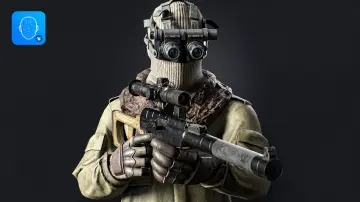
Customized Alien Soldier
Explore practical deployment of the Customized Alien Soldier, covering head customization, clothing textures, Epic Skeleton rigging, and TPS inventory setups.
Sci-fi battlefields, remote planetary outposts, and subterranean fantasy combat zones demand humanoid infantry models capable of adapting to distinct combat situations. In lowpoly shooter environments, visual readability and clear mechanical behavior take precedence over excessive surface micro-detail. A combatant operating across the stylistic frontier of science fiction and tactical fantasy needs to function reliably both as an individual threat and as a member of an organized squad. Deploying an extraterrestrial foot soldier into stylized combat encounters gives developers immediate access to familiar tactical behaviors while retaining a distinct non-human identity on the battlefield.
Staging Alien Combat Encounters in Stylized Environments
Industrial corridors, planetary defense bases, and fortified extraterrestrial strongholds require hostile units that move with military order. When constructing tactical combat encounters, enemy silhouettes must communicate their intended behavior to players in fractions of a second. Combining non-human anatomical features with structured soldier uniforms allows the model to convey both biological hostility and military discipline.
Players identify this combatant as an armed tactical foe rather than a rampaging beast. The model visually signals that it can take cover, shoulder weapons, execute tactical retreats, and coordinate flanking routes across a combat zone. The lowpoly aesthetic keeps silhouettes sharp and edges legible against diverse environmental backdrops, preventing the character from blending into complex geometry during intense firefights.
Configuring the Customized Alien Soldier for Squad Variety
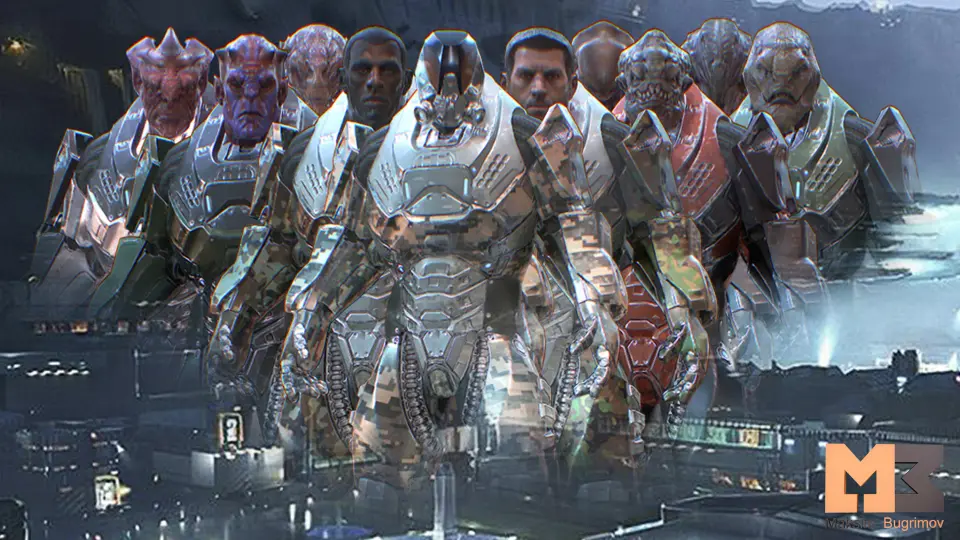
Combat encounters lose tension when every enemy unit shares an identical look. The ability to switch character heads provides an immediate method for differentiating roles across a squad. Swapping head meshes transforms the unit from a rank-and-file trooper into a squad commander, an infiltrator, or a specialized combatant without requiring distinct character meshes for each post.
Clothing texture variations build upon this variety by establishing visible combat tiers and environmental specializations. Adjusting the character clothing textures allows teams to match units to specific biomes or ranks:
Camouflage and muted tones for outdoor terrain, planetary surfaces, or recon squads.
Darker tactical schemes suited for indoor installations, security details, and derelict starships.
Distinct color codings to highlight officer ranks, elite guard detachments, or specialized combat roles.
Visual separation between hostile alien factions fighting over the same planetary objective.
Because these appearance changes rely on texture swaps and modular head meshes rather than unique skeletal assets, games maintain low draw call counts and streamlined memory usage across large combat encounters.
Rigging Mechanics with the Standard Epic Skeleton and Animationblueprint
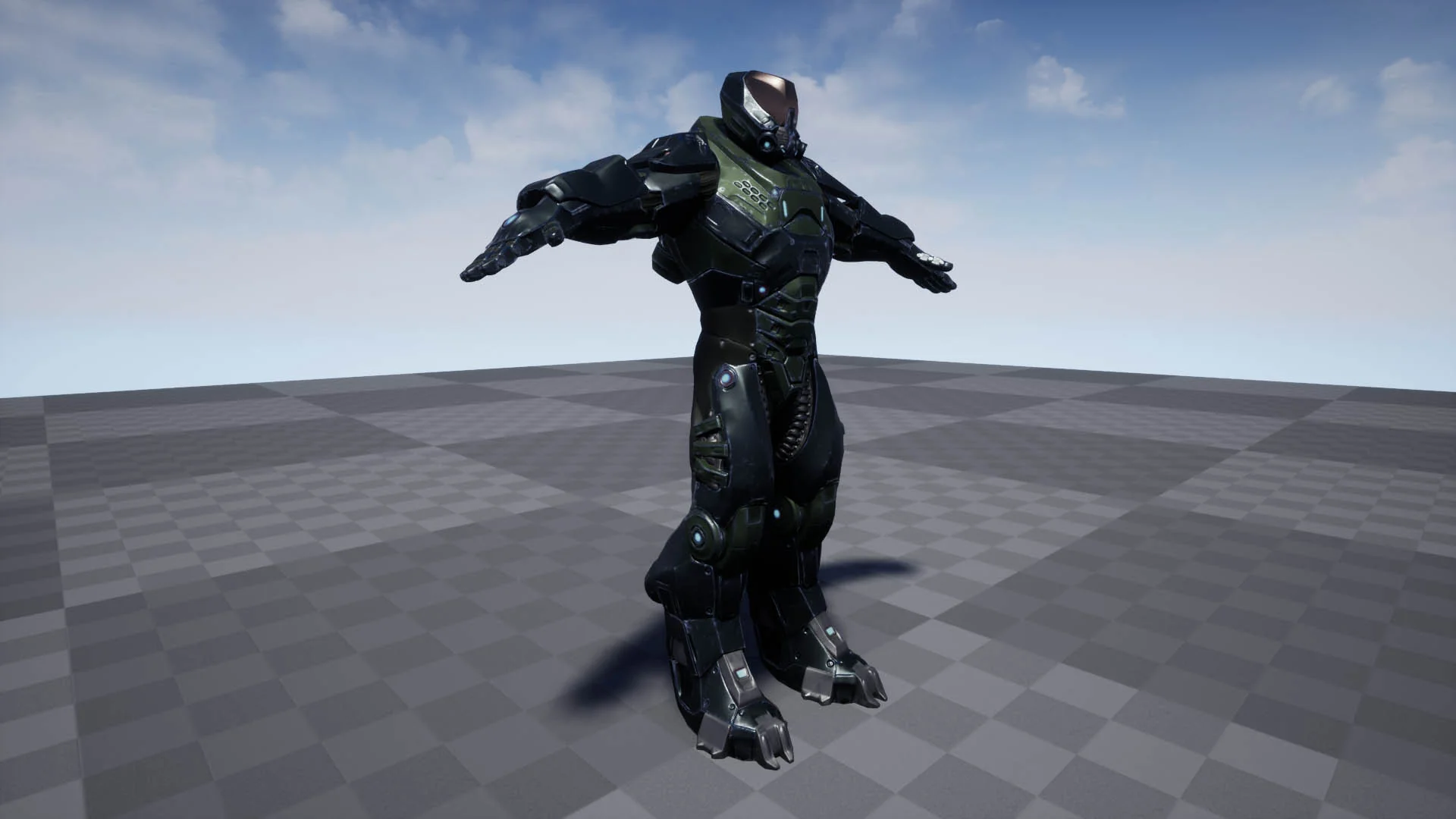
Locomotion consistency across modern shooter engines depends directly on bone hierarchy. Because the model uses a standard Epic Skeleton, developers can bypass manual bone remapping and deploy existing animation libraries directly onto the character. Third-person tactical shooters rely on an extensive suite of interrelated motion states: standard weapon idles, directional strafing cycles, crouch walking, evasive rolls, and procedural aim offsets.
Integrating the character into an established Animationblueprint becomes an effortless process under this skeletal standard. Blend spaces manage the transitions between forward sprints, lateral dashes, and walk cycles smoothly. Aim offset nodes direct the upper spine toward player-aimed targets while foot placement inverse kinematics align the legs to uneven ground slopes. Ragdoll physics setups, physics assets, and directional hit reactions can be assigned directly using standard socket and bone references, eliminating pipeline friction during gameplay iteration.
Weapon Handling and the Advanced TPS Inventory Pack Workflow
Firearms, holsters, and gear management form the core interactive loop of modern shooter gameplay. The character has been tested alongside the Advanced TPS Inventory Pack, ensuring that its skeletal hierarchy and proportions support third-person weapon handling mechanics cleanly. Tactical inventory frameworks require stable attachment points for rifles, sidearms, and equipment packs, alongside reliable animation hooks for drawing, stowing, and firing gear.
Testing with this inventory pack validates that the character handles weapon sockets properly across common combat states. As scripts manage item cycling, weapon attachments match right-hand and left-hand sockets accurately without hand mesh twisting or clipping into shoulder geometry. Reload sequences, secondary holster attachments on the hip or spine, and item pickup routines operate cleanly within standard third-person controller scripts, letting developers focus on balance and combat pace rather than debugging attachment offsets.
Integrating Roster Assets Across the Mega Bundle
Cohesive art direction across an entire game project depends on asset compatibility. This combatant maintains direct compatibility with the All My 3D Characters Mega Bundle, allowing developers to draw from a wider cast of models sharing matching design conventions. When building out extensive campaign missions or varied enemy factions, having characters that adhere to the same structural and stylistic guidelines prevents visual fragmentation across levels.
Sci-fi and fantasy shooters frequently introduce multiple species or allied combat forces within the same game world. Developers can pair this extraterrestrial infantry model with allied combatants, mercenary groups, or specialized boss units from the broader mega bundle collection. Because these assets adhere to common lowpoly proportions and skeletal conventions, animation graphs, damage application scripts, and inventory setups can be duplicated across the entire enemy roster with minimal adjustment.
Tactical Fit and Production Utility
This character model serves developers who need a reliable, modular enemy combatant for fast-paced shooters, tactical strategy games, or stylized sci-fi prototypes. The lowpoly construction ensures smooth frame rates on platforms where performance budgets are strictly enforced, while the inclusion of the standard Epic Skeleton, modular head options, clothing texture variants, and proven inventory compatibility provides a solid, ready-to-deploy combat foundation.
 Characters
 Characters
 Characters
 Characters