"7ad89cffa44984cf"{"id":"1002516","slug":"creeping-creatures-pack","title":"Creeping Creatures Pack","category":"Characters \u0026 Creatures","engine":"4.24+,5.0+","assetVersion":"","engineVersion":"Engine Version: 4.24+,5.0+","tag":"Characters","accent":"blue","visual":"character","summary":"Explore the Creeping Creatures Pack, featuring lowpoly horror character assets with upper-body animations, trailing leg physics, and dynamic attachable guts.","platform":"Unreal Engine","indexPolicy":"index","publishedAt":"2026-11-13T08:57:45.236Z","updatedAt":"2026-11-13T08:57:45.236Z","sourceNotes":[],"fileContents":[],"compatibility":["Unreal Engine","Engine Version: 4.24+,5.0+"],"featuredImage":{"alt":"Creeping Creatures Pack","src":"/wp-content/uploads/published/2026/11/10219ebf7854-ddffd186-7c28-47a6-b8ff-42ae49c25df1-41538984b9.webp"},"hasDownloadLink":true,"downloads":0,"terms":[{"taxonomy":"category","slug":"characters-and-creatures","name":"Characters \u0026 Creatures"}],"galleryImages":[{"src":"/wp-content/uploads/published/2026/11/b530049a415d-9a9ab892-0b51-4268-8f78-285558e6d056-5a5a5968f4.webp","alt":"Creeping Creatures Pack"},{"src":"/wp-content/uploads/published/2026/11/b4704897af1f-c82b0ead-a766-4fdd-8dee-d6d123b75d41-8c87f6007b.webp","alt":"Creeping Creatures Pack"},{"src":"/wp-content/uploads/published/2026/11/3916bbba3968-6a33ca49-550b-4cd4-94b1-0afd381d975b-772302094a.webp","alt":"Creeping Creatures Pack"},{"src":"/wp-content/uploads/published/2026/11/e58af06a11bd-a7e2e8d8-c6aa-4a6d-a92c-89e25ee9286e-aeb2abedc5.webp","alt":"Creeping Creatures Pack"},{"src":"/wp-content/uploads/published/2026/11/e28aed32bc1c-d8019238-00dd-4f24-ac28-e74d2d0d4b39-8fd78bdbc3.webp","alt":"Creeping Creatures Pack"},{"src":"/wp-content/uploads/published/2026/11/44907d762c55-d4af2a68-ffdb-46bc-8c59-b6e6cf2c5a71-affe19c7f3.webp","alt":"Creeping Creatures Pack"}],"accessPanel":{"kind":"resource","title":"Get this resource","eyebrow":"Free resource","message":"Download this resource in your browser.","fileName":"Content.7z","safetyNote":"Resources are manually reviewed before listing to improve quality and reduce obvious risks.","actionLabel":"Get this resource","resourceType":"Resource archive","versions":[]},"contentHtml":"\u003cp\u003eDark corridors, subterranean fantasy dungeons, and claustrophobic horror environments often demand creature movement that defies conventional upright navigation. Typical walking and running locomotion can strip an encounter of tension, reducing an otherworldly threat to a familiar bipedal or quadrupedal cycle. The Creeping Creatures Pack provides an alternative movement paradigm tailored for crawling horrors and ground-level encounters, shifting focus toward physical dragging, upper-body pulling, and visceral trailing anatomy.\u003c/p\u003e \u003ch2\u003eUpper-Body Motion in the Creeping Creatures Pack\u003c/h2\u003e \u003cp\u003eLocomotion within the Creeping Creatures Pack departs from standard character assets through a dedicated division between the upper and lower anatomy. Keyframed motion within the collection focuses exclusively on the upper torso, chest, arms, and head. Rather than presenting a unified full-body skeletal cycle, the provided sequences are tailored to pull the entity forward using arm reaches, crawls, and deliberate forward lurches.\u003c/p\u003e \u003cp\u003eThis animation setup directly addresses the physical reality of ground-bound terrors. When a beast has lost the functional use of its hind limbs or naturally relies on crawling, standard full-body loops often look rigid or disconnected from ground contact. By restricting the keyframed skeletal animation to the upper body, the rig channels all deliberate intent through the front limbs. The entity pulls itself across surfaces, hauling the rest of its mass behind each strike or crawling stroke.\u003c/p\u003e \u003ch2\u003eConfiguring Physics for Dragging Lower Limbs\u003c/h2\u003e \u003cp\u003eBecause the legs in the Creeping Creatures Pack contain no keyframed animation cycles, adapting the character for monsters that possess hind legs requires a specific physics-driven setup. Users must enable physics simulation on the legs so that the lower limbs react dynamically to the motion of the upper torso.\u003c/p\u003e \u003cp\u003eWhen leg physics are turned on, the limbs lose skeletal rigidity and transform into passive, reactive entities. As the upper body crawls, scrambles, or shifts forward under the influence of the animation data, the un-animated legs drag behind the body across the environment. This hybrid mechanical approach prevents the static hovering or frozen posturing that typically occurs when skeletal clips omit lower-body keys.\u003c/p\u003e \u003cp\u003eThe physical dragging delivers significant visual advantages across uneven floors, stairs, rubble, and slopes. Keyframed leg animations frequently clip through irregular ground or float above depressions unless complex inverse kinematics systems are implemented. In contrast, dragging limbs driven by simulation naturally collide with obstacles, fold over ledges, and conform to sloping terrain in direct response to the upper torso's velocity and directional changes.\u003c/p\u003e \u003ch2\u003eAttachable Guts with Dynamic Movement Physics\u003c/h2\u003e \u003cp\u003eBeyond the core character framework, visceral details form a critical part of the horror aesthetic provided in the pack. Characters feature several separate gut elements that can be attached directly to the main body. These components provide modularity in how grotesque or mutilated the entity appears during an encounter.\u003c/p\u003e \u003cp\u003eEvery attachable gut element includes movement physics. Instead of remaining static meshes pinned rigidly to the character rig, the guts react dynamically to external forces and momentum. When the creature pulls itself forward, halts abruptly, lunges, or twists its torso, the attached guts sway, jiggle, and drag in accordance with their simulated properties.\u003c/p\u003e \u003cp\u003eSecondary motion of this type reinforces the weight and horrific nature of the creeping monstrosity. As the physical legs trail behind the pulling arms, the dangling internal anatomy adds another layer of dynamic inertia. The combination of physics-driven limbs and physics-driven visceral attachments transforms every crawling sequence into a chaotic, unsettling visual display that changes organically with every movement vector.\u003c/p\u003e \u003ch2\u003eBlueprint Logic for Creeping Character Rigs\u003c/h2\u003e \u003cp\u003eManaging the interplay between animated upper limbs, trailing simulated legs, and attached physical guts is supported through Blueprint and Animation Blueprint integration. With 56 animations for creatures available in the asset set, organizing state transitions requires a pipeline that can cleanly separate skeletal keyframes from simulated bones.\u003c/p\u003e \u003cp\u003eThe Animation Blueprint handles the state machines, transition logic, and blend spaces across the 56 movement sequences. Because the animation data applies strictly to the upper body, blending setups inside the Animation Blueprint can maintain aggressive crawling cycles, reaching behaviors, attacks, and idle states while leaving the lower skeletal hierarchy open to physics simulation blends.\u003c/p\u003e \u003cp\u003eComplementary Blueprint scripts allow developers to manage the attachment of the gut assets to appropriate sockets or parent joints on the primary character mesh. Within these script components, simulation parameters can be activated or tuned to ensure that the physics of the guts interact properly with the character's movement velocity without clipping or detaching during rapid upper-body transitions.\u003c/p\u003e \u003ch2\u003eLowpoly PBR Construction in Fantasy and Horror Settings\u003c/h2\u003e \u003cp\u003eThe Creeping Creatures Pack utilizes a lowpoly mesh structure paired with Physically Based Rendering (PBR) materials. This technical balance ensures that the models remain optimized for real-time rendering budgets while preserving the surface detail necessary for modern horror lighting.\u003c/p\u003e \u003cp\u003eLowpoly geometry is especially advantageous when running real-time physics simulations on secondary anatomy. Calculating collision, friction, and joint limits for dragging legs and multiple swaying gut pieces introduces computational overhead. Keeping the underlying polycount efficient leaves ample performance headroom for physical calculation threads and multi-creature encounters.\u003c/p\u003e \u003cp\u003eMeanwhile, the PBR material pipeline allows the creature surfaces, torn flesh, and attachable viscera to respond accurately to ambient scene light. Damp reflections on exposed muscle, rough skin textures, and dull bone fragments react correctly under flickering dungeon torches, flashlight beams, or harsh directional spotlights. Whether deployed in a grim fantasy catacomb or a dark sci-fi corridor, the physical interaction of light across the crawling models anchors the creatures firmly into their surrounding environment.\u003c/p\u003e \u003ch2\u003eImplementation Scenarios and Production Utility\u003c/h2\u003e \u003cp\u003eProjects seeking non-standard monster encounters gain direct utility from this collection. Game developers constructing survival horror titles, dungeon-crawling fantasy games, or tense narrative experiences frequently struggle to find animations that depict genuinely wounded, mutated, or floor-bound antagonists. Standard humanoid asset packs rarely provide the specialized pulling locomotion found here.\u003c/p\u003e \u003cp\u003eThe combination of 56 specialized creature animations, un-animated legs ready for physical drag simulation, attachable visceral geometry, and pre-configured Blueprint structures offers a comprehensive toolkit. Developers can implement encounters where enemies emerge from beneath barricades, drag themselves through narrow crawlways, or pursue players along ground level with physically responsive, gruesome authenticity.\u003c/p\u003e\n\n\u003ch2\u003eRelated Resources Worth Checking\u003c/h2\u003e\n\u003cul\u003e\n\u003cli\u003e\u003ca href=\"https://3dcghub.com/creatures-mega-pack/\" rel=\"noopener noreferrer\"\u003eCreatures Mega Pack\u003c/a\u003e\u003c/li\u003e\n\u003cli\u003e\u003ca href=\"https://3dcghub.com/creature-insect/\" rel=\"noopener noreferrer\"\u003eCreature Insect\u003c/a\u003e\u003c/li\u003e\n\u003cli\u003e\u003ca href=\"https://3dcghub.com/crab-animated-creature/\" rel=\"noopener noreferrer\"\u003eCrab - Animated Creature\u003c/a\u003e\u003c/li\u003e\n\u003cli\u003e\u003ca href=\"https://3dcghub.com/humanoids-creatures-pack/\" rel=\"noopener noreferrer\"\u003eHumanoids Creatures Pack\u003c/a\u003e\u003c/li\u003e\n\u003cli\u003e\u003ca href=\"https://3dcghub.com/blind-creature/\" rel=\"noopener noreferrer\"\u003eBlind Creature\u003c/a\u003e\u003c/li\u003e\n\u003c/ul\u003e","contentTextLength":7384,"navigation":{"current":61,"total":4499,"previous":{"id":"1002517","slug":"creepy-girl","title":"Creepy Girl","category":"Characters \u0026 Creatures","platform":"Unreal Engine","updatedAt":"2026-11-13T08:58:56.485Z"},"next":{"id":"1002515","slug":"creatures-mega-pack","title":"Creatures Mega Pack","category":"Characters \u0026 Creatures","platform":"Unreal Engine","updatedAt":"2026-11-13T08:55:54.714Z"}},"relatedResources":[{"id":"1002515","slug":"creatures-mega-pack","title":"Creatures Mega Pack","category":"Characters \u0026 Creatures","engine":"4.26+,5.0+","assetVersion":"","engineVersion":"Engine Version: 4.26+,5.0+","tag":"Characters","accent":"blue","visual":"character","summary":"Explore the Creatures Mega Pack, featuring 18 lowpoly fantasy and horror monster characters complete with Animationblueprint setups and supporting scripts.","platform":"Unreal Engine","indexPolicy":"index","publishedAt":"2026-11-13T08:55:54.714Z","updatedAt":"2026-11-13T08:55:54.714Z","sourceNotes":[],"fileContents":[],"compatibility":["Unreal Engine","Engine Version: 4.26+,5.0+"],"featuredImage":{"alt":"Creatures Mega Pack","src":"/wp-content/uploads/published/2026/11/d0b9b1af2202-7e9eaa9f-9cae-4c81-94f6-1adaef9b45a8-f4ac8e0dd8.webp"},"hasDownloadLink":true,"downloads":0},{"id":"1002514","slug":"creature-insect","title":"Creature Insect","category":"Characters \u0026 Creatures","engine":"4.26+,5.0+","assetVersion":"","engineVersion":"Engine Version: 4.26+,5.0+","tag":"Characters","accent":"blue","visual":"character","summary":"Explore the Creature Insect asset, featuring 56 creature animations, animation blueprint support, and scripts for shooter, fantasy, and horror games.","platform":"Unreal Engine","indexPolicy":"index","publishedAt":"2026-11-13T08:53:58.041Z","updatedAt":"2026-11-13T08:53:58.041Z","sourceNotes":[],"fileContents":[],"compatibility":["Unreal Engine","Engine Version: 4.26+,5.0+"],"featuredImage":{"alt":"Creature Insect","src":"/wp-content/uploads/published/2026/11/24a8299822e6-13db0c35-d25c-4048-b0c7-19b3b5d8d84b-1e967acae2.webp"},"hasDownloadLink":true,"downloads":0},{"id":"1002558","slug":"pbr-creature","title":"PBR Creature","category":"Characters \u0026 Creatures","engine":"4.18+,5.0+","assetVersion":"","engineVersion":"Engine Version: 4.18+,5.0+","tag":"Characters","accent":"blue","visual":"character","summary":"An analysis of the PBR Creature asset, detailing its low-poly mesh, 56 creature animations, and Animationblueprint setup across horror, shooter, and fantasy gen","platform":"Unreal Engine","indexPolicy":"index","publishedAt":"2026-11-13T10:50:56.597Z","updatedAt":"2026-11-13T10:50:56.597Z","sourceNotes":[],"fileContents":[],"compatibility":["Unreal Engine","Engine Version: 4.18+,5.0+"],"featuredImage":{"alt":"PBR Creature","src":"/wp-content/uploads/published/2026/11/a75d6edd99e4-564c8565-9398-4b84-9f8c-872ea342c9e5-9b3aabfcbe.webp"},"hasDownloadLink":true,"downloads":0}]}
Characters
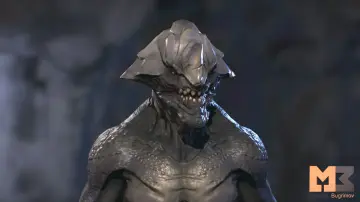
Creeping Creatures Pack
Explore the Creeping Creatures Pack, featuring lowpoly horror character assets with upper-body animations, trailing leg physics, and dynamic attachable guts.
Dark corridors, subterranean fantasy dungeons, and claustrophobic horror environments often demand creature movement that defies conventional upright navigation. Typical walking and running locomotion can strip an encounter of tension, reducing an otherworldly threat to a familiar bipedal or quadrupedal cycle. The Creeping Creatures Pack provides an alternative movement paradigm tailored for crawling horrors and ground-level encounters, shifting focus toward physical dragging, upper-body pulling, and visceral trailing anatomy.
Upper-Body Motion in the Creeping Creatures Pack
Locomotion within the Creeping Creatures Pack departs from standard character assets through a dedicated division between the upper and lower anatomy. Keyframed motion within the collection focuses exclusively on the upper torso, chest, arms, and head. Rather than presenting a unified full-body skeletal cycle, the provided sequences are tailored to pull the entity forward using arm reaches, crawls, and deliberate forward lurches.
This animation setup directly addresses the physical reality of ground-bound terrors. When a beast has lost the functional use of its hind limbs or naturally relies on crawling, standard full-body loops often look rigid or disconnected from ground contact. By restricting the keyframed skeletal animation to the upper body, the rig channels all deliberate intent through the front limbs. The entity pulls itself across surfaces, hauling the rest of its mass behind each strike or crawling stroke.
Configuring Physics for Dragging Lower Limbs
Because the legs in the Creeping Creatures Pack contain no keyframed animation cycles, adapting the character for monsters that possess hind legs requires a specific physics-driven setup. Users must enable physics simulation on the legs so that the lower limbs react dynamically to the motion of the upper torso.
When leg physics are turned on, the limbs lose skeletal rigidity and transform into passive, reactive entities. As the upper body crawls, scrambles, or shifts forward under the influence of the animation data, the un-animated legs drag behind the body across the environment. This hybrid mechanical approach prevents the static hovering or frozen posturing that typically occurs when skeletal clips omit lower-body keys.
The physical dragging delivers significant visual advantages across uneven floors, stairs, rubble, and slopes. Keyframed leg animations frequently clip through irregular ground or float above depressions unless complex inverse kinematics systems are implemented. In contrast, dragging limbs driven by simulation naturally collide with obstacles, fold over ledges, and conform to sloping terrain in direct response to the upper torso's velocity and directional changes.
Attachable Guts with Dynamic Movement Physics
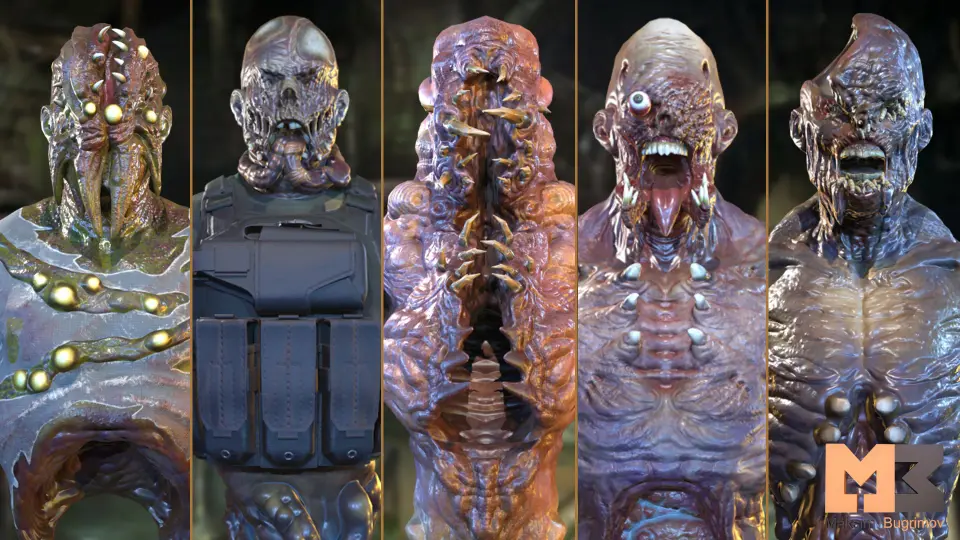
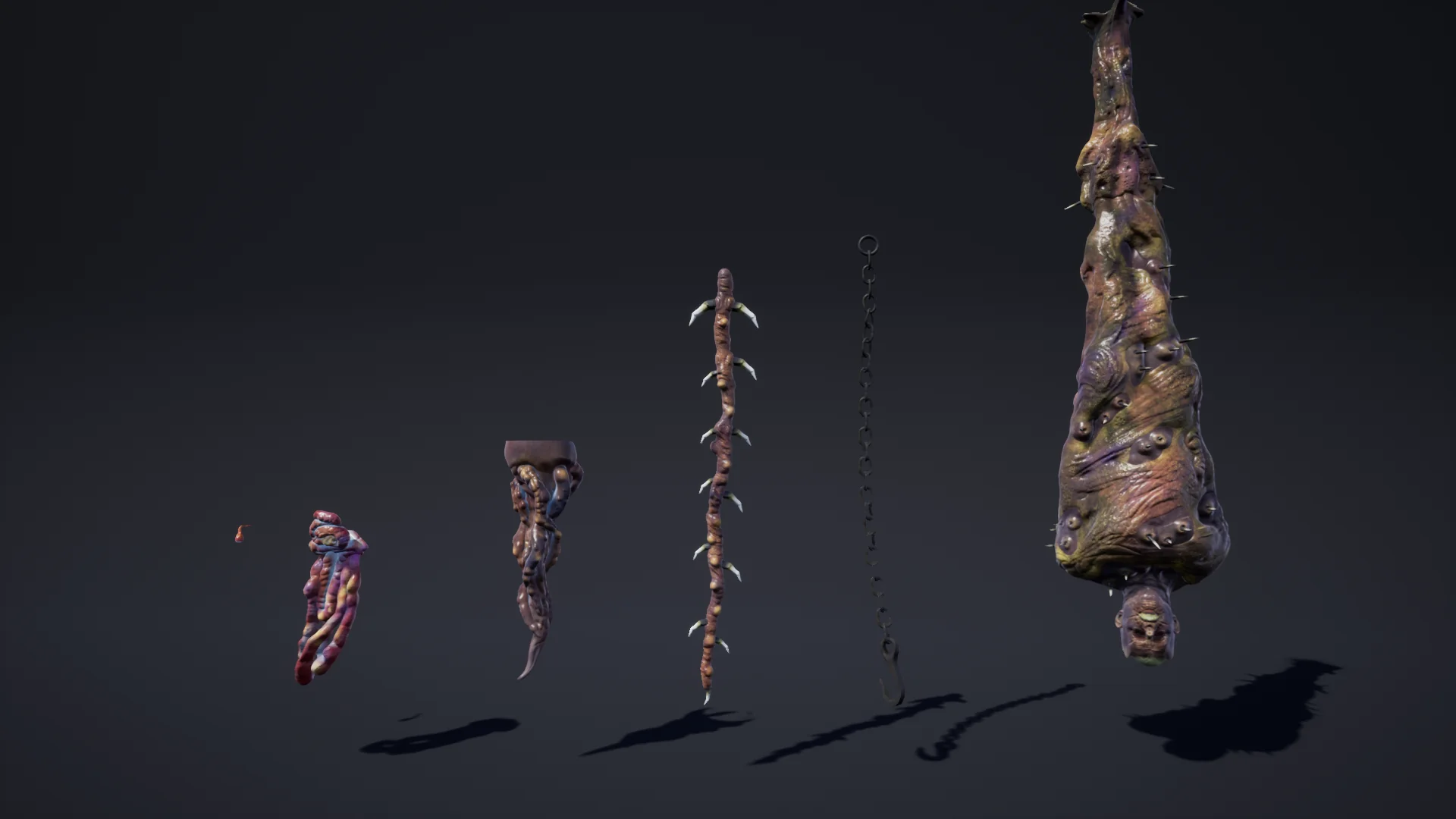
Beyond the core character framework, visceral details form a critical part of the horror aesthetic provided in the pack. Characters feature several separate gut elements that can be attached directly to the main body. These components provide modularity in how grotesque or mutilated the entity appears during an encounter.
Every attachable gut element includes movement physics. Instead of remaining static meshes pinned rigidly to the character rig, the guts react dynamically to external forces and momentum. When the creature pulls itself forward, halts abruptly, lunges, or twists its torso, the attached guts sway, jiggle, and drag in accordance with their simulated properties.
Secondary motion of this type reinforces the weight and horrific nature of the creeping monstrosity. As the physical legs trail behind the pulling arms, the dangling internal anatomy adds another layer of dynamic inertia. The combination of physics-driven limbs and physics-driven visceral attachments transforms every crawling sequence into a chaotic, unsettling visual display that changes organically with every movement vector.
Blueprint Logic for Creeping Character Rigs
Managing the interplay between animated upper limbs, trailing simulated legs, and attached physical guts is supported through Blueprint and Animation Blueprint integration. With 56 animations for creatures available in the asset set, organizing state transitions requires a pipeline that can cleanly separate skeletal keyframes from simulated bones.
The Animation Blueprint handles the state machines, transition logic, and blend spaces across the 56 movement sequences. Because the animation data applies strictly to the upper body, blending setups inside the Animation Blueprint can maintain aggressive crawling cycles, reaching behaviors, attacks, and idle states while leaving the lower skeletal hierarchy open to physics simulation blends.
Complementary Blueprint scripts allow developers to manage the attachment of the gut assets to appropriate sockets or parent joints on the primary character mesh. Within these script components, simulation parameters can be activated or tuned to ensure that the physics of the guts interact properly with the character's movement velocity without clipping or detaching during rapid upper-body transitions.
Lowpoly PBR Construction in Fantasy and Horror Settings
The Creeping Creatures Pack utilizes a lowpoly mesh structure paired with Physically Based Rendering (PBR) materials. This technical balance ensures that the models remain optimized for real-time rendering budgets while preserving the surface detail necessary for modern horror lighting.
Lowpoly geometry is especially advantageous when running real-time physics simulations on secondary anatomy. Calculating collision, friction, and joint limits for dragging legs and multiple swaying gut pieces introduces computational overhead. Keeping the underlying polycount efficient leaves ample performance headroom for physical calculation threads and multi-creature encounters.
Meanwhile, the PBR material pipeline allows the creature surfaces, torn flesh, and attachable viscera to respond accurately to ambient scene light. Damp reflections on exposed muscle, rough skin textures, and dull bone fragments react correctly under flickering dungeon torches, flashlight beams, or harsh directional spotlights. Whether deployed in a grim fantasy catacomb or a dark sci-fi corridor, the physical interaction of light across the crawling models anchors the creatures firmly into their surrounding environment.
Implementation Scenarios and Production Utility
Projects seeking non-standard monster encounters gain direct utility from this collection. Game developers constructing survival horror titles, dungeon-crawling fantasy games, or tense narrative experiences frequently struggle to find animations that depict genuinely wounded, mutated, or floor-bound antagonists. Standard humanoid asset packs rarely provide the specialized pulling locomotion found here.
The combination of 56 specialized creature animations, un-animated legs ready for physical drag simulation, attachable visceral geometry, and pre-configured Blueprint structures offers a comprehensive toolkit. Developers can implement encounters where enemies emerge from beneath barricades, drag themselves through narrow crawlways, or pursue players along ground level with physically responsive, gruesome authenticity.
 Characters
 Characters
 Characters
 Characters