"fb5ea1e7d1b41445"{"id":"1002400","slug":"vampire-girl-remaster","title":"Vampire Girl Remaster","category":"Characters \u0026 Creatures","engine":"4.20+,5.0+","assetVersion":"","engineVersion":"Engine Version: 4.20+,5.0+","tag":"Characters","accent":"blue","visual":"character","summary":"Technical analysis of the Vampire Girl Remaster character model, covering its 380-bone skeleton, 57 combat animations, dual head meshes, and engine setups.","platform":"Unreal Engine","indexPolicy":"index","publishedAt":"2026-11-10T04:29:40.350Z","updatedAt":"2026-11-10T04:29:40.350Z","sourceNotes":[],"fileContents":[],"compatibility":["Unreal Engine","Engine Version: 4.20+,5.0+"],"featuredImage":{"alt":"Vampire Girl Remaster","src":"/wp-content/uploads/published/2026/11/4ca8215a22f7-0fb979ce-b7f1-4748-9cd5-5109b05f2405-af7a569b29.webp"},"hasDownloadLink":true,"downloads":0,"terms":[{"taxonomy":"category","slug":"characters-and-creatures","name":"Characters \u0026 Creatures"}],"galleryImages":[{"src":"/wp-content/uploads/published/2026/11/1010a553a578-cf8e500a-fe19-4d79-b090-348aedd44bd6-6efe009e24.webp","alt":"Vampire Girl Remaster"},{"src":"/wp-content/uploads/published/2026/11/c08d423cfac1-52b5cae4-857f-4b47-ab7e-565f9bed6780-718dad487c.webp","alt":"Vampire Girl Remaster"},{"src":"/wp-content/uploads/published/2026/11/f9db3283c189-e661c4af-7285-497d-8509-f0c0389d94a8-d205f83d5c.webp","alt":"Vampire Girl Remaster"},{"src":"/wp-content/uploads/published/2026/11/f9c131d2efab-47c284c4-1b8d-416d-af23-c2d2ed8a4a89-1ae8252f1d.webp","alt":"Vampire Girl Remaster"},{"src":"/wp-content/uploads/published/2026/11/c9300cda5c89-63edbc3a-6167-49c3-8229-f23bb90aa1f9-2a66f84d2e.webp","alt":"Vampire Girl Remaster"},{"src":"/wp-content/uploads/published/2026/11/07b2cd8707b9-6dd171c6-e7bd-4934-a932-e81eb5ab4aa7-2bdc9dc7d1.webp","alt":"Vampire Girl Remaster"},{"src":"/wp-content/uploads/published/2026/11/c52c53dc7d86-0da371d5-021c-4d5e-8b58-d49c168df9cb-33fc5d1b11.webp","alt":"Vampire Girl Remaster"},{"src":"/wp-content/uploads/published/2026/11/66d88e14268f-39b98f6f-62e8-4455-88e2-070c8636c914-c6f759d006.webp","alt":"Vampire Girl Remaster"},{"src":"/wp-content/uploads/published/2026/11/3c28169eea94-03719369-2119-46d0-8b74-0b46ab5d9a41-1145c4b4b6.webp","alt":"Vampire Girl Remaster"},{"src":"/wp-content/uploads/published/2026/11/aadb3fb0ad64-b2e4297a-c549-4f54-bb60-6fdfb0e595ca-2f3a258c52.webp","alt":"Vampire Girl Remaster"}],"accessPanel":{"kind":"resource","title":"Get this resource","eyebrow":"Free resource","message":"Download this resource in your browser.","fileName":"Content.7z","safetyNote":"Resources are manually reviewed before listing to improve quality and reduce obvious risks.","actionLabel":"Get this resource","resourceType":"Resource archive","versions":[]},"contentHtml":"\u003ch2\u003eVisualizing Gothic Action with the Vampire Silhouette\u003c/h2\u003e\n\u003cp\u003eDark fantasy settings, gothic cathedrals, crumbling castles, and high-tempo hack-and-slash encounters rely heavily on character silhouettes that communicate both elegance and threat. Vampire Girl Remaster provides a dedicated combatant suited to third-person action, role-playing games, and gothic horror encounters. The character is styled as an armored, winged vampire woman featuring expansive bat wings engineered with two distinct membranes per side. Her outfit combines a tailored high collar, an ornate corset embedded with protective armor elements, a flowing cloth toga drape complete with front and back flaps, a necktie, and cinched functional belts.\u003c/p\u003e\n\u003cp\u003eDefensive and offensive utility carries through the secondary accessories, including structured elbow fins and a one-handed sword wielded in the right hand. Because the design accommodates fast-paced tactical engagement, the silhouette balances heavy armored accents with lighter drapery, creating strong visual lines during rapid turns, high-speed dodges, and airborne maneuvers. For developers working within gothic combat spaces, the character provides an immediate visual anchor suited for enemy encounters, playable hero roles, or roaming boss confrontations.\u003c/p\u003e \u003ch2\u003eMesh Configurations in the Vampire Girl Remaster\u003c/h2\u003e\n\u003cp\u003eTwo distinct head options allow the model to serve different aesthetic preferences and technical setups. The first configuration, designated as head 1, represents the complete equipment loadout across 35 separated mesh parts. This assembly tallies 67,469 faces, 42,603 vertices, and 69,257 triangles. It presents a fully realized dark fantasy presence with hair styled open beneath the collar line.\u003c/p\u003e\n\u003cp\u003eThe alternate configuration, head 2, introduces a ponytail hairstyle that reorganizes the upper geometry. With all equipment active across 32 individual mesh parts, this variant clocks in at 58,445 faces, 37,071 vertices, and 63,702 triangles. The modular breakdown into separate mesh components across both head setups offers technical flexibility for technical artists who need to isolate specific garments, toggle accessories, or configure custom dynamic hiding rules for equipment during intense close-up cinematography.\u003c/p\u003e \u003ch2\u003eRig Structure and the Expanded 380-Bone Hierarchy\u003c/h2\u003e\n\u003cp\u003eTo support complex mechanical interactions across flight membranes and layered clothing, the character relies on an expanded skeletal hierarchy. Starting from the standard Unreal Engine 5 Manny baseline of 161 bones, the rig incorporates 219 additional bones, yielding a total count of 380 joints. This extensive skeletal footprint ensures that secondary animations do not suffer from collapsed silhouettes or rigid intersections during complex melee combos.\u003c/p\u003e\n\u003cp\u003eThe wing structure claims a significant portion of this extended framework. The large wings utilize 76 individual joints, while the smaller wings operate across 62 joints, allowing animator control over deep membrane flexing, folding, and expansion during flight routines. Clothing physics are backed by dedicated joints, including 29 bones distributed along five leg-wrapping chains for the toga, six bones governing the cinched belts, two joints dedicated to the necktie, and 12 joints managing the elbow fins. Armor sections remain flexible through four shoulder pad bones and four chest bones.\u003c/p\u003e\n\u003cp\u003eFacial articulation is supported through dedicated facial structures rather than baked blend states. The face includes four eye bones, six eyelid joints, three jaw bones, and five individual tongue joints, supporting reactive battle grimaces and bite animations. The included ponytail hairstyle on head 2 incorporates six independent bones for inertia. The weapon connects directly to the right-hand structure, fully skinned to the weapon_r socket for immediate synchronization with combat swings. While the skeleton utilizes an Unreal-style bone structure and includes IK bones, exact compatibility with the stock Epic Mannequin or MetaHuman framework has not been verified, and technical pipelines should evaluate two-sided rendering parameters inside the target engine to properly display the cloth flaps and wing membranes.\u003c/p\u003e \u003ch2\u003eGround Locomotion and Aerial Flight Animations\u003c/h2\u003e\n\u003cp\u003eMotion coverage spans ground-based swordplay and full aerial locomotion, provided as 57 distinct character animation assets in the engine project, mirrored by 57 standalone character FBX animation files. An additional batch of seven separate demo motion FBX files is also provided for broader staging tests. Both In-Place and Root Motion formats are supplied across displacement attacks, locomotion sequences, hit reactions, turns, and aerial transitions, allowing teams to align movement systems with their chosen engine physics model.\u003c/p\u003e\n\u003cp\u003eGround operations feature standard walks, backward walks, two running cycles, four-way strafing, and 90-degree left and right turn cycles. Ground attacks are divided into eight separate one-handed sword swings that account for advancing strikes, chained combinations, and stationary slices. Defensive animations include three distinct hit reactions and four comprehensive death sequences.\u003c/p\u003e\n\u003cp\u003eTransitioning into the air is managed through dedicated takeoff and landing routines. Flight mechanics are fleshed out with two aerial idle variations, four directional forward flight states, and four airborne 90-degree turning sequences. Aerial combat is fully represented through six dedicated airborne sword strikes, allowing the character to dive, slice, and engage mid-flight. Flight-based damage reactions are accounted for through three airborne hit variations and two aerial death animations that resolve into mid-air collapses.\u003c/p\u003e \u003ch2\u003eMulti-Engine Assets and Texture Organization\u003c/h2\u003e\n\u003cp\u003eAsset delivery encompasses multiple pipeline targets, supplying a complete Unreal Engine 5.1 project alongside an import-ready Unity package. For DCC-level modifications, the base geometry is provided in both FBX format and native Maya Binary (.mb) files. Base FBX exports are structured with six discrete material slots to keep modular equipment layers cleanly organized.\u003c/p\u003e\n\u003cp\u003eWithin the Unreal environment, rendering is handled by four master materials connected to 24 material instances, providing three distinct skin options to differentiate combatants or denote elite status. The Unreal project hosts 108 textures, backed by 132 source TGA files organized into three complete texture sets. Asset resolutions are authored at clean 2048x2048 and dense 4096x4096 dimensions, incorporating alternative channel packings to suit differing roughness, metallic, and ambient occlusion standards across modern PBR pipelines. The character also maintains thematic and structural compatibility with the wider Dracula's Army bundle.\u003c/p\u003e \u003ch2\u003eProject Suitability\u003c/h2\u003e\n\u003cp\u003eVampire Girl Remaster fits projects needing an expressive, flight-capable combatant without requiring manual rigging for complex wing folds or drapery. Teams building action RPGs, hack-and-slash bosses, or dark fantasy arena encounters will gain the most mileage from the asset's pre-built aerial-to-ground animation chains, fully rigged clothing elements, and versatile multi-engine source files.\u003c/p\u003e\n\n\u003ch2\u003eRelated Resources Worth Checking\u003c/h2\u003e\n\u003cul\u003e\n\u003cli\u003e\u003ca href=\"https://3dcghub.com/novice-girl/\" rel=\"noopener noreferrer\"\u003eNovice Girl\u003c/a\u003e\u003c/li\u003e\n\u003cli\u003e\u003ca href=\"https://3dcghub.com/cyberpunk-sniper-girl/\" rel=\"noopener noreferrer\"\u003eCyberpunk Sniper Girl\u003c/a\u003e\u003c/li\u003e\n\u003cli\u003e\u003ca href=\"https://3dcghub.com/samantha-cyberpunk-girl/\" rel=\"noopener noreferrer\"\u003eSamantha - Cyberpunk girl\u003c/a\u003e\u003c/li\u003e\n\u003cli\u003e\u003ca href=\"https://3dcghub.com/post-apocalypse-girl/\" rel=\"noopener noreferrer\"\u003ePost Apocalypse Girl\u003c/a\u003e\u003c/li\u003e\n\u003cli\u003e\u003ca href=\"https://3dcghub.com/forest-druid-girl/\" rel=\"noopener noreferrer\"\u003eForest Druid Girl\u003c/a\u003e\u003c/li\u003e\n\u003c/ul\u003e","contentTextLength":7313,"navigation":{"current":19,"total":4340,"previous":{"id":"1002401","slug":"z-mech-robot-giant","title":"Z-Mech Robot Giant","category":"Characters \u0026 Creatures","platform":"Unreal Engine","updatedAt":"2026-11-10T04:31:06.426Z"},"next":{"id":"1002399","slug":"sword-elf","title":"Sword Elf","category":"Humans","platform":"Unreal Engine","updatedAt":"2026-11-10T04:28:30.060Z"}},"relatedResources":[{"id":"1002393","slug":"novice-girl","title":"Novice Girl","category":"Characters \u0026 Creatures","engine":"4.19+,5.0+","assetVersion":"","engineVersion":"Engine Version: 4.19+,5.0+","tag":"Characters","accent":"blue","visual":"character","summary":"Explore the Novice Girl modular 3D character featuring Epic Skeleton retargeting, 4K PBR textures, custom secondary bones, and facial blendshapes.","platform":"Unreal Engine","indexPolicy":"index","publishedAt":"2026-11-10T04:18:53.597Z","updatedAt":"2026-11-10T04:18:53.597Z","sourceNotes":[],"fileContents":[],"compatibility":["Unreal Engine","Engine Version: 4.19+,5.0+"],"featuredImage":{"alt":"Novice Girl","src":"/wp-content/uploads/published/2026/11/e8273e779ef8-dcc4dcfd-4b9c-4e05-8d40-f18cadfc206b-6adc7cfe28.webp"},"hasDownloadLink":true,"downloads":0},{"id":"1001605","slug":"cyberpunk-sniper-girl","title":"Cyberpunk Sniper Girl","category":"Characters \u0026 Creatures","engine":"4.26+,5.0+","assetVersion":"","engineVersion":"Engine Version: 4.26+,5.0+","tag":"Characters","accent":"blue","visual":"character","summary":"Cyberpunk Sniper Girl character breakdown covering 4 body shapes, Epic Skeleton rigging, 10 4K PBR texture sets, and Apple ARKit facial blendshapes.","platform":"Unreal Engine","indexPolicy":"index","publishedAt":"2026-10-10T16:29:58.108Z","updatedAt":"2026-10-10T16:29:58.108Z","sourceNotes":[],"fileContents":[],"compatibility":["Unreal Engine","Engine Version: 4.26+,5.0+"],"featuredImage":{"alt":"Cyberpunk Sniper Girl","src":"/wp-content/uploads/published/2026/10/506286d4db2b-22acae93-9939-48b9-8849-2410b63ab75c-7980f17e44.webp"},"hasDownloadLink":true,"downloads":1},{"id":"1002185","slug":"samantha-cyberpunk-girl","title":"Samantha - Cyberpunk girl","category":"Characters \u0026 Creatures","engine":"4.22+,5.0+","assetVersion":"","engineVersion":"Engine Version: 4.22+,5.0+","tag":"Characters","accent":"blue","visual":"character","summary":"Integrate Samantha - Cyberpunk girl with single mesh geometry, 5 texture sets, socketed hair physics, and Undead Prisoners Pack compatibility.","platform":"Unreal Engine","indexPolicy":"index","publishedAt":"2026-10-29T14:26:36.100Z","updatedAt":"2026-10-29T14:26:36.100Z","sourceNotes":[],"fileContents":[],"compatibility":["Unreal Engine","Engine Version: 4.22+,5.0+"],"featuredImage":{"alt":"Samantha - Cyberpunk girl","src":"/wp-content/uploads/published/2026/10/81f7b6daaaa0-98828ec8-c6de-40c2-b9f1-8e79ad1227d0-7b6a58a401.webp"},"hasDownloadLink":true,"downloads":0}]}
Characters
Vampire Girl Remaster
Technical analysis of the Vampire Girl Remaster character model, covering its 380-bone skeleton, 57 combat animations, dual head meshes, and engine setups.
Visualizing Gothic Action with the Vampire Silhouette
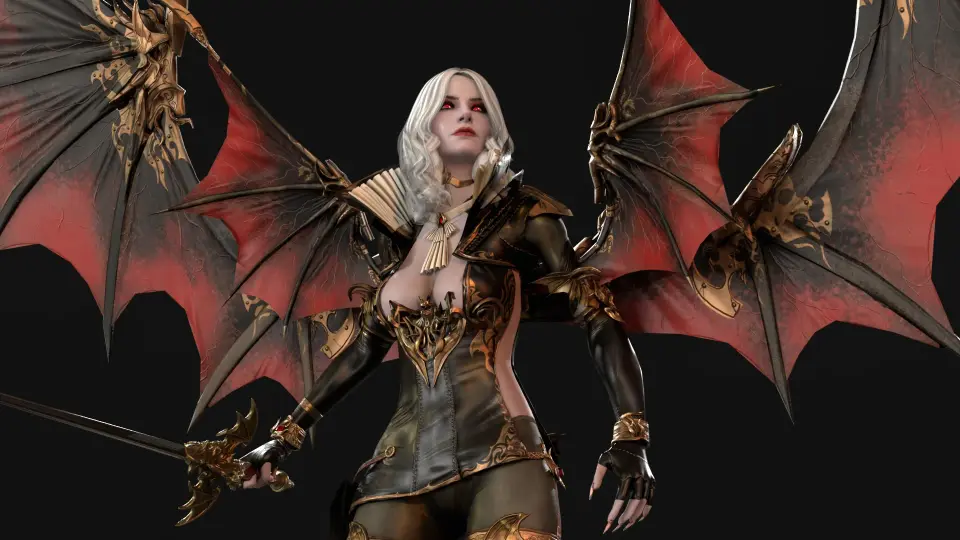
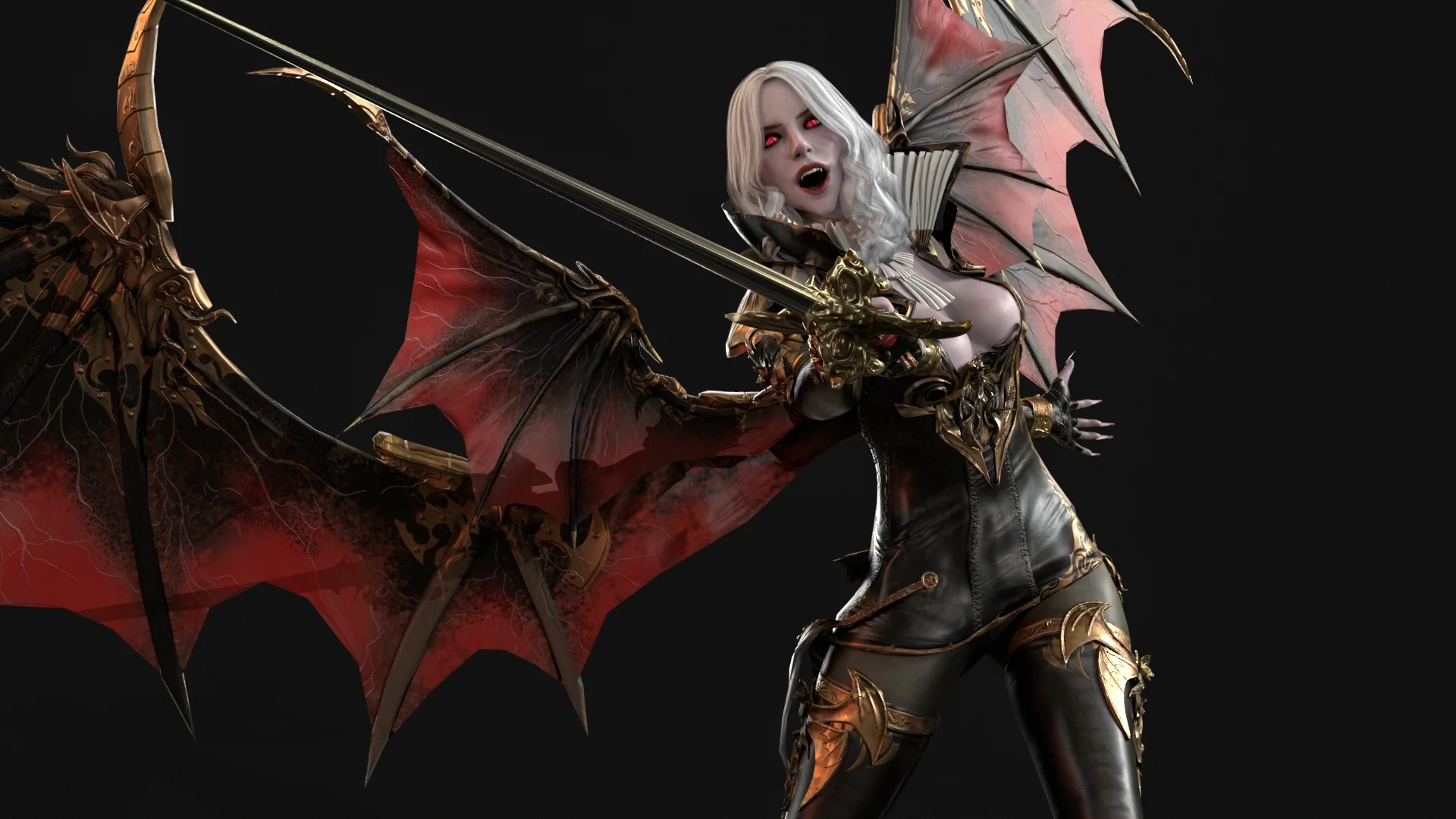
Dark fantasy settings, gothic cathedrals, crumbling castles, and high-tempo hack-and-slash encounters rely heavily on character silhouettes that communicate both elegance and threat. Vampire Girl Remaster provides a dedicated combatant suited to third-person action, role-playing games, and gothic horror encounters. The character is styled as an armored, winged vampire woman featuring expansive bat wings engineered with two distinct membranes per side. Her outfit combines a tailored high collar, an ornate corset embedded with protective armor elements, a flowing cloth toga drape complete with front and back flaps, a necktie, and cinched functional belts.
Defensive and offensive utility carries through the secondary accessories, including structured elbow fins and a one-handed sword wielded in the right hand. Because the design accommodates fast-paced tactical engagement, the silhouette balances heavy armored accents with lighter drapery, creating strong visual lines during rapid turns, high-speed dodges, and airborne maneuvers. For developers working within gothic combat spaces, the character provides an immediate visual anchor suited for enemy encounters, playable hero roles, or roaming boss confrontations.
Mesh Configurations in the Vampire Girl Remaster
Two distinct head options allow the model to serve different aesthetic preferences and technical setups. The first configuration, designated as head 1, represents the complete equipment loadout across 35 separated mesh parts. This assembly tallies 67,469 faces, 42,603 vertices, and 69,257 triangles. It presents a fully realized dark fantasy presence with hair styled open beneath the collar line.
The alternate configuration, head 2, introduces a ponytail hairstyle that reorganizes the upper geometry. With all equipment active across 32 individual mesh parts, this variant clocks in at 58,445 faces, 37,071 vertices, and 63,702 triangles. The modular breakdown into separate mesh components across both head setups offers technical flexibility for technical artists who need to isolate specific garments, toggle accessories, or configure custom dynamic hiding rules for equipment during intense close-up cinematography.
Rig Structure and the Expanded 380-Bone Hierarchy
To support complex mechanical interactions across flight membranes and layered clothing, the character relies on an expanded skeletal hierarchy. Starting from the standard Unreal Engine 5 Manny baseline of 161 bones, the rig incorporates 219 additional bones, yielding a total count of 380 joints. This extensive skeletal footprint ensures that secondary animations do not suffer from collapsed silhouettes or rigid intersections during complex melee combos.
The wing structure claims a significant portion of this extended framework. The large wings utilize 76 individual joints, while the smaller wings operate across 62 joints, allowing animator control over deep membrane flexing, folding, and expansion during flight routines. Clothing physics are backed by dedicated joints, including 29 bones distributed along five leg-wrapping chains for the toga, six bones governing the cinched belts, two joints dedicated to the necktie, and 12 joints managing the elbow fins. Armor sections remain flexible through four shoulder pad bones and four chest bones.
Facial articulation is supported through dedicated facial structures rather than baked blend states. The face includes four eye bones, six eyelid joints, three jaw bones, and five individual tongue joints, supporting reactive battle grimaces and bite animations. The included ponytail hairstyle on head 2 incorporates six independent bones for inertia. The weapon connects directly to the right-hand structure, fully skinned to the weapon_r socket for immediate synchronization with combat swings. While the skeleton utilizes an Unreal-style bone structure and includes IK bones, exact compatibility with the stock Epic Mannequin or MetaHuman framework has not been verified, and technical pipelines should evaluate two-sided rendering parameters inside the target engine to properly display the cloth flaps and wing membranes.
Ground Locomotion and Aerial Flight Animations
Motion coverage spans ground-based swordplay and full aerial locomotion, provided as 57 distinct character animation assets in the engine project, mirrored by 57 standalone character FBX animation files. An additional batch of seven separate demo motion FBX files is also provided for broader staging tests. Both In-Place and Root Motion formats are supplied across displacement attacks, locomotion sequences, hit reactions, turns, and aerial transitions, allowing teams to align movement systems with their chosen engine physics model.
Ground operations feature standard walks, backward walks, two running cycles, four-way strafing, and 90-degree left and right turn cycles. Ground attacks are divided into eight separate one-handed sword swings that account for advancing strikes, chained combinations, and stationary slices. Defensive animations include three distinct hit reactions and four comprehensive death sequences.
Transitioning into the air is managed through dedicated takeoff and landing routines. Flight mechanics are fleshed out with two aerial idle variations, four directional forward flight states, and four airborne 90-degree turning sequences. Aerial combat is fully represented through six dedicated airborne sword strikes, allowing the character to dive, slice, and engage mid-flight. Flight-based damage reactions are accounted for through three airborne hit variations and two aerial death animations that resolve into mid-air collapses.
Multi-Engine Assets and Texture Organization
Asset delivery encompasses multiple pipeline targets, supplying a complete Unreal Engine 5.1 project alongside an import-ready Unity package. For DCC-level modifications, the base geometry is provided in both FBX format and native Maya Binary (.mb) files. Base FBX exports are structured with six discrete material slots to keep modular equipment layers cleanly organized.
Within the Unreal environment, rendering is handled by four master materials connected to 24 material instances, providing three distinct skin options to differentiate combatants or denote elite status. The Unreal project hosts 108 textures, backed by 132 source TGA files organized into three complete texture sets. Asset resolutions are authored at clean 2048x2048 and dense 4096x4096 dimensions, incorporating alternative channel packings to suit differing roughness, metallic, and ambient occlusion standards across modern PBR pipelines. The character also maintains thematic and structural compatibility with the wider Dracula's Army bundle.
Project Suitability
Vampire Girl Remaster fits projects needing an expressive, flight-capable combatant without requiring manual rigging for complex wing folds or drapery. Teams building action RPGs, hack-and-slash bosses, or dark fantasy arena encounters will gain the most mileage from the asset's pre-built aerial-to-ground animation chains, fully rigged clothing elements, and versatile multi-engine source files.
 Characters
 Characters
 Characters
 Characters