"e9c335e082208b17"{"id":"1002880","slug":"boss-ai-toolkit","title":"Boss AI Toolkit","category":"Gameplay Features","engine":"5.0+","assetVersion":"Asset Version: 1.3","engineVersion":"Engine Version: 5.0+","tag":"Gameplay Features","accent":"blue","visual":"mech","summary":"Create multi-phase boss encounters in Unreal Engine using the Boss AI Toolkit. Features a modular Ability system, Blueprint logic, and MMO raid design.","platform":"Unreal Engine","indexPolicy":"index","publishedAt":"2026-11-21T01:42:35.865Z","updatedAt":"2026-11-21T01:42:35.865Z","sourceNotes":[],"fileContents":[],"compatibility":["Unreal Engine","Asset Version: 1.3","Engine Version: 5.0+"],"featuredImage":{"alt":"Boss AI Toolkit","src":"/wp-content/uploads/published/2026/11/9dd5611ec2fd-6cf54a09-9bb7-4393-b023-9febc3c4e49f-6a82e80f29.webp"},"fileSizeBytes":469811558,"hasDownloadLink":true,"downloads":0,"terms":[{"taxonomy":"category","slug":"gameplay-features","name":"Gameplay Features"}],"galleryImages":[{"src":"/wp-content/uploads/published/2026/11/4a6b75ef279f-c626a6ca-6f98-4ecf-8d1e-d2f4a29bbe70-dbe9582888.webp","alt":"Boss AI Toolkit"},{"src":"/wp-content/uploads/published/2026/11/3a160a744807-13f7fa71-c436-4cca-9494-604f6f4f3898-98f1f113be.webp","alt":"Boss AI Toolkit"},{"src":"/wp-content/uploads/published/2026/11/ca5d716c034b-a1288899-d07a-4572-b5df-d7d97b9a69f6-79766ac00f.webp","alt":"Boss AI Toolkit"},{"src":"/wp-content/uploads/published/2026/11/51b69d6f4d95-0c4235d4-315f-4cf8-9257-3d27b74448c3-4a49e7e40e.webp","alt":"Boss AI Toolkit"},{"src":"/wp-content/uploads/published/2026/11/20560eb527a7-3e78e6db-1145-4b40-9d89-c737257386cd-48846ae3c7.webp","alt":"Boss AI Toolkit"},{"src":"/wp-content/uploads/published/2026/11/9ddcf35d1714-d8199e7f-213f-472c-a65e-a0e9a58eb5ba-98f2e88279.webp","alt":"Boss AI Toolkit"},{"src":"/wp-content/uploads/published/2026/11/b11d37eca1a9-d5ad5503-1a4f-41db-b82c-63de61696d4a-a5b2dd6015.webp","alt":"Boss AI Toolkit"}],"contentHtml":"\u003ch2\u003eIntegrating the Boss AI Toolkit into Custom Projects\u003c/h2\u003e\n\u003cp\u003eBringing an encounter framework into an active production requires a clear boundary between incoming AI logic and pre-existing character systems. The Boss AI Toolkit is structured specifically with existing projects in mind, enabling developers to introduce dedicated boss encounters without discarding their current player code. Rather than enforcing an all-in-one game template, the architecture allows teams to retain their established player characters, movement setups, and interaction mechanics while pointing the toolkit's artificial intelligence directly at those existing player targets.\u003c/p\u003e\n\u003cp\u003eDuring initial setup, project configuration relies partly on Epic demo content to function. This dependency means that standard sample assets and foundational dependencies must be present within the project environment before instantiating the toolkit assets. Incorporating the system into an established codebase revolves around identifying the points where player characters communicate threat or presence to the enemy artificial intelligence. Because the toolkit is intended to slot alongside existing pipelines, developers can treat the integration process as an additive layer, anchoring boss logic into existing levels without rebuilding core player inputs or camera controls from scratch.\u003c/p\u003e \u003ch2\u003eStructuring Encounters with the Boss Ability System\u003c/h2\u003e\n\u003cp\u003eCentral to orchestrating dynamic combat pacing is the toolkit's flexible Ability system. Drawing structural cues from traditional role-playing boss battles and multiplayer raid encounters, the system centers on breaking down adversary actions into discrete attack patterns and shifting combat phases. Instead of relying on a flat, unyielding loop of simple melee strikes or basic projectile triggers, designers can configure distinct operational stages that adapt as an engagement progresses.\u003c/p\u003e\n\u003cp\u003ePhased progression gives creators direct control over dramatic pacing. When configuring an encounter, a designer can assign specialized attack patterns to trigger during distinct operational windows. For instance, early phases can focus on testing player positioning and reaction timing using measured, telegraphed offensive abilities. As encounter parameters change, the logic can transition the intelligent NPC into escalated phases where attack patterns become more intricate, aggressive, or varied. This modular approach to abilities makes it straightforward to build layered encounters that mirror the multi-stage climaxes found in dedicated RPG boss arenas and MMO raids.\u003c/p\u003e \u003ch2\u003eAdapting Logic for Shooters, RPGs, and Raid Environments\u003c/h2\u003e\n\u003cp\u003eAlthough encounter design often leans heavily toward fantasy role-playing mechanics, the underlying logic within the Boss AI Toolkit supports a broad spectrum of combat perspectives, ranging from third-person RPG brawlers to first-person shooters. In an FPS context, boss artificial intelligence must react cleanly to ranged weapons, ballistic engagements, and line-of-sight tracking across arena geometry. The toolkit's intelligent NPC behavior provides the decision-making backbone required to execute targeted abilities, manage spatial pressure, and close distances against players wielding firearms.\u003c/p\u003e\n\u003cp\u003eFor multiplayer and raid-inspired titles, the encounter flow demands robust coordination across multiple combatants. Multiplayer environments require an artificial adversary capable of acquiring targets, cycling through diverse offensive abilities, and managing pressure across multiple active player threats. Because the design draws direct inspiration from MMO raids, the timing, telegraphing, and sequencing of attack patterns can be calibrated to reward group coordination, dodge timing, and situational awareness. Whether configuring an intimate duel for a tactical shooter or a multi-participant raid boss in an extended role-playing game, the toolkit provides the baseline decision architecture needed to drive combat interactions.\u003c/p\u003e \u003ch2\u003eBlueprint Architecture and AI Scope Boundaries\u003c/h2\u003e\n\u003cp\u003eThe system is constructed using Unreal Engine Blueprints, giving technical designers and programmers an accessible visual scripting framework for managing complex behavior. Working in Blueprints simplifies the process of inspecting logic flow, tweaking ability triggers, and introducing project-specific conditions directly within the editor. Developers can trace how the boss AI evaluates target positions, initiates distinct attack phases, and cycles through its assigned ability inventory without having to step outside the visual scripting workflow.\u003c/p\u003e\n\u003cp\u003eWhen deploying the toolkit, understanding scope boundaries is essential. The package is fundamentally an AI framework built strictly around boss combatants. Consequently, the player character included with the system serves merely as a baseline testing harness and is explicitly not production-ready. It is not intended to substitute for dedicated, production-grade player combat systems found across the marketplace. Instead, the included character allows teams to verify ability triggers, evaluate hit reactions, and monitor phase shifts inside a test environment before routing the boss AI logic toward their actual hero characters.\u003c/p\u003e \u003ch2\u003eProduction Readiness and Maintenance Considerations\u003c/h2\u003e\n\u003cp\u003eDeploying boss encounters into active pipelines involves ongoing maintenance, particularly as game systems evolve across production cycles. The toolkit has seen structured iteration through updates such as version 1.2.0 and version 1.3.0, reflecting adjustments to system behavior over time. Staying aligned with these release milestones ensures that teams leverage refinements made to ability routing, integration stability, and overall Blueprint performance.\u003c/p\u003e\n\u003cp\u003eBecause the resource focuses entirely on driving intelligent enemy mechanics rather than full-game frameworks, its production role remains specialized. Teams should plan their integration by bringing their own polished player movement, health, and combat architectures, reserving the Boss AI Toolkit to govern enemy intelligence, multi-phase structures, and attack sequencing. By pairing a custom player combat framework with the toolkit's configurable Ability system and Blueprint-driven encounter logic, developers gain a dedicated foundation for producing challenging, phase-driven boss battles tailored to both single-player campaigns and multiplayer cooperative arenas.\u003c/p\u003e\n\n\u003ch2\u003eRelated Resources Worth Checking\u003c/h2\u003e\n\u003cul\u003e\n\u003cli\u003e\u003ca href=\"https://3dcghub.com/easy-map-and-navigation-system/\" rel=\"noopener noreferrer\"\u003eEasy Map and Navigation System\u003c/a\u003e\u003c/li\u003e\n\u003cli\u003e\u003ca href=\"https://3dcghub.com/defender-melee-combat/\" rel=\"noopener noreferrer\"\u003eDefender: Melee Combat\u003c/a\u003e\u003c/li\u003e\n\u003cli\u003e\u003ca href=\"https://3dcghub.com/inventory-system-pro-by-moonville/\" rel=\"noopener noreferrer\"\u003eInventory System Pro by Moonville\u003c/a\u003e\u003c/li\u003e\n\u003cli\u003e\u003ca href=\"https://3dcghub.com/plug-and-play-shooter-ai/\" rel=\"noopener noreferrer\"\u003ePlug and Play Shooter AI\u003c/a\u003e\u003c/li\u003e\n\u003cli\u003e\u003ca href=\"https://3dcghub.com/daforma-vertex-shader-based-3d-deformation-effectors/\" rel=\"noopener noreferrer\"\u003edaforma - Vertex Shader based 3D Deformation Effectors\u003c/a\u003e\u003c/li\u003e\n\u003c/ul\u003e","contentTextLength":6594,"navigation":{"current":55,"total":4839,"previous":{"id":"1002881","slug":"content-pack-generator","title":"Content Pack Generator","category":"Engine Tools","platform":"Unreal Engine","updatedAt":"2026-11-21T01:43:25.890Z"},"next":{"id":"1002879","slug":"advance-female-customization","title":"Advance Female Customization","category":"Characters \u0026 Creatures","platform":"Unreal Engine","updatedAt":"2026-11-21T01:41:07.470Z"}},"relatedResources":[{"id":"1002005","slug":"easy-map-and-navigation-system","title":"Easy Map and Navigation System","category":"Gameplay Features","engine":"5.0+","assetVersion":"","engineVersion":"Engine Version: 5.0+","tag":"Gameplay Features","accent":"blue","visual":"mech","summary":"Explore the Easy Map and Navigation System, featuring a compass minimap with AI tracking, path display, rough terrain 3D pointers, and full worldmap tools.","platform":"Unreal Engine","indexPolicy":"index","publishedAt":"2026-10-26T12:23:06.080Z","updatedAt":"2026-10-26T12:23:06.080Z","sourceNotes":[],"fileContents":[],"compatibility":["Unreal Engine","Engine Version: 5.0+"],"featuredImage":{"alt":"Easy Map and Navigation System","src":"/wp-content/uploads/published/2026/10/280c293cab36-c2a58787-289a-4148-bba7-cc35f43f4275-931fe92c6f.webp"},"fileSizeBytes":90978966,"hasDownloadLink":true,"downloads":1},{"id":"1001875","slug":"defender-melee-combat","title":"Defender: Melee Combat","category":"Gameplay Features","engine":"5.4+","assetVersion":"","engineVersion":"Engine Version: 5.4+","tag":"Gameplay Features","accent":"blue","visual":"mech","summary":"A melee combat starter template built across 110+ Blueprints, featuring event-driven components, enemy AI, visual feedback, and partitioned save systems.","platform":"Unreal Engine","indexPolicy":"index","publishedAt":"2026-10-22T11:17:54.526Z","updatedAt":"2026-10-22T11:17:54.526Z","sourceNotes":[],"fileContents":[],"compatibility":["Unreal Engine","Engine Version: 5.4+"],"featuredImage":{"alt":"Defender: Melee Combat","src":"/wp-content/uploads/published/2026/10/87f226ec89c3-35fa5e37-d655-4036-a9fa-d931c94c364b-347c63b4a2.webp"},"fileSizeBytes":582772473,"hasDownloadLink":true,"downloads":1},{"id":"1001617","slug":"inventory-system-pro-by-moonville","title":"Inventory System Pro by Moonville","category":"Gameplay Features","engine":"5.4+","assetVersion":"","engineVersion":"Engine Version: 5.4+","tag":"Gameplay Features","accent":"blue","visual":"mech","summary":"Inventory System Pro delivers a Blueprint-only toolkit featuring uniform and jigsaw grids, survival mechanics, and combat equipment for Unreal Engine.","platform":"Unreal Engine","indexPolicy":"index","publishedAt":"2026-10-11T01:45:57.813Z","updatedAt":"2026-10-11T01:45:57.813Z","sourceNotes":[],"fileContents":[],"compatibility":["Unreal Engine","Engine Version: 5.4+"],"featuredImage":{"alt":"Inventory System Pro by Moonville","src":"/wp-content/uploads/published/2026/10/cff3dc4ff029-f198679a-e82f-4dd8-b6af-a92f2cff2487-78f73d85b7.webp"},"fileSizeBytes":1380542352,"hasDownloadLink":true,"downloads":1}]}
Resource screenshots
1 / 7
Join our channel
Follow 3DCGHUB on Telegram for new resource drops, migration updates, and community notices.
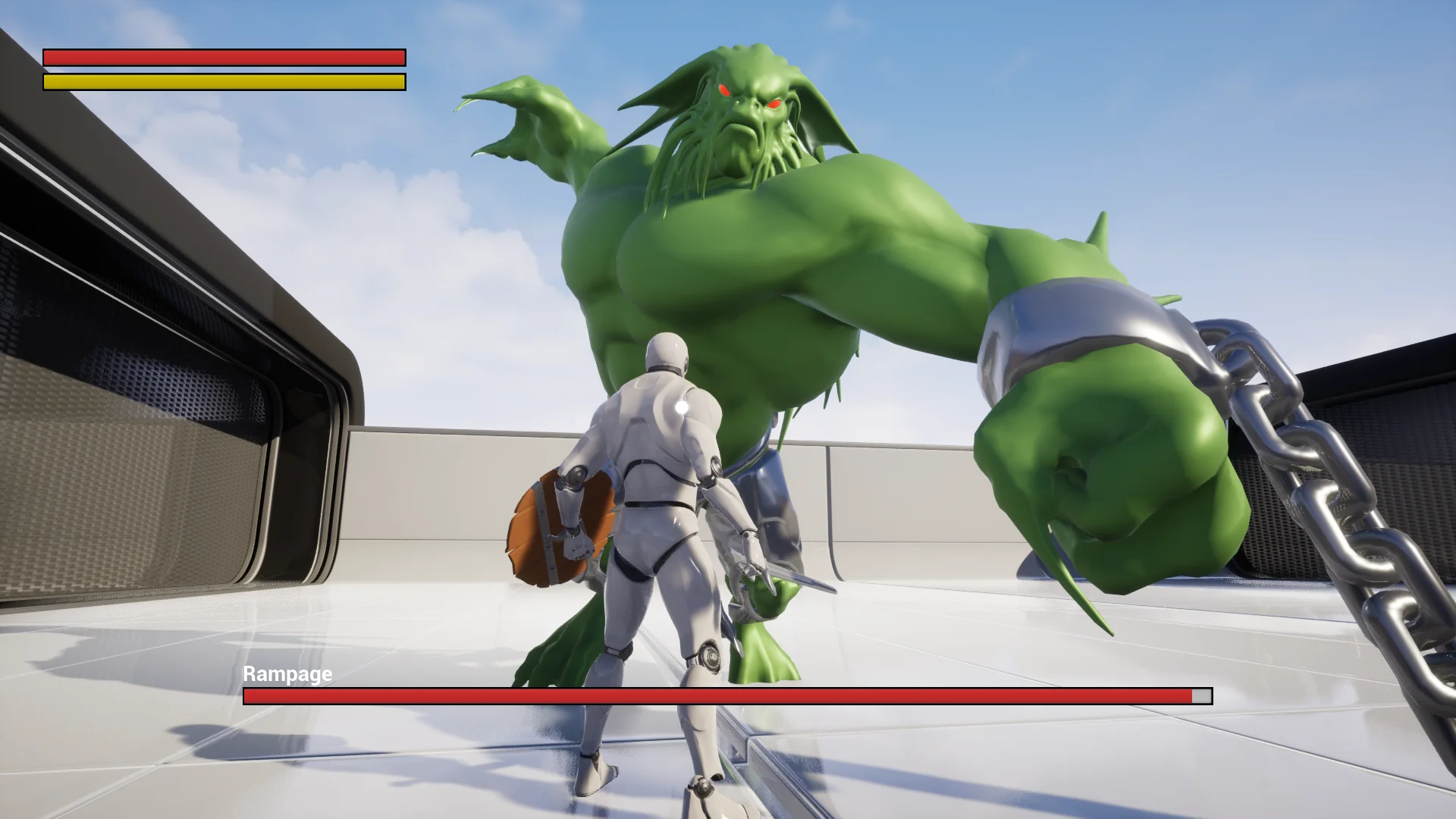
Create multi-phase boss encounters in Unreal Engine using the Boss AI Toolkit. Features a modular Ability system, Blueprint logic, and MMO raid design.
Integrating the Boss AI Toolkit into Custom Projects
Bringing an encounter framework into an active production requires a clear boundary between incoming AI logic and pre-existing character systems. The Boss AI Toolkit is structured specifically with existing projects in mind, enabling developers to introduce dedicated boss encounters without discarding their current player code. Rather than enforcing an all-in-one game template, the architecture allows teams to retain their established player characters, movement setups, and interaction mechanics while pointing the toolkit's artificial intelligence directly at those existing player targets.
During initial setup, project configuration relies partly on Epic demo content to function. This dependency means that standard sample assets and foundational dependencies must be present within the project environment before instantiating the toolkit assets. Incorporating the system into an established codebase revolves around identifying the points where player characters communicate threat or presence to the enemy artificial intelligence. Because the toolkit is intended to slot alongside existing pipelines, developers can treat the integration process as an additive layer, anchoring boss logic into existing levels without rebuilding core player inputs or camera controls from scratch.
Structuring Encounters with the Boss Ability System
Central to orchestrating dynamic combat pacing is the toolkit's flexible Ability system. Drawing structural cues from traditional role-playing boss battles and multiplayer raid encounters, the system centers on breaking down adversary actions into discrete attack patterns and shifting combat phases. Instead of relying on a flat, unyielding loop of simple melee strikes or basic projectile triggers, designers can configure distinct operational stages that adapt as an engagement progresses.
Phased progression gives creators direct control over dramatic pacing. When configuring an encounter, a designer can assign specialized attack patterns to trigger during distinct operational windows. For instance, early phases can focus on testing player positioning and reaction timing using measured, telegraphed offensive abilities. As encounter parameters change, the logic can transition the intelligent NPC into escalated phases where attack patterns become more intricate, aggressive, or varied. This modular approach to abilities makes it straightforward to build layered encounters that mirror the multi-stage climaxes found in dedicated RPG boss arenas and MMO raids.
Adapting Logic for Shooters, RPGs, and Raid Environments
Although encounter design often leans heavily toward fantasy role-playing mechanics, the underlying logic within the Boss AI Toolkit supports a broad spectrum of combat perspectives, ranging from third-person RPG brawlers to first-person shooters. In an FPS context, boss artificial intelligence must react cleanly to ranged weapons, ballistic engagements, and line-of-sight tracking across arena geometry. The toolkit's intelligent NPC behavior provides the decision-making backbone required to execute targeted abilities, manage spatial pressure, and close distances against players wielding firearms.
For multiplayer and raid-inspired titles, the encounter flow demands robust coordination across multiple combatants. Multiplayer environments require an artificial adversary capable of acquiring targets, cycling through diverse offensive abilities, and managing pressure across multiple active player threats. Because the design draws direct inspiration from MMO raids, the timing, telegraphing, and sequencing of attack patterns can be calibrated to reward group coordination, dodge timing, and situational awareness. Whether configuring an intimate duel for a tactical shooter or a multi-participant raid boss in an extended role-playing game, the toolkit provides the baseline decision architecture needed to drive combat interactions.
Blueprint Architecture and AI Scope Boundaries
The system is constructed using Unreal Engine Blueprints, giving technical designers and programmers an accessible visual scripting framework for managing complex behavior. Working in Blueprints simplifies the process of inspecting logic flow, tweaking ability triggers, and introducing project-specific conditions directly within the editor. Developers can trace how the boss AI evaluates target positions, initiates distinct attack phases, and cycles through its assigned ability inventory without having to step outside the visual scripting workflow.
When deploying the toolkit, understanding scope boundaries is essential. The package is fundamentally an AI framework built strictly around boss combatants. Consequently, the player character included with the system serves merely as a baseline testing harness and is explicitly not production-ready. It is not intended to substitute for dedicated, production-grade player combat systems found across the marketplace. Instead, the included character allows teams to verify ability triggers, evaluate hit reactions, and monitor phase shifts inside a test environment before routing the boss AI logic toward their actual hero characters.
Production Readiness and Maintenance Considerations
Deploying boss encounters into active pipelines involves ongoing maintenance, particularly as game systems evolve across production cycles. The toolkit has seen structured iteration through updates such as version 1.2.0 and version 1.3.0, reflecting adjustments to system behavior over time. Staying aligned with these release milestones ensures that teams leverage refinements made to ability routing, integration stability, and overall Blueprint performance.
Because the resource focuses entirely on driving intelligent enemy mechanics rather than full-game frameworks, its production role remains specialized. Teams should plan their integration by bringing their own polished player movement, health, and combat architectures, reserving the Boss AI Toolkit to govern enemy intelligence, multi-phase structures, and attack sequencing. By pairing a custom player combat framework with the toolkit's configurable Ability system and Blueprint-driven encounter logic, developers gain a dedicated foundation for producing challenging, phase-driven boss battles tailored to both single-player campaigns and multiplayer cooperative arenas.
 Gameplay Features
 Gameplay Features
 Gameplay Features