"e9c335e082208b17"{"id":"1002879","slug":"advance-female-customization","title":"Advance Female Customization","category":"Characters \u0026 Creatures","engine":"5.0+","assetVersion":"","engineVersion":"Engine Version: 5.0+","tag":"Characters","accent":"blue","visual":"character","summary":"Create diverse character rosters in Unreal Engine with Advance Female Customization, featuring 30+ outfits, body shaping, and runtime presets.","platform":"Unreal Engine","indexPolicy":"index","publishedAt":"2026-11-21T01:41:07.470Z","updatedAt":"2026-11-21T01:41:07.470Z","sourceNotes":[],"fileContents":[],"compatibility":["Unreal Engine","Engine Version: 5.0+"],"featuredImage":{"alt":"Advance Female Customization","src":"/wp-content/uploads/published/2026/11/8839d7cda0a4-faaf9963-392c-41f4-8647-7a7720a9c2f6-c22b8cb523.webp"},"fileSizeBytes":625419135,"hasDownloadLink":true,"downloads":0,"terms":[{"taxonomy":"category","slug":"characters-and-creatures","name":"Characters \u0026 Creatures"}],"galleryImages":[{"src":"/wp-content/uploads/published/2026/11/0720150304b6-0c32a3b4-0b99-4dbf-ab94-e1683040ef7c-11b3720be6.webp","alt":"Advance Female Customization"},{"src":"/wp-content/uploads/published/2026/11/7cdf65427cbd-8a664a73-d2ed-4252-a5ae-cd1881a46f52-28bfd93a7b.webp","alt":"Advance Female Customization"},{"src":"/wp-content/uploads/published/2026/11/9e005421f531-7241fd53-3f03-48d9-a2c1-c0f760f34e27-6989c3b8ec.webp","alt":"Advance Female Customization"},{"src":"/wp-content/uploads/published/2026/11/e37725ae870b-2067a077-e9a7-4749-8384-497238bae0f7-9ee2cc741e.webp","alt":"Advance Female Customization"},{"src":"/wp-content/uploads/published/2026/11/64b1195ec926-781836b4-1b6d-4232-ad4e-930f6d99a1d6-c9edab1486.webp","alt":"Advance Female Customization"},{"src":"/wp-content/uploads/published/2026/11/4f37badcfa95-3536ece5-6d31-408b-b4a7-e09a527fa11b-1e7c44915a.webp","alt":"Advance Female Customization"},{"src":"/wp-content/uploads/published/2026/11/9a02478055ce-fb6482ff-aad6-4cd8-94c6-010a86894364-9f3b5d4138.webp","alt":"Advance Female Customization"},{"src":"/wp-content/uploads/published/2026/11/6a11b515d1e7-780ef9a5-fefb-4337-9f08-890544d44f12-f9a9bbf2ea.webp","alt":"Advance Female Customization"},{"src":"/wp-content/uploads/published/2026/11/68890d888ec1-7f9f7182-b18c-482f-938e-7434530b0aa1-f18073ac70.webp","alt":"Advance Female Customization"},{"src":"/wp-content/uploads/published/2026/11/a310121c883b-5fdce591-68d7-4e48-a8f1-c4709e1365ab-b7c962884f.webp","alt":"Advance Female Customization"}],"contentHtml":"\u003ch2\u003ePopulating Medieval and Action Casts with Advance Female Customization\u003c/h2\u003e\u003cp\u003ePopulating an interactive world often demands hundreds of believable figures without repeating recognizable silhouettes. Whether building crowded medieval market squares, covert guildhalls filled with deadly assassins, or mountain strongholds guarded by disciplined ninjas, character variation dictates environmental credibility. Advance Female Customization addresses this challenge by providing an integrated framework to generate female character models across diverse historical and stylized genres without leaving Unreal Engine.\u003c/p\u003e\u003cp\u003eInstead of manually sculpting distinct body meshes or switching between multiple third-party authoring tools, artists can rely on the system to derive distinct personalities from a unified foundation. A quiet village scene can feature dozens of unique maidens, each displaying subtle shifts in posture, stature, and styling. The same core system adapts just as easily to high-stakes action scenes where agility, stealth, and lethal discipline require tailored combat garments and athletic profiles. Because the setup handles wide aesthetic shifts, production teams can build entire factions, wandering civilian populations, or elite strike teams using consistent structural logic.\u003c/p\u003e\u003ch2\u003eSculpting Facial Features, Cosmetic Details, and Female Anatomy\u003c/h2\u003e\u003cp\u003eCharacter identity begins at the head, where fine-grained facial adjustments determine age, ethnicity, and expressive tone. The built-in face modification controls allow developers to alter structural geometry directly, preventing background crowds and key secondary characters from sharing identical contours. Beyond bone structure and facial proportions, surface treatments establish personal history and immediate context. The tool includes dedicated options for applying cosmetics and grime, giving artists the freedom to switch between pristine courtly makeup and mud-caked battlefield wear.\u003c/p\u003e\u003cp\u003eA stealth operative stalking a target through woodland terrain benefits from layers of dirt and muted surface tones, grounding the character in the surrounding climate. Conversely, a noblewoman presiding over a castle banquet demands elaborate cosmetic highlights and immaculate skin rendering. Layering these surface details transforms the base geometry without requiring separate material instances hand-painted in external software.\u003c/p\u003e\u003cp\u003eAnatomy controls extend through the full body, offering adjustable height and weight parameters alongside regional shaping for the torso and limbs. Developers can define slender, swift couriers, burly blacksmiths, or imposing warrior figures simply by adjusting body sliders. These modifications maintain anatomical balance across the female form, ensuring that changes to stature or mass deform realistically rather than stretching or distorting surface features unpredictably.\u003c/p\u003e\u003ch2\u003eWardrobe Assembly and In-Engine Customization of Meshes\u003c/h2\u003e\u003cp\u003eCostuming defines an era as much as architectural design or environmental foliage. Advance Female Customization includes a modular library containing over 30 clothing meshes, allowing creators to assemble outfits that match their narrative needs. Garments can be combined to reflect peasant attire, hooded assassin gear, lightweight ninja uniforms, or layered period dress. The modular breakdown ensures individual wardrobe elements can be mixed and matched across character archetypes without clipping errors or geometric misalignment.\u003c/p\u003e\u003cp\u003eComplementing the garment meshes is an in-engine texturing tool that lets developers paint, recolor, and texture all apparel directly inside the Unreal Engine viewport. Rather than returning to standalone texturing programs to swap wool patterns for dyed silk or alter the leather sheen on a scabbard belt, material adjustments happen live in the scene. This immediate feedback loop accelerates the visual tuning process, allowing teams to align garment tones with scene lighting conditions instantly.\u003c/p\u003e\u003cp\u003eHairstyles complete the physical silhouette. The system provides 6 distinct hair meshes that configure into up to 12 unique hairstyles. By cycling through these variations, creators can pair braided arrangements with ornate gowns, tie back locks for combat utility, or drop strands loosely around the shoulders to suit casual civilian roles.\u003c/p\u003e\u003ch2\u003eManaging 10,000 Presets Across Editor and In-Game Systems\u003c/h2\u003e\u003cp\u003eWith thousands of permutations possible across facial meshes, body weights, apparel combinations, and surface colors, asset organization becomes a central priority. The platform allows users to generate over 10,000 unique character presets through a single centralized tool. Rather than locking these permutations behind static visual configurations, the system integrates a robust preset management workflow that functions seamlessly in both editor viewports and live runtime environments.\u003c/p\u003e\u003cp\u003eDuring level assembly, world designers can load saved presets from the editor to dress historical settlements and populate castles with varied populations in minutes. Because presets can also be saved and loaded in-game, developers working on role-playing games or action titles can hook the system directly into player-facing character creation menus. Players can select hair styles, adjust height, apply makeup, and select wardrobe textures on the fly, with all underlying data managed consistently by the tool's runtime logic.\u003c/p\u003e\u003ch2\u003eBlueprint Pipeline and Single Migrate Node Deployment\u003c/h2\u003e\u003cp\u003eTechnical integration often creates friction when merging third-party character frameworks into established game architectures. Advance Female Customization avoids complex pipeline setups by organizing its underlying systems within clean Blueprint and Animation Blueprint networks. These scripts govern the parameter handling, skeletal binding, and mesh swapping necessary to keep customized figures responsive to player input and animation controllers.\u003c/p\u003e\u003cp\u003eTransferring the framework into an active production environment requires minimal overhead. Characters and their corresponding systems import into existing codebases using a single Migrate Node, preventing broken asset references or missing material dependencies. The complete inclusion of source files provides technical artists and gameplay programmers with full visibility into how variables, morph targets, and clothing instances interact. Teams can inspect the script logic, hook custom animation sets into the Animation Blueprint, or expand the parameter array to accommodate specialized gameplay features.\u003c/p\u003e\u003cp\u003eWhether tasked with building an army of varied medieval warriors, orchestrating a diverse cast of covert operatives, or implementing a complete runtime hero editor, developers gain an all-in-one character production workflow anchored entirely within Unreal Engine.\u003c/p\u003e\n\n\u003ch2\u003eExplore Similar Assets\u003c/h2\u003e\n\u003cul\u003e\n\u003cli\u003e\u003ca href=\"https://3dcghub.com/character-customization-female/\" rel=\"noopener noreferrer\"\u003eCharacter Customization: Female\u003c/a\u003e\u003c/li\u003e\n\u003cli\u003e\u003ca href=\"https://3dcghub.com/sci-fi-assault-trooper/\" rel=\"noopener noreferrer\"\u003eSci-Fi Assault Trooper\u003c/a\u003e\u003c/li\u003e\n\u003cli\u003e\u003ca href=\"https://3dcghub.com/f2-cyber-girl-davina/\" rel=\"noopener noreferrer\"\u003eF2 Cyber Girl Davina\u003c/a\u003e\u003c/li\u003e\n\u003cli\u003e\u003ca href=\"https://3dcghub.com/cyberpunk-girl/\" rel=\"noopener noreferrer\"\u003eCyberpunk Girl\u003c/a\u003e\u003c/li\u003e\n\u003cli\u003e\u003ca href=\"https://3dcghub.com/modular-medieval-npc-metahuman-male-female/\" rel=\"noopener noreferrer\"\u003eModular Medieval NPC - Metahuman - Male/Female\u003c/a\u003e\u003c/li\u003e\n\u003c/ul\u003e","contentTextLength":6924,"navigation":{"current":56,"total":4839,"previous":{"id":"1002880","slug":"boss-ai-toolkit","title":"Boss AI Toolkit","category":"Gameplay Features","platform":"Unreal Engine","updatedAt":"2026-11-21T01:42:35.865Z"},"next":{"id":"1002878","slug":"ai-turret-component","title":"AI Turret Component","category":"Weapons \u0026 Combat","platform":"Unreal Engine","updatedAt":"2026-11-21T01:40:08.769Z"}},"relatedResources":[{"id":"1854","slug":"character-customization-female","title":"Character Customization: Female","category":"Characters \u0026 Creatures","engine":"5.2+","assetVersion":"Engine version: 5.2+","engineVersion":"4.19","tag":"Characters","accent":"blue","visual":"character","summary":"Create unique NPCs and player characters with this advanced female customization system. Features 50+ face morphs, body shapes, and a robust save/load system.","platform":"Unreal Engine","indexPolicy":"noindex","publishedAt":"2026-02-06T22:09:35.000Z","updatedAt":"2026-04-19T15:58:28.000Z","sourceNotes":[],"fileContents":[],"compatibility":["Unreal Engine","Engine version: 5.2+"],"featuredImage":{"alt":"Character Customization: Female","src":"https://3dcghub.com/wp-content/uploads/2026/02/433c0f6e-b22e-49d7-a1f0-cb276d75fc46.webp"},"fileSizeBytes":1514098708,"hasDownloadLink":true,"downloads":2},{"id":"3398","slug":"sci-fi-assault-trooper","title":"Sci-Fi Assault Trooper","category":"Characters \u0026 Creatures","engine":"4.26,5.0+","assetVersion":"Engine version: 4.26,5.0+","engineVersion":"4.22","tag":"Characters","accent":"blue","visual":"character","summary":"Enhance your futuristic project with the Sci-Fi Assault Trooper pack. Features 10 modular meshes, male and female soldiers, and customizable materials.","platform":"Unreal Engine","indexPolicy":"noindex","publishedAt":"2026-02-09T07:00:56.000Z","updatedAt":"2026-04-19T15:57:39.000Z","sourceNotes":[],"fileContents":[],"compatibility":["Unreal Engine","Engine version: 4.26,5.0+"],"featuredImage":{"alt":"Sci-Fi Assault Trooper","src":"https://3dcghub.com/wp-content/uploads/2026/02/578e5358-c676-457f-b5e4-9b852865255f.webp"},"fileSizeBytes":589242342,"hasDownloadLink":true,"downloads":2},{"id":"2307","slug":"f2-cyber-girl-davina","title":"F2 Cyber Girl Davina","category":"Characters \u0026 Creatures","engine":"4.27,5.0+","assetVersion":"Engine version: 4.27,5.0+","engineVersion":"4.27","tag":"Characters","accent":"blue","visual":"character","summary":"Enhance your game with F2 Cyber Girl Davina. This modular Unreal Engine character features ARkit blendshapes, Epic Skeleton rigging, and full customization.","platform":"Unreal Engine","indexPolicy":"noindex","publishedAt":"2026-02-07T09:01:16.000Z","updatedAt":"2026-04-19T15:58:03.000Z","sourceNotes":[],"fileContents":[],"compatibility":["Unreal Engine","Engine version: 4.27,5.0+"],"featuredImage":{"alt":"F2 Cyber Girl Davina","src":"https://3dcghub.com/wp-content/uploads/2026/02/fce4b9a4-5695-4f8c-a9f1-ded481db34f6.webp"},"fileSizeBytes":861945280,"hasDownloadLink":true,"downloads":0}]}
Resource screenshots
1 / 10
Join our channel
Follow 3DCGHUB on Telegram for new resource drops, migration updates, and community notices.
Populating Medieval and Action Casts with Advance Female Customization
Populating an interactive world often demands hundreds of believable figures without repeating recognizable silhouettes. Whether building crowded medieval market squares, covert guildhalls filled with deadly assassins, or mountain strongholds guarded by disciplined ninjas, character variation dictates environmental credibility. Advance Female Customization addresses this challenge by providing an integrated framework to generate female character models across diverse historical and stylized genres without leaving Unreal Engine.
Instead of manually sculpting distinct body meshes or switching between multiple third-party authoring tools, artists can rely on the system to derive distinct personalities from a unified foundation. A quiet village scene can feature dozens of unique maidens, each displaying subtle shifts in posture, stature, and styling. The same core system adapts just as easily to high-stakes action scenes where agility, stealth, and lethal discipline require tailored combat garments and athletic profiles. Because the setup handles wide aesthetic shifts, production teams can build entire factions, wandering civilian populations, or elite strike teams using consistent structural logic.
Sculpting Facial Features, Cosmetic Details, and Female Anatomy
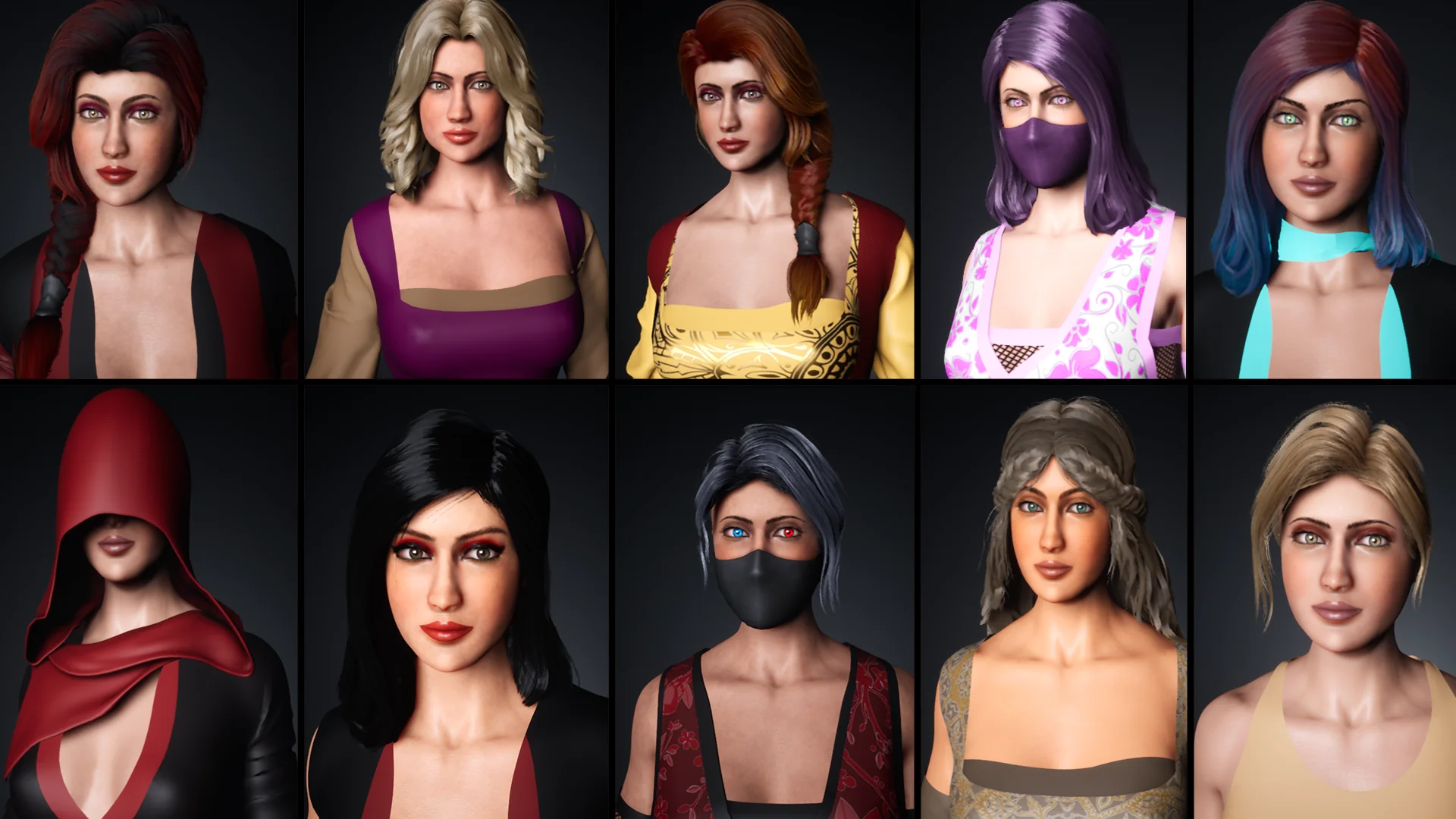
Character identity begins at the head, where fine-grained facial adjustments determine age, ethnicity, and expressive tone. The built-in face modification controls allow developers to alter structural geometry directly, preventing background crowds and key secondary characters from sharing identical contours. Beyond bone structure and facial proportions, surface treatments establish personal history and immediate context. The tool includes dedicated options for applying cosmetics and grime, giving artists the freedom to switch between pristine courtly makeup and mud-caked battlefield wear.
A stealth operative stalking a target through woodland terrain benefits from layers of dirt and muted surface tones, grounding the character in the surrounding climate. Conversely, a noblewoman presiding over a castle banquet demands elaborate cosmetic highlights and immaculate skin rendering. Layering these surface details transforms the base geometry without requiring separate material instances hand-painted in external software.
Anatomy controls extend through the full body, offering adjustable height and weight parameters alongside regional shaping for the torso and limbs. Developers can define slender, swift couriers, burly blacksmiths, or imposing warrior figures simply by adjusting body sliders. These modifications maintain anatomical balance across the female form, ensuring that changes to stature or mass deform realistically rather than stretching or distorting surface features unpredictably.
Wardrobe Assembly and In-Engine Customization of Meshes
Costuming defines an era as much as architectural design or environmental foliage. Advance Female Customization includes a modular library containing over 30 clothing meshes, allowing creators to assemble outfits that match their narrative needs. Garments can be combined to reflect peasant attire, hooded assassin gear, lightweight ninja uniforms, or layered period dress. The modular breakdown ensures individual wardrobe elements can be mixed and matched across character archetypes without clipping errors or geometric misalignment.
Complementing the garment meshes is an in-engine texturing tool that lets developers paint, recolor, and texture all apparel directly inside the Unreal Engine viewport. Rather than returning to standalone texturing programs to swap wool patterns for dyed silk or alter the leather sheen on a scabbard belt, material adjustments happen live in the scene. This immediate feedback loop accelerates the visual tuning process, allowing teams to align garment tones with scene lighting conditions instantly.
Hairstyles complete the physical silhouette. The system provides 6 distinct hair meshes that configure into up to 12 unique hairstyles. By cycling through these variations, creators can pair braided arrangements with ornate gowns, tie back locks for combat utility, or drop strands loosely around the shoulders to suit casual civilian roles.
Managing 10,000 Presets Across Editor and In-Game Systems
With thousands of permutations possible across facial meshes, body weights, apparel combinations, and surface colors, asset organization becomes a central priority. The platform allows users to generate over 10,000 unique character presets through a single centralized tool. Rather than locking these permutations behind static visual configurations, the system integrates a robust preset management workflow that functions seamlessly in both editor viewports and live runtime environments.
During level assembly, world designers can load saved presets from the editor to dress historical settlements and populate castles with varied populations in minutes. Because presets can also be saved and loaded in-game, developers working on role-playing games or action titles can hook the system directly into player-facing character creation menus. Players can select hair styles, adjust height, apply makeup, and select wardrobe textures on the fly, with all underlying data managed consistently by the tool's runtime logic.
Blueprint Pipeline and Single Migrate Node Deployment
Technical integration often creates friction when merging third-party character frameworks into established game architectures. Advance Female Customization avoids complex pipeline setups by organizing its underlying systems within clean Blueprint and Animation Blueprint networks. These scripts govern the parameter handling, skeletal binding, and mesh swapping necessary to keep customized figures responsive to player input and animation controllers.
Transferring the framework into an active production environment requires minimal overhead. Characters and their corresponding systems import into existing codebases using a single Migrate Node, preventing broken asset references or missing material dependencies. The complete inclusion of source files provides technical artists and gameplay programmers with full visibility into how variables, morph targets, and clothing instances interact. Teams can inspect the script logic, hook custom animation sets into the Animation Blueprint, or expand the parameter array to accommodate specialized gameplay features.
Whether tasked with building an army of varied medieval warriors, orchestrating a diverse cast of covert operatives, or implementing a complete runtime hero editor, developers gain an all-in-one character production workflow anchored entirely within Unreal Engine.
 Characters
 Characters
 Characters