"c68a05d5e51405b3"{"id":"1001875","slug":"defender-melee-combat","title":"Defender: Melee Combat","category":"Gameplay Features","engine":"5.4+","assetVersion":"","engineVersion":"Engine Version: 5.4+","tag":"Gameplay Features","accent":"blue","visual":"mech","summary":"A melee combat starter template built across 110+ Blueprints, featuring event-driven components, enemy AI, visual feedback, and partitioned save systems.","platform":"Unreal Engine","publishedAt":"2026-10-22T11:17:54.526Z","updatedAt":"2026-10-22T11:17:54.526Z","sourceNotes":[],"fileContents":[],"compatibility":["Unreal Engine","Engine Version: 5.4+"],"featuredImage":{"alt":"Defender: Melee Combat","src":"/wp-content/uploads/published/2026/10/87f226ec89c3-35fa5e37-d655-4036-a9fa-d931c94c364b-347c63b4a2.webp"},"hasDownloadLink":true,"downloads":0,"terms":[{"taxonomy":"category","slug":"gameplay-features","name":"Gameplay Features"}],"galleryImages":[{"src":"/wp-content/uploads/published/2026/10/0e47c5ca5d46-8ebf889f-2a59-44e0-8bb9-6e052519eeae-7fbb583456.webp","alt":"Defender: Melee Combat"},{"src":"/wp-content/uploads/published/2026/10/92e8954205e8-7a738c69-492a-4e44-93f7-c95e9d278dc4-c28fc19ea5.webp","alt":"Defender: Melee Combat"},{"src":"/wp-content/uploads/published/2026/10/92c52b59c051-51ad8d48-4f61-4a62-a3e0-5130d54abc67-26a2ea951f.webp","alt":"Defender: Melee Combat"},{"src":"/wp-content/uploads/published/2026/10/3ec35f654b05-4373ac86-d6c1-4424-ba91-63feb35f76cf-1981e4bc76.webp","alt":"Defender: Melee Combat"},{"src":"/wp-content/uploads/published/2026/10/304375f4d197-d7c7a641-1a63-4e72-aefe-d08a2b40a50a-ab4f7c94e3.webp","alt":"Defender: Melee Combat"},{"src":"/wp-content/uploads/published/2026/10/e3cc35d5b4c2-feba1021-4851-43ed-81a0-be0f9d33bb6f-308eb5966a.webp","alt":"Defender: Melee Combat"},{"src":"/wp-content/uploads/published/2026/10/d59d9ea1033f-4c578f40-2380-409b-a026-aacc035369b5-2791fb7e2b.webp","alt":"Defender: Melee Combat"},{"src":"/wp-content/uploads/published/2026/10/21066cf59cf3-c1343bbc-cc13-4d92-8358-66590e37c4f7-5fcb4c2cb7.webp","alt":"Defender: Melee Combat"},{"src":"/wp-content/uploads/published/2026/10/168d5522d427-22e09806-19aa-43cd-8745-e086929531c6-abbd7eca4a.webp","alt":"Defender: Melee Combat"}],"accessPanel":{"kind":"resource","title":"Download this resource","eyebrow":"Free Download","message":"Log in or create a free account to start your download.","fileName":"Defender Melee Combat.7z","safetyNote":"Resources are manually reviewed before listing to improve quality and reduce obvious risks.","actionLabel":"Download Free","resourceType":"Resource archive"},"contentHtml":"\u003ch2\u003eConstructing Close-Quarters Encounters in Action Environments\u003c/h2\u003e\u003cp\u003eThird-person action arenas, dungeon crawls, and hostile alien landscapes demand responsive physical interactions when weapons connect. Implementing melee mechanics into these environments requires tight orchestration between character position, swing timing, hit registration, and reaction cues. Rather than forcing creators to assemble these interconnected mechanics piece by piece, an established combat template provides the core framework required to stage immediate battles between player characters and hostile swarms.\u003c/p\u003e\u003cp\u003eA fully set up playable demo level demonstrates these encounters directly, utilizing Paragon's Gideon as the player-controlled character. Within this playable space, combat revolves around physical engagements with distinct enemy types. Player strikes, defensive maneuvers, and positioning are tested against small-scale gruntlings, agile spiderlings, and an imposing spider boss encounter. The included environment and encounters offer a practical reference for staging balanced combat arenas, pacing enemy wave compositions, and organizing encounter geometry to support deliberate melee engagements.\u003c/p\u003e\u003ch2\u003eDefender: Melee Combat Architecture and Event-Driven Logic\u003c/h2\u003e\u003cp\u003eUnderpinning the framework is a collection of over 110 fully commented Blueprints. The implementation avoids brittle dependencies by relying strictly on component-based architecture and event-driven logic. In standard combat development, referencing different actors frequently leads to heavy casting chains, where character blueprints constantly cast to game modes, user interface widgets, weapon actors, and target entities. This template replaces expensive casting operations with event-driven notifications, keeping logic execution light and modular across all participating entities.\u003c/p\u003e\u003cp\u003eBecause the logic is separated into standalone actor components, developers can detach individual mechanics and drop them into existing character hierarchies or entirely separate game genres. The underlying code structure has been deployed and battle-tested within multiple complete game frameworks, including Voyager: Third Person Shooter Template (compatible with version 3), Defender: Top Down Shooter Template, and Defender: Side Scroller Shooter Kit. The educational blueprint design serves as both an out-of-the-box gameplay framework and an architectural learning resource, offering clear examples of how to construct clean, scalable gameplay logic without performance-draining cross-blueprint dependencies.\u003c/p\u003e\u003ch2\u003eDamageFlashComp, DissolveComp, and Visual Feedback Systems\u003c/h2\u003e\u003cp\u003eCombat feel relies heavily on how game entities communicate state changes to the player. When a blade strikes an opponent, the interaction must produce instant readability. This package includes a specialized suite of gameplay components focused entirely on surface-level visual feedback, hit reactions, and spatial awareness.\u003c/p\u003e\u003cp\u003eImmediate visual responses are handled through targeted utility components:\u003c/p\u003e\u003cul\u003e\u003cli\u003e\u003cstrong\u003eDamageFlashComp:\u003c/strong\u003e Drives an actor flash effect across the target's material whenever damage events are registered, providing instantaneous confirmation of successful hits.\u003c/li\u003e\u003cli\u003e\u003cstrong\u003eDissolveComp:\u003c/strong\u003e Executes a material-based dissolve across character meshes upon death or defeat, streamlining the visual transition of defeated entities out of the active combat space.\u003c/li\u003e\u003cli\u003e\u003cstrong\u003eFadeMeshComp:\u003c/strong\u003e Automatically manages mesh transparency when environmental geometry or foreground objects block the camera's line of sight to the main character.\u003c/li\u003e\u003cli\u003e\u003cstrong\u003eDynamic HP Bar Component:\u003c/strong\u003e Adds a responsive health bar to any actor within a few clicks, complete with a lazy-bar interpolation effect that visually lags behind immediate damage to emphasize the quantity of health lost.\u003c/li\u003e\u003cli\u003e\u003cstrong\u003eDamage Text Display:\u003c/strong\u003e Projects improved floating combat text directly above affected targets to display numeric damage outputs.\u003c/li\u003e\u003cli\u003e\u003cstrong\u003eMesh Outline Material:\u003c/strong\u003e Generates distinct outlines around meshes to visually separate loot drops, interactive items, and characters from the background scenery.\u003c/li\u003e\u003c/ul\u003e\u003ch2\u003eEnemy AI Behavior Trees and Combat Opponents\u003c/h2\u003e\u003cp\u003eHostile encounters inside the project rely on Unreal Engine behavior trees to govern enemy decision-making, spatial evaluation, and attack execution. Instead of basic tracking logic, the built-in enemy AI coordinates approach routines, attack intervals, and target tracking suited to distinct combat roles.\u003c/p\u003e\u003cp\u003eThe package details three distinct combat adversaries out of the box. Gruntlings handle basic melee pressure, closing the gap to execute straightforward strikes. Spiderlings introduce faster, lower-profile threats that flank and test the player's spatial control. Dominating the encounter setup is the spider boss, which combines higher health pools with dedicated attack routines to challenge defensive positioning and combo timing. Each enemy profile functions through the central combat component pipeline, allowing creators to inspect how behavior tree tasks trigger weapon collision sweeps, trigger damage events, and process incoming player counter-attacks.\u003c/p\u003e\u003ch2\u003eUI Management and the Partitioned Save/Load System\u003c/h2\u003e\u003cp\u003eData persistence and interface communication operate alongside the moment-to-moment combat mechanics. The project incorporates a partitioned Save/Load system, isolating player progression, state flags, and persistent world data into distinct segments. This compartmentalized data structure prevents file bloat, reduces serialization overhead, and makes adding new saved variables straightforward as a game expands.\u003c/p\u003e\u003cp\u003eOn-screen messaging is managed via a dedicated multi-message feature capable of processing and stacking multiple in-game notifications efficiently without UI clutter. To support standardized modern menus, navigation, and input handling, the project requires Epic Games' free Common UI Plugin. Furthermore, the demonstration sandbox draws upon various assets distributed freely by Epic Games—including elements from Lyra, Paragon, Action RPG, Content Examples, Animation Starter Pack, and Infinity Blade: Weapons and Grasslands—to present an end-to-end combat loop complete with swords, axes, combo mechanics, and integrated UMG interface widgets.\u003c/p\u003e\u003ch2\u003eImplementation Precautions and Project Fit\u003c/h2\u003e\u003cp\u003eThis melee package fits teams seeking a modular, Blueprint-only combat foundation that avoids C++ compilation steps while maintaining strict architectural hygiene. It is equally suited for creators who want to build a complete melee-focused action title from scratch or those who need to extract specific elements—such as the lazy-bar health system, camera mesh fading, or behavior tree combat AI—into an ongoing production.\u003c/p\u003e\u003cp\u003eWhen updating to newer versions of the template, creators should establish a clean backup of their existing project before overwriting any files to safeguard custom component modifications. With its modular structure, clean component separation, and comprehensive feedback tools, the package offers a stable starting point for building fluid, readable, and responsive close-quarters combat mechanics.\u003c/p\u003e\n\n\u003ch2\u003eRelated Resources Worth Checking\u003c/h2\u003e\n\u003cul\u003e\n\u003cli\u003e\u003ca href=\"https://3dcghub.com/close-combat-swordsman/\" title=\"Close Combat: Swordsman\"\u003eClose Combat: Swordsman\u003c/a\u003e\u003c/li\u003e\n\u003cli\u003e\u003ca href=\"https://3dcghub.com/smart-ai/\" title=\"Smart AI\"\u003eSmart AI\u003c/a\u003e\u003c/li\u003e\n\u003cli\u003e\u003ca href=\"https://3dcghub.com/inventory-system-pro-by-moonville/\" title=\"Inventory System Pro by Moonville\"\u003eInventory System Pro by Moonville\u003c/a\u003e\u003c/li\u003e\n\u003cli\u003e\u003ca href=\"https://3dcghub.com/character-interaction/\" title=\"Character Interaction\"\u003eCharacter Interaction\u003c/a\u003e\u003c/li\u003e\n\u003cli\u003e\u003ca href=\"https://3dcghub.com/open-world-audio-system/\" title=\"Open World Audio System\"\u003eOpen World Audio System\u003c/a\u003e\u003c/li\u003e\n\u003c/ul\u003e","contentTextLength":7179,"navigation":{"current":50,"total":3860,"previous":{"id":"1001876","slug":"destruction-system","title":"Destruction System","category":"Weapons \u0026 Combat","platform":"Unreal Engine","updatedAt":"2026-10-22T11:18:28.834Z"},"next":{"id":"1001874","slug":"dark-forest","title":"Dark Forest","category":"Forest \u0026 Jungle","platform":"Unreal Engine","updatedAt":"2026-10-22T11:16:29.587Z"}},"relatedResources":[{"id":"1000803","slug":"close-combat-swordsman","title":"Close Combat: Swordsman","category":"Gameplay Features","engine":"5.0+","assetVersion":"","engineVersion":"Engine Version: 5.0+","tag":"Gameplay Features","accent":"blue","visual":"mech","summary":"Close Combat: Swordsman builds a combat, movement, leveling, and skill template for action games, RPGs, slashers, and fighting games with melee swordplay system","platform":"Unreal Engine","publishedAt":"2026-07-30T23:17:13.049Z","updatedAt":"2026-07-30T23:17:13.049Z","sourceNotes":[],"fileContents":[],"compatibility":["Unreal Engine","Engine Version: 5.0+"],"featuredImage":{"alt":"Close Combat: Swordsman","src":"/wp-content/uploads/published/2026/07/538fb59b9a20-d1fddabc-3782-4bdd-83c2-39e1f39f2c83-1d9aab6c4b.webp"},"hasDownloadLink":true,"downloads":2},{"id":"11105","slug":"smart-ai","title":"Smart AI","category":"Gameplay Features","engine":"4.27,5.0+","assetVersion":"Engine version: 4.27,5.0+","engineVersion":"4.26","tag":"Gameplay Features","accent":"blue","visual":"city","summary":"Enhance your project with Smart AI, a versatile system offering 15 unique behaviors and full multiplayer support. It includes melee and ranged combat, specialized AI types, and advanced optimization tools.","platform":"Unreal Engine","publishedAt":"2026-03-03T16:56:50.000Z","updatedAt":"2026-04-19T15:49:49.000Z","sourceNotes":[],"fileContents":[],"compatibility":["Unreal Engine","Engine version: 4.27,5.0+"],"featuredImage":{"alt":"Smart AI","src":"https://3dcghub.com/wp-content/uploads/2026/03/3e6175a6-1ad0-4a6a-aa6a-a60785237185.webp"},"hasDownloadLink":true,"downloads":1},{"id":"1001617","slug":"inventory-system-pro-by-moonville","title":"Inventory System Pro by Moonville","category":"Gameplay Features","engine":"5.4+","assetVersion":"","engineVersion":"Engine Version: 5.4+","tag":"Gameplay Features","accent":"blue","visual":"mech","summary":"Inventory System Pro delivers a Blueprint-only toolkit featuring uniform and jigsaw grids, survival mechanics, and combat equipment for Unreal Engine.","platform":"Unreal Engine","publishedAt":"2026-10-11T01:45:57.813Z","updatedAt":"2026-10-11T01:45:57.813Z","sourceNotes":[],"fileContents":[],"compatibility":["Unreal Engine","Engine Version: 5.4+"],"featuredImage":{"alt":"Inventory System Pro by Moonville","src":"/wp-content/uploads/published/2026/10/cff3dc4ff029-f198679a-e82f-4dd8-b6af-a92f2cff2487-78f73d85b7.webp"},"hasDownloadLink":true,"downloads":1}]}
Gameplay Features
Defender: Melee Combat
A melee combat starter template built across 110+ Blueprints, featuring event-driven components, enemy AI, visual feedback, and partitioned save systems.
Constructing Close-Quarters Encounters in Action Environments
Third-person action arenas, dungeon crawls, and hostile alien landscapes demand responsive physical interactions when weapons connect. Implementing melee mechanics into these environments requires tight orchestration between character position, swing timing, hit registration, and reaction cues. Rather than forcing creators to assemble these interconnected mechanics piece by piece, an established combat template provides the core framework required to stage immediate battles between player characters and hostile swarms.
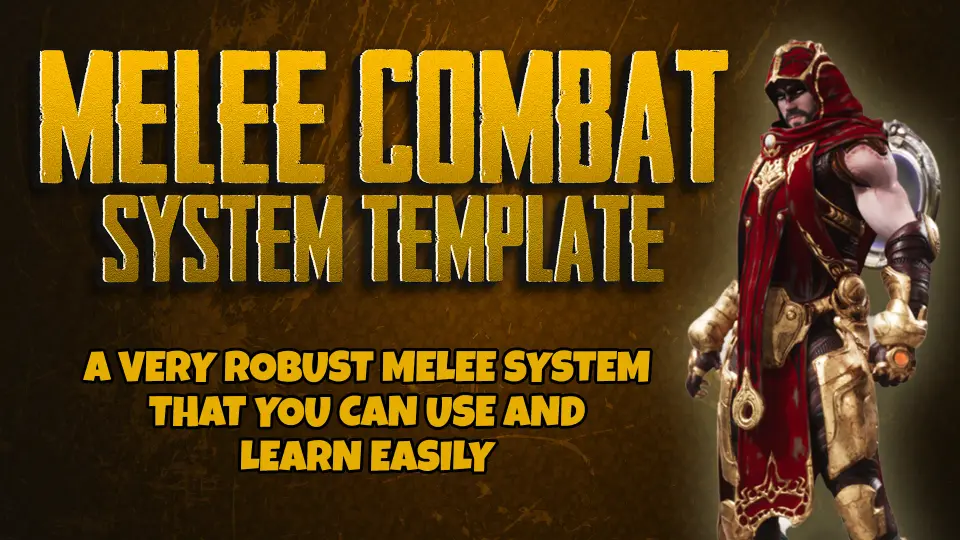
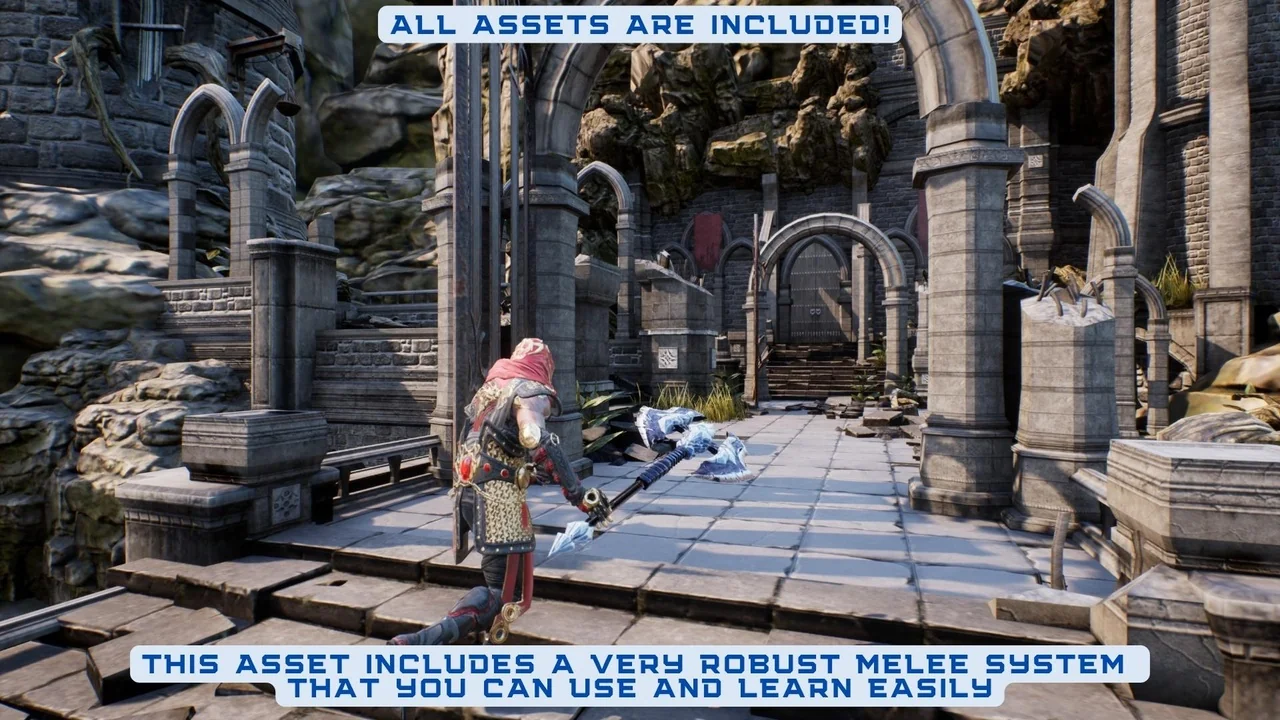
A fully set up playable demo level demonstrates these encounters directly, utilizing Paragon's Gideon as the player-controlled character. Within this playable space, combat revolves around physical engagements with distinct enemy types. Player strikes, defensive maneuvers, and positioning are tested against small-scale gruntlings, agile spiderlings, and an imposing spider boss encounter. The included environment and encounters offer a practical reference for staging balanced combat arenas, pacing enemy wave compositions, and organizing encounter geometry to support deliberate melee engagements.
Defender: Melee Combat Architecture and Event-Driven Logic
Underpinning the framework is a collection of over 110 fully commented Blueprints. The implementation avoids brittle dependencies by relying strictly on component-based architecture and event-driven logic. In standard combat development, referencing different actors frequently leads to heavy casting chains, where character blueprints constantly cast to game modes, user interface widgets, weapon actors, and target entities. This template replaces expensive casting operations with event-driven notifications, keeping logic execution light and modular across all participating entities.
Because the logic is separated into standalone actor components, developers can detach individual mechanics and drop them into existing character hierarchies or entirely separate game genres. The underlying code structure has been deployed and battle-tested within multiple complete game frameworks, including Voyager: Third Person Shooter Template (compatible with version 3), Defender: Top Down Shooter Template, and Defender: Side Scroller Shooter Kit. The educational blueprint design serves as both an out-of-the-box gameplay framework and an architectural learning resource, offering clear examples of how to construct clean, scalable gameplay logic without performance-draining cross-blueprint dependencies.
DamageFlashComp, DissolveComp, and Visual Feedback Systems
Combat feel relies heavily on how game entities communicate state changes to the player. When a blade strikes an opponent, the interaction must produce instant readability. This package includes a specialized suite of gameplay components focused entirely on surface-level visual feedback, hit reactions, and spatial awareness.
Immediate visual responses are handled through targeted utility components:
DamageFlashComp: Drives an actor flash effect across the target's material whenever damage events are registered, providing instantaneous confirmation of successful hits.
DissolveComp: Executes a material-based dissolve across character meshes upon death or defeat, streamlining the visual transition of defeated entities out of the active combat space.
FadeMeshComp: Automatically manages mesh transparency when environmental geometry or foreground objects block the camera's line of sight to the main character.
Dynamic HP Bar Component: Adds a responsive health bar to any actor within a few clicks, complete with a lazy-bar interpolation effect that visually lags behind immediate damage to emphasize the quantity of health lost.
Damage Text Display: Projects improved floating combat text directly above affected targets to display numeric damage outputs.
Mesh Outline Material: Generates distinct outlines around meshes to visually separate loot drops, interactive items, and characters from the background scenery.
Enemy AI Behavior Trees and Combat Opponents
Hostile encounters inside the project rely on Unreal Engine behavior trees to govern enemy decision-making, spatial evaluation, and attack execution. Instead of basic tracking logic, the built-in enemy AI coordinates approach routines, attack intervals, and target tracking suited to distinct combat roles.
The package details three distinct combat adversaries out of the box. Gruntlings handle basic melee pressure, closing the gap to execute straightforward strikes. Spiderlings introduce faster, lower-profile threats that flank and test the player's spatial control. Dominating the encounter setup is the spider boss, which combines higher health pools with dedicated attack routines to challenge defensive positioning and combo timing. Each enemy profile functions through the central combat component pipeline, allowing creators to inspect how behavior tree tasks trigger weapon collision sweeps, trigger damage events, and process incoming player counter-attacks.
UI Management and the Partitioned Save/Load System
Data persistence and interface communication operate alongside the moment-to-moment combat mechanics. The project incorporates a partitioned Save/Load system, isolating player progression, state flags, and persistent world data into distinct segments. This compartmentalized data structure prevents file bloat, reduces serialization overhead, and makes adding new saved variables straightforward as a game expands.
On-screen messaging is managed via a dedicated multi-message feature capable of processing and stacking multiple in-game notifications efficiently without UI clutter. To support standardized modern menus, navigation, and input handling, the project requires Epic Games' free Common UI Plugin. Furthermore, the demonstration sandbox draws upon various assets distributed freely by Epic Games—including elements from Lyra, Paragon, Action RPG, Content Examples, Animation Starter Pack, and Infinity Blade: Weapons and Grasslands—to present an end-to-end combat loop complete with swords, axes, combo mechanics, and integrated UMG interface widgets.
Implementation Precautions and Project Fit
This melee package fits teams seeking a modular, Blueprint-only combat foundation that avoids C++ compilation steps while maintaining strict architectural hygiene. It is equally suited for creators who want to build a complete melee-focused action title from scratch or those who need to extract specific elements—such as the lazy-bar health system, camera mesh fading, or behavior tree combat AI—into an ongoing production.
When updating to newer versions of the template, creators should establish a clean backup of their existing project before overwriting any files to safeguard custom component modifications. With its modular structure, clean component separation, and comprehensive feedback tools, the package offers a stable starting point for building fluid, readable, and responsive close-quarters combat mechanics.
 Gameplay Features
 Gameplay Features
 Gameplay Features
 Gameplay Features