"7aa4acc705f0d80b"{"id":"1001948","slug":"animal-skull-pack","title":"Animal Skull Pack","category":"Horror","engine":"5.2+","assetVersion":"","engineVersion":"Engine Version: 5.2+","tag":"Horror","accent":"blue","visual":"mech","summary":"Explore the Animal Skull Pack featuring scan-based, midpoly, quad-topology animal skulls with packed 2K textures for museum, horror, and open-world levels.","platform":"Unreal Engine","publishedAt":"2026-10-24T11:22:48.530Z","updatedAt":"2026-10-24T11:22:48.530Z","sourceNotes":[],"fileContents":[],"compatibility":["Unreal Engine","Engine Version: 5.2+"],"featuredImage":{"alt":"Animal Skull Pack","src":"/wp-content/uploads/published/2026/10/46707f7c3f5a-2eacde6d-cb80-4d12-b2cc-28e3e1799f0c-4bdfa4f95c.webp"},"hasDownloadLink":true,"downloads":0,"terms":[{"taxonomy":"category","slug":"horror","name":"Horror"}],"galleryImages":[{"src":"/wp-content/uploads/published/2026/10/33a8d469e7df-5d05a9cb-fda5-4ba9-a787-c38d8c22a5a0-3932006ce8.webp","alt":"Animal Skull Pack"},{"src":"/wp-content/uploads/published/2026/10/38597563ccb9-4d00651b-11de-4159-8122-f79cc1f52f91-880d55b1aa.webp","alt":"Animal Skull Pack"},{"src":"/wp-content/uploads/published/2026/10/fd2dbaffa75b-a5b0f80e-41c2-44ee-b36b-dff22983d0d1-c5694c11fb.webp","alt":"Animal Skull Pack"},{"src":"/wp-content/uploads/published/2026/10/920c7b66ce10-4085ad2f-d606-429f-b60e-c9c7b51ead62-fe39888b66.webp","alt":"Animal Skull Pack"},{"src":"/wp-content/uploads/published/2026/10/0d99ad07493f-9bca6173-38f1-4f2a-b6da-915e33a5b130-ef4e77021e.webp","alt":"Animal Skull Pack"},{"src":"/wp-content/uploads/published/2026/10/1af1673daea3-c3eb9df6-7442-4bec-84cc-e22be48cb172-8617cb82d4.webp","alt":"Animal Skull Pack"},{"src":"/wp-content/uploads/published/2026/10/4b390e8c8254-eee757c4-87ac-48eb-afd4-98d4313a1825-014e837223.webp","alt":"Animal Skull Pack"},{"src":"/wp-content/uploads/published/2026/10/48c8238e5e9b-aa026504-ddd8-4633-94cb-3c2c0eae2ec2-202f708c54.webp","alt":"Animal Skull Pack"},{"src":"/wp-content/uploads/published/2026/10/ff68c1ca04ae-e40c9d31-efe2-474a-b2b6-84a79b1b0851-2a6eef2c77.webp","alt":"Animal Skull Pack"}],"accessPanel":{"kind":"resource","title":"Download this resource","eyebrow":"Free Download","message":"Log in or create a free account to start your download.","fileName":"Content.7z","safetyNote":"Resources are manually reviewed before listing to improve quality and reduce obvious risks.","actionLabel":"Download Free","resourceType":"Resource archive"},"contentHtml":"\u003cp\u003eScattering organic remains across a landscape immediately communicates history, danger, or ecological storytelling without requiring a single line of dialogue. In an open-world setting, a sun-bleached bone half-buried in dirt suggests predator activity or harsh environmental conditions. Positioned beneath the soft spotlights of a museum exhibit, the exact same structure reads as an educational artifact, curated and preserved. Placed within a claustrophobic corridor of a horror project, it transforms into an omen or the remnant of an occult ritual. The Animal Skull Pack provides game-ready meshes shaped specifically to inhabit these divergent scene types, offering realistic surfaces rooted in real-world reference.\u003c/p\u003e \u003ch2\u003eStaging Animal Skulls in Horror, Museum, and Open-World Scenes\u003c/h2\u003e \u003cp\u003eContext dictates how environmental props are perceived, and animal skeletal elements possess an unusual degree of narrative versatility. In museum environments, fidelity and anatomical believability take precedence. Because these assets are derived from real-world scans, the organic irregularities, genuine proportions, and natural contours of bone structures are preserved. Set dressing an exhibit hall or an archival storage room requires props that hold up to scrutiny under clean, direct display lighting, where artificial or stylized anatomy can break immersion.\u003c/p\u003e \u003cp\u003eHorror environments demand a completely different emotional frequency from the same biological forms. An animal skull mounted above an entrance, arranged alongside crude implements, or resting inside an abandoned shelter immediately signals predatory violence or ritualistic folklore. Because the assets are balanced to capture genuine anatomical traits, they carry the weight of real biological remains rather than exaggerated props, anchoring grim or unsettling themes in physical reality.\u003c/p\u003e \u003cp\u003eFor open-world development, the primary role of biological scatter is world-building through natural debris. Skulls serve as distinct focal points along arid trails, beneath dense forest canopies, or near animal dens. Distributing bone fragments across terrain breaks up repetitive foliage and ground materials, providing players with subtle navigational landmarks and reinforcing the feeling of an active, untamed ecosystem.\u003c/p\u003e \u003ch2\u003eScan-Derived Geometry and Hand-Sculpted Quad Topology\u003c/h2\u003e \u003cp\u003eRaw three-dimensional scans often present steep technical hurdles when moved directly into interactive pipelines. Unprocessed scan data typically carries dense, erratic surface meshes filled with microscopic noise, tangled triangulations, and interior hollows that contribute nothing to visual fidelity while draining rendering budgets. To solve this, the assets in this collection have been hand sculpted and refined to eliminate unnecessary, unseen internal geometry.\u003c/p\u003e \u003cp\u003eBy manually clearing occluded internal cavities and non-essential reverse faces, the resulting meshes focus exclusively on surfaces that actually register in a camera view. This cleanup process keeps each asset in the midpoly range, striking a deliberate middle ground between visual richness, file size, and practical runtime performance. Midpoly density ensures that silhouettes remain smooth and organic even during medium-range camera passes, avoiding the faceted edges common in ultra-low-polygon geometry without adopting the excessive weight of raw scan data.\u003c/p\u003e \u003cp\u003eIn addition to geometry culling, the meshes are built with an all-quad topology. Quad-dominant structure is particularly useful when technical artists or environment modelers need to alter an asset after import. If a scene calls for bespoke modifications—such as slicing a skull in half, punching bullet impacts into the surface, modeling custom fractures, or running a subdivision smoothing pass—clean quad loops make manual modeling, boolean operations, and edge adjustments predictable and stable.\u003c/p\u003e \u003ch2\u003eRendering Flexibility With or Without Nanite\u003c/h2\u003e \u003cp\u003eProduction pipelines vary significantly across teams and engine configurations, especially when managing geometric detail across differing hardware tiers. The Animal Skull Pack is engineered to operate smoothly whether a project chooses to utilize Nanite virtualization or rely on standard rendering workflows.\u003c/p\u003e \u003cp\u003eWhen running inside pipelines configured for Nanite, the midpoly meshes integrate directly into virtualized geometry systems. They stream seamlessly alongside massive environmental kits, participating in micro-poly rasterization without requiring manual level-of-detail adjustments. Because the hand-sculpted models are free of tangled interior triangles and non-manifold scan artifacts, the virtualization system can parse and stream their surface clusters cleanly.\u003c/p\u003e \u003cp\u003eFor projects that operate without Nanite—whether targeting hardware platforms where the feature is unavailable or maintaining a standard pipeline—the midpoly baseline functions reliably on its own. The manual optimization ensures that polygon counts remain controlled, allowing the skulls to be populated as ambient debris, small prop groupings, or collectible items across standard rendering setups without creating geometry bottlenecks.\u003c/p\u003e \u003ch2\u003eOptimized 2K Texture Packing and Material Efficiency\u003c/h2\u003e \u003cp\u003eVisual fidelity in realistic props relies heavily on how light interacts with microscopic surface variations, from the matte, porous texture of dried bone to the slightly polished sheen of weathered surfaces. Each skull in the collection is paired with a dedicated 2K texture set tailored to its individual surface contours, preserving the fine nuances captured from the original physical scans.\u003c/p\u003e \u003cp\u003eTo keep draw calls and memory overhead efficient across dense scenes, the material data uses channel packing. Ambient Occlusion, Roughness, and Metallic maps are consolidated into the individual color channels of a single packed texture map. This packing strategy minimizes the number of texture samples the graphics hardware must execute per frame:\u003c/p\u003e \u003cul\u003e \u003cli\u003e\u003cstrong\u003eAmbient Occlusion\u003c/strong\u003e Is stored within the packed channel setup to ground the bone's recessed crevices and natural sockets in ambient shade.\u003c/li\u003e \u003cli\u003e\u003cstrong\u003eRoughness\u003c/strong\u003e Values map the subtle micro-surface differences between smooth bone plates and rough, weathered areas.\u003c/li\u003e \u003cli\u003e\u003cstrong\u003eMetallic\u003c/strong\u003e Data is integrated into the channel structure to maintain complete material standard compatibility across unified shading models.\u003c/li\u003e\n\u003c/ul\u003e \u003cp\u003eBy combining custom 2K resolutions with channel-packed data, the surfaces maintain crisp definition during close-up examination without inflating texture memory or requiring sprawling master material graphs.\u003c/p\u003e \u003ch2\u003eLow-Footprint Integration and Japan Environment Pack Compatibility\u003c/h2\u003e \u003cp\u003eLarge asset packages can quickly balloon project repository sizes and lengthen build deployment cycles. Across the entire collection, the total pack size is held to 133 megabytes. This compact footprint allows entire teams to incorporate realistic bone scatter into their asset libraries without burdening source control systems, streaming budgets, or disk overhead.\u003c/p\u003e \u003cp\u003eThe pack also features verified compatibility with the Japan Environment Pack. This pairing expands historical, rural, and wilderness staging possibilities. Placing realistic animal skulls around rustic shrine perimeters, deep mountain paths, abandoned wooden structures, or overgrown rural outskirts complements the architectural and natural aesthetic of Japanese-themed environments, reinforcing atmospheric environmental narrative across varied exterior and interior levels.\u003c/p\u003e \u003cp\u003eBy combining scan-based anatomical realism, hand-sculpted quad meshes, channel-packed 2K maps, and flexible Nanite or non-Nanite deployment, the collection offers an efficient prop solution for realistic set dressing across museum displays, horror environments, and expansive open terrain.\u003c/p\u003e\n\n\u003ch2\u003eRelated Resources Worth Checking\u003c/h2\u003e\n\u003cul\u003e\n\u003cli\u003e\u003ca href=\"https://3dcghub.com/apocalyptic-hospital/\" title=\"Apocalyptic Hospital\"\u003eApocalyptic Hospital\u003c/a\u003e\u003c/li\u003e\n\u003cli\u003e\u003ca href=\"https://3dcghub.com/post-apocalyptic-mansion-albert-manor-day-and-night-lighting/\" title=\"Post Apocalyptic Mansion Albert Manor (Day and Night Lighting)\"\u003ePost Apocalyptic Mansion Albert Manor (Day and Night Lighting)\u003c/a\u003e\u003c/li\u003e\n\u003cli\u003e\u003ca href=\"https://3dcghub.com/horror-corridor/\" title=\"Horror Corridor\"\u003eHorror Corridor\u003c/a\u003e\u003c/li\u003e\n\u003cli\u003e\u003ca href=\"https://3dcghub.com/forgotten-hotel/\" title=\"Forgotten Hotel\"\u003eForgotten Hotel\u003c/a\u003e\u003c/li\u003e\n\u003cli\u003e\u003ca href=\"https://3dcghub.com/asylum/\" title=\"Asylum\"\u003eAsylum\u003c/a\u003e\u003c/li\u003e\n\u003c/ul\u003e","contentTextLength":7880,"navigation":{"current":42,"total":3925,"previous":{"id":"1001949","slug":"animalia-ladybug","title":"Animalia - Ladybug","category":"Characters \u0026 Creatures","platform":"Unreal Engine","updatedAt":"2026-10-24T11:23:19.406Z"},"next":{"id":"1001947","slug":"ancient-cemetery-props","title":"Ancient Cemetery Props","category":"Environments","platform":"Unreal Engine","updatedAt":"2026-10-24T11:20:42.864Z"}},"relatedResources":[{"id":"1000273","slug":"apocalyptic-hospital","title":"Apocalyptic Hospital","category":"Horror","engine":"5.0+","assetVersion":"","engineVersion":"Engine Version: 5.0+","tag":"Horror","accent":"blue","visual":"mech","summary":"Construct abandoned clinics and ruined ICUs with the Apocalyptic Hospital environment, featuring nearly 900 modular assets, prefabs, and global shaders.","platform":"Unreal Engine","publishedAt":"2026-07-02T17:04:38.453Z","updatedAt":"2026-07-02T17:04:38.453Z","sourceNotes":[],"fileContents":[],"compatibility":["Unreal Engine","Engine Version: 5.0+"],"featuredImage":{"alt":"Apocalyptic Hospital","src":"/wp-content/uploads/published/2026/07/b5775f1689af-9c7ca78e-5e53-4b54-bc26-482ccd8638a3-da53250d71.webp"},"hasDownloadLink":true,"downloads":9},{"id":"1001129","slug":"post-apocalyptic-mansion-albert-manor-day-and-night-lighting","title":"Post Apocalyptic Mansion Albert Manor (Day and Night Lighting)","category":"Horror","engine":"5.3+","assetVersion":"","engineVersion":"Engine Version: 5.3+","tag":"Horror","accent":"blue","visual":"mech","summary":"Post-apocalyptic mansion Albert Manor delivers a ruined exterior for Unreal Engine with 300 meshes, master material controls, day/night dynamic lighting, foliag","platform":"Unreal Engine","publishedAt":"2026-09-07T18:33:34.153Z","updatedAt":"2026-09-07T18:33:34.153Z","sourceNotes":[],"fileContents":[],"compatibility":["Unreal Engine","Engine Version: 5.3+"],"featuredImage":{"alt":"Post Apocalyptic Mansion Albert Manor (Day and Night Lighting)","src":"/wp-content/uploads/published/2026/09/8ba08547c7f3-1351b525-aca0-4fc9-ae54-559f87377a0a-01fd175d01.webp"},"hasDownloadLink":true,"downloads":0},{"id":"1001635","slug":"horror-corridor","title":"Horror Corridor","category":"Horror","engine":"4.26+,5.0+","assetVersion":"","engineVersion":"Engine Version: 4.26+,5.0+","tag":"Horror","accent":"blue","visual":"mech","summary":"Build tense indoor environments with Horror Corridor, featuring modular walls, 4K textures, realistic props, and an interactive door drag Blueprint.","platform":"Unreal Engine","publishedAt":"2026-10-13T02:12:52.752Z","updatedAt":"2026-10-13T02:12:52.752Z","sourceNotes":[],"fileContents":[],"compatibility":["Unreal Engine","Engine Version: 4.26+,5.0+"],"featuredImage":{"alt":"Horror Corridor","src":"/wp-content/uploads/published/2026/10/4e28963c38c8-1f7af0bd-9cde-4323-93ca-f2831a4faf71-75644b0f6a.webp"},"hasDownloadLink":true,"downloads":0}]}
Horror
Animal Skull Pack
Explore the Animal Skull Pack featuring scan-based, midpoly, quad-topology animal skulls with packed 2K textures for museum, horror, and open-world levels.
Category:Unreal Engine,HorrorPlatform: Unreal EngineEngine Version: 5.2+Published: Oct 24, 2026
Horror
Resource overview
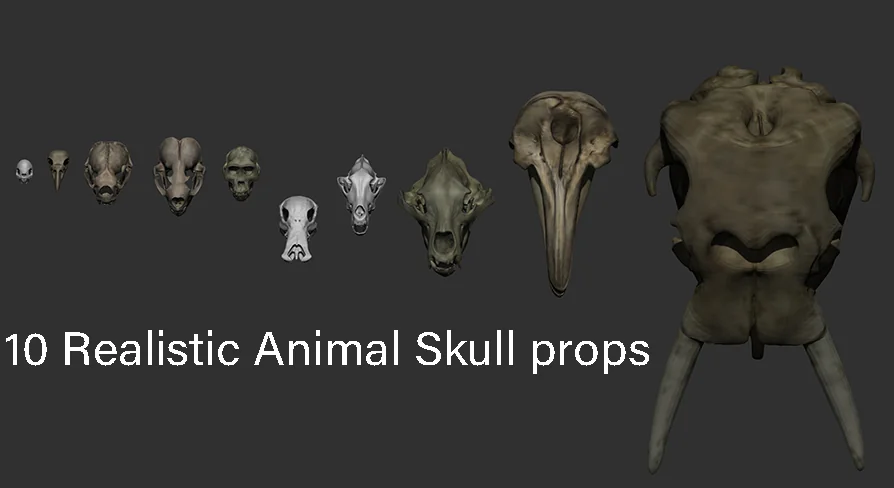
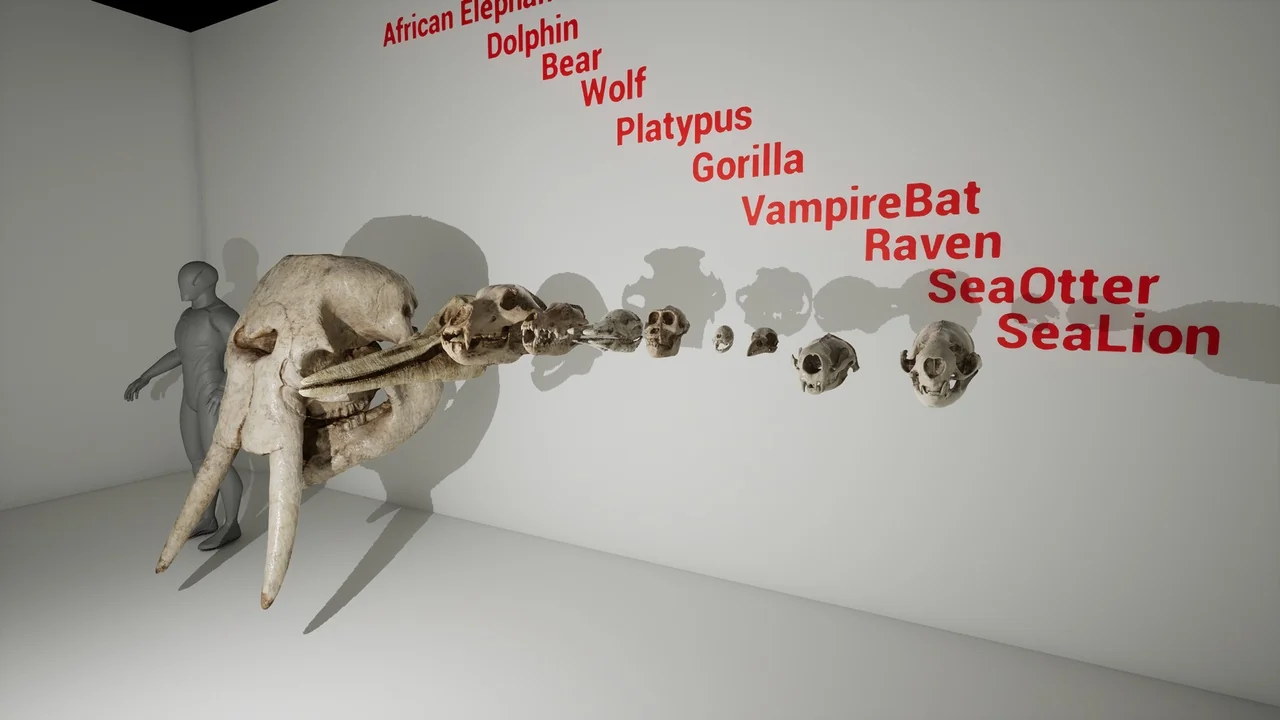
Scattering organic remains across a landscape immediately communicates history, danger, or ecological storytelling without requiring a single line of dialogue. In an open-world setting, a sun-bleached bone half-buried in dirt suggests predator activity or harsh environmental conditions. Positioned beneath the soft spotlights of a museum exhibit, the exact same structure reads as an educational artifact, curated and preserved. Placed within a claustrophobic corridor of a horror project, it transforms into an omen or the remnant of an occult ritual. The Animal Skull Pack provides game-ready meshes shaped specifically to inhabit these divergent scene types, offering realistic surfaces rooted in real-world reference.
Staging Animal Skulls in Horror, Museum, and Open-World Scenes
Context dictates how environmental props are perceived, and animal skeletal elements possess an unusual degree of narrative versatility. In museum environments, fidelity and anatomical believability take precedence. Because these assets are derived from real-world scans, the organic irregularities, genuine proportions, and natural contours of bone structures are preserved. Set dressing an exhibit hall or an archival storage room requires props that hold up to scrutiny under clean, direct display lighting, where artificial or stylized anatomy can break immersion.
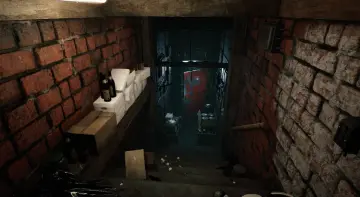
Horror environments demand a completely different emotional frequency from the same biological forms. An animal skull mounted above an entrance, arranged alongside crude implements, or resting inside an abandoned shelter immediately signals predatory violence or ritualistic folklore. Because the assets are balanced to capture genuine anatomical traits, they carry the weight of real biological remains rather than exaggerated props, anchoring grim or unsettling themes in physical reality.
For open-world development, the primary role of biological scatter is world-building through natural debris. Skulls serve as distinct focal points along arid trails, beneath dense forest canopies, or near animal dens. Distributing bone fragments across terrain breaks up repetitive foliage and ground materials, providing players with subtle navigational landmarks and reinforcing the feeling of an active, untamed ecosystem.
Scan-Derived Geometry and Hand-Sculpted Quad Topology
Raw three-dimensional scans often present steep technical hurdles when moved directly into interactive pipelines. Unprocessed scan data typically carries dense, erratic surface meshes filled with microscopic noise, tangled triangulations, and interior hollows that contribute nothing to visual fidelity while draining rendering budgets. To solve this, the assets in this collection have been hand sculpted and refined to eliminate unnecessary, unseen internal geometry.
By manually clearing occluded internal cavities and non-essential reverse faces, the resulting meshes focus exclusively on surfaces that actually register in a camera view. This cleanup process keeps each asset in the midpoly range, striking a deliberate middle ground between visual richness, file size, and practical runtime performance. Midpoly density ensures that silhouettes remain smooth and organic even during medium-range camera passes, avoiding the faceted edges common in ultra-low-polygon geometry without adopting the excessive weight of raw scan data.
In addition to geometry culling, the meshes are built with an all-quad topology. Quad-dominant structure is particularly useful when technical artists or environment modelers need to alter an asset after import. If a scene calls for bespoke modifications—such as slicing a skull in half, punching bullet impacts into the surface, modeling custom fractures, or running a subdivision smoothing pass—clean quad loops make manual modeling, boolean operations, and edge adjustments predictable and stable.
Rendering Flexibility With or Without Nanite
Production pipelines vary significantly across teams and engine configurations, especially when managing geometric detail across differing hardware tiers. The Animal Skull Pack is engineered to operate smoothly whether a project chooses to utilize Nanite virtualization or rely on standard rendering workflows.
When running inside pipelines configured for Nanite, the midpoly meshes integrate directly into virtualized geometry systems. They stream seamlessly alongside massive environmental kits, participating in micro-poly rasterization without requiring manual level-of-detail adjustments. Because the hand-sculpted models are free of tangled interior triangles and non-manifold scan artifacts, the virtualization system can parse and stream their surface clusters cleanly.
For projects that operate without Nanite—whether targeting hardware platforms where the feature is unavailable or maintaining a standard pipeline—the midpoly baseline functions reliably on its own. The manual optimization ensures that polygon counts remain controlled, allowing the skulls to be populated as ambient debris, small prop groupings, or collectible items across standard rendering setups without creating geometry bottlenecks.
Optimized 2K Texture Packing and Material Efficiency
Visual fidelity in realistic props relies heavily on how light interacts with microscopic surface variations, from the matte, porous texture of dried bone to the slightly polished sheen of weathered surfaces. Each skull in the collection is paired with a dedicated 2K texture set tailored to its individual surface contours, preserving the fine nuances captured from the original physical scans.
To keep draw calls and memory overhead efficient across dense scenes, the material data uses channel packing. Ambient Occlusion, Roughness, and Metallic maps are consolidated into the individual color channels of a single packed texture map. This packing strategy minimizes the number of texture samples the graphics hardware must execute per frame:
Ambient Occlusion Is stored within the packed channel setup to ground the bone's recessed crevices and natural sockets in ambient shade.
Roughness Values map the subtle micro-surface differences between smooth bone plates and rough, weathered areas.
Metallic Data is integrated into the channel structure to maintain complete material standard compatibility across unified shading models.
By combining custom 2K resolutions with channel-packed data, the surfaces maintain crisp definition during close-up examination without inflating texture memory or requiring sprawling master material graphs.
Low-Footprint Integration and Japan Environment Pack Compatibility
Large asset packages can quickly balloon project repository sizes and lengthen build deployment cycles. Across the entire collection, the total pack size is held to 133 megabytes. This compact footprint allows entire teams to incorporate realistic bone scatter into their asset libraries without burdening source control systems, streaming budgets, or disk overhead.
The pack also features verified compatibility with the Japan Environment Pack. This pairing expands historical, rural, and wilderness staging possibilities. Placing realistic animal skulls around rustic shrine perimeters, deep mountain paths, abandoned wooden structures, or overgrown rural outskirts complements the architectural and natural aesthetic of Japanese-themed environments, reinforcing atmospheric environmental narrative across varied exterior and interior levels.
By combining scan-based anatomical realism, hand-sculpted quad meshes, channel-packed 2K maps, and flexible Nanite or non-Nanite deployment, the collection offers an efficient prop solution for realistic set dressing across museum displays, horror environments, and expansive open terrain.
 Horror
 Horror
 Horror
 Horror