"7aa4acc705f0d80b"{"id":"1001949","slug":"animalia-ladybug","title":"Animalia - Ladybug","category":"Characters \u0026 Creatures","engine":"4.20+,5.0+","assetVersion":"","engineVersion":"Engine Version: 4.20+,5.0+","tag":"Characters","accent":"blue","visual":"character","summary":"Detailed look at Animalia - Ladybug, featuring 19 animations with and without root motion, 4K textures, LODs, and a ragdoll setup.","platform":"Unreal Engine","publishedAt":"2026-10-24T11:23:19.406Z","updatedAt":"2026-10-24T11:23:19.406Z","sourceNotes":[],"fileContents":[],"compatibility":["Unreal Engine","Engine Version: 4.20+,5.0+"],"featuredImage":{"alt":"Animalia - Ladybug","src":"/wp-content/uploads/published/2026/10/064d90255f2e-c8cb5fe4-c2b2-4f53-bfbe-7b028def7908-009b536d6f.webp"},"hasDownloadLink":true,"downloads":0,"terms":[{"taxonomy":"category","slug":"characters-and-creatures","name":"Characters \u0026 Creatures"}],"galleryImages":[{"src":"/wp-content/uploads/published/2026/10/2168a261b8a7-5e436f0e-c0bf-40bc-b103-9303bedc0493-1c7100edcc.webp","alt":"Animalia - Ladybug"},{"src":"/wp-content/uploads/published/2026/10/74f9ee655805-9039065b-7d4b-4ced-a0ea-d33f858fcdcf-229ad25835.webp","alt":"Animalia - Ladybug"},{"src":"/wp-content/uploads/published/2026/10/6ae2686efabb-a9629111-1624-44ed-9d4a-3f16a2cdc131-82c3b47be3.webp","alt":"Animalia - Ladybug"},{"src":"/wp-content/uploads/published/2026/10/5af6f86a4615-9c798e3a-4370-4069-a86c-4307ec551a71-3a30ed1f2a.webp","alt":"Animalia - Ladybug"},{"src":"/wp-content/uploads/published/2026/10/534fb618bb93-a5759be1-7c28-49dc-add2-0ea86a5f21ee-6de78fb1f8.webp","alt":"Animalia - Ladybug"}],"accessPanel":{"kind":"resource","title":"Download this resource","eyebrow":"Free Download","message":"Log in or create a free account to start your download.","fileName":"Content.7z","safetyNote":"Resources are manually reviewed before listing to improve quality and reduce obvious risks.","actionLabel":"Download Free","resourceType":"Resource archive"},"contentHtml":"\u003cp\u003eClose-up environmental storytelling often demands high visual fidelity for small subjects. When a camera tracks along soil, passes over foliage, or frames a macro cinematic shot of forest ground cover, tiny fauna can establish the scale and realism of the setting. Animalia - Ladybug delivers a realistic insect asset configured specifically for natural environments, simulation sequences, and ground-level world-building.\u003c/p\u003e \u003ch2\u003eGround-Level Environments and Macro Wildlife Requirements\u003c/h2\u003e\n\u003cp\u003eIn standard outdoor level design, miniature creatures are frequently relegated to simple billboard particles or low-resolution background meshes. That approach fails whenever the focal length shifts or gameplay mechanics bring players close to surfaces such as tree bark, leaves, or stones. A realistic ladybug requires true geometric definition and surface texturing that withstands macro camera distances without breaking down into pixelated artifacts or blocky silhouettes.\u003c/p\u003e\n\u003cp\u003eBy delivering a dedicated creature mesh built for realistic presentation, the asset supports scenes where insects are the primary focal point rather than an afterthought. Narrative cutscenes tracking micro ecosystems, educational scientific visualizations, interactive nature simulations, and survival games with small-scale protagonists all rely on this level of close-up precision. The asset functions equally well as an incidental background element that enriches forest floors, residential gardens, greenhouse interiors, and agricultural landscapes.\u003c/p\u003e \u003ch2\u003eNineteen Ladybug Animations With and Without Root Motion\u003c/h2\u003e\n\u003cp\u003eLocomotion for articulated insect limbs can be difficult to manage realistically without distinct movement tracks. Animalia - Ladybug includes a library of 19 animations, structured to accommodate different control schemes and scene implementations. Every animation in the package is provided in two separate versions: one with root motion applied, and one without root motion.\u003c/p\u003e\n\u003cp\u003eOffering both animation styles addresses fundamental differences between animation workflows. Root motion drives the actual transformation of the character via the animation data itself, ensuring that walking, turning, or shifting cadence matches limb movement without visible foot sliding against surfaces. This is critical for cinematics, linear sequences, and navigation scenarios where exact path traversal must respect the physical stride of the legs.\u003c/p\u003e\n\u003cp\u003eIn-place variations—the clips without root motion—serve setups where motion is managed through capsule components, pathfinding nodes, AI controllers, or physics-driven navigation systems. By leaving position translation to code or character movement components, developers can adjust movement speed dynamically, interpolate orientation along custom curves, or attach the insect to animated environmental objects like swaying branches without battling baked transform offsets.\u003c/p\u003e \u003ch2\u003eBalancing 4K Textures and LODs for Close-Up and Background Performance\u003c/h2\u003e\n\u003cp\u003eBecause insects occupy small spatial volumes in a scene, managing their rendering cost requires careful handling of texture resolution and geometric detail. Animalia - Ladybug incorporates 4K textures to ensure that the signature spotted elytra, head casing, jointed legs, and underside retain crisp detail even under extreme macro observation. High-resolution surface maps preserve subtle shell sheen, surface contours, and chitin texturing that would otherwise blur when viewed from inches away.\u003c/p\u003e\n\u003cp\u003eTo keep this high visual standard from degrading frame rates when multiple insects populate a space, the package includes level of detail stages (LODs). As the camera pulls back into standard character perspectives or wide landscape shots, lower LOD stages strip unnecessary geometric complexity from the mesh. This automatic reduction minimizes draw call impact and vertex processing overhead, allowing developers to scatter multiple ladybugs across an environment without sacrificing real-time rendering performance.\u003c/p\u003e \u003ch2\u003ePhysics Interactions Through the Ragdoll Setup\u003c/h2\u003e\n\u003cp\u003eDynamic scenes require reactive physical behavior when an insect collides with objects, suffers damage, or drops from higher surfaces. Animalia - Ladybug includes a fully configured ragdoll setup, allowing the joint structure to transition from keyed skeletal motion into physics-driven simulation.\u003c/p\u003e\n\u003cp\u003eThis physical configuration allows the creature to tumble naturally down slopes, respond to environmental forces, or collapse convincingly when struck. Rather than relying on rigid static meshes for death or impact states, physics simulation lets each joint respond independently to collisions with complex terrain geometry, rocks, and foliage.\u003c/p\u003e\n\u003cp\u003eTechnical implementation is kept straightforward. While the package notes the availability of gFur for Unreal Engine 5, the ladybug mesh itself does not require the gFur plugin to function. The asset deploys cleanly as an independent creature without requiring specialized third-party dependencies, preserving an uncluttered project pipeline from the initial release version 2.0.0.\u003c/p\u003e \u003ch2\u003eTarget Workflows and Practical Deployment\u003c/h2\u003e\n\u003cp\u003eThis package is especially well-suited for cinematographers and technical animators building micro-scale nature sequences where camera proximity exposes low-resolution assets. Artists working on lush outdoor dioramas can place the insect directly onto plants and ground foliage, relying on LODs to keep resource usage manageable.\u003c/p\u003e\n\u003cp\u003eGameplay programmers and systems designers handling wildlife AI will benefit from the dual animation options. Having 19 motion states provided in both root-motion and static-root configurations simplifies the setup of state machines, behavior trees, and reactive collision routines without requiring manual asset retargeting or external animation extraction.\u003c/p\u003e\n\n\u003ch2\u003eRelated Resources Worth Checking\u003c/h2\u003e\n\u003cul\u003e\n\u003cli\u003e\u003ca href=\"https://3dcghub.com/animalia-lion-male/\" title=\"Animalia - Lion (male)\"\u003eAnimalia - Lion (male)\u003c/a\u003e\u003c/li\u003e\n\u003cli\u003e\u003ca href=\"https://3dcghub.com/animalia-gray-wolf-young/\" title=\"Animalia - Gray Wolf (young)\"\u003eAnimalia - Gray Wolf (young)\u003c/a\u003e\u003c/li\u003e\n\u003cli\u003e\u003ca href=\"https://3dcghub.com/animalia-raccoon/\" title=\"Animalia - Raccoon\"\u003eAnimalia - Raccoon\u003c/a\u003e\u003c/li\u003e\n\u003cli\u003e\u003ca href=\"https://3dcghub.com/animalia-bluebird/\" title=\"Animalia - Bluebird\"\u003eAnimalia - Bluebird\u003c/a\u003e\u003c/li\u003e\n\u003cli\u003e\u003ca href=\"https://3dcghub.com/animalia-housefly/\" title=\"Animalia - Housefly\"\u003eAnimalia - Housefly\u003c/a\u003e\u003c/li\u003e\n\u003c/ul\u003e","contentTextLength":5915,"navigation":{"current":41,"total":3925,"previous":{"id":"1001950","slug":"animated-medieval-bows","title":"Animated Medieval Bows","category":"Weapons \u0026 Combat","platform":"Unreal Engine","updatedAt":"2026-10-24T11:24:14.806Z"},"next":{"id":"1001948","slug":"animal-skull-pack","title":"Animal Skull Pack","category":"Horror","platform":"Unreal Engine","updatedAt":"2026-10-24T11:22:48.530Z"}},"relatedResources":[{"id":"1000974","slug":"animalia-lion-male","title":"Animalia - Lion (male)","category":"Characters \u0026 Creatures","engine":"4.26+,5.0+","assetVersion":"","engineVersion":"Engine Version: 4.26+,5.0+","tag":"Characters","accent":"blue","visual":"character","summary":"Realistic male lion with 60fps animations, 4K textures, gFur support, Maya/3ds Max rigs, LODs, and ragdoll for Unreal Engine 4.24 and up.","platform":"Unreal Engine","publishedAt":"2026-08-17T16:08:33.242Z","updatedAt":"2026-08-17T16:08:33.242Z","sourceNotes":[],"fileContents":[],"compatibility":["Unreal Engine","Engine Version: 4.26+,5.0+"],"featuredImage":{"alt":"Animalia - Lion (male)","src":"/wp-content/uploads/published/2026/08/799ef29163e0-6c655651-224e-4b8d-9200-2a0d57dbd08f-30295b193d.webp"},"hasDownloadLink":true,"downloads":0},{"id":"1000973","slug":"animalia-gray-wolf-young","title":"Animalia - Gray Wolf (young)","category":"Characters \u0026 Creatures","engine":"4.26+,5.0+","assetVersion":"","engineVersion":"Engine Version: 4.26+,5.0+","tag":"Characters","accent":"blue","visual":"character","summary":"A realistic young Gray Wolf with 60fps animations, 4K textures, gFur support, Maya/3ds Max rigs, LODs, and ragdoll setup for Unreal Engine 5 projects.","platform":"Unreal Engine","publishedAt":"2026-08-17T16:04:58.364Z","updatedAt":"2026-08-17T16:04:58.364Z","sourceNotes":[],"fileContents":[],"compatibility":["Unreal Engine","Engine Version: 4.26+,5.0+"],"featuredImage":{"alt":"Animalia - Gray Wolf (young)","src":"/wp-content/uploads/published/2026/08/9fcd1d0b632e-f6aeddf4-1dc7-45c0-91e5-98a501f9cf7e-0eaf67a9d1.webp"},"hasDownloadLink":true,"downloads":0},{"id":"1000912","slug":"animalia-raccoon","title":"Animalia - Raccoon","category":"Characters \u0026 Creatures","engine":"4.26+,5.0+","assetVersion":"","engineVersion":"Engine Version: 4.26+,5.0+","tag":"Characters","accent":"blue","visual":"character","summary":"Realistic raccoon with 60fps animations, 2K textures, gFur support, LODs, ragdoll setup, and a 3ds Max rig. Works with UE 4.24+ and the Animalia Starter Kit.","platform":"Unreal Engine","publishedAt":"2026-08-07T17:04:40.260Z","updatedAt":"2026-08-07T17:04:40.260Z","sourceNotes":[],"fileContents":[],"compatibility":["Unreal Engine","Engine Version: 4.26+,5.0+"],"featuredImage":{"alt":"Animalia - Raccoon","src":"/wp-content/uploads/published/2026/08/2674d40980b0-8799a4c5-7e67-49ed-88a6-836893685cf5-b83809c831.webp"},"hasDownloadLink":true,"downloads":0}]}
Characters
Animalia - Ladybug
Detailed look at Animalia - Ladybug, featuring 19 animations with and without root motion, 4K textures, LODs, and a ragdoll setup.
Close-up environmental storytelling often demands high visual fidelity for small subjects. When a camera tracks along soil, passes over foliage, or frames a macro cinematic shot of forest ground cover, tiny fauna can establish the scale and realism of the setting. Animalia - Ladybug delivers a realistic insect asset configured specifically for natural environments, simulation sequences, and ground-level world-building.
Ground-Level Environments and Macro Wildlife Requirements
In standard outdoor level design, miniature creatures are frequently relegated to simple billboard particles or low-resolution background meshes. That approach fails whenever the focal length shifts or gameplay mechanics bring players close to surfaces such as tree bark, leaves, or stones. A realistic ladybug requires true geometric definition and surface texturing that withstands macro camera distances without breaking down into pixelated artifacts or blocky silhouettes.
By delivering a dedicated creature mesh built for realistic presentation, the asset supports scenes where insects are the primary focal point rather than an afterthought. Narrative cutscenes tracking micro ecosystems, educational scientific visualizations, interactive nature simulations, and survival games with small-scale protagonists all rely on this level of close-up precision. The asset functions equally well as an incidental background element that enriches forest floors, residential gardens, greenhouse interiors, and agricultural landscapes.
Nineteen Ladybug Animations With and Without Root Motion
Locomotion for articulated insect limbs can be difficult to manage realistically without distinct movement tracks. Animalia - Ladybug includes a library of 19 animations, structured to accommodate different control schemes and scene implementations. Every animation in the package is provided in two separate versions: one with root motion applied, and one without root motion.
Offering both animation styles addresses fundamental differences between animation workflows. Root motion drives the actual transformation of the character via the animation data itself, ensuring that walking, turning, or shifting cadence matches limb movement without visible foot sliding against surfaces. This is critical for cinematics, linear sequences, and navigation scenarios where exact path traversal must respect the physical stride of the legs.
In-place variations—the clips without root motion—serve setups where motion is managed through capsule components, pathfinding nodes, AI controllers, or physics-driven navigation systems. By leaving position translation to code or character movement components, developers can adjust movement speed dynamically, interpolate orientation along custom curves, or attach the insect to animated environmental objects like swaying branches without battling baked transform offsets.
Balancing 4K Textures and LODs for Close-Up and Background Performance
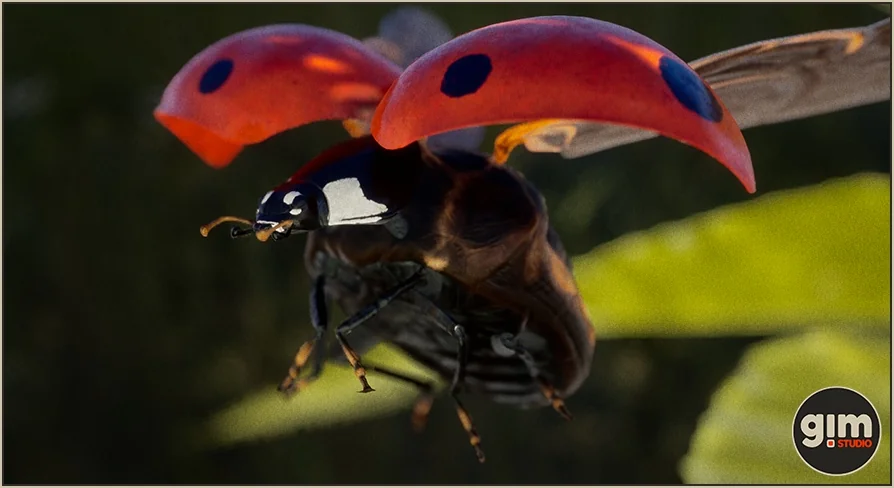
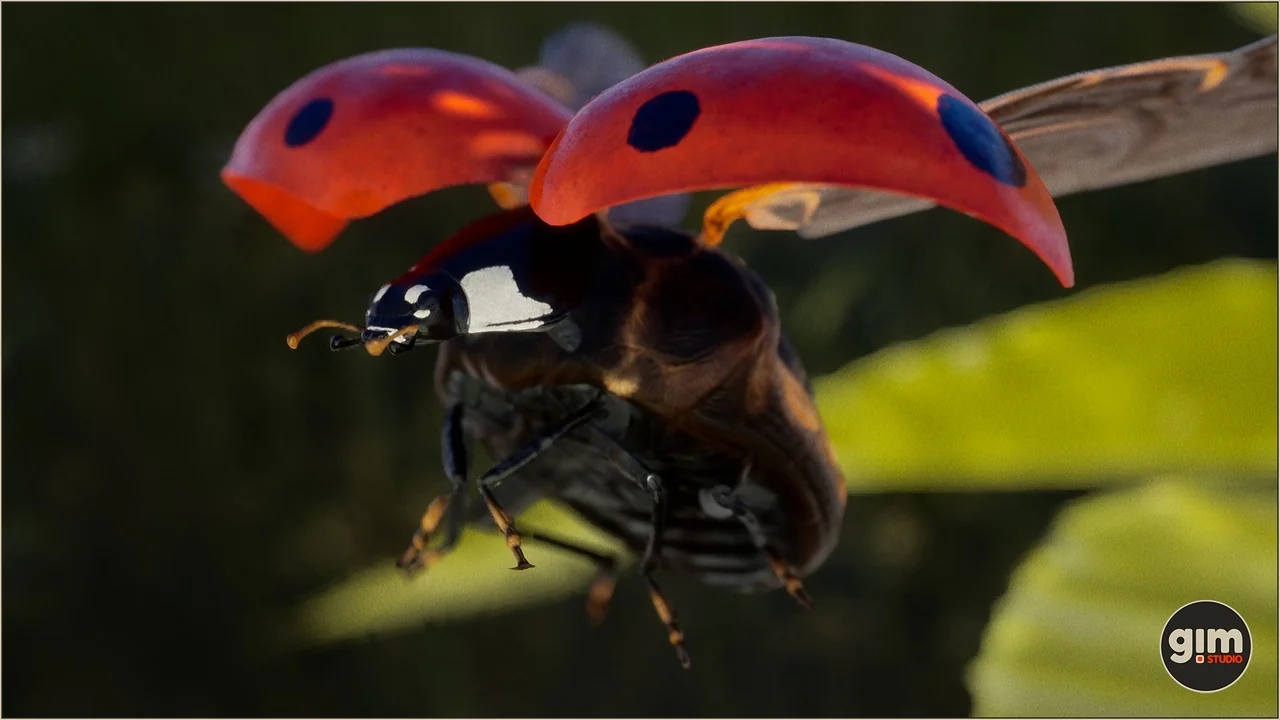
Because insects occupy small spatial volumes in a scene, managing their rendering cost requires careful handling of texture resolution and geometric detail. Animalia - Ladybug incorporates 4K textures to ensure that the signature spotted elytra, head casing, jointed legs, and underside retain crisp detail even under extreme macro observation. High-resolution surface maps preserve subtle shell sheen, surface contours, and chitin texturing that would otherwise blur when viewed from inches away.
To keep this high visual standard from degrading frame rates when multiple insects populate a space, the package includes level of detail stages (LODs). As the camera pulls back into standard character perspectives or wide landscape shots, lower LOD stages strip unnecessary geometric complexity from the mesh. This automatic reduction minimizes draw call impact and vertex processing overhead, allowing developers to scatter multiple ladybugs across an environment without sacrificing real-time rendering performance.
Physics Interactions Through the Ragdoll Setup
Dynamic scenes require reactive physical behavior when an insect collides with objects, suffers damage, or drops from higher surfaces. Animalia - Ladybug includes a fully configured ragdoll setup, allowing the joint structure to transition from keyed skeletal motion into physics-driven simulation.
This physical configuration allows the creature to tumble naturally down slopes, respond to environmental forces, or collapse convincingly when struck. Rather than relying on rigid static meshes for death or impact states, physics simulation lets each joint respond independently to collisions with complex terrain geometry, rocks, and foliage.
Technical implementation is kept straightforward. While the package notes the availability of gFur for Unreal Engine 5, the ladybug mesh itself does not require the gFur plugin to function. The asset deploys cleanly as an independent creature without requiring specialized third-party dependencies, preserving an uncluttered project pipeline from the initial release version 2.0.0.
Target Workflows and Practical Deployment
This package is especially well-suited for cinematographers and technical animators building micro-scale nature sequences where camera proximity exposes low-resolution assets. Artists working on lush outdoor dioramas can place the insect directly onto plants and ground foliage, relying on LODs to keep resource usage manageable.
Gameplay programmers and systems designers handling wildlife AI will benefit from the dual animation options. Having 19 motion states provided in both root-motion and static-root configurations simplifies the setup of state machines, behavior trees, and reactive collision routines without requiring manual asset retargeting or external animation extraction.
 Characters
 Characters
 Characters
 Characters