"e9c335e082208b17"{"id":"1002897","slug":"ai-enemies-drone","title":"AI Enemies - Drone","category":"Artificial Intelligence","engine":"5.3+","assetVersion":"","engineVersion":"Engine Version: 5.3+","tag":"Artificial Intelli","accent":"blue","visual":"mech","summary":"Explore the implementation and mechanics of AI Enemies - Drone, featuring physics-based flight for drones, helicopters, and UFOs with independent AI logic.","platform":"Unreal Engine","indexPolicy":"index","publishedAt":"2026-11-21T04:46:11.617Z","updatedAt":"2026-11-21T04:46:11.617Z","sourceNotes":[],"fileContents":[],"compatibility":["Unreal Engine","Engine Version: 5.3+"],"featuredImage":{"alt":"AI Enemies - Drone","src":"/wp-content/uploads/published/2026/11/51ac16ace58d-470e1f6e-cb35-42c6-bbb5-341a9d0c4ae1-195d28ec3a.webp"},"fileSizeBytes":124641196,"hasDownloadLink":true,"downloads":0,"terms":[{"taxonomy":"category","slug":"artificial-intelligence","name":"Artificial Intelligence"}],"galleryImages":[{"src":"/wp-content/uploads/published/2026/11/e344cc2b9798-d5123934-7c6c-4586-95a7-6d1ed096443d-b140c4712c.webp","alt":"AI Enemies - Drone"}],"contentHtml":"\u003ch2\u003eFlight Physics and Simulating Drone, Helicopter, and UFO Units\u003c/h2\u003e\n\u003cp\u003eHandling aerial movement inside a game engine requires a distinctly different mechanical structure than standard ground-based pathfinding. AI Enemies - Drone provides a physics-based character NPC framework engineered specifically to reproduce aerial flight profiles. Rather than relying on simple kinematic translation or clamped ground-clamping logic, the system utilizes physics interactions to govern how units navigate three-dimensional volume. This fundamental architecture allows developers to represent different types of aerial craft using the same underlying blueprint base.\u003c/p\u003e\n\u003cp\u003eThe system accommodates three primary aerial archetypes: small multi-rotor drones, standard helicopters, and unconventional UFO-style craft. Because the flight model is driven by physics, the movement naturally translates across these varied unit silhouettes. Drones can execute tight hovering patterns and directional shifts, helicopters maintain the characteristic momentum and transitional drift expected of rotorcraft, and UFO configurations can leverage fluid, multi-axis physics trajectories. Because it is delivered as a game-ready, drag-and-drop asset, these flight dynamics function immediately upon placing the blueprint into an active scene without requiring custom flight-math authoring from scratch.\u003c/p\u003e \u003ch2\u003eIndependent AI Logic and Scene Character Interaction\u003c/h2\u003e\n\u003cp\u003eA frequent challenge when integrating aerial non-player characters into an ongoing project is resolving conflicts with existing artificial intelligence managers. AI Enemies - Drone bypasses this friction by functioning completely independently from external or pre-existing AI systems. Developers running proprietary decision trees, standard engine behavior trees, or custom logic loops can introduce this aerial system without worrying about conflicting global blackboard keys or hijacked navigation controllers.\u003c/p\u003e\n\u003cp\u003eEven while maintaining self-contained logic, the blueprint interacts directly with all other characters situated in the scene. Whether approaching ground pawns, moving targets, or other flying units, the drone NPC registers and responds to other scene characters in real time. This universal character interaction model ensures that physics-driven collisions, targeting decisions, and spatial reactions occur smoothly between disparate character types. The standalone architecture keeps the logic self-contained while preserving direct engagement with players, friendly squads, and competing non-player entities in the level.\u003c/p\u003e \u003ch2\u003eInfinite Team Configurations for Enemies and Allies\u003c/h2\u003e\n\u003cp\u003eAerial units in tactical game design frequently need to switch operational roles depending on level objectives, mission phases, or dynamic faction dynamics. The AI Enemies - Drone package provides native role flexibility, enabling units to serve either as hostile threats hunting the player or as allied support assets providing protective air cover. This role assignment extends beyond a binary player-versus-enemy relationship through a comprehensive multi-team structure.\u003c/p\u003e\n\u003cp\u003eThe asset allows developers to create infinite teams within a single encounter. Rather than limiting the level layout to conventional two-sided conflicts, the team framework supports multi-faction engagements where multiple opposing forces battle each other simultaneously alongside the player. Separate hostile factions can engage in localized dogfights or target opposing ground elements, while allied drones provide defensive fields. This broad faction capability provides developers with the architectural freedom to craft multi-front battles, cross-faction ambushes, and complex dynamic encounters without rebuilding faction management arrays.\u003c/p\u003e \u003ch2\u003eResource Management Through the Dedicated Spawn System\u003c/h2\u003e\n\u003cp\u003eDeploying physics-enabled flying units at scale demands careful control over engine overhead and memory utilization. To prevent performance degradation during prolonged skirmishes or dense encounters, the package incorporates an integrated Spawn System. This system manages the exact resources required to instantiate, track, and sustain aerial assets throughout active gameplay cycles.\u003c/p\u003e\n\u003cp\u003eBy delegating unit creation to this dedicated manager, level designers can meter how many drones, helicopters, or UFOs appear in a given volume at any single moment. The spawn framework assists in regulating asset allocation, ensuring that dynamic encounters do not over-saturate scene processing with excessive simultaneous physics checks or overlapping character collision evaluations. When tuning an extended mission, this structured control point allows teams to adjust deployment timing and encounter volume to match performance budgets directly.\u003c/p\u003e \u003ch2\u003eIntegrating Drone Behavior Alongside Assault Soldier Systems\u003c/h2\u003e\n\u003cp\u003eWhile the blueprint operates entirely on its own, it is also constructed to plug directly into the broader ecosystem established by the AI Enemies series. AI Enemies - Drone is fully compatible out of the box with AI Enemies - Assault Soldier. This mutual compatibility simplifies the process of authoring mixed-arms combat scenarios where ground infantry and physics-driven air assets coordinate within the same physical environment.\u003c/p\u003e\n\u003cp\u003eIn a mixed-unit engagement, ground-based assault soldiers operate within their standard tactical envelopes while the drone system handles low-altitude scouting, aerial harassment, or overhead fire support. Because both systems share compatible interaction principles, scenes containing both packs do not suffer from character communication failures or mismatched team registrations. The developer also publishes a 796 MB playable demo of the AI Enemies series, giving creators an immediate, practical benchmark for examining how ground troops and aerial drones function together in real-time execution.\u003c/p\u003e \u003ch2\u003eDocumentation, Community Channels, and Practical Project Support\u003c/h2\u003e\n\u003cp\u003eTo assist developers during setup, configuration, and maintenance, the package is accompanied by complete documentation covering core blueprint setups and implementation steps. In addition to technical documentation, reference videos—including short clips, extended breakdowns, and detailed pack content demonstrations—illustrate the system in motion across different unit types and simulation modes. A public changelog tracks updates and adjustments across revisions, while a community Discord server provides an active communication channel for resolving implementation questions. Combined with clean drag-and-drop functionality, these workflow resources ensure that implementing physics-based aerial combat remains predictable throughout every stage of game production.\u003c/p\u003e\n\n\u003ch2\u003eMore From The Same Workflow\u003c/h2\u003e\n\u003cul\u003e\n\u003cli\u003e\u003ca href=\"https://3dcghub.com/combat-drone/\" rel=\"noopener noreferrer\"\u003eCombat Drone\u003c/a\u003e\u003c/li\u003e\n\u003cli\u003e\u003ca href=\"https://3dcghub.com/enforcer-rig/\" rel=\"noopener noreferrer\"\u003eEnforcer Rig\u003c/a\u003e\u003c/li\u003e\n\u003cli\u003e\u003ca href=\"https://3dcghub.com/zombie-ai-system/\" rel=\"noopener noreferrer\"\u003eZombie AI System\u003c/a\u003e\u003c/li\u003e\n\u003cli\u003e\u003ca href=\"https://3dcghub.com/civilian-npcs-ai-smart-crowd-and-behavior-system-for-ue5/\" rel=\"noopener noreferrer\"\u003eCivilian NPCs AI – Smart Crowd \u0026amp; Behavior System for UE5\u003c/a\u003e\u003c/li\u003e\n\u003cli\u003e\u003ca href=\"https://3dcghub.com/ultimate-game-ready-character-and-enemy-ai/\" rel=\"noopener noreferrer\"\u003eUltimate Game Ready Character and Enemy AI\u003c/a\u003e\u003c/li\u003e\n\u003c/ul\u003e","contentTextLength":6835,"navigation":{"current":37,"total":4839,"previous":{"id":"1002898","slug":"ambulance-premium-drivable-and-interactable","title":"Ambulance - Premium - Drivable and Interactable","category":"Vehicles \u0026 Transportation","platform":"Unreal Engine","updatedAt":"2026-11-21T04:46:56.252Z"},"next":{"id":"1002295","slug":"auto-node-arranger","title":"Auto Node Arranger","category":"Automations","platform":"Unreal Engine","updatedAt":"2026-11-21T03:46:03.901Z"}},"relatedResources":[{"id":"1000574","slug":"combat-drone","title":"Combat Drone","category":"Gameplay Features","engine":"4.27+,5.0+","assetVersion":"","engineVersion":"Engine Version: 4.27+,5.0+","tag":"Gameplay Features","accent":"blue","visual":"mech","summary":"Combat Drone is a Blueprint component for Unreal Engine featuring a controllable flying pawn and AI logic, compatible with engine versions 4.27 through 5.6.","platform":"Unreal Engine","indexPolicy":"index","publishedAt":"2026-07-16T22:28:44.557Z","updatedAt":"2026-10-24T04:34:34.705Z","sourceNotes":[],"fileContents":[],"compatibility":["Unreal Engine","Engine Version: 4.27+,5.0+"],"featuredImage":{"alt":"Combat Drone","src":"/wp-content/uploads/published/2026/07/e50469e73388-fa787e2d-e3bb-4c39-923d-d38969ed0f15-0aad1eba2f.webp"},"fileSizeBytes":103520728,"hasDownloadLink":true,"downloads":0},{"id":"2275","slug":"enforcer-rig","title":"Enforcer Rig","category":"Characters \u0026 Creatures","engine":"4.26+,5.0+","assetVersion":"Engine version: 4.26+,5.0+","engineVersion":"4.16","tag":"Characters","accent":"blue","visual":"character","summary":"Enhance your sci-fi game with the Enforcer Rig, a modular drone character featuring customizable armor sets and retargetable animations for easy prototyping.","platform":"Unreal Engine","indexPolicy":"noindex","publishedAt":"2026-02-07T08:46:21.000Z","updatedAt":"2026-04-19T15:58:04.000Z","sourceNotes":[],"fileContents":[],"compatibility":["Unreal Engine","Engine version: 4.26+,5.0+"],"featuredImage":{"alt":"Enforcer Rig","src":"https://3dcghub.com/wp-content/uploads/2026/02/b5151ea5-27ea-4c1c-b29f-9b266ee9bada.webp"},"fileSizeBytes":173155730,"hasDownloadLink":true,"downloads":0},{"id":"1001714","slug":"zombie-ai-system","title":"Zombie AI System","category":"Artificial Intelligence","engine":"5.0+","assetVersion":"","engineVersion":"Engine Version: 5.0+","tag":"Artificial Intelli","accent":"blue","visual":"mech","summary":"Explore the Zombie AI System for Unreal Engine, featuring drag-and-drop setup, customizable movement states, and single-player survival mechanics.","platform":"Unreal Engine","indexPolicy":"index","publishedAt":"2026-10-14T17:18:34.903Z","updatedAt":"2026-10-14T17:18:34.903Z","sourceNotes":[],"fileContents":[],"compatibility":["Unreal Engine","Engine Version: 5.0+"],"featuredImage":{"alt":"Zombie AI System","src":"/wp-content/uploads/published/2026/10/893e70521d68-f2274112-b13d-41c0-8305-dfba10437621-fe288309de.webp"},"fileSizeBytes":313375171,"hasDownloadLink":true,"downloads":4}]}
Resource screenshots
1 / 1
Join our channel
Follow 3DCGHUB on Telegram for new resource drops, migration updates, and community notices.
Explore the implementation and mechanics of AI Enemies - Drone, featuring physics-based flight for drones, helicopters, and UFOs with independent AI logic.
Flight Physics and Simulating Drone, Helicopter, and UFO Units
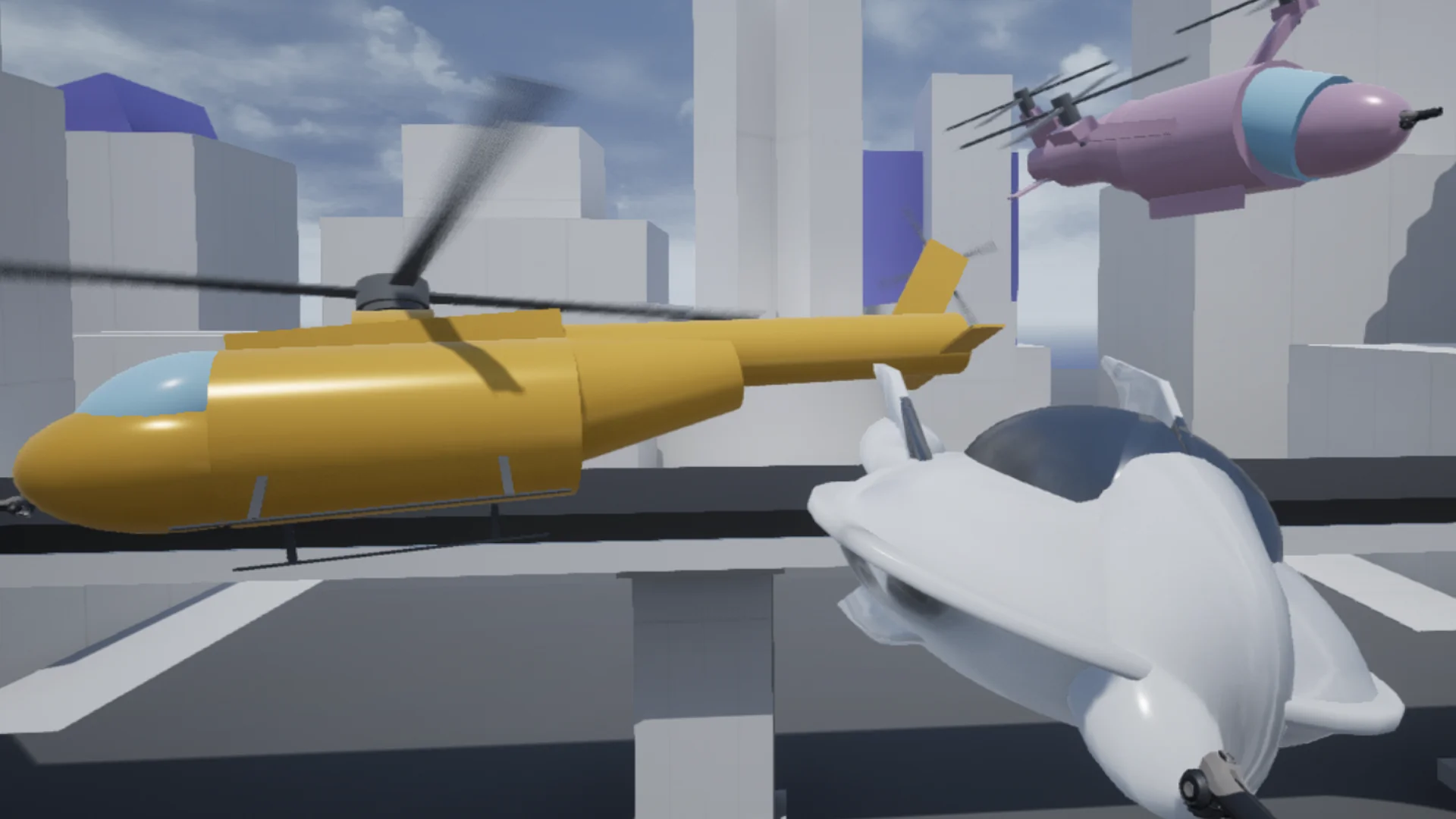
Handling aerial movement inside a game engine requires a distinctly different mechanical structure than standard ground-based pathfinding. AI Enemies - Drone provides a physics-based character NPC framework engineered specifically to reproduce aerial flight profiles. Rather than relying on simple kinematic translation or clamped ground-clamping logic, the system utilizes physics interactions to govern how units navigate three-dimensional volume. This fundamental architecture allows developers to represent different types of aerial craft using the same underlying blueprint base.
The system accommodates three primary aerial archetypes: small multi-rotor drones, standard helicopters, and unconventional UFO-style craft. Because the flight model is driven by physics, the movement naturally translates across these varied unit silhouettes. Drones can execute tight hovering patterns and directional shifts, helicopters maintain the characteristic momentum and transitional drift expected of rotorcraft, and UFO configurations can leverage fluid, multi-axis physics trajectories. Because it is delivered as a game-ready, drag-and-drop asset, these flight dynamics function immediately upon placing the blueprint into an active scene without requiring custom flight-math authoring from scratch.
Independent AI Logic and Scene Character Interaction
A frequent challenge when integrating aerial non-player characters into an ongoing project is resolving conflicts with existing artificial intelligence managers. AI Enemies - Drone bypasses this friction by functioning completely independently from external or pre-existing AI systems. Developers running proprietary decision trees, standard engine behavior trees, or custom logic loops can introduce this aerial system without worrying about conflicting global blackboard keys or hijacked navigation controllers.
Even while maintaining self-contained logic, the blueprint interacts directly with all other characters situated in the scene. Whether approaching ground pawns, moving targets, or other flying units, the drone NPC registers and responds to other scene characters in real time. This universal character interaction model ensures that physics-driven collisions, targeting decisions, and spatial reactions occur smoothly between disparate character types. The standalone architecture keeps the logic self-contained while preserving direct engagement with players, friendly squads, and competing non-player entities in the level.
Infinite Team Configurations for Enemies and Allies
Aerial units in tactical game design frequently need to switch operational roles depending on level objectives, mission phases, or dynamic faction dynamics. The AI Enemies - Drone package provides native role flexibility, enabling units to serve either as hostile threats hunting the player or as allied support assets providing protective air cover. This role assignment extends beyond a binary player-versus-enemy relationship through a comprehensive multi-team structure.
The asset allows developers to create infinite teams within a single encounter. Rather than limiting the level layout to conventional two-sided conflicts, the team framework supports multi-faction engagements where multiple opposing forces battle each other simultaneously alongside the player. Separate hostile factions can engage in localized dogfights or target opposing ground elements, while allied drones provide defensive fields. This broad faction capability provides developers with the architectural freedom to craft multi-front battles, cross-faction ambushes, and complex dynamic encounters without rebuilding faction management arrays.
Resource Management Through the Dedicated Spawn System
Deploying physics-enabled flying units at scale demands careful control over engine overhead and memory utilization. To prevent performance degradation during prolonged skirmishes or dense encounters, the package incorporates an integrated Spawn System. This system manages the exact resources required to instantiate, track, and sustain aerial assets throughout active gameplay cycles.
By delegating unit creation to this dedicated manager, level designers can meter how many drones, helicopters, or UFOs appear in a given volume at any single moment. The spawn framework assists in regulating asset allocation, ensuring that dynamic encounters do not over-saturate scene processing with excessive simultaneous physics checks or overlapping character collision evaluations. When tuning an extended mission, this structured control point allows teams to adjust deployment timing and encounter volume to match performance budgets directly.
Integrating Drone Behavior Alongside Assault Soldier Systems
While the blueprint operates entirely on its own, it is also constructed to plug directly into the broader ecosystem established by the AI Enemies series. AI Enemies - Drone is fully compatible out of the box with AI Enemies - Assault Soldier. This mutual compatibility simplifies the process of authoring mixed-arms combat scenarios where ground infantry and physics-driven air assets coordinate within the same physical environment.
In a mixed-unit engagement, ground-based assault soldiers operate within their standard tactical envelopes while the drone system handles low-altitude scouting, aerial harassment, or overhead fire support. Because both systems share compatible interaction principles, scenes containing both packs do not suffer from character communication failures or mismatched team registrations. The developer also publishes a 796 MB playable demo of the AI Enemies series, giving creators an immediate, practical benchmark for examining how ground troops and aerial drones function together in real-time execution.
Documentation, Community Channels, and Practical Project Support
To assist developers during setup, configuration, and maintenance, the package is accompanied by complete documentation covering core blueprint setups and implementation steps. In addition to technical documentation, reference videos—including short clips, extended breakdowns, and detailed pack content demonstrations—illustrate the system in motion across different unit types and simulation modes. A public changelog tracks updates and adjustments across revisions, while a community Discord server provides an active communication channel for resolving implementation questions. Combined with clean drag-and-drop functionality, these workflow resources ensure that implementing physics-based aerial combat remains predictable throughout every stage of game production.
 Gameplay Features
 Characters
 Artificial Intelli