"fa182e0cd0a6ea73"{"id":"1001798","slug":"civilian-npcs-ai-smart-crowd-and-behavior-system-for-ue5","title":"Civilian NPCs AI – Smart Crowd \u0026 Behavior System for UE5","category":"Artificial Intelligence","engine":"5.6+","assetVersion":"","engineVersion":"Engine Version: 5.6+","tag":"Artificial Intelli","accent":"blue","visual":"mech","summary":"Populate UE5 environments with Civilian NPCs AI, featuring dynamic seating, prop swapping, panic reactions, and gender-specific animation routines.","platform":"Unreal Engine","publishedAt":"2026-10-21T07:50:47.637Z","updatedAt":"2026-10-21T07:50:47.637Z","sourceNotes":[],"fileContents":[],"compatibility":["Unreal Engine","Engine Version: 5.6+"],"featuredImage":{"alt":"Civilian NPCs AI – Smart Crowd \u0026 Behavior System for UE5","src":"/wp-content/uploads/published/2026/10/dd495238849d-d7e5c959-2931-418f-913a-502ce8aa2438-720f69ac3c.webp"},"hasDownloadLink":true,"downloads":1,"terms":[{"taxonomy":"category","slug":"artificial-intelligence","name":"Artificial Intelligence"}],"galleryImages":[{"src":"/wp-content/uploads/published/2026/10/bb029794bf2f-508fe6b4-d6dd-4fa4-9441-894bedf42245-1dca58f828.webp","alt":"Civilian NPCs AI – Smart Crowd \u0026 Behavior System for UE5"},{"src":"/wp-content/uploads/published/2026/10/846066ef7bee-f5ddf5e2-4369-48a3-a548-0c53afcc1c07-9484442f4d.webp","alt":"Civilian NPCs AI – Smart Crowd \u0026 Behavior System for UE5"},{"src":"/wp-content/uploads/published/2026/10/376d6127d7ff-78625e2c-1399-4ad2-b544-9b2cbdd94115-a2b481f47f.webp","alt":"Civilian NPCs AI – Smart Crowd \u0026 Behavior System for UE5"},{"src":"/wp-content/uploads/published/2026/10/74f438b454f6-abf9b76c-f3a8-441b-be00-445497cc93f3-6908082e7a.webp","alt":"Civilian NPCs AI – Smart Crowd \u0026 Behavior System for UE5"},{"src":"/wp-content/uploads/published/2026/10/7928f2f48370-96bcb12c-9f60-4f48-ad23-c67074352c1c-69a82a5cd5.webp","alt":"Civilian NPCs AI – Smart Crowd \u0026 Behavior System for UE5"},{"src":"/wp-content/uploads/published/2026/10/3f57a810c834-65e3a31e-fe04-45f1-bccd-83db1baa279d-78923c81c3.webp","alt":"Civilian NPCs AI – Smart Crowd \u0026 Behavior System for UE5"},{"src":"/wp-content/uploads/published/2026/10/57891c1aecc3-7ca2abcd-c3f8-4869-89d3-9941df725775-268651c7c4.webp","alt":"Civilian NPCs AI – Smart Crowd \u0026 Behavior System for UE5"},{"src":"/wp-content/uploads/published/2026/10/444d10f8f1dd-02462320-0f26-4502-9d2d-21f2a1072038-fbf32704a5.webp","alt":"Civilian NPCs AI – Smart Crowd \u0026 Behavior System for UE5"},{"src":"/wp-content/uploads/published/2026/10/554d5f722036-17572ed8-f62f-47af-a151-5e6f4214886b-e2b797c808.webp","alt":"Civilian NPCs AI – Smart Crowd \u0026 Behavior System for UE5"},{"src":"/wp-content/uploads/published/2026/10/980980ab3b08-2f2c218d-4eb8-47ba-b2c4-8be1d278d655-02f163cb76.webp","alt":"Civilian NPCs AI – Smart Crowd \u0026 Behavior System for UE5"}],"accessPanel":{"kind":"resource","title":"Download this resource","eyebrow":"Free Download","message":"Log in or create a free account to start your download.","fileName":"Content.7z","safetyNote":"Resources are manually reviewed before listing to improve quality and reduce obvious risks.","actionLabel":"Download Free","resourceType":"Resource archive"},"contentHtml":"\u003ch2\u003ePopulating Walkways and Public Spaces Across Varied Perspectives\u003c/h2\u003e\n\u003cp\u003eUrban landscapes and public venues feel hollow when streets lack background foot traffic and social activity. Civilian NPCs AI provides a modular framework configured to bring ambient crowds into these environments, adapting across first-person, third-person, and top-down camera views. Whether establishing a dense downtown street corner, a quiet community park, or an open transit hub, the system supplies the underlying routines needed to make background pedestrians look purposeful rather than decorative.\u003c/p\u003e\n\u003cp\u003eA major factor in natural crowd simulation is the variation in how individuals inhabit open areas. Pedestrians rarely move strictly alone or in uniform grids; they move alongside colleagues, halt to engage in discussions, and position themselves around built architecture. Setting up these population layers allows level designers to construct bustling plazas, corporate corridors, or open sandbox streets without manually scripting individual movement splines or basic ambient logic for every single non-player character.\u003c/p\u003e \u003ch2\u003eEveryday Citizen Behaviors, Animation Styles, and Custom Prop Meshes\u003c/h2\u003e\n\u003cp\u003eCivilian NPCs AI equips characters with everyday interactive routines that break up repetitive ambient patterns. Characters transition between walking, standing, and resting postures while performing contextual activities. These micro-behaviors include talking, checking or talking on phones, smoking, having a drink, or conversing directly with other nearby pedestrians.\u003c/p\u003e\n\u003cp\u003eTo avoid visual uniformity across large groups, the system includes multiple performance styles alongside gender assignment options for each character. Rather than repeating identical idle stances, male and female characters draw from varied animation sets. Available movement and idle styles include:\u003c/p\u003e\n\u003cul\u003e \u003cli\u003eActive discussions and hand gestures during conversations\u003c/li\u003e \u003cli\u003eCasual dancing animations for social zones or street entertainment\u003c/li\u003e \u003cli\u003eStreet busking routines, such as playing the guitar\u003c/li\u003e \u003cli\u003eApplauding and clapping within spectator groups\u003c/li\u003e \u003cli\u003ePhysical workout and exercise routines for park or gym environments\u003c/li\u003e\n\u003c/ul\u003e\n\u003cp\u003eIntegrating these animations into distinct visual styles is supported by an open prop system. Items held during idle behaviors—such as handheld mobile devices, beverage containers, and cigarettes—can be exchanged directly for custom static or skeletal meshes. This allows the system to fit different visual standards, historical periods, or stylized art directions by swapping modern items for setting-appropriate alternatives without altering the base behavior logic.\u003c/p\u003e \u003ch2\u003eConfiguring Paired Navigation and Dynamic Seating with Editor Ghost Previews\u003c/h2\u003e\n\u003cp\u003ePopulating a believable scene requires characters to respect physical spaces, particularly when settling into seating or traveling together. The framework includes a dedicated follow setup that allows one character to track and accompany another. This capability enables natural narrative and environmental staging, such as two business colleagues sharing a discussion while walking down a sidewalk or a couple casually strolling together through an outdoor market.\u003c/p\u003e\n\u003cp\u003eStatic placement around street furniture is handled through an integrated seating behavior system. Characters can autonomously target designated chairs, benches, and outdoor seating arrangements while actively checking for occupancy. When a seat is already taken by another pedestrian, the AI recognizes the space as blocked and looks for an alternative spot rather than overlapping meshes or clipping into another character.\u003c/p\u003e\n\u003cp\u003eTo speed up level design and prevent visual alignment errors, the system generates transparent ghost versions of the NPCs within the Unreal Engine editor viewport. When placing designated seating markers, level designers can view the exact posture and alignment of the character directly against the target chair or bench mesh. This visual preview eliminates guesswork around floor clipping or floating meshes before launching the session; once the simulation runs, characters occupy the exact spatial coordinates established by the editor ghost.\u003c/p\u003e \u003ch2\u003ePanic Responses, Aim Detection, and Threat Sound Triggers\u003c/h2\u003e\n\u003cp\u003eCrowd immersion relies heavily on how pedestrians react when combat occurs. In shooter and action settings, background civilians must acknowledge danger immediately rather than continuing their calm ambient loops. The system includes built-in threat detection that responds directly to aimed firearms and active gunshots.\u003c/p\u003e\n\u003cp\u003eWhen a player or hostile entity aims a weapon toward an NPC, or when gunfire erupts in the immediate area, the character abandons peaceful activities. Based on the situation, civilians dynamically switch to survival responses, either scattering on foot to flee the area or immediately dropping to the floor to take cover. These branching physical reactions provide tactical weight to high-stakes encounters, turning calm city streets into chaotic, responsive conflict zones.\u003c/p\u003e\n\u003cp\u003eAuditory feedback works alongside visual panic reactions. When targeted or startled by gunfire, civilians trigger audible screams and stress reactions. All sound effects tied to panic and fear states are accessible directly within the Details panel, allowing developers to swap audio assets with custom vocal tracks, localized voice packs, or project-specific sound effects without navigating core logic blueprints.\u003c/p\u003e \u003ch2\u003eFramework Suitability and Multi-System Compatibility\u003c/h2\u003e\n\u003cp\u003eCivilian NPCs AI serves as an extensible crowd foundation for city builders, sandbox open worlds, linear action games, and survival projects requiring civilian density. Its support for top-down, third-person, and first-person perspectives makes it applicable to top-down tactical games just as easily as immersive first-person street scenes. Furthermore, the asset maintains compatibility with Zombie AI Behaviour, including multiplayer support, allowing developers to pit infected or hostile frameworks directly against functional civilian populations in shared network environments.\u003c/p\u003e\n\n\u003ch2\u003eMore From The Same Workflow\u003c/h2\u003e\n\u003cul\u003e\n\u003cli\u003e\u003ca href=\"https://3dcghub.com/monster-ai-kit/\" title=\"Monster Ai Kit\"\u003eMonster Ai Kit\u003c/a\u003e\u003c/li\u003e\n\u003cli\u003e\u003ca href=\"https://3dcghub.com/fast-ai-plugin-multiplayer/\" title=\"Fast AI Plugin (Multiplayer)\"\u003eFast AI Plugin (Multiplayer)\u003c/a\u003e\u003c/li\u003e\n\u003cli\u003e\u003ca href=\"https://3dcghub.com/hierarchical-task-network-planning-ai/\" title=\"Hierarchical Task Network Planning AI\"\u003eHierarchical Task Network Planning AI\u003c/a\u003e\u003c/li\u003e\n\u003cli\u003e\u003ca href=\"https://3dcghub.com/zombie-ai-system/\" title=\"Zombie AI System\"\u003eZombie AI System\u003c/a\u003e\u003c/li\u003e\n\u003cli\u003e\u003ca href=\"https://3dcghub.com/world-director-npc-pro-massive-npc-simulation-with-multiplayer-and-optimization/\" title=\"World Director NPC PRO – Massive NPC Simulation with Multiplayer \u0026amp; Optimization\"\u003eWorld Director NPC PRO – Massive NPC Simulation with Multiplayer \u0026amp; Optimization\u003c/a\u003e\u003c/li\u003e\n\u003c/ul\u003e","contentTextLength":6238,"navigation":{"current":58,"total":3789,"previous":{"id":"1001799","slug":"custom-wheel","title":"Custom Wheel","category":"Vehicles \u0026 Transportation","platform":"Unreal Engine","updatedAt":"2026-10-21T07:51:38.956Z"},"next":{"id":"1001797","slug":"city-bus","title":"City bus","category":"Service \u0026 Commercial Vehicles","platform":"Unreal Engine","updatedAt":"2026-10-21T07:49:51.255Z"}},"relatedResources":[{"id":"10242","slug":"monster-ai-kit","title":"Monster Ai Kit","category":"Artificial Intelligence","engine":"4.27,5.0+","assetVersion":"Engine version: 4.27,5.0+","engineVersion":"5.1","tag":"Artificial Intelli","accent":"blue","visual":"city","summary":"The Monster Ai Kit provides a modular framework for building intelligent creatures in Unreal Engine 5. It features built-in behavior states, perception systems, and native multiplayer support for various game genres.","platform":"Unreal Engine","publishedAt":"2026-03-02T17:30:03.000Z","updatedAt":"2026-04-19T15:50:05.000Z","sourceNotes":[],"fileContents":[],"compatibility":["Unreal Engine","Engine version: 4.27,5.0+"],"featuredImage":{"alt":"Monster Ai Kit","src":"https://3dcghub.com/wp-content/uploads/2026/03/4da8d686-abec-4212-9844-94bb6b86881e.webp"},"hasDownloadLink":true,"downloads":1},{"id":"1000602","slug":"fast-ai-plugin-multiplayer","title":"Fast AI Plugin (Multiplayer)","category":"Artificial Intelligence","engine":"5.3,5.5 - 5.6","assetVersion":"Asset Version: 2.1.3 - 2.2.6","engineVersion":"Engine Version: 5.3,5.5 - 5.6","tag":"Artificial Intelli","accent":"blue","visual":"mech","summary":"C++ AI system for Unreal Engine supporting single-player and multiplayer with melee, ranged, zombie, animal, and civilian NPCs, plus pooling and optimization to","platform":"Unreal Engine","publishedAt":"2026-07-20T15:37:11.434Z","updatedAt":"2026-07-20T15:37:11.434Z","sourceNotes":[],"fileContents":[],"compatibility":["Unreal Engine","Asset Version: 2.1.3 - 2.2.6","Engine Version: 5.3,5.5 - 5.6"],"featuredImage":{"alt":"Fast AI Plugin (Multiplayer)","src":"/wp-content/uploads/published/2026/07/02f169ae5179-f5295a1f-228e-4784-8203-b58dd35d6870-7131490d73.webp"},"hasDownloadLink":true,"downloads":0},{"id":"13566","slug":"hierarchical-task-network-planning-ai","title":"Hierarchical Task Network Planning AI","category":"Artificial Intelligence","engine":"5.1 - 5.4","assetVersion":"Engine version: 5.1 - 5.4","engineVersion":"4.24","tag":"Artificial Intelli","accent":"blue","visual":"mech","summary":"Empower your characters with the Hierarchical Task Network Planning AI plugin. This tool features a visual graph editor and predictive logic to create sophisticated, tactical AI behaviors.","platform":"Unreal Engine","publishedAt":"2026-03-11T03:45:14.000Z","updatedAt":"2026-04-19T15:46:26.000Z","sourceNotes":[],"fileContents":[],"compatibility":["Unreal Engine","Engine version: 5.1 - 5.4"],"featuredImage":{"alt":"Hierarchical Task Network Planning AI","src":"https://3dcghub.com/wp-content/uploads/2026/03/a61cd7ac-52d7-428a-a6ac-280c9d5d8bfb.webp"},"hasDownloadLink":true,"downloads":0}]}
Artificial Intelli
Civilian NPCs AI – Smart Crowd & Behavior System for UE5
Populate UE5 environments with Civilian NPCs AI, featuring dynamic seating, prop swapping, panic reactions, and gender-specific animation routines.
Populating Walkways and Public Spaces Across Varied Perspectives
Urban landscapes and public venues feel hollow when streets lack background foot traffic and social activity. Civilian NPCs AI provides a modular framework configured to bring ambient crowds into these environments, adapting across first-person, third-person, and top-down camera views. Whether establishing a dense downtown street corner, a quiet community park, or an open transit hub, the system supplies the underlying routines needed to make background pedestrians look purposeful rather than decorative.
A major factor in natural crowd simulation is the variation in how individuals inhabit open areas. Pedestrians rarely move strictly alone or in uniform grids; they move alongside colleagues, halt to engage in discussions, and position themselves around built architecture. Setting up these population layers allows level designers to construct bustling plazas, corporate corridors, or open sandbox streets without manually scripting individual movement splines or basic ambient logic for every single non-player character.
Everyday Citizen Behaviors, Animation Styles, and Custom Prop Meshes
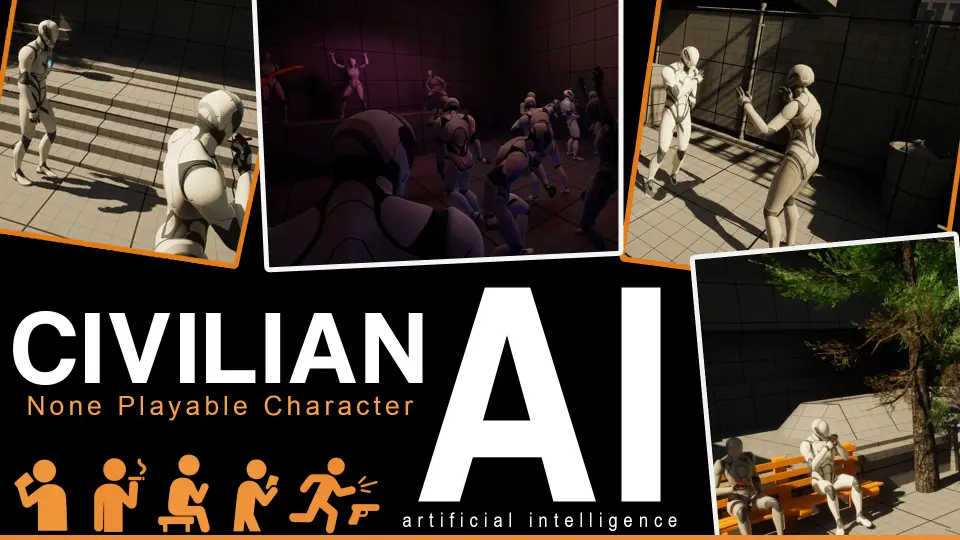
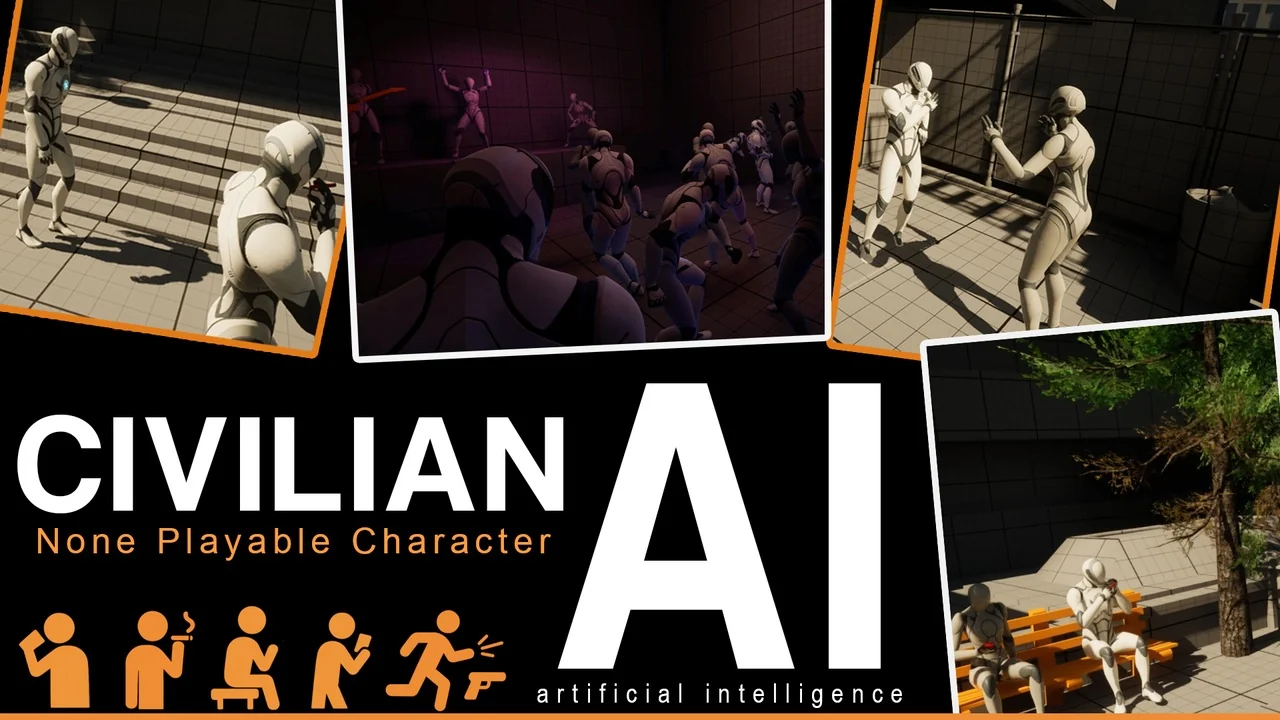
Civilian NPCs AI equips characters with everyday interactive routines that break up repetitive ambient patterns. Characters transition between walking, standing, and resting postures while performing contextual activities. These micro-behaviors include talking, checking or talking on phones, smoking, having a drink, or conversing directly with other nearby pedestrians.
To avoid visual uniformity across large groups, the system includes multiple performance styles alongside gender assignment options for each character. Rather than repeating identical idle stances, male and female characters draw from varied animation sets. Available movement and idle styles include:
Active discussions and hand gestures during conversations
Casual dancing animations for social zones or street entertainment
Street busking routines, such as playing the guitar
Applauding and clapping within spectator groups
Physical workout and exercise routines for park or gym environments
Integrating these animations into distinct visual styles is supported by an open prop system. Items held during idle behaviors—such as handheld mobile devices, beverage containers, and cigarettes—can be exchanged directly for custom static or skeletal meshes. This allows the system to fit different visual standards, historical periods, or stylized art directions by swapping modern items for setting-appropriate alternatives without altering the base behavior logic.
Configuring Paired Navigation and Dynamic Seating with Editor Ghost Previews
Populating a believable scene requires characters to respect physical spaces, particularly when settling into seating or traveling together. The framework includes a dedicated follow setup that allows one character to track and accompany another. This capability enables natural narrative and environmental staging, such as two business colleagues sharing a discussion while walking down a sidewalk or a couple casually strolling together through an outdoor market.
Static placement around street furniture is handled through an integrated seating behavior system. Characters can autonomously target designated chairs, benches, and outdoor seating arrangements while actively checking for occupancy. When a seat is already taken by another pedestrian, the AI recognizes the space as blocked and looks for an alternative spot rather than overlapping meshes or clipping into another character.
To speed up level design and prevent visual alignment errors, the system generates transparent ghost versions of the NPCs within the Unreal Engine editor viewport. When placing designated seating markers, level designers can view the exact posture and alignment of the character directly against the target chair or bench mesh. This visual preview eliminates guesswork around floor clipping or floating meshes before launching the session; once the simulation runs, characters occupy the exact spatial coordinates established by the editor ghost.
Panic Responses, Aim Detection, and Threat Sound Triggers
Crowd immersion relies heavily on how pedestrians react when combat occurs. In shooter and action settings, background civilians must acknowledge danger immediately rather than continuing their calm ambient loops. The system includes built-in threat detection that responds directly to aimed firearms and active gunshots.
When a player or hostile entity aims a weapon toward an NPC, or when gunfire erupts in the immediate area, the character abandons peaceful activities. Based on the situation, civilians dynamically switch to survival responses, either scattering on foot to flee the area or immediately dropping to the floor to take cover. These branching physical reactions provide tactical weight to high-stakes encounters, turning calm city streets into chaotic, responsive conflict zones.
Auditory feedback works alongside visual panic reactions. When targeted or startled by gunfire, civilians trigger audible screams and stress reactions. All sound effects tied to panic and fear states are accessible directly within the Details panel, allowing developers to swap audio assets with custom vocal tracks, localized voice packs, or project-specific sound effects without navigating core logic blueprints.
Framework Suitability and Multi-System Compatibility
Civilian NPCs AI serves as an extensible crowd foundation for city builders, sandbox open worlds, linear action games, and survival projects requiring civilian density. Its support for top-down, third-person, and first-person perspectives makes it applicable to top-down tactical games just as easily as immersive first-person street scenes. Furthermore, the asset maintains compatibility with Zombie AI Behaviour, including multiplayer support, allowing developers to pit infected or hostile frameworks directly against functional civilian populations in shared network environments.
 Artificial Intelli
 Artificial Intelli
 Artificial Intelli
 Artificial Intelli