"e9c335e082208b17"{"id":"1002898","slug":"ambulance-premium-drivable-and-interactable","title":"Ambulance - Premium - Drivable and Interactable","category":"Vehicles \u0026 Transportation","engine":"5.0+","assetVersion":"","engineVersion":"Engine Version: 5.0+","tag":"Vehicles","accent":"blue","visual":"mech","summary":"A game-ready, multiplayer-replicated ambulance vehicle asset with interactive parts, custom skeletal rigging, Chaos physics, and optimization features.","platform":"Unreal Engine","indexPolicy":"index","publishedAt":"2026-11-21T04:46:56.252Z","updatedAt":"2026-11-21T04:46:56.252Z","sourceNotes":[],"fileContents":[],"compatibility":["Unreal Engine","Engine Version: 5.0+"],"featuredImage":{"alt":"Ambulance - Premium - Drivable and Interactable","src":"/wp-content/uploads/published/2026/11/0eb4865e0993-58aaac97-0879-4ceb-89cd-e1ce6a292be4-86c2064016.webp"},"fileSizeBytes":914749270,"hasDownloadLink":true,"downloads":0,"terms":[{"taxonomy":"category","slug":"vehicles-and-transportation","name":"Vehicles \u0026 Transportation"}],"galleryImages":[{"src":"/wp-content/uploads/published/2026/11/8099975e3848-48766b12-9c14-4a61-a95d-3ba678927d70-e6824491d6.webp","alt":"Ambulance - Premium - Drivable and Interactable"},{"src":"/wp-content/uploads/published/2026/11/d9aed9be52b9-d36d3a00-522f-47bb-b762-4bed631c8bd7-863ddc1add.webp","alt":"Ambulance - Premium - Drivable and Interactable"},{"src":"/wp-content/uploads/published/2026/11/be22dc9fb5cf-314d025d-db64-46da-a00c-aa4a6167a8b5-66c52af5b2.webp","alt":"Ambulance - Premium - Drivable and Interactable"},{"src":"/wp-content/uploads/published/2026/11/d7ec1feba6af-455ed32b-e69d-4494-83e2-5459aed7db72-71c46bfab4.webp","alt":"Ambulance - Premium - Drivable and Interactable"},{"src":"/wp-content/uploads/published/2026/11/d3c83e7930f8-d672095d-3663-4311-b8c6-bd93622254e4-0461db319e.webp","alt":"Ambulance - Premium - Drivable and Interactable"},{"src":"/wp-content/uploads/published/2026/11/aad8d833b688-48e0f8d0-70c3-4a90-978b-4fd473104a03-f2c8aaceae.webp","alt":"Ambulance - Premium - Drivable and Interactable"},{"src":"/wp-content/uploads/published/2026/11/37dd84923c18-104a2b26-b3ce-405a-a9d3-94ff0efd0281-c3802c7083.webp","alt":"Ambulance - Premium - Drivable and Interactable"},{"src":"/wp-content/uploads/published/2026/11/8d898c53d0dd-b5f8ffcd-449c-4d05-89b0-b3d2e1efba1a-0424d8f3a8.webp","alt":"Ambulance - Premium - Drivable and Interactable"},{"src":"/wp-content/uploads/published/2026/11/522f700da107-6262614e-305e-48dc-90ae-2d2ed3f6b43b-5c0a48ed1c.webp","alt":"Ambulance - Premium - Drivable and Interactable"},{"src":"/wp-content/uploads/published/2026/11/5b32e6181cae-437ffb17-9c47-437b-8b66-077ba58004bf-86b77e93a5.webp","alt":"Ambulance - Premium - Drivable and Interactable"}],"contentHtml":"\u003cp\u003eA functional vehicle asset needs to bridge several distinct technical layers: skeletal mesh articulation, physics handling, interactive logic, replication over networks, and scalable rendering performance. Ambulance - Premium - Drivable and Interactable delivers a game-ready emergency vehicle asset configured for immediate deployment across interactive playable sequences and wide-scale environmental dressing. At its core, the package combines a multiplayer-ready drivable Blueprint with a dedicated skeleton, exposed shader parameters, audio systems, and optimization mechanics designed to prevent performance drops across large layouts.\u003c/p\u003e\u003ch2\u003eSkeletal Structure and Drivable Blueprint Rigging\u003c/h2\u003e\u003cp\u003eThe core of the vehicle relies on a custom skeleton configured with individual bones mapped across every moving part. Rather than relying on a rigid single-mesh vehicle frame, this setup assigns discrete bones to each wheel, every door, the hood, the boot, the steering wheel, and the gear stick. Because these mechanical pieces exist as distinct structural entities within the hierarchy, they can react dynamically to physics impulses, user controls, and structural states rather than remaining static visual fixtures.\u003c/p\u003e\u003cp\u003eDriving functionality is handled through Unreal Engine's Chaos Vehicles framework, requiring the activation of both the Chaos Vehicles and OpenXR plugins. This foundational system handles the vehicle's contact patches and weight distribution. Behind the wheel, the model features an interactive interior equipped with working odometer and RPM gauges that reflect vehicle operation during gameplay. Advanced vehicle physics are also integrated, generating burnouts and realistic tire decals when rubber slips against road surfaces under heavy acceleration or braking.\u003c/p\u003e\u003cp\u003eNetwork gameplay is built directly into the core vehicle logic. The driving Blueprint comes multiplayer-ready out of the box, ensuring that wheel rotation, body sway, door access, and velocity synchronize properly between server and client without requiring extensive post-setup networking passes.\u003c/p\u003e\u003ch2\u003eAmbulance Interactive Fixtures, Lights, and Audio Systems\u003c/h2\u003e\u003cp\u003eBeyond standard driving capabilities, an emergency vehicle relies on specialized audiovisual indicators. The ambulance package includes fully functional lights and sirens configured across two distinct rendering setups: emissive light surfaces for direct visual feedback and physical light sources for casting illuminance onto the surrounding scene geometry. This dual setup allows technical artists to tailor light cast intensity based on project performance profiles and lighting conditions.\u003c/p\u003e\u003cp\u003eSound design accompanies each mechanical state through an integrated suite of sound effects. Audio cues are assigned to engine operations across varying throttle states, door opening and closing actions, and glass impacts. Visual particle systems work in tandem with the audio engine, deploying dedicated particle emitters for exhaust fumes and tire smoke during heavy driving maneuvers or burnouts.\u003c/p\u003e\u003cp\u003ePhysical wear and combat scenarios are accommodated through destructible vehicle components. Vulnerable sections such as windows and mirrors can sustain damage and break during gameplay, supported by custom hand-made collision meshes tailored to the vehicle exterior and interior contours. These custom boundaries ensure accurate projectile and physical collision behavior without the unpredictable clipping common to automatically generated collision bounds.\u003c/p\u003e\u003ch2\u003eShader Customization and Surface Variation\u003c/h2\u003e\u003cp\u003eVisual presentation is managed by approximately 100 exposed procedural parameters, granting direct control over surface materials and weathering without requiring external texture authoring. The texture system isolates paint coats from environmental wear layers, allowing level designers to adjust underlying paint values without altering or breaking existing dirt, grime, and rust distribution. This decoupling is essential when creating fleets of vehicles with matching grime maps but varying service finishes.\u003c/p\u003e\u003cp\u003eFor projects requiring abandoned or post-apocalyptic settings, the material graph incorporates procedural foliage and moss coverage directly into the exterior surfaces. The vehicle also carries a highly detailed interior, an exposed engine bay, and an articulated undercarriage for shots where the vehicle is overturned, elevated, or inspected at close quarters. License plates can also be customized directly within the material properties to prevent repetitive visual patterns in scenes with multiple vehicle instances.\u003c/p\u003e\u003ch2\u003eLevel Design Workflows and Scene Assembly\u003c/h2\u003e\u003cp\u003ePopulating levels with vehicles often creates bottlenecks when assets must be manually placed, transformed, and managed individually. This asset incorporates level designer-friendly tooling right inside the editor. Designers can use foliage tools integration to paint vehicle meshes across large terrain sections like brush assets, making it straightforward to fill highway pileups, abandoned medical compounds, or broad quarantine scenes in minutes.\u003c/p\u003e\u003cp\u003eWithin the viewport, dedicated in-editor buttons allow for rapid mesh and variation regeneration directly on selected instances. This eliminates the need to dive through deep Blueprint dropdown menus simply to switch configurations. Furthermore, the asset features drag-and-drop character controller switching, which smooths out the integration process when transitioning player characters between walking and driving modes.\u003c/p\u003e\u003ch2\u003eOptimization and the Smart Actor Framework\u003c/h2\u003e\u003cp\u003ePlacing dozens or hundreds of interactive actors into a scene often degrades frame rates due to ongoing tick events, complex physics computations, and draw call overhead. To address high instance counts, the asset implements a Smart Actor framework that reduces computational cost to near zero whenever the vehicle sits idle, avoiding unnecessary background tick cycles while retaining interactive readiness.\u003c/p\u003e\u003cp\u003eRendering performance scales across multiple tiers through instanced and dynamic meshes, complemented by hand-made level of detail (LOD) models that preserve critical silhouettes at intermediate view ranges. For extreme camera distances, the system generates a single draw-call proxy mesh, allowing massive numbers of vehicles to sit on screen simultaneously without overburdening the graphics pipeline. During interaction and performance stress testing, environments containing over 1,500 vehicle instances have maintained 120 frames per second.\u003c/p\u003e\u003ch2\u003eProduction Integration and Deployment Scope\u003c/h2\u003e\u003cp\u003eWhether dropped into a pristine municipal simulation, a rapid medical response sequence, or an overgrown abandoned city corridor, the package supplies both the high-fidelity mechanics needed for up-close driving sequences and the lightweight proxies required for dense level dressing. By joining mechanical articulation, complete sensory effects, multiplayer replication, and low-cost idling under a single framework, the vehicle serves as a flexible foundation for modern Unreal Engine vehicle pipelines.\u003c/p\u003e\n\n\u003ch2\u003eExplore Similar Assets\u003c/h2\u003e\n\u003cul\u003e\n\u003cli\u003e\u003ca href=\"https://3dcghub.com/emergency-vehicles-premium-drivable-and-interactable/\" rel=\"noopener noreferrer\"\u003eEmergency Vehicles - Premium - Drivable and Interactable\u003c/a\u003e\u003c/li\u003e\n\u003cli\u003e\u003ca href=\"https://3dcghub.com/replicated-drivable-gokart-blueprint/\" rel=\"noopener noreferrer\"\u003eReplicated Drivable Gokart (Blueprint)\u003c/a\u003e\u003c/li\u003e\n\u003cli\u003e\u003ca href=\"https://3dcghub.com/replicated-drivable-rc-car-blueprint/\" rel=\"noopener noreferrer\"\u003eReplicated Drivable RC Car (Blueprint)\u003c/a\u003e\u003c/li\u003e\n\u003cli\u003e\u003ca href=\"https://3dcghub.com/vehicle-variety-first-person-vehicle-interaction-system-fpvis/\" rel=\"noopener noreferrer\"\u003eVehicle Variety First Person Vehicle Interaction System (FPVIS)\u003c/a\u003e\u003c/li\u003e\n\u003cli\u003e\u003ca href=\"https://3dcghub.com/drivable-retro-car-farton/\" rel=\"noopener noreferrer\"\u003eDrivable retro car \u0026quot;Farton\u0026quot;\u003c/a\u003e\u003c/li\u003e\n\u003c/ul\u003e","contentTextLength":7293,"navigation":{"current":36,"total":4839,"previous":{"id":"1002899","slug":"ascent-finite-state-machine-fsm","title":"Ascent Finite State Machine (FSM)","category":"Engine Tools","platform":"Unreal Engine","updatedAt":"2026-11-21T04:47:16.312Z"},"next":{"id":"1002897","slug":"ai-enemies-drone","title":"AI Enemies - Drone","category":"Artificial Intelligence","platform":"Unreal Engine","updatedAt":"2026-11-21T04:46:11.617Z"}},"relatedResources":[{"id":"1000989","slug":"emergency-vehicles-premium-drivable-and-interactable","title":"Emergency Vehicles - Premium - Drivable and Interactable","category":"Vehicles \u0026 Transportation","engine":"5.3+","assetVersion":"","engineVersion":"Engine Version: 5.3+","tag":"Vehicles","accent":"blue","visual":"mech","summary":"Add drivable emergency vehicles with a full rig, functional interior, sirens, destructible parts, and level designer tools. Chaos Vehicles and OpenXR required.","platform":"Unreal Engine","indexPolicy":"index","publishedAt":"2026-08-18T06:37:54.815Z","updatedAt":"2026-08-18T06:37:54.815Z","sourceNotes":[],"fileContents":[],"compatibility":["Unreal Engine","Engine Version: 5.3+"],"featuredImage":{"alt":"Emergency Vehicles - Premium - Drivable and Interactable","src":"/wp-content/uploads/published/2026/08/1c514b2e1f8f-66ce2b26-a13c-4ac2-af06-f1e66e8c1668-e2131ac210.webp"},"fileSizeBytes":1695853745,"hasDownloadLink":true,"downloads":2},{"id":"1001828","slug":"replicated-drivable-gokart-blueprint","title":"Replicated Drivable Gokart (Blueprint)","category":"Vehicles \u0026 Transportation","engine":"5.0+","assetVersion":"","engineVersion":"Engine Version: 5.0+","tag":"Vehicles","accent":"blue","visual":"mech","summary":"Explore the Replicated Drivable Gokart for Unreal Engine, featuring native vehicle physics, multiplayer replication, rigged skeletal meshes, and custom lighting","platform":"Unreal Engine","indexPolicy":"index","publishedAt":"2026-10-21T08:20:49.526Z","updatedAt":"2026-10-21T08:20:49.526Z","sourceNotes":[],"fileContents":[],"compatibility":["Unreal Engine","Engine Version: 5.0+"],"featuredImage":{"alt":"Replicated Drivable Gokart (Blueprint)","src":"/wp-content/uploads/published/2026/10/0158e36d8f36-baa6c062-d685-4943-b955-32c41359465d-ce1bf6a53f.webp"},"fileSizeBytes":295835246,"hasDownloadLink":true,"downloads":0},{"id":"1002081","slug":"replicated-drivable-rc-car-blueprint","title":"Replicated Drivable RC Car (Blueprint)","category":"Vehicles \u0026 Transportation","engine":"5.0+","assetVersion":"","engineVersion":"Engine Version: 5.0+","tag":"Vehicles","accent":"blue","visual":"mech","summary":"Explore the Replicated Drivable RC Car Blueprint, featuring fully rigged skeletal meshes, bone scale integrity, color material parameters, and VoIP support.","platform":"Unreal Engine","indexPolicy":"index","publishedAt":"2026-10-26T15:50:47.654Z","updatedAt":"2026-10-26T15:50:47.654Z","sourceNotes":[],"fileContents":[],"compatibility":["Unreal Engine","Engine Version: 5.0+"],"featuredImage":{"alt":"Replicated Drivable RC Car (Blueprint)","src":"/wp-content/uploads/published/2026/10/9812b44c9454-0b4bfd06-0230-4573-8df6-b954f12d503d-86b6a7726b.webp"},"fileSizeBytes":146876127,"hasDownloadLink":true,"downloads":0}]}
Resource screenshots
1 / 10
Join our channel
Follow 3DCGHUB on Telegram for new resource drops, migration updates, and community notices.
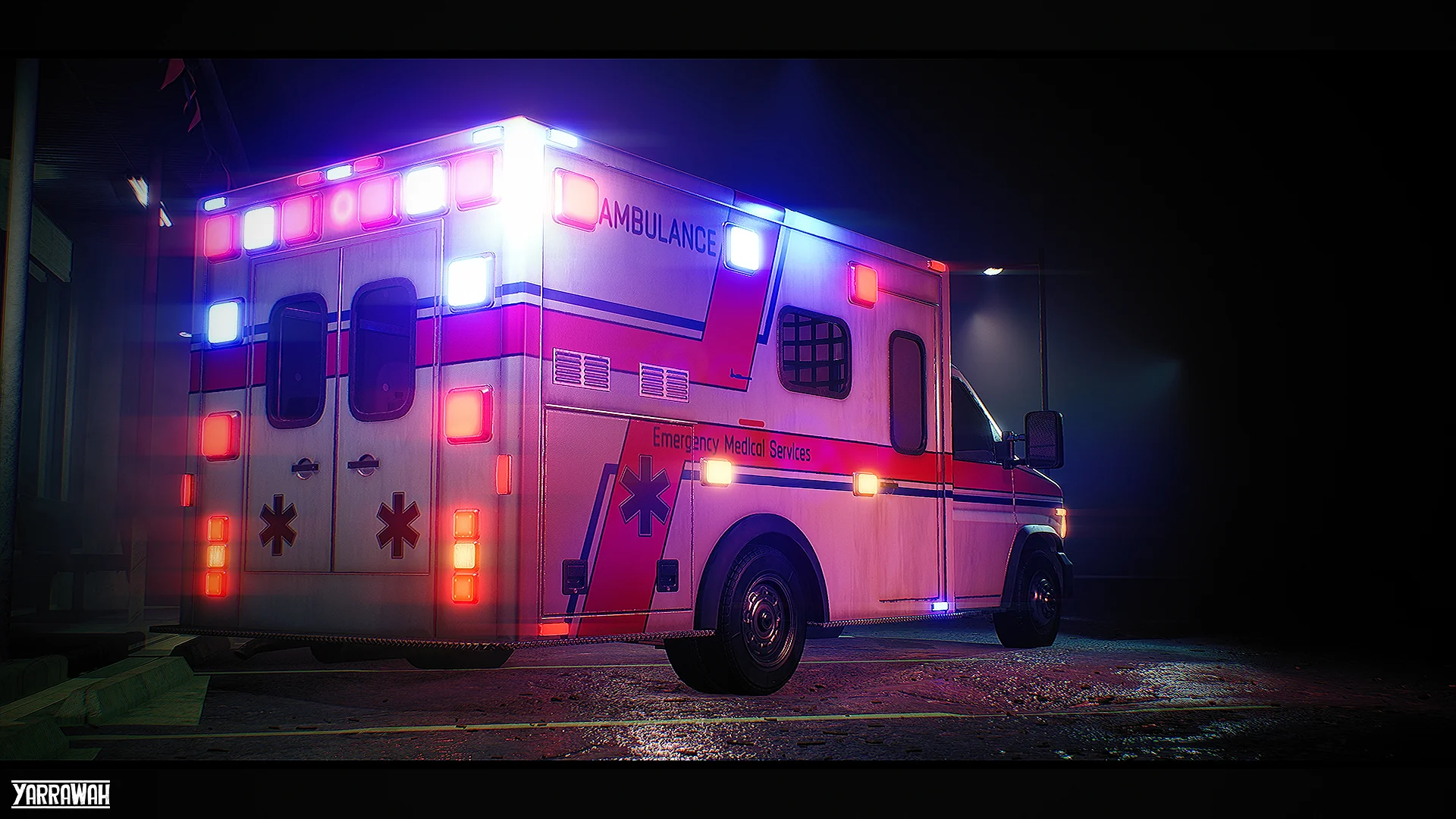
A functional vehicle asset needs to bridge several distinct technical layers: skeletal mesh articulation, physics handling, interactive logic, replication over networks, and scalable rendering performance. Ambulance - Premium - Drivable and Interactable delivers a game-ready emergency vehicle asset configured for immediate deployment across interactive playable sequences and wide-scale environmental dressing. At its core, the package combines a multiplayer-ready drivable Blueprint with a dedicated skeleton, exposed shader parameters, audio systems, and optimization mechanics designed to prevent performance drops across large layouts.
Skeletal Structure and Drivable Blueprint Rigging
The core of the vehicle relies on a custom skeleton configured with individual bones mapped across every moving part. Rather than relying on a rigid single-mesh vehicle frame, this setup assigns discrete bones to each wheel, every door, the hood, the boot, the steering wheel, and the gear stick. Because these mechanical pieces exist as distinct structural entities within the hierarchy, they can react dynamically to physics impulses, user controls, and structural states rather than remaining static visual fixtures.
Driving functionality is handled through Unreal Engine's Chaos Vehicles framework, requiring the activation of both the Chaos Vehicles and OpenXR plugins. This foundational system handles the vehicle's contact patches and weight distribution. Behind the wheel, the model features an interactive interior equipped with working odometer and RPM gauges that reflect vehicle operation during gameplay. Advanced vehicle physics are also integrated, generating burnouts and realistic tire decals when rubber slips against road surfaces under heavy acceleration or braking.
Network gameplay is built directly into the core vehicle logic. The driving Blueprint comes multiplayer-ready out of the box, ensuring that wheel rotation, body sway, door access, and velocity synchronize properly between server and client without requiring extensive post-setup networking passes.
Ambulance Interactive Fixtures, Lights, and Audio Systems
Beyond standard driving capabilities, an emergency vehicle relies on specialized audiovisual indicators. The ambulance package includes fully functional lights and sirens configured across two distinct rendering setups: emissive light surfaces for direct visual feedback and physical light sources for casting illuminance onto the surrounding scene geometry. This dual setup allows technical artists to tailor light cast intensity based on project performance profiles and lighting conditions.
Sound design accompanies each mechanical state through an integrated suite of sound effects. Audio cues are assigned to engine operations across varying throttle states, door opening and closing actions, and glass impacts. Visual particle systems work in tandem with the audio engine, deploying dedicated particle emitters for exhaust fumes and tire smoke during heavy driving maneuvers or burnouts.
Physical wear and combat scenarios are accommodated through destructible vehicle components. Vulnerable sections such as windows and mirrors can sustain damage and break during gameplay, supported by custom hand-made collision meshes tailored to the vehicle exterior and interior contours. These custom boundaries ensure accurate projectile and physical collision behavior without the unpredictable clipping common to automatically generated collision bounds.
Shader Customization and Surface Variation
Visual presentation is managed by approximately 100 exposed procedural parameters, granting direct control over surface materials and weathering without requiring external texture authoring. The texture system isolates paint coats from environmental wear layers, allowing level designers to adjust underlying paint values without altering or breaking existing dirt, grime, and rust distribution. This decoupling is essential when creating fleets of vehicles with matching grime maps but varying service finishes.
For projects requiring abandoned or post-apocalyptic settings, the material graph incorporates procedural foliage and moss coverage directly into the exterior surfaces. The vehicle also carries a highly detailed interior, an exposed engine bay, and an articulated undercarriage for shots where the vehicle is overturned, elevated, or inspected at close quarters. License plates can also be customized directly within the material properties to prevent repetitive visual patterns in scenes with multiple vehicle instances.
Level Design Workflows and Scene Assembly
Populating levels with vehicles often creates bottlenecks when assets must be manually placed, transformed, and managed individually. This asset incorporates level designer-friendly tooling right inside the editor. Designers can use foliage tools integration to paint vehicle meshes across large terrain sections like brush assets, making it straightforward to fill highway pileups, abandoned medical compounds, or broad quarantine scenes in minutes.
Within the viewport, dedicated in-editor buttons allow for rapid mesh and variation regeneration directly on selected instances. This eliminates the need to dive through deep Blueprint dropdown menus simply to switch configurations. Furthermore, the asset features drag-and-drop character controller switching, which smooths out the integration process when transitioning player characters between walking and driving modes.
Optimization and the Smart Actor Framework
Placing dozens or hundreds of interactive actors into a scene often degrades frame rates due to ongoing tick events, complex physics computations, and draw call overhead. To address high instance counts, the asset implements a Smart Actor framework that reduces computational cost to near zero whenever the vehicle sits idle, avoiding unnecessary background tick cycles while retaining interactive readiness.
Rendering performance scales across multiple tiers through instanced and dynamic meshes, complemented by hand-made level of detail (LOD) models that preserve critical silhouettes at intermediate view ranges. For extreme camera distances, the system generates a single draw-call proxy mesh, allowing massive numbers of vehicles to sit on screen simultaneously without overburdening the graphics pipeline. During interaction and performance stress testing, environments containing over 1,500 vehicle instances have maintained 120 frames per second.
Production Integration and Deployment Scope
Whether dropped into a pristine municipal simulation, a rapid medical response sequence, or an overgrown abandoned city corridor, the package supplies both the high-fidelity mechanics needed for up-close driving sequences and the lightweight proxies required for dense level dressing. By joining mechanical articulation, complete sensory effects, multiplayer replication, and low-cost idling under a single framework, the vehicle serves as a flexible foundation for modern Unreal Engine vehicle pipelines.
 Vehicles
 Vehicles
 Vehicles