"4481da9c895ef786"{"id":"1000989","slug":"emergency-vehicles-premium-drivable-and-interactable","title":"Emergency Vehicles - Premium - Drivable and Interactable","category":"Vehicles \u0026 Transportation","engine":"5.3+","assetVersion":"","engineVersion":"Engine Version: 5.3+","tag":"Vehicles","accent":"blue","visual":"mech","summary":"Add drivable emergency vehicles with a full rig, functional interior, sirens, destructible parts, and level designer tools. Chaos Vehicles and OpenXR required.","platform":"Unreal Engine","publishedAt":"2026-08-18T06:37:54.815Z","updatedAt":"2026-08-18T06:37:54.815Z","sourceNotes":[],"fileContents":[],"compatibility":["Unreal Engine","Engine Version: 5.3+"],"featuredImage":{"alt":"Emergency Vehicles - Premium - Drivable and Interactable","src":"/wp-content/uploads/published/2026/08/1c514b2e1f8f-66ce2b26-a13c-4ac2-af06-f1e66e8c1668-e2131ac210.webp"},"hasDownloadLink":true,"downloads":2,"terms":[{"taxonomy":"category","slug":"vehicles-and-transportation","name":"Vehicles \u0026 Transportation"}],"galleryImages":[{"src":"/wp-content/uploads/published/2026/08/2a6aeef1f53e-72dba2cb-7abd-4e8b-8f08-f121ba597adb-99ea5d9c02.webp","alt":"Emergency Vehicles - Premium - Drivable and Interactable"},{"src":"/wp-content/uploads/published/2026/08/8c6107ae59bb-7e9c1551-5f06-4a57-8e4d-49eb79b66dd4-774aaf36a5.webp","alt":"Emergency Vehicles - Premium - Drivable and Interactable"},{"src":"/wp-content/uploads/published/2026/08/db1658c2c69b-61117a70-3512-45be-b480-81b4a72d4ae6-9364e73cef.webp","alt":"Emergency Vehicles - Premium - Drivable and Interactable"},{"src":"/wp-content/uploads/published/2026/08/a253b7530eba-f3e1b86f-7b02-4ad9-bbd1-4a69c23a3eb7-43d1cb416f.webp","alt":"Emergency Vehicles - Premium - Drivable and Interactable"},{"src":"/wp-content/uploads/published/2026/08/c5ad80d89671-0b8c2f0c-8f12-4ba1-9560-25ee494c1dd4-9afdab5282.webp","alt":"Emergency Vehicles - Premium - Drivable and Interactable"},{"src":"/wp-content/uploads/published/2026/08/d17f7ca9eacd-f928f7c8-b646-435d-b4f1-e8465b7b6a33-c520e78d88.webp","alt":"Emergency Vehicles - Premium - Drivable and Interactable"},{"src":"/wp-content/uploads/published/2026/08/6775d0538d02-ae504ced-66bd-4965-9bc0-44e6e17b9cbf-2f07c227dd.webp","alt":"Emergency Vehicles - Premium - Drivable and Interactable"},{"src":"/wp-content/uploads/published/2026/08/dc44fc4b0fa0-532d9eec-6d79-4425-8fd3-f1b0d0341107-7649d9b67e.webp","alt":"Emergency Vehicles - Premium - Drivable and Interactable"},{"src":"/wp-content/uploads/published/2026/08/d86ab68e0e48-6618ee34-e42c-4e59-a2c0-3e056c1e810d-895d78a5b4.webp","alt":"Emergency Vehicles - Premium - Drivable and Interactable"},{"src":"/wp-content/uploads/published/2026/08/d6abdd609d92-25556ac1-3b41-476c-8a80-f25acc3ade63-cf1fdfe274.webp","alt":"Emergency Vehicles - Premium - Drivable and Interactable"}],"accessPanel":{"kind":"resource","title":"Download this resource","eyebrow":"Free Download","message":"Log in or create a free account to start your download.","fileName":"Emergency Vehicles - Premium - Drivable and Interactable.7z","safetyNote":"Resources are manually reviewed before listing to improve quality and reduce obvious risks.","actionLabel":"Download Free","resourceType":"Resource archive"},"contentHtml":"\u003cp\u003eBefore the first vehicle can roll out, two plugins need to be enabled in your editor: Chaos Vehicles and OpenXR. A restart follows, and then the blueprints are ready to populate a scene. This system is built to speed up that process for level designers, putting drivable and interactable emergency vehicles into a map in minutes rather than hours.\u003c/p\u003e \u003ch2\u003eEnabling Chaos Vehicles and OpenXR\u003c/h2\u003e\n\u003cp\u003eThe setup path is explicit. Open your project's plugin manager, turn on Chaos Vehicles and OpenXR, then restart the editor. These are not optional extras; the drivable blueprints rely on them. With the plugins active, every vehicle blueprint in the pack has the physics and interaction systems it needs to run as intended.\u003c/p\u003e \u003ch2\u003eThe Drivable Blueprint and Its Custom Skeleton\u003c/h2\u003e\n\u003cp\u003eEach vehicle comes as a fully rigged, multiplayer-ready drivable blueprint. The skeleton is custom built with individual bones for each wheel and door, plus the steering wheel, gear stick, hood, and boot. That level of bone separation means doors can swing independently, wheels spin and steer on their own axes, and the hood and boot can be opened or animated without breaking the rig.\u003c/p\u003e\n\u003cp\u003eThe interior is functional rather than decorative. An odometer and RPM gauge are part of the cockpit, so when a player is behind the wheel, the dashboard reacts to speed and engine load. Advanced physics behaviors are already wired in: burnouts leave tire decals, and the vehicle responds to driving inputs with a believable weight transfer.\u003c/p\u003e \u003ch2\u003eLevel Designer–Friendly Placement Tools\u003c/h2\u003e\n\u003cp\u003eFor level designers, the system integrates with foliage tools. That means vehicles can be painted into a map like foliage, scattered across roads, parking lots, or crash scenes without placing each one manually. In-editor buttons allow rapid regeneration of vehicles, so a placed fleet can be reset or rebuilt with a single click while working. Character controller switching is handled with drag-and-drop, which makes testing a scene from a driver or pedestrian perspective straightforward.\u003c/p\u003e \u003ch2\u003ePerformance Structure: Smart Actors, LODs, and Proxy Meshes\u003c/h2\u003e\n\u003cp\u003ePerformance is a core part of the system. A \u0026ldquo;Smart Actor\u0026rdquo; approach keeps each vehicle near zero cost when it is idle, so a scene can contain many parked or inactive vehicles without dragging the frame rate down. Meshes use instanced and dynamic rendering techniques, and LODs are hand-made rather than auto-generated. For extremely distant vehicles, a single draw-call proxy mesh replaces the full model, allowing large vistas with many vehicles to render efficiently. An included performance demo shows 1500+ vehicles running at 120fps, which suggests how far this scalability can be pushed.\u003c/p\u003e \u003ch2\u003eProcedural Parameters and Material Variation\u003c/h2\u003e\n\u003cp\u003eVisually, the pack exposes about 100 procedural parameters. These are designed to let an artist or level designer adjust a vehicle's look without digging into material graphs. Advanced texture variations separate paint control from rust and dirt, so the paint color can be changed while the weathering stays intact. Number plates are customizable, and the high-detail interior, engine, and undercarriage are all modeled, meaning the vehicles hold up in close-up shots as well as in gameplay.\u003c/p\u003e\n\u003cp\u003eRealistic foliage and moss coverage are also part of the system. Vehicles can be placed with natural overgrowth, which suits abandoned or post-apocalyptic scenes. The showcased \u0026ldquo;The Last of Us inspired\u0026rdquo; scene by Michael Gerard demonstrates this look in practice.\u003c/p\u003e \u003ch2\u003eLights, Sound, Particles, and Destructible Components\u003c/h2\u003e\n\u003cp\u003eEmergency vehicle functionality goes beyond driving. The lights and sirens are fully functional, using both emissive materials and physical light sources. A full suite of sound effects covers engine, glass, and doors, so interactions have audio feedback. Integrated particle effects include exhaust and tire smoke, which pair with the burnouts and decals. Destructible components are in place for windows, mirrors, and other breakable parts, and the collisions are hand-made rather than relying on simple primitives, improving both durability and interaction accuracy.\u003c/p\u003e \u003ch2\u003eDocumentation and Ongoing Support\u003c/h2\u003e\n\u003cp\u003eThe pack includes PDF documentation, which covers setup, the exposed parameters, and how the vehicle blueprints are structured. For project-specific questions, a Discord community and a direct support email provide a path to get help or report issues. Because the system is shaped by designer-friendly tools, the documentation focuses on getting vehicles into a level and tuning them from the editor, not on deep C++ knowledge.\u003c/p\u003e\n\u003cp\u003eFrom the plugin requirement to the proxy mesh system, the entire workflow is shaped by getting emergency vehicles from an empty level to a populated, interactive scene quickly. The combination of customization, performance optimization, and destructible features makes it a production-ready piece of a larger vehicle toolkit.\u003c/p\u003e\n\n\u003ch2\u003eContinue Browsing Similar Packs\u003c/h2\u003e\n\u003cul\u003e\n\u003cli\u003e\u003ca href=\"https://3dcghub.com/driveable-vehicle-ah-raider/\" title=\"Driveable Vehicle : AH-Raider\"\u003eDriveable Vehicle : AH-Raider\u003c/a\u003e\u003c/li\u003e\n\u003cli\u003e\u003ca href=\"https://3dcghub.com/scifi-cyber-car-2/\" title=\"SciFi Cyber Car 2\"\u003eSciFi Cyber Car 2\u003c/a\u003e\u003c/li\u003e\n\u003cli\u003e\u003ca href=\"https://3dcghub.com/drivable-retro-car-farton/\" title=\"Drivable retro car \u0026quot;Farton\u0026quot;\"\u003eDrivable retro car \u0026quot;Farton\u0026quot;\u003c/a\u003e\u003c/li\u003e\n\u003cli\u003e\u003ca href=\"https://3dcghub.com/military-truck-rigged-bp-controllable-military-truck-army-drivable-car-3d/\" title=\"Military Truck - Rigged/BP Controllable ( Military Truck Army Drivable Car 3D )\"\u003eMilitary Truck - Rigged/BP Controllable ( Military Truck Army Drivable Car 3D )\u003c/a\u003e\u003c/li\u003e\n\u003cli\u003e\u003ca href=\"https://3dcghub.com/military-boat-rigged-bp-controllable-w-skins-military-boat-boats-soldier/\" title=\"Military Boat - Rigged/BP Controllable W/Skins ( Military Boat Boats Soldier )\"\u003eMilitary Boat - Rigged/BP Controllable W/Skins ( Military Boat Boats Soldier )\u003c/a\u003e\u003c/li\u003e\n\u003c/ul\u003e","contentTextLength":5178,"navigation":{"current":393,"total":3269,"previous":{"id":"1000990","slug":"fortuna-ultimate-menu-system","title":"Fortuna Ultimate Menu System","category":"UI Kits / HUDs","platform":"Unreal Engine","updatedAt":"2026-08-18T06:42:18.738Z"},"next":{"id":"1000988","slug":"eastern-orthodox-byzantine-church","title":"Eastern Orthodox Byzantine Church","category":"Interior","platform":"Unreal Engine","updatedAt":"2026-08-18T06:31:01.776Z"}},"relatedResources":[{"id":"1001027","slug":"vehicle-variety-first-person-vehicle-interaction-system-fpvis","title":"Vehicle Variety First Person Vehicle Interaction System (FPVIS)","category":"Vehicles \u0026 Transportation","engine":"5.1+","assetVersion":"","engineVersion":"Engine Version: 5.1+","tag":"Vehicles","accent":"blue","visual":"mech","summary":"Four drivable vehicles with interiors, a first-person interaction system for opening doors and picking up physics objects, plus 31 props for Unreal Engine.","platform":"Unreal Engine","publishedAt":"2026-08-23T06:31:45.549Z","updatedAt":"2026-08-23T06:31:45.549Z","sourceNotes":[],"fileContents":[],"compatibility":["Unreal Engine","Engine Version: 5.1+"],"featuredImage":{"alt":"Vehicle Variety First Person Vehicle Interaction System (FPVIS)","src":"/wp-content/uploads/published/2026/08/931540a117b2-fae03a09-f100-4f0e-b0e9-1501943e1998-36105223ac.webp"},"hasDownloadLink":true,"downloads":0},{"id":"5090","slug":"drivable-retro-car-farton","title":"Drivable retro car \"Farton\"","category":"Vehicles \u0026 Transportation","engine":"5.0+","assetVersion":"Engine version: 5.0+","engineVersion":"5.0","tag":"Vehicles","accent":"blue","visual":"character","summary":"Enhance your Unreal Engine projects with the Farton retro car. This drivable vehicle features realistic Chaos physics, modular design, and vintage aesthetics.","platform":"Unreal Engine","publishedAt":"2026-02-14T17:39:17.000Z","updatedAt":"2026-04-19T15:57:01.000Z","sourceNotes":[],"fileContents":[],"compatibility":["Unreal Engine","Engine version: 5.0+"],"featuredImage":{"alt":"Drivable retro car \"Farton\"","src":"https://3dcghub.com/wp-content/uploads/2026/02/ee4dbe6d-e321-41b7-be25-32c344d48762.webp"},"hasDownloadLink":true,"downloads":1},{"id":"5107","slug":"driveable-vehicle-ah-raider","title":"Driveable Vehicle : AH-Raider","category":"Vehicles \u0026 Transportation","engine":"5.0+","assetVersion":"Engine version: 5.0+","engineVersion":"4.16","tag":"Vehicles","accent":"blue","visual":"animation","summary":"Boost your Unreal Engine project with the AH-Raider. This drivable stealth helicopter features optimized blueprints, seven skins, and advanced weapon systems.","platform":"Unreal Engine","publishedAt":"2026-02-14T17:43:29.000Z","updatedAt":"2026-04-19T15:57:01.000Z","sourceNotes":[],"fileContents":[],"compatibility":["Unreal Engine","Engine version: 5.0+"],"featuredImage":{"alt":"Driveable Vehicle : AH-Raider","src":"https://3dcghub.com/wp-content/uploads/2026/02/99e4b997-773c-4bcc-b1c0-ddff44a70701.webp"},"hasDownloadLink":true,"downloads":0}]}
Vehicles
Emergency Vehicles - Premium - Drivable and Interactable
Add drivable emergency vehicles with a full rig, functional interior, sirens, destructible parts, and level designer tools. Chaos Vehicles and OpenXR required.
Before the first vehicle can roll out, two plugins need to be enabled in your editor: Chaos Vehicles and OpenXR. A restart follows, and then the blueprints are ready to populate a scene. This system is built to speed up that process for level designers, putting drivable and interactable emergency vehicles into a map in minutes rather than hours.
Enabling Chaos Vehicles and OpenXR
The setup path is explicit. Open your project's plugin manager, turn on Chaos Vehicles and OpenXR, then restart the editor. These are not optional extras; the drivable blueprints rely on them. With the plugins active, every vehicle blueprint in the pack has the physics and interaction systems it needs to run as intended.
The Drivable Blueprint and Its Custom Skeleton
Each vehicle comes as a fully rigged, multiplayer-ready drivable blueprint. The skeleton is custom built with individual bones for each wheel and door, plus the steering wheel, gear stick, hood, and boot. That level of bone separation means doors can swing independently, wheels spin and steer on their own axes, and the hood and boot can be opened or animated without breaking the rig.
The interior is functional rather than decorative. An odometer and RPM gauge are part of the cockpit, so when a player is behind the wheel, the dashboard reacts to speed and engine load. Advanced physics behaviors are already wired in: burnouts leave tire decals, and the vehicle responds to driving inputs with a believable weight transfer.
Level Designer–Friendly Placement Tools
For level designers, the system integrates with foliage tools. That means vehicles can be painted into a map like foliage, scattered across roads, parking lots, or crash scenes without placing each one manually. In-editor buttons allow rapid regeneration of vehicles, so a placed fleet can be reset or rebuilt with a single click while working. Character controller switching is handled with drag-and-drop, which makes testing a scene from a driver or pedestrian perspective straightforward.
Performance Structure: Smart Actors, LODs, and Proxy Meshes
Performance is a core part of the system. A “Smart Actor” approach keeps each vehicle near zero cost when it is idle, so a scene can contain many parked or inactive vehicles without dragging the frame rate down. Meshes use instanced and dynamic rendering techniques, and LODs are hand-made rather than auto-generated. For extremely distant vehicles, a single draw-call proxy mesh replaces the full model, allowing large vistas with many vehicles to render efficiently. An included performance demo shows 1500+ vehicles running at 120fps, which suggests how far this scalability can be pushed.
Procedural Parameters and Material Variation
Visually, the pack exposes about 100 procedural parameters. These are designed to let an artist or level designer adjust a vehicle's look without digging into material graphs. Advanced texture variations separate paint control from rust and dirt, so the paint color can be changed while the weathering stays intact. Number plates are customizable, and the high-detail interior, engine, and undercarriage are all modeled, meaning the vehicles hold up in close-up shots as well as in gameplay.
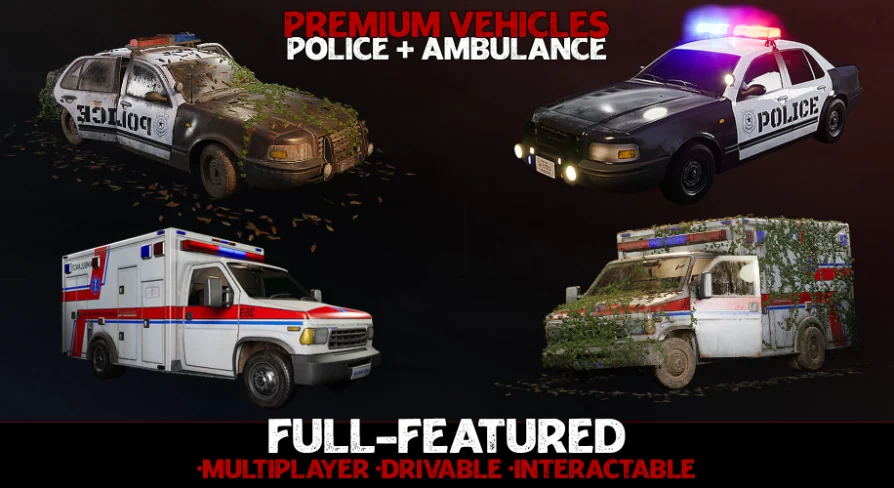
Realistic foliage and moss coverage are also part of the system. Vehicles can be placed with natural overgrowth, which suits abandoned or post-apocalyptic scenes. The showcased “The Last of Us inspired” scene by Michael Gerard demonstrates this look in practice.
Lights, Sound, Particles, and Destructible Components
Emergency vehicle functionality goes beyond driving. The lights and sirens are fully functional, using both emissive materials and physical light sources. A full suite of sound effects covers engine, glass, and doors, so interactions have audio feedback. Integrated particle effects include exhaust and tire smoke, which pair with the burnouts and decals. Destructible components are in place for windows, mirrors, and other breakable parts, and the collisions are hand-made rather than relying on simple primitives, improving both durability and interaction accuracy.
Documentation and Ongoing Support
The pack includes PDF documentation, which covers setup, the exposed parameters, and how the vehicle blueprints are structured. For project-specific questions, a Discord community and a direct support email provide a path to get help or report issues. Because the system is shaped by designer-friendly tools, the documentation focuses on getting vehicles into a level and tuning them from the editor, not on deep C++ knowledge.
From the plugin requirement to the proxy mesh system, the entire workflow is shaped by getting emergency vehicles from an empty level to a populated, interactive scene quickly. The combination of customization, performance optimization, and destructible features makes it a production-ready piece of a larger vehicle toolkit.
 Vehicles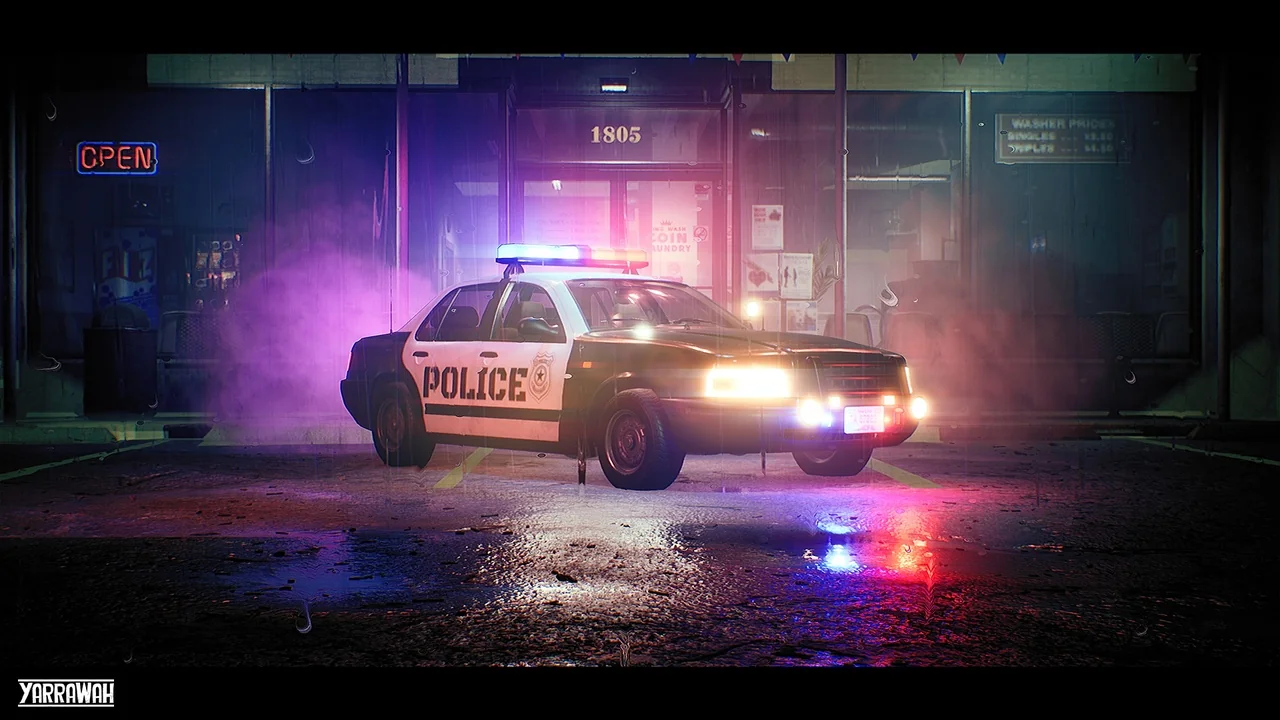
 Vehicles
 Vehicles
 Vehicles