"fa182e0cd0a6ea73"{"id":"1001828","slug":"replicated-drivable-gokart-blueprint","title":"Replicated Drivable Gokart (Blueprint)","category":"Vehicles \u0026 Transportation","engine":"5.0+","assetVersion":"","engineVersion":"Engine Version: 5.0+","tag":"Vehicles","accent":"blue","visual":"mech","summary":"Explore the Replicated Drivable Gokart for Unreal Engine, featuring native vehicle physics, multiplayer replication, rigged skeletal meshes, and custom lighting","platform":"Unreal Engine","publishedAt":"2026-10-21T08:20:49.526Z","updatedAt":"2026-10-21T08:20:49.526Z","sourceNotes":[],"fileContents":[],"compatibility":["Unreal Engine","Engine Version: 5.0+"],"featuredImage":{"alt":"Replicated Drivable Gokart (Blueprint)","src":"/wp-content/uploads/published/2026/10/0158e36d8f36-baa6c062-d685-4943-b955-32c41359465d-ce1bf6a53f.webp"},"hasDownloadLink":true,"downloads":0,"terms":[{"taxonomy":"category","slug":"vehicles-and-transportation","name":"Vehicles \u0026 Transportation"}],"galleryImages":[{"src":"/wp-content/uploads/published/2026/10/b93c684cfc92-45881e88-d1aa-42e6-986c-8ada21ddcc88-e4638252b0.webp","alt":"Replicated Drivable Gokart (Blueprint)"},{"src":"/wp-content/uploads/published/2026/10/63795efd0639-399fc619-fdbe-4018-86c1-fa666755574c-daad7243c9.webp","alt":"Replicated Drivable Gokart (Blueprint)"},{"src":"/wp-content/uploads/published/2026/10/ad216a1227b0-08dc37bb-0ad8-4a7f-b189-a3fcbb664704-65cdf5beb4.webp","alt":"Replicated Drivable Gokart (Blueprint)"},{"src":"/wp-content/uploads/published/2026/10/4f4dc13470d7-66b79f45-8e3a-49b1-9916-cea183d51d95-d5e30c8d8c.webp","alt":"Replicated Drivable Gokart (Blueprint)"},{"src":"/wp-content/uploads/published/2026/10/c0d996e58719-d512f83c-d2a3-44b5-8655-ce005fefc443-7e019fdf49.webp","alt":"Replicated Drivable Gokart (Blueprint)"},{"src":"/wp-content/uploads/published/2026/10/2ae7e042c202-fc4b3a06-7a44-4e45-9e0e-3a6ebc5a1dbe-33e116de1a.webp","alt":"Replicated Drivable Gokart (Blueprint)"},{"src":"/wp-content/uploads/published/2026/10/77f62577facb-03b44b66-b31b-4bd8-88c9-389e57114686-ada4eefbad.webp","alt":"Replicated Drivable Gokart (Blueprint)"},{"src":"/wp-content/uploads/published/2026/10/4682e81c9db5-242887e6-fba8-4cc1-a1dd-a15792f6dcb6-a78b37745c.webp","alt":"Replicated Drivable Gokart (Blueprint)"},{"src":"/wp-content/uploads/published/2026/10/e9e14e0776b8-661fc97c-82af-4cc5-b174-10ac98f62fbe-fa4157896d.webp","alt":"Replicated Drivable Gokart (Blueprint)"},{"src":"/wp-content/uploads/published/2026/10/96831e015cee-fa0ef973-2d0d-44ef-bd73-f00b3f55dd4b-55373acbbe.webp","alt":"Replicated Drivable Gokart (Blueprint)"}],"accessPanel":{"kind":"resource","title":"Download this resource","eyebrow":"Free Download","message":"Log in or create a free account to start your download.","fileName":"Replicated Drivable Gokart (Blueprint).7z","safetyNote":"Resources are manually reviewed before listing to improve quality and reduce obvious risks.","actionLabel":"Download Free","resourceType":"Resource archive"},"contentHtml":"\u003cp\u003eAccelerating off the starting line in a multiplayer session requires precise physics handling and immediate network synchronization. The Replicated Drivable Gokart delivers that baseline directly out of the box, operating as a game-ready vehicle asset constructed on Unreal Engine's native vehicle architecture. Because it utilizes the engine's built-in vehicle foundation, the asset avoids non-standard movement components and works harmoniously with default engine systems. Developers seeking a functional small-scale motorsport vehicle can deploy it immediately without building mechanical replication logic or rigging physics colliders from scratch.\u003c/p\u003e \u003ch2\u003eNetworked Handling on Unreal Engine Default Vehicle Architecture\u003c/h2\u003e\n\u003cp\u003eReplication remains one of the most demanding technical hurdles when implementing vehicles in multiplayer environments. The Replicated Drivable Gokart handles this through a dedicated Blueprint setup configured specifically for client-server environments. Wheel rotations, chassis velocity, acceleration, braking, and positional corrections synchronize between the server and connecting clients. By relying strictly on Unreal's default vehicle system, the Blueprint maintains standard replication cycles, ensuring that server authority governs movement while client prediction keeps the driving experience responsive.\u003c/p\u003e\n\u003cp\u003eThe system adapts effectively whether a project demands lightweight arcade handling or more grounded simulation dynamics. Game-ready architecture means the core driving scripts, input bindings, and physics profiles are already wired together. Rather than spending production time diagnosing desynchronization glitches or tuning basic wheel trace behaviors, designers can focus directly on track design, lap logic, and race balancing.\u003c/p\u003e \u003ch2\u003eRigged Skeletal Meshes and Standardized Bone Hierarchy\u003c/h2\u003e\n\u003cp\u003eUnderpinning the gokart is a fully rigged skeletal mesh built with strict adherence to engine-standard bone naming and scale proportions. Vehicle rigging in Unreal Engine can be notoriously unforgiving; mismatched bone scales or non-standard joint orientations often lead to collapsed suspension, floating wheels, or catastrophic physics calculations when the vehicle actor initializes. This asset circumvents those pitfalls by incorporating correct bone names and standardized uniform scales across the entire vehicle armature.\u003c/p\u003e\n\u003cp\u003eThe chassis serves as the hierarchy root, branching neatly into functional wheel bones that match the requirements of the vehicle movement component. Because the bone structure conforms directly to standard conventions, the skeletal mesh interfaces cleanly with animation Blueprints. Wheel rotation, steering angle deflections, and wheel suspension offsets resolve reliably against driving surface geometry without requiring custom remapping nodes or mesh transformations.\u003c/p\u003e \u003ch2\u003eDriver Steering Animation and Integrated Gokart Lighting\u003c/h2\u003e\n\u003cp\u003eA vehicle's sense of speed and immersion depends heavily on real-time visual feedback from both the mechanical components and the operator. The package includes dedicated driver steering animation assets that synchronize pilot movement with player input. As steering commands are passed to the gokart's front wheels, the accompanying driver animation reflects those directional inputs, showing the hands and body shifting along with the wheel. This keeps the driver model from remaining static, which is critical in open-cockpit vehicles like karts where the driver remains completely visible to other players on the track.\u003c/p\u003e\n\u003cp\u003eVisual detailing extends to the vehicle's illumination systems. The asset incorporates both front and rear light setups within the Blueprint structure. The inclusion of front lights enables visibility across low-light circuits, tunnel sections, or nighttime driving stages. Rear lights provide essential visual indicators for following racers during braking or deceleration phases, reinforcing spatial awareness and tactical racing lines in competitive pack driving.\u003c/p\u003e \u003ch2\u003eColor Customization via Material Parameters\u003c/h2\u003e\n\u003cp\u003eVisual diversity is critical in kart-based games where multiple identical vehicle silhouettes populate the starting grid. To prevent repetitive field visuals, the asset provides exposed material parameters dedicated to vehicle color. Developers and technical artists can adjust body paint schemes dynamically using Material Instance parameters without authoring new texture maps or duplicating underlying shaders.\u003c/p\u003e\n\u003cp\u003eThese exposed scalar and vector parameters allow teams to establish uniform color profiles for specific teams, randomize livery palettes at player spawn, or let racers select custom body shades from an in-game garage interface. The streamlined material setup maintains performance by using instance parameters, which helps preserve low render overhead during dense races involving numerous lowpoly vehicles running on screen simultaneously.\u003c/p\u003e \u003ch2\u003eMultiplayer Racing Scenarios and VoIP Integration\u003c/h2\u003e\n\u003cp\u003eThe feature set of the gokart makes it exceptionally suited for competitive multiplayer tracks, obstacle mini-games, and arcade racing circuits. Because the asset is tagged for lowpoly, realistic, and arcade styling, it slips into stylized indie tracks or realistic training circuits with minimal aesthetic friction. Its clean Blueprint structure leaves ample room for custom additions such as power-up boxes, speed boost pads, drift meters, or custom damage counters.\u003c/p\u003e\n\u003cp\u003eCommunication during high-speed races is supported through explicit compatibility with the Dynamic Voice Chat System (VoIP). In competitive racing titles or multiplayer social lobbies, spatial communication enhances the experience significantly. Because the vehicle works alongside this VoIP solution, developers can establish positional audio systems where players hear adjacent racers shouting or coordinating as they drift around hairpin turns or draft behind one another down long straightaways.\u003c/p\u003e \u003ch2\u003eStandalone Deployment and the Replicated Vehicles Collection\u003c/h2\u003e\n\u003cp\u003eFor studios focusing exclusively on kart racing, track trials, or miniature vehicle mini-games, the Replicated Drivable Gokart functions as a fully self-contained package containing all necessary scripts, rigs, animations, and materials. It requires no external vehicle libraries to run, serving as an immediate plug-and-play solution for quick prototypes or specialized standalone racing games.\u003c/p\u003e\n\u003cp\u003eFor broader productions that feature varied vehicle types, the asset is also available as part of the Replicated Drivable Vehicles Pack. This shared ecosystem ensures that developers expanding beyond karts into larger automotive fleets can retain consistent network handling conventions, skeletal rigging standards, and Blueprint architectures across their entire vehicle lineup.\u003c/p\u003e\n\n\u003ch2\u003eExplore Similar Assets\u003c/h2\u003e\n\u003cul\u003e\n\u003cli\u003e\u003ca href=\"https://3dcghub.com/driveable-vehicle-ah-raider/\" title=\"Driveable Vehicle : AH-Raider\"\u003eDriveable Vehicle : AH-Raider\u003c/a\u003e\u003c/li\u003e\n\u003cli\u003e\u003ca href=\"https://3dcghub.com/military-boat-rigged-bp-controllable-w-skins-military-boat-boats-soldier/\" title=\"Military Boat - Rigged/BP Controllable W/Skins ( Military Boat Boats Soldier )\"\u003eMilitary Boat - Rigged/BP Controllable W/Skins ( Military Boat Boats Soldier )\u003c/a\u003e\u003c/li\u003e\n\u003cli\u003e\u003ca href=\"https://3dcghub.com/buggy-v1-2/\" title=\"Buggy v1.2\"\u003eBuggy v1.2\u003c/a\u003e\u003c/li\u003e\n\u003cli\u003e\u003ca href=\"https://3dcghub.com/military-truck-rigged-bp-controllable-military-truck-army-drivable-car-3d/\" title=\"Military Truck - Rigged/BP Controllable ( Military Truck Army Drivable Car 3D )\"\u003eMilitary Truck - Rigged/BP Controllable ( Military Truck Army Drivable Car 3D )\u003c/a\u003e\u003c/li\u003e\n\u003cli\u003e\u003ca href=\"https://3dcghub.com/scifi-grasshopper-mono-bike/\" title=\"SciFi Grasshopper Mono Bike\"\u003eSciFi Grasshopper Mono Bike\u003c/a\u003e\u003c/li\u003e\n\u003c/ul\u003e","contentTextLength":6981,"navigation":{"current":28,"total":3789,"previous":{"id":"1001829","slug":"robot-robbie-01","title":"Robot Robbie 01","category":"Characters \u0026 Creatures","platform":"Unreal Engine","updatedAt":"2026-10-21T08:21:32.204Z"},"next":{"id":"1001827","slug":"polygon-pro-racer","title":"POLYGON - Pro Racer","category":"Vehicles \u0026 Transportation","platform":"Unreal Engine","updatedAt":"2026-10-21T08:19:51.104Z"}},"relatedResources":[{"id":"5107","slug":"driveable-vehicle-ah-raider","title":"Driveable Vehicle : AH-Raider","category":"Vehicles \u0026 Transportation","engine":"5.0+","assetVersion":"Engine version: 5.0+","engineVersion":"4.16","tag":"Vehicles","accent":"blue","visual":"animation","summary":"Boost your Unreal Engine project with the AH-Raider. This drivable stealth helicopter features optimized blueprints, seven skins, and advanced weapon systems.","platform":"Unreal Engine","publishedAt":"2026-02-14T17:43:29.000Z","updatedAt":"2026-04-19T15:57:01.000Z","sourceNotes":[],"fileContents":[],"compatibility":["Unreal Engine","Engine version: 5.0+"],"featuredImage":{"alt":"Driveable Vehicle : AH-Raider","src":"https://3dcghub.com/wp-content/uploads/2026/02/99e4b997-773c-4bcc-b1c0-ddff44a70701.webp"},"hasDownloadLink":true,"downloads":0},{"id":"28204","slug":"military-boat-rigged-bp-controllable-w-skins-military-boat-boats-soldier","title":"Military Boat - Rigged/BP Controllable W/Skins ( Military Boat Boats Soldier )","category":"Vehicles \u0026 Transportation","engine":"4.26+,5.0+","assetVersion":"Engine version: 4.26+,5.0+","engineVersion":"","tag":"Vehicles","accent":"blue","visual":"audio","summary":"Military Boat – Rigged/BP Controllable W/Skins brings a drivable military watercraft into Unreal Engine with a setup that already includes assets, maps, and materials. Its rigged and Blueprint-based structure gives artists and developers a clear starting po...","platform":"Unreal Engine","publishedAt":"2026-05-06T13:56:55.000Z","updatedAt":"2026-05-06T13:56:56.000Z","sourceNotes":[],"fileContents":[],"compatibility":["Unreal Engine","Engine version: 4.26+,5.0+"],"featuredImage":{"alt":"Military Boat - Rigged/BP Controllable W/Skins ( Military Boat Boats Soldier )","src":"https://3dcghub.com/wp-content/uploads/2026/05/293c1dc006da_32830d07-e5b5-4939-b7ff-4caf04bcfd06.webp"},"hasDownloadLink":true,"downloads":2},{"id":"4935","slug":"buggy-v1-2","title":"Buggy v1.2","category":"Vehicles \u0026 Transportation","engine":"4.26+,5.0+","assetVersion":"Engine version: 4.26+,5.0+","engineVersion":"4.25","tag":"Vehicles","accent":"blue","visual":"mech","summary":"Enhance your game with Buggy v1.2. This high-performance vehicle asset features realistic physics, blueprint customization, and professional racing mechanics.","platform":"Unreal Engine","publishedAt":"2026-02-14T17:05:29.000Z","updatedAt":"2026-04-19T15:57:03.000Z","sourceNotes":[],"fileContents":[],"compatibility":["Unreal Engine"],"featuredImage":{"alt":"Buggy v1.2","src":"https://3dcghub.com/wp-content/uploads/2026/02/9dd63a90-8515-4d72-b9bd-00aef18a425b.webp"},"hasDownloadLink":true,"downloads":0}]}
Vehicles
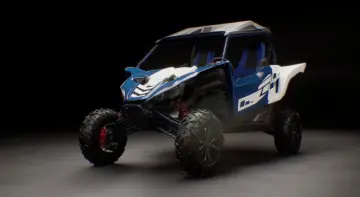
Replicated Drivable Gokart (Blueprint)
Explore the Replicated Drivable Gokart for Unreal Engine, featuring native vehicle physics, multiplayer replication, rigged skeletal meshes, and custom lighting
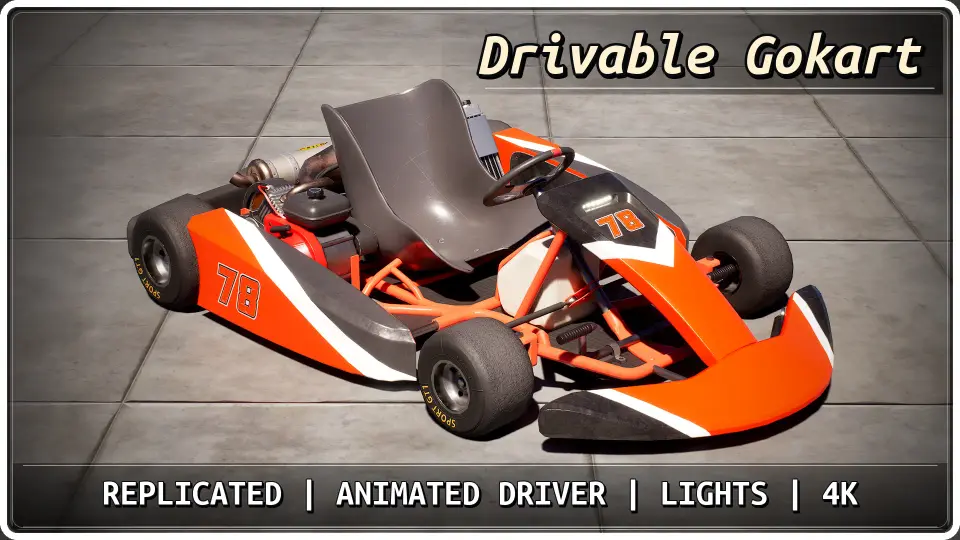
Accelerating off the starting line in a multiplayer session requires precise physics handling and immediate network synchronization. The Replicated Drivable Gokart delivers that baseline directly out of the box, operating as a game-ready vehicle asset constructed on Unreal Engine's native vehicle architecture. Because it utilizes the engine's built-in vehicle foundation, the asset avoids non-standard movement components and works harmoniously with default engine systems. Developers seeking a functional small-scale motorsport vehicle can deploy it immediately without building mechanical replication logic or rigging physics colliders from scratch.
Networked Handling on Unreal Engine Default Vehicle Architecture
Replication remains one of the most demanding technical hurdles when implementing vehicles in multiplayer environments. The Replicated Drivable Gokart handles this through a dedicated Blueprint setup configured specifically for client-server environments. Wheel rotations, chassis velocity, acceleration, braking, and positional corrections synchronize between the server and connecting clients. By relying strictly on Unreal's default vehicle system, the Blueprint maintains standard replication cycles, ensuring that server authority governs movement while client prediction keeps the driving experience responsive.
The system adapts effectively whether a project demands lightweight arcade handling or more grounded simulation dynamics. Game-ready architecture means the core driving scripts, input bindings, and physics profiles are already wired together. Rather than spending production time diagnosing desynchronization glitches or tuning basic wheel trace behaviors, designers can focus directly on track design, lap logic, and race balancing.
Rigged Skeletal Meshes and Standardized Bone Hierarchy
Underpinning the gokart is a fully rigged skeletal mesh built with strict adherence to engine-standard bone naming and scale proportions. Vehicle rigging in Unreal Engine can be notoriously unforgiving; mismatched bone scales or non-standard joint orientations often lead to collapsed suspension, floating wheels, or catastrophic physics calculations when the vehicle actor initializes. This asset circumvents those pitfalls by incorporating correct bone names and standardized uniform scales across the entire vehicle armature.
The chassis serves as the hierarchy root, branching neatly into functional wheel bones that match the requirements of the vehicle movement component. Because the bone structure conforms directly to standard conventions, the skeletal mesh interfaces cleanly with animation Blueprints. Wheel rotation, steering angle deflections, and wheel suspension offsets resolve reliably against driving surface geometry without requiring custom remapping nodes or mesh transformations.
Driver Steering Animation and Integrated Gokart Lighting
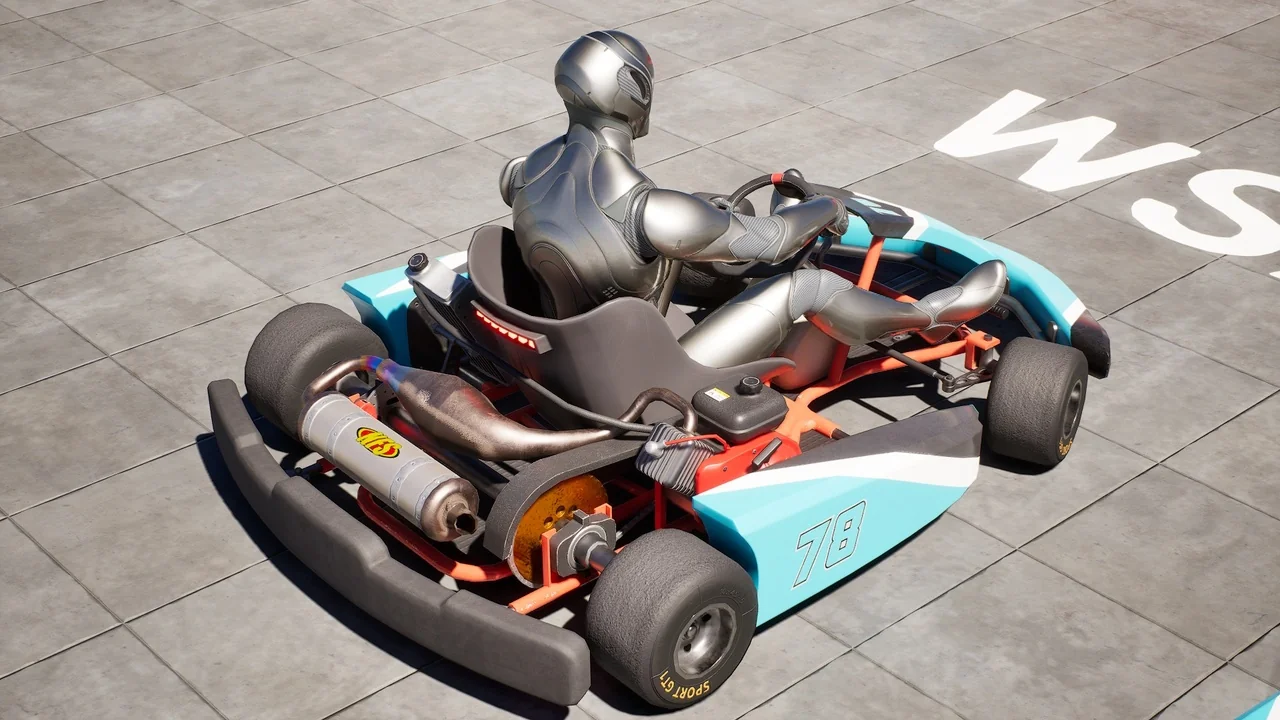
A vehicle's sense of speed and immersion depends heavily on real-time visual feedback from both the mechanical components and the operator. The package includes dedicated driver steering animation assets that synchronize pilot movement with player input. As steering commands are passed to the gokart's front wheels, the accompanying driver animation reflects those directional inputs, showing the hands and body shifting along with the wheel. This keeps the driver model from remaining static, which is critical in open-cockpit vehicles like karts where the driver remains completely visible to other players on the track.
Visual detailing extends to the vehicle's illumination systems. The asset incorporates both front and rear light setups within the Blueprint structure. The inclusion of front lights enables visibility across low-light circuits, tunnel sections, or nighttime driving stages. Rear lights provide essential visual indicators for following racers during braking or deceleration phases, reinforcing spatial awareness and tactical racing lines in competitive pack driving.
Color Customization via Material Parameters
Visual diversity is critical in kart-based games where multiple identical vehicle silhouettes populate the starting grid. To prevent repetitive field visuals, the asset provides exposed material parameters dedicated to vehicle color. Developers and technical artists can adjust body paint schemes dynamically using Material Instance parameters without authoring new texture maps or duplicating underlying shaders.
These exposed scalar and vector parameters allow teams to establish uniform color profiles for specific teams, randomize livery palettes at player spawn, or let racers select custom body shades from an in-game garage interface. The streamlined material setup maintains performance by using instance parameters, which helps preserve low render overhead during dense races involving numerous lowpoly vehicles running on screen simultaneously.
Multiplayer Racing Scenarios and VoIP Integration
The feature set of the gokart makes it exceptionally suited for competitive multiplayer tracks, obstacle mini-games, and arcade racing circuits. Because the asset is tagged for lowpoly, realistic, and arcade styling, it slips into stylized indie tracks or realistic training circuits with minimal aesthetic friction. Its clean Blueprint structure leaves ample room for custom additions such as power-up boxes, speed boost pads, drift meters, or custom damage counters.
Communication during high-speed races is supported through explicit compatibility with the Dynamic Voice Chat System (VoIP). In competitive racing titles or multiplayer social lobbies, spatial communication enhances the experience significantly. Because the vehicle works alongside this VoIP solution, developers can establish positional audio systems where players hear adjacent racers shouting or coordinating as they drift around hairpin turns or draft behind one another down long straightaways.
Standalone Deployment and the Replicated Vehicles Collection
For studios focusing exclusively on kart racing, track trials, or miniature vehicle mini-games, the Replicated Drivable Gokart functions as a fully self-contained package containing all necessary scripts, rigs, animations, and materials. It requires no external vehicle libraries to run, serving as an immediate plug-and-play solution for quick prototypes or specialized standalone racing games.
For broader productions that feature varied vehicle types, the asset is also available as part of the Replicated Drivable Vehicles Pack. This shared ecosystem ensures that developers expanding beyond karts into larger automotive fleets can retain consistent network handling conventions, skeletal rigging standards, and Blueprint architectures across their entire vehicle lineup.
 Vehicles
 Vehicles
 Vehicles
 Vehicles