"f9f23ccf4eeb20e2"{"id":"1003053","slug":"action-jrpg-template","title":"Action jRPG Template","category":"RPG","engine":"4.26+,5.0+","assetVersion":"","engineVersion":"Engine Version: 4.26+,5.0+","tag":"RPG","accent":"blue","visual":"mech","summary":"Blueprint jRPG template with single-player exploration, battle-only co-op and PvP, melee and magic combat, quests, crafting, equipment, and console support.","platform":"Unreal Engine","indexPolicy":"index","publishedAt":"2026-11-27T05:46:38.862Z","updatedAt":"2026-11-27T05:46:38.862Z","sourceNotes":[],"fileContents":[],"compatibility":["Unreal Engine","Engine Version: 4.26+,5.0+"],"featuredImage":{"alt":"Action jRPG Template","src":"/wp-content/uploads/published/2026/11/cb44dacfd71d-e2845604-a36c-4356-a805-d882ee3c6a7d-b9404686e0.webp"},"fileSizeBytes":10007747533,"hasDownloadLink":true,"downloads":1,"terms":[{"taxonomy":"category","slug":"rpg","name":"RPG"}],"galleryImages":[{"src":"/wp-content/uploads/published/2026/11/cd3d41177d8f-99c5259e-c0cc-406c-87cb-860966d2f85a-f37accc92f.webp","alt":"Action jRPG Template"},{"src":"/wp-content/uploads/published/2026/11/d44c8c26bf0e-207e66f1-3e89-422e-975a-c74c5e9f02fc-e6ba0cf775.webp","alt":"Action jRPG Template"},{"src":"/wp-content/uploads/published/2026/11/429c2e85c806-1864fc39-3e07-4093-946d-31af4d5b5e8b-226a54e33d.webp","alt":"Action jRPG Template"},{"src":"/wp-content/uploads/published/2026/11/77a5816d9415-f5b13de1-ebbb-4a08-8b68-057bd2e56b1c-53ecc0d901.webp","alt":"Action jRPG Template"},{"src":"/wp-content/uploads/published/2026/11/17bb6dec844e-4f56fa50-117e-4924-abdd-dfae820d2098-304febf2e9.webp","alt":"Action jRPG Template"},{"src":"/wp-content/uploads/published/2026/11/3200b0358739-6c6411ec-6e2d-4f96-b71d-014b5a481c64-bf3bafeb3e.webp","alt":"Action jRPG Template"},{"src":"/wp-content/uploads/published/2026/11/cfcf7acd8602-b2f9dc28-1f48-4247-961a-261e219e28f4-431097a3d1.webp","alt":"Action jRPG Template"}],"accessPanel":{"kind":"resource","title":"Get this resource","safetyNote":"Resources are manually reviewed before listing to improve quality and reduce obvious risks.","fileFormat":".7z","resourceType":"Resource archive","versions":[]},"contentHtml":"\u003ch2\u003eHow the Action jRPG Template Separates Explore Mode from Battles\u003c/h2\u003e\n\u003cp\u003eThe Action jRPG Template makes one structural decision early: exploration and battle do not share the same multiplayer scope. Walking through town, talking to NPCs, accepting quests, interacting with the environment, and crafting items are all single-player activities. Battles are the only part that opens up to multiplayer, where a host can run co-op or PvP sessions and players can fight alongside or against one another. That split shapes how the template is assembled and what a team needs to test.\u003c/p\u003e\n\u003cp\u003eThis is not a case where every system inherits multiplayer state. The explore layer stays self-contained while the battle layer supports hosted sessions. For a project, that means the town, quest, and crafting loops can be authored without networking overhead, while combat encounters need the co-op and PvP pathways checked separately. The split is a clean boundary, but it is a boundary that has to be respected in the design.\u003c/p\u003e\n\u003cp\u003eExplore and battle also happen on the same map. The template does not force a separate battle scene, so transitions from walking around to fighting are part of the same spatial setup. Battle transitions and a battle boundaries effect are included, which gives the encounter a distinct visual break while keeping the map context intact.\u003c/p\u003e \u003ch2\u003eCombat and Unit Control in the Action jRPG Template\u003c/h2\u003e\n\u003cp\u003eCombat covers melee, range, and magic. Melee attacks use hit detection, while ranged and magic attacks use projectiles. Dodge and miss logic sit on top of that, so attacks are not guaranteed to land. A targeting system supports the flow, and a generic AI can use skills rather than relying on scripted attack routines. The combination gives the template a combat layer that can handle different enemy behaviors without a bespoke AI for every encounter.\u003c/p\u003e\n\u003cp\u003ePlayers can control different units at any time. That flexibility applies both in exploration and battle, and it changes how the party is managed. Instead of locking the player to one avatar, the template allows switching between units as the situation demands. Melee, ranged, and magic roles can be moved between without leaving the current map.\u003c/p\u003e\n\u003cp\u003eWeapon choice feeds directly into animation. Different attack animations play based on the weapon in use, and a combo system extends the attack sequence. Supportive and offensive skills are both available, with target and area skills covering single-target and grouped effects. Usable items are part of the combat inventory, and boss fights are supported as a distinct encounter type. The template also includes battle transitions and a battle boundaries effect to frame encounters.\u003c/p\u003e\n\u003cp\u003eEquipment is more than a stat block. The equipment system changes the mesh depending on what is equipped, so visible gear updates alongside the underlying stats. That detail matters for a template that lets players swap units and weapons frequently; the visual state has to keep up with the mechanical state.\u003c/p\u003e \u003ch2\u003eQuests, Crafting, and the Single-Player Layer\u003c/h2\u003e\n\u003cp\u003eThe explore mode is where the RPG structure lives. NPCs can be talked to, quests can be accepted, the environment can be interacted with, and items can be crafted. A quest system and a crafting system are both included, along with interactables that populate the world. A vendor supports item buying and selling, which gives the economy a place in the loop rather than leaving items as combat drops only.\u003c/p\u003e\n\u003cp\u003eStats and leveling sit underneath these systems. Characters progress, and the numbers feed back into combat and equipment choices. Save and load functionality is included, so the single-player exploration layer can persist its state. For a project using the template, the explore side is therefore not just a hub between fights; it carries quests, crafting, vendors, interaction, and progression.\u003c/p\u003e\n\u003cp\u003eThe separation from multiplayer is most visible here. Because explore mode is single-player only, quests, crafting, and town interaction do not need to reconcile multiple players. The template keeps those systems in a single-player context and reserves hosted sessions for battle. That is a practical arrangement for a jRPG structure where the story and world are authored for one player, while combat can be shared.\u003c/p\u003e \u003ch2\u003eInterface, Effects, and Plugin Compatibility\u003c/h2\u003e\n\u003cp\u003eThe UI is fully functional, covering the screens and feedback needed for the systems above. The interface artwork is sourced from open game art collections. A Time Warp effect is included as part of the visual feature set, adding a distinct effect to the template's presentation. Console support is part of the template's scope, which matters for teams targeting console play rather than desktop only.\u003c/p\u003e\n\u003cp\u003eCompatibility with the Conversation2D Plugin is included. That plugin hook is relevant for dialogue and conversation flow, which fits alongside the quest and NPC interaction systems. The battle animations are re-targeted from Paragon Greystone animations, giving the combat layer a defined animation source.\u003c/p\u003e\n\u003cp\u003eBecause the template is 100% Blueprints, the implementation is accessible through Blueprint graphs rather than requiring a code-first workflow. That affects how systems are inspected, extended, and debugged. The template ships with its own UI, combat logic, quest and crafting systems, and save/load handling, all within that Blueprint structure.\u003c/p\u003e \u003ch2\u003eWhat the Explore-and-Battle Split Means for Production\u003c/h2\u003e\n\u003cp\u003eThe most important production consideration is the multiplayer boundary. Co-op and PvP battles are supported, but only for battles. The explore mode remains single player. A team planning shared town exploration or multiplayer questing would be working outside the template's stated scope. A team planning a single-player RPG with optional co-op or PvP combat is operating within it.\u003c/p\u003e\n\u003cp\u003eThe second consideration is the amount of switching the template expects. Players can control different units anytime, equipment changes meshes, weapon types change attack animations, and combat mixes melee hit detection with projectiles. Each of those systems has to stay in sync: the unit being controlled, the weapon being used, the equipment being displayed, and the battle state being hosted. The template provides the systems, but the interactions between them are where a project will spend its integration time.\u003c/p\u003e\n\u003cp\u003eThe third is the single-player layer's depth. Quests, crafting, vendors, interactables, stats, leveling, and save/load are all present. They are not battle-only features, and they do not inherit the battle multiplayer model. That makes the explore mode a substantial part of the template rather than a thin transition space.\u003c/p\u003e\n\u003cp\u003eFor a grounded assessment, the Action jRPG Template is structured through a clear split: a single-player explore mode with quests, crafting, vendors, and interaction, plus a battle mode that supports co-op and PvP. Its combat layer covers melee, range, magic, targeting, dodge and miss logic, skills, items, combos, and boss fights. Its presentation layer includes a fully functional UI, battle transitions, a battle boundaries effect, and a Time Warp effect. The Blueprint implementation, console support, and Conversation2D Plugin compatibility round out the scope. The template's readiness depends on keeping those two layers distinct and testing the battle-only multiplayer path against the single-player world systems.\u003c/p\u003e\n\n\u003ch2\u003eExplore Similar Assets\u003c/h2\u003e\n\u003cul\u003e\n\u003cli\u003e\u003ca href=\"https://3dcghub.com/action-rpg-multiplayer-starter-template/\" rel=\"noopener noreferrer\"\u003eAction RPG Multiplayer Starter Template\u003c/a\u003e\u003c/li\u003e\n\u003cli\u003e\u003ca href=\"https://3dcghub.com/easy-topdown-template-v2-1-survival-action-shooter-top-down-rpg/\" rel=\"noopener noreferrer\"\u003eEasy TopDown Template V2.1 | Survival Action Shooter Top Down RPG\u003c/a\u003e\u003c/li\u003e\n\u003cli\u003e\u003ca href=\"https://3dcghub.com/turn-based-jrpg-template/\" rel=\"noopener noreferrer\"\u003eTurn-Based jRPG Template\u003c/a\u003e\u003c/li\u003e\n\u003cli\u003e\u003ca href=\"https://3dcghub.com/action-rpg-template/\" rel=\"noopener noreferrer\"\u003eAction RPG Template\u003c/a\u003e\u003c/li\u003e\n\u003cli\u003e\u003ca href=\"https://3dcghub.com/soulslike-framework-complete-soulslike-kit/\" rel=\"noopener noreferrer\"\u003eSoulslike Framework - Complete Soulslike Kit\u003c/a\u003e\u003c/li\u003e\n\u003c/ul\u003e","contentTextLength":7571,"navigation":{"current":2,"total":4975,"previous":{"id":"1003054","slug":"customizable-deadly-traps","title":"Customizable Deadly Traps","category":"Gameplay Features","platform":"Unreal Engine","updatedAt":"2026-11-27T07:00:49.083Z"},"next":{"id":"1003052","slug":"stylized-japanese-temple","title":"Stylized Japanese Temple","category":"Temple","platform":"Unreal Engine","updatedAt":"2026-11-27T04:44:51.787Z"}},"relatedResources":[{"id":"1002876","slug":"action-rpg-multiplayer-starter-template","title":"Action RPG Multiplayer Starter Template","category":"RPG","engine":"5.0+","assetVersion":"","engineVersion":"Engine Version: 5.0+","tag":"RPG","accent":"blue","visual":"mech","summary":"Explore the Action RPG Multiplayer Starter Template featuring jigsaw inventory, data-driven skills, AI encounters, quest authoring, and trading.","platform":"Unreal Engine","indexPolicy":"index","publishedAt":"2026-11-21T01:05:41.691Z","updatedAt":"2026-11-21T01:05:41.691Z","sourceNotes":[],"fileContents":[],"compatibility":["Unreal Engine","Engine Version: 5.0+"],"featuredImage":{"alt":"Action RPG Multiplayer Starter Template","src":"/wp-content/uploads/published/2026/11/1046e0a3eb0a-722ea6b8-641b-4312-80dd-80c2ac6a831d-a70db02ce7.webp"},"fileSizeBytes":335168011,"hasDownloadLink":true,"downloads":1},{"id":"1001031","slug":"easy-topdown-template-v2-1-survival-action-shooter-top-down-rpg","title":"Easy TopDown Template V2.1 | Survival Action Shooter Top Down RPG","category":"RPG","engine":"5.6+","assetVersion":"","engineVersion":"Engine Version: 5.6+","tag":"RPG","accent":"blue","visual":"mech","summary":"Production-ready top-down survival RPG template with replicated multiplayer, combat, inventory, building, AI, narrative systems, 280+ docs, and a V3 roadmap.","platform":"Unreal Engine","indexPolicy":"index","publishedAt":"2026-08-23T12:26:25.601Z","updatedAt":"2026-08-23T12:26:25.601Z","sourceNotes":[],"fileContents":[],"compatibility":["Unreal Engine","Engine Version: 5.6+"],"featuredImage":{"alt":"Easy TopDown Template V2.1 | Survival Action Shooter Top Down RPG","src":"/wp-content/uploads/published/2026/08/8044fdff0e95-28bfa536-f855-4e68-910b-00eda2dc37ec-911ae442b6.webp"},"fileSizeBytes":798001790,"hasDownloadLink":true,"downloads":8},{"id":"1000898","slug":"turn-based-jrpg-template","title":"Turn-Based jRPG Template","category":"RPG","engine":"5.4+","assetVersion":"Asset Version: 12.4.0","engineVersion":"Engine Version: 5.4+","tag":"RPG","accent":"blue","visual":"mech","summary":"A fully Blueprint-driven turn-based JRPG template with same-map exploration and battles, equipment visuals, quests, crafting, save/load, and mobile/console supp","platform":"Unreal Engine","indexPolicy":"index","publishedAt":"2026-08-06T04:55:52.266Z","updatedAt":"2026-08-06T04:55:52.266Z","sourceNotes":[],"fileContents":[],"compatibility":["Unreal Engine","Asset Version: 12.4.0","Engine Version: 5.4+"],"featuredImage":{"alt":"Turn-Based jRPG Template","src":"/wp-content/uploads/published/2026/08/32552b8463f9-c012103c-6661-4ee2-b632-47bd65648896-aa336cda0e.webp"},"fileSizeBytes":55888787,"hasDownloadLink":true,"downloads":0}]}[{"id":4225,"sourceId":4225,"taxonomyId":4225,"taxonomy":"category","slug":"asset-library","name":"Asset Library","parentId":null,"count":0,"hasChildren":true,"href":"/","seoTitle":"Free Game Assets Library | 3DCGHUB","seoDescription":"Browse free Unreal Engine, Unity, Blender assets and game development tutorials on 3DCGHUB with previews, compatibility notes, and secure downloads.","sitemapEnabled":true,"children":[{"id":4227,"sourceId":4227,"taxonomyId":4227,"taxonomy":"category","slug":"blender-add-ons-plugins","name":"Blender Add-ons \u0026 Plugins","parentId":4225,"count":0,"hasChildren":false,"href":"/category/blender-add-ons-plugins/","seoTitle":"Free Blender Add-ons \u0026 Plugins | 3DCGHUB","seoDescription":"Browse free Blender Add-ons \u0026 Plugins tools for Blender on 3DCGHUB: curated downloads with preview images, compatibility notes and secure download access.","sitemapEnabled":true},{"id":514,"sourceId":514,"taxonomyId":514,"taxonomy":"category","slug":"unity-2","name":"Unity","parentId":4225,"count":0,"hasChildren":true,"href":"/category/unity-2/","seoTitle":"Free Unity Assets | 3DCGHUB","seoDescription":"Browse free Unity resources on 3DCGHUB: curated downloads with preview images, compatibility notes and secure download access.","sitemapEnabled":true,"children":[{"id":523,"sourceId":523,"taxonomyId":523,"taxonomy":"category","slug":"2d","name":"2D","parentId":514,"count":0,"hasChildren":true,"href":"/category/2d/","seoTitle":"Free Unity 2D | 3DCGHUB","seoDescription":"Browse free 2D assets for Unity on 3DCGHUB: curated downloads with preview images, compatibility notes and secure download access.","sitemapEnabled":true},{"id":515,"sourceId":515,"taxonomyId":515,"taxonomy":"category","slug":"3d-unity-2","name":"3D","parentId":514,"count":0,"hasChildren":true,"href":"/category/3d-unity-2/","seoTitle":"Free Unity 3D Assets | 3DCGHUB","seoDescription":"Browse free 3D assets for Unity on 3DCGHUB: curated downloads with preview images, compatibility notes and secure download access.","sitemapEnabled":true},{"id":565,"sourceId":565,"taxonomyId":565,"taxonomy":"category","slug":"add-ons","name":"Add-Ons","parentId":514,"count":0,"hasChildren":false,"href":"/category/add-ons/","seoTitle":"Free Unity Add-Ons | 3DCGHUB","seoDescription":"Browse free Add-Ons assets for Unity on 3DCGHUB: curated downloads with preview images, compatibility notes and secure download access.","sitemapEnabled":true},{"id":529,"sourceId":529,"taxonomyId":529,"taxonomy":"category","slug":"audio-unity-2","name":"Audio","parentId":514,"count":0,"hasChildren":true,"href":"/category/audio-unity-2/","seoTitle":"Free Unity Audio | 3DCGHUB","seoDescription":"Browse free Audio for Unity on 3DCGHUB: curated downloads with preview images, compatibility notes and secure download access.","sitemapEnabled":true},{"id":557,"sourceId":557,"taxonomyId":557,"taxonomy":"category","slug":"templates","name":"Templates","parentId":514,"count":0,"hasChildren":true,"href":"/category/templates/","seoTitle":"Free Unity Templates | 3DCGHUB","seoDescription":"Browse free Unity project templates on 3DCGHUB. Starter kits with previews, compatibility notes, and secure download access.","sitemapEnabled":true},{"id":533,"sourceId":533,"taxonomyId":533,"taxonomy":"category","slug":"tools-unity-2","name":"Tools","parentId":514,"count":0,"hasChildren":true,"href":"/category/tools-unity-2/","sitemapEnabled":true},{"id":554,"sourceId":554,"taxonomyId":554,"taxonomy":"category","slug":"vfx-unity-2","name":"VFX","parentId":514,"count":0,"hasChildren":true,"href":"/category/vfx-unity-2/","seoTitle":"Free Unity VFX | 3DCGHUB","seoDescription":"Browse free VFX for Unity on 3DCGHUB: curated downloads with preview images, compatibility notes and secure download access.","sitemapEnabled":true}]},{"id":511,"sourceId":511,"taxonomyId":511,"taxonomy":"category","slug":"unreal-engine-2","name":"Unreal Engine","parentId":4225,"count":0,"hasChildren":true,"href":"/category/unreal-engine-2/","seoTitle":"Free Unreal Engine Assets | 3DCGHUB","seoDescription":"Browse free Unreal Engine resources on 3DCGHUB: curated downloads with preview images, compatibility notes and secure download access.","sitemapEnabled":true,"children":[{"id":54,"sourceId":54,"taxonomyId":54,"taxonomy":"category","slug":"3d","name":"3D","parentId":511,"count":0,"hasChildren":true,"href":"/category/3d/","seoTitle":"Free Unreal Engine 3D | 3DCGHUB","seoDescription":"Browse free 3D assets for Unreal Engine on 3DCGHUB: curated downloads with preview images, compatibility notes and secure download access.","sitemapEnabled":true},{"id":441,"sourceId":441,"taxonomyId":441,"taxonomy":"category","slug":"animations","name":"Animations","parentId":511,"count":0,"hasChildren":true,"href":"/category/animations/","seoTitle":"Free Unreal Engine Animations | 3DCGHUB","seoDescription":"Browse free Animations for Unreal Engine on 3DCGHUB: curated downloads with preview images, compatibility notes and secure download access.","sitemapEnabled":true},{"id":446,"sourceId":446,"taxonomyId":446,"taxonomy":"category","slug":"audio","name":"Audio","parentId":511,"count":0,"hasChildren":true,"href":"/category/audio/","seoTitle":"Free Unreal Engine Audio Resources | 3DCGHUB","seoDescription":"Browse free Unreal Engine audio resources including sound effects, voices, dialogue, and ambient sounds. Curated free downloads on 3DCGHUB.","sitemapEnabled":true},{"id":466,"sourceId":466,"taxonomyId":466,"taxonomy":"category","slug":"game-systems","name":"Game Systems","parentId":511,"count":0,"hasChildren":true,"href":"/category/game-systems/","seoTitle":"Free Unreal Engine Game Systems | 3DCGHUB","seoDescription":"Browse free Game Systems tools for Unreal Engine on 3DCGHUB: curated downloads with preview images, compatibility notes and secure download access.","sitemapEnabled":true},{"id":478,"sourceId":478,"taxonomyId":478,"taxonomy":"category","slug":"game-templates","name":"Game Templates","parentId":511,"count":0,"hasChildren":true,"href":"/category/game-templates/","seoTitle":"Free Unreal Engine Game Templates | 3DCGHUB","seoDescription":"Browse free Game Templates for Unreal Engine on 3DCGHUB: curated downloads with preview images, compatibility notes and secure download access.","sitemapEnabled":true},{"id":432,"sourceId":432,"taxonomyId":432,"taxonomy":"category","slug":"hdri","name":"HDRI","parentId":511,"count":0,"hasChildren":true,"href":"/category/hdri/","seoTitle":"Free Unreal Engine HDRI | 3DCGHUB","seoDescription":"Browse free Unreal Engine HDRI skies and lighting maps on 3DCGHUB. Environment lighting with previews and secure downloads.","sitemapEnabled":true},{"id":228,"sourceId":228,"taxonomyId":228,"taxonomy":"category","slug":"material-and-textures","name":"Material \u0026 Textures","parentId":511,"count":0,"hasChildren":true,"href":"/category/material-and-textures/","seoTitle":"Free Unreal Engine Material \u0026 Textures | 3DCGHUB","seoDescription":"Browse free Material \u0026 Textures for Unreal Engine on 3DCGHUB: curated downloads with preview images, compatibility notes and secure download access.","sitemapEnabled":true},{"id":298,"sourceId":298,"taxonomyId":298,"taxonomy":"category","slug":"sprites-and-flipbooks","name":"Sprites \u0026 Flipbooks","parentId":511,"count":0,"hasChildren":true,"href":"/category/sprites-and-flipbooks/","seoTitle":"Free Unreal Engine Sprites \u0026 Flipbooks | 3DCGHUB","seoDescription":"Browse free Sprites \u0026 Flipbooks assets for Unreal Engine on 3DCGHUB: curated downloads with preview images, compatibility notes and secure download access.","sitemapEnabled":true},{"id":489,"sourceId":489,"taxonomyId":489,"taxonomy":"category","slug":"tools-and-plugins","name":"Tools \u0026 Plugins","parentId":511,"count":0,"hasChildren":true,"href":"/category/tools-and-plugins/","seoTitle":"Free Unreal Engine Tools \u0026 Plugins | 3DCGHUB","seoDescription":"Browse free Tools \u0026 Plugins for Unreal Engine on 3DCGHUB: curated downloads with preview images, compatibility notes and secure download access.","sitemapEnabled":true},{"id":459,"sourceId":459,"taxonomyId":459,"taxonomy":"category","slug":"ui","name":"UI","parentId":511,"count":0,"hasChildren":true,"href":"/category/ui/","seoTitle":"Free Unreal Engine UI | 3DCGHUB","seoDescription":"Browse free UI for Unreal Engine on 3DCGHUB: curated downloads with preview images, compatibility notes and secure download access.","sitemapEnabled":true},{"id":450,"sourceId":450,"taxonomyId":450,"taxonomy":"category","slug":"vfx","name":"VFX","parentId":511,"count":0,"hasChildren":true,"href":"/category/vfx/","seoTitle":"Free Unreal Engine VFX | 3DCGHUB","seoDescription":"Browse free VFX for Unreal Engine on 3DCGHUB: curated downloads with preview images, compatibility notes and secure download access.","sitemapEnabled":true}]}]},{"id":4222,"sourceId":4222,"taxonomyId":4222,"taxonomy":"category","slug":"tutorial-library","name":"Tutorial Library","parentId":null,"count":0,"hasChildren":false,"href":"/tutorials/","seoTitle":"Free Game Development Tutorial Library | 3DCGHUB","seoDescription":"Browse free game development tutorials for Unreal Engine, Unity, Blender, and more on 3DCGHUB with practical workflows and secure downloads.","sitemapEnabled":true}]
Resource screenshots
1 / 7
Asset drops
Daily Asset Drops
Follow 3DCGHUB on Telegram for daily Unreal, Unity & Blender drops and curated CC0 releases.
Resources are manually reviewed before listing to improve quality and reduce obvious risks.
Reviewed archive
RPG
Action jRPG Template
Blueprint jRPG template with single-player exploration, battle-only co-op and PvP, melee and magic combat, quests, crafting, equipment, and console support.
How the Action jRPG Template Separates Explore Mode from Battles
The Action jRPG Template makes one structural decision early: exploration and battle do not share the same multiplayer scope. Walking through town, talking to NPCs, accepting quests, interacting with the environment, and crafting items are all single-player activities. Battles are the only part that opens up to multiplayer, where a host can run co-op or PvP sessions and players can fight alongside or against one another. That split shapes how the template is assembled and what a team needs to test.
This is not a case where every system inherits multiplayer state. The explore layer stays self-contained while the battle layer supports hosted sessions. For a project, that means the town, quest, and crafting loops can be authored without networking overhead, while combat encounters need the co-op and PvP pathways checked separately. The split is a clean boundary, but it is a boundary that has to be respected in the design.
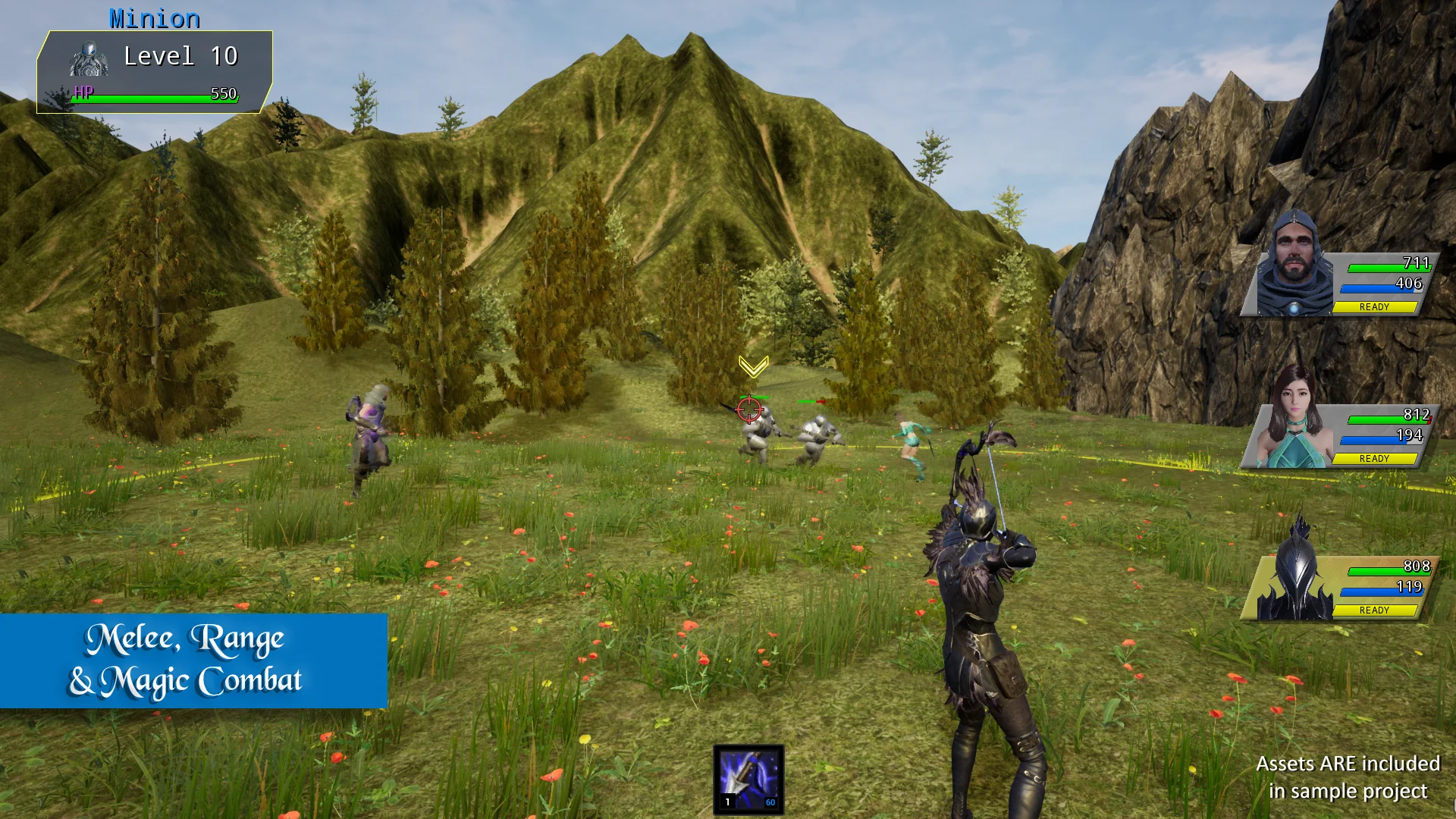
Explore and battle also happen on the same map. The template does not force a separate battle scene, so transitions from walking around to fighting are part of the same spatial setup. Battle transitions and a battle boundaries effect are included, which gives the encounter a distinct visual break while keeping the map context intact.
Combat and Unit Control in the Action jRPG Template
Combat covers melee, range, and magic. Melee attacks use hit detection, while ranged and magic attacks use projectiles. Dodge and miss logic sit on top of that, so attacks are not guaranteed to land. A targeting system supports the flow, and a generic AI can use skills rather than relying on scripted attack routines. The combination gives the template a combat layer that can handle different enemy behaviors without a bespoke AI for every encounter.
Players can control different units at any time. That flexibility applies both in exploration and battle, and it changes how the party is managed. Instead of locking the player to one avatar, the template allows switching between units as the situation demands. Melee, ranged, and magic roles can be moved between without leaving the current map.
Weapon choice feeds directly into animation. Different attack animations play based on the weapon in use, and a combo system extends the attack sequence. Supportive and offensive skills are both available, with target and area skills covering single-target and grouped effects. Usable items are part of the combat inventory, and boss fights are supported as a distinct encounter type. The template also includes battle transitions and a battle boundaries effect to frame encounters.
Equipment is more than a stat block. The equipment system changes the mesh depending on what is equipped, so visible gear updates alongside the underlying stats. That detail matters for a template that lets players swap units and weapons frequently; the visual state has to keep up with the mechanical state.
Quests, Crafting, and the Single-Player Layer
The explore mode is where the RPG structure lives. NPCs can be talked to, quests can be accepted, the environment can be interacted with, and items can be crafted. A quest system and a crafting system are both included, along with interactables that populate the world. A vendor supports item buying and selling, which gives the economy a place in the loop rather than leaving items as combat drops only.
Stats and leveling sit underneath these systems. Characters progress, and the numbers feed back into combat and equipment choices. Save and load functionality is included, so the single-player exploration layer can persist its state. For a project using the template, the explore side is therefore not just a hub between fights; it carries quests, crafting, vendors, interaction, and progression.
The separation from multiplayer is most visible here. Because explore mode is single-player only, quests, crafting, and town interaction do not need to reconcile multiple players. The template keeps those systems in a single-player context and reserves hosted sessions for battle. That is a practical arrangement for a jRPG structure where the story and world are authored for one player, while combat can be shared.
Interface, Effects, and Plugin Compatibility
The UI is fully functional, covering the screens and feedback needed for the systems above. The interface artwork is sourced from open game art collections. A Time Warp effect is included as part of the visual feature set, adding a distinct effect to the template's presentation. Console support is part of the template's scope, which matters for teams targeting console play rather than desktop only.
Compatibility with the Conversation2D Plugin is included. That plugin hook is relevant for dialogue and conversation flow, which fits alongside the quest and NPC interaction systems. The battle animations are re-targeted from Paragon Greystone animations, giving the combat layer a defined animation source.
Because the template is 100% Blueprints, the implementation is accessible through Blueprint graphs rather than requiring a code-first workflow. That affects how systems are inspected, extended, and debugged. The template ships with its own UI, combat logic, quest and crafting systems, and save/load handling, all within that Blueprint structure.
What the Explore-and-Battle Split Means for Production
The most important production consideration is the multiplayer boundary. Co-op and PvP battles are supported, but only for battles. The explore mode remains single player. A team planning shared town exploration or multiplayer questing would be working outside the template's stated scope. A team planning a single-player RPG with optional co-op or PvP combat is operating within it.
The second consideration is the amount of switching the template expects. Players can control different units anytime, equipment changes meshes, weapon types change attack animations, and combat mixes melee hit detection with projectiles. Each of those systems has to stay in sync: the unit being controlled, the weapon being used, the equipment being displayed, and the battle state being hosted. The template provides the systems, but the interactions between them are where a project will spend its integration time.
The third is the single-player layer's depth. Quests, crafting, vendors, interactables, stats, leveling, and save/load are all present. They are not battle-only features, and they do not inherit the battle multiplayer model. That makes the explore mode a substantial part of the template rather than a thin transition space.
For a grounded assessment, the Action jRPG Template is structured through a clear split: a single-player explore mode with quests, crafting, vendors, and interaction, plus a battle mode that supports co-op and PvP. Its combat layer covers melee, range, magic, targeting, dodge and miss logic, skills, items, combos, and boss fights. Its presentation layer includes a fully functional UI, battle transitions, a battle boundaries effect, and a Time Warp effect. The Blueprint implementation, console support, and Conversation2D Plugin compatibility round out the scope. The template's readiness depends on keeping those two layers distinct and testing the battle-only multiplayer path against the single-player world systems.
 RPG
 RPG
 RPG