"6ac84fdb0bd06614"{"id":"1000145","slug":"aaa-game-environment-creation-in-unreal-engine-5","title":"AAA Game Environment Creation in Unreal Engine 5","category":"Unreal Engine","engine":"File Content: video + English subtitles","assetVersion":"Video Language: English","engineVersion":"File Content: video + English subtitles","tag":"Unreal Engine","accent":"blue","visual":"city","summary":"A beginner Unreal Engine 5 course focused on AAA environment set dressing, art fundamentals, design theory, and lighting for stronger scenes.","platform":"Unreal Engine","publishedAt":"2026-06-13T08:44:03.779Z","updatedAt":"2026-06-13T08:44:03.779Z","sourceNotes":[],"fileContents":[],"compatibility":["Unreal Engine","Video Language: English","File Content: video + English subtitles"],"featuredImage":{"alt":"AAA Game Environment Creation in Unreal Engine 5","src":"/wp-content/uploads/published/2026/06/2e2726eb21ab-6708657-817a-8e95909d91.webp"},"hasDownloadLink":true,"downloads":1,"terms":[{"taxonomy":"category","slug":"tutoriallibrary-unrealengine","name":"Unreal Engine"}],"galleryImages":[],"accessPanel":{"kind":"video-resource","title":"Download this video resource","eyebrow":"Free Download","message":"Log in or create a free account to start your download.","fileName":"Video.7z","safetyNote":"Resources are manually reviewed before listing to improve quality and reduce obvious risks.","actionLabel":"Download Free","resourceType":"Video download"},"contentHtml":"\u003cp\u003eScenes become convincing when the placement of assets, the use of color, and the control of lighting all support the same visual idea. \u003cstrong\u003eAAA Game Environment Creation in Unreal Engine 5\u003c/strong\u003e Focuses on that process inside Unreal Engine 5, teaching environment creation through techniques used in AAA games. Rather than isolating one narrow topic, it connects set dressing, art fundamentals, design theory, and lighting so that a level can move toward a stronger final look.\u003c/p\u003e \u003cp\u003eThis is a beginner course taught by Mao Mao, with a total workload of 4 hours and 49 minutes. Its curriculum begins with an introduction, and the course centers on helping learners understand how to create good looking environments in Unreal Engine 5.\u003c/p\u003e \u003ch2\u003eAAA Environment Set Dressing in Unreal Engine 5\u003c/h2\u003e\n\u003cp\u003eOne of the clearest practical focuses here is the AAA environment set dressing pipeline in Unreal Engine 5. This helps because set dressing is where a scene stops feeling empty and starts reading as a complete environment. The course places that pipeline at the center of the learning path, making it one of the main ways students approach scene building.\u003c/p\u003e \u003cp\u003eBy framing set dressing as a pipeline, the course points to more than simple object placement. It treats environment work as a structured process for shaping how a level looks. In a beginner context, that gives learners a practical way to think about environment creation: not as random decoration, but as a guided method associated with AAA game production.\u003c/p\u003e \u003cp\u003eFor aspiring environment artists, this is one of the most concrete parts of the course. The emphasis is not on abstract appreciation of game worlds. It is on learning how to assemble a scene inside Unreal Engine 5 through a recognizable environment art workflow.\u003c/p\u003e \u003ch2\u003eColor theory, design language, and lighting\u003c/h2\u003e\n\u003cp\u003eThe course does not stop at placing elements into a level. It also teaches art fundamentals, including color theory, design language, and lighting. These subjects sit close to the visual decisions that determine whether an environment feels coherent or weak, readable or confused.\u003c/p\u003e \u003cp\u003eColor theory gives learners a way to think about how the scene holds together visually. In environment work, color affects mood, emphasis, and the relationship between different parts of the space. By including color theory in a course about environment creation, the material keeps the visual side of level building connected to artistic judgment rather than treating Unreal Engine 5 as only a technical tool.\u003c/p\u003e \u003cp\u003eDesign language adds another layer. A good looking environment is not only a collection of assets with decent placement. It also needs a clear visual logic. The course includes design language as part of its art fundamentals, which helps position environment creation as a discipline where artistic consistency matters as much as technical execution.\u003c/p\u003e \u003cp\u003eLighting is addressed twice in the course focus, which makes it one of the most important concrete themes. It appears first as part of the art fundamentals and then again as a dedicated learning goal aimed at increasing the quality of a scene. That repeated emphasis gives lighting a specific role: it is not just another topic in the course, but one of the primary tools for improving environment presentation.\u003c/p\u003e \u003ch2\u003eDesign Theory for good looking environments\u003c/h2\u003e\n\u003cp\u003eAlongside art fundamentals, the course teaches design theory to help learners understand how to create good looking environments. That phrasing is direct and useful. It places the goal on visual outcome rather than on memorizing isolated concepts.\u003c/p\u003e \u003cp\u003eDesign theory in this context supports the decision-making behind environment art. It gives beginners a framework for understanding why certain environments read well and why others do not. Combined with set dressing, color theory, and lighting, it forms a broader picture of environment creation where the scene is evaluated as a complete composition.\u003c/p\u003e \u003cp\u003eThis also affects how the course fits into a learning path. Someone starting with Unreal Engine 5 environment work often needs more than software familiarity. They need help recognizing what makes an environment visually effective. By including design theory, the course addresses that gap directly.\u003c/p\u003e \u003cp\u003eThis gives a structure that moves beyond software operation alone. Learners are being introduced to the reasoning behind scene quality, not only the steps used to place content into a level.\u003c/p\u003e \u003ch2\u003eBeginner scope with a clear environment artist target\u003c/h2\u003e\n\u003cp\u003eThe course is marked for beginners, which sets expectations for how it is positioned. It is aimed at aspiring 3D environment artists who want to create good looking levels, and it also speaks to aspiring 3D environment artists who want to land a job at a AAA game studio.\u003c/p\u003e \u003cp\u003eThose two audience descriptions are closely related, but they point to slightly different motivations. One group is trying to improve the look of their levels. The other is connecting that improvement to a career goal in AAA game development. The shared requirement between both groups is the ability to build stronger environments, and the course stays focused on that need.\u003c/p\u003e \u003cp\u003eBecause the level is beginner, the material is positioned as an entry point rather than an advanced specialization. That makes the course easier to place within a broader training plan. It is for learners who want to begin understanding how Unreal Engine 5 environment creation works when judged through AAA-oriented standards and techniques.\u003c/p\u003e \u003cp\u003eThe total workload of 4 hours and 49 minutes reinforces that scope. It is substantial enough to cover several connected topics, but still compact enough to read as a focused course rather than a long-form program spread across many different disciplines.\u003c/p\u003e \u003ch2\u003eHow Unreal Engine 5 environment work is framed here\u003c/h2\u003e\n\u003cp\u003eThe most notable part of this course is the way it groups environment creation into a connected visual workflow. Set dressing pipelines, art fundamentals, design theory, and lighting are not presented as unrelated subjects. They all feed into the same practical goal: improving the quality and appearance of a scene in Unreal Engine 5.\u003c/p\u003e \u003cp\u003eThat framing gives the course a usable internal structure. Set dressing covers how the environment is assembled. Art fundamentals shape the visual decisions within that assembly. Design theory supports the judgment behind those choices. Lighting then becomes one of the major tools for raising scene quality.\u003c/p\u003e \u003cp\u003eFor anyone evaluating the course as a learning resource, that combination is its strongest concrete point. It is not only about creating an environment in Unreal Engine 5. It is about learning how several core disciplines contribute to a good looking result, with a specific emphasis on techniques associated with AAA games.\u003c/p\u003e \u003ch2\u003eThe strongest takeaway for aspiring AAA environment artists\u003c/h2\u003e\n\u003cp\u003eFor beginners who want a focused path into environment art, the course is anchored in the parts of scene creation that most directly affect visual quality: AAA set dressing in Unreal Engine 5, color theory, design language, design theory, and lighting techniques. Its clearest value is that it treats good looking environments as the outcome of an interconnected workflow beyond one trick or isolated tool.\u003c/p\u003e\n\n\u003ch2\u003eContinue Browsing Similar Packs\u003c/h2\u003e\n\u003cul\u003e\n\u003cli\u003e\u003ca href=\"https://3dcghub.com/complete-modular-environments-in-unreal-engine/\" title=\"Complete Modular Environments in Unreal Engine\"\u003eComplete Modular Environments in Unreal Engine\u003c/a\u003e\u003c/li\u003e\n\u003cli\u003e\u003ca href=\"https://3dcghub.com/3d-pool-in-ue5-c-aaa-quality-beginner-to-advance/\" title=\"3D pool in UE5 C++ AAA Quality (Beginner to Advance)\"\u003e3D pool in UE5 C++ AAA Quality (Beginner to Advance)\u003c/a\u003e\u003c/li\u003e\n\u003cli\u003e\u003ca href=\"https://3dcghub.com/main-menus-beginner-class-unreal-engine-5/\" title=\"Main Menus Beginner Class - Unreal Engine 5\"\u003eMain Menus Beginner Class - Unreal Engine 5\u003c/a\u003e\u003c/li\u003e\n\u003cli\u003e\u003ca href=\"https://3dcghub.com/make-a-2d-platformer-in-unreal-engine-5-c/\" title=\"Make a 2D platformer in Unreal engine 5 C++\"\u003eMake a 2D platformer in Unreal engine 5 C++\u003c/a\u003e\u003c/li\u003e\n\u003cli\u003e\u003ca href=\"https://3dcghub.com/unreal-engine-5-one-course-solution-for-material/\" title=\"Unreal Engine 5: One Course Solution For Material\"\u003eUnreal Engine 5: One Course Solution For Material\u003c/a\u003e\u003c/li\u003e\n\u003c/ul\u003e","contentTextLength":7438,"navigation":{"current":1140,"total":3181,"previous":{"id":"1000146","slug":"amaya","title":"Amaya","category":"Humans","platform":"Unreal Engine","updatedAt":"2026-06-18T05:32:39.353Z"},"next":{"id":"1000144","slug":"1000-mega-decal-package-ai-sources","title":"1000+ Mega Decal Package / AI SOURCES","category":"Variety","platform":"Unreal Engine","updatedAt":"2026-06-12T18:37:30.067Z"}},"relatedResources":[{"id":"1000741","slug":"real-time-automotive-rendering-1001","title":"Real-Time Automotive Rendering 1001","category":"Unreal Engine","engine":"File Content: video + English subtitles","assetVersion":"Video Language: English","engineVersion":"File Content: video + English subtitles","tag":"Unreal Engine","accent":"blue","visual":"mech","summary":"A beginner-friendly Unreal Engine course covering automotive cinematic creation: asset prep in Maya, shader setup, exterior and studio lighting, and camera rend","platform":"Unreal Engine","publishedAt":"2026-07-27T11:52:00.768Z","updatedAt":"2026-07-27T11:52:00.768Z","sourceNotes":[],"fileContents":[],"compatibility":["Unreal Engine","Video Language: English","File Content: video + English subtitles"],"featuredImage":{"alt":"Real-Time Automotive Rendering 1001","src":"/wp-content/uploads/published/2026/07/e10d685964d4-rtat1001-0002-porsche-shot-chateu-1-0005-2048x811-da382017e6.webp"},"hasDownloadLink":true,"downloads":1},{"id":"1000413","slug":"learn-how-to-create-a-survival-horror-in-unreal-engine","title":"Learn How To Create A Survival Horror In Unreal Engine","category":"Unreal Engine","engine":"File Content: video + English subtitles","assetVersion":"Video Language: English","engineVersion":"File Content: video + English subtitles","tag":"Unreal Engine","accent":"blue","visual":"mech","summary":"Master the foundational mechanics of atmospheric tension, from custom interaction and inventory systems to monster creation and environment design in Unreal Eng","platform":"Unreal Engine","publishedAt":"2026-07-08T15:52:50.913Z","updatedAt":"2026-07-08T15:52:50.913Z","sourceNotes":[],"fileContents":[],"compatibility":["Unreal Engine","Video Language: English","File Content: video + English subtitles"],"featuredImage":{"alt":"Learn How To Create A Survival Horror In Unreal Engine","src":"/wp-content/uploads/published/2026/07/41c408dcc4bb-5887536-1b36-2-cfd2501c4d.webp"},"hasDownloadLink":true,"downloads":1},{"id":"1000748","slug":"unreal-engine-aaa-spellcasting-system","title":"Unreal Engine AAA Spellcasting System","category":"Unreal Engine","engine":"File Content: video + English subtitles","assetVersion":"Video Language: English","engineVersion":"File Content: video + English subtitles","tag":"Unreal Engine","accent":"blue","visual":"mech","summary":"A 100% Blueprint spellcasting course covering cooldown systems, cinematic hero intros, and signature abilities like Dragon Transformation for RPG and fantasy ga","platform":"Unreal Engine","publishedAt":"2026-07-27T13:24:24.308Z","updatedAt":"2026-07-27T13:24:24.308Z","sourceNotes":[],"fileContents":[],"compatibility":["Unreal Engine","Video Language: English","File Content: video + English subtitles"],"featuredImage":{"alt":"Unreal Engine AAA Spellcasting System","src":"/wp-content/uploads/published/2026/07/ebed083ff01f-6571001-a993-6-a5372b57cb.webp"},"hasDownloadLink":true,"downloads":0}]}
Unreal Engine
AAA Game Environment Creation in Unreal Engine 5
A beginner Unreal Engine 5 course focused on AAA environment set dressing, art fundamentals, design theory, and lighting for stronger scenes.
Category:Unreal Engine, Unreal EnginePlatform: Unreal EngineVideo Language: EnglishFile Content: video + English subtitlesPublished: Jun 13, 2026
Unreal Engine
Resource overview
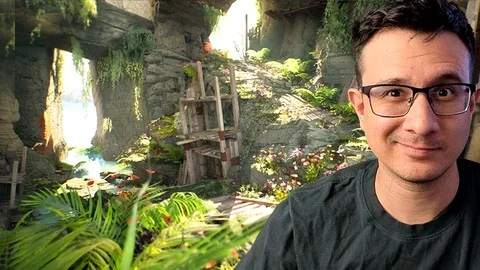
Scenes become convincing when the placement of assets, the use of color, and the control of lighting all support the same visual idea. AAA Game Environment Creation in Unreal Engine 5 Focuses on that process inside Unreal Engine 5, teaching environment creation through techniques used in AAA games. Rather than isolating one narrow topic, it connects set dressing, art fundamentals, design theory, and lighting so that a level can move toward a stronger final look.
This is a beginner course taught by Mao Mao, with a total workload of 4 hours and 49 minutes. Its curriculum begins with an introduction, and the course centers on helping learners understand how to create good looking environments in Unreal Engine 5.
AAA Environment Set Dressing in Unreal Engine 5
One of the clearest practical focuses here is the AAA environment set dressing pipeline in Unreal Engine 5. This helps because set dressing is where a scene stops feeling empty and starts reading as a complete environment. The course places that pipeline at the center of the learning path, making it one of the main ways students approach scene building.
By framing set dressing as a pipeline, the course points to more than simple object placement. It treats environment work as a structured process for shaping how a level looks. In a beginner context, that gives learners a practical way to think about environment creation: not as random decoration, but as a guided method associated with AAA game production.
For aspiring environment artists, this is one of the most concrete parts of the course. The emphasis is not on abstract appreciation of game worlds. It is on learning how to assemble a scene inside Unreal Engine 5 through a recognizable environment art workflow.
Color theory, design language, and lighting
The course does not stop at placing elements into a level. It also teaches art fundamentals, including color theory, design language, and lighting. These subjects sit close to the visual decisions that determine whether an environment feels coherent or weak, readable or confused.
Color theory gives learners a way to think about how the scene holds together visually. In environment work, color affects mood, emphasis, and the relationship between different parts of the space. By including color theory in a course about environment creation, the material keeps the visual side of level building connected to artistic judgment rather than treating Unreal Engine 5 as only a technical tool.
Design language adds another layer. A good looking environment is not only a collection of assets with decent placement. It also needs a clear visual logic. The course includes design language as part of its art fundamentals, which helps position environment creation as a discipline where artistic consistency matters as much as technical execution.
Lighting is addressed twice in the course focus, which makes it one of the most important concrete themes. It appears first as part of the art fundamentals and then again as a dedicated learning goal aimed at increasing the quality of a scene. That repeated emphasis gives lighting a specific role: it is not just another topic in the course, but one of the primary tools for improving environment presentation.
Design Theory for good looking environments
Alongside art fundamentals, the course teaches design theory to help learners understand how to create good looking environments. That phrasing is direct and useful. It places the goal on visual outcome rather than on memorizing isolated concepts.
Design theory in this context supports the decision-making behind environment art. It gives beginners a framework for understanding why certain environments read well and why others do not. Combined with set dressing, color theory, and lighting, it forms a broader picture of environment creation where the scene is evaluated as a complete composition.
This also affects how the course fits into a learning path. Someone starting with Unreal Engine 5 environment work often needs more than software familiarity. They need help recognizing what makes an environment visually effective. By including design theory, the course addresses that gap directly.
This gives a structure that moves beyond software operation alone. Learners are being introduced to the reasoning behind scene quality, not only the steps used to place content into a level.
Beginner scope with a clear environment artist target
The course is marked for beginners, which sets expectations for how it is positioned. It is aimed at aspiring 3D environment artists who want to create good looking levels, and it also speaks to aspiring 3D environment artists who want to land a job at a AAA game studio.
Those two audience descriptions are closely related, but they point to slightly different motivations. One group is trying to improve the look of their levels. The other is connecting that improvement to a career goal in AAA game development. The shared requirement between both groups is the ability to build stronger environments, and the course stays focused on that need.
Because the level is beginner, the material is positioned as an entry point rather than an advanced specialization. That makes the course easier to place within a broader training plan. It is for learners who want to begin understanding how Unreal Engine 5 environment creation works when judged through AAA-oriented standards and techniques.
The total workload of 4 hours and 49 minutes reinforces that scope. It is substantial enough to cover several connected topics, but still compact enough to read as a focused course rather than a long-form program spread across many different disciplines.
How Unreal Engine 5 environment work is framed here
The most notable part of this course is the way it groups environment creation into a connected visual workflow. Set dressing pipelines, art fundamentals, design theory, and lighting are not presented as unrelated subjects. They all feed into the same practical goal: improving the quality and appearance of a scene in Unreal Engine 5.
That framing gives the course a usable internal structure. Set dressing covers how the environment is assembled. Art fundamentals shape the visual decisions within that assembly. Design theory supports the judgment behind those choices. Lighting then becomes one of the major tools for raising scene quality.
For anyone evaluating the course as a learning resource, that combination is its strongest concrete point. It is not only about creating an environment in Unreal Engine 5. It is about learning how several core disciplines contribute to a good looking result, with a specific emphasis on techniques associated with AAA games.
The strongest takeaway for aspiring AAA environment artists
For beginners who want a focused path into environment art, the course is anchored in the parts of scene creation that most directly affect visual quality: AAA set dressing in Unreal Engine 5, color theory, design language, design theory, and lighting techniques. Its clearest value is that it treats good looking environments as the outcome of an interconnected workflow beyond one trick or isolated tool.
 Unreal Engine
 Unreal Engine
 Unreal Engine
 Unreal Engine