"6ac84fdb0bd06614"{"id":"1000146","slug":"amaya","title":"Amaya","category":"Humans","engine":"4.26+,5.0+","assetVersion":"","engineVersion":"Engine Version: 4.26+,5.0+","tag":"Humans","accent":"blue","visual":"mech","summary":"A technical breakdown of the Amaya character model, detailing its Animation Blueprint integration, morph target facial controls, and pre-configured physics.","platform":"Unreal Engine","publishedAt":"2026-06-18T05:32:39.353Z","updatedAt":"2026-06-18T05:32:39.353Z","sourceNotes":[],"fileContents":[],"compatibility":["Unreal Engine","Engine Version: 4.26+,5.0+"],"featuredImage":{"alt":"Amaya","src":"/wp-content/uploads/published/2026/06/26fe8ddd942a-a1ade4cc-bf92-4c13-9f55-97b66929ddc7-6733753419.webp"},"hasDownloadLink":true,"downloads":1,"terms":[{"taxonomy":"category","slug":"humans","name":"Humans"}],"galleryImages":[{"src":"/wp-content/uploads/published/2026/06/e0145665ce6b-ab28d4b2-20f4-4dd7-97b2-706dca159567-8d35ded5f7.webp","alt":"Amaya"},{"src":"/wp-content/uploads/published/2026/06/ada6c7110848-7fda8471-38b1-4325-8024-34d60db571b9-bd1508f3f9.webp","alt":"Amaya"},{"src":"/wp-content/uploads/published/2026/06/163c9fdb7c36-1fbc5b7c-b7a8-4114-bd83-5d3f56977772-f1f338ecdd.webp","alt":"Amaya"},{"src":"/wp-content/uploads/published/2026/06/db669934ab51-2ea97656-a15d-48dd-8c86-470c814ccf70-54aa8848ea.webp","alt":"Amaya"},{"src":"/wp-content/uploads/published/2026/06/f95987098a91-d8c32de3-5808-47c0-adec-4ae0d259a60a-02c45692e6.webp","alt":"Amaya"},{"src":"/wp-content/uploads/published/2026/06/f61e0d849db7-0489c788-4de5-4ccc-bd1a-edd171ddf42f-6ee4272c36.webp","alt":"Amaya"},{"src":"/wp-content/uploads/published/2026/06/6b82c49c9098-36db0142-3412-4cc2-b536-000ed1fdcb87-a5ed02ce2e.webp","alt":"Amaya"}],"accessPanel":{"kind":"resource","title":"Download this resource","eyebrow":"Free Download","message":"Log in or create a free account to start your download.","fileName":"Content.7z","safetyNote":"Resources are manually reviewed before listing to improve quality and reduce obvious risks.","actionLabel":"Download Free","resourceType":"Resource archive"},"contentHtml":"\u003ch2\u003eInitial Setup and Animation Blueprint Integration\u003c/h2\u003e\n\u003cp\u003eIntegrating the Amaya character model into a development environment relies heavily on the provided Animation Blueprint and script structure. For developers, the presence of an Animation Blueprint dictates how the character processes skeletal animation data and transitions between different movement states. This blueprint serves as the central logic hub for the model, ensuring that movement inputs, physics reactions, and facial adjustments process together smoothly without requiring a ground-up build. Rather than starting from a static mesh and constructing the underlying logic manually, developers can drop the character into a scene and immediately begin tying custom project logic into the existing blueprint architecture.\u003c/p\u003e\n\u003cp\u003eThe accompanying script elements provide the hooks necessary to trigger changes dynamically during runtime. These scripts interact directly with the Animation Blueprint, allowing for programmatic control over the model's various states. A script can be written to fire a specific expression when the character enters a specific area, or to adjust how the mesh reacts to environmental factors. This modular approach to character logic shortens the initial implementation phase, keeping the focus on fine-tuning the character's interactions within the specific environment.\u003c/p\u003e\n\u003ch2\u003eFacial Expression Controls via Morph Targets\u003c/h2\u003e\n\u003cp\u003eDriving the emotional and communicative aspects of the character is handled through a system of pre-configured morph targets. These blend shapes are dedicated specifically to facial expressions, allowing developers to manipulate the character's face without relying on a dense, complex facial bone rig. The facial expression system places a strong emphasis on the upper face, specifically highlighting built-in controls for the eyes and eyelids.\u003c/p\u003e\n\u003cp\u003eIn realistic character animation, the eyes dictate the focus and life of the model. The included eyelid morph targets allow for natural blinking cycles, squinting, or widening of the eyes in response to environmental triggers. Because these are built as morph targets rather than skeletal deformations, developers can smoothly blend multiple expressions together via the Animation Blueprint or custom scripts. This creates nuanced, lifelike reactions that enhance the character's realistic styling.\u003c/p\u003e\n\u003ch2\u003eMorph Targets and Low-Poly Optimization\u003c/h2\u003e\n\u003cp\u003eUtilizing morph targets for facial expressions is particularly beneficial for a low-poly character like Amaya. Traditional bone-based facial rigs require a higher density of polygons around the mouth, eyes, and brow to deform naturally without tearing the mesh or creating sharp, unnatural angles. By using morph targets, the specific vertex data is baked directly into the mesh variations, ensuring that the low-poly geometry transitions smoothly between different expressions.\u003c/p\u003e\n\u003cp\u003eThe specific focus on eyes and eyelids is crucial for maintaining visual fidelity. The geometry of the eyelids must fold and stretch accurately over the curvature of the eyeball. The pre-configured morph targets handle this precise vertex movement, ensuring that the realistic aesthetic holds up even when the character performs subtle micro-expressions. This setup allows the character to convey complex emotions while adhering strictly to performance budgets.\u003c/p\u003e\n\u003ch2\u003eConfigured Physics for Secondary Motion\u003c/h2\u003e\n\u003cp\u003eBeyond primary skeletal animations, the Amaya model includes a dedicated physics setup to handle secondary motion. When a character moves, elements that are not rigidly attached to the skeleton must react to that momentum to maintain the illusion of realism. The package includes pre-configured physics for the character's hair, earrings, and breasts. The hair physics ensure that the strands react naturally to head turns, walking, or running, adding dynamic fluidity to the model.\u003c/p\u003e\n\u003cp\u003eThe earrings are similarly constrained via the physics engine. Setting up small, dangling accessories often requires precise collision and constraint tuning to prevent them from clipping through the character's neck or face during rapid movement. Having these earrings pre-configured saves developers the tedious task of establishing those micro-physics volumes from scratch. The breast physics setup adds another layer of anatomical realism, ensuring that the character's mass reacts appropriately to gravity and the momentum of the primary animations. All of these physics elements work in tandem within the Animation Blueprint to create a cohesive sense of motion.\u003c/p\u003e\n\u003ch2\u003eMaintaining Secondary Physics Constraints\u003c/h2\u003e\n\u003cp\u003eSecondary motion grounds a realistic character in their environment. If a realistic model moves but its hair and accessories remain completely rigid, the visual presentation feels stiff. The provided setup establishes the necessary mass, stiffness, and damping values for these specific body parts and accessories. Hair requires a delicate balance of stiffness to maintain its style and flexibility to react to sudden stops. Earrings require rigid constraints that allow rotation but prevent the mesh from detaching entirely.\u003c/p\u003e\n\u003cp\u003eBecause these physics parameters are already integrated and balanced against each other, the complex trial-and-error phase usually associated with character physics setup is largely bypassed. The developer can rely on the baseline physics configuration to handle the heavy lifting of secondary animation, making adjustments only if the specific project demands extreme physics reactions.\u003c/p\u003e\n\u003ch2\u003eAesthetic Profile and Demographic Versatility\u003c/h2\u003e\n\u003cp\u003eBalancing visual fidelity with performance is a core aspect of the model's design. The character is categorized as low-poly, ensuring that the mesh remains optimized and lightweight for real-time rendering environments. Despite the reduced polygon count, the design targets a realistic visual style. This requires careful topology routing to ensure that the geometry deforms correctly during animation, particularly around the joints and the face.\u003c/p\u003e\n\u003cp\u003eThe visual design of the character provides a specific demographic profile. The facial structure and overall aesthetic are tailored to meet the needs of projects requiring authentic East Asian representation, categorized under specific tags for Japanese, Korean, and Chinese visual profiles. By maintaining a realistic anatomical structure within a low-poly framework, the model provides a versatile baseline for projects that require believable human characters without heavily taxing system resources. The character remains adaptable, ready to be integrated into various genres ranging from modern urban settings to stylized realistic environments.\u003c/p\u003e\n\n\u003ch2\u003eRelated Resources Worth Checking\u003c/h2\u003e\n\u003cul\u003e\n\u003cli\u003e\u003ca href=\"https://3dcghub.com/kind-witch-game-ready-stylized-mmorpg-fps-realistic-modular-character/\" title=\"Kind Witch - Game Ready Stylized MMORPG FPS Realistic Modular Character\"\u003eKind Witch - Game Ready Stylized MMORPG FPS Realistic Modular Character\u003c/a\u003e\u003c/li\u003e\n\u003cli\u003e\u003ca href=\"https://3dcghub.com/bunny-cute-fighting-anime-warrior-girl-realistic-mmorpg-fps-stylized-character/\" title=\"Bunny - Cute Fighting Anime Warrior Girl Realistic MMORPG FPS Stylized Character\"\u003eBunny - Cute Fighting Anime Warrior Girl Realistic MMORPG FPS Stylized Character\u003c/a\u003e\u003c/li\u003e\n\u003cli\u003e\u003ca href=\"https://3dcghub.com/primrose-deluxe-version-game-ready/\" title=\"Primrose Deluxe Version - Game Ready\"\u003ePrimrose Deluxe Version - Game Ready\u003c/a\u003e\u003c/li\u003e\n\u003cli\u003e\u003ca href=\"https://3dcghub.com/amazon-female-warrior-native-knight-realistic-girl-mmorpg-stylized-character/\" title=\"Amazon Female Warrior, Native Knight Realistic Girl MMORPG Stylized Character\"\u003eAmazon Female Warrior, Native Knight Realistic Girl MMORPG Stylized Character\u003c/a\u003e\u003c/li\u003e\n\u003cli\u003e\u003ca href=\"https://3dcghub.com/kitsune/\" title=\"Kitsune\"\u003eKitsune\u003c/a\u003e\u003c/li\u003e\n\u003c/ul\u003e","contentTextLength":6926,"navigation":{"current":1139,"total":3181,"previous":{"id":"1000147","slug":"animalia-leopard-young","title":"Animalia - Leopard (young)","category":"Characters \u0026 Creatures","platform":"Unreal Engine","updatedAt":"2026-06-18T06:44:20.152Z"},"next":{"id":"1000145","slug":"aaa-game-environment-creation-in-unreal-engine-5","title":"AAA Game Environment Creation in Unreal Engine 5","category":"Unreal Engine","platform":"Unreal Engine","updatedAt":"2026-06-13T08:44:03.779Z"}},"relatedResources":[{"id":"1000306","slug":"knight-vesuvius","title":"Knight Vesuvius","category":"Humans","engine":"4.26+,5.0+","assetVersion":"","engineVersion":"Engine Version: 4.26+,5.0+","tag":"Humans","accent":"blue","visual":"mech","summary":"A technical breakdown of the Knight Vesuvius character model for Unreal Engine, detailing its fused and stripped meshes, PBR skins, and Epic Skeleton rig.","platform":"Unreal Engine","publishedAt":"2026-07-04T09:23:21.715Z","updatedAt":"2026-07-04T09:23:21.715Z","sourceNotes":[],"fileContents":[],"compatibility":["Unreal Engine","Engine Version: 4.26+,5.0+"],"featuredImage":{"alt":"Knight Vesuvius","src":"/wp-content/uploads/published/2026/07/de15c0697fea-f4bca91a-801b-4fc9-8a6b-ac05f98448aa-8be7d5514c.webp"},"hasDownloadLink":true,"downloads":0},{"id":"1000421","slug":"assassin-girl-modular","title":"Assassin Girl Modular","category":"Humans","engine":"4.27,5.0+","assetVersion":"","engineVersion":"Engine Version: 4.27,5.0+","tag":"Humans","accent":"blue","visual":"mech","summary":"Modular rigged female assassin character with Epic Skeleton, facial blendshapes, PBR 4K textures, and Unreal Engine physics. Includes dagger and multiple body t","platform":"Unreal Engine","publishedAt":"2026-07-09T20:16:25.138Z","updatedAt":"2026-07-09T20:16:25.138Z","sourceNotes":[],"fileContents":[],"compatibility":["Unreal Engine","Engine Version: 4.27,5.0+"],"featuredImage":{"alt":"Assassin Girl Modular","src":"/wp-content/uploads/published/2026/07/571d57f12c7f-2b2ffcf1-fa74-4d6a-81c3-00378fd516a0-1a49c79810.webp"},"hasDownloadLink":true,"downloads":3},{"id":"1000423","slug":"camo-sniper","title":"Camo Sniper","category":"Humans","engine":"4.26+,5.0+","assetVersion":"","engineVersion":"Engine Version: 4.26+,5.0+","tag":"Humans","accent":"blue","visual":"mech","summary":"A rigged sniper character with three camouflage variants, animation blueprint, and control rig for Unreal Engine shooter environments.","platform":"Unreal Engine","publishedAt":"2026-07-09T20:24:51.594Z","updatedAt":"2026-07-09T20:24:51.594Z","sourceNotes":[],"fileContents":[],"compatibility":["Unreal Engine","Engine Version: 4.26+,5.0+"],"featuredImage":{"alt":"Camo Sniper","src":"/wp-content/uploads/published/2026/07/7879520b7c0d-b76ac364-8da2-451d-99d1-0ecef6c2e369-6013704236.webp"},"hasDownloadLink":true,"downloads":1}]}
Humans
Amaya
A technical breakdown of the Amaya character model, detailing its Animation Blueprint integration, morph target facial controls, and pre-configured physics.
Category:Unreal Engine, HumansPlatform: Unreal EngineEngine Version: 4.26+,5.0+Published: Jun 18, 2026
Humans
Resource overview
Initial Setup and Animation Blueprint Integration
Integrating the Amaya character model into a development environment relies heavily on the provided Animation Blueprint and script structure. For developers, the presence of an Animation Blueprint dictates how the character processes skeletal animation data and transitions between different movement states. This blueprint serves as the central logic hub for the model, ensuring that movement inputs, physics reactions, and facial adjustments process together smoothly without requiring a ground-up build. Rather than starting from a static mesh and constructing the underlying logic manually, developers can drop the character into a scene and immediately begin tying custom project logic into the existing blueprint architecture.
The accompanying script elements provide the hooks necessary to trigger changes dynamically during runtime. These scripts interact directly with the Animation Blueprint, allowing for programmatic control over the model's various states. A script can be written to fire a specific expression when the character enters a specific area, or to adjust how the mesh reacts to environmental factors. This modular approach to character logic shortens the initial implementation phase, keeping the focus on fine-tuning the character's interactions within the specific environment.
Facial Expression Controls via Morph Targets
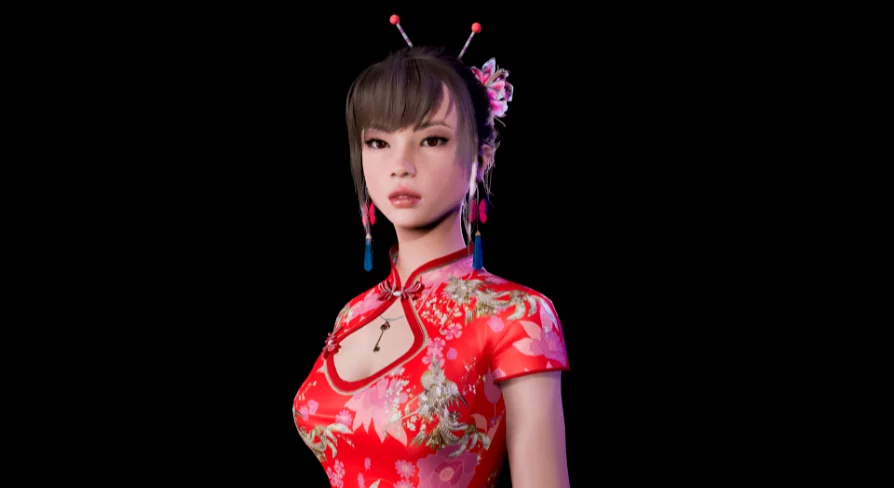
Driving the emotional and communicative aspects of the character is handled through a system of pre-configured morph targets. These blend shapes are dedicated specifically to facial expressions, allowing developers to manipulate the character's face without relying on a dense, complex facial bone rig. The facial expression system places a strong emphasis on the upper face, specifically highlighting built-in controls for the eyes and eyelids.
In realistic character animation, the eyes dictate the focus and life of the model. The included eyelid morph targets allow for natural blinking cycles, squinting, or widening of the eyes in response to environmental triggers. Because these are built as morph targets rather than skeletal deformations, developers can smoothly blend multiple expressions together via the Animation Blueprint or custom scripts. This creates nuanced, lifelike reactions that enhance the character's realistic styling.
Morph Targets and Low-Poly Optimization
Utilizing morph targets for facial expressions is particularly beneficial for a low-poly character like Amaya. Traditional bone-based facial rigs require a higher density of polygons around the mouth, eyes, and brow to deform naturally without tearing the mesh or creating sharp, unnatural angles. By using morph targets, the specific vertex data is baked directly into the mesh variations, ensuring that the low-poly geometry transitions smoothly between different expressions.
The specific focus on eyes and eyelids is crucial for maintaining visual fidelity. The geometry of the eyelids must fold and stretch accurately over the curvature of the eyeball. The pre-configured morph targets handle this precise vertex movement, ensuring that the realistic aesthetic holds up even when the character performs subtle micro-expressions. This setup allows the character to convey complex emotions while adhering strictly to performance budgets.
Configured Physics for Secondary Motion
Beyond primary skeletal animations, the Amaya model includes a dedicated physics setup to handle secondary motion. When a character moves, elements that are not rigidly attached to the skeleton must react to that momentum to maintain the illusion of realism. The package includes pre-configured physics for the character's hair, earrings, and breasts. The hair physics ensure that the strands react naturally to head turns, walking, or running, adding dynamic fluidity to the model.
The earrings are similarly constrained via the physics engine. Setting up small, dangling accessories often requires precise collision and constraint tuning to prevent them from clipping through the character's neck or face during rapid movement. Having these earrings pre-configured saves developers the tedious task of establishing those micro-physics volumes from scratch. The breast physics setup adds another layer of anatomical realism, ensuring that the character's mass reacts appropriately to gravity and the momentum of the primary animations. All of these physics elements work in tandem within the Animation Blueprint to create a cohesive sense of motion.
Maintaining Secondary Physics Constraints
Secondary motion grounds a realistic character in their environment. If a realistic model moves but its hair and accessories remain completely rigid, the visual presentation feels stiff. The provided setup establishes the necessary mass, stiffness, and damping values for these specific body parts and accessories. Hair requires a delicate balance of stiffness to maintain its style and flexibility to react to sudden stops. Earrings require rigid constraints that allow rotation but prevent the mesh from detaching entirely.
Because these physics parameters are already integrated and balanced against each other, the complex trial-and-error phase usually associated with character physics setup is largely bypassed. The developer can rely on the baseline physics configuration to handle the heavy lifting of secondary animation, making adjustments only if the specific project demands extreme physics reactions.
Aesthetic Profile and Demographic Versatility
Balancing visual fidelity with performance is a core aspect of the model's design. The character is categorized as low-poly, ensuring that the mesh remains optimized and lightweight for real-time rendering environments. Despite the reduced polygon count, the design targets a realistic visual style. This requires careful topology routing to ensure that the geometry deforms correctly during animation, particularly around the joints and the face.
The visual design of the character provides a specific demographic profile. The facial structure and overall aesthetic are tailored to meet the needs of projects requiring authentic East Asian representation, categorized under specific tags for Japanese, Korean, and Chinese visual profiles. By maintaining a realistic anatomical structure within a low-poly framework, the model provides a versatile baseline for projects that require believable human characters without heavily taxing system resources. The character remains adaptable, ready to be integrated into various genres ranging from modern urban settings to stylized realistic environments.
 Humans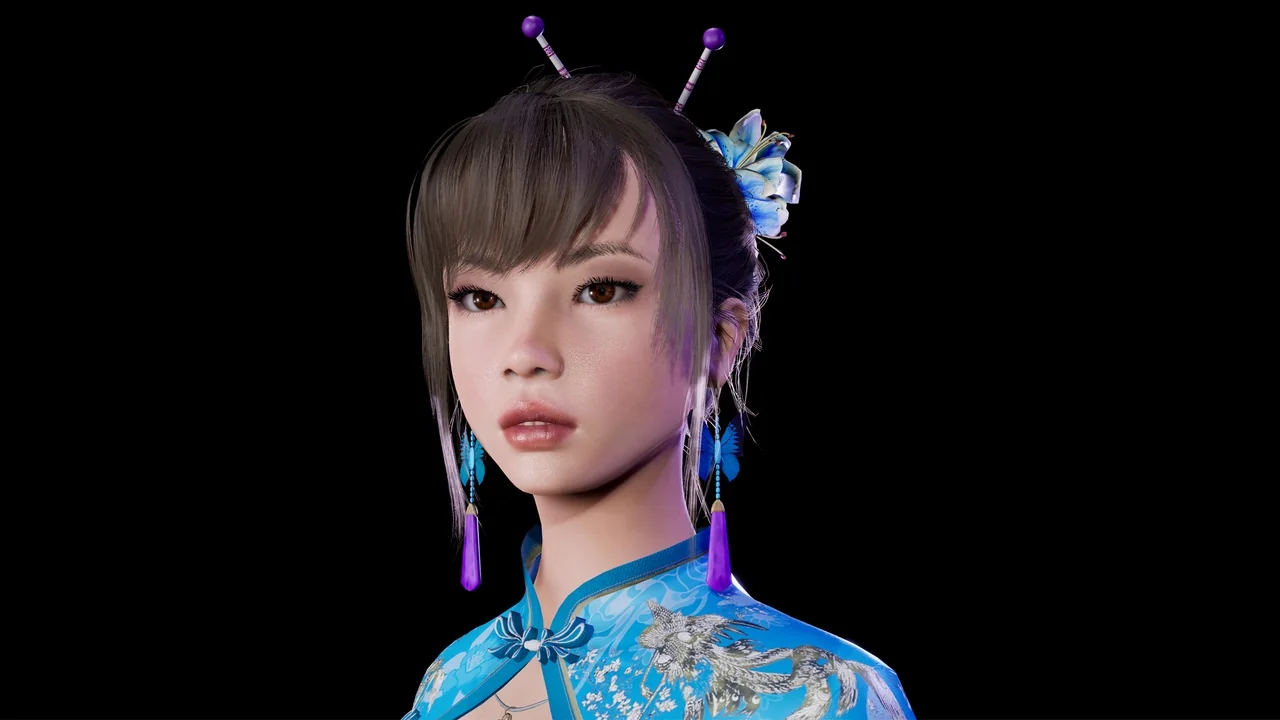
 Humans
 Humans
 Humans