"8652e693bd7bbc55"{"id":"1002969","slug":"2d-endless-runner-platform-kit","title":"2D Endless Runner Platform Kit","category":"Environments","engine":"4.26+,5.0+","assetVersion":"","engineVersion":"Engine Version: 4.26+,5.0+","tag":"Environments","accent":"blue","visual":"city","summary":"A 2D infinite runner kit where the character jumps and double jumps past spawned obstacles, collects coins and power-ups, and runs on Android and iOS.","platform":"Unreal Engine","indexPolicy":"index","publishedAt":"2026-11-25T08:43:39.114Z","updatedAt":"2026-11-25T08:43:39.114Z","sourceNotes":[],"fileContents":[],"compatibility":["Unreal Engine","Engine Version: 4.26+,5.0+"],"featuredImage":{"alt":"2D Endless Runner Platform Kit","src":"/wp-content/uploads/published/2026/11/a39c0957f22d-2409aab9-3acf-4485-a739-e16419cb7d9b-a46bc3188e.webp"},"hasDownloadLink":true,"downloads":0,"terms":[{"taxonomy":"category","slug":"environments-sprites-and-flipbooks","name":"Environments"}],"galleryImages":[{"src":"/wp-content/uploads/published/2026/11/4b9b24fd69c2-be49dbb1-9308-4e50-be58-a4544a32f460-df9310027d.webp","alt":"2D Endless Runner Platform Kit"},{"src":"/wp-content/uploads/published/2026/11/e8cd8c5a8a2d-6480f6b0-e586-413c-9b05-8b7249b9372e-84a69db5ea.webp","alt":"2D Endless Runner Platform Kit"},{"src":"/wp-content/uploads/published/2026/11/a27dab9b6a59-c38e3afb-ac86-48e5-b22f-e4c940551d03-030aff1548.webp","alt":"2D Endless Runner Platform Kit"},{"src":"/wp-content/uploads/published/2026/11/16897c732041-9130972e-dc92-4989-b461-bcdc4507226a-6fcd6b2ba5.webp","alt":"2D Endless Runner Platform Kit"},{"src":"/wp-content/uploads/published/2026/11/7f46f5f55061-2a09c2eb-1c4a-46a2-95f8-63e754ae0461-cd7adaf466.webp","alt":"2D Endless Runner Platform Kit"},{"src":"/wp-content/uploads/published/2026/11/e103265da09b-4ec20ad6-07a7-4b86-b4c0-948f03e53959-2f67a6a588.webp","alt":"2D Endless Runner Platform Kit"},{"src":"/wp-content/uploads/published/2026/11/3c5a7a093f7a-47966d93-256b-4a0e-865c-fd313bf44c6f-1023b26b7b.webp","alt":"2D Endless Runner Platform Kit"}],"accessPanel":{"kind":"resource","title":"Get this resource","safetyNote":"Resources are manually reviewed before listing to improve quality and reduce obvious risks.","fileName":"2D Endless Runner Platform Kit.7z","resourceType":"Resource archive","versions":[]},"contentHtml":"\u003cp\u003eThe runner keeps moving, and the decisions come in short bursts: hop a low block, tap again to carry the character over something taller, drop back down onto solid ground, then swing wide for a coin sitting above the gap. The 2D Endless Runner Platform Kit is shaped by exactly that rhythm — a side-on character that must avoid obstacles and gather coins and power-ups as the level streams past.\u003c/p\u003e \u003cp\u003eIt is a kit rather than a finished game, which means the pieces of that loop are already wired together and meant to be reworked: the character movement, the obstacle and pickup spawning, the systems that support a run, and the blueprint logic that holds it all together. Everything sits in a 2D plane, so the character reads clearly against the background and every jump is a matter of timing rather than spatial navigation.\u003c/p\u003e \u003ch2\u003eJumping and Double Jumping in the Runner's Spawn Field\u003c/h2\u003e \u003cp\u003eThe core verb is the jump, and the kit gives it two stages. A character can jump onto an object or over it, and can double jump — a second upward push while already airborne. That distinction matters more than it sounds, because it changes how obstacles can be authored. A single-jump obstacle is a hop. A double-jump obstacle forces the player to spend both jumps, and any coin placed above it can only be reached by committing to the full arc.\u003c/p\u003e \u003cp\u003eBecause the character can both \u003cem\u003eLand on\u003c/em\u003e And \u003cem\u003eClear\u003c/em\u003e Objects, obstacle placement is not limited to things that kill on contact. Some objects function as geometry to be stood on, others as hazards to be avoided, and the same spawned item can play either role depending on how it is placed. In a scene, this is what separates a flat corridor of blocks from something with a little vertical texture: a stack to climb, a gap to leap, a coin sitting just out of reach of one jump.\u003c/p\u003e \u003ch2\u003ePatterns, Coins and Power-Ups as They Come\u003c/h2\u003e \u003cp\u003eCoins and obstacles do not arrive as an unbroken stream of random objects. They are spawned either grouped in a pattern or individually. A grouped pattern is a deliberate arrangement — a run of coins in an arc, a cluster of obstacles at a fixed spacing — while an individual spawn is a single object dropped into the field on its own. Having both options available is what allows a course to breathe: dense patterned sections where the player is reading a sequence, and looser individual placements where the pace relaxes before the next cluster.\u003c/p\u003e \u003cp\u003eCoins are the collectible layer that gives a run its score. Power-ups are a separate pickup, gathered the same way — by steering the character into them — but distinct from the coin stream. Both sit in the same world as the obstacles, which means a single well-placed pattern can ask the player to choose: take the safe line, or chase the pickup through the riskier one.\u003c/p\u003e \u003ch2\u003eBlueprint Communication Inside the Kit\u003c/h2\u003e \u003cp\u003eThe systems are expressed in blueprints, and the blueprints are commented. That is a small sentence with a large practical consequence. A commented blueprint tells you what a node cluster is for without requiring you to reverse-engineer it from the wiring, which is the difference between opening a graph and understanding it in a minute versus an afternoon.\u003c/p\u003e \u003cp\u003eJust as important is how the pieces talk to each other. The blueprints communicate in a centralized manner rather than through a web of direct, scattered references. When one system needs to trigger another — a pickup informing the run, a collision informing the health system — the path goes through a shared point of contact. For anyone extending the kit, that shape is easier to trace: you follow one hub instead of hunting across dozens of actors for whoever happens to be listening.\u003c/p\u003e \u003ch2\u003eAndroid and iOS Are Covered\u003c/h2\u003e \u003cp\u003eThe kit ships with full mobile support for Android and iOS. For an endless runner, that is less a checkbox than a design constraint that has already been accounted for. Runs are short, input is a tap or two, and the play session is measured in minutes — the genre was practically built for phones, and a 2D side-on course with jump and double jump maps cleanly onto a touchscreen.\u003c/p\u003e \u003cp\u003eTargeting both platforms means the kit can serve as the base for a phone release without first being reworked from a desktop assumption. The 2D presentation helps here as well: flat sprites and layered depth read at small sizes, where a busy three-dimensional scene would lose legibility on a handheld display.\u003c/p\u003e \u003ch3\u003eHealth and the Save System\u003c/h3\u003e \u003cp\u003eA run needs a way to end and a way to persist. Health covers the first part — the state that tracks how much damage the character can absorb before the run stops. Saving covers the second, carrying progress across sessions rather than resetting the player to nothing every time the game closes. For a mobile runner these two systems are close companions: a health value that matters over repeated short attempts, and saved state that makes those attempts add up to something.\u003c/p\u003e \u003ch3\u003eParallax Layers, Sound and Effects\u003c/h3\u003e \u003cp\u003eParallax is what turns a flat forward scroll into depth. Background layers move at different rates relative to the player, so the world appears to sit behind the playfield rather than beside it. Sound and effects fill in the feedback layer — the audible and visual response to a jump, a pickup, a hit — which is how a player knows an action registered without looking away from the obstacle ahead. These are the parts of a runner that are easy to leave until the end and hard to retrofit convincingly, so having them already represented in the kit saves that reconstruction.\u003c/p\u003e \u003ch2\u003eMatching the Kit to a Project\u003c/h2\u003e \u003cp\u003eThe clearest fit is a small team or solo developer building a mobile 2D runner and wanting the loop already standing: a character that jumps and double jumps, obstacles and coins that spawn in patterns or on their own, power-ups to collect, and the supporting systems for health, saving, parallax, sound and effects. It also suits prototyping — the centralized blueprint structure and the comments make it practical to gut a system and replace it with something specific to a project, without the rest of the kit collapsing.\u003c/p\u003e \u003cp\u003eWhat the kit does not do is decide the content. Patterns still have to be authored, the balance between a fair obstacle and a cheap one still has to be tuned, and the feel of the double jump still has to be adjusted until it lands right. The strongest concrete takeaway is this: the plumbing of an endless runner — spawning, pickups, health, saving, parallax, platform coverage — is already assembled and documented, so the work left is the part that makes a runner worth playing.\u003c/p\u003e\n\n\u003ch2\u003eRelated Resources Worth Checking\u003c/h2\u003e\n\u003cul\u003e\n\u003cli\u003e\u003ca href=\"https://3dcghub.com/endless-runner-mega-template/\" rel=\"noopener noreferrer\"\u003eEndless Runner Mega Template\u003c/a\u003e\u003c/li\u003e\n\u003cli\u003e\u003ca href=\"https://3dcghub.com/2d-pixel-scene-3/\" rel=\"noopener noreferrer\"\u003e2D Pixel Scene 3\u003c/a\u003e\u003c/li\u003e\n\u003cli\u003e\u003ca href=\"https://3dcghub.com/endless-runner-creator-v3/\" rel=\"noopener noreferrer\"\u003eEndless Runner Creator V3\u003c/a\u003e\u003c/li\u003e\n\u003cli\u003e\u003ca href=\"https://3dcghub.com/push-push-puzzle-2d-kit/\" rel=\"noopener noreferrer\"\u003ePush Push Puzzle 2D Kit\u003c/a\u003e\u003c/li\u003e\n\u003cli\u003e\u003ca href=\"https://3dcghub.com/endless-runner-shooter-template/\" rel=\"noopener noreferrer\"\u003eEndless Runner Shooter Template\u003c/a\u003e\u003c/li\u003e\n\u003c/ul\u003e","contentTextLength":6671,"navigation":{"current":22,"total":4911,"previous":{"id":"1002970","slug":"3d-radar","title":"3D Radar","category":"Gameplay Features","platform":"Unreal Engine","updatedAt":"2026-11-25T08:44:46.149Z"},"next":{"id":"13990","slug":"file-system-library","title":"File System Library","category":"Engine Tools","platform":"Unreal Engine","updatedAt":"2026-11-25T06:24:43.758Z"}},"relatedResources":[{"id":"1001803","slug":"endless-runner-mega-template","title":"Endless Runner Mega Template","category":"Platformer","engine":"5.0+","assetVersion":"","engineVersion":"Engine Version: 5.0+","tag":"Platformer","accent":"blue","visual":"mech","summary":"Explore the Endless Runner Mega Template, featuring procedural generation, character spells, dynamic difficulty scaling, and tickless Blueprint optimization.","platform":"Unreal Engine","indexPolicy":"index","publishedAt":"2026-10-21T07:54:58.391Z","updatedAt":"2026-10-21T07:54:58.391Z","sourceNotes":[],"fileContents":[],"compatibility":["Unreal Engine","Engine Version: 5.0+"],"featuredImage":{"alt":"Endless Runner Mega Template","src":"/wp-content/uploads/published/2026/10/ee153be13f3e-99a6af0a-95bb-4bdb-84cf-24cbc1f5debc-5a4dc71c0d.webp"},"fileSizeBytes":308930239,"hasDownloadLink":true,"downloads":0},{"id":"13352","slug":"2d-pixel-scene-3","title":"2D Pixel Scene 3","category":"Environments","engine":"4.26+,5.0+","assetVersion":"Engine version: 4.26+,5.0+","engineVersion":"4.24","tag":"Environments","accent":"blue","visual":"city","summary":"Enhance your project with 2D Pixel Scene 3, a collection of 70 unique pixel art images. These versatile assets are ideal for immersive game backgrounds and stylized user interface elements.","platform":"Unreal Engine","indexPolicy":"noindex","publishedAt":"2026-03-10T16:54:29.000Z","updatedAt":"2026-04-19T15:46:29.000Z","sourceNotes":[],"fileContents":[],"compatibility":["Unreal Engine","Engine version: 4.26+,5.0+"],"featuredImage":{"alt":"2D Pixel Scene 3","src":"https://3dcghub.com/wp-content/uploads/2026/03/64accedb-3522-47eb-ac77-d60113db1219.webp"},"fileSizeBytes":165228068,"hasDownloadLink":true,"downloads":0},{"id":"11715","slug":"endless-runner-creator-v3","title":"Endless Runner Creator V3","category":"Platformer","engine":"4.26+,5.0+","assetVersion":"Engine version: 4.26+,5.0+","engineVersion":"Asset Version:V3","tag":"Platformer","accent":"blue","visual":"mech","summary":"Build high-performance endless runner games with a flexible system featuring seven unique game types. This optimized engine supports both mobile and desktop platforms with ease.","platform":"Unreal Engine","indexPolicy":"noindex","publishedAt":"2026-03-05T18:18:19.000Z","updatedAt":"2026-04-19T15:48:08.000Z","sourceNotes":[],"fileContents":[],"compatibility":["Unreal Engine","Engine version: 4.26+,5.0+","Asset Version: V3"],"featuredImage":{"alt":"Endless Runner Creator V3","src":"https://3dcghub.com/wp-content/uploads/2026/03/1121ed83-5490-4700-8c2f-5c8bc92844fc.webp"},"fileSizeBytes":260755704,"hasDownloadLink":true,"downloads":0}]}[{"id":4225,"sourceId":4225,"taxonomyId":4225,"taxonomy":"category","slug":"asset-library","name":"Asset Library","parentId":null,"count":4765,"hasChildren":true,"href":"/","seoTitle":"Free Game Assets Library | 3DCGHUB","seoDescription":"Browse free Unreal Engine, Unity, Blender assets and game development tutorials on 3DCGHUB with previews, compatibility notes, and secure downloads.","sitemapEnabled":true,"children":[{"id":4227,"sourceId":4227,"taxonomyId":4227,"taxonomy":"category","slug":"blender-add-ons-plugins","name":"Blender Add-ons \u0026 Plugins","parentId":4225,"count":10,"hasChildren":false,"href":"/category/blender-add-ons-plugins/","seoTitle":"Free Blender Add-ons \u0026 Plugins | 3DCGHUB","seoDescription":"Browse free Blender Add-ons \u0026 Plugins tools for Blender on 3DCGHUB: curated downloads with preview images, compatibility notes and secure download access.","sitemapEnabled":true},{"id":514,"sourceId":514,"taxonomyId":514,"taxonomy":"category","slug":"unity-2","name":"Unity","parentId":4225,"count":453,"hasChildren":true,"href":"/category/unity-2/","seoTitle":"Free Unity Assets | 3DCGHUB","seoDescription":"Browse free Unity resources on 3DCGHUB: curated downloads with preview images, compatibility notes and secure download access.","sitemapEnabled":true,"children":[{"id":523,"sourceId":523,"taxonomyId":523,"taxonomy":"category","slug":"2d","name":"2D","parentId":514,"count":1,"hasChildren":true,"href":"/category/2d/","seoTitle":"Free Unity 2D | 3DCGHUB","seoDescription":"Browse free 2D assets for Unity on 3DCGHUB: curated downloads with preview images, compatibility notes and secure download access.","sitemapEnabled":true},{"id":515,"sourceId":515,"taxonomyId":515,"taxonomy":"category","slug":"3d-unity-2","name":"3D","parentId":514,"count":162,"hasChildren":true,"href":"/category/3d-unity-2/","seoTitle":"Free Unity 3D Assets | 3DCGHUB","seoDescription":"Browse free 3D assets for Unity on 3DCGHUB: curated downloads with preview images, compatibility notes and secure download access.","sitemapEnabled":true},{"id":565,"sourceId":565,"taxonomyId":565,"taxonomy":"category","slug":"add-ons","name":"Add-Ons","parentId":514,"count":2,"hasChildren":false,"href":"/category/add-ons/","seoTitle":"Free Unity Add-Ons | 3DCGHUB","seoDescription":"Browse free Add-Ons assets for Unity on 3DCGHUB: curated downloads with preview images, compatibility notes and secure download access.","sitemapEnabled":true},{"id":529,"sourceId":529,"taxonomyId":529,"taxonomy":"category","slug":"audio-unity-2","name":"Audio","parentId":514,"count":1,"hasChildren":true,"href":"/category/audio-unity-2/","seoTitle":"Free Unity Audio | 3DCGHUB","seoDescription":"Browse free Audio for Unity on 3DCGHUB: curated downloads with preview images, compatibility notes and secure download access.","sitemapEnabled":true},{"id":557,"sourceId":557,"taxonomyId":557,"taxonomy":"category","slug":"templates","name":"Templates","parentId":514,"count":36,"hasChildren":true,"href":"/category/templates/","seoTitle":"Free Unity Templates | 3DCGHUB","seoDescription":"Browse free Unity project templates on 3DCGHUB. Starter kits with previews, compatibility notes, and secure download access.","sitemapEnabled":true},{"id":533,"sourceId":533,"taxonomyId":533,"taxonomy":"category","slug":"tools-unity-2","name":"Tools","parentId":514,"count":0,"hasChildren":true,"href":"/category/tools-unity-2/","sitemapEnabled":true},{"id":554,"sourceId":554,"taxonomyId":554,"taxonomy":"category","slug":"vfx-unity-2","name":"VFX","parentId":514,"count":4,"hasChildren":true,"href":"/category/vfx-unity-2/","seoTitle":"Free Unity VFX | 3DCGHUB","seoDescription":"Browse free VFX for Unity on 3DCGHUB: curated downloads with preview images, compatibility notes and secure download access.","sitemapEnabled":true}]},{"id":511,"sourceId":511,"taxonomyId":511,"taxonomy":"category","slug":"unreal-engine-2","name":"Unreal Engine","parentId":4225,"count":4303,"hasChildren":true,"href":"/category/unreal-engine-2/","seoTitle":"Free Unreal Engine Assets | 3DCGHUB","seoDescription":"Browse free Unreal Engine resources on 3DCGHUB: curated downloads with preview images, compatibility notes and secure download access.","sitemapEnabled":true,"children":[{"id":54,"sourceId":54,"taxonomyId":54,"taxonomy":"category","slug":"3d","name":"3D","parentId":511,"count":2434,"hasChildren":true,"href":"/category/3d/","seoTitle":"Free Unreal Engine 3D | 3DCGHUB","seoDescription":"Browse free 3D assets for Unreal Engine on 3DCGHUB: curated downloads with preview images, compatibility notes and secure download access.","sitemapEnabled":true},{"id":441,"sourceId":441,"taxonomyId":441,"taxonomy":"category","slug":"animations","name":"Animations","parentId":511,"count":245,"hasChildren":true,"href":"/category/animations/","seoTitle":"Free Unreal Engine Animations | 3DCGHUB","seoDescription":"Browse free Animations for Unreal Engine on 3DCGHUB: curated downloads with preview images, compatibility notes and secure download access.","sitemapEnabled":true},{"id":446,"sourceId":446,"taxonomyId":446,"taxonomy":"category","slug":"audio","name":"Audio","parentId":511,"count":63,"hasChildren":true,"href":"/category/audio/","seoTitle":"Free Unreal Engine Audio Resources | 3DCGHUB","seoDescription":"Browse free Unreal Engine audio resources including sound effects, voices, dialogue, and ambient sounds. Curated free downloads on 3DCGHUB.","sitemapEnabled":true},{"id":466,"sourceId":466,"taxonomyId":466,"taxonomy":"category","slug":"game-systems","name":"Game Systems","parentId":511,"count":366,"hasChildren":true,"href":"/category/game-systems/","seoTitle":"Free Unreal Engine Game Systems | 3DCGHUB","seoDescription":"Browse free Game Systems tools for Unreal Engine on 3DCGHUB: curated downloads with preview images, compatibility notes and secure download access.","sitemapEnabled":true},{"id":478,"sourceId":478,"taxonomyId":478,"taxonomy":"category","slug":"game-templates","name":"Game Templates","parentId":511,"count":151,"hasChildren":true,"href":"/category/game-templates/","seoTitle":"Free Unreal Engine Game Templates | 3DCGHUB","seoDescription":"Browse free Game Templates for Unreal Engine on 3DCGHUB: curated downloads with preview images, compatibility notes and secure download access.","sitemapEnabled":true},{"id":432,"sourceId":432,"taxonomyId":432,"taxonomy":"category","slug":"hdri","name":"HDRI","parentId":511,"count":6,"hasChildren":true,"href":"/category/hdri/","seoTitle":"Free Unreal Engine HDRI | 3DCGHUB","seoDescription":"Browse free Unreal Engine HDRI skies and lighting maps on 3DCGHUB. Environment lighting with previews and secure downloads.","sitemapEnabled":true},{"id":228,"sourceId":228,"taxonomyId":228,"taxonomy":"category","slug":"material-and-textures","name":"Material \u0026 Textures","parentId":511,"count":172,"hasChildren":true,"href":"/category/material-and-textures/","seoTitle":"Free Unreal Engine Material \u0026 Textures | 3DCGHUB","seoDescription":"Browse free Material \u0026 Textures for Unreal Engine on 3DCGHUB: curated downloads with preview images, compatibility notes and secure download access.","sitemapEnabled":true},{"id":298,"sourceId":298,"taxonomyId":298,"taxonomy":"category","slug":"sprites-and-flipbooks","name":"Sprites \u0026 Flipbooks","parentId":511,"count":18,"hasChildren":true,"href":"/category/sprites-and-flipbooks/","seoTitle":"Free Unreal Engine Sprites \u0026 Flipbooks | 3DCGHUB","seoDescription":"Browse free Sprites \u0026 Flipbooks assets for Unreal Engine on 3DCGHUB: curated downloads with preview images, compatibility notes and secure download access.","sitemapEnabled":true},{"id":489,"sourceId":489,"taxonomyId":489,"taxonomy":"category","slug":"tools-and-plugins","name":"Tools \u0026 Plugins","parentId":511,"count":390,"hasChildren":true,"href":"/category/tools-and-plugins/","seoTitle":"Free Unreal Engine Tools \u0026 Plugins | 3DCGHUB","seoDescription":"Browse free Tools \u0026 Plugins for Unreal Engine on 3DCGHUB: curated downloads with preview images, compatibility notes and secure download access.","sitemapEnabled":true},{"id":459,"sourceId":459,"taxonomyId":459,"taxonomy":"category","slug":"ui","name":"UI","parentId":511,"count":45,"hasChildren":true,"href":"/category/ui/","seoTitle":"Free Unreal Engine UI | 3DCGHUB","seoDescription":"Browse free UI for Unreal Engine on 3DCGHUB: curated downloads with preview images, compatibility notes and secure download access.","sitemapEnabled":true},{"id":450,"sourceId":450,"taxonomyId":450,"taxonomy":"category","slug":"vfx","name":"VFX","parentId":511,"count":413,"hasChildren":true,"href":"/category/vfx/","seoTitle":"Free Unreal Engine VFX | 3DCGHUB","seoDescription":"Browse free VFX for Unreal Engine on 3DCGHUB: curated downloads with preview images, compatibility notes and secure download access.","sitemapEnabled":true}]}]},{"id":4222,"sourceId":4222,"taxonomyId":4222,"taxonomy":"category","slug":"tutorial-library","name":"Tutorial Library","parentId":null,"count":117,"hasChildren":false,"href":"/tutorials/","seoTitle":"Free Game Development Tutorial Library | 3DCGHUB","seoDescription":"Browse free game development tutorials for Unreal Engine, Unity, Blender, and more on 3DCGHUB with practical workflows and secure downloads.","sitemapEnabled":true}]
Resource screenshots
1 / 7
Asset drops
Daily Asset Drops
Follow 3DCGHUB on Telegram for daily Unreal, Unity & Blender drops and curated CC0 releases.
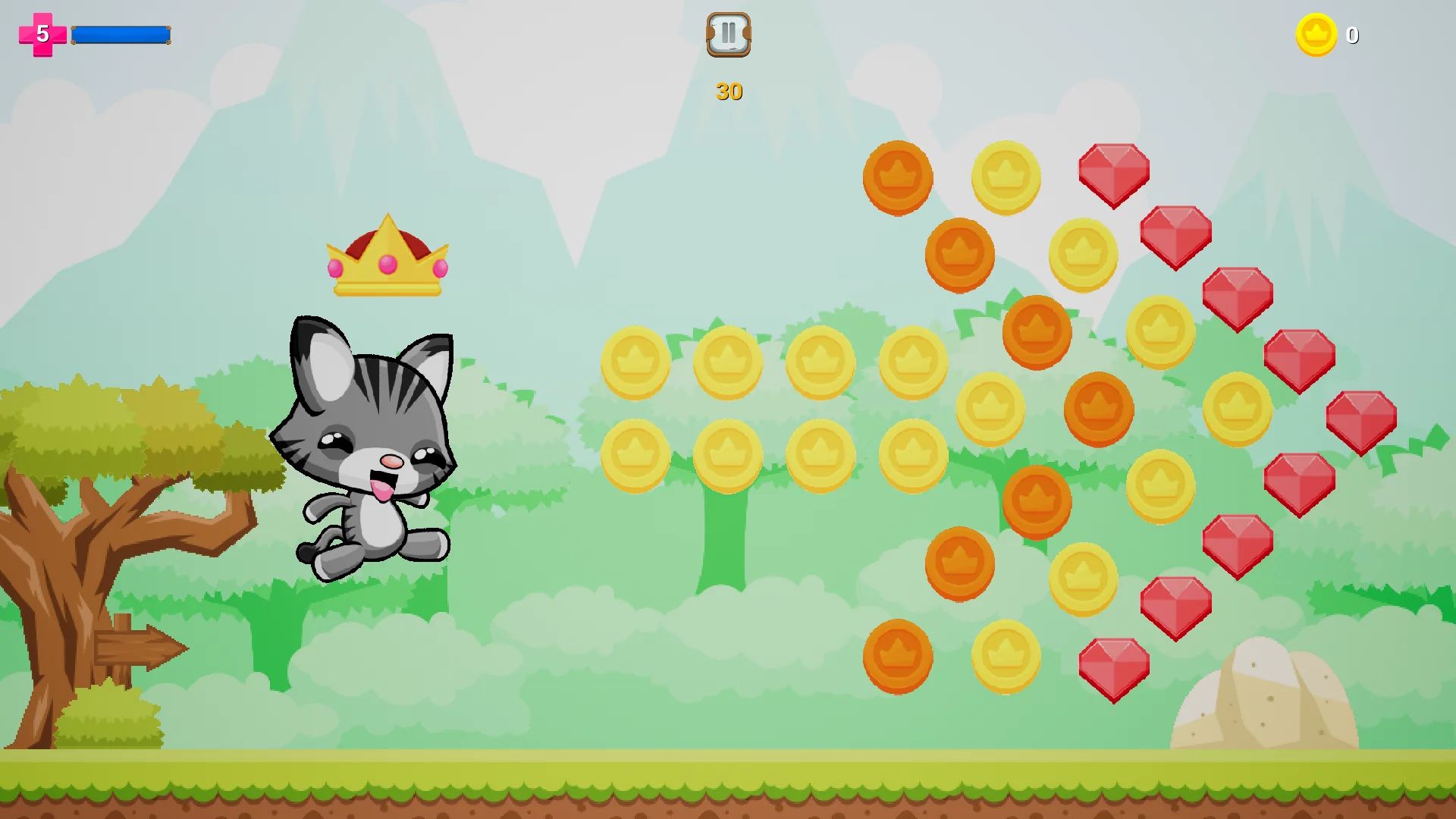
The runner keeps moving, and the decisions come in short bursts: hop a low block, tap again to carry the character over something taller, drop back down onto solid ground, then swing wide for a coin sitting above the gap. The 2D Endless Runner Platform Kit is shaped by exactly that rhythm — a side-on character that must avoid obstacles and gather coins and power-ups as the level streams past.
It is a kit rather than a finished game, which means the pieces of that loop are already wired together and meant to be reworked: the character movement, the obstacle and pickup spawning, the systems that support a run, and the blueprint logic that holds it all together. Everything sits in a 2D plane, so the character reads clearly against the background and every jump is a matter of timing rather than spatial navigation.
Jumping and Double Jumping in the Runner's Spawn Field
The core verb is the jump, and the kit gives it two stages. A character can jump onto an object or over it, and can double jump — a second upward push while already airborne. That distinction matters more than it sounds, because it changes how obstacles can be authored. A single-jump obstacle is a hop. A double-jump obstacle forces the player to spend both jumps, and any coin placed above it can only be reached by committing to the full arc.
Because the character can both Land on And Clear Objects, obstacle placement is not limited to things that kill on contact. Some objects function as geometry to be stood on, others as hazards to be avoided, and the same spawned item can play either role depending on how it is placed. In a scene, this is what separates a flat corridor of blocks from something with a little vertical texture: a stack to climb, a gap to leap, a coin sitting just out of reach of one jump.
Patterns, Coins and Power-Ups as They Come
Coins and obstacles do not arrive as an unbroken stream of random objects. They are spawned either grouped in a pattern or individually. A grouped pattern is a deliberate arrangement — a run of coins in an arc, a cluster of obstacles at a fixed spacing — while an individual spawn is a single object dropped into the field on its own. Having both options available is what allows a course to breathe: dense patterned sections where the player is reading a sequence, and looser individual placements where the pace relaxes before the next cluster.
Coins are the collectible layer that gives a run its score. Power-ups are a separate pickup, gathered the same way — by steering the character into them — but distinct from the coin stream. Both sit in the same world as the obstacles, which means a single well-placed pattern can ask the player to choose: take the safe line, or chase the pickup through the riskier one.
Blueprint Communication Inside the Kit
The systems are expressed in blueprints, and the blueprints are commented. That is a small sentence with a large practical consequence. A commented blueprint tells you what a node cluster is for without requiring you to reverse-engineer it from the wiring, which is the difference between opening a graph and understanding it in a minute versus an afternoon.
Just as important is how the pieces talk to each other. The blueprints communicate in a centralized manner rather than through a web of direct, scattered references. When one system needs to trigger another — a pickup informing the run, a collision informing the health system — the path goes through a shared point of contact. For anyone extending the kit, that shape is easier to trace: you follow one hub instead of hunting across dozens of actors for whoever happens to be listening.
Android and iOS Are Covered
The kit ships with full mobile support for Android and iOS. For an endless runner, that is less a checkbox than a design constraint that has already been accounted for. Runs are short, input is a tap or two, and the play session is measured in minutes — the genre was practically built for phones, and a 2D side-on course with jump and double jump maps cleanly onto a touchscreen.
Targeting both platforms means the kit can serve as the base for a phone release without first being reworked from a desktop assumption. The 2D presentation helps here as well: flat sprites and layered depth read at small sizes, where a busy three-dimensional scene would lose legibility on a handheld display.
Health and the Save System
A run needs a way to end and a way to persist. Health covers the first part — the state that tracks how much damage the character can absorb before the run stops. Saving covers the second, carrying progress across sessions rather than resetting the player to nothing every time the game closes. For a mobile runner these two systems are close companions: a health value that matters over repeated short attempts, and saved state that makes those attempts add up to something.
Parallax Layers, Sound and Effects
Parallax is what turns a flat forward scroll into depth. Background layers move at different rates relative to the player, so the world appears to sit behind the playfield rather than beside it. Sound and effects fill in the feedback layer — the audible and visual response to a jump, a pickup, a hit — which is how a player knows an action registered without looking away from the obstacle ahead. These are the parts of a runner that are easy to leave until the end and hard to retrofit convincingly, so having them already represented in the kit saves that reconstruction.
Matching the Kit to a Project
The clearest fit is a small team or solo developer building a mobile 2D runner and wanting the loop already standing: a character that jumps and double jumps, obstacles and coins that spawn in patterns or on their own, power-ups to collect, and the supporting systems for health, saving, parallax, sound and effects. It also suits prototyping — the centralized blueprint structure and the comments make it practical to gut a system and replace it with something specific to a project, without the rest of the kit collapsing.
What the kit does not do is decide the content. Patterns still have to be authored, the balance between a fair obstacle and a cheap one still has to be tuned, and the feel of the double jump still has to be adjusted until it lands right. The strongest concrete takeaway is this: the plumbing of an endless runner — spawning, pickups, health, saving, parallax, platform coverage — is already assembled and documented, so the work left is the part that makes a runner worth playing.
 Platformer
 Environments
 Platformer