"d33c94b0a941547b"{"id":"1002749","slug":"wet-flatwoods-habitat-brush","title":"Wet Flatwoods Habitat Brush","category":"Forest \u0026 Jungle","engine":"5.0+","assetVersion":"","engineVersion":"Engine Version: 5.0+","tag":"Forest \u0026 Jungle","accent":"blue","visual":"mech","summary":"Examine the technical layout, plant rosters, and foliage painting workflows of the Wet Flatwoods Habitat Brush for real-time Central Florida biomes.","platform":"Unreal Engine","indexPolicy":"index","publishedAt":"2026-11-19T07:00:46.783Z","updatedAt":"2026-11-19T07:00:46.783Z","sourceNotes":[],"fileContents":[],"compatibility":["Unreal Engine","Engine Version: 5.0+"],"featuredImage":{"alt":"Wet Flatwoods Habitat Brush","src":"/wp-content/uploads/published/2026/11/0a738504eaca-9c23a913-6cc0-4239-9953-3a16ef0acbab-cafe8bd1be.webp"},"fileSizeBytes":214714185,"hasDownloadLink":true,"downloads":0,"terms":[{"taxonomy":"category","slug":"forest-and-jungle","name":"Forest \u0026 Jungle"}],"galleryImages":[{"src":"/wp-content/uploads/published/2026/11/cc0476aac47e-77bf701f-c3df-4a31-bb85-261f47fa864e-76a79114e8.webp","alt":"Wet Flatwoods Habitat Brush"},{"src":"/wp-content/uploads/published/2026/11/7035fac30776-d1b52b64-dc80-4993-b5e9-22955fae8d38-7b93a780ba.webp","alt":"Wet Flatwoods Habitat Brush"}],"accessPanel":{"kind":"resource","title":"Get this resource","safetyNote":"Resources are manually reviewed before listing to improve quality and reduce obvious risks.","fileName":"Content.7z","resourceType":"Resource archive","versions":[]},"contentHtml":"\u003ch2\u003eAssembling Authentic Ecosystems with the Wet Flatwoods Set\u003c/h2\u003e\u003cp\u003eConstructing realistic natural biomes for real-time environments often stalls on botanical accuracy and performance optimization. Balancing the visual fidelity of subtropical undergrowth with the poly-budget constraints of interactive applications requires assets that capture natural leaf patterns and regional plant pairings without dragging frame rates down.\u003c/p\u003e\u003cp\u003eWet Flatwoods Habitat Brush tackles this challenge by supplying 115 unique low-polygon meshes across 29 photorealistic plant species specific to Central Florida landscapes. Based directly on photographs taken in the wild, every plant in the collection is optimized for AR and VR workflows. Rather than forcing artists to cross-reference ecological distribution charts manually, the package includes an example natural community and ecosystem built directly from real-world plant inventory records and geographic information system (GIS) distribution data. This provides a direct framework for reconstructing native wetland flatwoods, pine savannas, and damp palmetto scrublands with authentic plant associations.\u003c/p\u003e\u003ch2\u003ePainting Foliage Using the Large-Scale Brush Workflow\u003c/h2\u003e\u003cp\u003eBroad, sprawling terrains can consume enormous development time when foliage instances must be scattered across miles of terrain by hand.\u003c/p\u003e\u003cp\u003eTo accelerate open-world territory layout, the package provides a dedicated landscape tailored for wide-area application along with preset foliage densities. The recommended workflow utilizes an extensive brush size around 4000, allowing artists to sweep entire vegetative strata across rolling soil profiles in unified passes. Instead of placing individual clumps of wiregrass or singular palmetto fronds, the preset distribution matrices blend tall pines, low-lying herbs, and mid-story shrubs at biologically accurate frequency ratios. This setup prevents clustering errors where canopy trees and sensitive groundcover unnaturally crowd one another, maintaining a clear spatial rhythm between open clearings, dense thickets, and saturated basins.\u003c/p\u003e\u003ch2\u003eMaterial Shading, Leaf Rustle, and Subsurface Scattering\u003c/h2\u003e\u003cp\u003eConvincing foliage depends heavily on responsive surface light interactions and natural environmental motion.\u003c/p\u003e\u003cp\u003eEvery mesh in the collection includes multiple levels of detail (LODs) and custom lighting maps that respond directly to the environment. Subsurface scattering maps govern how sunlight bleeds through delicate foliage membranes, providing realistic light transparency and back-face reflection across broad palm fronds, grass blades, and flower petals. For environmental reactivity, the assets incorporate an editable wind material network that simulates gentle breezes and leaf rustle. Artists can adjust the amplitude and wave parameters within the wind shader to scale foliage response from tranquil subtropical humidity to active, storm-blown pine flatwoods.\u003c/p\u003e\u003ch2\u003eLayering Ground Materials and Understory Noise in the Habitat\u003c/h2\u003e\u003cp\u003eEcosystem realism breaks down quickly if pristine plant stems sprout directly from an untextured or repetitive ground canvas.\u003c/p\u003e\u003cp\u003eThe collection includes six specialized ground materials made for terrain painting workflows, enabling realistic blending between muddy soil, sandy patches, and pine needle litter. To interrupt the uniformity of standard terrain splat maps, the package provides discrete weed meshes meant to serve as low-profile surface noise. Integrating these subtle weeds directly along the borders between painted mud paths and dense scrub cushions hard transitions. Artists can paint damp ground materials into low depressions, apply fallen needle layers beneath canopies, and scatter rough surface weeds across the boundary lines where soil meets standing foliage.\u003c/p\u003e\u003ch2\u003eCanopy, Shrub, and Wildflower Varieties Across the Flatwoods\u003c/h2\u003e\u003cp\u003eA regional flatwoods ecosystem relies on distinct vegetative stratification ranging from tall emergent pines down to tiny insectivorous herbs and lichens.\u003c/p\u003e\u003cp\u003eThe 29 plant species cover the entire vertical cross-section of a Central Florida native community:\u003c/p\u003e\u003cul\u003e\u003cli\u003e\u003cstrong\u003eCanopy and Upper Story:\u003c/strong\u003e Longleaf Pine, Pond Cypress, Sand Live Oak, and Sabal Palm establish the tall vertical profile, while dangling Spanish Moss can be integrated into tree branches to reflect regional humidity.\u003c/li\u003e\u003cli\u003e\u003cstrong\u003eShrub and Mid-Story Layers:\u003c/strong\u003e Saw Palmetto, Wax Myrtle, Dahoon Holly, Fetterbush, and Prickly Pear form the dense, thorny scrub layer characteristic of undisturbed flatwoods borders.\u003c/li\u003e\u003cli\u003e\u003cstrong\u003eGrasses and Groundcover:\u003c/strong\u003e Chalky Bluestem, Lopsided Indiangrass, and Wiregrass create the foundational understory layer, accompanied by patches of terrestrial Reindeer Moss and moisture-seeking Hooded Pitcher Plants.\u003c/li\u003e\u003cli\u003e\u003cstrong\u003eWildflowers and Forbs:\u003c/strong\u003e Flowering accents include Blazing Star, Bracken Fern, Coastalplain Honeycomb, Feay's Palafox, Flattop Goldenrod, Florida Paintbrush, Florida Tickseed, Forked Bluecurl, Goldenrod, Rayless Sunflower, Scarlet Calamint, Shortleaf Rosegentian, St. John's Wort, and Tall Jointweed.\u003c/li\u003e\u003c/ul\u003e\u003cp\u003eBecause each botanical variety provides multiple model variations, scenes avoid the repeating silhouettes that often betray synthetic foliage distributions. Distinct growth stages and directional variants allow designers to construct varied groves of Saw Palmetto or wild stands of Longleaf Pine without visibly recycling individual meshes.\u003c/p\u003e\u003ch2\u003eDeploying Central Florida Biomes in Real-Time Productions\u003c/h2\u003e\u003cp\u003eIntegrating these regional assets into production requires balancing visual density against memory allocation in simulation engines and immersive virtual setups.\u003c/p\u003e\u003cp\u003eBecause the meshes are structured through low-polygon topologies and equipped with functional LOD steps, the entire library accommodates demanding rendering budgets such as virtual reality walk-throughs, flight training simulations, and open-world game levels. The GIS-informed ecosystem data serves as a functional blueprint for level designers, establishing clear guidelines on where water-loving species like Pond Cypress and Hooded Pitcher Plants thrive relative to the drier, sandy rises populated by Sand Live Oak, Wiregrass, and Prickly Pear. Production teams can deploy the assets directly into interactive nature reserves, historical recreations, or expansive wilderness stages where real-time performance and regional ecological accuracy must align seamlessly.\u003c/p\u003e\n\n\u003ch2\u003eContinue Browsing Similar Packs\u003c/h2\u003e\n\u003cul\u003e\n\u003cli\u003e\u003ca href=\"https://3dcghub.com/subtropical-waterbody-habitat-brush/\" rel=\"noopener noreferrer\"\u003eSubtropical Waterbody Habitat Brush\u003c/a\u003e\u003c/li\u003e\n\u003cli\u003e\u003ca href=\"https://3dcghub.com/scrubby-flatwoods-habitat-brush/\" rel=\"noopener noreferrer\"\u003eScrubby Flatwoods Habitat Brush\u003c/a\u003e\u003c/li\u003e\n\u003cli\u003e\u003ca href=\"https://3dcghub.com/mesic-flatwoods-habitat-brush/\" rel=\"noopener noreferrer\"\u003eMesic Flatwoods Habitat Brush\u003c/a\u003e\u003c/li\u003e\n\u003cli\u003e\u003ca href=\"https://3dcghub.com/basin-swamp-habitat-brush/\" rel=\"noopener noreferrer\"\u003eBasin Swamp Habitat Brush\u003c/a\u003e\u003c/li\u003e\n\u003cli\u003e\u003ca href=\"https://3dcghub.com/watermills-nature-environment-watermills-nature-environment-nature-ruin/\" rel=\"noopener noreferrer\"\u003eWatermills / Nature Environment ( Watermills Nature Environment Nature Ruin )\u003c/a\u003e\u003c/li\u003e\n\u003c/ul\u003e","contentTextLength":6539,"navigation":{"current":8,"total":4676,"previous":{"id":"1002750","slug":"white-castle","title":"White castle","category":"Medieval","platform":"Unreal Engine","updatedAt":"2026-11-19T07:01:42.231Z"},"next":{"id":"1002748","slug":"watermills-nature-environment-watermills-nature-environment-nature-ruin","title":"Watermills / Nature Environment ( Watermills Nature Environment Nature Ruin )","category":"Forest \u0026 Jungle","platform":"Unreal Engine","updatedAt":"2026-11-19T07:00:18.097Z"}},"relatedResources":[{"id":"1002754","slug":"xeric-hammock-habitat-brush","title":"Xeric Hammock Habitat Brush","category":"Forest \u0026 Jungle","engine":"5.0+","assetVersion":"","engineVersion":"Engine Version: 5.0+","tag":"Forest \u0026 Jungle","accent":"blue","visual":"mech","summary":"Populate realistic Central Florida biomes with 78 low-poly foliage meshes, SSS materials, wind leaf rustle, and GIS-informed ecosystem distributions.","platform":"Unreal Engine","indexPolicy":"index","publishedAt":"2026-11-19T07:40:53.059Z","updatedAt":"2026-11-19T07:40:53.059Z","sourceNotes":[],"fileContents":[],"compatibility":["Unreal Engine","Engine Version: 5.0+"],"featuredImage":{"alt":"Xeric Hammock Habitat Brush","src":"/wp-content/uploads/published/2026/11/8cfd2dc2c3d2-7c806d38-d3d7-42fb-8cd1-a174fce52883-40ff564e84.webp"},"fileSizeBytes":182045831,"hasDownloadLink":true,"downloads":0},{"id":"1002735","slug":"subtropical-waterbody-habitat-brush","title":"Subtropical Waterbody Habitat Brush","category":"Forest \u0026 Jungle","engine":"5.0+","assetVersion":"","engineVersion":"Engine Version: 5.0+","tag":"Forest \u0026 Jungle","accent":"blue","visual":"mech","summary":"Build authentic Central Florida biomes with the Subtropical Waterbody Habitat Brush, featuring 126 meshes, 34 low-poly species, and Unreal Water setup.","platform":"Unreal Engine","indexPolicy":"index","publishedAt":"2026-11-17T19:11:11.403Z","updatedAt":"2026-11-17T19:11:11.403Z","sourceNotes":[],"fileContents":[],"compatibility":["Unreal Engine","Engine Version: 5.0+"],"featuredImage":{"alt":"Subtropical Waterbody Habitat Brush","src":"/wp-content/uploads/published/2026/11/f3fe860005f2-41a62504-6541-4515-9efd-ab0bdd338c1d-b433c99355.webp"},"fileSizeBytes":234140247,"hasDownloadLink":true,"downloads":0},{"id":"1002688","slug":"scrubby-flatwoods-habitat-brush","title":"Scrubby Flatwoods Habitat Brush","category":"Forest \u0026 Jungle","engine":"5.0+","assetVersion":"","engineVersion":"Engine Version: 5.0+","tag":"Forest \u0026 Jungle","accent":"blue","visual":"mech","summary":"Examine the Scrubby Flatwoods Habitat Brush, featuring Central Florida plant species like Longleaf Pine, Saw Palmetto, and Wiregrass for virtual environments.","platform":"Unreal Engine","indexPolicy":"index","publishedAt":"2026-11-16T22:45:18.155Z","updatedAt":"2026-11-16T22:45:18.155Z","sourceNotes":[],"fileContents":[],"compatibility":["Unreal Engine","Engine Version: 5.0+"],"featuredImage":{"alt":"Scrubby Flatwoods Habitat Brush","src":"/wp-content/uploads/published/2026/11/685ed7892533-26771ffd-4d04-4070-ba79-cea84eac19f3-2307013c68.webp"},"fileSizeBytes":214594549,"hasDownloadLink":true,"downloads":0}]}
Resource screenshots
1 / 2
Join our channel
Follow 3DCGHUB on Telegram for new resource drops, migration updates, and community notices.
Assembling Authentic Ecosystems with the Wet Flatwoods Set
Constructing realistic natural biomes for real-time environments often stalls on botanical accuracy and performance optimization. Balancing the visual fidelity of subtropical undergrowth with the poly-budget constraints of interactive applications requires assets that capture natural leaf patterns and regional plant pairings without dragging frame rates down.
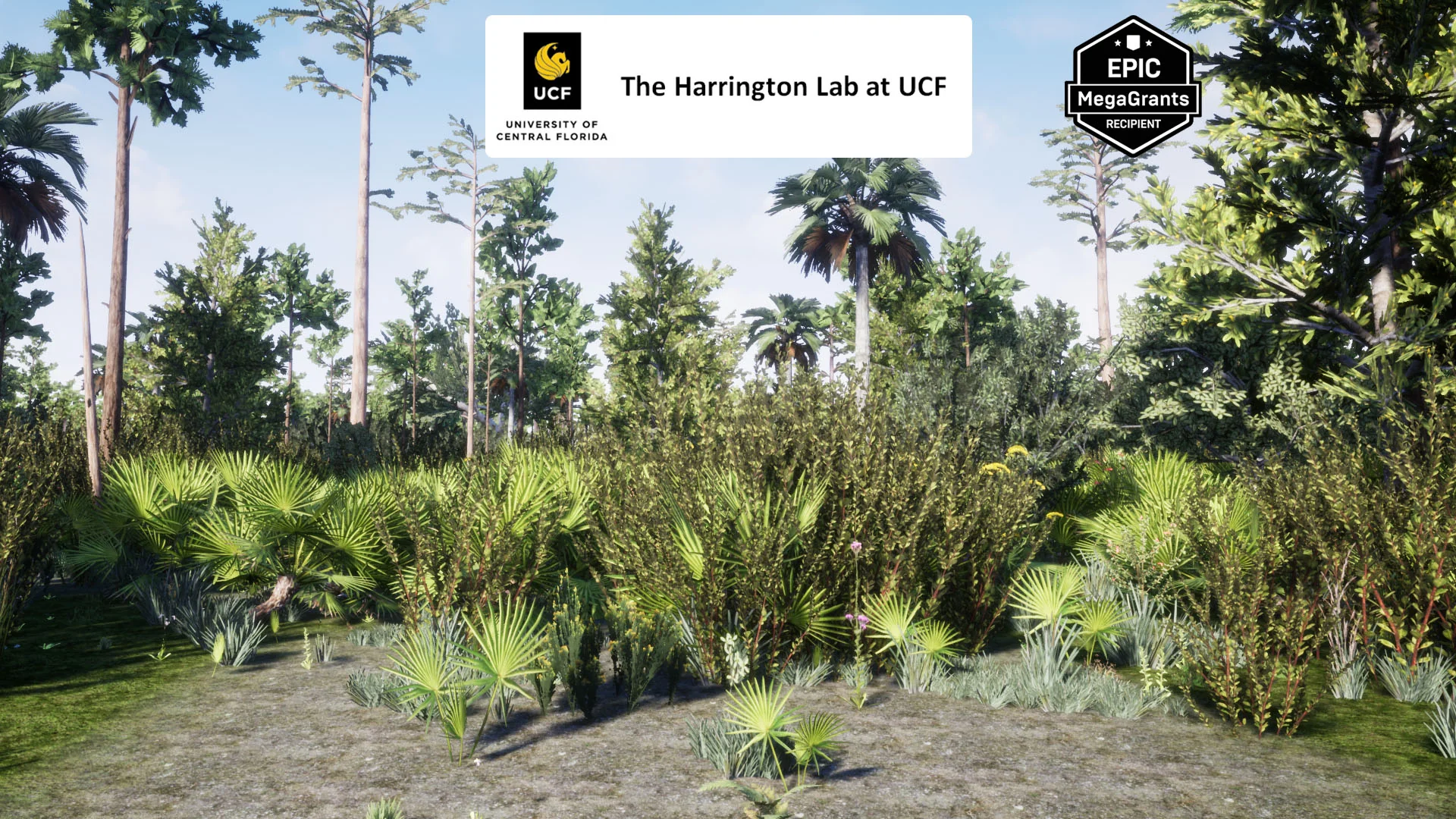
Wet Flatwoods Habitat Brush tackles this challenge by supplying 115 unique low-polygon meshes across 29 photorealistic plant species specific to Central Florida landscapes. Based directly on photographs taken in the wild, every plant in the collection is optimized for AR and VR workflows. Rather than forcing artists to cross-reference ecological distribution charts manually, the package includes an example natural community and ecosystem built directly from real-world plant inventory records and geographic information system (GIS) distribution data. This provides a direct framework for reconstructing native wetland flatwoods, pine savannas, and damp palmetto scrublands with authentic plant associations.
Painting Foliage Using the Large-Scale Brush Workflow
Broad, sprawling terrains can consume enormous development time when foliage instances must be scattered across miles of terrain by hand.
To accelerate open-world territory layout, the package provides a dedicated landscape tailored for wide-area application along with preset foliage densities. The recommended workflow utilizes an extensive brush size around 4000, allowing artists to sweep entire vegetative strata across rolling soil profiles in unified passes. Instead of placing individual clumps of wiregrass or singular palmetto fronds, the preset distribution matrices blend tall pines, low-lying herbs, and mid-story shrubs at biologically accurate frequency ratios. This setup prevents clustering errors where canopy trees and sensitive groundcover unnaturally crowd one another, maintaining a clear spatial rhythm between open clearings, dense thickets, and saturated basins.
Material Shading, Leaf Rustle, and Subsurface Scattering
Convincing foliage depends heavily on responsive surface light interactions and natural environmental motion.
Every mesh in the collection includes multiple levels of detail (LODs) and custom lighting maps that respond directly to the environment. Subsurface scattering maps govern how sunlight bleeds through delicate foliage membranes, providing realistic light transparency and back-face reflection across broad palm fronds, grass blades, and flower petals. For environmental reactivity, the assets incorporate an editable wind material network that simulates gentle breezes and leaf rustle. Artists can adjust the amplitude and wave parameters within the wind shader to scale foliage response from tranquil subtropical humidity to active, storm-blown pine flatwoods.
Layering Ground Materials and Understory Noise in the Habitat
Ecosystem realism breaks down quickly if pristine plant stems sprout directly from an untextured or repetitive ground canvas.
The collection includes six specialized ground materials made for terrain painting workflows, enabling realistic blending between muddy soil, sandy patches, and pine needle litter. To interrupt the uniformity of standard terrain splat maps, the package provides discrete weed meshes meant to serve as low-profile surface noise. Integrating these subtle weeds directly along the borders between painted mud paths and dense scrub cushions hard transitions. Artists can paint damp ground materials into low depressions, apply fallen needle layers beneath canopies, and scatter rough surface weeds across the boundary lines where soil meets standing foliage.
Canopy, Shrub, and Wildflower Varieties Across the Flatwoods
A regional flatwoods ecosystem relies on distinct vegetative stratification ranging from tall emergent pines down to tiny insectivorous herbs and lichens.
The 29 plant species cover the entire vertical cross-section of a Central Florida native community:
Canopy and Upper Story: Longleaf Pine, Pond Cypress, Sand Live Oak, and Sabal Palm establish the tall vertical profile, while dangling Spanish Moss can be integrated into tree branches to reflect regional humidity.
Shrub and Mid-Story Layers: Saw Palmetto, Wax Myrtle, Dahoon Holly, Fetterbush, and Prickly Pear form the dense, thorny scrub layer characteristic of undisturbed flatwoods borders.
Grasses and Groundcover: Chalky Bluestem, Lopsided Indiangrass, and Wiregrass create the foundational understory layer, accompanied by patches of terrestrial Reindeer Moss and moisture-seeking Hooded Pitcher Plants.
Wildflowers and Forbs: Flowering accents include Blazing Star, Bracken Fern, Coastalplain Honeycomb, Feay's Palafox, Flattop Goldenrod, Florida Paintbrush, Florida Tickseed, Forked Bluecurl, Goldenrod, Rayless Sunflower, Scarlet Calamint, Shortleaf Rosegentian, St. John's Wort, and Tall Jointweed.
Because each botanical variety provides multiple model variations, scenes avoid the repeating silhouettes that often betray synthetic foliage distributions. Distinct growth stages and directional variants allow designers to construct varied groves of Saw Palmetto or wild stands of Longleaf Pine without visibly recycling individual meshes.
Deploying Central Florida Biomes in Real-Time Productions
Integrating these regional assets into production requires balancing visual density against memory allocation in simulation engines and immersive virtual setups.
Because the meshes are structured through low-polygon topologies and equipped with functional LOD steps, the entire library accommodates demanding rendering budgets such as virtual reality walk-throughs, flight training simulations, and open-world game levels. The GIS-informed ecosystem data serves as a functional blueprint for level designers, establishing clear guidelines on where water-loving species like Pond Cypress and Hooded Pitcher Plants thrive relative to the drier, sandy rises populated by Sand Live Oak, Wiregrass, and Prickly Pear. Production teams can deploy the assets directly into interactive nature reserves, historical recreations, or expansive wilderness stages where real-time performance and regional ecological accuracy must align seamlessly.
 Forest & Jungle
 Forest & Jungle
 Forest & Jungle