"f0d304d7232d0332"{"id":"1002735","slug":"subtropical-waterbody-habitat-brush","title":"Subtropical Waterbody Habitat Brush","category":"Forest \u0026 Jungle","engine":"5.0+","assetVersion":"","engineVersion":"Engine Version: 5.0+","tag":"Forest \u0026 Jungle","accent":"blue","visual":"mech","summary":"Build authentic Central Florida biomes with the Subtropical Waterbody Habitat Brush, featuring 126 meshes, 34 low-poly species, and Unreal Water setup.","platform":"Unreal Engine","indexPolicy":"index","publishedAt":"2026-11-17T19:11:11.403Z","updatedAt":"2026-11-17T19:11:11.403Z","sourceNotes":[],"fileContents":[],"compatibility":["Unreal Engine","Engine Version: 5.0+"],"featuredImage":{"alt":"Subtropical Waterbody Habitat Brush","src":"/wp-content/uploads/published/2026/11/f3fe860005f2-41a62504-6541-4515-9efd-ab0bdd338c1d-b433c99355.webp"},"fileSizeBytes":234140247,"hasDownloadLink":true,"downloads":0,"terms":[{"taxonomy":"category","slug":"forest-and-jungle","name":"Forest \u0026 Jungle"}],"galleryImages":[{"src":"/wp-content/uploads/published/2026/11/f0bae4dbaa13-088a02b1-ab3a-4e63-8f39-73bbc71bfb76-d8c199ec01.webp","alt":"Subtropical Waterbody Habitat Brush"},{"src":"/wp-content/uploads/published/2026/11/f745223e7226-d45f16af-48d7-433b-9f5e-346f61f7edb0-60f38c750b.webp","alt":"Subtropical Waterbody Habitat Brush"}],"accessPanel":{"kind":"resource","title":"Get this resource","safetyNote":"Resources are manually reviewed before listing to improve quality and reduce obvious risks.","fileName":"Content.7z","resourceType":"Resource archive","versions":[]},"contentHtml":"\u003cp\u003eDense wetlands, open flatwoods, and coastal transition zones present distinct layout challenges when assembling real-time natural environments. Subtropical Waterbody Habitat Brush provides a specialized botanical collection focused strictly on the native flora of Central Florida. Built using photographic references captured in the wild, the asset library delivers 34 AR and VR photorealistic, low-polygon plant species distributed across 126 unique meshes. Environment artists and level designers can establish authentic southeastern ecosystems without relying on mismatched plant varieties, using assets grounded in regional distribution patterns.\u003c/p\u003e \u003ch2\u003eConstructing Central Florida Ecosystems with Subtropical Foliage\u003c/h2\u003e\n\u003cp\u003eCreating believable natural biomes requires an understanding of how individual plant varieties group together across different moisture levels, soil types, and canopy elevations. To assist this assembly, the package includes two example natural communities and ecosystems modeled directly from plant inventory and plant distribution GIS data for Central Florida. These pre-configured environments show how regional trees, palmettos, shrubs, and flowering forbs coexist in native habitats, establishing reference standards for ecological placement.\u003c/p\u003e\n\u003cp\u003eThe botanical roster spans 34 low-polygon plant species translated into 126 unique meshes. The inclusion of multiple individual variations for species prevents visual repetition when painting thick understories, dense thickets, or broad woodland canopies. Forest structures can be anchored using characteristic canopy trees such as the Longleaf Pine, Pond Cypress, and Sand Live Oak. These trees establish realistic height variation across wetlands and upland margins, while mid-story vegetation is supported by species like the Sabal Palm, Dahoon Holly, and Wax Myrtle.\u003c/p\u003e\n\u003cp\u003eThe understory contains an extensive selection of structural shrubs and ground covers native to southeastern flatwoods and scrub habitats. Species such as the Saw Palmetto, Coontie, Fetterbush, Scrub Rosemary, and American Beautyberry provide natural bulk across ground planes. For open clearings, pine savannas, and path margins, the library includes Wiregrass, Chalky Bluestem, Lopsided Indiangrass, Bracken Fern, and Reindeer Moss. These ground covers allow artists to build realistic transitions between dense thickets and exposed soil.\u003c/p\u003e\n\u003cp\u003eBiodiversity is further expanded with a large assortment of regional wildflowers and herbaceous perennials. The species list features Blazing Star, Coastalplain Honeycomb, Feay's Palafox, Flattop Goldenrod, Goldenrod, Florida Paintbrush, Florida Tickseed, Forked Bluecurl, Rayless Sunflower, Scarlet Calamint, Shortleaf Rosegentian, St. John's Wort, Tall Jointweed, and Titusville Balm. Alongside these blooms, unique regional specimens such as the carnivorous Hooded Pitcher Plant, moisture-draped Spanish Moss, and arid-tolerant Prickly Pear enable accurate biome variations spanning damp bogs to sandy scrub ridges.\u003c/p\u003e \u003ch2\u003eTerrain Coverage and Foliage Brush Workflows\u003c/h2\u003e\n\u003cp\u003ePopulating large-scale outdoor maps by hand-placing dozens of individual plant types can be time-consuming. To streamline level composition, the package provides one pre-built landscape designed specifically for large-scale foliage painting. The recommended brush size of 4000 enables level artists to sweep natural groupings across broad spans of terrain with fluid control, allowing for rapid coverage of sprawling outdoor levels.\u003c/p\u003e\n\u003cp\u003eTo maintain balanced botanical spacing across wide areas, the setup includes preset foliage densities tailored for quickly painting foliage on large landscapes. These density presets ensure that trees, mid-story shrubs, and fine ground cover scatter in proportional relationships, preventing over-clustering while preserving the dense, tangled appearance characteristic of Central Florida wilderness areas.\u003c/p\u003e\n\u003cp\u003eTerrain surface rendering is supported by six dedicated ground materials suited to landscape painting. These materials allow artists to paint soil, mud, and sand transitions directly onto the terrain mesh. To eliminate the artificial smoothness common in painted terrain layers, the kit supplies dedicated ground weeds. Scattering these weeds over painted ground layers introduces surface noise and tactile breakups that blend bare earth naturally into the surrounding vegetation.\u003c/p\u003e \u003ch2\u003eIntegrating Aquatic Flora Across Waterbody Surfaces\u003c/h2\u003e\n\u003cp\u003eWetland environments depend heavily on how plant life interacts with standing and flowing water. Subtropical Waterbody Habitat Brush requires the Unreal Water Plug-in to deliver its intended wetland setup. This integration is particularly important when placing aquatic flora such as the Waterlily.\u003c/p\u003e\n\u003cp\u003eRather than relying on automated procedural scattering that might submerge stems or hover above dynamic ripples, the workflow calls for manually placing each Waterlily mesh directly onto the water surface. This hands-on placement provides precise artistic control along marsh boundaries, pond shores, lake edges, and slow-moving streams. Artists can cluster lily pads in sheltered inlets, scatter individual floating leaves along cypress shorelines, or build expansive mats that interact cleanly with the water plane.\u003c/p\u003e \u003ch2\u003eMaterial Shading, Leaf Rustle, and Habitat Performance\u003c/h2\u003e\n\u003cp\u003eOutdoor lighting conditions in subtropical settings place heavy demands on foliage materials, as high sun angles and direct light expose artificial shading immediately. The assets in this collection incorporate subsurface scattering maps specifically configured for light transparency and reflection on leaf surfaces. Light filtering through palm fronds, cypress needles, and broadleaf shrubs displays natural translucency, preserving depth across both direct sunlight and shadowed understories.\u003c/p\u003e\n\u003cp\u003eDynamic movement is handled by an editable wind material featuring leaf rustle effects. World builders can adjust wind parameters to suit calm inland swamps or breezy coastal conditions, giving vegetation responsive movement across branches and leaves. Additionally, dedicated light effects ensure natural visual integration under real-time sky systems.\u003c/p\u003e\n\u003cp\u003ePerformance optimization remains central to the 126 meshes. Developed as AR and VR photorealistic, low-polygon assets, the foliage features individual level-of-detail (LOD) chains that step down polygon density smoothly over distance. This construction keeps the entire Central Florida plant library efficient enough for demanding immersive hardware while preserving photographic fidelity for desktop environments, virtual reality spaces, and real-time visualization scenes.\u003c/p\u003e\n\n\u003ch2\u003eContinue Browsing Similar Packs\u003c/h2\u003e\n\u003cul\u003e\n\u003cli\u003e\u003ca href=\"https://3dcghub.com/scrubby-flatwoods-habitat-brush/\" rel=\"noopener noreferrer\"\u003eScrubby Flatwoods Habitat Brush\u003c/a\u003e\u003c/li\u003e\n\u003cli\u003e\u003ca href=\"https://3dcghub.com/mesic-flatwoods-habitat-brush/\" rel=\"noopener noreferrer\"\u003eMesic Flatwoods Habitat Brush\u003c/a\u003e\u003c/li\u003e\n\u003cli\u003e\u003ca href=\"https://3dcghub.com/basin-swamp-habitat-brush/\" rel=\"noopener noreferrer\"\u003eBasin Swamp Habitat Brush\u003c/a\u003e\u003c/li\u003e\n\u003cli\u003e\u003ca href=\"https://3dcghub.com/lush-stylized-environment-set/\" rel=\"noopener noreferrer\"\u003eLUSH: Stylized Environment Set\u003c/a\u003e\u003c/li\u003e\n\u003cli\u003e\u003ca href=\"https://3dcghub.com/lookout-tower/\" rel=\"noopener noreferrer\"\u003eLookout Tower\u003c/a\u003e\u003c/li\u003e\n\u003c/ul\u003e","contentTextLength":6774,"navigation":{"current":5,"total":4660,"previous":{"id":"1002736","slug":"sunset-modular-medieval-brick-buildings","title":"Sunset - Modular Medieval Brick Buildings","category":"Forest \u0026 Jungle","platform":"Unreal Engine","updatedAt":"2026-11-17T19:12:11.213Z"},"next":{"id":"1002734","slug":"stylized-spruce-forest","title":"Stylized Spruce Forest","category":"Forest \u0026 Jungle","platform":"Unreal Engine","updatedAt":"2026-11-17T19:10:36.432Z"}},"relatedResources":[{"id":"1002688","slug":"scrubby-flatwoods-habitat-brush","title":"Scrubby Flatwoods Habitat Brush","category":"Forest \u0026 Jungle","engine":"5.0+","assetVersion":"","engineVersion":"Engine Version: 5.0+","tag":"Forest \u0026 Jungle","accent":"blue","visual":"mech","summary":"Examine the Scrubby Flatwoods Habitat Brush, featuring Central Florida plant species like Longleaf Pine, Saw Palmetto, and Wiregrass for virtual environments.","platform":"Unreal Engine","indexPolicy":"index","publishedAt":"2026-11-16T22:45:18.155Z","updatedAt":"2026-11-16T22:45:18.155Z","sourceNotes":[],"fileContents":[],"compatibility":["Unreal Engine","Engine Version: 5.0+"],"featuredImage":{"alt":"Scrubby Flatwoods Habitat Brush","src":"/wp-content/uploads/published/2026/11/685ed7892533-26771ffd-4d04-4070-ba79-cea84eac19f3-2307013c68.webp"},"fileSizeBytes":214594549,"hasDownloadLink":true,"downloads":0},{"id":"1002679","slug":"mesic-flatwoods-habitat-brush","title":"Mesic Flatwoods Habitat Brush","category":"Forest \u0026 Jungle","engine":"5.0+","assetVersion":"","engineVersion":"Engine Version: 5.0+","tag":"Forest \u0026 Jungle","accent":"blue","visual":"mech","summary":"Create authentic Central Florida environments with Mesic Flatwoods Habitat Brush, featuring 134 meshes, GIS-based ecosystems, and foliage painting presets.","platform":"Unreal Engine","indexPolicy":"index","publishedAt":"2026-11-16T22:29:57.567Z","updatedAt":"2026-11-16T22:29:57.567Z","sourceNotes":[],"fileContents":[],"compatibility":["Unreal Engine","Engine Version: 5.0+"],"featuredImage":{"alt":"Mesic Flatwoods Habitat Brush","src":"/wp-content/uploads/published/2026/11/03fc5d7d5f3d-3e037f39-c3ce-41f3-940e-e68fe5760859-23ef5ead28.webp"},"fileSizeBytes":248979374,"hasDownloadLink":true,"downloads":0},{"id":"1002652","slug":"basin-swamp-habitat-brush","title":"Basin Swamp Habitat Brush","category":"Forest \u0026 Jungle","engine":"5.0+","assetVersion":"","engineVersion":"Engine Version: 5.0+","tag":"Forest \u0026 Jungle","accent":"blue","visual":"mech","summary":"Explore the Basin Swamp Habitat Brush, featuring 17 photorealistic low-poly plant species, 73 unique meshes, GIS-based ecosystems, and terrain painting tools.","platform":"Unreal Engine","indexPolicy":"index","publishedAt":"2026-11-16T21:51:27.105Z","updatedAt":"2026-11-16T21:51:27.105Z","sourceNotes":[],"fileContents":[],"compatibility":["Unreal Engine","Engine Version: 5.0+"],"featuredImage":{"alt":"Basin Swamp Habitat Brush","src":"/wp-content/uploads/published/2026/11/9654da7ee0c1-3a2a75b8-9cbc-41fe-9dbe-399c0dbbb761-9f225abda9.webp"},"fileSizeBytes":204506307,"hasDownloadLink":true,"downloads":0}]}
Resource screenshots
1 / 2
Join our channel
Follow 3DCGHUB on Telegram for new resource drops, migration updates, and community notices.
Resources are manually reviewed before listing to improve quality and reduce obvious risks.
No account required
Forest & Jungle
Subtropical Waterbody Habitat Brush
Build authentic Central Florida biomes with the Subtropical Waterbody Habitat Brush, featuring 126 meshes, 34 low-poly species, and Unreal Water setup.
Dense wetlands, open flatwoods, and coastal transition zones present distinct layout challenges when assembling real-time natural environments. Subtropical Waterbody Habitat Brush provides a specialized botanical collection focused strictly on the native flora of Central Florida. Built using photographic references captured in the wild, the asset library delivers 34 AR and VR photorealistic, low-polygon plant species distributed across 126 unique meshes. Environment artists and level designers can establish authentic southeastern ecosystems without relying on mismatched plant varieties, using assets grounded in regional distribution patterns.
Constructing Central Florida Ecosystems with Subtropical Foliage
Creating believable natural biomes requires an understanding of how individual plant varieties group together across different moisture levels, soil types, and canopy elevations. To assist this assembly, the package includes two example natural communities and ecosystems modeled directly from plant inventory and plant distribution GIS data for Central Florida. These pre-configured environments show how regional trees, palmettos, shrubs, and flowering forbs coexist in native habitats, establishing reference standards for ecological placement.
The botanical roster spans 34 low-polygon plant species translated into 126 unique meshes. The inclusion of multiple individual variations for species prevents visual repetition when painting thick understories, dense thickets, or broad woodland canopies. Forest structures can be anchored using characteristic canopy trees such as the Longleaf Pine, Pond Cypress, and Sand Live Oak. These trees establish realistic height variation across wetlands and upland margins, while mid-story vegetation is supported by species like the Sabal Palm, Dahoon Holly, and Wax Myrtle.
The understory contains an extensive selection of structural shrubs and ground covers native to southeastern flatwoods and scrub habitats. Species such as the Saw Palmetto, Coontie, Fetterbush, Scrub Rosemary, and American Beautyberry provide natural bulk across ground planes. For open clearings, pine savannas, and path margins, the library includes Wiregrass, Chalky Bluestem, Lopsided Indiangrass, Bracken Fern, and Reindeer Moss. These ground covers allow artists to build realistic transitions between dense thickets and exposed soil.
Biodiversity is further expanded with a large assortment of regional wildflowers and herbaceous perennials. The species list features Blazing Star, Coastalplain Honeycomb, Feay's Palafox, Flattop Goldenrod, Goldenrod, Florida Paintbrush, Florida Tickseed, Forked Bluecurl, Rayless Sunflower, Scarlet Calamint, Shortleaf Rosegentian, St. John's Wort, Tall Jointweed, and Titusville Balm. Alongside these blooms, unique regional specimens such as the carnivorous Hooded Pitcher Plant, moisture-draped Spanish Moss, and arid-tolerant Prickly Pear enable accurate biome variations spanning damp bogs to sandy scrub ridges.
Terrain Coverage and Foliage Brush Workflows
Populating large-scale outdoor maps by hand-placing dozens of individual plant types can be time-consuming. To streamline level composition, the package provides one pre-built landscape designed specifically for large-scale foliage painting. The recommended brush size of 4000 enables level artists to sweep natural groupings across broad spans of terrain with fluid control, allowing for rapid coverage of sprawling outdoor levels.
To maintain balanced botanical spacing across wide areas, the setup includes preset foliage densities tailored for quickly painting foliage on large landscapes. These density presets ensure that trees, mid-story shrubs, and fine ground cover scatter in proportional relationships, preventing over-clustering while preserving the dense, tangled appearance characteristic of Central Florida wilderness areas.
Terrain surface rendering is supported by six dedicated ground materials suited to landscape painting. These materials allow artists to paint soil, mud, and sand transitions directly onto the terrain mesh. To eliminate the artificial smoothness common in painted terrain layers, the kit supplies dedicated ground weeds. Scattering these weeds over painted ground layers introduces surface noise and tactile breakups that blend bare earth naturally into the surrounding vegetation.
Integrating Aquatic Flora Across Waterbody Surfaces
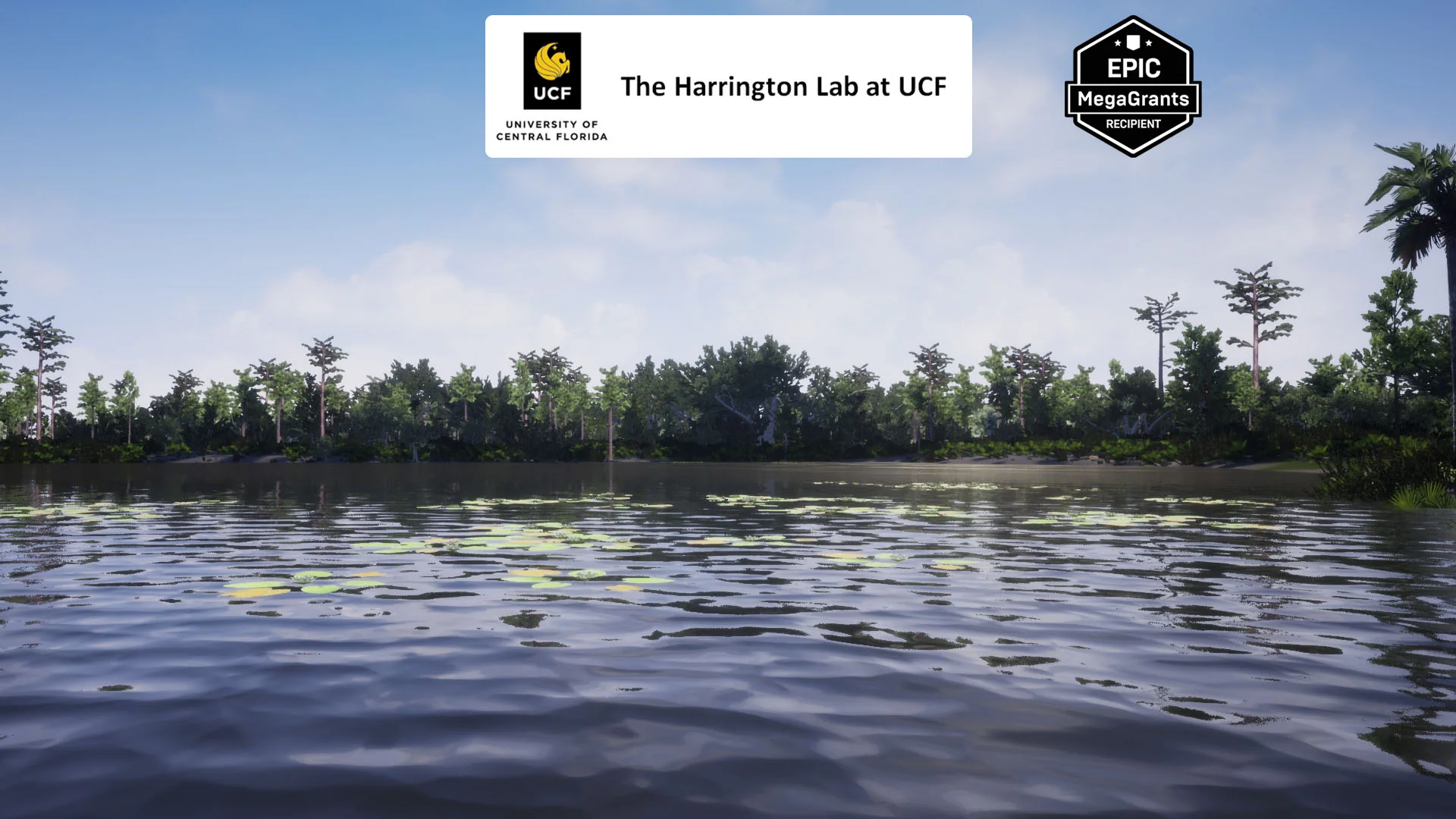
Wetland environments depend heavily on how plant life interacts with standing and flowing water. Subtropical Waterbody Habitat Brush requires the Unreal Water Plug-in to deliver its intended wetland setup. This integration is particularly important when placing aquatic flora such as the Waterlily.
Rather than relying on automated procedural scattering that might submerge stems or hover above dynamic ripples, the workflow calls for manually placing each Waterlily mesh directly onto the water surface. This hands-on placement provides precise artistic control along marsh boundaries, pond shores, lake edges, and slow-moving streams. Artists can cluster lily pads in sheltered inlets, scatter individual floating leaves along cypress shorelines, or build expansive mats that interact cleanly with the water plane.
Material Shading, Leaf Rustle, and Habitat Performance
Outdoor lighting conditions in subtropical settings place heavy demands on foliage materials, as high sun angles and direct light expose artificial shading immediately. The assets in this collection incorporate subsurface scattering maps specifically configured for light transparency and reflection on leaf surfaces. Light filtering through palm fronds, cypress needles, and broadleaf shrubs displays natural translucency, preserving depth across both direct sunlight and shadowed understories.
Dynamic movement is handled by an editable wind material featuring leaf rustle effects. World builders can adjust wind parameters to suit calm inland swamps or breezy coastal conditions, giving vegetation responsive movement across branches and leaves. Additionally, dedicated light effects ensure natural visual integration under real-time sky systems.
Performance optimization remains central to the 126 meshes. Developed as AR and VR photorealistic, low-polygon assets, the foliage features individual level-of-detail (LOD) chains that step down polygon density smoothly over distance. This construction keeps the entire Central Florida plant library efficient enough for demanding immersive hardware while preserving photographic fidelity for desktop environments, virtual reality spaces, and real-time visualization scenes.
 Forest & Jungle
 Forest & Jungle
 Forest & Jungle